The white sand atolls and coral islands might soon be buttressed with concrete as rising sea levels force the Maldivian President into drastic action, said ABC Radio presenter Monica Attard, in an interview in Sydney last week with President Mohamed Nasheed.
Protesters outside last December’s Copenhagen climate change conference, where one of the world’s smallest nations – the Maldives – went asking the worlds richer nations to curb their carbon emissions.
The result was, as we all know, a very imperfect accord.
Dhiraagu has extended its 3G Plus network to Fuvah Mulah in Gnaviyani Atoll, one of the more densely populated islands in the Maldives.
The expansion gives residents of Fuvah Mulah access to high speed mobile broadband internet, the company said in a statement.
Mobile broadband, along with WiMax technology, is thought to be one of the most economical ways of connecting the scattered population of Maldives to the internet, rather than laying extensive cabling for small populations.
“We are also pleased to reveal today that the work of extending Dhiraagu 3G Plus network and Broadband service to cover more islands, is progressing rapidly,” the company said.
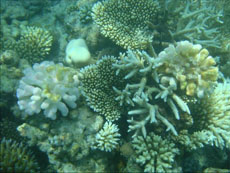
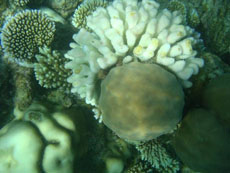
The Maldives is currently suffering the most serious incidence of coral bleaching since the major 1998 El Niño–event that destroyed most of the country’s shallow reef coral.
Coral bleaching is caused when rising water temperatures stress the coral, leading it to expel the algae it uses to obtain nutrients. When water temperatures rise even slightly, algae leaves the coral polyp and enters the water column, causing the coral to lose its colour and eventually die.
Reports of bleaching have been trickling in from marine biologists and researchers across the country.
Hussein Zahir from the Marine Research Centre (MRC) has been collecting reports of the bleaching, and said that based on his estimates, “10-15 percent of shallow reef coral is now completely white, while 50-70 percent has begun to pale.”
Senior Marine Biologist Guy Stevens, based at the Four Seasons Resort in Landaa Giraavaru, said that he had noticed that bleaching was beginning to occur last year “after a change in the weather linked to El Niño. The last one in 1998 was pretty catastrophic, and reefs in the Maldives have been recovering ever since.”
“It had a huge impact across the Indian Ocean, and the Maldives was most affected – pristine reefs suffered coral mortality rates of 95 percent,” Stevens explained. “At the time people were mortified and scientists were predicting the end of the reefs – coral is the foundation of the whole reef ecosystem.”
Coral in North Male Atoll at different stages of bleaching
Since the devastating El Niño in 1998, marine biologists in the Maldives “have been holding their breath for the next one. In the meantime the coral has been slowly recovering. It was pretty depressing in 2003, but roll forward to 2010 and it’s starting to look good again. It recovers exponentially.”
Meanwhile, colleagues of Stevens based in Thailand, which escaped largely unscathed in 1998, have reported coral mortality rates “of up to 100 percent.”
“The hot spots move around, but they cover a big area and the coral here could easily take another hit,” Stevens commented.
Zahir noted that temperatures this year were following similar patterns to those of 1998, with a surface temperature in April of one degree above the long term average.
However the recent drop in temperature, brought on by rain and the onset of the southwest monsoon, has lowered the surface sea temperature and brought some relief, “and may give the coral time to recover.”
“Now the temperature has dropped from 32 degrees to 29-30 degrees, so hopefully things will improve. The conditions are right for the coral to become healthy again,” Zahir noted, however he emphasised the need for the tourism industry to assist with monitoring the bleaching.
“Here in the Maldives we have a vast reef area, and the MRC has very little capacity to do surveys. From the very beginning we’ve been running a bleach-watch reporting programme with the dive industry, but for some reason the feedback has been very disappointing. There’s a hundred resorts, but I can count on my fingers the ones who are working to raise awareness. I know it might impact on their marketing, but this needs to be documented.”
All the MRC required was GPS coordinates and an indication of how much bleaching was occurring, he explained.
In the meantime, both Stevens and Zahir noted that there was little that could be done to prevent further bleaching.
Cooler temperatures may have averted disaster
“There is very little we can do, especially in a resort environment, other than reducing human impact on the reef while it recovers – that means ceasing things like sand-pumping and beach renewal on a daily basis, while the reef is especially vulnerable to sedimentation,” Zahir explained.
Verena Wiesbauer, a marine biologist at Male-based consultancy Water Solutions, said she had just returned from visiting two islands in North Male’ Atoll and had documented heavy coral bleaching.
“The reefs had only just recovered, and now it’s struck again. It’s a big setback,” she observed.
“Fortunately it’s not as bad as 1998, and now the temperature is dropping. But I hope someone will keep track of the paling coral, to see if it gets its colour back.”
Wiesbauer added that the bleaching did not appear to have affected fish numbers yet, and suggested that “many fish don’t need live coral as long as the structure is there for them to hide in, and many algae feeders don’t mind [bleaching] at all. But there are some specialist coral feeders we need to watch for changes.”
Meanwhile, like Zahir, Stevens observed that the tourism industry appeared to have been in no hurry to report that bleaching was occurring.
“That’s something the resorts obviously don’t want to publicise,” Stevens commented. “But I don’t think it’s any good burying our heads in the sand, when there’s going to be no sand left to bury our heads in.”
The artificial coral breeding programs run at many resorts were well-intentioned, “but rather like putting a band-aid on a gushing wound.”
“It doesn’t address the issue. Rather [breeding programmes] are a tool to raise awareness and alleviate pressure on the local reef. But there are things like sand-pumping that resorts should halt during periods of bleaching because it makes the problem worse,” he said, concurring with Zahir.
“Otherwise there’s very little we can do – it’s really a global issue. We haven’t seen a reduction in fish life, turtles and mantas, and it seems those parts of the ecosystem can survive while the reef structure is at least in place, but overall I think we’re going to see a gradual decline. Coral reefs may be the first ecosystem we’ll lose on our planet.”
Images courtesy of the Marine Research Centre (MRC).
The cemetery (Aa-sahara) in Male’ has reached capacity and Male’ municipality council has begun burying dead bodies on top of one another, by adding six feet of soil to the burial ground.
Islamic burial practices state that bodies must be buried six feet under the earth, and must not be stacked above other bodies – a logistical challenge for densely-populated Male’, where space is at a premium.
Head of Municipality Council Adam ‘Sarangu’ Manik said the council had no other choice because there was no other land in the city to bury dead bodies.
”We have to do it like this because every day one or two people need be buried there,” Adam explained.
”The soil was put on top of the graves and prepared by the former government,” he said. ”We have no other place to bury dead bodies, so we continued burying them there.”
State Islamic Minister Sheikh Mohamed Shaheem Ali Saeed reiterated that under Islam it was prohibited to bury dead bodies in this manner.
”It is allowed only if there is no other way,” Sheikh Shaheem said, noting ”it is not a must to only bury dead people in Male’ – there is space in Hulhumale and Villingili. We should take the dead bodies in a speed boat to Hulhumale’, Villingili or another nearby island,” he said.
A strong wind blew down a 500 year-old Banyan tree in Kuribi of Haadhaalu Atoll, which was believed to be among the ancient relics remaining on the island.
Island Councilor Abdul Wahid told Minivan News that the tree fell down on Friday afternoon at around 3:00pm due to a strong wind that came with the rain clouds.
”The wind was blowing faster than 70 km/h,” said Wahid. ”Many coconut palm trees and other trees in the area fell down,”
Wahid said the tree was 125 feet long and was used as a landmark for travelers, as it was visible on the horizon before even the island appeared.
”It would have a diameter of 15 feet and a spread of 200 feet,” Wahid said.
He said that nobody was injured during the incident.
”It fell and hit the outer wall of Hukuru Miskiy [Friday mosque] and damaged the wall,” he said. ”Some other trees in the area were also pulled down.”
He said that the ancient Banyan tree would be put up for auction tomorrow.
An official at the Department of Meteorology (MET) said that its bureau on Hanimaadhoo in Haa Dhaalu Atoll has recorded that Hanimaadhoo experienced strong winds blowing at almost 90 km/h on Friday afternoon.
She said that the heavy rain and strong winds was due to the southwest monsoon, and added that no tornadoes had been recorded recently.
Floods
A solid two days of rain in Nolhivaram, also in Haa Dhaalu Atoll, has caused shin-high flooding.
Island Councilor Hussein Areef said the deluge lasted from Friday morning to 10pm last night, and had caused the water level to rise to to 1.5 feet in some areas.
Eight houses on the island had been flooded, he said, and some trees had died.
Areef said that schools were closed today due to the flood.
”Many trees on island also fell due to the rain and strong wind,” Areef said. ”We are trying to drain the water and we hope we can reopen the schools by tomorrow.”
”Now it is not raining, but the sky is overcasts and by 6:00pm it would start showering again,” he added.
Profits of the Maldives Tourism Development Corporation (MTDC) in 2009 dropped 29 percent to Rf86 million, according a report in Haveeru.
In its annual report MTDC claimed management issues at Herathera resort were the major reason for the decline in 2009. The company received a profit of Rf46.6 million from the resort in 2008, but this fell to Rf76,458 in 2009.
MTDC also invested heavily in settling disputes with Yacht Tours Maldives, spending RF23.3 million to extricate itself from the arrangement and losing a further Rf17.3 in land rent.
The report also blamed the 2009 economic recession for MTDC’s difficulty in obtainnig bank loans to pursue investment projects.
The Commonwealth will host a four-day media development workshop tomorrow at Holiday Inn, in conjunction with the Maldives Journalists Association (MJA).
The event will launch tomorrow morning at 10:00am with a speech by Minister for Tourism, Arts and Culture, Dr Ahmed Ali Sawad.
The four day workshop will be led by two senior editors from Singapore. Bhagman Singh, Senior Editor, NewsHub, MediaCorp News, which owns and operates the regional satellite news network, Channel NewsAsia, will sessions on TV and radio journalism, while Jayandra Menon, Deputy Foreign Editor of The Straits Times, an English language daily, will share his skills on newspaper and online reporting.
Minivan News Editor JJ Robinson will also be present a session on Tuesday morning.
Deputy spokesperson for the Commonwealth Secretariat, Manoah Esipisu, said the workshop would “bring together two Commonwealth neighbours, Singapore and Maldives, in the sharing of expertise and experiences in media development.”
“This cross-cultural exchange will help to broaden and deepen understanding on journalism and the influence of politics and governance, culture, tradition, environment, education and technology,” Esipisu said.
“We are delighted that Mr Bhagman and Mr Menon have put their substantial experience in reporting Asia and global affairs at the disposal of their colleagues in Maldives, and look to their work in enhancing a sound tradition of media professionalism, leading to greater consistency in the accuracy, fairness and balance of news reports,” he added.
The Australian Agency for International Development (AusAID) and the United Nations Development Programme (UNDP) and have signed an agreement to boost civil society in the Maldives.
UNDP said the aim of the project would be to strengthen civil society organisations in the hope of promoting an open and democratic society.
The ‘Support to Civil Society Development’ project will particularly target smaller and more remote organisations at a grassroots level, as well as financially support NGOs in human rights, governance, rights-base development and gender equality.
“A strong civil society can only make a democracy stronger, by promoting dialogue, good
governance and even differing points of view,” said UNDP Resident Representative Andrew
Cox, in a statement.
“This project will be an important and practical step in bringing real support and building the capacity of Maldivian NGOs,” he said, acknowledging “the important role played by civil society organisations in
advancing the democratic process.”
 (0)Dislikes
 (0)
(0)