At 6:30am ahead of its second press conference on Saturday, the Elections Commission issued a statement advising that police had moved to prevent the election from taking place.
“As we continued with [preparation for] voting, the Maldives Police Services have said no document relating to the election can leave the commission’s offices, stopping the election,” the statement read.
“The Elections Commission has carried out all preparations to hold the first round of the presidential election on 19 October 2013 as per the Supreme Court verdict no 2013/SC-C/42.
“When we are informed of the next date for the election, we will announce the election,” the EC’s statement read.
The police issued an earlier statement at 5:30am stating that they “will not support an election held in contravention of the Supreme Court verdict and guidelines.”
In a letter addressed to EC President Fuwad Thowfeek, police informed him that “when the Supreme Court has ordered state institutions to ensure compliance with [its guidelines], the police will not support an election that contravenes the guidelines delineated in the verdict as such an act contravenes the Supreme Court verdict.”
“We have assured the Elections Commission that if the Supreme Court issues a ruling stating that elections can proceed even if certain tasks in the Supreme Court verdict 2013/SC-C/42 are not completed, then the Maldives Police Services will abide by such a ruling.”
The Elections Commission (EC) at 3:30am on Saturday morning declared the election would proceed as planned, despite the Progressive Party of the Maldives (PPM) and Jumhoree Party (JP)’s refusal to sign the voter lists yesterday.
“The PPM and JP failed to [sign the lists]. I believe their failure to do what they should do must not stop the entire system. Just because one person fails to do their duties, refuses to do what they must do, it does not mean everyone else must stop their work, and deprive the Maldivian citizen’s of their right to vote,” Thowfeek stated, at the 3:30am briefing.
Requiring parties to signing off the new voter lists was one of the 16 guidelines imposed on the EC following the Supreme Court’s annulment of the September 7 election. Those guidelines also order the EC to hold the first round before October 20.
The Maldivian Democratic Party (MDP) accepted and signed the new lists based on the Department of National Registration (DNR)’s records as per the Supreme Court’s request, noting that the 0.61 percent margin of error was “negligible”.
The JP and PPM could not be contacted immediately following the EC’s deadline to sign the lists on Friday, but subsequently declared unwillingness to sign without first verifying at least 10 percent of the new fingerprinted forms.
After a meeting between the EC, Home Ministry and the parties ended in a stalemate, the PPM and JP requested the Supreme Court delay the election, while the EC sought clarification from the court.
An early morning meeting between the Supreme Court judges present in the country resulted in a brief statement ordering the Elections Commission to abide by its guidelines.
Following the EC’s declaration that elections would be going ahead, the PPM issued a statement declaring the polls “unlawful”.
Minivan News has now ceased updating this news blog.
1:30am: Progressive Party of the Maldives (PPM) MP Ahmed Nihan has the party has held “long discussions” on how to proceed with the election, though said it had not put forward a possible date for voting to be held.
“Our only request is that the Elections Commisison (EC) hold a free and fair poll,” he said, adding that it still hoped that some number of those registered be verified through fingerprint identification.
Nihan argued that the PPM had requested that 10 percent of the registry be verified through fingerprint identification, with the JP asking for five percent.
Citing Elections Commissioner Fuwad Thowfeek and the challenges facing holding a vote, he added that it may not be possible to hold a vote by next Saturday (October 26).
“Re-registration has to be followed, there are people who could turn 18 years of age in between vote being held. We are asking for the election to be held as early as possible.
It could be held the day after tomorrow as far as we are concerned,” Nihan said.
Despite expressing that the party wished to hold an election as soon as possible, the PPM MP also said that concerns raised by the EC today of unknown individuals gaining access to the voter registry system also needed to be investigated.
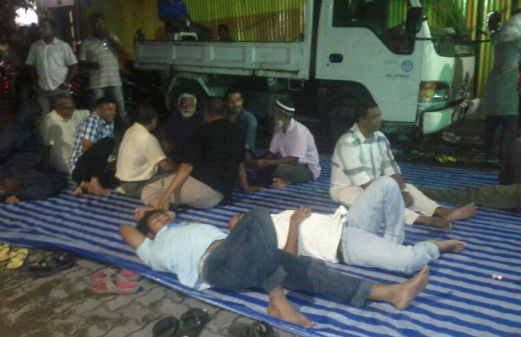
01:00am: Some protesters are sleeping on Sosun Magu, whilst those still awake say they have no plans to leave.
12.25am: The Police Integrity Commission (PIC) has declared that the police had no legal mandate to intervene and stop elections this morning, local media has reported.
PIC Chief Dr Abdulla Waheed said that the commission had received a complaint into the events of this morning, being asked to investigate.
“We won’t take too long to probe the allegations,” he told Haveeru.
He did point out, however, that it was too early to comment on whether the direct responsibility lay with the police. Dr Abdulla noted that the commission could not rely merely on media reports.
12:02am: A police media official has told Minivan News that there had been no arrests made by police either in Male’ or the nearby island of Hulhumale’ as protests have continued throughout the day – with no notable clashes between protesters and its officers at time of press.
Majeedhee Magu has become quieter although some protesters remain.
12:00am Defence Minister Mohamed Nazim told local media that the government had agreed upon a new date for elections with the Elections Commission.
Nazim did not reveal the new date, however, stating that the EC would make the announcement later in the evening.
Meanwhile, EC Chair Fuwad Thowfeek told Haveeru that the election could not be held under the the Supreme Court’s guidelines and that the state must ensure an easier way.
Fuwad revealed that he had been asked by the government to hold elections before November 2, though he told state television this evening that the commission would require 21 days to amend the voter registry once again.
No official EC statement has been released as yet.
11:55pm: Hundreds of people from three islands of Addu Atoll have conducted a sit down in the area connecting Maradhoo and Feydhoo, MDP MP Ahmed Adham told Minivan News.
“After a while, PPM activists we recognise turned up alongside SO officers in full riot gear with shields,” alleged Adham. “The PPM activists started throwing stones and tried to provoke us into reacting. Then SO barged into the crowd and roughed up out protesters.”
Adham stated that six protesters were arrested and a number of others injured as the SO dispersed, though he noticed protests were continuing in multiple locations.
“The people are determined to continue protesting until we are granted our right to vote.”
11:50pm: The Maldives Police Service has urged anyone taking part in demonstrations across the country to show consideration to the wider public when conducting their protests.
“Since impeding on the rights of others while attempting to exercise one’s own constitutional rights is not the most responsible course of action, the Maldives Police Service strongly urges all demonstrators to not conduct themselves in such a way,” read an official statement posted online.
Police said that despite the peaceful manner of demonstrations, protesters should not try to adversely affect transportation either by land or sea.
“The Maldives Police Service also urges the demonstrators to always conduct themselves in ways that conform to the laws and regulations of the nation,” concluded the statement.
11.41pm: At a press conference this evening, the Jumhooree Party (JP) presented conditions for a re-vote and said the party is ready for elections on Saturday, October 26 if conditions are met, local media reports.
JP has demanded that the voter registry be sourced from the Department of National Registration’s (DNR) database and assurance from the National Center for Information Technology (NCIT) that the Elections Commission’s (EC) database is secure before and throughout the voting period.
JP is ready to approve the voter registry within a 24 hour period if the Elections Commission verified five percent of the reregistration forms via the police, allowed a three day period for candidates to raise complaints over the voter registry and addressed the complaints, CNM reported.
If a second round of elections needed to be held, they must be held before November 2 and an elected president must be sworn in at the end of the current presidential term on November 11, the JP said.
11:29pm: Maldives Transport and Contracting Company (MTCC) executive Ismail Fariq has said ferry services between Male’ and Hulhumale’ had resumed at 10:45pm after temporarily being halted due to protests at its terminal on the island.
“The protest has ended. It was a peaceful protest. No damages. No arrests,” he said.
Fariq added that the company’s Hulhumale’ bus service was also expected to “resume shortly” after being suspended for several hours today owing to protests.
11:09pm: President Dr Mohamed Waheed has told media he will not remain in office past the constitutionally mandate end of his term on November 11 – even if an elected head of state is not chosen by the deadline.
Local newspaper Haveeru, citing the Associated Press news agency, said he would not be comfortable staying on as head of state once his term is finished.
“I am not comfortable to stay on. As you know I had to take a very heavy burden in carrying out the responsibilities during the last year and a half. It would be my preference that there be an elected president and it would also be my preference if in case it is not possible, some other arrangement is made,” he was quoted as saying.
President Waheed, who obtained 5.13 percent of the popular vote during the now defunct presidential election held on September 7, announced on October 12 that he would not be standing in the rerun schedule originally scheduled for today.
He then claimed there was “room for doubt” over the integrity and fairness of this year’s polls, before yesterday calling on all parties not to act in a fashion that obstructs holding of the election and to prioritise national interest over personal interest”.
11:00pm: Intermittent but heavy downpours appear not to have affected the numbers of protesters on Majeedhee Magu.

10:35pm: Appearing on state television, Elections Commissioner Fuwad Thowfeek has said that it would take a minimum of 21 days to amend the voter registry once again as voters return from their Eid holidays.
10:00pm: Around 600 protesters on the island of Gan in Laamu atoll are protesting in front of the island’s province offices, explained MDP activist Naeemahtha.
“We’ve padlocked the main gates of this building which has the council offices, bank, and the majority of other service providers in it. We will not budge and do not intend to go home until we are given the right to vote.”
“Police turned up and tried to take away the lorry playing campaign music but protesters wouldn’t give them a chance to do so. They’ve left without the lorry now and the protest is proceeding in full swing.”
9:40pm: Speaking to supporters on Majeedhee Magu shortly before 6:00 pm, Nasheed threatened to arrest President Dr Mohamed Waheed Hassan, Defense Minister Mohamed Nazim and Police Commissioner Abdulla Riyaz. He called on his supporters to continue to block Majeedhee Magu and shut down the city of Malé.
Unless we are able to carry out peaceful political activities, we cannot bring the change we wish to the Maldives. There has been a coup in the Maldives, and the coup backers, in order to maintain that coup, are committing bigger and bigger atrocities day after day. They overthrew an elected government through a coup. More than 18 months have passed since the coup. And when we asked for an election, when the election’s results became clear, they annulled the election and now are attempting to make sure an election does not take place.
This is 2013. Maldivian citizens are not apathetic and we will not let them get away with this. I repeat, I repeat, I will not get tired. I will not go home. When I fall, I will get up even faster, God willing, we will change the Maldives.
I assure you, we will not step back. They can beat us. They can arrest us, but this ideology cannot be erased. We will establish good governance in the Maldives.
There is no need to plan this. I call on every single citizen, as much as you can, do everything you can to arrest baagee [traitor] Mohamed Waheed Hassan. I will not speak about an election unless Baagee Mohamed Waheed and Baagee Mohamed Nazim and Baagee Riyaz are arrested. We can only hold a free and fair election in the Maldives when Baagee Mohamed Waheed is removed from power. I will do as much as possible to oust Baagee Mohamed Waheed. I will not stop, I will remain steadfast. My hope, my sincere appeal to all Maldivian citizens is to do all we can to remove Baagee Mohamed Waheed from power, to arrest him and jail him.
I say to Baagee Mohamed Waheed, God willing, I have more time than you do. Death is that which is closest to each and every one of us. And death is that which is the farthest from each and every one of us. I will do all I can to bring you down, to bring you to down to these Malé streets. Know very clearly, who we are. Know very clearly, where we grew up. We will not let go. We will not let go. We will not stay in our houses. We will not stop. We will not step back. We will go forward. We will go forward, with strength, with speed. We will win this election. We will change this coup government.
I call on you to block these streets. If Henveiru kids can do it, shut down Henveiru. Galholu will do it, Machangoalhi will try, Maafannu will try, let us shut down Malé. Malé cannot function, we must succeed.
Thank you. Do not worry. Be angry. Do not be disheartened. Melancholia lowers your spirits. Anger makes you determined, makes you act. We should be angry at this moment. This is not the time for melancholia. This is not the time to step back. This is the time to go forward. To come out and overthrow Baagee Mohamed Waheed. God willing, we will accomplish this task.
9:25pm: Minivan News has learned that all food being booked for the protesters up and down Majeedhee Magu has been donated by local shopkeepers and residents.
Protesters have named the hotdogs being served ‘Ali Hameed sausages’ in reference to the Supreme Court who has been the subject of investigations for his alleged role in a series of sex-tapes.
One protester, aged 28, shared her distress at the election delay with Minivan News:
“I’m lost, I don’t think we can trust these coup leaders – this is such a mess.”
9:18pm: Mohamed Haisham, a protester gathered at the Hulhumale’ ferry terminal this evening, has said that boat services from the island had been brought to a stop as part of ongoing peaceful action planned until a new election date is agreed.
Haisham said that around 200 people had gathered at the terminal this evening in order to bring internal transport to a stop in order to raise concerns over the delay to elections.
He claimed that a large majority of those protesting at the terminal and main roads across the island were young people aged between 18 and 35.
Haisham added that police had meanwhile been “very cooperative” with the ongoing protests.
“The police don’t have control here. They have agreed to let us protest as long as we don’t damage property,” he said.
Protesters this evening said they intended to continue their actions tomorrow (October 20) morning as part of efforts to try and shut down government offices.
9:05pm: The MDP’s peaceful protests continue along Majeedhee Magu, with groups still blocking the road’s major intersections. Small groups are sitting, playing cards, smoking sheesha, and cooking food. Live music is expected to start shortly.
9:00pm:
8:55pm: The Indian Ministry of External Affairs released a statement earlier today, expressing its disappointment that the election was not held as scheduled today.
India and the international community have been closely watching the developments in Maldives and are seriously concerned at the attempts to stall the democratic process. It is for the people of Maldives to decide their future, and their strong desire to elect a new president is evident from theturnout of 88% in the first round of elections held on September 7, 2013, which was considered free and fair by the large contingent of international and domestic observers present. Keeping in mind the wishes and aspirations of the people of Maldives, who have so far shown admirable patience and restraint, it is important that the electoral process is put back on track immediately with a definite timeline so that a new president is elected and sworn in on November 11, 2013 as mandated by the constitution. India calls upon the Government of Maldives and all parties concerned to fulfiltheir responsibility towards the people of Maldives by playing a constructive role in the elections process and fully assisting the Elections Commission in holding the Presidential elections without further delay.India also calls upon all parties to abjure violence and maintain calm.
8:46pm: Police have confirmed that officers are present at the Hulhumale’ ferry terminal where protests are ongoing. A police media official said no arrests had been made at the terminal, with protests continuing peacefully at present. Ferry operator the MTCC has meanwhile confirmed that it will discontinuing boat services to Male’ form the island this evening as a result of protests.
8:20pm: Speaking on local television a short time ago, Male’ City Council stated that it would stop services until the people’s “fundamental right to vote, a right we get every five years” is assured. Male’ City Mayor ‘Maizan’ Ali Manik said that, whilst mosques would be looked after, services such as waste management, issuing building and birth certificates would be stopped.
The council’s declaration – supported by eight of its 11 members – condemned the delay in the election and supported the MDP’s ongoing protests on the streets of Male’.
“I am telling you our council will not function until we have a date for an election and the election is conducted,” said Manik.
8:15pm: Maldives Transport and Contracting Company (MTCC) executive Ismail Fariq said that protesters had begun to gather near to the ferry terminal building on Hulhumale’, but services were continuing at present. The company added that it discontinued its bus services on Hulhumale’ earlier due to a situation it said was not accommodating to operate under.
8:11pm: Maldives Transport and Contracting Company (MTCC) executive Ismail Fariq has said that the company was aware of proposals for strike action this evening on some of its ferry services between Male’ and the islands of Hulhumale’ and Villimale’. However, Fariq said he did not believe there would be any service interruptions or cancellations at present. “We don’t know how the situation will unfold. We will not compromise any loss to our assets or staff,” he said.
The MTCC also operates a high speed boat service to Ibrahim Nasir International Airport (INIA), but does not operate standard ferries.
7:55pm: Secretary General of the Tourism Employees Association of the Maldives (TEAM) Mauroof Zakir has said no decision has so far been taken by its members to hold imminent strikes on any of the country’s resort properties. He said that TEAM had been receiving calls from its members expressing an interest in holding “peaceful gatherings” at resorts to highlight concerns over delays to the election. T
EAM last month announced it had committed its 5000 members to “prolonged” strike action should the election be delayed.
7:52pm: Elections Commissioner Fuwad Thowfeek and EC Deputy Ahmed Fayaz have met President Mohamed Waheed, Acting Home Minister Ahmed Shafeeu, Attorney General Azima Shukoor and Defence Minister Mohamed Nazim.
Thowfeek confirmed to Minivan News that Nazim had been appointed the government’s focal point for anything election-related. The Elections officials were pressed during the meeting to give a date for another attempt at the election, but said they would need to discuss this with the other EC members. EC members will be holding a meeting at 8:00pm to decide how to proceed.
7:06pm: MDP supporters are calling friends and telling them to come to Majeedhee Magu with food tonight, to participate in the ongoing sit-down protest in the capital.
7:00pm: Hulhumalé resident Mohamed Haisham has said protesters have blocked the road to the airport and main streets in Hulhumale, preventing buses from travelling.
6:53pm: The Maldives National Defence Force (MNDF) has confirmed the appointment of Defence Minister Mohamed Nazim as the government’s representative to the Elections Commission (EC), but has said denied the military will be taking a direct role in the electoral process.
MNDF Spokesperson Colonel Abdul Raheem confirmed that the military would not be taking an any additional role concerning the functioning of the EC. Defence Minister Nazim was not responding to requests for information at time of press.
6:09pm: Police have confirmed that they had consulted both the President’s Office and Attorney General Azima Shukoor ahead of taking their decision to physically obstruct polling scheduled for this morning. A police media official confirmed that no consultation was held with the Prosecutor General’s Office on whether to cancel polling. Several legal experts including senior figures serving under both the current and present governments have told Minivan News today that the Maldives Police Service had no legal mandate to prevent elections from happening today in the absence of a direct court order. Meanwhile, the Commonwealth Observer Group here to oversee election conduct earlier today issued a statement distancing itself from comments made by police alleging it had provided advice on delaying polls. Police also retracted the claim.
5:52pm: Commonwealth Secretary-General Kamalesh Sharma had said he is “extremely concerned by the further stalling of the democratic process in Maldives, following the stopping this morning of the scheduled 19 October presidential election.” The latest development follows the postponement by the Maldivian Supreme Court of the second round of the election scheduled for 28 September and the subsequent annulment of the 7 September first round election. The Secretary-General noted that the continuing delay was “of deep concern, given that the term of the current government will expire on 11 November 2013.” Mr Sharma said:
“I cannot stress firmly enough how critical it is for all state institutions and presidential candidates to cooperate in good faith to ensure that this election can take place as soon as possible. It is essential that the independent Elections Commission is able to conduct an election, consistent with international electoral standards, without any unnecessary delay. “The people of Maldives have already demonstrated, on 7 September, their strong desire to cast their votes and express their collective will. It is the moral responsibility of political leaders and those who hold positions of authority to ensure that the Maldivian people can exercise their fundamental constitutional right to elect their president.”
The Secretary-General said he would continue to monitor developments very closely in the coming days, given the fundamental importance of democratic values to the Commonwealth.
5:48pm: Haveeru reports that Defence Minister Mohamed Nazim has been appointed the government’s representative for the elections. Nazim reportedly said he had negotiated a date with the Elections Commission to hold polls and was inviting presidential candidates to meet him this evening. “The Elections commission will announce a date later tonight,” Nazim said. Minivan News is seeking to confirm this with the Elections Commission.
5:40pm: The NGO Federation has issued a statement “condemning in strongest terms” the actions of police preventing the elections from taking place as scheduled.
The NGO Federation in strongest terms condemns the actions of the Maldives Police Services to prevent the efforts made by the Elections Commission – the state institution constitutionally mandated to hold and organise elections – to hold the rerun of first round presidential election on October 19, by not cooperating with the commission and obstructing them without any court order. We call on the Head of State, President Mohamed Waheed Hassan and all state institutions to immediately assist in creating an environment that would pave way for the Elections Commission to operate independently and autonomously. We also appreciate and acknowledge the hard work and sacrifices made by the members and staff of Elections Commission to ensure the right of the people to freely cast their vote, and encourage the commission to remain determined in its continued efforts to hold free and fair elections. As the article 4 of the Maldivian Constitution explicitly states that all powers of the state are derived from the people and remain with the people, we call upon all political figures of the country who have been obstructing and preventing the people from rightly electing their ruler to immediately stop their actions, and act in a responsible manner and to respect the democratic principles adopted by the people of Maldives. We call on the Prosecutor General, the Chief Justice and all relevant authorities to uphold the law and take action against those who are responsible for depriving the people of their most fundamental right of right freely cast their vote guaranteed by the constitution, and those responsible for undermining the power and the authority of Elections Commission vested under the Elections Commission Act and General Elections Act.
5:30pm:Police attempts to drive through the intersection failed after near 10 minutes after protesters surrounded the vehicle, forcing it to back up and detour. “You can’t have your way all the time, baghees (traitors),” said one protester.
“This is my country too. Ride over us if you dare, or back away,” said another. “You trampled our votes. Let ‘s see if you’ll dare run over us,” said a third. 
5:33pm: DRP MP Ali Azim at the sit down protest urged the public: “Don’t go out to work. Call your family and friends, tell them to stop work.” Meanwhile, a barbecue appears to be underway in the intersection.
5:27pm: A 34 year-old man at the sit down protest said: “We sitting in joles (traditional Maldivian seat) and blocking the road as there are no more rules according to the police. We can do anything we want now according to them.” A 29 year-old protester added sarcastically, “We are all gathering here because the Commonwealth told us to.” 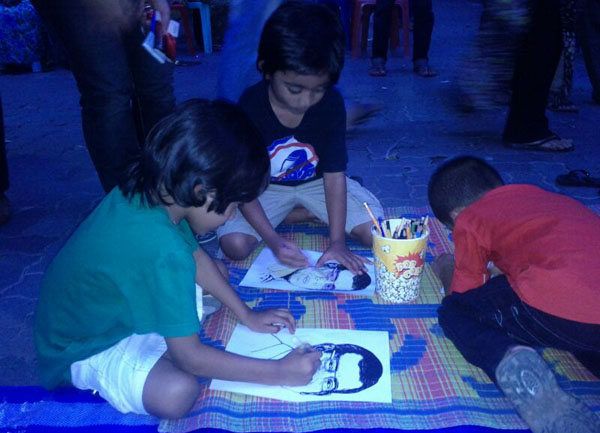
5:24pm: Small numbers of people are obstructing nearly every junction on the main road of Majeedhee Magu, with tables, vehicles and tarpaulins with people sitting. The majority remain concentrated near city hall.
5:15pm: 33 year-old artist Ahmed Khalid at the sit down protested said: “I am embarrassed by the Supreme Court. The police are in control of this country. This is a coup. We want the Majlis members to get us our right to vote. There is no hope, but we will keep trying.”
5:00pm: Male is becoming difficult to travel around with police and military blocking are area around Republic Square, Supreme Court and the President’s Office, while the MDP blocks a key junction on the main road Majeedhee Magu. Protesters have cordoned off the streets with human chains, yellow cords, vehicles including motor bikes and trucks. Protesters are slowly blocking more junctions, in an apparent attempt to close down all of Majeedhee Magu.
4:40pm: Smaller crowd on Sosun Magu – around 40 people – staging similar sit-down protest blocking traffic. Signs held my protesters read ‘Where is the voice of the citizens?’, ‘Yameen is a bodu gunda [‘big thug’]’, and ‘hurry up the election’.
4:20pm: Crowd on Majeedhee Magu, now thousands strong, is said to be growing by the minute.
4:10pm: Supporters of the Maldivian Democratic Party (MDP) have begun to gather on Majeedhee Magu – Male’s main thoroughfare. After laying down tarpaulins, people have begun to set up tables and chairs in the middle of the street. Whilst some are playing cards, presidential candidate Mohamed Nasheed and Speaker of the Majlis Abdulla Shahid sat sipping tea and eating hedika.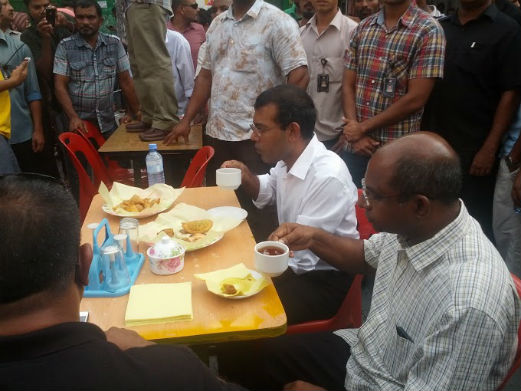
3:40pm: President Dr Mohamed Waheed has asked for presidential elections to be held on Saturday 26 October 2013. The President’s Office has said Waheed is concerned about the delay in holding election as planned. The President’s Office has also said the President wants a free and peaceful election with the participation of all candidates. “The President calls on the Elections Commission to hold discussions with all candidates to find a way to hold the presidential election on Saturday, October 26. The President urges all candidates and their political parties to find a solution to election disputes,” read the statement.
3:30pm: The Police Integrity Commission has commenced an investigation into police obstruction of polls. Speaking to local media CNM, PIC President Dr Abdulla Waheed said he believed if the police did indeed obstruct polls, then it was outside their mandate. However, he could only speak further after an investigation. The EC had released a statement this morning accusing police of overstepping their mandate and unlawfully halting the first round of presidential polls. The EC urged an investigation into “the unlawful use of police powers and acting in contravention to the spirit and purpose of police laws.”
3:20pm: Speaker of the House Abdulla Shahid has released a statement to the media.
While article 26 in chapter two of the constitution very clearly states that it is the right of every citizen of the Maldives 18 years of age or older to vote in elections and run for public office, article 18 of the constitution definitively states that it is the duty of the state to protect and promote the rights and freedoms provided in chapter two of the constitution. And, article 170 of the constitution entrusts the Elections Commission with the responsibility to hold and declare the results of elections within periods prescribed by law, to conduct, manage and supervise elections, to ensure the proper exercise of the right to vote, and to ensure that all elections and public referendums are conducted freely and fairly, without intimidation, aggression, undue influence or corruption. I believe what occurred today, Saturday, 19 October 2013, deprived citizens of the fundamental rights guaranteed by the constitution of the Republic of Maldives. And I condemn the actions of police outside the bounds delineated in the constitution and the law on orders from the heads of the Maldives Police Service. Therefore, I call upon the Elections Commission to decide upon and announce a date for the election forthwith and proceed with performing the responsibility entrusted by the constitution of the Republic of Maldives for a president directly elected by the people to assume the office of the presidency on 11 November 2013.
3:10pm: MDP have released a statement:
“We have decided to cancel the National Executive Committee meeting scheduled today and call on all NEC representatives to do everything necessary to to establish a lawful government and elect a president to represent the people. We believe every citizen of the Maldives must work to establish an elected government following the Supreme Court’s unconstitutional annulment of the first round of presidential elections held on 7 September 2013, and the Supreme Court’s unconstitutional infringement on the independent Elections Commissions powers by delineating how an election must proceed, and the Maldives Police Services unconstitutional abuse of their powers to invalidate and halt the much awaited presidential election for a second time. Today is a sad day for democracy in the Maldives with the violation of a fundamental right of governance, especially as all powers of the Maldives Constitution derive from the citizens of the Maldives, Elections are the most fundamental right enshrined in the constitution. As Maldivian citizens have been deprived of this right, we call on all Maldivian citizens to commence protests to obtain this right.”
2:40pm: Around 30 protesters, gathered outside of the People’s Majlis, refused to move when asked to by police. “Who made you the voice of authority to decide all we do? You can’t tell us where to sit,” protesters told the police. “You stole our vote, we won’t let you take away everything else including our freedom”. “I am here to ask for our constitutional right to vote,” said Hassan Shah in his early thirties, refusing to budge as a policeman prods him from behind asking him to leave the area. “This country is ridiculous. There is no rule of law, there is nothing but tyranny: by the police, by an unelected coup president, by the corrupt judiciary and every other principleless person or institute. Its time we refused to budge. I want my right to vote,” said Ahmed Amir, 29.
2:35pm: The MDP have cancelled the scheduled meeting of their National Council. They had been due to meet at 2:30pm.
2:30pm: Statement released by the UK Foreign Secretary William Hague:
I am deeply dismayed by further delays in the Maldives Presidential elections. It is vital that the democratic process is allowed to proceed and that a new President is inaugurated by 11 November in line with the Maldives Constitution. I strongly urge that the Election Commission be permitted to carry out the presidential election at the earliest possible date so that constitutional requirements may be met. With the eyes of the world on the Maldives, I call on all parties to respect democratic values, and to allow transparent, free and fair elections to proceed without further delay. Elections which reflect the will of the people can help to build a more stable Maldives for the future. It is clear from the extremely high turnout seen on 7 September that the Maldives people are fully engaged in the process, and their voices should be heard through the ballot box. Continuing challenges to prevent elections taking place will be seen as nothing less than an attempt to frustrate the democratic process. This would undermine democracy, create greater uncertainty, further instability and damage the Maldives economy and international reputation. Together with fellow Commonwealth member states, the EU and the wider international community, Britain continues to monitor developments in the Maldives very closely. We remain committed to supporting the Maldivian people to work towards strengthening democratic processes and values.
1:57pm: Mohamed Shafaz Wajeeh, an Attorney-at-Law for the Maldives-based Praxis Law Firm, today stressed that police could only be mandated to take action to prevent an election under a direct court order. Police today confirmed that it took the decision on its own initiative after consultations with state authorities. Shafaz took the example of a dispute where a court orders that a tenant be evicted from a property for not paying rent as agreed to a landlord. He argued that in a case where a tenant still refused to move from a property after the eviction notice is ordered, police would not be able to intervene until given a direct court order to do so. According to Shifaz, while police noted that the Supreme Court’s 16 point guideline did require that representatives of all three contesting candidates sign the amended voter registry before polling, no order or role has been so far provided to police to prevent voting today. “It is constitutionally guaranteed that a person or body is not prevented from performing the duties they are charged with unless mandated by a court,” he said.
1:50pm: Transparency Maldives has issued a press release expressing concern over the additional delay of polls, as well as the failure to set a new date for elections. “While the Constitutional deadlines for conducting the election have already been breached, we urge setting a new date immediately to ensure there is a democratically elected President by November 11, 2013.”
Highlighting the separation of powers inherent in the constitution, Transparency has called upon all actors to refrain from obstructing the Elections Commission’s independence and mandate.
“Transparency Maldives reiterates that its extensive and systematic observation of the September 7 elections found no evidence of systematic fraud and no such evidence has so far been made public,” continued the statement. “Transparency Maldives also believes that for long-term national interest and democratic consolidation, the Presidential Election must ensure the participation of all political actors and parties,” the release concluded.
1:45pm: HRCM Member Jeehan Mamdhooh added that the police in a democratic system are only allowed to assist in election related matters to the extent and in the manner requested by the EC. “The SC’s 16 point guideline clearly mentions in each separate point if the involvement of any institution besides the EC is needed for that specific task. Point number 5 [about the candidates signatures on the voter list] which the police stated as their justification today, does not ask for the involvement of any institution besides the EC in this task,” Jeehan stated.
“It is for a reason that police are given such a narrow role in the electoral proceedings of a democratic system. They are under the authority of some branch of the state, which brings down the confidence of their involvement not compromising the independence of the electoral process. For example, they are directly under the executive in the Maldives,” she continued.
“Point one of the Supreme Court’s 16 point guideline orders all institutions to provide cooperation to hold an election before October 20th. And yet, today Police had obstructed EC and brought the election to a halt. Even if there are concerns, the Elections Commission is the authority mandated by the Constitution of Maldives to stop an election if there is a need for it”.
“HRCM does not believe that the police have any mandate to interfere with the electoral process in this manner, and feel they have acted outside of their mandate in obstructing elections”.
1:40pm: “The SC guidelines do not give the police any space to act against democratic norms. Yes, the right to vote must be ensured for all citizens and we are too are working to achieve this. However, using this as a justification, police cannot obstruct the work of the EC. All us institutions must work within our margins. We cannot accept the police’s actions to halt elections,” continued HRCM Vice President Ahmed Tholal.
“I agree that there are some limitations faced after the SC regulations were issued. It didn’t provide much time for election preparation, which cut down the time that can be assigned for list verification. What I am saying is however, that there is a major difference between candidates or their representatives raising concerns about this matter, and the police forcing elections to be brought to a halt.”
“If the police were concerned as they predicted unrest in the country, they had the option of strengthening security operations. Hypothetically, if police think any certain court verdict may cause discord or disagreement in public, can they go in to court and order the verdict to be changed as they see fit? No. Similarly, the constitution does not allow them to inhibit the holding of an election”.
1:30pm: The Human Rights Commission of the Maldives (HRCM) has condemned the Maldives Police Services actions to obstruct the Elections Commission from conducting presidential elections on Saturday, stating that police were acting outside their mandate. In a live appearance on state TV on Saturday afternoon, HRCM Vice President Ahmed Tholal stated, “With this act, they have undermined people’s right to vote. In a democratic system, obstructing the right to vote, especially when done by the police, sets a dangerous precedent”. “The Supreme Court’s guideline is in alignment with the Constitution and laws. I do not believe the Police has any authority to halt election, not even under this guideline. If, as the police say, the concern is that holding elections may cause some form of unrest in the country, it is again the EC’s responsibility to consider that,” Tholal said. “I accept that there are concerns. The HRCM have also received just over 300 complaints regarding reregistration which we are looking into it. It is within the democratic system for the EC to be mandated to look into this, and for political parties to raise concerns about this,” he continued.
1:20pm: “The failure to hold elections this morning represents a real threat to democracy in Maldives,” an official from the United Embassy in Colombo told the Foreign Correspondents’ Association of Sri Lanka. 1:10pm: Alistair Burt, former minister at the UK Foreign & Commonwealth Office has tweeted his thoughts on the current Maldives crisis.
1/2 Deeply concerned at news from Maldives. Vital that democracy not thwarted. Commonwealth and Int Observers need to express views. — Alistair Burt (@AlistairBurtMP) October 19, 2013
2/2 Also vital that calm is kept with no provocations. Free fair elections and democratic path only way forward for Maldivian people. — Alistair Burt (@AlistairBurtMP) October 19, 2013
1:06pm: The same legal source has told Minivan News that it was unclear under what grounds police cancelled today’s election, adding that the Supreme Court’s conflicting guidelines requiring an election by hold by tomorrow (October 20) were “confusing”.
While several candidates have sought Supreme Court intervention to prevent polling without their signatures on the voter registry, the legal source said that the guidelines effectively allowed an individual to hold up the electoral process, potentially on unreasonable grounds, without providing alternatives in the case of a stand-off.
“The guidelines don’t say anything about what happens if a candidate refuses to sign the voter registry say for up to six months, in that case we will not be having an election,” claimed the senior legal figure.
“Everyone must try and reasonably ensure that each of the guidelines are met.”
The legal figure also expressed concern over prioritising one guideline in the Supreme Court ruling over another, adding that the country’s apex court had also requested that the rerun of September 7’s cancelled poll be held by October 20 at the latest.
12:55pm: A senior legal source, who has served under both the present and former governments, has today questioned the mandate of police to decide upon cancelling the election, arguing there is no Supreme Court order providing them with the powers to do so.
“Having read the Supreme Court decision, there is nothing in the guidelines to say police can take preventative action [against holding the election],” said the source.
The legal figure, speaking on condition of anonymity, said that the only guideline outlining roles for the police was in them transporting ballot boxes and equipment for polling.
12:30pm: Police release a statement clarifying the Commonwealth’s role in the decision to halt the election:
“Further to the press conference held by the Maldives Police Service on the morning of 19 October 2013, the Maldives Police Service would like to clarify that at no point did the technical adviser from the Commonwealth or any one from the Commonwealth Observer Group advise the Police to take actions to prevent the election from taking place.”
12:08pm: The Maldivian Democratic Party (MDP) will hold a meeting of its National Council at 2:30pm.
11:34am: The Commonwealth Observer Group has issued a statement distancing itself from comments made during the police press conference this morning.
The Observer Group wishes to clarify that at no stage did the Commonwealth Observer Group or any of its members give advice to the Maldives Police Service regarding its decision to take action to prevent the 19 October Presidential election from taking place. On the contrary, the Commonwealth Observer Group issued a statement on 17 October, in which the Chair of the Observer Group, Dr Lawrence Gonzi, said “I hope that all Maldivians will play their part to ensure that the 19 October election is conducted in a credible and peaceful manner, so that the people of Maldives can exercise their fundamental right to choose their President.”
11:30am: Chief Superintendent Abdulla Nawaz told a press conference that police had “made this decision ourselves” after seeking advice from President Waheed, Attorney General Azima Shukoor, the police national security council, and Acting Home Minister Ahmed Shafeeu.
“The police have taken a stand to not provide cooperation to the EC as the 16 point guideline issued by SC is not being completely followed,” he said.
Asked if the Commonwealth’s advisor had agreed with the police stance to not cooperate with EC, Nawaz declined to answer, saying that was a national security matter. The Commonwealth’s observer group have disputed giving any advice, labelling this as “incorrect” and “damaging”.
Asked whose orders the police were following, Chief Superintendent Nawaz stated that “we are speaking of advice here. Not orders. Based on advice, police ourselves made this decision.”
“Since police do not only concentrate on elections alone, we are also considering the consequences that may arise from letting the election proceed in breach of the law and SC order. We considered any unrest that may occur in the country as a result of letting the election proceed,” he said.
“Police have even previously requested EC’s president to start sending voters’ list to candidates for review as they were being prepared. He initially said yes, but later said that the other commission members refused to act so.”
“The Police Act mandates us to work to protect citizens’ interests, and we have taken this stand in alignment with these provisions. We have provided what assistance we can, including sending officers abroad for ballot box and paper security with election officials,” he said.
“Although the 16 point regulation does say the election must be held before 20th, it also has a lot of other points. Therefore, we believe all 16 points must be followed, and thus took this stand to withdraw cooperation,” he added.
Asked how the police were weighting the guidelines, in apparently giving preference to the one asking for candidates to sign the vote list over the one demanding the holding of elections before 20th, Nawaz replied: “Both are of equal weight. We believe all of this must be fulfilled.”
“I don’t think it is the police’s concern who is responsible for getting the lists signed, or whether it is the candidates’ responsibility or the ECs. I don’t think we need to consider whether the EC tried enough to get this signatures, or what their actual efforts were. We believe there probably are better ways for EC to fullfil this. However, what we just see is that the signatures are not there. And as a result, it is our duty to take a stand to not cooperate with EC to carry forward elections without fulfilling this SC order.”
Nawaz did not respond when asked if he believed police had the authority to halt the election, and if they accepted they were stepping beyond the boundaries of their mandate.
Asked by a foreign journalist why police were interfering when the SC order was directed at the EC and not the police, Nawaz replied “I don’t think so but there are different interpretations of the SC order. But do you believe that an illegal election, which is against the SC order, should be conducted?”
10:37am: “We have previously sent a letter to EC telling them that we will not provide the cooperation we have to if it is working against the SC regulations,” explained Chief Superintendent Nawaz.
10:30am: Chief Superintendent of Police Abdulla Nawaz has told the press that prior to the decision to halt the election advice was sought from their Commonwealth advisor, President Dr Mohamed Waheed, the police executive council, Attorney General Azima Shukoor, and Acting Home Minister Ahmed Shafeeu.
The Commonwealth Secretariat had previously provided the assistance of an elections security expert, Eldred de Klerk. Minivan News is seeking to confirm whether any advice noted by police was indeed provided, but has been informed by the Commonwealth team present in the Maldives that this was incorrect.
09:50am: When asked at this morning’s press conference whether the actions of the police and political parties were due to remnants of former President Maumoon Gayoom’s 30-year autocratic rule trying to remain in power, EC Chair Thowfeek was reluctant to answer.
“I don’t know and [because I’m] holding this position, it’s very difficult to comment on such questions, it’s better not to,” said Thowfeek.
09:25am: Minivan News observed that as of 6:30am at the Elections Commission, a police van with an unknown number of officers was parked directly in front of the EC secretariat, about eight police in ‘blues’ were stationed in the lobby, while four police officers were inside the 4th floor of the commission.
After the EC’s press conference concluded around 7:45am, only two police officers remained in the lobby, the police van remained parked in front of the secretariat’s entrance, and a few special operations police were seen on the corner of Ameenee Magu – a main thoroughfare directly south of the commission – watching the secretariat.
The mood in the commission was somber and the commission was no longer a hive of activity. EC officials and staff seemed fatigued, conveying their frustration and disappointment to Minivan News that they had been stopped from holding the election today, despite being prepared to do so. However, they did not seem defeated or hopeless. They appeared to still be digesting how events have unfolded.
09:22am: “Today the world is like one community, every country is connected to another, so the international concerns will be there if they find that democracy is not working in any country… they will be concerned about the status of every country,” said EC Chair Fuwad Thowfeek at this morning’s press conference.
“We are a country very much dependent on tourism and there are tens of thousands of tourists coming from European and Asian countries, so all those countries will be watching and will be monitoring the situation in every country. They will be thinking about the status of the Maldives,” he concluded.
09:20am: “After everything was done within such a short period and after achieving almost everything, two of the candidates [Yameen and Gasim] refused to sign the voters list. That is the reason police stopped us from conducting this election, so because two candidates did not obey the supreme court’s rule, police have penalised the Elections Commission and the people of the country,” said EC Chair Fuwad Thowfeek.
“I don’t know why [they have stopped the elections], I don’t think it is their duty to stop what we are doing here. as long as we are trying to do something according to the constitutional rights of the elections commission. They will know better what their intention is.”
09:15am: The Elections Commission believes the uncooperative actions of the police are actually in violation of the Supreme Court’s mandate for government institutions to collaborate and cooperate with the EC.
“The Supreme Court’s decision does not ask the police services to look into the voters list and check what is there in the voters list. The police services have been asked to see to our security and provide protection to the ballot boxes, ballot papers, and the staff of the Elections Commission,” said EC Chair Fuwad Thowfeek this morning.
“Today and on September 28 it was the police actions that stopped our election. We were forced to stop by them. They are acting beyond their mandate, they have a completely different duty. I think they have crossed the line and they kind of think that they can be our bosses, that we are an institution below them, so they can dictate to us, control us,” he continued.
9:10am: The Elections Commission believes that the Maldives Police Service (MPS) is colluding with political parties and/or government institutions to intentionally violate Maldivian constitutional right to vote.
“I think they are doing so because now it looks like we can [only] act with their permission – if they allow us to do something. The constitutional right that is given [to vote] is not existing anymore, based on what we are experiencing these days,” EC Chairperson Fuwad Thowfeek told media earlier today.
“It’s a pity, we are a very young democracy, [it has been] just five years since we got a multiparty democratic system. We are very much concerned about what is going on in this country at this time,” Thowfeek noted.
9:00am: Police confirm they will be holding a press conference at 9:30am in the Iskandar Building on Ameenee Magu, Male’.
8:13am: Thunder showers and rough seas are predicted for the remainder of the day in Male’, impeding movement in and around the capital.
7:45am: “Right now the international community are doing their best, telling the government how much they value a democratic system,” said Thowfeek.
7:40am: “I do not have any hope that election can be held before November 11 [the end of the presidential term]”, Thowfeek said. With the second delay, elections have become a “plaything.”
Thowfeek said that while EC staff were “disheartened”, “This does not sap our determination. It makes it stronger. Resignation is not a choice. God willing, we will continue to serve the Maldivian citizens until the end of our terms.”
7:10am: Elections Commissioner Fuwad Thowfeek has said police have surrounded the EC secretariat and stopped any document from leaving the building. “As per the Supreme Court’s guidelines, police were asked to provide security, not to check whether the voter registry has been signed,” Thowfeek stated. “We cannot proceed with the election if police are obstructing it.”
“The Elections Commission has spent MVR 70 million (US$4.53 million) on the presidential election. We have worked 15 hour days throughout the holiday period. We are very disappointed, very much frustrated,” he said. “Police have overstepped their authority and impinged on the EC’s constitutional duties.”
“Today is a dark day for democracy,” added EC member Ali Manik.
7:06am: This is the second time police have blocked the EC from holding the election. When it sought to proceed with the September 28 run-off election, Special Operations police surrounded the EC secretariat with orders from Police Commissioner Abdulla Riyaz to take over the building and confiscate ballot papers should it proceed.
6:45am: Police are present at the Elections Commission. A second press conference for the morning is now underway.
Likes (0)Dislikes
 (0)
(0)