Parliament cancelled for second day

The sitting of the People’s Majlis (parliament) was cancelled on Wednesday for the second day running without explanation, although parliamentary procedures require Monday, Tuesday and Wednesday sittings.

The secretariat did not give a reason for the cancellation, both opposition and pro-government MPs told Minivan News.

An unnamed MP from the ruling Progressive Party of Maldives suggested to online CNM that the cancellation might be down to the absence of Speaker Abdulla Maseeh Mohamed, who is overseas at a meeting of the Inter-Parliamentary Union.

However, Monday’s sitting was held with Deputy Speaker ‘Reeko’ Moosa Manik presiding.

Since parliament returned from recess earlier this month, opposition Maldivian Democratic Party MPs have been protesting on the Majlis floor with sirens, whistles and megaphones, calling for the release of former President Mohamed Nasheed.

However, Speaker Maseeh has been continuing proceedings despite the disorder in chamber.

Parliament also ceased providing a live feed of the sittings to television stations whilst debate on bills is inaudible to the viewing gallery.

At Monday’s sitting of parliament, 44 MPs voted in favour of extending the lifespan of 39 regulations under the General Regulations Act until April 2016.

The law was passed in late 2008 as a parent legislation for over 80 regulations without a statutory basis when the new constitution was adopted.

Article 271 of the constitution states: “Regulations derive their authority from laws passed by the People’s Majlis pursuant to which they are enacted and are enforceable pursuant to such lawful authority.”

The parent act prolonged the lifespan of the regulations – which did not derive authority from an act of parliament – until new legislation such as a Criminal Procedures Act, Evidence Act and laws dealing with the health sector could be passed.

Parliament has been periodically extending the General Regulations Act since 2009.

Prior to the latest extension, three regulations were removed from the law – concerning business registration and procedures for requesting information – following the passage of new legislation on those areas.

Likes(1)Dislikes(0)

Victim of accident in Addu City dies of injuries

viber-image

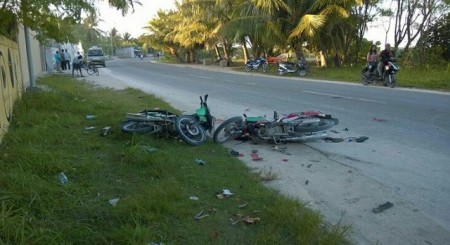
A 16-year-old victim of an accident in Addu City died of injuries yesterday while undergoing treatment at the regional hospital.

According to police, an 18-year-old man and a 16-year-old girl also sustained injuries after two motorcycles collided in the Hithadhoo link road around 5:55pm yesterday.

Both cycles were also damaged beyond repair. The 16-year-old boy was driving one motorcycle while the 18-year-old was driving the second vehicle.

Police said the 18-year-old was flown to Malé for treatment last night whilst the 16-year-old girl was undergoing treatment at the Hithadhoo regional hospital.

Several fatal accidents have occurred on the Addu City link road, which connects three interlinked islands in the southernmost atoll.

In November, a 33-year-old man died following a motorcycle accident whilst two men died in September after their motorcycle collided with a pickup.

Likes(1)Dislikes(1)

Adhaalath cleric attacks government

Influential cleric Sheikh Ilyas Hussain today denounced the government’s alleged attempts to “create strife and discord” among religious Adhaalath Party members.

The ruling Progressive Party of the Maldives has claimed Adhaalath’s break from the government and subsequent alliance with the opposition was not a popular decision among Adhaalath’s religious scholars and members.

But Ilyas, the president of Adhaalath’s scholar’s council, said he backed the opposition’s anti-government protests, and that the council had met on the matter.

“Dear brothers and sisters, remain vigilant of the rival’s attempt to create strife and discord. I urge everyone to go forward with the party’s president [Sheikh Imran Abdulla],” he said in an audio message from Malaysia.

“We held a meeting on March 7, and discussed the current events in the country. I call upon everyone to refrain from spreading false information regarding the council,” said Ilyas.

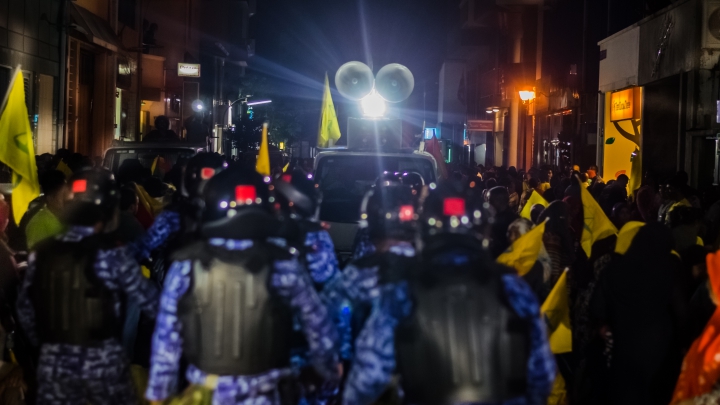
Adhaalath has been holding nightly protests alongside the opposition Maldivian Democratic Party urging the government to stop its alleged human rights violations.

Likes(1)Dislikes(0)

Police bust Maldivian drug network in Sri Lanka

Police have busted an international drug network operated by a group of Maldivians in Sri Lanka following a two-year long operation.

Police superintendent Ahmed Shifan said three Maldivians were arrested with 165 grams of heroin and a large amount of cash in a joint operation conducted by the Drug Enforcement Department (DED) and the Sri Lankan Narcotics Bureau.

Shifan, head of the DED, said the three were suspected of carrying out large-scale drug trafficking through several countries, including Pakistan, Thailand, China, and India.

The first suspect arrested in the case – a 25-year-old – had travelled to these countries with fake passports numerous times since 2012, Shifan said.

Shifan also said that a Maldivian woman was recently arrested in Sri Lanka with 100 grams of cannabis.

However, the woman has since been released because cannabis is considered a soft drug in Sri Lanka.

Likes(1)Dislikes(0)

Government slams UK lord’s op-ed on Nasheed trial

The government has responded furiously to a Huffington Post opinion piece  by a member of Britain’s House of Lords about the trial of former president Mohamed Nasheed, calling it inaccurate, one-sided, and “an act of gross irresponsibility”.

Lord David Alton’s article called for targeted sanctions and a boycott of tourist resorts linked to the government following Nasheed’s conviction on terrorism charges.

In an open letter to Lord Alton from the Maldives High Commission to the UK, the government said that as a member of the All-Party British-Maldives Parliamentary Group the independent cross-bench life peer had been kept regularly informed about the opposition leader’s trial.

“Nevertheless, you have decided to comment on the trial in such an inaccurate and public manner, that it will further exacerbate the domestic ramifications of the case for our young democracy. This is incredibly disappointing,” reads the letter.

The government was “a firm defender of freedom of speech,” but “it is our opinion that your authorship of an op-ed piece of such inaccuracy and one-sidedness was an act of gross irresponsibility,” it continued.

The response forms part of a diplomatic offensive by the government aiming to counter criticism of Nasheed’s trial by the United Nations, Amnesty International and several governments.

Lord Alton described Nasheed’s terrorism trial as “an extraordinary farce” and a “gross miscarriage of justice” in a piece entitled “We must send the Maldivian regime a clear, unambiguous and robust message: Their behaviour is unacceptable”, published on March 22.

The op-ed contained a “litany of inaccuracies,” the government contended, whilst uninformed commentary in the international media “only serves to perpetuate the spread of misinformation and baseless rumour”.

The High Commission’s letter noted that Nasheed was charged under the 1990 Anti-Terrorism Act, for ordering the military to “unlawfully and unconstitutionally abduct Chief Judge Abdullah in January 2012.”

“The government of Maldives would like to make it clear that there is no conspiracy by the government to unwarrantedly convict Mr Nasheed,” it added, reiterating that the executive could “neither interfere nor influence any decision of the Prosecutor General or the judiciary.”

Information wars

The High Commission repeated demonstrably false claims in letters from the government sent both to stakeholders in India and the UN High Commissioner for Human Rights.

The letter falsely claimed that Nasheed was presented before a judge a day after his arrest for “a procedural remand hearing” whilst his lawyers were not present as they had failed to register.

However, Nasheed was brought to court for the first hearing of his trial after his lawyers had been told they should have registered two days in advance, despite being unaware of the trial until the opposition leader’s arrest the previous day.

The letter suggested that Lord Alton confused “allegations that two of [the] judges were witnesses for the prosecution with the court’s refusal to hear Mr Nasheed’s defence witnesses.”

The prosecutor general and two of the three presiding judges were at Judge Abdullah’s home at the time of his arrest and had testified in a 2012 Human Rights Commission investigation.

Meanwhile, the presiding judges later refused to call any of Nasheed’s witnesses to the stand, claiming they did not appear to “negate” the prosecution’s case.

The letter also dismissed Lord Alton’s claim that police manhandled Nasheed – which was widely reported and shown on television – insisting that police followed standard procedure.

Lord Alton had meanwhile called for “targeted sanctions” against the Maldives, suspension from the Commonwealth, and Nasheed’s nomination for the Nobel Peace Prize.

“The European Union should freeze the assets of senior regime officials and their crony backers. A travel ban should be imposed on senior regime leaders,” he wrote.

“And a carefully targeted tourism boycott, aimed at resorts owned by regime associates, is needed. Sir Richard Branson has already called for such a boycott, and others should join that call.”

Likes(1)Dislikes(0)

Home minister plans law changes to boost police power

The government is preparing changes to several laws to increase police powers and remove “loopholes”, Home Minister Umar Naseer told police at an anniversary event last night.

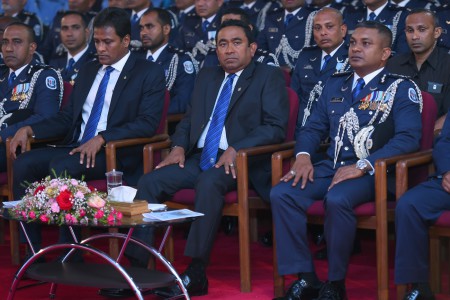
At a ceremony to mark the 82nd anniversary of the Maldives Police Service, Naseer said existing laws were unsuited to the Maldives, making it harder to maintain public order, and needed to be revised to reflect the country’s “unique circumstances”.

He appealed for cooperation from MPs to “solve problems in laws that conflict with the Maldivian environment.”

“The result of making laws disproportionate to the state’s means, the Maldives’ geography, and the state’s resources is police not arresting a person unless they are absolutely forced to,” he said.

A coat tailor-made for a “tall, bulky Englishman” would be ill-fitting for a “short Maldivian in tropical Maldives”, Naseer said.

Naseer’s remarks come in the wake of a recent spike in violence in Malé that saw the murder of a 29-year-old on Saturday night.

While public anger was directed towards the police following the incidents, Naseer said police should not consider all such criticism as politically motivated, suggesting it stemmed from ignorance of obstacles faced by police.

The public were unaware of loopholes in the law that allowed criminals to go free, he said.

The home minister said several laws passed after the adoption of the 2008 constitution were copied from England and pose difficulties for law enforcement.

As a consequence, Naseer argued, expensive police operations intended to protect society from criminals become exercises in futility.

Presenting detainees before a judge within 24 hours was also difficult and costly due to the geographical dispersion of Maldivian islands, he said.

Moreover, Naseer suggested that constitutional rights of people arrested by police should be restricted or narrowed for the good of the whole society.
61609_26a9187f-8_ (1)

In his speech at the function, President Abdulla Yameen also argued that the safety and security of the community trumped individual rights.

President Yameen pledged to do everything in the government’s power to curb violent crime.

The government has decided that the army will assist police in security operations, he added.

Narrowing constitutional rights

In December, the People’s Majlis amended a 2010 law banning “threats and carrying dangerous weapons and sharp objects” and restricted the rights to remain silent and retain legal counsel for suspects arrested for violent assault.

Suspects accused of murder, or of causing death or loss of limb and organ by assault, cannot exercise the right to remain silent “to any extent” and will only be able to speak to their lawyer for the first 96 hours of arrest in the presence of the police.

Further, suspects will only be allowed six hours to appoint a lawyer. If the suspect fails to appoint a lawyer or if the lawyer is not able to present a valid reason for absence, police are authorised to question the suspect without a lawyer.

The amendments also relaxed requirements for courts in extending pre-trial detention.

Advocacy NGOs the Maldivian Democracy Network and Commonwealth Human Rights Initiative said the amendments “absolutely violate… fundamental rights of the people” and would “seriously hinder the democratic system Maldives has transited to”.

The opposition Maldivian Democratic Party (MDP) meanwhile released a statement yesterday noting that seven out of 12 murders since December 2013 occurred in the capital Malé.

Instead of combating crime, MDP contended that police resources were being deployed to “weaken peaceful political activities”.

Public trust in the police institution has fallen to unprecedented levels, the statement continued, whilst police are suspected of committing a number of “atrocities”.

Incidents of police brutality, discrimination in providing services, and using obscene language against protesters have also increased, the party said, insisting the police leadership should bear responsibility for this state of affairs.

“Misusing powers granted to police by laws in order to maintain public safety and using resources provided to police through public funds towards political ends are alien to democratic norms and mechanisms and conflicts with best practices of the police service,” the MDP statement read.

Police said last week that 162 protesters have been arrested since February and police have forwarded cases involving 95 protesters, including two MPs, to the Prosecutor General’s Office.

Likes(2)Dislikes(0)

Parliament to consider mandatory Shariah punishments

Anara Naeem MP; Haa Dhaal Makunudhoo; Adhaalath1

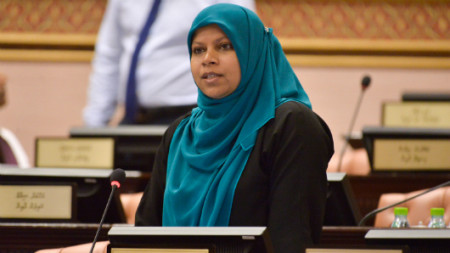
An amendment to make Islamic Shariah punishments mandatory in the new penal code was accepted for consideration at today’s sitting of the People’s Majlis.

Proposed by Adhaalath Party MP Anara Naeem, the amendment to article 1,205(a) (Dhivehi) reads: “If a person is found guilty of a crime with qisas [retaliation in kind] or hadd [a punishment fixed in the Quran or teachings of the Prophet], the sentence must be the penalty prescribed in Islamic Shariah.”

Introducing the amendment, the MP for Haa Dhaal Makunudhoo referred to Article 10(b) of the Constitution, which states, “No law contrary to any tenet of Islam shall be enacted in the Maldives.”

The new penal code is due to come into force on April 13. Anara noted that the law currently states that Islamic Shariah punishments must be meted out only for crimes with a punishment fixed in the Quran.

The purpose of her amendment is to “further improve” the provision in line with the constitution, Anara said.

The six crimes with punishments fixed in the Quran are theft (amputation of the hand), illicit sexual relations (death by stoning or one hundred lashes), making unproven accusations of illicit sex (eighty lashes), drinking intoxicants (eighty lashes), apostasy (death or banishment), and highway robbery (death).

The only one of these punishments that is currently implemented is the flogging punishment for illicit sexual relations, normally enforced on women. However, the home minister last year established a death chamber at Maafushi jail, ending a six-decade moratorium on the death penalty.

The amendment bill was unanimously accepted for consideration with 44 votes in favour and sent to the National Security Committee for further review.

Progressive Party of Maldives (PPM) MP Ibrahim Riza also proposed several amendments to the penal code on behalf of the government to correct minor errors and problems noted during the preparations for implementing the new law.

The government-sponsored legislation proposes amending issues of conflicting interpretations and confusing provisions as well as reordering sections.

Riza’s bill was accepted with 40 votes in favour and two abstentions.

Likes(1)Dislikes(0)

Five-year-old ‘almost poisoned by mother’

A five-year-old boy in Laamu atoll Maabaidhoo has been saved from his mother’s attempt to poison him, media reports said.

The Indian woman had tried to poison her son by barricading herself inside her home and pouring pesticide in to the boy’s mouth on Monday night, said Ibrahim Shareef, the Island Council President, according to local media.

The woman had already been arrested and released over a family dispute on Sunday evening in which she threatened to kill the child, Haveeru reported.

The council went to the woman’s home, concerned for the family’s welfare, but found all the doors closed. They broke down the door to find the child being fed pesticide, but were able to intervene and save him.

The woman had made previous attempts on her children’s lives, the report said.

Shareef said the boy had been treated at Maabaidhoo Health Centre.

In a separate case in 2010, the Indian wife of a Maldivian man was arrested after being accused of infanticide. The state was unable to provide her with an attorney, so the case stalled and she was confined in Dhoonidhoo detention center for four years before being released without charge.

Likes(1)Dislikes(0)

A new storm brewing over the Maldives

The following article is by Paulo Casaca, the Executive Director of the South Asia Democratic Forum (SADF).

Many Europeans flock to the beautiful Islands of the Maldives to spend their honeymoon, discover the amazing scuba diving possibilities, and walk in pure sandy beaches and to enjoy the warm hospitality of people of the island state. The Maldives is often referred to as Paradise on earth. Today, this statement could not be further from the truth. Many visitors are unaware of the political and constitutional turmoil, the increasing danger posed by fundamentalists, the inefficient and politicized judiciary, and the erosion of human rights and democratic principles. They are neatly tucked away on island resorts, while Malé is once again prone to turn into a battleground.

The 30 year long authoritarian era of former President Maumoon Abdul Gayoom, who ruled the country from 1978 to 2008, formally came to an end seven years ago, but the reality on the ground is different. Gayoom has managed to keep a firm grip on power through old friends, family members and beneficiaries.
When Mohamed Nasheed, a long time democracy campaigner won the country’s first multi-party elections in 2008, there was hope the longest reigning autocracy in South Asia would come to an end. Nasheed was able to initiate first steps in democratizing the island state, but his efforts were blocked by a destructive opposition that continued to act ewithin the same obstructive and totalitarian logic of the past. The 2012 coup d’état that ousted Nasheed from power, half-way through his term, showed that the forces of oppression had not been silenced and were still alive and kicking.

The dysfunctional state of democracy, especially with regards to the judiciary, became blatantly evident in the recent terrorism charges and sentencing of Nasheed through what can only be described as a “show trial.” The fact that judges presiding over the trial had acted as prosecution’s witnesses says it all. Not only are judged politicised, biased, and negligent of the constitution, they also lack professional education and training. In May 2013, the UN Special Rapporteur on the Independence of Judged and Lawyers Gabriela Knaul described the Maldivian Justice system as a “system in crisis” and expressed great concern over political bias and low qualifications. Nothing has changed in the past two years.

And nothing will change, if the international community shies away from robust measures. In 2004, the EU’s threatened sanctions on the Maldives in the wake of human rights abuses and totalitarian governance void of any democratic principles. Only then did the regime, under the auspices of supranational bodies, start changing its atrocious behaviour towards its own people. Only when the party cadre was affected personally, did they slowly and unwillingly soften their chocking grip on civil society and the hope of freedom.
Issuing statements is a good and necessary first step. It creates awareness, and generates and increases the interest of the public. But it is not enough.

If democracy wants to have a chance in the Maldives, the international community must help pro-democratic forces. Roughly a decade after the first wave of sanctions, the EU especially, has to consider imposing them again. Freezing foreign assets and all non-humanitarian aid as well as issuing travel bans are efficient tools in this regard.

There is a old Maldivian proverb, Furifá huri badiyale gudu gude naalhaane (roughly translated from Divehi: “The water pot that is full will not shake”). Under Nasheed, water was poured into the water pot, but it trickled away due to existing holes and new holes added by the then-opposition. Now the vessel is on the brink of being completely emptied. The EU and other supranational institutions should play their role in preventing the water from being absorbed by the authoritarian modus operandi.

All comment pieces are the sole view of the author and do not reflect the editorial policy of Minivan News. If you would like to write an opinion piece, please send proposals to [email protected].

Likes(1)Dislikes(0)