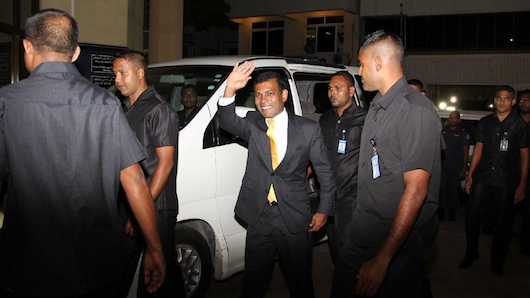
High Court says Nasheed can still appeal

Former president Mohamed Nasheed can still appeal a 13-year terrorism conviction at the High Court despite the end of the 10-day appeal period, the court says.

However, Nasheed’s lawyers say they believe they have no legal route through which to launch an appeal, and the ex-leader’s only hope for release is a clemency procedure initiated by the president.

The legal team says Nasheed is seeking a political solution involving President Abdulla Yameen, saying he has no faith in the judicial system to treat his case fairly.

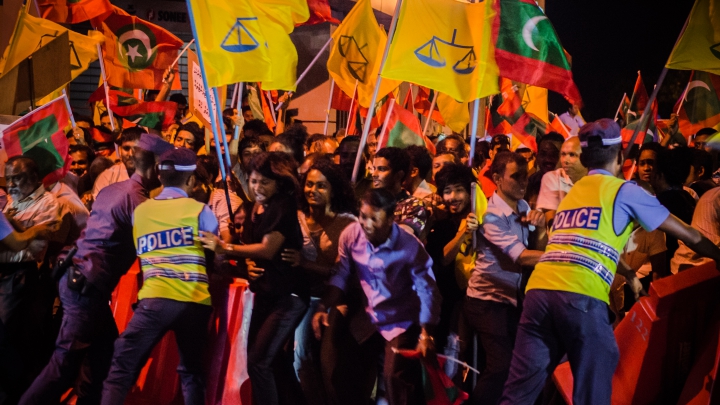
Nasheed’s conviction last month was met with outrage from the opposition, which has been holding daily protests, while his trial was heavily criticised by several international bodies.

Late appeals

High Court judges are authorized to accept a late appeal if a “reasonable justification” is given, court media official Ameen Faisal said.

These include the lower court’s failure to provide detailed reports into court proceedings on time, as had happened in Nasheed’s case.

However, a lawyer on Nasheed’s team says there is no legal avenue to file an appeal, because the Supreme Court has removed the High Court’s discretionary power to accept late appeals.

This change was made in the same January ruling that shortened a 90-day appeal period to 10 days, shortly before Nasheed’s trial.

Only President Abdulla Yameen can now resolve the impasse, Nasheed’s lawyer Ibrahim Riffath said. The president can reduce Nasheed’s sentence through special powers granted in the Clemency Act.

In January, the Supreme Court voided Article 42 of the Judicature Act which set out appeal deadlines and gave judges discretionary powers in accepting late appeals.

The 90–180 day appeal period obstructed justice, the Supreme Court said. A new 10-day appeal period was set out, but the apex court was silent on procedures for late appeals.

Riffath said the High Court must now seek the Supreme Court’s instruction before accepting an appeal.

Political solution?

In any case, Nasheed’s team on March 19 announced that the former president desired a political solution and would not seek an appeal, stating he had no faith in the judiciary.

His lawyers believe such an appeal would inevitably fail, because they do not believe the High Court judges to be independent.

Six of the nine High Court judges are to be relocated to two new High Court branches with reduced powers in the north and south. The government-controlled judicial watchdog has not yet decided which judges will be relocated, and the threat of this demotion has silenced the judges, Nasheed’s lawyers believe.

President’s spokesperson Ibrahim Muaz Ali last week suggested President Yameen could consider granting a pardon if Nasheed asked for it, saying the office had not received a letter yet.

But Riffath said the normal clemency procedures do not apply in Nasheed’s case, as the president cannot pardon offences relating to terrorism. However, the president on his own initiative could reduce sentences or postpone them indefinitely under special procedures listed in Article 29 of the Clemency Act.

Article 29 states that the president can reduce sentences depending on the age, health or special circumstances of the convict.

Yameen has so far insisted that the court process is independent from his government and that he is not personally involved.

Daily protests are ongoing across the Maldives, and opposition leaders last Thursday reiterated calls for President Yameen to initiate talks.

The government last week stripped Nasheed of membership of the main opposition Maldivian Democratic Party, by using its parliamentary majority to pass a law banning prisoners from political party membership.

Separately, the ruling PPM has also submitted an amendment to the law on privileges for former presidents stripping any president who resigned – as Nasheed did, although he said it was under duress – from army protection and financial privileges.

Nasheed was convicted in a trial condemned by the UN, Amnesty International and the EU, US and UK over lack of due process. Amnesty called the trial a travesty of justice, while the UN said it made a mockery of the constitution and international treaties.

Likes(3)Dislikes(0)

Comment: The darkest hour is just before the dawn

Latheefa Ahmed Verall is former President Mohamed Nasheed’s maternal aunt

I was twenty-eight when Maumoon Abdul Gayoom became the president of the Maldives. President Nasir had been demonised and vilified, and a saviour, like a shining beacon of virtue from the deep, ancient bowels of Al- Azhar had appeared. He came in trailing clouds of glory that was Islamic scholarship. I was simply bowled over – to use a phrase that he and I probably share as lovers of cricket!

The year 1978 was an auspicious year for us both. I was expecting my first child; he was starting on his life’s work as the longest ruling dictator of Asia. Our paths never crossed of course because he was in the business of silencing public dissent in a frenzy of torture and authoritarian heavy handedness, while miles away in New Zealand, I was in the business of teaching my students and eventually my own children, the importance of asking the question ‘why’.

I want to talk to you, the readers of this website and also to others in our extremely divided nation, so that you may open your minds enough to listen to the reason why we must never, never give up striving for our rights. Get over the fact that I am [former President Mohamed] Nasheed’s aunt, get over the fact I live over eleven thousand kilometres away. I am 65 years old and smart enough to separate what I want for my nephew and what I want for my country. They are two different things. This is for my country.

For those people who question my right to voice these concerns, I have this to say. My generation in the Maldives had no voice. We did not have the know-how or the belief that we could stand up to what was unfair, corrupt or unjust. Most of us, particularly women, believed that life was about accepting the status quo, being obedient, humble and respectful towards authority and power. That was the world-view we held and we strived to live ’good’ lives within it. We forgot to ask the question why things were the way they were.

When I saw the pictures of Evan Naseem, his dead body beaten and bruised, his hair matted in his own blood, I realised this was an atrocity that had been years in the making. This lack of respect for human life and dignity had its roots years before 2003. My generation had allowed the regime to come to that point of inhumanity because of our impotency and lack of action. I wept as the words, “The only thing necessary for the triumph of evil is for good men to do nothing,” resonated in me. I have never forgotten their significance.

Our impotency came in many guises: we thought bowing down to authority, however unfair, was part of our heritage, we thought it was what our religion demanded of us, we assumed that deference was owed to a ruler simply because he was the ruler and finally we feared that the regime was too powerful to be affected by our concerns.

Today, the imprisonment of Nasheed and the unleashing of the regime’s vendetta on any who disagreed with their Grand Design, are natural progressions for a group of people who had always dealt with problems in a predictable and unimaginative way. They have no answers other than sheer brutality. But now, we the people, no longer find this acceptable. We are no longer prepared to consider it the norm. Those early activists and opposition supporters have helped liberate us all. And all of us working together have finally brought the eyes of the world on the Yameen/Maumoon regime.

[President Abdulla] Yameen, with the same lack of imagination, is following in his brother’s footsteps, and the prisons are once again filling up with their opponents. The events of the last few months scream out the desperation of a group that has once again run out of options: an ex-president jailed by a regime-controlled judiciary who, because of their incompetence and the political pressure of their masters, turned Nasheed’s trial into a farce, a defence minister sentenced for terrorism because of insurmountable differences and divisions in their own dog eat dog cabinet, a predictable falling out with their rich coalition partner who facilitated the regime’s return to power and is currently kept impotent by the threat of financial ruin and finally the country spurned by all freedom loving citizens of the world. Their solution: to move towards a state of emergency because they cannot control the citizenry other than by force.

This mounting opposition to the regime makes it abundantly clear that this is not Nasheed’s fight alone. He is not the only one to suffer brutality and injustice. Under this regime, to various degrees, we have all been within prison walls and we have all suffered from huge injustices. And our fathers, mothers, brothers, uncles, aunts, nieces, nephews and friends have been affected by this cancer that has destroyed the very soul of the country which we hold dear to our hearts.

I am a student of history and I know that in any great struggle between the forces of tradition and modernity or the rights and wellbeing of all people and the greed of the few, the hardest time is when we feel that fortune has taken a dramatic turn for the worse. With Nasheed in prison, the regime in control of the judiciary so that they can dish out their malice willy-nilly, and the police high on testosterone, it may appear that our objectives are all but unattainable.

But life’s great lesson is that this is exactly the time for us to view our achievements and persevere in the face of adversity. The darkest time is always before the dawn. This is the time to have faith in our ability and not give up. This is the time to increase our resolve, increase our determination and increase our action.

Why?

Unlike my generation, today’s Maldivians are not incapacitated by years of tradition and social isolation. The question ‘why’ has been asked. People have dared. And more than that, we have several leaders in prison and this may well be a positive turning point, as for the first time, the eyes of the world are turned on the Maldives as never before. The time is ripe for our action, to actively insist that we do not want a future of brutality and suppression.

The regime believes that by imprisoning Nasheed and other leaders they can curb the move towards democracy and return to the good old days of untrammelled power. But these arrests give all of us the unheralded power to break this regime. We can prove them wrong. They can continue to imprison people, but they cannot suppress an idea. They cannot imprison or beat an ideal.

The time to unhinge this crumbling, ancient relic of a regime is now. This is our time to act.

All comment pieces are the sole view of the author and do not reflect the editorial policy of Minivan News. If you would like to write an opinion piece, please send proposals to [email protected].

Likes(4)Dislikes(1)

MP Mahloof held for 15 days after rejecting second protest ban

Independent MP Ahmed Mahloof has been taken into police custody for 15 days after refusing to accept a conditional release from detention under which he would have been barred from protests.

Mahloof scuffled with police outside the court after the period of detention was handed down Friday evening. Police said he tried to flee while being escorted into a vehicle. He was immediately seized by officers, but said he had just been trying to speak to his wife.

Mahloof’s wife Nazra Naseem was also involved in an altercation with officers and later said they had twisted her arm, pinched her stomach and torn buttons from her top.

Mahloof is being held at the Dhoonidhoo detention centre, his lawyer said.

Formerly a member of the ruling party, Mahloof was initially arrested on 25 March at an opposition protest over the jailing of ex-president Mohamed Nasheed, and was detained under house arrest for five days.

He was handed additional house arrest for refusing a previous protest ban, then was taken to the criminal court last night for a third remand hearing, as the court order to detain him was about to expire.

The criminal court ordered that Mahloof be detained again because he refused for a second time to accept the court’s condition to stay away from gatherings of four or more people for 30 days.

“Mahloof said he would not accept the court’s terms, so he was remanded for an extra 15 days in police detention,” said Abdulla Haseen, the MP’s lawyer.

The criminal court has recently released a series of protesters on condition they stay away from demonstrations for a set period of time, but this tactic has met with criticism from legal experts and the prosecutor general.

“Releasing a person suspected of a crime with conditions other than ensuring the person’s return to the court maybe unconstitutional,” the prosecutor general wrote in a letter to the chief judge of the criminal court, obtained by Minivan News last week.

Meanwhile, the constitution says people can only be held in pre-trial detention under certain circumstances: if further interrogation is needed, if they are a danger to society, if they may influence witnesses or if they might flee.

Scuffle

Police said Mahloof had tried to run away from officers as he was being escorted into a police vehicle after Friday’s remand hearing, a claim he denies.

“Mahloof said he wanted to talk to the reporters outside because police manhandled his wife,” said his lawyer.

Eyewitness Sabra Noordeen said the MP did not try to flee but “ran to his wife” because she was shouting.

“Nazra [Mahloof’s wife] was near the police vehicle and he ran towards her. He wasn’t trying to flee though,” she said.

Speaking to Raajje TV last night, Nazra said she was molested by police as she tried to meet her husband outside the court.

“One policeman pinched my stomach and touched parts of my body that he should not have. He also tore off the buttons of the top I was wearing,” she said.

“My arm and finger were twisted so badly that I thought they were going to break it. I am sure if I hadn’t screamed he [the police officer] would have broken my fingers.”

Nazra has submitted a complaint to the Human Rights Commission of the Maldives today.

Meanwhile the opposition Maldivian Democratic Party (MDP) has condemned “police brutality towards Mahloof and his family”.

“Mahloof has been detained illegally for 25 days without charge. The MDP is concerned about the criminal court’s harassment of MP Mahloof and we condemn it,” the statement read.

“MDP sees the harassment towards MP Mahloof and his family as a warning to all Maldivian citizens by the government.”

Mahloof, a close associate of former President Maumoon Abdul Gayoom, was expelled from the ruling Progressive Party of Maldives (PPM) last month after he publicly criticised President Abdulla Yameen and the government.

He is now part of the opposition Alliance against Brutality, an anti-government coalition.

Likes(3)Dislikes(0)

UN sees increase in Maldivian jihadists overseas

A UN report has raised concerns over an increase in fighters leaving the Maldives to join terrorist organisations including al-Qaida and the Islamic State in Iraq and Syria.

The expert report to the UN Security Council, obtained by The Associated Press, said the flow of fighters globally “is higher than it has ever been historically”, increasing from a few thousand a decade ago to over 25,000 from more than 100 nations today.

The Maldives police chief Hussein Waheed in January estimated some 50 Maldivians are fighting in foreign wars, but the main opposition Maldivian Democratic Party says the figure could be as high as 200.

Waheed’s comments came after reports of at least 13 Maldivians leaving for jihad surfaced in local media in early January. Since then, at least four more have traveled to the Middle East.

Some seven Maldivians are reported to have died in the past year during battle in Syria, according to local media.

Waheed said that police were monitoring the activities of militants and would reveal details of plans to prevent radicalisation at a later date. The MDP has said the government is doing little to counter radicalisation and prevent recruitment of would-be fighters.

The UN report, written by a UN panel monitoring sanctions against Al-Qaida, listed the Maldives, Finland and Trinidad and Tobago as countries from which numbers of fighters were increasing, while the highest number of foreign fighters come from Tunisia, Morocco, France and Russia.

Most fighters travel to Syria and Iraq, to fight primarily for the Islamic State and the Al-Nusra front.

Likes(3)Dislikes(0)

Government hands discounted flats to judges, commission heads

The government has awarded luxury flats at discount prices to Supreme Court judges and four heads of independent bodies including the Anti-Corruption Commission in what it calls an attempt to “ensure their integrity”.

However, the opposition has condemned the distribution as a “government effort to enslave independent institutions”.

The government was handed 10 flats in the newly built Rehendi Residency, constructed by FW Construction in Male’. The housing ministry then offered the semi-finished apartments for MVR 1.6m (US $103,761), much lower than the market price, to the chosen individuals.

Hassan Lutfee, president of the Anti-Corruption Commission, confirmed to Minivan News he had signed a contract to buy one of the apartments at the discounted price.

A former owner of one of the apartments not awarded to the government told Haveeru he had bought his apartment for MVR 2m (US $129,000).

The government also waived the six per cent interest charged to other flat buyers on their loans, though the prosecutor general said he had requested to pay the normal rate.

According to the local media, the flats were awarded to Chief Justice Abdulla Saeed, Supreme Court judges Ahmed Abdulla Didi, Adam Mohamed Abdulla, Abdulla Areef and Ali Hameed, Criminal Court Judge Abdul Bari Yoosuf and Prosecutor General Muhthaz Muhsin.

Apartments were also allotted to Commissioner General of Taxation Yazeed Mohamed and Information Commissioner Abdul Azeez Jamal Abu-Bakr. Not all the recipients have yet signed contracts to buy the flats.

Co-chair of the Economic Council Ahmed Adeeb told a press conference on Wednesday that the apartments were awarded to “ensure the integrity of independent institutions”.

“The flats were not handed out. The recipients have to pay for them. This will result in ensured integrity of independent institutions and moreover it will strengthen the state,” he said.

However, the opposition parties accused the government of trying to “enslave” the judiciary and independent institutions.

“This clearly is corruption. The constitution clearly states that no benefits can be given to members of independent institutions without parliament’s approval,” said MP Ali Hussain of the opposition Jumhoory Party.

“The fact that the flats were given personally to the heads of the institution and not [linked to] the post is outrageous.”

Article 102 of the constitution states that members of the judiciary and independent commissions “shall be paid such salary and allowances as determined by the People’s Majlis [parliament]”. However, parliament was not involved in allotting the apartments.

Muhathaz, the prosecutor general, told Minivan News he does not think the awards involve corruption.

“In my opinion the awarding of the flats is not unconstitutional. But I personally believe that it would have been better if it was awarded to the prosecutor general and not to me,” he said.

Information Commissioner Jamal said the flats were given to help the judges and institution heads live in a secure building, and dismissed any idea of government influence.

“I assure the people that I will always act professionally and within the bounds of the constitution and the laws,” he said.

The prosecutor general receives a monthly salary and allowances of MVR 57,500 (US $3,741), while the anti-corruption commission chief receives MVR 45,000 (US $2,927). Supreme court justices are paid MVR 71,000 ($4,619) and the chief justice MVR 73,125 ($4,757). They also receive extra benefits such as insurance.

A majority of civil servants are paid less than MVR 5,000 (US $325) a month.

The Supreme Court declined to comment on the issue, while the Housing Ministry refused to give information beyond what was discussed in the Economic Council press conference.

Judge Bari and Taxation Commissioner Yazeed were unavailable for comment at the time of going to press.

Likes(4)Dislikes(0)

Singapore firm to advise on airport expansion

A Singapore-based consultancy is to advise the Maldives Airports Company on the long-awaited expansion of the country’s main international airport.

Surbana International Consultants will provide management consultancy services and a design and engineering review for the proposed redesign of Ibrahim Nasir International Airport on Hulhule’ island near Male’.

Plans for the renovations include a new international terminal building, runway, cargo terminal and taxiway expansions and new fuel firm.

Airport capacity will increase to 7 million international passengers and 1.5 million domestic passenger movements from the current 2.3 million after the renovations, said a joint statement from the two companies.

The government had previously signed a separate consultancy agreement with Singapore’s Changi International Airport to advise on the renewal and expansion of the airport terminal.

President Abdulla Yameen last month held talks with Saudi Arabia’s Saudi Fund about low-interest loans for the project, appearing to have scrapped previous plans to seek aUS$600million loan from China and Japan.

The expansion project is estimated to cost US$ 845 million, including improvements to shore protection of the airport island, new seaplane facilities and existing runway re-surfacing.

Economic Development Minister Mohamed Saeed previously said the runway expansion project had been awarded to Chinese Beijing Urban Construction Group, while the development of the airport terminal was awarded to Japanese Taisei Corporation.

The airport redevelopment project has been beset by problems and delays. In 2012, the government abruptly cancelled a concession agreement with the GMR-Malaysia Airports (GMR-MAHB) consortium to manage and upgrade the airport.


Likes(1)Dislikes(0)

State broadcaster disciplines editor after court ‘abduction’

The state broadcaster has taken disciplinary action against a well-known news editor who accused the criminal court of “abduction” last month during the trial of ex-president Mohamed Nasheed.

The Maldives Broadcasting Corporation (MBC) on March 15 transferred Mohamed Afsal from covering trials and legal affairs to working on the website, according to Haveeru.

Afsal had previously presented the “Raajje Miadhu” programme on Television Maldives and hosted special programmes.

The local daily reported that the transfer was prompted by the incident at court on the night former President Mohamed Nasheed was convicted.

On March 13, trial observers and journalists were held for nearly two hours inside the building after the initial hearing, as judges deliberated on a verdict. They were not allowed to use their phones or communicate with reporters gathered outside.

Afsal asked to be allowed to leave, as did Misbah Abbas from CNM and Muizz Ibrahim from Avas, but court officials refused to allow the three outside or inside the courtroom for the verdict. The three were held in the waiting area until the verdict was delivered.

The journalists accused the criminal court of kidnapping and terrorism and filed a complaint with police and the Human Rights Commission.

However, police dismissed the case, saying they had no jurisdiction to investigate it.

The Maldivian Democratic Party condemned the state broadcaster’s move today, characterising it as an attack on press freedom.

Likes(1)Dislikes(0)

Adhaalath party complains of double standards on protests

The religious conservative Adhaalath party has formally complained to the Human Rights Commission about what it says are double standards in how the Elections Commission handles political party protests.

Adhaalath’s letter notes that the Elections Commission last week fined the both the main opposition Maldivian Democratic Party (MDP) and the Adhaalath party for breaking political party rules and allegedly inciting violence.

However, the Adhaalath party said that at protests of the ruling Progressive Party of Maldives (PPM), “Young men have been present with their faces covered, holding pipes and sticks.”

Despite these circumstances, police and the Elections Commission did not take any action against the PPM, the letter said.

The Adhaalath Party asked the Human Rights Commission to investigate discrimination between parties, and what they said was obstruction of the freedom of expression by the Elections Commission.

Police have also previously written to the Adhaalath party, saying they received complaints from the public about protests held jointly by the Adhaalath and MDP.

Police said the protests were violating the human rights of other citizens, and asked the Adhaalath to hold protests without being too loud or disrupting the peace and order of Male’ city.

Likes(1)Dislikes(0)