Comment: Changing cheerleaders into leaders

Less than 48 hours is left before the ballot boxes open. On Saturday (September 7), the Maldives will choose its next president. The personalities and policies of four presidential hopefuls may differ from each other, but all do share one thing in common – they are all men.

And where are the women? They are standing behind their men.

Though no woman has a spot in the presidential race – dominated by four male candidates and their running mates – women have undoubtedly become an inextricable part of the elections.

As campaigning intensified over the past months, women and girls have been busy sewing more flags than they can count, cooking massive pots of Bondibaiy (sweetened rice) and spicy fish to quench the hunger brought on by mass rallies, and walking day and night to knock every door in order to win votes for their candidates.

Women are  also seen taking the front line at every political demonstration or march around the island – donning blazing yellow burqas, glittering pink t-shirts, or bright red blouses – colours synonymous with their candidate’s parties. Without the female presence, political events would have neither the same magnitude nor diversity as currently seen.

Participation of women of all ages is a highlight of this, the second ever multiparty presidential elections to be hosted in the country.

Out of all the major political parties contesting in this year’s elections, the Maldivian Democratic Party (MDP) stands out in particular for the scores of women that are participating in party’s events.

“Women have become a very important part of our campaign. Women are mostly involved in door to door campaigning – talking to the people, collecting crucial information we need for policy making and campaigning.” says Aminath Shauna, leader of MDP’s youth wing. “Most of the patch agents and campaign team is largely women.”

The MDP is contesting to regain power, following the controversial end to its three year old government after the resignation of former President Mohamed Nasheed on February 7 last year. The party vehemently contends that Nasheed was forced to resign in a coup.

In the wake of Nasheed’s resignation, massive protests led by his supporters against the new regime were suppressed using force and dozens were severely injured in the process – many of them women and girls.

A peaceful sit down demonstration by MDP female supporters outside the President’s Office was dispersed with water canons, while several women were beaten on the southern atoll of Addu – where women took the streets to protest against what they call a “coup government”.
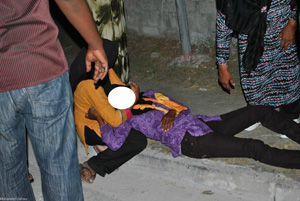
Woman injured during a police crackdown of pro-Nasheed protests in Addu

But, since February 7, female supporters of Nasheed have braved their way against pepper spray, batons and water cannons and continued to take lead in an army of yellow supporters, determined to fight till end to bring Nasheed back to power.

Shauna believes that this unwavering support by women is a result of policies adopted by the MDP’s short-lived government which mostly “benefited women”.

“If you look into the social protection program over 100,000 people directly benefited from it. It was largely spent on elderly, single parents who are mostly women. Also programs such as Hunaru [vocational education] and Second Chance program [rehabilitation and reintegration of inmates] largely accepted by women because, although women do not bring income to the family, its women who make household decisions and look after the elderly parents, take them to hospital and look after the children. So the person who really understood and felt the benefits of these programs were women,” Shauna observed.

During the campaigns, two out of four presidential candidates have  announced women specific policies; including daycare centres, flexible working hours, online jobs and reserved seats, among other things.

Though MDP claims to hold the policies benefiting women, the party is one of the two that has not prioritised a policy towards achieving gender equality and improving women’s rights- one the  few remanining development goals the country has so far failed to achieve due to widespread violence against women and  low representation of women in political and economic life.

Second is Jumhoory Party’s Gasim Ibrahim. The party speaks of introducing a pregnancy allowance and ensure gynaecology services on every islands as policy on women. For a party backed by Islamist party Adhaalath which believes in strict enforcement of Sharia and patriarchal dominance within public and domestic spheres, having no progressive policies on women is unsurprising.

But why does MDP, a party which asserts to be an alternative to the rest, holding egalitarian and moderate views does not have a policy specifically aimed at women? The party has never been recognised for its suitable policies for women. In fact, MDP’s record of gender policies during its short-lived three year term does not score well either.

Take the issue of domestic abuse and gender-based violence in the country. With every one in three woman estimated to be a victim of physical or sexual abuse, it is one of the biggest challenge women face across all islands. However, Nasheed’s government and its parliamentary group failed to step up in bringing any necessary legal reforms while its rivals were instrumental in drafting, promoting and passing domestic violence and child abuse legislations.

Unemployment among women is double that of males, however, no day care centres, flexible working hours or economic policies specifically targeted to reducing female unemployment were introduced. Research suggests reasons behind female and male unemployment differs with young women finding more difficult to find work due to early marriage, household responsibilities, societal attitude.

Maldives holds the record of one of the highest divorce rates in the world with almost every one in two marriages falling apart. This often leaves women struggling to raise children under extreme financial hardship. The single parent allowance, despite the temporary relief it brings, is merely a band-aid solution for these families. Economic emancipation remains unachieved.

Meanwhile, women also continued to remain as a minority at state decision making level under Nasheed’s era. Any point in time, Nasheed’s cabinet were dominated by men and his female appointees made up less than a quarter of all political positions.

His party followed same track, or even worse.

Currently, women hold 5 seats in 77 member parliament and only 57 out of 1091 local councils.

MDP secured full seats in the city councils of Addu and Male’ – two of the most populated areas – but none of them were sadly women. The party did not take any public initiative in encouraging female candidates to these elected posts. They simply embarked on making laws, building cities and running the state without an equal say of women who make up half of the country.

But perhaps, this elections is a harbinger for change.

This week, Nasheed sat down with women to listen to their woes. He promised that his economic and social policies are targeted, though not directly, towards addressing the most serious problems women face. Including housing, jobs, education and healthcare.

However, he stopped short of promising women an equal representation in his government or party.

Several women are throwing their support behind Nasheed because they also believe in the values of equality and justice he preaches. Perhaps, it needs to be put into practice a little better.

A good place to start would be within the party itself.

Mariyam Zulfa, who served as Tourism Minister during last months of Nasheed’s rule recently gave a subtle warning to MDP’s main rival, Abdulla Yameen of PPM.

“Yameen please don’t have your eye on 2018, thats gonna be a year for women, we have waited patiently enough, like Hillary Clinton,” she posted on Facebook.

This status echoes an important message – MDP women are ready  to climb to the top rung of the political ladder.

But, amid an environment of highly competitive and machiavellian men jostling for power, women often find themselves at crossroads. Whether to challenge the male dominance and risk losing or just be happy with the little voice she has. Choosing the latter also makes it easier to juggle the personal life often sacrificed by women pursuing a career.
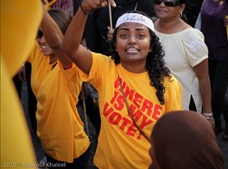
MDP Youth Wing leader Shauna at an anti-coup protest

Shauna is one the few young women who has bravely made it to the top tier of MDP, and she shared the challenges women face on the field.

“One of the reasons why we do not see women in elected posts is because women do not have access to campaign finance. We do not see many women in government senior posts because simply there is not policy that promotes it – working hours are not flexible for women with families, senior posts mean a lot of time and commitment. Working environment and hours do not give this women any flexibility. Harassment exists at all levels in the Maldives and there must be an end to that for more women to take up senior posts.” she explained.

These are problems can be resolved by changing  MDP’s current gender mainstreaming policies to a more direct women empowerment strategies such us quotas for women, setting up a budget for funding female candidates, running political leadership training programs. When more women take part in decision making, the diversity of opinions and ideas leads to better results in developing the country.

MDP also has continued to voice against rising extremism and the resulting backlash in women’s role in public life.

“There is also a movement towards conservative Islam that is a threat for women in politics and social sphere.” Shauna observes. “If there is no counter movement to conservative views of Islam, I do not think we can have a female president anytime soon.”

There is no better way in countering extremism than encouraging those subjugated by it to be free and exercise their power. Several women have already put their faith and support behind the party. It is time for Nasheed and his party to return the favour and let women have the equal space they deserves.

Should MDP hesitate, it is bound to create rifts through its existing female support base. But for now, women cheering for Nasheed seems to have his back.

All comment pieces are the sole view of the author and do not reflect the editorial policy of Minivan News. If you would like to write an opinion piece, please send proposals to [email protected].

Likes(0)Dislikes(0)

Cursed coconuts on Fuvahmulah allegedly used to disrupt elections

Additional reporting by Ahmed Nazeer

Coconuts with black magic spells are allegedly being used to sway voters’ political party allegiance and incite confrontations between Maldivian Democratic Party (MDP) supporters and police on Fuvahmulah, ahead of Saturday’s Presidential Election.

A ‘kurumba’ (young coconut) suspected to have a ‘fanditha’ (black magic) curse, with Arabic writing and suspicious symbols burned into the husk, was found in the garden of a home located in Fuvahmulah’s Dhiguvaadu ward yesterday (September 4), a source from Dhiguvaadu ward told Minivan News today.

The woman who found the suspicious coconut in the early hours of the morning intended to inform the police, however the homeowners – “hard core” Progressive Party of the Maldives (PPM) supporters – told her not to do anything until an expert investigated the coconut first, said the source.

“Neighbors supporting President Mohamed Waheed’s Gaumee Ihthihad Party (GIP) live in the area, so they heard about the fanditha coconut and wanted to create problems, so they contacted the police,” the source continued.

“MDP and PPM have been running strong campaigns and have many supporters in the area, however GIP only has about 15 members,” the source noted.

“Since GIP has very few supporters, they are trying to redirect attention away from the other political parties to gain votes,” alleged the source. “GIP has told PPM that MDP planted the fanditha coconut, however they are telling MDP that PPM is responsible.”

“Neighbors a few houses away were awake around 3:00am that night and did not notice any suspicious activity,” said the source.

The source believes that GIP, PPM and Jumhoree Party (JP) supporters are trying incite unrest among MDP activists on Fuvahmulah – especially GIP by involving the police in the fanditha coconut incident.

MDP supporters on Fuvahmulah remain very upset about the violent police crackdown that happened after the controversial transition of power in February 2012, according to the source.

“When MDP activists see local police they are not good with them, they do not keep calm, there is always a huge scene, shouting, etc.,” the source explained.

“[However,] these days MDP [Island] Councilors are trying to the max to keep supporters calm,” the source continued.

“And the situation is very calm right now. It [the fanditha coconut incident] was nothing huge, just a very simple thing,” the source said. “There won’t be any impact on voting.”

Fuvahmulah police did not want to get involved in the black magic incident, instead they preferred to allow the family to take action independently, a police source told Minivan News today.

“If we get involved, it will turn into a big thing,” said the police source, in reference to inciting unrest among MDP supporters.

However, local media reported that police took possession of the black magic coconut.

The Maldives Police Service was not responding to calls at time of press.

Black magic sabotage

A black magic practitioner from Fuvahmulah allegedly cast spells on five yellow young coconuts – kurumba can also be green or orange – and gave them to another man to deliver to a specific key location, a Fuvahmulah island council source told Minivan News today.

The island council source alleged a person named *Easa cast a spell on five coconuts and gave them to *Moosa to deliver. However, Moosa left the coconuts on his bed covered with a sheet before going to work.

“Moosa’s wife was not told about the cursed coconuts, so she was shocked to find coconuts on their bed and called the police immediately,” said the island council source. “The police went over to the house and took the coconuts.”

“She thought MDP had cast the black magic spells because the coconuts were yellow,’’ the island council source explained. “Once Moosa found out what his wife had done, he told her it was very bad that she had reported it to police.’’

Moosa and his wife then went to get the cursed coconuts back from the police, but police refused to return them, according to the island council source.

The island council source noted that Easa made a typographical error when cursing the coconuts. The coconut curse says to “get rid of [PPM presidential candidate Abdulla] Yameen”, but was supposed to read “get benefits from Yameen”.

Furthermore, during the 2008 presidential election Easa also started practicing black magic a month before the election day, noted the island council source.

“Every day after dawn prayer he went to the beach and did black magic stuff. He also went near the polling station and threw cursed objects at people,’’ said the island council source. “[But] Easa’s spells did not work the last time.”

“This hasn’t been taken too seriously by the islanders, but the MDP supporters are very concerned,’’ the island council source said.

No arrests have been made in connection with the case, the source added.

Earlier this week, police summoned a white magic practitioner to evaluate a young coconut believed to have been cursed by a black magic spell, after it was found near the Guraidhoo Island presidential election polling station in Kaafu Atoll.

*Names have been changed

Spiritual healing

This is the second cursed coconut incident reported in as many days, related to the presidential election. To better understand this “very common practice”, Minivan News spoke with Spiritual Healers of the Maldives President and Exorcist, Ajnaadh Ali.

“During elections black magic is used to gain votes and make people ill,” explained Ali.

Ali suspects a spell was read over the Fuvahmulah fanditha coconut instead of inscribed, because the coconut reads “May Allah protect us from Abdulla Yameen”.

The black magic spell cast to influence voting “is a spell of separation. It’s the same idea as a love spell. It can either bring people together or split them apart,” Ali noted. “The black magic will attack them mentally, by demanding the individual think a certain way even if they would normally know something is bad. It makes them blind in the mind.”

“While any object can be used, because coconuts represent a life structure (like eggs) they use those objects to make the spell powerful, with the advice of the devil,” noted Ali.

“There is a long history of the practice in the Maldives, but it is still very common nowadays on every island,” he continued. “There is a lack of knowledge regarding the religion. Some people who do black magic think it’s right because the Quran is used.”

“In Dhivehi, fanditha means magic – black or white – but the way it is practiced is what makes it good or bad. Black magic is when people worship or invoke jins or devils to cause harm to others,” Ali explained.

“Black magic is practiced by misusing the Quran, chanting or writing verses and the names of devils or jins (spirits) to summon their help. It cannot be done unless someone has some disbelief of Allah,” he continued. “It it also disrespectful of the Quran.”

The best protection against black magic is reading Quranic verses, particularly the last two chapters of the Quran, said Ali. ‘Ruqyah’ is a form of white magic, specifically an Islamic exorcism where Quranic verses are read and prayers recited to heal.”

“Ruqyah will neutralise black magic to rid of the evil eye or any other spiritual matter, like jin possessions or mental illness,” he explained.

It can also be conducted for the benefit of worshipping Allah, he added.

“Any Muslim can practice ruqyah by themselves, however its more effective if they have knowledge of jins and the Quran. Also, they must be following the religion,” he noted.

The five pillars of Islam are prayer, fasting, alms for the poor, pilgrimage to Mecca, and declaring belief in one God, Allah.

A 1979 law requires persons wishing to practice fanditha to “write and seek approval from the Ministry of Health.”

Likes(2)Dislikes(0)

Comment: Conspiracy of silence over GMR arbitration

Amidst the high decibel of the election campaign, it is easy to completely miss out on some critical issues.

This seems to have happened last week, when the Maldives Airport Company Limited (MACL) recorded an early loss in its legal battle with GMR over [President Dr Mohamed] Waheed’s government’s decision to terminate the Male airport concession agreement. There has been no word or confirmation from the Waheed government on this and his eager-than-ever spokespersons are nowhere to be found. This is especially interesting since they have been more than keen to take any credit they can on the entire airport saga.

Per a report in Minivan News, this is an “early legal skirmish” for GMR in its $1.4Bn claim against Government of Maldives and MACL for illegal termination of its concession agreement in December last year. In one of the earlier comment pieces in this same publication, it has been argued how the termination was a political decision, not an economic decision and how politicisation of the airport by Waheed and his ex-allies is systematically destroying our national asset. This latest news now is all the more concerning and I am certainly surprised to see that it hasn’t been picked up by any of the other newspapers which leads me to believe many people didn’t realize what this may mean for us as a nation.

While Minivan News hasn’t highlighted their source for this judicial order. I wish they had.  In this column I will highlight what I believe are the implications of this order.

Legal setback – arbitration panel leaning away from MACL?

No doubt this is a major setback for Waheed and his Attorney General, Azima Shukoor. Waheed’s government has lost the first round of the battle and the first blood has gone to the other side. The judicial order provides early indications as to which way the arbitration panel may be leaning based on the arguments that they have heard from both parties till now.

Waheed government could not convince the tribunal members on the right way to proceed with the case and this would certainly make one nervous about whether they will be able to convince the panel about their legal position that the contract is void. We have to keep in mind that members of the government and their allies were publicly criticising the deal, protests were being staged against GMR and cries of nationalisation were being made just before Azima suddenly pulled the rabbit out of the hat and claimed that there was no contract all this while!

Details of the political campaign run by members of the government are in the public domain, and they raise questions as to whether the contract was invalid or if the lawyers were asked to find ways of canceling it.

Certainty of compensation by Maldives for termination?

The most important part of the article that the tribunal has discussed is awarding three different types of claims according to which way the panel decides on the legal question of whether the contract was void ab initio or not: “GMR-MAHB’s claim for compensation as per the termination clause of its concession agreement, its parallel claim for loss of profits over the lifespan of the agreement due to its termination, and the government’s counter-claim for restitution should the tribunal decide in its favour”. If one thinks deeply about it, this doesn’t sound like good news at all for Waheed and Azima, or for our nation.

If we lose the legal arguments, we will be faced with a US$1.4 billion claim that we may have to pay for how the airport contract was terminated. However, if Azima wins the legal arguments in the panel then it’s the restitution claims that will be relevant. Otherwise, the contract itself has some termination clauses and this is the third type of claim that may be awarded by the panel based on legal arguments. Let’s look at each of these three claims one by one.

GMR’s US$1.4 billion claim is what it is and we will have to wait and watch if they are awarded this claim. The more interesting aspect is what the panel seems to have said on the other two types of claims.

On the termination payments per the contract, I am all but reminded that in a press conference last year Azima herself said that if the contract is cancelled, we may have to pay GMR anywhere between US$600-700 million in compensation. Given that Azima has been maintaining that Nasheed’s government did not do any due diligence while procuring the contract, whereas she has done extensive due diligence before canceling the contract, I am tempted to take her word on the estimated cost of termination. Hence, in this case, we may have to pay GMR around US$600-700 million.

Now, for the worst part and which Azima has argued in court: in case we win the legal arguments in court, the panel will decide for restitution. If one quickly goes to Wikipedia and understands what restitution refers to in legal terms, it means “orders the defendant to give up his/her gains to the claimant… to restore the benefit conferred to the non-breaching party”.

In essence, if restitution is done in this case, the government will have to give back all the money that GMR brought to Maldives with them to invest and GMR will have to give back what they got from Maldives. Even some quick ‘back-of-the-envelope’ calculations reveal that this would still mean paying around US$240 million to GMR!

If one believes their statements that they have already invested ~US$240 million in the airport, then this money will need to be given back to GMR. At the same time, they have also said that they haven’t taken investment out of the airport and whatever they earned was put back in the airport. Hence, we are still looking at a claim of US$240 million that we may need to give GMR even if we win the legal case!

Conspiracy of silence?

During his controversy-ridden reign in which he has lost allies one by one, Waheed has taken a number of suspect decisions which he has been too happy to slip under the carpet. He perhaps thought that the decision to axe the airport contract was a populist decision and he had probably hoped that it would bring him back to power.

This is why his spokespersons as well as the AG were trigger-happy to announce that nothing will happen in the arbitration before next year – “since there is no valid contract, there can be no compensation”.

Now, this early legal setback– which may cost us millions of dollars in damages even if we win the arbitration– has laid bare all the arguments that Azima gave when the contract was cancelled. The shallowness of her arguments has now left the nation with a US$240 million bill in the best case, and more than a billion dollars at worst! So much for the “legal due diligence and advice of foreign lawyers” that she received.

No wonder that there has been no word from the government on this so far. This may be either because they have nothing to say given the early setback that they have received or they would rather push this under the rug and hope they can get through the elections without making any comment which may jeopardise their chances. At the end of it, they seem to have taken advantage of a tight election schedule to hide without giving any explanations whatsoever!

All comment pieces are the sole view of the author and do not reflect the editorial policy of Minivan News. If you would like to write an opinion piece, please send proposals to [email protected].

Likes(0)Dislikes(0)

Two arrested for giving death threats to police officer

Police have arrested two men on the island of Naifaru in Lhaviyani Atoll on suspicion of giving death threats to a police officer.

According to police, the two men – aged 28 and 30 – allegedly threatened the officer while he was inside a restaurant on the island.

Police said that the 28 year-old suspect has a previous record for participating in an illegal gathering, encouraging others to participate in an illegal gathering and a drug related offense.  The 30 year-old suspect meanwhile has a record for using forged US dollars, robbery and drug related charges, according to the police.

Likes(0)Dislikes(0)

Police operate under “law of the land”, not the orders of individuals: Commissioner Riyaz

Additional reporting by Mariyath Mohamed

Police Commissioner Abdulla Riyaz has dismissed opposition allegations of the possible politicisation of officers during the presidential election, scheduled for September 7, maintaining that the institution is bound by the “law of the land” and not any one individual.

In the lead up to this month’s polling, the opposition Maldivian Democratic Party (MDP) has continued to accuse the chief of police of conducting “overtly political” actions, while also being a key player in the controversial transfer of power on February 7, 2012 – which it maintains was a “coup d’etat”.

Commissioner Riyaz is currently under investigation by the Police Integrity Commission (PIC) over the temporary publication of a letter on Twitter that was allegedly written by a third party urging officers to vote against MDP candidate and former President Mohamed Nasheed.

Article 69 of the Police Act states, “It shall be illegal for any police officer to commit any of the following acts even in his or her personal capacity, a) Committing any act or participating in any activity that obstructs the performance of his or her duty without bias or partiality b) Committing any act or participating in any activity that could create doubts in the minds of citizens/the public concerning the performance of his duty without bias or partiality c) Becoming a member of any political party, or participating in any activity organised by a political party, or providing financial assistance to a political party.”

Nasheed resigned from office last year following a police and military mutiny that led to Riyaz being appointed as chief of police.

While the investigation over the Twitter case is pending, the PIC yesterday ruled that the commissioner had been appointed to his position in compliance with the Police Act, and that his appointment was lawful.

Meanwhile, Riyaz stressed in July this year the police service will continue to refuse any orders it decides are “unconstitutional” after expressing concerns over leaked proposals allegedly devised by the MDP to reform the country’s security forces should it win the upcoming election.

Committed to transparency

Speaking to media in Male’ today, the police commissioner said the institution was committed to transparency in providing election security.

However, he declined to discuss the investigation into the content of a previous controversial post on his official Twitter page, or the issue of why officers were today seen by local media removing campaign posters and images posted on private property, depicting a violent crackdown against MDP supporters by authorities directly following the change in government last year.

The commissioner said he could only answer questions on matters relating to Saturday’s election, while also rejecting accusations that the Maldives Police Service favoured any specific candidate during voting.

“The Maldives Police Service is an institution and not an individual. We are bound by the constitution to make sure officers operate with the laws of the land,” he said. “Yes, there have been some allegations [of politicisation among senior officers including himself] from one party out of several, but we do our best to be transparent.”

Riyaz told Minivan News that the MDP – as the country’s sole opposition – has been invited to four separate meetings held for political parties to discuss any concerns regarding the police strategy to produce election security on polling day.

He added that the party had declined to attend on all occasions.

“My message would be is that all officers must act in accordance to the law and human rights,” Riyaz said.

Electoral security plans

The commissioner also today updated local media on the police service’s election security plans that will see officers stationed on all inhabited islands by this evening under the name ‘Operation Blue Waves‘.

Riyaz said he was calling on all “political actors and their supporters”, as well as the general public to ensure officers were provided with maximum cooperation to officers involved in providing security during the election.

“I also urge everyone to maintain peace, and should they have any concerns, to address them within due process,” he advised.

“We must set an example to the world by showing that we can get through this elections while maintaining absolute peace and stability.”

In comparison to the country’s first multi-party election held in 2008, Riyaz described the present election campaign period as being generally peaceful despite a “few incidents” occurring, arguing he had received no complaints of any presidential candidate being refused entry to islands.

“I have personally observed how ready our teams are to deal with any situation that may arise. Each officer knows their role and responsibility. We are working closely with the Elections Commission (EC) under an MOU we signed, and are also working with the Maldives National Defence Force (MNDF). I am certain that this election day will proceed peacefully, without incident,” he continued.

Despite anticipating a peaceful vote, Riyaz added that SWAT teams and Special Operations (SO) Officers had been provided with election-related training, but would only deployed as a “last resort”.

“Here is the thing, we will only be using the ‘Blues’ [general police officers] for election security purposes. Only if things escalate, and special response teams need to be deployed will we use the SO and SWAT teams. They will only be used as a last and final resort when we absolutely have to. We will try our best to avoid deploying them,” he responded.

The commissioner said that UN human rights experts had also held training with both the SO and SWAT teams on overseeing polling efficiently.

“The team they trained then held wider sessions for the rest of the police force. Our aim is to protect all citizens of Maldives, and all officers are trained to do so,” he said.

As part of the police’s election security strategy, Riyaz added that the Commonwealth had also provided a technical expert who was continuing to assist the institution and provide feedback on their plans for the election day.

The technical consultant, Eldred de Klerk, today met with officers from the country’s South Police Division based in Addu to try to get an understanding of their work and technical capabilities available on the ground during polling.

Likes(1)Dislikes(0)

Carnival atmosphere in Male’ as capital prepares for polls

Votes on Male are divided for Saturday’s presidential election, however ‘Nasheed’ and ‘Yameen’ are the two names on people’s minds as they look forward to a resolution of the 18-month campaign season.

Forty-eight year-old shop owner Ahmed asserts that former president and Maldivian Democratic Party (MDP) candidate Mohamed Nasheed, and Progressive Party of the Maldives (PPM) candidate Abdulla Yameen, are the two most likely winners of Saturday’s election, but believes that the final decision will be made in a second round.

“The candidates are equal right now,” he said, suggesting that Yameen and Jumhoree Party candidate Gasim Ibrahim had conducted the most effective campaigns “because they have the money… to spend on traveling to the islands.”

To the Maldives’ 350,000 citizens, the four presidential candidates’ personal and political histories are familiar tales. For one middle-aged man surveyed on Majeedhee Magu, the present campaign cannot undo past experiences.

“Anni’s [Nasheed] campaign is most effective, he is good for campaigning but not for the presidency,” he said. He firmly believes that the MDP executed the most effective campaign, but feels that Nasheed’s actions during his presidency have lost him the vote to PPM’s Yameen.

“We have seen 30 years [under PPM president and former president Maumoon Gayoom, Yameen’s half brother]. And then we saw Nasheed’s three years. In these last three years we didn’t see development,” he said. “Giving my mom MVR 2,000 (US$130) is not development. Giving insurance to buy Panadol pills for my mom is not development either. I do believe Nasheed is the one who can bring the development we desire, but the way his Aasandha [health insurance] program and other policies are organised is not helping the most needy.”

The man explained that his request for then-president Nasheed’s help for his dying 18-year-old son elicited only a letter from the party stating that “the Attorney General has instructed them not to spend on anything beside state expenses.”

Across town, 49-year-old Asfari anticipates a 70 percent win for Nasheed in the first round, but allows that Yameen was the likely runner up. “He is the second-best man to be president,” she said.

For some, familiarity generates confidence; for others, apathy.

“Politics gives me a headache,” declared a middle-aged female shop owner.

Some youth surveyed were similarly apathetic.

“In my thinking there is no candidate that is suitable for the election,” said Naushad, age 22, adding that alienation of the young generation was a key factor. “Politics will destroy the country, 100 percent.”

Twenty-three year-old voter Ahamed said the campaigns “were really good, but some of them have been using money and buying people’s vote.”

Although he intends to vote, he expressed frustration with the way that voters we reacting towards free handouts.

“Most of the people just take it. If they’re given money, they don’t see the disadvantages of it… but the campaign will affect the votes, obviously. Some will even feel guilty when they vote.”

Ahamed pointed out that party manifestos have become another means of buying votes.

“One of my friends is voting just because one candidate promised to give a salary to all the national chess players,” he explained.

Of surveyed youth who said they will vote, most self-identified as MDP supporters who anticipated a sweeping win on Saturday.

Rhombus employee Ibrahim, age 23, expects MDP “will win 100 percent”. In a nearby shop Ahmed Ibrahim, age 19, declared “this is the young generation voting for Anni [Nasheed].”

Ahmed works on a safari boat that was recently chartered for President Waheed’s campaign tour in Gaaf Dhaal Atoll. He said he is tired of “chaos and fighting” and that if Nasheed is elected “everything will go back to normal and the Maldives will [progress].”

While many youth surveyed cited general hopes for calm and progress, a few highlighted the importance of a manifesto.

“I wouldn’t vote if there wasn’t a manifesto,” said Ahamed, noting that MDP’s manifesto was a “very different, good and cost-effective manifesto.”

Shauna Rashid, age 18, said that as a student she sides with MDP for its position on education.

Peaceful polls, but “we had a coup”

Security preparations for the election have been a concern since the February 2012, when forces clashed with protesting citizens over the change in government.

With the security forces on red alert all week, Male residents surveyed expect a peaceful election but were hesitant offer predictions beyond close of polls.

Several people, ages 20-50, said they expect the roads to be crowded with excited voters and are wary of possible trouble.

Naushad and Ahmed Ibrahim expect Male’ to be calm on Saturday. “But after the election something will happen,” Naushad surmised.

“There are a lot of concerns because we had a coup, so there is a possibility that there will be a fight,” Shafa said.

Others dismissed concerns of violence. “It will be normal,” said shop-owner Ahmed.

A Commonwealth-appointed security expert will oversee security activities this weekend.

Some observed that rainy forecasts may temper election enthusiasm- forecasts show a 40-60 percent chance of rain through Sunday.

Race to the finish line

Candidates are squeezing Male’ for votes prior to Friday’s 6:00pm campaigning deadline. Party camps were partially closed on Thursday while candidates and volunteers conducted door-to-door campaigns, representatives said. All parties will be holding rallies between Thursday evening and Friday afternoon; MDP, JP and GIP will hold marches on Friday afternoon.

MDP and GIP alleged that they are targeting all demographics, although JP hopes for a strong turnout from the elderly in response to the party’s welfare proposal. PPM and JP representatives were unavailable for comment.

Party representatives interviewed all said they are hoping to reach the winning minimum 51 percent vote on Saturday; one ambitious MDP activist said they anticipated more than 80 percent.

Likes(0)Dislikes(0)

MDP requests Prosecutor General investigate “coup agreement”

The opposition Maldivian Democratic Party (MDP) has requested the Prosecutor General’s (PG) Office launch an investigation into the “coup agreement” that was recently leaked on social media.

MDP Spokesperson Imthiyaz Fahmy told local media today (September 5) that the request was filed at the PG’s Office along with supporting evidence that backed the authenticity of the document.

After toppling former President Nasheed’s government, the plan according to the document was for then Vice President Mohamed Waheed to take charge and form a “national unity government” that represented all the opposition parties.  It also outlined plans to dismantle and factionalise then ruling party MDP.

Despite denial from the parties implicated in the agreement, Fahmy – also MP for the Maafannu Dhekunu constituency, argued that the Prosecutor General Ahmed Muizz had the power to order investigations into such cases.

Fahmy claimed that the reason the MDP had not submitted the case to police was that senior officers “had a direct involvement in the coup and therefore they would not investigate” the case.

“The agreement, which plots to carry out acts that violate the constitution and the laws, reveals that certain members of police and the military were prepared to pledge their support to the anti-government movement. After plotting to carry out several criminal offences, they had toppled a government elected by the people using force and violence,” Fahmy claimed.

Fahmy furthermore claimed that the MDP would be closely monitoring whether the PG exercises the duty vested in him by the constitution. Former President Nasheed earlier this week questioned the PG’s ability to act impartially.

Previously, the PG Muizz had ignored a solicitation petitioned to him by former MDP Chairperson and MP Mariya Didi arguing that President Waheed had played a “pivotal” role in the “unlawful overthrow” of his predecessor on February 7, 2012,  thereby committing the offence of plotting to remove the president or topple the government by the use of an unlawful weapon, as mentioned under section 30 of penal code.

However, no decision from the PG has been made on the solicitation to this date. The media official at the PG’s Office was not responding to calls at time of press.

Authenticity denied

The leaked “coup agreement” mentions a detailed step by step manual to oust Nasheed’s government that was to commence from a nation-wide Islamic symposium on February 24, 2012 – 17 days earlier than the day Nasheed felt forced to resign from office.

The document surfaced on social media on Tuesday (September 3). According to the document, the plot included forcing Nasheed to resign the presidency, and having the Supreme Court order him to remain away from politics for the rest of his life.

The document, dated December 29, 2011, featured seals resembling those of the then-opposition parties Progressive Party of Maldives (PPM), religious conservative Adhaalath Party (AP), Dhivehi Qaumee Party (DQP), Jumhoree Party (JP), Dhivehi Rayythunge Party (DRP), People’s Alliance (PA) and the Civil Alliance.

However, all parties to the alleged agreement denied the document’s authenticity, arguing that their signatures had been forged.

Speaking to Minivan News last Wednesday, Vice President of the Civil Alliance coalition of NGOs, Abdulla Mohamed – named in the agreement – dismissed the document: “I swear by Allah, that I have never signed an agreement with any political parties both in my personal capacity and in my capacity as the Vice President of the Civil Alliance.”

“Any agreement, had we made one, would have been live on television. I even have the minutes of meetings held with political parties and I will reveal them soon,” Abdulla Mohamed said.

The unauthenticated signatures in the document appeared to include those of PPM Vice President Umar Naseer, Islamic Minister Sheikh Shaheem Ali Saeed (on behalf of the AP), Leader of the DQP Dr Hassan Saeed, Leader of the JP Gasim Ibrahim, DRP Leader Ahmed Thasmeen Ali, and Deputy Speaker of Parliament Ahmed Nazim on behalf of the PA.

Read an English translation of the document

Download the original document in Dhivehi

Likes(1)Dislikes(0)

Over two hundred prisoners allegedly unable to register for Saturday’s election

As the Elections Commission (EC) today announced details of their plans for Saturday’s presidential election, Minivan News has learned that many inmates of Maafushi Prison will be unable to take part in the poll, despite their legal right to do so.

A source within the Maafushi Prison has told Minivan News that more than 200 inmates were not registered to vote because they do not have national identity cards. The source claimed that inmates have to pay the prison department to renew their ID cards but that there are inmates in the cells who have no way to get money.

“Many of the inmates in the cells have no connection with their family or anyone to help them, so they can’t afford to deposit money to their prison account to make ID cards,” he said. “We talked to the senior prison officers about this and their reply was that inmates have to find their own ways to get money and pay for the ID card.”

He said that inmates have contacted politicians and have been told it is  the responsibility of the Home Ministry to make ID cards for all the inmates who don’t have them.

The source also claimed that inmates have complained about either the Prison Department or the Home Ministry stealing the money the government had given them to get ID cards for inmates.

Election plans

Meanwhile, the EC has announced that the preliminary results of the presidential elections will be revealed on Saturday night at 11pm in a press conference held by the commission.

The EC also said that it would have four press conferences on Saturday – one in the morning from 9 until 9:30 pm, one in the afternoon at 2:30pm, another at 5:30pm to 6pm, before a final press conference at 11pm. Voting begins at 7:30am.

Polling stations based in Trivandrum, New Dehli, and SriLanka will begin voting at 8am and end at 4:30pm. The ballot box in London will be open for voting at 9:am until 5:30 pm UK time.

Ballot boxes in Malaysia and Singapore will be open for voting from 10:30 pm until 7pm local time.

The EC’s  national complaints bureaus will be online from 8am to 4pm and then 8pm to 10pm, except for Friday. On Friday the complaints bureaus will be working from 2:30 pm to 5:30 pm and then from 8pm to 10pm.

The national complaints bureaus can be contacted at 3004489, 3004492, 9901051, 7986942 – or complaints can be faxed to 3004495 or 3004497. Complaints can also be mailed to [email protected].

Meanwhile, President Dr Waheed Hassan has decided that the day following polling (8 September) will be a public holiday.

Giving further information about the decision, the President’s Office issued a statement saying that the decision had been made in compliance with a request made by the Elections Commission.

Furthermore, the President’s Office has said that President Waheed will address the nation tonight at 8:30pm through the media and will give his message to the people regarding the election.

Likes(0)Dislikes(0)

Two expats stabbed in Male’

Police have said that two expats were stabbed in Male’ last night in two different incidents.

The first incident occurred at about 7:50pm near Galolhu Madharusa – a 16 year-old minor was arrested in connection with the case.

Police said that a passing by police officer stopped the 16 year-old and arrested him while he was fleeing the area after attacking the expat.

The nationality of the victim was not revealed in the case.

The second incident occurred at about 10:15pm near the Ekuveni track area. Police said a 36 year-old Bangladeshi man was victimized in the attack. No arrests were made in connection with this incident.

Likes(0)Dislikes(0)