Police to break up “unauthorised” protests

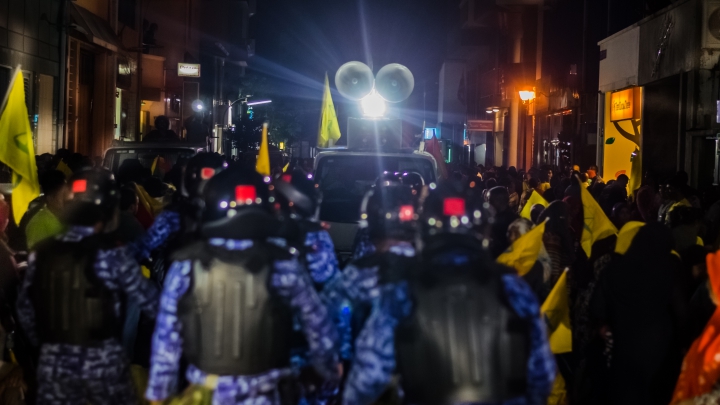
Police have announced they will break up protests which have not received authorisation in advance, in an apparent attempt to clamp down on daily demonstrations over the jailing of ex-president Mohamed Nasheed.

The opposition said its daily protests would continue, while decrying the move as a violation of the right to peaceful assembly guaranteed in the constitution. A member of the human rights commission also said the police plan was unconstitutional.

Police said last night that regular protests using “unusually loud” sound systems have been disrupting schools, businesses and are not in the public interest.

The opposition Maldivian Democratic Party (MDP) and allied parties have been holding daily protests throughout the country to demand the release of Nasheed, who was sentenced last month to 13 years in jail on terrorism charges. Protesters in the capital Malé have been marching through the streets every night, often through its main thoroughfare Majedhee Magu and through its narrow alleys.

Police said that demonstrators must apply for authorisation in advance for any “pre-planned” protests , as required by article 13 of the Freedom of Peaceful Assembly Act.

The act was passed in 2013 but police have not so far enforced the authorisation requirement, although hundreds of protesters have been arrested on other charges.

Police last night warned they will break up any unauthorized protests after one warning, and will confiscate loud sound systems.

The police announcement was deemed “unconstitutional” by Human Rights Commission member Ahmed Tholal.

Speaking to Minivan News today, Tholal said that freedom to assemble peacefully without permission from the state is a fundamental right granted by article 32 of the constitution.

“They [police] cannot withhold constitutional rights by referring to a provision in the [assembly] act. If there are problems with regards to the provisions in the act, they should address it without limiting constitutional rights,” said Tholal.

Police have arrested over 100 people at recent opposition protests. While some of them have been released without detention, several were barred by the criminal court from going to further protests for 60 days.

Elsewhere, the Ministry of Housing and Infrastructure wrote to the MDP on April 1 saying that the ministry would not be able to provide any plot of land for political activity because of the political situation in the country.

However, Minivan News understands that ruling Progressive Party of Maldives will be holding a rally at the artificial beach tonight (April 9).

MDP MP Eva Abdulla described the government actions as an attempt to “harass the opposition by attempting to obstruct peaceful assembly.”

“This is a coordinated attack by the government on our constitutionally stipulated rights to freedom of assembly and yet another example of how far this regime is willing to go in its harassment and persecution of the opposition,” Eva said.

“There is no longer any pretence of the government upholding our laws and our constitution,” she continued.

Minivan News was unable to obtain any comment from the Housing Ministry about the letter at the time of going to press.

Likes(5)Dislikes(0)

Power subsidy deadline extended amid public anger

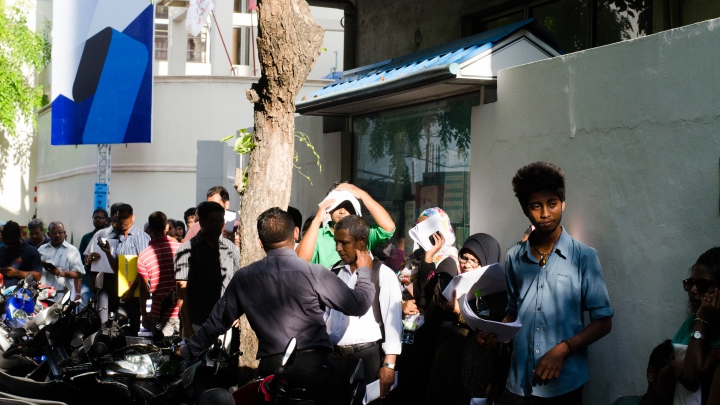
The government today extended a deadline for households to seek subsidies for electricity by a month as hundreds queued up for hours to submit forms.

Shops in Haa Dhaal Vaikaradhoo shut down today to join growing protests against the government’s decision to cut subsidies for businesses, and Gaaf Dhaal Gahdhoo council said it will now seek rent on lands leased to the state owned electricity company.

The government says the current blanket electricity subsidy benefits the affluent over the needy, and targeting subsidies will rein in expenditure and increase aid to the poor.

But many who queued up to submit forms today were unsure whether they would receive the subsidy as the government has not yet revealed the criteria for a successful application.

“I really don’t know if I will get subsidies. But I’m applying in the hope the government will be fair about it,” applicant Abdul Latheef said.

In an interview with Haveeru last week, the chief executive of the National Social Protection Agency, Mujthaba Jaleel, said that “everyone who applies for subsidy will get it.” But yesterday he said that “the criteria have not yet been set”.

Mujthaba was unavailable for comment today.

People in queues today complained of the extensive documentation required for the application, which includes rent contracts, wage details, and the number of household appliances that use power.

“This application form is a hazard. We have to get a lot of unnecessary documents. It would have been better if they set up an online system instead of making us wait in queues for hours, only to later reject my application,” Mohamed Yoosuf said as he waited in a queue.

The new deadline for form submission has been moved from April 9 to May 9, Ahmed Nihan, an MP for the ruling Progressive Party of the Maldives, said in a tweet.

However, the government has stood by its decision to cut subsidies for businesses, despite critics claiming the move would destroy small and medium-sized enterprises on rural islands. Some businesses say their bills have doubled or tripled.

After closing shops earlier this week, businesses in Haa Dhaal Kulhdhuffushi, Gaafu Dhaal Thinadhoo, and Addu City have set up committees to negotiate with the government.

Gahdhoo in Gaaf Dhaal asked state electricity company Fenaka to pay the council MVR 506,840 (US $39,585) for plots of land rented to the company.

“Fenaka has never cooperated with us. Once we got lights to put in the harbour area but Fenaka refused to give power. Then this issue has come up with subsidies. So we have also severed ties with them,” councilor Mohamed Shujau said.

Businesses in Vaikaradhoo are also preparing a petition after a one day shop shut down, while those on southern Fuvahmulah have already submitted a petition demanding a fair price for electricity.

Shop owners have also taken issue with the higher electricity prices in the atolls as compared to Malé City.

Electricity prices are up to 72 percent higher in northern Haa Alif , Haa Dhaal, and Shaviyani Atolls and up to 37 percent higher in Addu City and Fuvahmulaku than in Male’ City, according to figures from Fenaka.


Likes(4)Dislikes(0)

Permanent water crisis for Maldives islanders

Every January, councillors on the central Maldivian island of Baa Atoll Goidhoo switch on the island’s water desalination plant in preparation for the dry season.

In doing so, the council hopes to scrape through the blistering heat of the four-month-long northeastern monsoon without having to rely on others to provide its 700 inhabitants with clean water.

However, this year the council was not able to fire up the plant because of severe budget constraints and maintenance issues.

“The government is not giving us money to repair it. How can we fix and run the plant while we can’t afford its electricity bill?” asked council president Mohamed Amir.

“The households have now run out of water,” Amir said.

“Every dry season we have the same problem.”

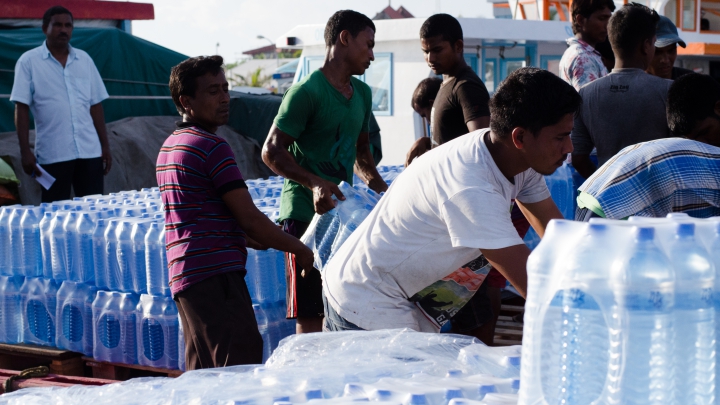
Amir had no choice but to notify the National Disaster Management Centre of severe water shortages, becoming one of over 69 islands to have reported droughts this year alone.

Since its inception in 2004 after the Indian Ocean tsunami, the centre has been providing water to about 80 of the Maldives’ 200 inhabited islands each dry season for the last ten years, says Hisaan Hassan, a spokesman for the centre.

The tsunami severely contaminated groundwater in several islands, forcing inhabitants to look up to the skies for rainwater instead.

When a fire in the capital, Malé, cut off water supplies last year, the crisis drew global media attention and prompted the public to ask how prepared the government is for an emergency water cutoff.

However, islanders who face the same problem every year remain hopeless, with no permanent solution in sight.

Environmental consultant and water expert Fathimath Saeedha says that the government needs to immediately come up with strategic, yet island-specific solutions.

Contaminated groundwater

Unlike in Malé, where the groundwater is heavily polluted due to over-consumption, islanders in atolls used to rely on groundwater for consumption.

However, thanks to a rapid population increase and the arrival of appliances such as washing machines, groundwater consumption in the islands has increased above the rate at which groundwater is naturally replenished, said the environment ministry.

In addition, the ministry points the finger towards the 2004 Indian Ocean tsunami, which heavily polluted many islands’ fresh water table, lying one to 1.5 meters below the soil surface. The tsunami killed at least 82 people in the Maldives and caused $470m of damage.

However, a United Nations Environmental Programme tsunami impact study in 2005 estimated that only 39 islands’ groundwater had been suitable for drinking even before the tsunami.

Water expert Saeedha also pointed out that poorly constructed septic tanks in the islands have contributed to water contamination.

“People built septic tanks on their own, which led to domestic waste leaking into the water table,” said Saeedha.

With the groundwater contaminated, inhabitants then had to rely on rainwater for consumption. In 2005, the government provided islands with large numbers of storage tanks to store rainwater.

However, with low average rainfall during the dry season, numerous islands are left in a drought every year, forced to rely on the disaster centre for drinking water.

Ready for droughts

Umar Fikry, another spokesman for the disaster centre, says that it has urged all island councils to inform the centre of water shortages in advance.

“We are prepared and ready for the water shortages every year,” Umar said.

He says that islands usually report water shortages to the centre when they are down to one month’s supply.

However, the National Disaster Management Centre is among those questioning whether the centre should be called upon to deal with shortages every year.

“We spend an average of MVR 5 million (US$ 330,000) on delivering water to the islands [each year]. The problem cannot be solved by the disaster centre alone,” said the centre’s Hisan Hassan.

Hisan believes it is time for everyone from the environment ministry to island councils and the general public to get involved in looking for a permanent solution.

Individuals have to keep in mind this happens every year and focus on better water usage, while councils should work on getting better storage systems in place for the dry season, said Hisaan.

The Environment Ministry meanwhile is running a water programme aiming to create an integrated network of island water storage containers in 30 strategic locations.

Three of the island storage locations have been completed, while seven are undergoing construction. Furthermore the ministry has secured finance to build 14 new desalination plants, it said.

Unsuitable emergency plans

With the disaster centre called upon to provide large quantities of water, some islands have criticised the quality of the water that arrives.

“People did not use the water because there was a pungent smell in it. We should be provided with good quality water,” complained Baa Atoll Dharavandhoo council president Hussein Nazim.

Dharavandhoo is home to one of the busiest regional airports in the country, bringing in tourists from the capital to the atoll’s eight resorts.

Nazim said that he was told that the water arrived from nearby Dhuvaafaru in the storage area of a fishing boat.

Some islanders had to resort to pumping water from households lucky enough to have clean well water, he added.

A resident of nearby Goidhoo said that it is “immensely difficult” to fulfill essential water needs during the dry season.

“Every house has a water tank which runs out during the dry season. Now we have to go to the water plant on the beach through the boiling sun,” she complained.

Tailor made solutions”

Water expert Faathimath Saeedha says there is no one overall solution to the annual water crisis, with different areas instead needing a “tailor-made solution”.

“Every island has very specific needs which need to be addressed,” she said. “Then only can we reach a permanent solution.”

It is important for the government to come up with a strategic plan to address the root cause of the issues for each island, she said.

Back in Goidhoo, council president Amir has been able to fire up the desalination plant with a “temporary fix which will last the current dry season”.

He believes that the situation will repeat itself again next year, with the councillors forced to resort to the barely functioning water plant, hoping for the best.

Likes(4)Dislikes(1)

Home ministry to create replica of ancient island village

The home ministry is planning to create a replica of an ancient island village on the eastern side of Malé to mark the upcoming golden jubilee of independence from the British.

Various cultural activities as well as arts and handicraft will be presented to the public during a three-day event. The home ministry has not announced a date for the exhibition.

Deputy home minister Abdulla Mohamed told the press today that small thatch houses, swings, and huts made of coconut palm trunks, will be built in the area stretching from Usfasgandu to the carnival area.

Small boats will be docked at the artificial beach while 20 halls will be set up for the 20 atolls of the Maldives to showcase the country’s history and culture.

The Maldives gained independence from the British on July 26, 1965.

The ‘Minivan 50’ office (Independence 50) set up to plan and oversee celebratory activities also plans to hold cultural events across the country.

A team of judges from the ministry will select the best presentation, after which it will be featured at the event in the capital.

Other activities to mark the golden jubilee include a skydiving event and a sea sports festival.


Likes(2)Dislikes(0)

Government promises jobs to Maldivians in new Thilafushi port

The government has assured jobs to Maldivians in a new commercial port to be built by a Emirati company on Thilafushi island.

MP of the ruling Progressive Party of the Maldives, Ahmed Nihan, said the chairman of Dubai Ports (DP) World has said Maldivians would be involved in the management of the port.

The Dubai-based marine terminal operator signed a Memorandum of Understanding with the Maldivian government last month to develop a port at Thilafushi as a free trade zone.

“He said Maldivians would also be sent to countries like Dubai, Hong Kong, and Korea for training. This would be a great encouragement for Maldivians to develop our human resources,” the majority leader of parliament was quoted as saying.

The relocation and development of the central port would not harm the domestic economy, he added.

DP World Chairman Sultan Ahmed Bin Sulayem met MPs of the Progressive Party of Maldives yesterday during an unofficial visit to the Maldives.

Tourism Minister Ahmed Adeeb and Economic Development Minister Mohamed Saeed also participated in the meeting. The former is the chairman of the government’s Special Economic Zones’ investment board.

According to the local daily, Sulayem also expressed interest in investing in other ‘mega projects’ announced by the government such as the ‘I-Havan’ transhipment port in the northernmost atoll.

“The Maldives has been growing rapidly, driven largely by its tourism development. We are working with them to help diversify the economy through building infrastructure, logistics and transport links needed to make this happen,” Sulayem said in a press statement last month.

“The UAE has much experience and expertise in this area thanks to the vision of our leaders to explore new growth strategies. We are proud to share our expertise with the Maldives as they develop their capabilities in the global supply chain industry.”

Adeeb told local media last month that DP World has agreed to complete the project within two years of signing a joint venture agreement with the Maldives Ports Limited.

A timeline for the project has been agreed upon and the MoU was signed with a view to signing the joint venture agreement in a month, he said.

Likes(1)Dislikes(0)

Jailed ex-minister Nazim to travel abroad for treatment

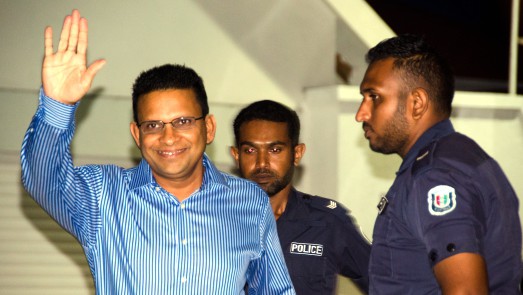
Jailed former defense minister Mohamed Nazim has been authorised to travel overseas for medical treatment for a potentially life threatening condition.

He will be allowed to leave the country for a set period of time, a media official from the Maldives Correctional Service said.

However, the jailed politician’s family said they had not yet been told about his permission to leave.

“The family has not been officially informed of the [authorisation] to leave the country. We are working on it,” said Adam Azim, Nazim’s brother.

The family declined to reveal details of Nazim’s medical condition, but said it needs to be monitored and treated.

“We are very concerned. But the government doesn’t seem to feel any urgency at all,” he said.

Nazim was arrested and fired from the cabinet in January after police found a gun during a controversial raid on his home, and in March was handed an 11-year jail sentence for smuggling illegal weapons.

After the midnight police raid in January, officers said they had confiscated a pistol, bullets and a pen drive containing information that Nazim was plotting a coup d’etat and planning to harm the president, police commissioner and tourism minister.

Nazim says the items were planted, and the opposition has been campaigning for his release.

He requested permission to travel overseas three weeks ago after his doctor advised him to undergo some tests unavailable in the Maldives.

Nazim’s lawyers are meanwhile compiling their appeal against his sentence.

“Lawyers are working on the appeal round the clock, listening to recordings, and hoping to file by Thursday or Sunday,” said Azim.

The correctional service said Nazim’s family would need to notify them of which country he plans to travel to so that they can check it is a country approved for Maldivian prisoner visits.

No prison guards will travel with him, but the correctional service and a guardian from the family will come to an agreement under which the guardian will be responsible for the inmate.

The spokesman said that inmates are usually allotted three months for overseas treatment, but that the medical board can extend the period if treatment is taking longer.

Nazim’s family had a monthly visit with him on Monday at Humafushi jail for two hours and reported he was in “high spirits”.

Likes(4)Dislikes(0)

President seeks changes to law barring Nasheed from MDP

President Abdulla Yameen has vetoed changes to the prison and parole law that would have stripped ex-president Mohamed Nasheed of his membership and leadership position in the opposition Maldivian Democratic Party (MDP).

However, the changes are expected to pass through parliament in an adjusted form that would still bar Nasheed from leading the MDP.

President Yameen reportedly advised parliament to adjust the planned changes so that convicts can remain members of political parties and associations, but did not recommend removing a clause barring them from leadership posts.

Critics of the government believe that clause is aimed specifically at Nasheed, who was jailed last month for 13 years on terrorism charges.

The president returned the bill to parliament for reconsideration yesterday and recommended revisions in light of issues raised by the attorney general, the President’s Office said.

Government-sponsored amendments to the Prisons and Parole Act had been passed on March 30 with 42 ruling coalition MPs voting in favour.

Nasheed was found guilty of terrorism last month over the detention of the criminal court chief judge in January 2012 and jailed for 13 years. The MDP contends that the charges were politically motivated, while the trial was widely criticised by the international community for its apparent lack of due process.

President’s Office spokesperson Ibrahim Muaz Ali and Majority Leader Ahmed Nihan were not responding to requests for comment at the time of publication.

Muaz told online news outlet CNM yesterday that the bill was unclear as to whether inmates could remain members of political parties, because of the ambiguous phrasing of the clause.

Muaz said the president believes the clause conflicts with the constitutional right to establish and participate in political parties.

Stripping convicts of political party membership would pose challenges to the Elections Commission in processing membership forms and maintaining registries of political parties, Muaz said.

President Yameen suggested rephrasing the clause to allow convicts to remain members of political parties and private associations, said Muaz, and to exempt detainees who have not been convicted of a crime.

Muaz noted that according to the constitution, fundamental rights and freedoms can only be limited to any extent “only if demonstrably justified in a free and democratic society”.

Speaking at a rally last week, MDP Chairperson Ali Waheed claimed Attorney General Mohamed Anil had advised parliament that the amendment was unconstitutional.

The chairman of the committee that was reviewing the legislation – ruling Progressive Party of Maldives MP Ibrahim Riza – kept the attorney general’s letter secret from other MPs, Waheed alleged.

Waheed declared that Nasheed remains the party’s leader and its presidential candidate for elections scheduled in 2018.

Voting on the bill meanwhile took place while MDP MPs were protesting inside the parliament chamber.

MDP MP Eva Abdulla told Minivan News at the time that the party would not accept the government using the People’s Majlis as “an extension of its tyranny to strip us of our democratic rights.”

“No amount of backtracking can strip him of the fact he formed the first political party in the country and became its first democratically elected leader. Or the fact that those who vote for this amendment today would not be in a political party if not for the hard work of this man to win them that freedom,” she said.

Likes(3)Dislikes(0)

Amal Clooney and other heavyweights to represent jailed ex President Nasheed

Jailed opposition leader Mohamed Nasheed has unveiled an international legal team including heavyweight human rights lawyers such as Amal Clooney.

Clooney, who has advised the UN and is the wife of Hollywood actor George Clooney, is accompanied by Jared Genser, the founder of the renowned campaign group for political prisoners Freedom Now, and Ben Emmerson, former UN rights chief on counter-terrorism and human rights.

Nasheed was sentenced to 13 years in jail last month on terrorism charges in a trial heavily criticised by observers including the UN and Amnesty International for its apparent lack of due process.

The former president hopes to increase international pressure on President Abdulla Yameen, who has so far remained silent in the face of the opposition’s daily protests, and calls for dialogue and a presidential pardon.

“I am very pleased to have such an extraordinary team agree to take up my legal defence internationally,” he said in a statement today.

Nasheed said he is determined to “ensure the world understands the injustice of my detention and the broader suffering of the Maldivian people under President Abdulla Yameen.”

President Yameen maintains he has no role in the trial, but called on the international community to respect the Criminal Court’s verdict.

The international team will push for Nasheed’s “freedom from arbitrary detention” through international lobbying and legal mechanisms such as the UN working group on arbitrary detention, the former president’s domestic legal team says.

The working group’s decision on Nasheed’s detention will affect the international community’s policy towards the Maldives, and would inform decisions on possible sanctions, they added.

Genser has represented Nobel Peace Prize laureates Aung San Suu Kyi and Liu Xiaobo, while Clooney has counseled political prisoners such as the former Prime Minister of Ukraine, Yulia Tymoshenko and Al Jazeera journalist Mohamed Fahmy.

Emmerson, meanwhile, is currently the British judge on international tribunals on Rwanda and the former Yugoslavia.

Nasheed on March 19 announced he would not seek an appeal after the Criminal Court failed to release required case documents on time, and said he is now seeking a political solution involving president Yameen.

The High Court still says Nasheed can appeal, claiming judges are authorized to accept late appeals if a “reasonable justification” is given, but Nasheed’s lawyers say Supreme Court has taken away the discretionary powers to judges in a new ruling in January.

Nasheed’s Maldivian Democratic Party describes Nasheed’s conviction as part of a broader government plan to silence dissent, a claim Yameen denies.

Since Nasheed’s conviction, former defence minister Mohamed Nazim has been sentenced to 13 years in jail on smuggling weapons and ruling party MP Ahmed Nazim was yesterday sentenced to 25 years in prison on corruption charges.

Likes(2)Dislikes(0)

Government proposes $5m resort lease extensions

The government is seeking legal changes to allow the extension of resort leases to 99 years for a lump sum of US $5m, and to expand the powers of the tourism ministry.

The lease extension scheme, which would represent the first time they have been lengthened beyond 50 years, aims to raise money for the government.

The bill submitted by government-aligned MP Mohamed Ismail would also transfer to the tourism ministry the power to authorise developments at resorts and conduct environmental assessments.

The changes aim to incentivise investors, make it easier to obtain financing from international institutions, and increase revenue for the government, the proposed law states.

To be eligible for a lease extension, a resort property must be operational with an existing lease period of 50 years and must not owe money to the government.

If the amendments pass, resorts will have to seek authorisation from the tourism ministry for any development on a resort that could “permanently alter” the island, plot of land, or lagoon’s environment. The ministry must compile an environmental impact assessment before issuing permission.

“Making the services available under one roof would ease the burden on investors, speed up services, and improve investor confidence,” the introduction to the legislation says.

Under existing laws, the Environment Protection Agency conducts assessments and authorises projects such as land reclamation. The agency functions under the environment ministry.

However, the new amendments state that “only the tourism ministry will have the authority” to conduct assessments and authorise developments.

The tourism ministry will also have the power to impose fines not exceeding US$5 million for violations.

The introduction says that the involvement of other ministries and institutions in resorts hinders the tourism ministry and “lowers investor confidence”.

“Flip-flopping”

Under the current Tourism Act, the maximum lease period for resorts or hotels is 50 years. However, the constitution allows leases up to 99 years.

Former Economic Development Minister Mahmoud Razee told Minivan News today that from “a commercial investment point of view it’s a good move,” but questioned the government’s “sincerity”.

“Because when they were in opposition they made a big hoohaa about it,” he said, with reference to current ruling party MPs protesting against the then-Maldivian Democratic Party (MDP) government’s plans to extend resort leases from 25 to 50 years.

The move shows the government is trying to make up revenue shortfalls, said Razee, who was part of the MDP government. He said the current administration was “not curtailing expenses” but increasing the number of political appointees.

This year’s record MVR24.3 billion (US$1.5 billion) state budget includes MVR3.4 billion (US$220 million) anticipated from new revenue raising measures.

The measures include revisions of import duty rates, the introduction of a “green tax”, acquisition fees from investments in special economic zones, and leasing 10 islands for resort development.

Razee also suggested that the administration might allow resorts to pay the extension fee in instalments if the tourism industry lobbies the government.

When the MDP government offered extension of leases for 50 years in exchange for an upfront fee, Razee said resort owners were “not so eager” and “relatively few” paid the fees.

In January 2014, Maldives Association of Tourism Industry secretary general Ahmed Nazeer questioned the practicality of collecting resort lease extensions in a lump sum.

Nazeer told a parliamentary committee reviewing revenue raising measures that only 17 out of the more than 100 resorts had paid lease extension fees upfront.

Razee meanwhile criticised the government’s “flip-flopping” on economic policy, referring to its reversal of a decision to impose higher import duties on garments and motorcycles.

He noted that customs authorities are promising to reimburse importers who are paying the higher tariffs that came into force on April 1, even before amendments reversing the hikes have been passed.

In December, the government also reversed a decision to impose a 10 percent import duty on staple foodstuff such as rice, flour, wheat and sugar.

“There’s no clear-cut, defined, long-term policy,” Razee said.

Likes(3)Dislikes(0)