EC schedules presidential elections for September 7, but warns of funding shortfall

President of the Elections Commission (EC) Fuad Thaufeeq has said the commission will be unable to hold a presidential election this year without sufficient funding.

Speaking to Minivan News, Thaufeeq said holding the nationwide elections would cost between MVR 55-60 million (US$3.57-3.89 million). However, he expressed concern that the commission’s current budget would be insufficient.

“With the current budget given to the Elections Commission, I am afraid we may not be able to hold the elections. The commission has raised concerns with the Finance Minister, the President’s Office and Parliament’s Public Finance Committee,” he said.

According to the EC president, Finance Minister Abdulla Jihad told the commission to carry out its work with the current budget allocated, claiming that the government would “somehow find a way” to provide financial support to the commission.

However, the commission is yet to receive any additional funds, Thaufeeq added.

“The constitution is very clear. It is a constitutional duty to hold presidential elections every five years. I really do hope the authorities would somehow be able to support us in fulfilling this constitutional duty,” he said.

Thaufeeq confirmed reports circulating in local media that presidential elections would be held on September 7, and that preparations were under-way under finance provided from within the currently available budget. If required, a second round of elections will be held on September 28.

“ The decision to hold presidential elections in September was agreed by the members of the commission,” he said.

Asked if budget difficulties threatened the fairness of the election, Thaufeeq acknowledged a shortfall may “slightly have an impact”, but said the commission would do everything it could to ensure the elections were free and fair.

“We have set standards and procedures. We will go in accordance with those. But yes, the budget difficulties may slightly impact the elections. But we assure the public that we will do everything we can to ensure that elections are free and fair,” he said.

“Fully committed”, tweets President Waheed

Following his meeting with UK Parliamentary Under-Secretary of State Alistar Burt, President Mohamed Waheed Hassan announced his commitment towards a free and fair election on Twitter.

In his tweet he called upon the elections commission to “declare the election date as soon as possible”.

“I am fully committed to a free and fair election this year. Urge the Election Commission to declare the election date ASAP,” Waheed tweeted.

Asked about Thaufeeq’s concerns, Finance Minister Abdulla Jihad told Minivan News that the government was “working on it”.

“We will provide sufficient funds to hold elections. There is no question about it,” he said.

In April 2012, the US government pledged to provide  US$500,000 (Rf7.7 million) as assistance for an elections program intended to support Maldivian institutions in ensuring a free and fair presidential election.

Chargé d’Affaires of the US Embassy in Colombo, Valerie Fowler, said at the time that the funding would be made available from July 2012.

The US would lend any support, including technical assistance, to ensure the next presidential election in the Maldives is conducted “smoothly and observed the rule of law”, Fowler said.

“Through USAID we are in the process of starting an election program that will assist Maldivian institutions in ensuring a free and fair presidential election. We have allocated US$500,000 to start that process and anticipate that we can begin as soon as July 2012,” she noted at the time.

Asked about the US assistance program, Thaufeeq said that he had only heard of it through the media, and that no government authority had discussed it with the commission.

President’s Office Spokesperson Masood Imad was not responding to call at time of press.

Likes(0)Dislikes(0)

MDP election victory New Delhi’s only hope: Eurasia Review

New Delhi’s policies on the Maldives continue to display elements of infantilism, writes Dr Bibhu Prasad Routray for the Eurasia Review.

“A series of blunders since the past one year pose the real danger of alienating Maldives for good.

Waheed’s ready acceptance by New Delhi vide a swift recognition extended by the Prime Minister’s Office had much to do with the ‘pro-India’ certificate he received from then Indian High Commissioner Dnyaneshwar Mulay.

Mulay wrote to the MEA that Waheed’s pro-India stand “is not in question” since he “has not missed a single function in the India House”. Ironically, the same Mulay, within months, came under attack from the Maldives government for his advocacy role supporting GMR.

If Mulay’s assessment of the nature of the Waheed regime was all wrong, Delhi has not fared any better since his departure. All its actions ever since it refused to protect the interests of a private company, GMR, (although the MEA in its country brief on Maldives continues to flag GMR’s taking over of the Male Airport in 2010), resemble a crying baby syndrome, not that of a nation that wants to deepen its engagements with its neighbourhood.

New Delhi’s reactions in the past couple of months have included: freezing major aid promised to the country in the recent past, toughening visa regulations allowing only limited number of visas to the Maldivians seeking medical treatment in India, refusing the Maldives Foreign Minister to set up a meeting with the Indian Foreign Minister, and doing away with the special privileges accorded to the Maldivian vessels visiting Indian ports.

In the second week of January, the Indian High Commission went a step further to issue an 11-point list of grievances to the Maldives media. The HC accused the Maldives government of withholding the passports and restricting the travel of Indian nationals, refusing to renew visas in a timely fashion, exploiting Indian workers, and failing to investigate threat calls to Indian diplomats. In response, Maldives has tried playing the China card.

Active engagement and not argumentative detachment needs to be India’s policy in Maldives. Former President Nasheed, who has consistently remained pro-India in spite of New Delhi’s indifference, has called for a caretaker government to oversee the Presidential polls due in the next three to six months. An election under the present regime, he justifiably fears, could be unfair and to his disadvantage. New Delhi must ensure that the polls are fair and not rigged.

Electoral victory for the pro-India Maldivian Democratic Party remains New Delhi’s only hope. Any other scenario would further push New Delhi’s already sinking influence in that county to the point of oblivion. And the Chinese would not miss the chance.

Full story

Likes(0)Dislikes(0)

No “definitive answer” from US delegation over government’s failure to act on CoNI recommendations: MDP

The US delegation who visited the Maldives last week gave no “definitive answer” to political issues raised by former President Mohamed Nasheed, the party has said.

The delegation, consisting of Deputy Assistant Secretary of State James Moore, Deputy Assistant Secretary of Defense Vikram Singh and Deputy Assistant Secretary of State Jane Zimmerman, met with the former president on Thursday (January 31).

According to local media, Nasheed informed the delegates that the present government had failed to act upon the recommendations made in the Commission of National Inquiry (CoNI) report, claiming there had been a “lack of effort” to reform the judiciary.

However, MDP Spokesman Hamid Abdul Ghafoor said the US delegation were unable to answer the issues raised by Nasheed, and that their interest was focused on the implementation of free and fair elections later this year.

“The issue was a difficult question for them and we could not get a straight answer. Their purpose was to highlight the importance of implementing free and fair elections over here, but we wanted to find out how aligned they were with other issues,” Ghafoor added.

According to local media, the US delegation was set to meet various political parties and senior government officials to discuss the current political situation in the Maldives.

Issues including labour laws and the protection of worker’s rights were also a topic of discussion between Nasheed and the delegates, local media reported.

James R Moore is a Deputy Assistant Secretary of State in the Bureau of South and Central Asian Affairs since September 2010, and previously the Deputy Chief of Mission of the US Embassy in Colombo from 2006 to 2009.

Jane B Zimmerman is a Deputy Assistant Secretary of State in the Bureau of Democracy, Human Rights, and Labor, responsible for South and Central Asia, the Western Hemisphere, and International Religious Freedom.

Vikram J Singh is Deputy Assistant Secretary of Defence for South and Southeast Asia within the Office of the Assistant Secretary of Defence for Asian and Pacific Security Affairs.

Singh also serves as the principal adviser to senior leadership within the Department of Defence for all policy matters pertaining to development and implementation of defence strategies and plans for the region.

Likes(0)Dislikes(0)

Kun’burudhoo development hampered by bureaucracy, insufficient budget

The council of the island of Kun’burudhoo in Alif Dhaal Atoll is struggling to meet its mandate of bringing development to its population of just over 500 people, a problem they say is increased due to insufficient annual budget.

The Council President Mohamed Azmy, who was voted in as an independent candidate, echoed the concerns of atoll councils and the Local Government Authority(LGA) that the biggest challenge faced by the council was the lack of adequate funding.

“Last year’s budget covered nothing more than salaries and some stationery for the office. And this year, we have received an even lower budget,” Azmy said. “To add to this, the Decentralisation Act overlaps with other stronger laws and this in the end inhibits us from fundraising through other means.”

Azmy said the Ministry of Finance had notified island councils in late 2012 that any earnings of the councils are to be considered part of the state budget and must be deposited with the Maldives Inland Revenue Authority (MIRA).

Council Member Ahmed Ashraf, from the Maldivian Democratic Party (MDP), added that the past year’s budget had proved insufficient to maintain the office’s phone and fax lines, or to establish a work space for any of the council members besides the President.

“This is our work space,” Ashraf said, gesturing at a ‘joali’, a set of reclining seats, placed outside the office. “It’s impossible to work productively in conditions such as these. There is so much we are mandated to do for our island, but how will we achieve it unless the state can provide us with resources or at least the autonomy to raise funds ourselves?”

The councillors stated that despite a period of almost three years having passed since the local council elections, the LGA had still not transferred the government-owned lands, which can be used to generate income, to the jurisdiction of the council, citing administrative delays as a cause.

Relocation: President suggests Hulhumale’

President Mohamed Waheed Hassan pledged to address the major concerns of the council during a meeting held January 9.

Speaking of the small size of the island, and the ensuing lack of natural resources and difficulty in providing basic services, Waheed suggested relocating of the island’s population.

Vice President of the Council Mohamed Adam stated that the people of Kun’burudhoo had some demands if they were to be relocated, and that they would only accept the idea on condition that they were moved to a more developed island with a better standard of living.

“We haven’t released any land to individuals in over 30 years. Now there are large families sharing homes here and living standards are decreasing day by day,” Adam said, also pointing out the less than adequate health and education facilities.

The council said Waheed spoke of possibly moving the island’s people to Hulhumale’ during the second phase of its development or to the island of Maafushi, another island close to the capital city of Male’.

President’s Office Spokesperson Ahmed Thaufeeq denied that any mention of specific islands had been made during the time.

“Relocating smaller populations to larger islands is part of this government’s plan. However, we have not yet identified specifically which island will be relocated where. Moving people to Hulhumale’ is definitely not in our plans yet. I have no knowledge of any such plans,” he said.

Adam said that the council was aware that Waheed, as he had promised in the meeting, had approached the Health Ministry asking them to deal with the issues at the island’s health centre.

“It’s a level two health centre. Normally, centres at this tier have approximately 15 staff. In our case, we only have one doctor, one nurse, one community health officer, one administrative staff and one labourer. It’s extremely difficult to cater to people’s needs,” Azmy said. “We hope the health ministry responds to this in a timely manner.”

“There’s also the matter of our mosque. We closed it down last August when we discovered human remains on the premises. Now the ladies’ mosque is open for general use, but this cannot remain a permanent solution. We did put this matter forward to Waheed too,” Azmy continued.

The final issue the council took to the President was the matter of erosion and the damaged revetments of the recently constructed jetty.

The Maldives Transport and Contracting Company (MTCC) constructed the jetty in 2009 during Nasheed’s administration.

“This island has been facing the problem of erosion for years. When Nasheed came to power, he kept his pledge and constructed this jetty for us. Now, the jetty is showing signs of wear and tear. We are speaking with the government to find a way to deal with this before matters worsen, but there’s a confusion as to who has to take responsibility,” Azmy said.

Adam said according to the government, the MTCC had not officially handed over the jetty to the government to date.

“If we try to repair this ourselves, it might end up as us acting illegally. Unless this jetty is officially handed over, we ourselves can do nothing about it,” Adam said.

Thaufeeq said that the matter was currently being discussed with MTCC. He stated that the government was working to solve the issue as soon as possible.

“Of the four issues discussed at the meeting, the only action we’ve seen so far from the government is the letter sent to the Health Ministry. There’s been no news on anything else, but I hope what was said at the meeting does translate into action soon,” Adam said.

Waste dumped into sea

“Land erosion has always been a huge problem on this island. After the jetty was built, the erosion is now occurring on the eastern side of the island, opposite from where we had the problem before,” Ashraf said.

Besides soil erosion, the second biggest issue was pollution of the seas. The island does not have any waste management system.

“We leave waste management up to the households. There is a designated area where households burn their waste, but food items and other such waste often just get dumped into the sea,” Adam said.

“I understand that the environment is a very fragile thing. Nevertheless, I don’t see how we can ask the people to not dispose of their waste in the sea unless we can show them alternative means.”

Azmy said plans had been set in place to build a garbage site on the island during the previous administration, but that the council had heard no news about the project after the change in government.

Meanwhile, a number of large dustbins have been placed along the road adjacent to the jetty, bearing the logo of Conrad Maldives Rangali Island.

“Conrad donated those dustbins. The people are only allowed to throw waste like tins, bottles and packets into it. We at the council arrange its disposal. It’s strictly not for household waste,” Ashraf explained.

“Waste management is a massive problem which our government needs to deal with. The Environment Ministry is drafting up a plan to deal with the issue. There are currently mechanisms being put in place to manage waste in Male’, and we will do the same for big and small islands across the country in time,” Thaufeeg said, in response to the matter.

Likes(0)Dislikes(0)

Local media “misrepresenting and twisting issues”: Indian High Commission

The Indian High Commission has issued a statement slamming local media in the Maldives for “misrepresentation and twisting of issues”.

“The High Commission has noted a recent trend in a section of local media to publish negative, unsubstantiated reports, while blacking out objective and positive news on Indian issues,” the Commission said.

“These reports have the potential to create negative public sentiment and reflect a non-serious approach by the media concerned while dealing with sensitive issues,” the statement added.

The statement highlighted several recent examples, such as coverage of the Maldivian national Ahmed Ruffan Ali, who was reported as alleging he had been “tortured” in an Indian jail after being detained for illegally smuggling peacock feathers.

“The High Commission facilitated major help and assistance for the release of the youth while in distress in India,” the statement read.

“While prominently covering the unsubstantiated and motivated statement of the sentenced youth, the media concerned did not verify the facts from the High Commission and chose to overlook the statement of the youth. His subsequent rejoinder that he was not ‘tortured’ in India has not been carried by the media, so far.”

In a rejoinder statement forwarded by the High Commission, Rufwaan expresses “deep regret” that in an article on Sun Online, “using the word ‘tortured’ is a misrepresentation made in translation of the original statement I made on January 26, speaking to the media at Ibrahim Nasir International Airport (INIA), upon arrival from India.”

Rufwaan said he had been asked by reporters as to whether he was beaten in custody, to which he “regretfully responded, “It is a jail after all, and we will get beaten. Yes I was beaten. The rules of the officers there is that, once jailed we have to beg for mercy at their feet. I refused to do that, which is why I got the beating.”

However, Rufwaan stated, “Using the word ‘torture’ insinuates that I was exposed to extreme violent treatment which was not the case. It is also the ‘cultural’ language barrier that the Dhivehi language consists of limited vocabulary which when translated to English, can fit to a variety of synonyms.

“Also, the lack of literary expertise in linguistics of the journalists can often provide misleading information and I believe this could have caused this mistake. The concerned media has taken it very lightly and when requested to correct it, responded as ‘I’ll give it a thought’,” he added.

“Hence I kindly apologise to all concerned authorities for the unfortunate choice of word used in the article, which in my understanding, creates a far more negative and graphic image of how I intended to express,” he said, expressing “profound appreciation” for the High Commission’s “constant support and assistance” throughout his detention.

Editor of Sun and head of the Maldives Journalists Association, Ahmed ‘Hiriga’ Zahir, told Minivan News that the specific word Rufwaan had used, “aniyaa”, translated to “torture”, according to Sun’s audio recordings.

“We [later] received a call, not from him, but from somebody on his behalf,” said Hiriga, acknowledging that media had a responsibility to issue a clarification or correction if this was later required. “We will be making the correction. We do not want to create any problems.”

In a second example, the High Commission highlighted a report in a daily newspaper titled “India to stop export of sand, rice to Maldives”.

“The report is grossly unsubstantiated and does not provide any credible source of its information. As far as the High Commission is aware, the government of India has taken no such decision to ban export of rice or river sand to Maldives. There is a local court injunction for the export of river sand from Tuticorin, though the importers are free to source it from any other region/state in India,” the Indian High Commission stated.

Sun Online carried a story today that the State Trading Organisation (STO) had decided to import aggregate from Bangladesh and Sri Lanka “following a temporary suspension of export of aggregate from India.”

“The Maldives has been importing aggregate from India under a special quota extended by the Indian government. The Indian Ministry of Commerce has notified Indian suppliers that the aggregate quota has been temporarily suspended from the 15th of January onwards,” Sun reported.

Likes(0)Dislikes(0)

Opposition condemns “arbitrary arrest” of 15 protesters during anti-government demonstration

Police on Friday have arrested 15 Maldivian Democratic Party (MDP) activists at the party’s protest site ‘Usfasgandu’, during an anti-government demonstration.

Police said the demonstrators were arrested on charges of “breaking the police barricades” and “obstructing police duty”.

The police had previously cordoned off the party’s protest site  after the High Court ordered police to repossess the area until it delivered a verdict in an ownership dispute between Male’ City Council (MCC) and the Housing Ministry.

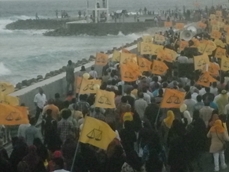
Over a thousand MDP demonstrators took to the streets of Male’ on Friday, calling for President Mohamed Waheed Hassan to immediately step down along with other government figures including Defense Minister Mohamed Nazim and Commissioner of Police Abdulla Riyaz.

The demonstration was led by senior figures of the party including former Chairperson MP Mariya Ahmed Didi and several ministers of the former government, who repeated the call for a caretaker-administration prior to scheduled presidential elections on September 9.

“The Maldives Police Service on strictest terms condemn the act of obstruction of police duty while this service was executing the order of High Court to cordon off the area,” read the police statement. Police said that out of the 15 arrested, two had been female protesters.

Speaking to Minivan News, police media official sub-Inspector Hassan Haneef said police had only arrested protesters who broke through police lines.

“We only arrested the people who broke the police line and entered the area. We did not target any political figures nor did we see which party the arrested individuals belonged to,” he said.

The arrested demonstrators were presented to court this afternoon, which extended the detention period of the protesters by five days.

Minivan News understands that among those currently in police custody include Male’ City Councilor Mohamed Falah and MDP Youth Wing President Aminath Shauna.

A protester who was present at the time disputed police allegations that demonstrators broke through police lines.

“We were just standing behind the barricades when they came in, we didn’t even move or run. We just stayed there, we didn’t even call them ‘baaghee’ (traitor) but we kept on telling them they should give a proper reason for arresting a person, they just can’t take people for no reason,” the protester told Minivan News.

Demonstrators kept questioning the police as to why they were making the arrests when none of them had crossed the police line.

“We kept on asking what the [the arrested protesters] had done. After taking in a few protesters, they came towards us and took Shauna. They came towards her and said she had to come with them whether she liked it or not. Two to three of us were holding her when they took her,” she added.

Meanwhile, the MDP in a statement called for immediate release of its members claiming the activists were arrested for their “illustrious work to defend freedom of assembly and freedom of expression” in the country.

“The MDP condemns in the strongest terms the police swoop into the rally as a politically motivated and premeditated illegal incursion to arrest a specific target list of highly dedicated party workers.

“Eyewitness reports have established that today’s foray also was characterised by high-handedness and needless force typical to the Police Special Operations squads in the clutches of a usurper police commissioner and usurper government,” read the statement.

The party also condemned “false reporting” of the incident by some local media outlets, who claimed that protesters “had breached police lines”, which the party alleged were “outright lies”.

Speaking to Minivan News, MDP Spokesperson MP Imthiyaz Fahmy suggested the arrests were a result of lack of a mechanism to hold the police officers accountable for arbitrary arrests.

“There is absolutely no way to hold the police accountable,” he said. “They know that everything will be settled once they take the protester to court. The Human Rights Commission of Maldives (HRCM) and the Police Integrity Commission (PIC)’s failure to hold the officers accountable means they can take full advantage of their impunity.”

Fahmy also dismissed claims made by police that those arrested had broken police lines.

“While I was there a group of police barged into the protest and randomly arrested a few people after looking at their faces. We did not break the police line. That is an outright lie,” he added.

If police can be held accountable for their actions, Fahmy said such arrests would not take place and freedom to carry out peaceful political activities would not be compromised.

After weeks of quiet in Male’, the MDP resumed their protests against the government on January 22,  led by former President Mohamed Nasheed.

Nasheed during the demonstration called on parliament to create an interim, caretaker administration “which can lead the country towards a genuinely free and fair presidential election in which all candidates are able to freely compete.”

MDP Spokesperson MP Hamid Abdul Ghafoor told Minivan News at the time that the party planned to hold more assemblies and protests in next coming months around Male’.

“The MDP have been off the streets some time, we have taken a break. Now we are back. We have too many options and ideas opening up and people need to know what’s going on,” Ghafoor said.

Likes(0)Dislikes(0)

Corrupt immigration practices, unregulated agencies fueling migrant worker abuse

Corrupt immigration practices and the use of unregulated employment agencies by private and state employers are limiting efforts to curb abuse of migrant workers and prevent illegal practices such as retaining staff passports, a Maldivian trade union has alleged.

The Tourism Employees Association of Maldives (TEAM) has claimed that while companies are not permitted to retain the passports of foreign workers, some hospitality operators – as well as unregulated third party agencies and government ministries – are still keeping employee travel documents without consent.

The comments were made as a source with knowledge of the current immigration system told Minivan News that the practice of retaining passports – a long-standing habit of Maldivian employers – was a key contributor to human trafficking in the country.

The source, who wished to remain anonymous, said despite improvements late last year among some state employers, the issue still needed significant work from government and private enterprise if it was to be resolved.

Last year, the Department of Immigration and Emigration issued a notice (Dhivehi) expressing concern at the rising numbers of undocumented workers in the country, and set out a revised visa system to try and combat potential people trafficking.

The document included a clause stating that under no circumstances should a passport or travel documents be possessed by anyone other than the rightful owner, and threatened legal action against anyone found to have infringed these rights on the grounds of human trafficking.  An unofficial translation can be read here.

Immigration Controller Dr Mohamed Ali was not responding to calls from Minivan News at time of press.

In October last year, a senior Indian diplomatic official expressed concern over the ongoing practice of confiscating passports of migrant workers arriving to the country from across South Asia – likening the practice to slavery.

Tourism workers

With the tourism industry one of the largest employers in the Maldives, TEAM Secretary General Mauroof Zakir alleged that relevant authorities in the country were either not able, or unwilling, to address abuse of foreigners.

“The issue of abuse of migrant workers is not being addressed by concerned authorities very much. We have a corrupted Immigration Department that is not able to handle these issues,” he said.

According to Mauroof, the practice of resort operators keeping worker passports was a “complicated issue” due to the common practice of outsourcing the hiring of foreign staff to agencies. He contended that a number of resorts and hotel operators were either keeping passports of staff themselves, or doing so through third party employment agents.

“Passports are being kept, often for stupid reasons. While passports should not be kept by employees, I am sure companies are doing this anyway,” he said.

Mauroof claimed that even this week, TEAM had received complaints that one multi-national hotel operator in Maldives was insisting on retaining the passports of its foreign staff, in some cases against their wishes.

Mauroof also criticised the use of third party employment agencies in particular, alleging that by relying on unscrupulous labour suppliers, resorts risked inadvertently hiring illegal workers.

“One complaint we received involved a resort paying a group of migrant workers US$100 as a monthly basic salary,” he claimed, adding that this did not include service charge payments.

A common human rights abuse involved the housing of foreign staff in substandard conditions. In one example, a group of labourers from Bangladesh were not provided with a toilet in their accommodation, forcing them to use the facilities at nearby mosques.

According to Mauroof, although TEAM’s constitution did allow for foreign workers to become members, only a small number of migrant employees had so far joined the union.

TEAM said it was at present handling three cases relating to the treatment of foreign staff.

With a majority of the country’s tourism workforce made up of foreign staff, Mauroof expressed concern that a large number of immigrant workers could see their basic rights infringed by employers with no realistic chance of seeking legal redress.

Societal attitude

A source with knowledge of the Department of Immigration’s work over the last several years said that while employers, including government ministries, had stepped up efforts to cease retaining passports, it would take “some time” before the issue was resolved.

The source claimed that the practice of retaining passports had been part of the employment culture in the Maldives for a long time, and that changing wider societal attitudes was challenging.

“Withholding passports infringes the basic rights of workers. We are talking about someone’s identity here. Addressing the matter is also the first step in working to prevent human trafficking,” the source claimed. “[Retaining passports] has been part of the culture here for a long time – the Education Ministry and Tourism Ministry have all done this. Keeping passports has been practised since foreign experts began coming to the Maldives.”

The source told Minivan News that the Department of Immigration and Emigration has sent “numerous memos” against the practice of retaining passports, but alleged that certain agencies favoured keeping worker documentation to better manipulate them.

“This is a common practice seen all over the world. But it creates major problems. If a foreigner wishes to go to law enforcement agencies for assistance, they will be asked to identify themselves with a passport,” the source said.

Third party agencies appeared to want to keep the passports to be able to “manipulate” foreign workers for their own financial advantage, the source explained.

“I do not believe that people are aware [keeping passports] is such a bad thing. Big companies, government employers and resort companies are all known to have done it,” the source claimed. “There has been an improvement that we have seen since late 2012 towards stopping the retention of passports. We have talked with government ministries and tried to resolve the matter, however when passports are being kept for visa processing they are not always returned.  This is a big challenge for employees in the outer atolls.”

The same source stressed that while ministries were showing improvements in returning passports to foreign workers, it may take “some time” till the matter was addressed properly.

Minivan News understands at present that the Department of Immigration is temporarily unable to renew work visas for expatriates, and is instead providing a three month extension period to foreign workers as a stop-gap measure. The temporary measures were imposed as a result of ongoing disputes over the controversial implementation of a new border control system provided by Malaysia-based IT firm, Nexbis.

Sources within the immigration department warned Minivan News that the country could have to resort to a “a pen and paper system” for monitoring immigration if the country’s courts approve a parliament vote to scrap the Nexbis deal, without providing an adequate replacement.

Resort challenges

Several resort operators in the Maldives, speaking on condition of anonymity, said while they did not use employment agencies themselves, the level of bureaucracy faced in hiring staff – especially for properties far from Male’ – did sometimes require third party assistance.

The general manager of one resort told Minivan News that the property had its own HR department to obtain documentation for its foreign employees, rather than relying on a third party.

“We do all the application processes ourselves and we have staff passports here in a fire-proof safe,” he claimed. “Staff can have these documents back whenever they request them.  If they do not want to be here, they are welcome to leave.”

Despite having opted against the use of employment agencies, the general manager added that, particularly for resorts in the country’s outer atolls where travel to the capital was difficult, some hospitality operators had little choice but to turn to employment agencies.

“In their defence, the state uses such a bureaucratic system that the government plays a part in these problems,” he claimed. “They have to simplify the [visa application] process. I would say some 70 percent of the rules they have are a joke.”

Another multi-national resort operator with properties across the Maldives confirmed that it did make use of some employment agencies, but favoured sourcing staff either internally from other operations, or from local islands. A source from the resort stressed that in the two years they had worked at the property, they had received no complaints concerning employment agencies they had used to bring in foreign workers.

Blue Ribbon Campaign

The Ministry of Foreign Affairs earlier this month inaugurated an initiative targeted at raising awareness of the human trafficking issue in the Maldives.

Entitled ‘Blue Ribbon Campaign Against Human Trafficking’, the strategy is expected to include activities to try and raise awareness among students and the business community.

The Foreign Ministry announced that it had signed a memorandum of understanding (MOU) with multiple local media outlets in the country as part of the campaign’s aim to raising awareness of human trafficking and other related issues.

The Maldives has come under strong criticism internationally in recent years for the prevalence of people trafficking, and the  country has appeared on the US State Department’s Tier Two Watch List for Human Trafficking for three years in a row.

Likes(0)Dislikes(0)

Stalled hotel development costing MVR 24 million annually: MTDC

Over MVR 24 million (US$1.5 million) is being lost annually by the Maldives Tourism Development Corporation (MTDC) on a stagnant hotel development in Uligamu in Haa Alif Atoll, it has been revealed.

MTDC Managing Director Mohamed Matheen told Minivan News that the corporation had been making losses on the City Hotel development after construction was halted half way into the project in 2010.

Matheen revealed that along with the City Hotel project – which had cost MVR 120 million (US$ 7.8 million) to develop it to its present state – MTDC’s Herethera Resort had also made a MVR 386 million (US$25 million) loss.

The land for City Hotel was leased to MTDC by the government on February 27, 2007, after which construction on the 100-bed hotel began. According to the 2010 annual report by MTDC, the project was halted after just 40 percent of the development had been completed.

“There have been certain issues to contend with in the project’s development. We have had some difficulties in attracting investors because of the US$1.5 million land rent and problems with the possibility of serving alcohol on the island.

“The previous board of directors had decided to terminate the contract as the land rent is costing too much. However I have made a lot of progress in trying to change that, and City Hotel can be completed by the end of this year,” Matheen claimed.

According to the MTDC website, the Maldives government has leased nine islands to the company “at a rate substantially below the market rate”. MTDC’s 2008 annual report stated that the company has over 21,000 shareholders making it one of the largest public companies in the Maldives.

In November last year, shareholders of MTDC expressed concern after the company failed to pay dividends for three consecutive years while also recording a net loss for the first time in 2011, local media reported.

Minivan News visited the City Hotel development last month with a surveyor who had worked and lived on the site in 2009.

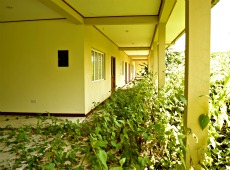
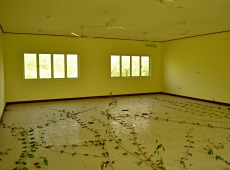
Minivan News witnessed that the entire development, including the inside of staff and residential quarters, had become overgrown with vegetation. Assorted earth-moving machinery was idle and in disrepair.

The MTDC Managing Director stated that MVR 80,000 (US$5,181) per month – MVR 960,000 (US$ 62,176) per year – is currently being spent on the “upkeep” of the development.

“We have 14 people looking after this facility, but it seems they are not able to keep the overgrowth down.

“With another seven to eight million dollars this development would be complete. It won’t cost us much to remove the overgrowth and the rooms were already completed to their rafters. It would involve minor repairs,” Matheen added.

According to the former surveyor – speaking on condition of anonymity –  construction was halted due to external pressures from conservative religious groups regarding the sale of alcohol on an inhabited island.

Asked about this issue, Matheen said discussions had taken place with native islands , however they were “divided” on the issue of alcohol sale.

“The bread and butter of the Maldives is definitely tourism. We are maintaining [Maldivians’] livelihood through tourism, and tourists want different products other than just sun and sand.

“Ninety-nine percent of tourists are drinkers, they are not coming here for many activities, and they are coming for relaxation and peace of mind. We have to cater to their needs,” Matheen added.

A committee formed by Uligamu islanders had submitted a court case regarding the halted development, according to Matheen.

“The island committee is not happy. They also think the development is controlled by the government when the majority is controlled by public shareholders. The government is not a major shareholder.

“The case is a pressure tactic. They think we have the money and they think we are purposefully not building here. They don’t accept the reality of the situation,” Matheen added.

In January 2012, local media reported that five people have been arrested in a youth-led demonstration at Uligamu against MTDC.

The protestors had demanded a reason as to why the development of the City Hotel had ceased, according to local media reports.

Matheen said that he was attempting to reduce the land rent costs as stipulated in the Tourism Act and that a new survey report of Uligamu is to be submitted this year.

US$25 million loss in Herethera Resort

Herethera resort – owned and operated by MTDC – was also said to have made a US$25 million loss following a series of “logistical issues”, Matheen said.

“We had pumped US$53 million into Herethera, however we are paying US$2 million in land lease and our operating costs are nearly 17 percent higher than resorts in the Male’ area because of location being so far away.

“When I took over this role in July, we did not have a single booking at the resort. Now we are fully booked until February 17,” Matheen said.

The MTDC Managing Director revealed that while no other resorts owned by MTDC are currently working at a loss, he admitted that because of the locations of the properties in the far south and far north, there were certain infrastructure issues.

Last month the bidding period for the management or purchase of Herethera Resort was been extended for the third time by the MTDC.

The company has not stated why the bidding period prior to this one ceased, but in previous instances the company said it had to cancel bids due to a lack of interest from potential investors.

ONYX, a company from Thailand, managed the resort until February 2012.

Likes(3)Dislikes(0)

Elections commission disbursing politcial party funds

Political parties will receive funds disbursed by the Elections Commission (EC) this week, according to local media.

Secretary General of EC Asim Abdul Sattar told Sun Online that the Finance Ministry was facing “difficulties” because of the high number of vouchers received at the beginning of the year, which is why funds had not previously been distributed.

According to EC Member Ali Mohamed Manik, seven political parties have had funds withheld because they have not held any political activities or submitted “up-to-standard” audit reports.

The Maldives presently has 16 registered political parties, however only eight meet the requirements for actively holding political events and having at least 3,000 registered members, states local media.

Party funding:

  • Maldivian Democratic Party (MDP): MVR 3.6 million (US$233,280);
  • Progressive Party of Maldives (PPM) MVR 1.98 million (US$128,304);
  • Dhivehi Rayyithunge Party (DRP) MVR 1.9 million (US$123,120);
  • Jumhooree Party (JP) MVR 1.2 million (US$77,760);
  • Adhaalath Party (AP) MVR 794,000 (US$51,451);
  • Maldives Development Alliance (MDA) MVR 624,000 (US$40,435);
  • Gaumee Itthihad MVR 608,000 (US$39,398);
  • Dhivehi Qaumee Party (DQP) MVR 529,000 (US$34,279); and
  • Maldives National Congress (MNC) MVR 478,000 (US$ 30,974).
Likes(1)Dislikes(0)