“We do not want to be in Paris to get perished,” Maldives ambassador tells climate change convention

The Maldives has urged the world to take reach a strong and legally binding climate change agreement at the 2015 United Nations Climate Change Conference.

Speaking at the plenary meeting of the 20th Conference of the Parties to United Nations Framework Convention on Climate Change (UNFCCC) in Lima Ambassador Ahmed Sareer emphasised on the need for a negotiated text in order to arrive at a strong agreement in Paris in 2015.

“We do not want to be in Paris to get perished,” said Sareer.

The Maldives mission to the United Nations reports that Sareer told the meeting that the Maldives, as a small, low-lying island state, is among the most vulnerable and least defensible countries to the projected impacts of climate change.

Touching on the ongoing water crisis in Malé, Sareer said that the situation “is a stark example of the vulnerability of small island developing states like the Maldives that has no natural fresh water sources”.

A fire in the capital’s only desalination plant left 130,000 people without running water last week, requiring international relief efforts to deal with the crisis.

Unusual in the crowded capital, water shortages have become commonplace in the country’s outer atolls – a combination of periods of drought and groundwater contaminated by the 2004 tsunami.

Noting the recent pledges to the Green Climate Fund – intended to raise $100 billion a year by 2020 – Sareer said: “as a small island developing state that is constantly facing an existential threat, the current pledges are simply not enough”.

The Maldives has recently become chair of the Alliance of Small Island States (AOSIS), while former President Maumoon Abdul Gayoom calling on larger nations to allow vulnerable states to take a lead in climate change policy.

Ambassador Sareer said that the Maldives’ share of global emission is negligible, and that the government of Maldives was striving to make the country resilient.

Former President Nasheed – who gained international acclaim for his efforts at the 2009 climate change conference – recently told the International Bar Association (IBA) that he feared Maldivians could become the world’s first climate change refugees.

“When I was elected president, I caused some controversy by saying we would someday have to leave our islands. I was hopeful then that we would be able to change the way our story ends. But I fear it is too late now for the Maldives,” he told the IBA’s showcase session on climate change and human rights.

The 2015 United Nations Climate Change Conference – or COP21 – will be held in Paris between November 30 and December 11 next year.

The COP21 organising committee has said that: “By the end of the meeting, for the first time in over 20 years of UN negotiations, all the nations of the world, including the biggest emitters of greenhouse gases, will be bound by a universal agreement on climate.”


Related to this story

Maldivians could be among first climate refugees, warns Nasheed

Maldives world’s most vulnerable country to climate-change related impacts on food security

Maldives’ economy hardest hit by climate change: Asian Development Bank

Likes(4)Dislikes(0)

JSC recommends dismissal of Chief Justice Ahmed Faiz and Justice Muthasim Adnan

The Judicial Services Commission has today recommended Chief Justice Ahmed Faiz and Justice Musthasim Adnan be dismissed from the Supreme Court bench.

The decision comes within hours of  President Abdulla Yameen ratifying an amendment to reduce the seven-member Supreme Court to five judges.

According to local media, several members of the judicial watchdog body boycotted today’s extraordinary meeting, claiming the amendment was unconstitutional.

JSC Secretary General Abu Bakr refused to provide details of today’s meeting stating the commission had decided to keep proceedings confidential until the Majlis reaches a decision.

According to the revised Judicature Act, the JSC must deem two of the seven judges unsuitable for the position within three days and the parliament must vote out the judges with a two-thirds majority of members present and voting within seven days. Dismissed judges will be provided a generous compensation package.

Article 154 of the Constitution says a judge can only be removed if the JSC finds a judge guilty of gross incompetence or misconduct.

Dismissal of the judges appear likely as the ruling Progressive Party of the Maldives (PPM) and coalition partner Maldives Development Alliance (MDA) control 48 seats of the 85-member house.

The opposition Maldivian Democratic Party (MDP) and Jumhooree Party (JP), who opposed the amendment, only control 23 and 12 seats respectively.

The amendment was proposed by MDP MP Ibrahim ‘Mavota’ Shareef, but the MDP issued a three line whip against the proposal with opposition leader and former President Mohamed Nasheed saying it would allow President Yameen to stack the Supreme Court bench in his favor.

JP Leader Gasim Ibrahim on December 2 called the amendment unconstitutional and an “atrocity.” He said the amendment will allow the executive and Majlis to change the Supreme Court bench at their whim.

Faiz and Adnan have formed the dissenting opinions in several controversial cases, including the decision to annul the first round of presidential elections held in September 2013.

Since then, the Supreme Court has been involved in numerous controversies both in and out of the court room.

Earlier this year, the Supreme Court used a ‘suo moto’ proceeding – allowing the Court to act as both the plaintiff and the judge – against the Elections Comission (EC).

EC president Fuwad Thowfeek and Vice President Ahmed Fayaz were subsequently charged with contempt of court and disobedience to order, being sentenced to six months in jail after the court used testimony given in the People’s Majlis independent commission’s oversight committee.

More recently, the court employed a similar ‘suo moto’ proceeding against the Human Rights Commission of the Maldives (HRCM) after it criticised the judiciary in its Universal Periodic Review (UPR) for the UN Human Rights Council.

The court charged the HRCM with undermining the constitution and sovereignty of the Maldives by spreading lies about the judiciary.  It said that the UPR submission– based on a 2013 report by the UN Special Rapporteur for Independence of Judges and Lawyers Gabriela Knaul – was “poorly researched”, “irresponsible” and “dangerous”.

June this year also saw Judge Ali Hameed – a sitting judge at the Supreme Court – cleared of a sex tape scandal after three recordings surfaced allegedly showing Ali Hameed engaging in sexual acts with three different woman.

The revised Judicature Act also propose the establishment of two additional branches of the High Court in the northern and southern regions of the Maldives.

The two new branches can only adjudicate the rulings of the magistrate courts. The nine-member High Court is to be divided among the three branches with three judges in each branch.

Likes(0)Dislikes(0)

Parliament reduces Supreme Court bench to five judges

The People’s Majlis has today amended the Judicature Act to reduce the seven-member Supreme Court bench to five judges.

The amendment proposed by opposition Maldivian Democratic Party (MDP) MP Ibrahim ‘Mavota’ Shareef passed with backing from the ruling Progressive Party of the Maldives (PPM) and its ally Maldives Development Alliance (MDA).

46 MPs voted in favor and 19 MPs voted against the amendment.

The MDP had issued a three-line whip against the proposal with opposition leader and former President Mohamed Nasheed claiming the amendment would allow President Abdulla Yameen to stack the bench in his favor.

Shareef himself voted against the amendment.

MDP MP ‘Reeko’ Moosa Manik – who has announced intentions to contest in the MDP’s 2018 presidential primary – voted for the amendment.

He previously described the formation of the current Supreme Court bench as a “shameful” political bargain between the MDP and then–opposition parties in 2010.

According to the amended Judicature Act, a Supreme Court judge can only be dismissed if the judicial watchdog body, the Judicial Services Commission (JSC), decides they are unsuitable for the position.

The JSC must then submit names of the judges to be dismissed within three days of the amendment’s enforcement.

Judges can only be dismissed by a two-third-majority vote of the Majlis. The amendment gives the Majlis a period of seven days to dismiss the judges. Judges who fail the vote will remain on the bench.

The PPM and MDA control a combined 48 seats in the 85-member house.

Three judges sit on the ten-member JSC. They are Supreme Court Judge Adam Mohamed, High Court Judge Abdulla Hameed and Superior Court Judge Mohamed Easa Fulhu.

The amendments also propose the establishment of two additional branches of the High Court in the northern and southern regions of the Maldives.

The two new branches can only adjudicate the rulings of the magistrate courts. The nine-member High Court is to be divided among the three branches with three judges in each branch.

The Supreme Court has recently been involved in numerous controversies both in and out of the court room.

Earlier this year, the Supreme Court used a ‘suo moto’ proceeding – allowing the Court to act as both the plaintiff and the judge – against the Elections Comission (EC).

EC president Fuwad Thowfeek and Vice President Ahmed Fayaz were subsequently charged with contempt of court and disobedience to order, being sentenced to six months in jail after the court used testimony given in the People’s Majlis independent commission’s oversight committee.

More recently, the court employed a similar ‘suo moto’ proceeding against the Human Rights Commission of the Maldives (HRCM) after it criticised the judiciary in its Universal Periodic Review (UPR) for the UN Human Rights Council.

The court charged the HRCM with undermining the constitution and sovereignty of the Maldives by spreading lies about the judiciary.  It said that the UPR submission– based on a 2013 report by the UN Special Rapporteur for Independence of Judges and Lawyers Gabriela Knaul – was “poorly researched”, “irresponsible” and “dangerous”.

Knaul’s report had detailed the pressing need for judicial reform, noting that the five-member transitional Supreme Court had been replaced by a seven-member permanent bench in 2010 with “no legal or constitutional basis”.

June this year also saw Judge Ali Hameed – a sitting judge at the Supreme Court – cleared of a sex tape scandal after three recordings surfaced allegedly showing Ali Hameed engaging in sexual acts with three different woman.

Likes(1)Dislikes(0)

20-year-old male arrested in Mafaz murder

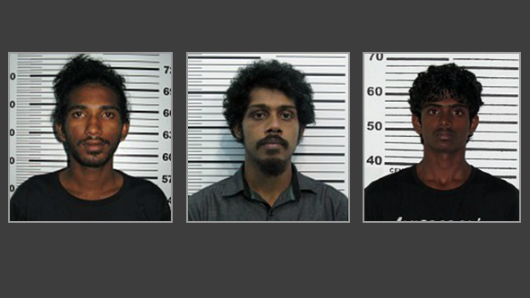
A 20-year-old man has been arrested over the brutal murder of Masodi gang member Ahmed Mafaz on December 7.

According to the Maldives Police Services, the man was arrested from Henveiru Bluebird in Malé under a court warrant at 3:35pm on December 9. The police also confiscated several items from the house.

Local media have identified the man to be Mohamed Midhath. He is the only individual arrested over the murder.

Mafaz, also known as ‘Masodi Mafa’, was stabbed to death at approximately 1:45am near the Alora furniture shop in Malé on December 7.

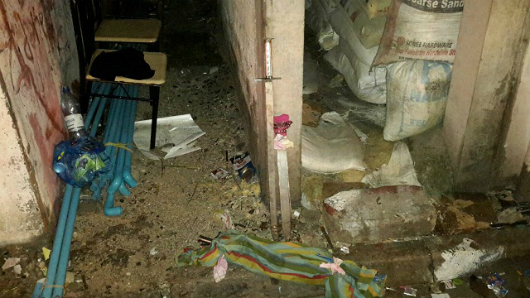
According to eyewitness reports, two men stabbed and beat up Mafaz while another group of men wielding machetes and other sharp weapons vandalised a building belonging to the Masodi gang and threatened to kill everyone inside.

The police said Mafaz died at ADK hospital while being given emergency treatment for numerous stab wounds, including fatal cuts in his neck and shoulders.

The stabbing was reported to the police at 1:45pm. Police took Mafaz to the hospital after stopping a taxi on the street.

The police on Tuesday also arrested a 16-year-old male over the fatal stabbing of 19-year-old Mohamed Aseel on August 23 and a further three men over gang violence near Billabong International School on November 16.

Aseel and two men, aged 20 and 13 years, were attacked near Iskandhar School in the Machangolhi ward of Malé.

Eyewitnesses said a group of masked men stabbed the two men in the back and struck the minor on the head before fleeing on motorbikes.

Aseel died on August 29 at the Indhira Gandhi Memorial Hospital. Doctors reportedly amputated his right leg in an attempt to save his life. He was stabbed six times. The other two did not suffer critical injuries.

The police had previously arrested six men and a minor over the stabbing. All remain in police custody.

The November 16 incident saw a group of men wielding machetes enter Billabong International High School following violence in front of the school. An 18-year-old was arrested from the scene.

Three men were arrested in relation to this incident at 4pm on Tuesday (December 9). They were caught hiding in a house called Aabaaru on Villimalé. They are Shaiban Zufrath, 18 years, of Malé Rosendale, Ulyan Ahmed, 19 years, of Dhambufashuvige of Gaaf Dhaal Gahdhoo Island, and Fassan Waleed, 19 years of Fahudhawadhee in Gaaf Alif Dhaandhoo Island.

Mafaz’s death marks the fifth murder this year.

The ruling Progressive Party of Maldives has submitted amendments to the law prohibiting possession of dangerous weapons – a move which some civil society groups say violates constitutional rights such as the right to remain silent and to retain legal counsel.

The amendment bill states that suspects arrested for assault with sharp objects or dangerous weapons will not be able to exercise the right to remain silent “to any extent”.

Police could also question the suspect if he or she is either unable to have an attorney present within six hours, or waives the right to retain legal counsel.

Moreover, the suspect could only consult a lawyer in the presence of a police officer for the first 96 hours after the arrest.

A joint statement by Maldivian Democracy Network and Commonwealth Human Rights Initiative urged the parliament to withhold from passing the amendments saying that it would “absolutely violate rather than limit fundamental rights of the people”.

Police media yesterday reported that a number of swords were discovered hidden under a car in the Henveiru ward of the capital in the early hours of Tuesday morning.

Head of Central Operations Command Ismail Naveen stated that the police have been working to curb the assaults in Malé by carrying out searches of suspicious individuals and inspecting suspicious locations.


Related to this story

28-year-old man stabbed to death in gang-related violence

Gang assault with machete in Billabong high school

MPs debate restricting constitutional rights after arrest

Yameen pledges to end violent crime at ‘Successful 365 Days’ rally

Likes(2)Dislikes(0)

Two tourists injured in Huraa Jet Ski accident

Two tourists have been hospitalized following injuries in a Jet Ski accident in Kaafu Atoll Huraa Island.

According to the Maldives Police Services, a Danish woman, 20 years old, and a Danish man, 21 years old, are being treated at Malé’s ADK hospital.

The two were riding two separate Jet Skis side by side and collided when one of the Jet Skis speeded up and attempted to turn around.

The case is under investigation, the police said.

Likes(1)Dislikes(0)

Both Transparency Maldives and MDP call for greater transparency in water crisis fund

Transparency Maldives has called on the government to display more transparency in order to avoid “economic and political repercussions stemming from the water crisis”.

“The Government must publicly provide a breakdown of the estimated US$20 million (more than MVR300 million) needed to overcome the crisis, and how the government intends to spend it,” read a press release from the anti-corruption NGO.

Transparency’s statement follows the announcement this week that the government is seeking donations in order to meet the costs of the fire that crippled Malé’s sole desalination plant on December 4.

“Furthermore, the decision to seek donations from the public raises questions given that MWSC is a private, profit-making corporation with 80 per cent government shares,” said Transparency.

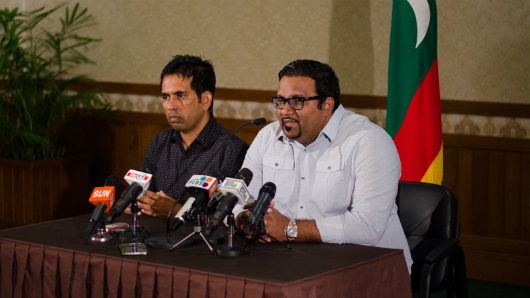
Minister of Tourism Ahmed Adeeb said today that the fund – which has already received support from both foreign and domestic donors – was not intended for the MWSC, but would be utilised by the government.

The opposition Maldivian Democratic Party (MDP) has also criticised the fund, stating that the government should only be able to demand US$20 million after they have decided how it is going to be spent.

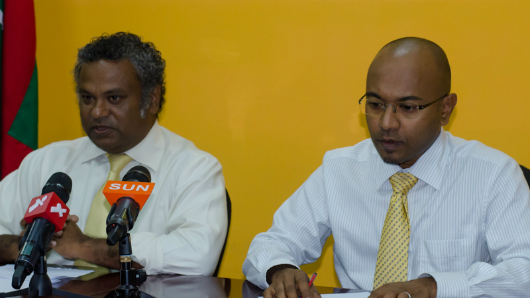
“The MDP along with the people of the Maldives demands answers from the government regarding the US$ 20 million fund,” said party Vice Chairperson Ali Niyaz at a press conference today.

“Where is the money going to go to? Why have not seen a breakdown on how the money is going to be spent? Will this be a new ring in the chain of corruption of the government?” he asked.

Additionally, party lawyer Hassan Latheef expressed concern that unnamed donors were giving large amounts of money to the fund.

“Relevant details should be provided as per the law on money laundering and corruption prevention law. Money laundering and financing for terrorism through donors is something which exists in the Maldives.”

Transparency has also called for an independent technical investigation to be conducted, and results to be made public before effective and preventative mechanisms are put in place.

“The investigation must scrutinise MWSC’s risk mitigation policy and asset management plan,” said the NGO.

With 130,000 citizens of the capital left without water, the government has said it could take up to two weeks to fully repair the extensive damage. President Abdulla Yameen has said that there could have been no back up plan for a “disaster of this magnitude”.

Former President and opposition leader Mohamed Nasheed has also called for an inquiry into the fire, suggesting that the Danish government previously recommended keeping 21 days of reserves in the capital.

Transparency noted that the crisis had demonstrated “the interminable relationship between good governance and citizens’ right to essential human needs,” calling for greater regulation of state-owned enterprises.

“Transparency Maldives believes that it is the responsibility of the government to hold accountable and to ensure that MWSC and other companies that provide essential services, such as the State Electric Company Limited (STELCO) and FENAKA Corporation  Limited, have mechanisms in place to review their working procedures so that similar incidents can be avoided in the future.”

MDP lawyer Latheef also criticised what he perceived to be the government’s attempts to pass the constitutional responsibility for water provision to the MWSC.


Related to this story

No fall back for disaster of this magnitude: President Yameen

Government seeks US$20 million in donations to repair Malé’s desalination plant

People’ Majlis disrupted after disorder over water crisis

UN Maldives commends government’s response in water crisis, opposition condemns

Likes(2)Dislikes(2)

35 percent of Asian MPs’ human rights cases from Maldives, says IPU

The Inter Parliamentary Union (IPU) has revealed that the Maldives accounts for 35 percent of all its human rights cases concerning Asian MPs.

“Maldives has a very high number of MPs (27) with cases before the Committee. Arbitrary detentions and violations of freedom of expression are the most common complaints reported, followed by torture, ill-treatment and other acts of violence,” said the IPU.

The union’s ‘Human Rights Abuses of MPs – 2014′ report – released to mark Human Rights Day (December 10) – shows that Africa and Asia are the most dangerous regions for parliamentarians.

Earlier this year, the union had suggested that the authorities’ response  to the growing number of threats against MPs would represent a test of the Maldives’ democracy.

The union emphasised the “high price parliamentarians are paying to defend fundamental human rights and exercise their right to freedom of expression”.

Despite being the smallest country in Asia, the Maldives made up 27 of 78 parliamentarians from 12 countries in Asia who have cases lodged with the IPU’s human rights committee.

Previous statistics from the IPU show that the global average number of inhabitants per parliamentarian is 146,000. With 85 MPs, the Maldives’ 2014 census shows the country has 1 MP for every 4,014 inhabitants.

In October, opposition Maldivian Democratic Party (MDP) MP Eva Abdulla – the first Maldivian member of the IPU – met with the committee to raise concerns over the personal safety of parliamentarians and journalists in the Maldives.

At the time, Eva highlighted the lack of thorough investigations in cases of threats and assault, perpetrators not facing trial, the failure of law enforcement, the failure of the parliament to look into cases, and the creation of a culture of intimidation in the Maldives.

In a year in which MDP MP Alhan Fahmy narrowly avoided paralysis following a stabbing, threats against MPs and their families have become commonplace.

In October, the Maldives National Defence Force temporarily offered MPs additional personal security as well as urging Majlis members not to go out at night time unless absolutely necessary.

The IPU’s list of Maldivian cases also included the late Progressive Party of Maldives MP Dr Afrasheem Ali, brutally murdered outside of his home in October 2012.

MDP MP Ali Azim was controversially removed from the Majlis over an issued of decreed debt last year

Cases from around the world

The IPU explained that 311 parliamentarians from 41 countries had cases referred to the IPU Committee in 2014 – a 13 per cent increase from 2013, which saw 270 parliamentarians lodge cases, from 40 countries.

The most common human rights complaints are arbitrary detention, lack of fair trial, violation of freedom of expression and unlawful suspension and loss of parliamentary mandate.

Other dangers faced by parliamentarians include death, torture, threats and arbitrary arrests, explained the IPU

As per the 2014 statistics, the highest number of parliamentarians who have lodged cases at the committee are from Africa with 38 per cent, followed by Asia with 25 per cent.

Middle East and North Africa have 18 percent, while the Americas have 14 percent, and Europe 5 percent.

71 percent of these parliamentarians are from opposition parties, and 89 percent are male.

“These figures are extremely worrying as they show that all over the world MPs face serious harassment and sometimes even death, in a clear attempt to intimidate and silence critical voices and dissent,” said IPU Secretary General Martin Chungong.

“The figures we are presenting today are cases reported to IPU, but there are other abuses that remain beyond our scope, as the Committee can only intervene at the request of the MP concerned, family members, legal representatives, fellow MPs or human rights organisations,” he continued.

The statement reads that the majority of cases have been under the committee’s consideration for less than five years, while 10 percent of the cases are from more than 10 years ago, and another 5 percent date back to the 1990s.

It also notes that 101 new decisions were adopted by the IPU this year, calling on authorities of the relevant countries to “take effective steps towards a satisfactory settlement of the cases”.

Of the 314 cases, 71 are new cases involving parliamentarians from the Maldives, Cambodia, Colombia, Democratic Republic of Congo, Ecuador, Iraq, Israel, Oman, Palestine, Venezuela and Zambia.

The Committee also closed cases involving 12 parliamentarians in 2014.


Related to this story

Government’s reaction to death threats is a test of democracy: IPU

Inter-Parliamentary Union requests urgent visit to Maldives

Opposition MP Alhan Fahmy stabbed

MPs urged to stay in at night as MNDF offers personal security

Likes(2)Dislikes(0)

Dealing with the dry spell – Malé’s water crisis continues

Five days since the fire at Malé Water and Sewerage Company (MWSC) – the capital city’s sole provider of running water – disrupted water supplies, residents and local businesses struggle to make do with the limited resources available.

As politicians begin finger-pointing, the inhabitants of the capital continue to cope with the crisis in any way they can.

The Maldives National Defence Force (MNDF) and the Maldives Red Crescent have been distributing bottled water received as aid from neighbouring countries to citizens since December 5.

The drinking water distributed by the MNDF in this manner is being transported to the capital city voluntarily from nearby islands by local businessman Adam Manik of Galolhu Sentuge, owner of Tug Service Marine Pvt Ltd.

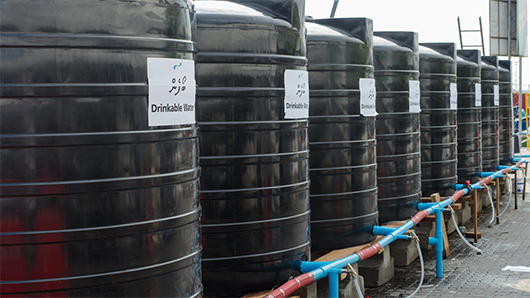
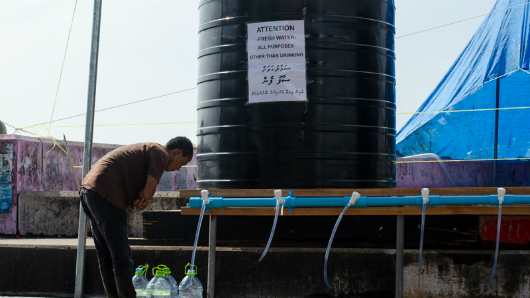
Adam Manik has also taken the initiative to set up nearly a dozen large water tanks near the Water Jetty, where drinking water is dispensed free of charge.

“I purchase the water, transport it to Male’ on my boats and distribute it for free to all and any citizens. I see this as a national effort and will continue to provide this service as long as the current water difficulties continue,” Adam Manik told Minivan News today.

Adam stated that his employees have been working relentlessly for the past 4 days on all his boats.

Three of his boats are being utilised for water transportation – ‘Adam 60’, which has the capacity to carry 200 metric tonnes of water, ‘Ifba’ carrying 60 metric tonnes and ‘Namoona’, carrying 20 metric tonnes.

Meanwhile, Happy Market is currently producing ‘Life’ bottled water at maximum capacity, catering to the public, businesses, and resorts.

Happy Market Purchases and Procurement Manager Akram stated that, while the company is unable to provide unlimited supplies, they are working to sell water at an equitable rate.

The public can at the moment purchase one case of four 5 litre bottles at any of the Happy Market outlets in the city for MVR56 (US$3)

Akram stated that other producers of bottled water are slowly resuming retail, which would stabilise the situation while taking some pressure off the sole seller of bottled water.

Leaving water troubles behind

While the queues at free distribution centres grow shorter, there are reports that many residents of Malé have chosen to travel to other islands, especially nearby Villingili and Hulhumalé – both of which have unaffected supply.

Guest house owners confirm that all accomodation at these islands are now fully booked, while some guesthouses have started a new strategy of only renting rooms to Malé residents on an hourly basis.

Traditionally, December is the time of the year when customary circumcision parties are held in the Maldives – which typically include a week long celebration after young boys undergo the procedure.

Fathimath Waheeda stated that on December 4, she had to move her son from the hospital to Villingili as, due to the water shortage, she could not cater to the multitude of guests who would visit her son’s party.

“I rented a room in Villingili and we are having the party here. Less people turn up, but at least there are no concerns of hygiene or catering here,” she said.

Limited water, Limited services

Local businesses are also facing hardship due to the water troubles, with some opting to temporarily close down business until water services resume.

Others continue to persevere, with many gathering water from distribution centres, or collecting water at the limited dispensing hours.

Fahari Cafe’ – run at the North Harbour of Malé – said it is attempting to run business as usual, assigning one employee the task of going to queue at water distribution centres, while another stays alert to collect water during dispensing hours.

Abdulla Saeed, owner of a food outlet called “Home Delivery” stated that they are following the same process.

“What else can we do? This is the work we do to feed ourselves. We cannot give it up regardless of how difficult it may be,” he said.

Marble Hotel owner Athif Saleem said that guests are aware of the crisis and that therefore very few complaints are received.

“We are providing well water to the guestrooms and notifying them of the water supply dispension hours. We are also using rainwater in the cafe for washing purposes and services are available. However, we are getting fewer local customers in the cafe’ during this crisis,” he explained.

Hair salons are also facing difficulties in providing normal services. Many claimed to be open only to offer a limited number of services – those which require a minimal amount of water usage.

Cyza Salon also spoke of decreased number of customers during the crisis.

“Like most others, we also bring water from the distribution centres. We aren’t getting too many customers these four days but if someone does come, we will try to provide services as best as we can”.

According to Special Task Force member Minister of Home Affairs Umar Naseer, it will take upto 10 days or more for regular water supply services to resume.

Likes(2)Dislikes(0)

No fall back for disaster of this magnitude: President Yameen

President Abdulla Yameen has spoken to the public for the first time regarding the Malé water crisis, saying that there could have been no fall back plan for such a crisis.

“We did not have any fall back plan for any disaster of this magnitude. However, we have done extremely hard work to try and bring the situation back to normal,” said the president.

Remarking that the extremely low odds of such an incident occurring had prevented the state-owned Malé Water and Sewerage Company from making plans to deal with the current situation.

Yameen said that five of the nine panel boards at the MWSC had now been fully repaired, estimating that the relief effort would cost US$20m million.

The Maldives’ capital was plunged into crisis on Thursday (December 4) as a fire at MWSC gutted the desalination plant, leaving 130,000 people without running water, leading to the dwindling of bottled drinking water supplies .

“I am not trying to make any excuses for the disaster at MWSC but the company was formed in the early 1980s. The design of the company and the water demand has changed with the population increase in Male.”

“There should be no difficulties with obtaining drinking water. However, there are problems with getting water for washing up and cleaning for people in high rise buildings,” said Yameen.

Large amounts of fresh water have been supplied via a number of international donors, who were thanked by the president.

“I would like to point out that even after some very difficult times for the foreign relations of the country, many nations are aiding the country in this heart wrenching time.”

The government will look into various ways to prevent such an occurrence maybe by dividing up the water grid by wards.”

Meanwhile, members of the president’s task force have told local media that the problem could not be fixed within a “politically desirable” timeframe.

In an interview with Haveeru, Minister of Defence Mohamed Nazim said that it would take two weeks to completely recover from the crisis, saying that 50 percent of this would be achieved by the end of the week.

Minister of Fisheries and Agriculture Dr Mohamed Shainee said that, while MWSC has utilised a backup plan after the fire, a completely foolproof system was financially prohibitive.

“If we were to look for a 100 percent foolproof system, it would need to be built far from MWSC – in another area.  This occurred within one year this government came into power. We had been preparing for water security,” Shainee told Haveeru.

Minister at the President’s Office Mohamed Hussain Shareef told Minivan News earlier that the residents of Malé consumed around 14,000 metric tonnes of water a day, with the fully functioning plant able to produce around 20,000 tonnes.

The Maldives National Defence Force, working alongside volunteers from the public and civil society, continues to distribute water brought from abroad and from desalination plants on nearby islands.

Bangladesh became the latest country to announce it would send naval vessels with fresh water and desalination capacity, following the arrival of two Indian ships as well as the expected arrival of the Chinese navy.

The INS Deepak was the latest Indian ship to arrive, with 800 tonnes of water and the capacity to desalinate 200 tonnes per day. Deepak’s arrival follows ten Indian aircraft which have brought regular supplies of fresh water since Friday.

The Maldivian Red Crescent today received the first shipment of 5 tonnes of fresh water today, while the UN in Maldives has said that 180 tonnes stored under its premises in Malé requires treatment before it can be handed to the public.


Related to this story

Government seeks US$20 million in donations to repair Malé’s desalination plant

President Yameen to return to Maldives as water crisis enters third day

Indian aircraft arrives to ease Malé water crisis

Nasheed calls for inquiry into MWSC fire

Likes(2)Dislikes(0)