Maldives Organisation for Elderly People receives US$40,000 UAE Health Award

The Maldives Organisation for Elderly People has been presented with the UAE Health Award during the World Health Organisation (WHO) meeting in Geneva, reports Gulf Today.

UAE minister of health Dr Hanif Hassan Ali Al Qassim, presented US$40,000 to the winning organisations, which also included the Society for Progress Association in Chad.

The award is annually granted to those individuals or organisations that provide various services in the medical and health development.

The Maldives Organisation for Elderly People provides a number of psychiatric and social services to the elderly in addition to health awareness programmes, physical education training sessions, yoga and physiotherapy either at home or at the centre.

Likes(0)Dislikes(0)

Expatriate slashed with machete

An expatriate man was badly injured after he was attacked with a machete in Henveiru Park in Male’ yesterday evening, reports Haveeru.

Police said they had no leads on the attack on the man, who was reportedly a food cart worker.

SunFM reported that a group of men asked the expatriate for a cigarette, and attacked him when he refused.

The injured man was taken to Indira Gandhi Memorial Hospital (IGMH) in a police car.

Likes(0)Dislikes(0)

Two women arrested in connection with the discovery of dead baby in Villingili

Two women have been arrested in connection to the discovery of discarded six month foetus in Villingili, found on Friday inside a Coast Milk tin.

Deputy head of police Serious and Organised Crime Department Inspector Abdulla Nawaz told media today that police had arrested a 30 year old woman from Noonu Atoll who was the suspected mother of the baby, and a 24 year old woman from Kaafu Atoll who was alleged to have assisted her deliver the baby prematurely.

Nawaz said that police were now examining the body of the 30 year old woman after she confessed to giving birth two days ago but was unable to tell police where the baby was.

The 24 year old had meanwhile confessed that she had assisted Shaira in delivering the baby prematurely, Nawaz said.

Abortion is illegal in the Maldives, although an unreleased 2007 by the International Planned Parenthood Foundation (IPPF) found the practice was believed to be widespread due to the social stigma faced by a woman bearing a child out of wedlock.

Nawaz said that police had also obtained information about the baby found dead in Male’ track swimming area in early May, and were seeking to verify the report.

This morning the body of a newborn baby boy was discovered in a park in Hulhumale’,  with underwear tied tightly around his neck.

Spokesperson for Hulhumale’ Hospital Dr Ahmed Ashraf said the baby may have died from asphyxiation because of the restricted air passage.

‘’When the baby was found the knot was a bit loose, but the marks on its neck shows that it was tied tightly around the neck,’’ Dr Ashraf said.

Likes(0)Dislikes(0)

Comment: Islam is for tolerance of the Other

It is disturbing and saddening to see that we dare to curtail basic human interests and entitlements of others that some of us take for granted.

What Islam stands for: According to Article 16 of the Madinah Charter (al-mithaq al-madinah) of 622 CE, social, legal and economic equality was promised to all loyal citizens of the state, including non-Muslims.

Similarly, ‘Umar ibn al-Khattab’s Covenant following the Arab conquest of Jerusalem reads:

“[‘Umar ibn al-Khattab] has given [people of Jerusalem] assurance of safety for their lives and property, for their churches and their crosses, for their sick and their healthy, and for all the rituals of their religion.

Their churches shall not be used as dwellings, nor shall they be demolished and nothing shall be diminished…”

Now all this has basis in the Qur’anic injunction that “there is no compulsion in religion”. Have we then lost our humanity and humaneness?

It is hypocritical of us to ban and curtail such basic freedoms by saying that the Maldives is a ‘sattain satta muslim qaum’.

How we became ‘sattain satta muslim qaum’

It is true that we have a strong Islamo-nationalist identity. But we must know that identities are artificial and they are constructed through symbols and discourses.

Our national identity is a construction of a discourse largely engineered by President Gayoom.

President Amin may have been behind the initial promotion of nationalism. But his nationalism was not based on an exclusionist Islam. None of his national day statements that I have read promoted such an oppressive conception of of Islamo-nationalism.

The discourse of an exclusionist Islamo-nationalism is found in Gayoom’s speeches, writings and policies. In fact, according to Gayoom’s official biography, A Man for All Islands, Gayoom, from the beginning, ensured that an Islamo-nationalism was a priority of his regime.

Gayoom-controlled radio, TV, and the education system promoted and socialised us into this discourse of exclusionist Islamo-nationalism.

We may not readily realize that we are influenced by and socialized into this mythical discourse of Islamo-nationalism based on ‘sattain satta muslim qaum’. The power of this discourse is so perverse that even the most natural word association for ‘sattain satta’ probably is ‘muslim/Islami qaum’.

And all major oppressive measures in the country have been justified based on the discourse of ‘sattain satta muslim qaum’.

Thanks to the 30-year efforts of Gayoom, today our ‘imagined community’ is thoroughly based on an exclusionist and oppressive conception of Islam.

Islamo-nationalism’s oppressions

According to Daniel Brumberg, total autocracies such as Saudi Arabia spread the idea that the state’s mission is to defend the supposedly unified nature of the nation or the Islamic community.

Gayoom’s regime may not have been a total autocracy. But his stated political justification of the state was his mission of defending a unified community.

We must know that, just like his Arab counterparts, this was just a ploy for political control. Hence, any differences of views to that of his vision are taken as ‘anomalies’ or ‘deviations’ or ‘falsities’ threatening national unity.

Such people must be ‘rectified’, exiled, imprisoned, deported, tortured, or if need be exterminated. Exclusion or extermination can also find more poignant forms such as civil death or suicide.

Gayoom’s discourse of ‘sattain satta muslim qaum’ often oppressed two kinds of opponents: Islamiyyun such as Sheikh Hussain Rasheed Ahmed and non-religious challengers like current president Nasheed.

Islamiyyun were brandished as ‘Islam din rangalah nudanna meehun’. And non-religious political opponents were brandished as either ‘fundamentalists’ or ‘Christian missionaries’.

The outcomes of this oppressive Islamo-nationalist discourse are naturally not limited to Maldivians.

Hence the migrant workers in the Maldives also cannot practice their religions as respectable and equal human beings.

Undoing Islamo-nationalism

Identities cannot easily been undone. But it is not impossible to undo them. As an immediate step, the government must stop spreading Gayoom’s discourse of ‘sattain satta muslim qaum’.

Even the current government spreads the discourse that ‘Maldives is the only 100% Muslim liberal democracy’. While this discourse is presented often to the donors, this is just the same Gayoomist myth. We are neither 100% Muslim nor a liberal democracy.

We are still a borderline democracy according to comparative democratization research. The Freedom House still designates the Maldives as an ‘electoral democracy’, and our donors know this. Instead of promoting Gayoom’s discourse, we must acknowledge our oppressive laws, practices and attitudes, and try to change them.

Secondly, we need to create a Divehi equivalent for ‘tolerance’. Divehi word ‘tahammal’ or ‘kekkurun’ does not fully convey the meaning of the concept of tolerance. Tolerance means accepting people and permitting their differences and practices even when we personally strongly disapprove of them.

We may not want to become Buddhists or Hindus, nor may we approve of Buddhism or Hinduism. But we must accept the Buddhist and Hindu Sri Lankans or Indians in the Maldives and we must permit their religious practices.

Third, our education system must promote tolerance, mutual respect, and a critical-history of the country and Islam in general.

Textbooks must problematize the mythical narrations like Rannamari, which as Maloney said, served to render other historical events peripheral. Instead, the real age and images of Divehis must be re-taught.

The age of the Divehi is not 900 years, but more than 1500 years. The real Divehi is indeed indicative of a far richer adventurism, innovation, cultural practices, linguistic uniqueness, adaptability, and the sheer incredible strength of spirit and survivability in these lands against numerous odds, not least foreign interventions.

The real Divehi is indicative of an incredible story of inclusiveness, of co-existence of political exiles and immigrants from India or Sri Lanka. This Divehi story must be our discourse for re-doing our historical identity.

Gayoom’s mythical unity as found in the oppressive Religious Unity Act is not even our historical reality in the Muslim period. Maliki madhab was dominant until 1573, when Muhammad Jamal Din advocated Shafi’I madhab.

Thus, whether we approve of it or not, we have both intra-religious and inter-religious differences. There is no way to stop this diversity except through despotic oppression.

We cannot remain ignoring this reality and deluding ourselves into a utopian umma. We must embrace the ‘fact of pluralism’ and tolerance as basis of our new national identity.

That, after all, is also what Islam stands for.

All comment pieces are the sole view of the author and do not reflect the editorial policy of Minivan News. If you would like to write an opinion piece, please send proposals to [email protected]

Likes(0)Dislikes(0)

Former prisons chief interrogated after release of DPRS torture photos

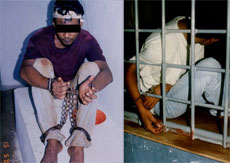
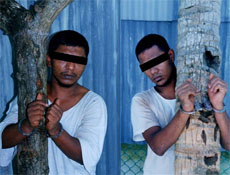
Former Prisons Division Head with the Department of Penitentiary and Rehabilitation Serivces (DPRS) Isthafa Ibrahim Manik has been detained and questioned by police, after disturbing photographs of tortured victims in custody were obtained by the Presidential Commission and leaked to the media.

Manik remains in custody at Maafushi after the courts granted police a 15-day extension of detention.

The photos released so far include images of men tied to coconut palms, caged, and bloodied. One of the photos, of a prisoner lying on a blood-soaked mattress, has a 2001 date stamp.

A senior government official told Minivan News that the photos were obtained by the Commission from the DPRS itself on Monday, and that those released “are just the tip of the iceberg.”

Inspector of Police Abdulla Nawaz confirmed in a statement to the state broadcaster MNBC that the matter involved severe cases of torture and suspected fatalities, and had been passed to police.

“Former heads of the Prisons Division will be interrogated,” he said. “We will also question former ministers if it is believed that they were involved,” he added, claiming that police would withhold the identities of some of those summoned for questioning.

One of the pictures, reportedly obtained from the DPRS

National Security Advisor and former Defence Minister Ameen Faisal, a member of the Presidential Commission, told MNBC that prison records had revealed that inmates were punished without court order “and subjected to inhumane torture and ill-treatment.”

“This commission has received information that some inmates who were tortured ended up dead,” Faisal said.

Many members of the current government, including President Mohamed Nasheed and Foreign Minister Ahmed Naseem, claim to have been tortured under the former administration.

“They were limited only by their imagination,” Naseem said, describing the describing the former government’s treatment of prisoners as “medieval”.

Gayoom’s spokesperson Mohamed Hussein ‘Mundhu’ Shareef told Haveeru that the government’s arrest of the former head of prisons was the “the third part of the drama” in a long-plotted lead up to the arrest of the former president.

“The attempt to arrest President Maumoon will only boost his profile. We see this simply as the government’s attempt to divert the people’s attention from the dollar crisis and rising commodity prices,” Shareef told Haveeru.

The Presidential Commission has previously summoned Gayoom, who refused to appear.

In October 2010, President Nasheed’s high profile support of elderly historian Ahmed Shafeeq, who has alleged that 111 people died in custody under the former administration and that he himself had been arrested and his diaries destroyed, prompted Gayoom to write to the British Prime Minister David Cameron.

In the letter, Gayoom appealed for pressure to be placed on President Mohamed Nasheed following “the escalation of attempts to harass and intimidate me and my family.”

The matter, he told the British PM, involved “unsubstantiated allegations by an elderly man by the name of Ahmed Shafeeq that I had, during my tenure as President, ordered the murder of 111 dissidents.”

“In a book authored by this Shafeeq, which was ceremoniously released [on October 10] by Mohamed Nasheed himself, it is accused that I also ordered the man’s arrest and supposed torture in prison. In a country of just over 300,000, it is safe to assume that even one ‘missing person’ would not go unnoticed, let alone 111.”

Men chained to coconut palms

Nasheed’s government had “escalated its attempts to harass me” in the run up to the local council elections, Gayoom wrote, despite his retirement from politics.

“After the government’s defeat in last year’s parliamentary elections, the popularity ratings of the ruling MDP have fallen further in recent months as a result of the government’s failure to deliver on its campaign promises, and its lack of respect for the law.”

“On the other hand,” Gayoom told the British PM, “I continue to enjoy the strong support, love and affection of the people, and have been voted by the public as ‘Personality of the Year’ in both years since stepping down from the presidency.”

Likes(0)Dislikes(0)

Maldives will starve in three months: future Adhaalath head

Potential future President of the religious Adhaalath Party Sheikh Imran Abdulla has reportedly claimed that the Maldives will starve once the country exhausts its foreign reserve in three months.

Sheikh Abdulla told press that the party had been informed of this during a meeting with the Maldives Monetary Authority (MMA).

Sheikh Abdulla made the claims during an event at Kalaafanu school to announce that the party would be competing in the 2013 Presidential elections. He is currently running unopposed for leadership of the party, which is in coalition with the ruling Maldivian Democratic Party (MDP).

Likes(0)Dislikes(0)

Premature baby found in Coast Milk tin on Villingili

The corpse of a premature baby boy was discovered yesterday inside a Coast Milk tin on the island of Villingli, the second abandoned infant found in as many weeks.

Police Sub-Inspector Ahmed Shiyam told Minivan News that the dead child, believed by forensic examiners to have been born three months premature, was discovered in the discarded container near the powerhouse area of the island.

The baby was taken to Indira Gandi Memorial Hospital (IGMH) in Male’ for forensic examination before being buried, according to the police.

On May 5 a dead infant was been found in a plastic bag in the swimming track area of Male’. A medical examination later concluded that the baby’s had sustained cuts, bruises and other wounds.

Shiyam said that yesterday’s discovery of the dead infant on Villingli was not believed by police to reflect an escalating problem in the country concerning child abandonment or abortion.  However,  he said police did have serious concerns about the health implications for mothers of these abandoned children.

“Although we know this [abandonment] is happening, it is not something we believe is a growing issue. However, we request the public not support people who are thinking of abandoning a baby,” he said. “We are very concerned about the health of the mothers of these children, who are not receiving proper medical treatment or the drugs they may require for recovery.”

Police added that they had not yet made any arrests in connection with the discovery of either body and asked for members of the public with any possible information about the case to come forward.

In November last year another abandoned newborn was discovered alive in some bushes near the Wataniya telecommunications tower in Hulhumale’.

Abortion is illegal in the Maldives except to save a mother’s life, or if a child suffers from a congenital defect such as thalassemia. Several studies on HIV in the Maldives have identified risk factors including high levels of promiscuity and little use of contraception, and anecdotal evidence points overwhelmingly to a high rate of abortion.

In an article on the subject in 2009, Minivan News reported that many women unable to travel to Sri Lanka resort to illegal abortions performed by unskilled individuals in unhygienic settings.

Abortion-inducing pills and injections administered by amateur abortionists are one recourse while others turn to harmful vaginal preparations, containing chemicals such as bleach or kerosene. Although infrequent, some insert objects into their uterus or induce abdominal trauma, such is the stigma of having a child out of wedlock.

Likes(0)Dislikes(0)