Doctor’s examination shows dead infant’s body had cuts, wounds and bruises

Doctors examining the body of an dead infant found in a bag in the swimming track area have reported that the baby’s body had cuts, bruises and other wounds.

A police officer swimming in the track area on Thursday discovered the corpse of the premature baby underwater.

“The doctor said there were three cuts in the arms, not very deep cuts,’’ said spokesperson for Indira Gandi Memorial Hospital (IGMH), Zeenath Ali.

‘’There were two bruises on a leg and two wounds to the head,” she added.

She said it was difficult to say the cause of the injuries.

‘’It may be the ropes in the area caused  these injuries,’’ she said, adding that the infant appeared to have been born 26-28 weeks prematurely.

Police Sub-Inspector Ahmed Shiyam also confirmed that several injuries were found on the infant’s body.

‘’We cannot say the cause of the injuries exactly,’’ Shiyam said. ‘’The dead body has now been laid to rest.’’

He said police were currently investigating the case.

Local media reported that the baby was bleeding when it was taken out of the water and that the umbilical cord and placenta were still attached. Haveeru published a picture of infant which appeared to have been put in a plastic bag.

In November last year another abandoned newborn female baby was discovered alive in some bushes near the Wataniya telecommunications tower in Hulhumale’.

As a Muslim country, abortion is illegal in the Maldives except to save a mother’s life, or if a child suffers from a congenital defect such as thalassemia. Several studies on HIV in the Maldives have identified risk factors including high levels of promiscuity and little use of contraception, and anecdotal evidence points overwhelmingly to a high rate of abortion.

In an article on the subject in 2009, Minivan News reported that many women unable to travel to Sri Lanka resort to illegal abortions performed by unskilled individuals in unhygienic settings. Abortion-inducing pills and injections administered by amateur abortionists are one recourse while others turn to harmful vaginal preparations, containing chemicals such as bleach or kerosene. Although infrequent, some insert objects into their uterus or induce abdominal trauma, such is the stigma of having a child out of wedlock.

Likes(0)Dislikes(0)

Turkish navy talks piracy challenges during inaugural Maldives visit

The Turkish navy concluded its first ever official visit to the Maldives last week during a patrol of the Indian Ocean it is conducting as part of a NATO-led anti-piracy initiative to try and deter potential attacks in and around the region’s territorial waters.

A spokesperson said that the three day visit by the naval ship TCG Giresun to the Maldives, which concluded on May 3, was not linked to any specific threat or incident of piracy within the country’s territorial waters.

He said it was instead linked to a wider NATO programme targeting concerns about pirate attacks spreading beyond the horn of Africa into territories around the Gulf of Aden and the Indian Ocean.

“We are trying to promote understanding to fight piracy, so one way to do this is to visit ports like Male’,” said the spokesperson. “The attacks of the pirates have widened into the Indian Ocean with one of the last incidents occurring approximately 250 nautical miles away from the shores of Male’, so NATO has widened the number of ports we are to visit to include Indian Ocean destinations like Mumbai and Male’.

Experts suggest that a growing number of Somali pirates are moving deeper into the Indian Ocean as they come under increased pressure from international task-forces designed to try and limit piracy around the horn of Africa. As a result of this movement, maritime security has become a notable security concern for the Maldives, even around the country’s secluded resort properties.

In March this year, a family were suspected of being kidnapped by Somali pirates after having set sail from the Maldives towards the Arabian sea, although the kidnapping was confirmed by security officials to have occurred outside of Maldivian waters.

Major Abdul Raheem of the Maldives National Defense Force (MNDF) said at the time that security officials in the country had not received any information concerning the kidnappings or any other kind of “terrorist activities” occurring recently within the territorial waters of the Maldives.

Raheem added that Maldivian authorities would not therefore be reviewing maritime security measures or safety advice for sailing sailing in and out of the country on top of measures and international cooperation already in place during the alleged kidnappings.

The Turkish navy says that during 2011 alone, it plans to send between three to four frigates to patrol the Indian Ocean and Arabian Sea as part of its commitments to try and protect Turkish and international merchant vessels from potential pirate attacks.

“We plan to conduct operations to protect merchant vessels,” said a spokesperson for the TCG Giresun. “During this deployment we will visit Aksaz Aqaba, Jidde, Al Hudeyde, Doha, Dubai, Mascat, Karachi and Mumbai.”

In previous patrols conducted by the TCG Giresun in the Gulf of Aden, the Turkish navy spokesperson claimed that the ship’s crew had apprehended 14 suspected pirates and a stash of weapons on a Yemeni dhow vessel along with seven local fishermen that were also being held on the ship.

In instances where suspected pirates were caught, the navy spokesperson said that the Turkish authorities were not able to try or incarcerate any of the individuals themselves.

“They are not our captives as we are operating under United Nations resolutions and currently there is not an established court to judge [alleged] pirates that have been captured. So we attempt to disrupt and deter them [from piracy], we take their weapons and drop the equipment into the sea,” he said.

“We take all their equipments and then return [the suspects] to the Somali coast. Some countries have special [legislative] agreements, such as Kenya and the Seychelles. These agreements relate only between [these nations] and not internationally, so they capture the alleged pirates and then take them to Kenya or to the Seychelles to be judged.”

The spokesperson claimed that a present a number of suspected pirates from Somalia were currently being returned to their native coast.

To try and counteract the challenges of detaining suspected pirates, the UN security council last month voted in favour of forming an international court – supported by a host of potential new laws – that would focus specifically on working to combat the spread of piracy.

Likes(0)Dislikes(0)

Sri Lankan man’s passport held for over a year in Reeko’s bootleg booze case

A Sri Lankan national has appealed to the Criminal Court to release his passport, which has been held for over a year in relation to a case concerning the discovery of hundreds of bottles of cheap alcohol  in a car belonging to Maldivian Democratic Party (MDP) Parliamentary Group leader ‘Reeko’ Moosa Manik.

The Court identified the expat as Muhaidhee Mohamed. Following his complaint the Court summoned the police investigator in charge of the case, Staff Sergeant Ali Faiz, who told the court the matter would be resent to the Prosecutor General this week.

Faiz told the Criminal Court that the leader of a group of expats involved in importing alcohol illegally to the Maldives had fled during the police investigation.

‘’We would like to note that it has been one year, two months and 10 days from the day he was arrested,’’ said the Criminal Court. ‘’He was released by the Criminal Court after he was kept in detention for two months.”

In February last year police arrested four expatriate men loading 168 bottles of whiskey and menthol gin into a car registered to Moosa, on the same day controversial liquor licensing regulations were unveiled by the Ministry of Economic Development.

Main opposition Dhivehi Rayyithunge Party Vice President Ibrahim Shareef then said he doubted the case “would go very far”, noting that “in the worst case scenario Reeko’s driver will be implicated and that will be the end of the story.”

The investigation into the case was concluded in October last year, and the case was sent to the Prosecutor General who rejected it and sent it back to police.

Police then said that the case was rejected because there was some necessary information was missing in the investigation.

Local media reported that during the court hearing during the investigation police told the judge that the main subject of the investigation was a person known only as  ‘Tin Tin’.

Moosa, who was in Singapore at the time of the incident, has maintained that his driver was bribed and the bottles were planted in his car to attack him politically.

Likes(0)Dislikes(0)

Day of protests ends with pepper spraying of Umar Naseer

An opposition protest held last night near the artificial beach was dispersed by police after the group tried to make its way towards the intersection of Majeedhee Magu and Chandanee Magu, the focal point of last week’s violent demonstrations.

Earlier this week police had announced they were restricting protests to the artificial beach and tsunami monument areas, and have since quickly dispersed those conducted elsewhere.

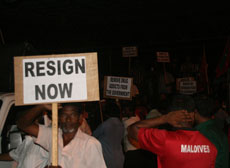
Demonstrators at the artificial beach last night carried placards written in English reading “Remove sex offenders/drug addicts from government”, and “Resign now”.

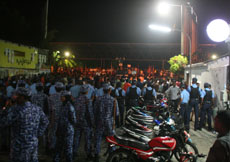
As the demonstration took place, five rows of police and Maldives National Defence Force (MNDF) personnel armed with heavy wooden batons stood between the 300-400 demonstrators and the route down Majeedhee Magu.

At around 11:30pm demonstrators, attempted to reach the intersection and were forced to split up by groups of police with interlocked arms.

Police eventually used pepper spray to subdue several protesters who attempted to force their way into the intersection, including dismissed Deputy Leader of the Dhivehi Rayyithunge Party (DRP) Umar Naseer.

Placards at the artificial beach

“Five or six people who tried to force their way through our shield line were arrested and taken to police headquarters, and then released,” Sub-Inspector Ahmed Shiyam said.

Minivan News observed a light police presence all over the city, with larger squads of riot police stationed near key locations such as the President’s Office and the Chandanee Magu intersection. Several MNDF troop trucks stood ready outside the MNDF headquarters, but the military presence appeared minimal.

Besides the opposition protest and groups of young men hanging around the intersection heckling police, Male’ was unusually quiet for late evening. Entire city blocks in the north-east of the city were closed off and Republican Square was deserted.

An opposition protest in the square that morning involving several hundred people was quickly dispersed by riot police, and covered by foreign media including Associated Press and Al-Jazeera. The protest was subsequently rescheduled for the evening.

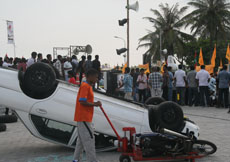
Later in the afternoon, a somewhat carnival atmosphere descended over the city as the Maldivian Democratic Party (MDP) staged a flag-waving counter-protest of several thousand people near the tsunami monument, alongside a concert stage and a police road safety campaign consisting of upturned cars and burned motorcycles.

Five lines of police blocked off Majeedee Magu.

“Anti-government protesters claim the uprising is inspired by the Arab revolution, that people power is rising up,” reported Al-Jazeera. “But here on the other side of town are thousands of voicing pointing out that the revolution has already happened.”

In an interview with the news network, President Nasheed accused the opposition of trying to reinstate authoritarian rule.

“I don’t think these are spontaneous demonstrations. If you look at the events and incidents [this week] it is very easy to understand this is very well stage-managed and fairly well played,” he said.

Al-Jazeera observed that “while leading opposition figures are clearly at the forefront of these demonstrations, they deny this,” and interviewed DRP Leader Ahmed Thasmeen Ali.

“It is not attempt overthrow or change the government, it’s just raising voices,” Thasmeen told Al-Jazeera.

Note: Maldives coverage begins at 0:50

Likes(0)Dislikes(0)

UN’s Sri Lankan war crimes report “singularly counterproductive”: Foreign Minister

Maldives Foreign Minister Ahmed Naseem has told journalists in Colombo that the UN report into human rights abuses in the closing days of the country’s civil war is “singularly counterproductive.”

The report was leaked to the Sri Lankan media several weeks ago and contains allegations that the army shelled hospitals, UN facilities and aid workers with the International Committee of the Red Cross (ICRC) in the final days of the civil war between the army and the Liberation Tigers of Tamil Eelam (LTTE).

The report also accuses the Sri Lankan government of intimidating and in some cases abducting journalists “in white vans”. The LTTE was criticised for allegedly using civilians as human shields.

A former UN spokesperson based in Sri Lanka told media after the report was leaked that it “damns the government of Sri Lanka’s so-called war on terror, which incidentally killed many thousands of civilians. The Tamil Tigers were equally rotten in their disdain for life.”

“The focus should now be on how the country can move forward,” Naseem said, during a press conference at the Galle Face Hotel.

“As a responsible member of the Human Rights Council, the Maldives believes it is imperative that the international community closely examine all aspects of the report before taking any further action.”

The UK’s television network Channel 4 has meanwhile said it will air what it claims is “probably the most horrific” footage the station has ever shown, after obtaining “trophy” videos of what it claims are Sri Lankan war crimes.

According to the network, footage obtained by the station includes “extrajudicial executions filmed by Sri Lankan soldiers as war trophies on their phones; the aftermath of shelling in civilian camps and hospitals alleged to have been deliberately targeted by Sri Lankan government forces; dead female Tamil fighters who appear to have been systematically raped; and pictures which document Tamil fighters alive in the custody of Sri Lankan government forces and then later dead, apparently having been executed.”

The Sri Lankan media has overwhelming supported the government against the UN report, contrasting war crime accusations from the West with the triumphalism displayed following the death of Osama Bin Laden.

“We suffered 30 years of ruthless terror, our innocent villagers were massacred, our security officers, innocent men, women and children were killed by suicide bomb blasts and snipers, our ministers, parliamentarians and presidents were killed or disabled for life, our children were massacred in trains, innocent travelers in buses were bombed, a bus load of our Buddhist priests were butchered,, our airports were bombed and terrorism restricted our daily existence,” wrote one commentator on the Lankaweb social media website.

Under the UN’s own regulations a formal war crimes investigation can only be launched on the invitation of the host country, or through a mandate voted by a body such as the UN Human Rights Council.

The Maldives has been a vocal member of the latter, and was quick to sever diplomatic ties with the Libyan government following “clear evidence that the Gaddafi regime is guilty of crimes against humanity and war crimes.”

“I’m concerned the UN report is a bit belated. Why say it now? Why not when the war was going on?” asked President Mohamed Nasheed’s Press Secretary, Mohamed Zuhair, speaking to Minivan News recently.

“My point is that this report only appeared after the war was over. We support the Sri Lankan government’s desire for peace and harmony, and any government that brought about that peace should be held in high honour,” Zuhair said.

If an investigation was to take place, Zuhair suggested, “it should happen in an independent manner, with reconciliation on both sides.”

Read the full UN report (English)

Likes(0)Dislikes(0)

Comment: Al-Islam huwa al-hall, from utopianism to hizbiyyah

Shura, ijma, and ‘amri bil ma’ruf wal nahyi’an al-munkar were largely formalities in the medieval Muslim world, and the situation was justified by Muslim jurists based on the notion of ‘ajz or impotence. At any rate, those concepts do not constitute a theory of a modern state.

Neither of the Islamists’ favorite jurists, Ibn Hanbal or Ibn Taymiyya, advocated rebellion against their respective dunyawi rulers. Such rebellion is only under ma’siyya. Ibn Taymiyya’s one of the most famous fatwas was not against his Memluke rulers, who by no means were particularly very religious, but was against the Mongols.

Equating state with religion: Maududi’s innovation

Therefore, what the most influential ideologues of Islamism, Abul A’la Maududi, did by advocating din wa dawla (not merely din wa dunya) was a clear break from the medieval conceptions of Islam.

Arguably, Maududi’s ideology was a reaction to an all encompassing modern state-formation and electoral politics dominated by the Indian Congress party at a particular point in time in India. His ideology was not intrinsic to Islam, for no founding texts of Islam has a theory of the modern state. Nation-states are all modern phenomena.

Failure of ‘al-Islam huwa al-hall’: lessons from Islamist politics

Again, advocating a bid’a concept of din wa dawla and condemning Nasser’s society as jahiliyya, Sayyid Qutb advocated a more militant strategy, but nevertheless an equally novel idea. We saw Qutb’s militancy taken up by several groups in Egypt and elsewhere to create an ‘Islamic state’ under the banner of al-Islam huwa al-hall. What happened? Clearly, we have not seen any ‘Islamic state’ anywhere in the world. The Islamist project of forcible change, under the banner of al-Islam huwa al-hall, has failed everywhere it was attempted.

After departing from Muslim Brotherhood’s founder al-Banna’s original and more conservative strategy of creating pious individuals, pious families, and a pious society first, which will then lead to an alleged ‘Islamic state’, Islamists learned lessons from their failure of militancy and re-embraced ‘Banna-strategy’.

Banna-strategy has, of course, been adopted by our Islamists, including Sheikh Mohamed Shaheem Ali Saeed and Dr Abdul Majeel Abdul Bari, in several of their writings and khutba. The ‘Islamic nahda’ we now see in the Maldives, through modern social movement strategies, is an outcome of this more conservative Islamism of focusing individuals and families, through prayer groups, mosques, schools, the Internet, the economy, and so on. There is, however, a limit to conservative Islamism too.

No Islamist party that had a platform of creating an ‘Islamic state’ had won a major national election in recent times. Neither in Turkey, where the AKP abandoned their former platforms, nor in Indonesia, where the almost 90 percent Muslim population chose reformist parties over Islamist parties, have we seen din wa dawla/al-Islam huwa al-hall platform succeed. But both Turkey and Indonesia saw a hitherto unseen level of increased Islamic piety and observance in their societies during the same period. Today, even Muslim Brotherhood is part of modern party politics/hizbiyyah who now at least pay lip service to democracy.

Not surprisingly, the Adalaath party too has failed miserably in the major national elections. If Adalaath party has an ounce of sense for political pragmatics, they need to learn from others’ failures. A utopian notion of Islam is neither al-hall for our social problems nor al-hall for Adalaath’s failures in electoral politics.

Din wa dawla: despotism and a mockery of religion

If al-Islam huwa al-hall means anything, then the Islamic Republic of Iran, where allegedly din wa dawla and velyat-e-faqih exist, would represent al-hall to life’s problems. Instead, what we see in Iran is not only brutal despotism, but also a mockery of religion. Khomeini, when faced with the complexity of a modern nation-state, authorised sacrificing even basics such as prayer if they contradicted the religious rule.

After all, what does it really mean to rally behind a utopian slogan of al-Islam huwa al-hall? A slogan is no hall to anything, except perhaps drawing few more members to one’s almaniyy/secular power politics. Virtue, piety, religiosity are all good things. But these utopian visions of the good life do not provide hall to drug-abuse, the housing crisis, gang-related violence, inflation, and violence against children and women.

The logic behind all utopian hall is absolute despotism: there is no way to make all people, even a majority in the Maldives, subscribe a single vision of the good life except through utter despotic force.

Blind taqlid and nifaq: failing shar’ah’s maqasid

Calling for codification of hudud punishments, while Qur’an emphasises a balance between retribution and islah, is blind taqlid of Islamists elsewhere. Moreover, enforcing hudud punishments only on the people who commit crimes cannot absolve us from our collective responsibility in these social ills. We as a society have collectively failed these youths. In our failed circumstances, Islam’s higher maqasid would not allow blind taqlidi implementation of fiqh.

Enforcing fiqh – which itself is a human outcome – through codified positive laws by a modern state with enormous power over the life and death of people of different conceptions of good life does not represent a particularly Islamic act. It is very much an almaniyy attempt. Democracy, parliaments, codifications of fiqh, positive laws, are all beset with almaniyya/secularism and are handled by very much almaniyy representatives who act not on the logic of piety but on the logic of power.

Besides, as other Muslim scholars have argued, Qur’an’s allowance for tauba and islah at all major instances of hudud punishment would be lost in a rigid codification of punishments to be implemented by an equally ad hoc and corruptible judiciary.

Thus, behind a false notion of satthain sattha/100 percent muslim qaum to codify fiqh is pure nifaq that is condemned in Qur’an. The banner of al-Islam huwa al-hall is in reality nothing more than a political party’s almaniyy strategy to mobilise political support.

However, if Adalaath party is to win the hearts and minds of a sizeable section of Maldivians, they must come out of the pretense of subscribing to an alleged Islamic notion of din wa dawla while at the same time attempting modern hizbiyyah.

All comment pieces are the sole view of the author and do not reflect the editorial policy of Minivan News. If you would like to write an opinion piece, please send proposals to [email protected]

Likes(0)Dislikes(0)

Corpse discovered in Male’ home

Maldives police have reportedly discovered a man’s corpse within a rented room in Male’ today, though have not disclosed any further details regarding the details of his death.

Haveeru reported that the body, which was identified by the newspaper as 26 year old Ahmed Shahid, was found within a house in the Henveiru area of the city.

According to the report, the room in which the corpse was discovered had been locked from the inside. Police have said they will disclose more details on the case at a later date.

Likes(0)Dislikes(0)

Parties launch protests as foreign media descends on Male’

Police this morning dispersed a rally of several hundred anti-government demonstrators who gathered at Republican Square near the headquarters of the Maldives National Defence Force (MNDF), amid a somewhat carnival atmosphere that settled over other parts of the city on Friday.

Dismissed Deputy Leader of the opposition Dhivehi Rayyithunge Party (DRP), Umar Naseer, and MPs Ali Arif and Ahmed Mahlouf were detained for an hour after allegedly shoving police.

After a run of demonstrations across Male’ this week in protest against the government’s decision to implement a managed float of the rufiya, effectively devaluing the currency, police on Wednesday announced that any protests not held in the open artificial beach or tsunami monument areas would be immediately dispersed.

The DRP, which insists the protests are ‘youth-led’ despite the apparent leadership of its MPs, has tried to replicate the ‘Arab Spring’ protests across the Middle East, painting President Nasheed as a despot to the international media and dubbing a busy Male’ intersection ‘Youth Square’.

The DRP announced that the protest would continue this evening at the artificial beach from 8:45pm.

Meanwhile, the ruling Maldivian Democratic Party (MDP) held a counter-protest this afternoon, with several thousand people gathering near the tsunami monument carrying banners and waving yellow flags.

Speaking at the rally, President Mohamed Nasheed stated that the government’s currency decision was backed by the International Monetary Fund (IMF), and challenged the opposition to defeat him in an election rather than attempting to topple the government illegitimately.

Nasheed claimed that the budget deficit had improved since the government took power, and that it had also introduced state pensions, health insurance and benefits for single parents and the disabled.

A concert stage and a number of upturned and smashed vehicles in the area, part of a police ‘Speed Kills’ campaign, provided a surreal backdrop to the pro-government demonstration.

An upturned car near the MDP rally, part of a police road accident campaign.

A number of foreign media outlets, including Al-Jazeera, have arrived in Male’ to cover the demonstrations after violent protests last week were widely publicised internationally.

Passing the DRP headquarters this afternoon and assumed to be foreign media, Minivan News was approached by an opposition supporter who compared the pro-government demonstrators to “pro-Mubarak supporters” who “beat us at night.”

Former Egyptian President of 30 years Hosni Mubarak was deposed by a democratic uprising in Egypt, leading to a tide of similar pro-democracy rallies across the Middle East.

Maldivian tourism representatives attending the Arabian Travel Market in Dubai, the region’s largest such expo, claimed this week to be receiving cancellations because of safety fears amid the ongoing demonstrations.

“Travel operators in Taiwan have said they are postponing and cancelling group bookings because of negative perceptions [of safety] in the Maldives,” a tourism source attending the expo told Minivan News.

“We just had another two confirmed bookings cancelled today because of reports of riots and instability. We worked hard to get these bookings and the potential domino effect is really worrying – people panic.”

Economic problems

An ongoing dollar shortage, reluctance of banks to exchange local currency, and a flourishing blackmarket that reached Rf 14.2-14.8 to the dollar, culminated in mid-April with the government finally acknowledging that the rufiya was overvalued – after a short-lived attempt to crack down on ‘illegal’ exchanges.

High demand immediately led to most banks and companies dealing in dollar commodities – such as airline ticketing agents – to immediately raise their rate of exchange to the maximum permitted rate Rf15.42.

With the Maldives almost totally reliant on outside imports, including fuel and basic staples such as rice, the government’s decision has effectively led to a 20 percent increase in the cost of living for most ordinary Maldivians.

In an article for Minivan News, Director of Structured Finance at the Royal Bank of Scotland Ali Imraan observed that ‘growth’ in the domestic economy had been driven by the public sector and “paid for by printing Maldivian rufiya and clever manoeuvres with T-Bills, which the government has used since 2009 to be able conveniently sidestep the charge of printing money. In simple terms: successive governments printed/created money to drive domestic economic growth.”

With the introduction this year of a 3.5 percent tourism goods and services tax, a business profit tax and a revision of the rents paid for resort islands, the government now has a number of economic levers it can pull to increase revenue in the future.

However, it has struggled to explain that to people now paying up to 20 percent extra for basic commodities – an affront to the MDP’s pledge to reduce the cost of living – and was caught unawares by this week’s populist protests.

Both factions of the opposition have seized the political opportunity to take the focus off the party’s internal troubles, but have offered few alternatives beyond demanding the government “reduce commodity prices”.

Read more on the Maldivian economy

Likes(0)Dislikes(0)

Police prepare for major demonstrations after sixth night of protests

Protesters in the capital city of Male’ gathered in the Artificial Beach area last night for a sixth night of protests, ahead of a major demonstration planned for today after Friday prayers.

The opposition Dhivehi Rayyithunge Party (DRP) maintains the protests are ‘youth led’ demonstrations against rising commodity prices, brought on by the government’s decision to implement a managed float of the rufiya.

Haveeru reported that despite warning demonstrators to remain in the open artifical beach area, police treatment of demonstrators was relaxed compared to previous evenings.

Groups of protesters split from the main group and attempted to gather in the intersection used as the focus of the protesters this week, but were dispersed by police.

Meanwhile, a senior government source claimed the Sri Lankan High Commission had called every hospital in Colombo in an attempt to locate local football star Assad ‘Adubarey’ Ali, who was flown to Sri Lanka for medical treatment after suffering injuries during the fifth night of protests in Male’.”
“He wasn’t admitted to any hospital in Colombo. He was however spotted in a Colombo nightclub,” the source alleged.
Haveeru reported yesterday that Assad had suffered “soft tissue injury” from force applied by a riot shield.

Dismissed deputy DRP leader Umar Naseer and several DRP MPs, including Ali Arif and Ahmed Mahloof, were briefly detained by police, and protests dissipated around 1:30am.

This morning riot police and Maldives National Defence Force (MNDF) personnel could be seen gathering in Republican Square ahead of mass protests the opposition has scheduled for this afternoon.
Likes(0)Dislikes(0)