Tension surges in Male’ as police arrest former President Mohamed Nasheed

Photo courtesy Jaawid Naseem, Jade Photography

Former President Mohamed Nasheed has been arrested by police ahead of his trial hearing at Hulhumale’ Magistrate Court, scheduled for 4:00pm tomorrow (March 6).

Police Spokesperson Chief Inspector Hassan Haneef confirmed that Nasheed had been arrested and taken into police custody at 1:30pm today (March 5).

“We have received the order. Police have taken Nasheed into custody in order to produce him at Hulhumale’ Magistrate Court 16 hours from now,” Haneef told Minivan News.

Photos of the arrest showed several dozen police wearing balaclavas and black riot gear, several armed with rubber bullet guns, entering Nasheed’s family home in Male’ and emerging with the former president.

Shortly after the arrest, Minivan News observed President Mohamed Waheed’s brother Ali Waheed forced off his motorcycle by several dozen angry demonstrators on the main road Majeedee Magu, at the turnoff to Nasheed’s house. A second, larger group pulled Ali Waheed to safety, abandoning his motorcycle. The first group then attacked a parked military vehicle, smashing a window.

A group of people including Nasheed’s representative on the Commission of National Inquiry, Ahmed ‘Gaha’ Saeed, blocked the road, trying to calm the more violent protesters. One man had laid down in the middle of the street as part of a silent protest.
“People have waited a year since the coup and are very angry and unlikely to act reasonably. They could bring Male’ to a standstill,” Saeed said.
Former Environment Minister Mohamed Aslam, arriving at the scene, said “There is no plan. People are agitated, they are angry. There is no plan, there is just outrage.”

Nasheed’s latest trial hearing follows his exit from the Indian High Commission last month, after the Maldivian and Indian government came to an alleged “understanding” that he would be able to conduct a peaceful campaign and participate in an inclusive election.

The former president told Indian media on Sunday (March 3) that while he had ended his 11-day stay in the Indian High Commission, he was still not entirely free and feared an arrest warrant would be issued against him any day soon.

Maldivian Democratic Party (MDP) Spokesperson Hamid Abdul Ghafoor confirmed to Minivan News that there were Special Operation (SO) officers outside Nasheed’s residence earlier today prior to his arrest.

“He has been taken away to Dhoonidhoo [prison], we are still in a state of shock,” Hamid said.

The former President sought refuge inside the High Commission building on February 13 after Hulhumale’ Magistrate Court ordered police to produce Nasheed at his trial hearing scheduled for later that day.

Nasheed has maintained that the charges against him – of detaining the Chief Criminal Court judge during his final days in office – are a politically-motivated effort to prevent him contesting the 2013 elections.

Nasheed spent 11 days inside the commission building before making an unannounced exit on February 23.

Following his exit from the High Commission, the Hulhumale’ Magistrate Court issued a travel ban to Nasheed, preventing him from leaving the country.

UPDATES

2:30pm: Shortly after Nasheed’s arrest, Minivan News observed President Mohamed Waheed’s brother Ali Waheed being pulled off his motorcycle by several dozen angry demonstrators on the main road Majeedee Magu. A second, larger group pulled Ali Waheed to safety, abandoning his motorcycle. The first group then attacked a military vehicle, smashing a window as it tried to move past the group.

3:00pm: More people are arriving outside the City Council Building near the demonstration, nearing a hundred people or so in size. Shops in the vicinity are closed, and one man is lying down in the middle of the road, stepped over by the occasional pedestrian. People on motorcycles are stopping to look, and turning around to find another route.

3:10pm: A separate group of two dozen men are turning away traffic at the next intersection, in an apparent attempt to shut down Male’s main road. No sign of police presence yet. A man passes through the blockade with a young girl on a motorcycle, to shouts of “baghee” (traitor).

3:12pm: Nasheed’s brother Dr Nashid tweets: – “given all clear to go to Dhoonidhoo [detention centre]. Waiting for Laila [Nasheed’s wife]”. In a second tweet, he adds that Nasheed’s bodyguards “were changed this morning.”

3:28pm: President Waheed tweeted: “Assaulting my brother Ali Waheed will not help Nasheed escape justice.”

3:30pm: A pickup truck is circling Male’ calling on people to come out on the streets. Light rain earlier has since cleared up.

3:37pm: Photos circulating on social media appear to show one of Nasheed’s bodyguard being restrained by police as the former President was escorted outside his family home.

3:39pm: Approximate 30 police have arrived at the scene. Demonstators threw plastic bottles at officers, who subsequently departed after detaining former Environment Minister Mohamed Aslam. The crowd numbers around 200 people.

3:42pm: SunOnline reports that protesters on Majeedhee Magu have pushed off a uniformed police officer from his motorcycle as he was driving through the protesters. The policeman abandoned his motorcycle and left on foot when the crowd moved to attack him, Sun reports.

3:44pm: Abbas Faiz, South Asia Specialist for Amnesty International tweets: Amnesty investigating concerns that former prez Nasheed arrest politically motivated and his safety uncertain.

3:46pm: A masked man climbed up the posts on which CCTV cameras are mounted on the junction of Majeedhee Magu and Alikilegefaanu Magu and spray-painted the camera, reports Sun Online.

4:01pm: A video of Nasheed outside his house has emerged on DhiTV, titled ‘Anni’s Quarrel’. In the video, a Special Operations police officer states: “We will accompany you there.” Nasheed: “Well, let’s go then. I won’t go in that way. I am doing what is good for you… I will know better than you. Let’s go already.” [Former Foreign Minister] Naseem: “He is going, isn’t he? What is wrong with you baaghees (traitors)?” “Nasheed: Sigh. What more can I say? Even I would know these laws and responsibilities. For God’s sake, let’s just go. Let’s go quickly. Let’s just go quickly.”

4:03pm: The Maldivian Democratic Party has issued a statement condemning the arrest:

President Nasheed was arrested while walking down the street in Male’ at approximately 13:45 local time today. He was apprehended by numerous armed and masked police officers, who did not identify themselves, nor produce an arrest warrant or court summons. Nasheed’s lawyers were not informed of the arrest, or of any court summons.

President Nasheed was taken to Dhoonidhoo Island detention centre – the facility in which he was tortured during the former regime of Maumoon Gayoom.

Commenting on the arrest, the MDP’s international spokesperson Hamid Abdul Gafoor said: “Once again Dr Waheed has proven that he can’t be trusted to hold a free and fair election – despite his assurances to the international community.

“Nasheed was supposed to be on an election campaign trip but instead he is languishing in jail.

“This arrest comes just days after the UN Special Rapporteur on the Independence of Judges and Lawyers, Gabriela Knaul, said the judges overseeing President Nasheed’s case had been appointed “arbitrarily”.

“Dr Waheed, in collusion with his friends in the judiciary, is pulling out all the stops to prevent President Nasheed competing in the elections.”

The UN Special Rapporteur also said that the Judicial Services Commission, which established the court trying President Nasheed, was “politicised” and subject to “external influence”.

4:07pm: The Maldives Journalists Association (MJA) has issued a statement condemning an attack on Sun journalist and a VTV cameraman:

Maldives Journalists Association (MJA) strongly condemns the violent attacks carried out against a journalist and a cameraman while covering the arrest of former President Nasheed today.

The journalist from sun.mv was attacked and tore his shirt and snatched his mobile phone while VTV cameraman was attacked and snatched his video tape in his camera. Both the incidents was happened near former president Nasheeds residence. We strongly call on all parties to allow media to do its duty without any harrasements. And also call on all responsible authorities to investigate the above incidents and call on media regulatory authorities to not to allow ‘hate speech’ on media.

4:11pm: President’s Office Spokesperson Masood Imad told Minvan News: “I have already told Indian and local media that the Maldives government has made no deal with the Indian government over Nasheed’s exit from the Indian High Commission. It was never said there would be a delay in Nasheed’s trial hearing, or his court case or any other matter involving him.”

“[The government] cannot make any delay or decision based on legal matters because it is not our business, it is the judiciary’s decision,” Masood said.

Asked if Nasheed’s arrest would harm relations between Maldives and India, Masood said: “If we had made a deal and broken it, then that would be an issue. But we have not made any deal, and there has been no deal between India and the Maldives regarding Nasheed’s case. There was no understanding between the respective governments. If Nasheed thought there was an understanding, it must have been something he understood. There is no dealing between us and the judiciary on Nasheed’s judgement, It is totally up to the judiciary, we will have have no interference with the court. I did not know that the court would order police to summon Nasheed today.”

4:21pm: Scuffles are breaking out between protesters and passerbys they deem to be “baghees” (traitors). One woman clung to a man screaming as the crowd surrounded them. “There is hatred here,” said one protester. “He was asking for it. He could see there was a [blockade] but came through anyway.”

The attitude of the crowd is divided between the angry and those appealing for calm. Around 20 riot police have arrived with shields.

4:30pm: Police reinforcements have arrived at an nearby intersection, heckled by the crowd of 200 demonstrators blocking the road.

4:31pm: A middle-aged women was arrested after heckling and singing songs, and was dancing in the back of the police truck. A further five or so individuals have been arrested.

4:36pm: Police have brought the area under control and are now directing traffic.

5:30pm: The US Embassy in Colombo has issued a statement:

The United States is increasingly concerned about ongoing events in Malé. We understand that both the Police Integrity Commission and the Human Rights Commission are monitoring the situation, and that the Human Rights Commission has requested access to Former President Nasheed.  We urge all sides to remain calm, reject the use of violence, and avoid rhetoric that could increase tensions. Former President Nasheed must be accorded due process under the law regarding his pending court cases.

We urge that the Presidential elections scheduled for September 7, 2013 be free, fair, credible, transparent and inclusive. The integrity of and public confidence in the Maldivian electoral process must be maintained. Accordingly, we note that all parties participating in these elections should be able to put forward the candidate of their choice. We also call upon the Government of the Maldives to implement all the recommendations of the Commission of National Inquiry (CONI) report, including the recommendations related to judicial and governmental reforms.  We continue to urge all parties to chart a way forward that strengthens Maldivian democratic institutions, the rule of law, human rights and fundamental freedoms.

5:30pm: Sun Online reports that protesters have rolled over a Redwave van (owned by shop owner Eydhafushi MP Ahmed Saleem) near Male’ City Council. The van was broken into, milk packets were taken and subsequently distributed to protesters.

5:51pm: British entrepeneur Richard Branson has tweeted on the Nasheed arrest: “Maldives former president Nasheed arrested, in court tomorrow. Hope he is treated with respect & fairness”.

6:31pm: Local media has reported that police have once again left Majeedee Magu.

7:10pm: Some 150 demonstrators remain on Majeedee Magu, situated around 20 metres from the Male’ City Council building. No police presence is witnessed by Minivan News at the current time, although traffic is still being diverted as a result of the makeshift blockade.

8:52pm: At a press conference held this evening, the Maldives Police Service have said that a total of 47 people were arrested so far during demonstrations today on Majeedee Magu.  Of those arrested 31 were male, 16 females were also detained.  Among those arrested was MDP MP Ahmed Easa, who authorities said was later released.

Likes(1)Dislikes(0)

“Illegitimate address by coup president warrants no official response”: MDP PG Leader Ibu Solih

Maldivian Democratic Party (MDP) Parliament Group Leader Ibrahim Mohamed Solih (Ibu Solih) has stated that the party will not be responding to the presidential address delivered by President Mohamed Waheed Hassan during Monday’s parliament opening ceremony.

Solih said the statement held no legitimacy as Waheed himself was an illegally installed president, and hence warranted no official response.

“Waheed is in his position through a coup d’etat. A year having passed since does not change that fact. That is what we demonstrated in parliament today,” Solih told local media.

“We are only obliged to respond to a presidential address given by a legitimate leader.”

If Waheed were to be a legal president, then he would be representing MDP. Were it so, then MDP would not need to respond to the address, and the task would be for some other party. So, in either of those instances, MDP has no obligation to respond to Waheed’s statement,” he continued.

MDP also refused to respond to Waheed’s address in 2012.

Parliament regulations state that the majority and minority parties in the parliament besides the one that the President represents must issue a response to the presidential address within a period of 14 days after it being issued.

Solih furthermore expressed concern over some actions during Monday’s parliamentary session.

“While the session was in a recess, an MNDF officer attacked one of our MPs. I saw this happen with my own eyes. I have already lodged a complaint about this with the parliament speaker. The security officer was removed from the parliament halls at the time. Incidentally, we have also identified him,” Solih alleged.

Solih also alleged that the party’s objective during this parliamentary year was to pass many of the important bills that have been pending for long periods of time.

“I believe this year we will see a lot of productive work being completed here. One of these pending bills is the Penal Code. Hopefully, this bill will be passed as law within the month,” Solih stated.

Presidential Address in six hours, six attempts

President Mohamed Waheed Hassan delivered the presidential address in parliament on Monday through six separate attempts made through nearly six hours.

The Maldivian Democratic Party (MDP) MPs staged protests inside the parliament chambers while simultaneous protests by party supporters carried on outside parliament, with thousands of supporters chanting “coup president resign now” and “we want an interim government now”.

While normal procedure during previous instances where a president speaks in a parliament is to fly the presidential flag alongside the national flag and the parliament flag, no such flag was hoisted during Monday’s session.

Waheed was prevented from entering the main parliament hall twice, and he proceeded to deliver the presidential address in four separate installments. Local media reported that Waheed had omitted much of the 17 page speech that had been distributed to media ahead of the parliament meeting.

Three of these times, he was led out of the hall by Parliament Speaker Abdulla Shahid due to disruptions caused by MDP MPs who were echoing the chants of “baaghee” [traitor] inside.

After Waheed concluded his presidential address, MDP MPs joined the street protests which were being carried out on Sosun Magu.

Former President and MDP Presidential Mohamed Nasheed joined to greet the MPs as they entered the gathering to the sound of loud cheering from party supporters.

Before the protest was concluded, MP Ali Waheed addressed the crowd, stating that the party would continue protesting against what he alleged is a “coup government.”

“What we have witnessed is the beginning of the end of Waheed’s coup administration,” MP Waheed told the gathered crowds.

“Just like the old dictator Maumoon had to retreat into his cave, Waheed will have the same fate,” he said.

“The events we saw in Majlis has proven a lot of things. The fact that members from all the other parties stayed quiet and did not attempt to intervene in our protests say a lot. They have said ‘no to Waheed’ in the loudest form that they can while they are still part of this current government,” Ali Waheed said.

“Around 30 of our MPs managed to hold Waheed back from speaking in parliament for over five hours despite him coming surrounded by police and army. There is hope that we will be victorious,” Ali Waheed said in conclusion of his address before the party marched off, bringing an end to Monday’s protests.

Likes(0)Dislikes(0)

President delivers address to parliament after six hours of heckling

Additional reporting by Mohamed Naahee.

President Dr Mohamed Waheed Hassan Manik has delivered his opening address to a boisterous parliament amid protests inside and outside the parliament chamber.

Waheed, who was due to deliver the address at 10:00am this morning, finally finished it at 4:00pm on the fourth attempt after repeated obstruction by opposition Maldivian Democratic Party (MDP) MPs.  Representatives from the party waved pieces of paper at him with phrases such as “illegitimate president” and “coup boss”.

Under the 2008 constitution, the head of state is required to deliver the opening address at the first sitting of parliament each year. The MDP contend that Waheed’s presidency is illegitimate, following the resignation of President Mohamed Nasheed on February 7, 2012, amid a police and military mutiny. The party disrupted last year’s opening session by blockading the chamber doors from the inside, while outside supporters clashed with police in the streets.

A sit-down protest in the afternoon at the Sosun Magu intersection appeared peaceful, although police had barricaded the roads around the parliament building. Inside, local media reported that five MPs left the chamber voluntarily after being ordered to do so by Speaker of Parliament Abdulla Shahid.

Deputy Parliamentary Group Leader of MDP Ali Waheed announced on Sunday that “usurpers don’t get to deliver presidential addresses”.

In his address, an English summary of which later appeared on the President’s Office website, President Waheed emphasised “independence and territorial dignity” and described his highest priority as “strengthening the principles of Islamic faith among the people.”

“Underscoring that the Maldivians have always defended their independence from foreign influence, President Waheed stressed on the sacrifices made by our ancestors with their lives and blood,” read the statement.

“In his Presidential Address, the President noted that the keystone of our independence is the allegiance of our forefathers to the ideals and integrity of the Maldives, and that the foundation of our unity lies in Islam. The President said that our common faith, language and ethnicity were the reason why our nation should not disintegrate into opposing factions.

“Continuing in this regard, the President reminded the people to be vigilant of the patience and determination necessary to maintain our independence and individuality, and to unwaveringly hold on to our Islamic faith,” the statement concluded.

According to local media, Waheed also remarked that the economy had “fallen into a pit” at the time he took over the presidency, with external debt of US$725 million.

Expropriating the airport from Indian infrastructure giant GMR – at the time the country’s single largest foreign investment at US$511 million – had increased foreign currency coming into the country and relieved the dollar shortage, Waheed said according to Sun Online.

Speaking to Minivan News, Deputy Parliamentary Group Leader of government-aligned Dhivehi Rayyithunge Party (DRP) MP Abdulla Mausoom said that the party would not support such “extremist” activities on the parliament floor.

“DRP will never support such activities. We will support to uphold rule of law and therefore the party would behave and strictly follow the parliamentary regulations,” he said.

He further claimed that “irresponsibility” and “stubbornness” within the parliament would not favour the MDP, and said the party should replace its leadership with “democrats” instead of “rogue extremists”.

“There are a lot of democrats working with the MDP. Many of them are in the parliament as well. But their hands are tied, their mouths taped and their pens capped. They should not bow down to the extremist elements within MDP,” Mausoom said.

Likes(0)Dislikes(0)

Former JSC Member calls on Parliament to review JSC’s 2010 appointment of judges

Former President’s Appointee to the Judicial Services Commission (JSC) Aishath Velezinee has called on parliament to review the appointment of judges and to begin to make the JSC accountable.

Speaking at a press briefing on Sunday, Velezinee pointed out that while a week has passed since UN Special Rapporteur on the independence of judges and lawyers Gabriela Knaul had released her preliminary findings, the JSC, Supreme Court, Attorney General, the Law Community and the Judges’ Community had failed to make any official comments on the findings.

She added that while it was important for all relevant actors to reflect and act on the recommendations, she especially hoped that the parliament would review the concerns raised by Knaul upon the beginning of its new session.

“Most serious case of corruption yet”

“Article 13 of the Act Against Corruption states that it a very serious form of corruption to obstruct citizens from receiving any benefits or good,” Velezinee said. “what is a more serious case of corruption than cheating citizens out an independent judiciary?”

Velezinee stated that since the complaints on the matter she had filed with the parliament in 2010 had never been examined, dueto political reasons, she had then submitted the case to the Anti Corruption Commission (ACC).

“In light of the background information I had, I saw a coup d’etat being rolled out when the then opposition set to the streets to ‘find Ablo Ghazi’ [Criminal Court Chief Judge Abdulla Mohamed] in January 2012,” Velezinee said.

“Therefore, I wrote to the ACC about these observations and enquired how far the case I had submitted had proceeded.”

“I got a response on February 6, 2012. The ACC said they had sent the details to the Independent Institutions Oversight Committee of the parliament on September 9, 2010,” she continued.

“Why then was the chair of this committee, independent member of parliament Mohamed Nasheed seen among the opposition group on the streets looking for Judge Abdulla Mohamed in January last year? Until the case at the committee is properly investigated there is no Judge Abdulla. What I see is Abdulla Mohamed of Bahaaruge from the island of Hulhudhufaaru just passing himself off as chief judge of the Criminal Court.”

“If we are to refer to the ‘rule of law’ and ‘due process’ that Home Minister Mohamed Jameel Ahmed keeps referring to, then no judges were appointed during my time serving in the JSC,” Velezinee stated.

Parliamentary initiative

“I have been continuously saying that numerous criminal offences have been committed within the JSC. The allegations I make against them are not matters that can be taken lightly. Hence, it cannot be at all acceptable to let the JSC continue with their duties without the parliament’s Independent Oversight Committee investigating these claims,” stated the former JSC member.

“One action that can be taken by the parliament even immediately is to enforce transparency in JSC proceedings and make their sessions accessible to the public,” she said.

“If the JSC meetings are seen by the public, no one else will need to run around like I did with concerns about the commission. Citizens will witness proceedings themselves. This in turn would ensure they do not get any opportunities to do wrong in there,” Velezinee recommended.

JSC politicised and ineffective

“Many of the recommendations shared by Knaul are matters which the JSC, initially constituted after the ratification of the new constitution in 2008, was mandated to do. Incidentally, I was then a member of this commission,” Velezinee said.

Velezinee stated that she had put in a lot of effort during her time at the JSC to align the commission’s work to the mandate it was constitutionally given, but said she had failed to achieve her goal.

“The JSC failed to establish a free and independent judiciary as detailed in our constitution. You must have seen the oath taking ceremony held on 4th August 2010 of the existing judges who had not been screened as per the due process. As a result of this failure, we have been hearing since that day, in local media and in various international forums, comments about how there is no justice in the Maldives, how judges lack freedom, and how the judiciary is politicised,” Velezinee stated.

While Knaul recommended that the JSC be reconstituted to free it from the current political influences which inhibited it from fulfilling its constitutional duties, Velezinee said she felt the failure of the commission was more a result of the members’ refusal to abide by the disciplinary guidelines than the nature of their political backgrounds.

“They [JSC members] always say that the constitution provided us with two years to build up the judiciary. But that is an outright distortion of what really is in our laws,” Velezinee stated.

“The constitution gave us two years to lay the foundation. It, however, allows us a period of 15 years in which we are to build an independent judiciary to an internationally acceptable standard. Nevertheless, even this article has been discarded without fulfillment by the JSC.”

Stating that the International Committee of Jurists (ICJ) had made similar comments in 2010, Velezinee said that Knaul’s findings indicated that the problems which had existed then had continued to elevate.

Velezinee alleged that the public were left unaware of the seriousness of the problems in the judiciary due to the highly politicised dialogue around the issues in the judiciary that were being put forth by various politicians.

“Article 285 is the foundation on which the constitution of the Maldives is based on. I sincerely hope that the parliament members will take a step back and review the events that took place when this article was breached in 2010 – matters that no state body previously paid any attention to – and that the parliament will this time around ensure that the people of the Maldives is guaranteed an independent judiciary free from any form of influence, and a proper democratic system,” Velezinee continued.

Velezinee furthermore criticised local media’s coverage of Knaul’s remarks, stating that some articles had sought to make implied political statements by picking out a single concept that Knaul had referred to, instead of focusing on the main issues.

Asked for a response to Jumhooree Party MP, leader, presidential candidate and member of JSC Gasim Ibrahim’s remarks about Knaul’s findings being “lies, jokes”, the former member dismissed these remarks as irresponsible.

“A man of Gasim’s status should not be making comments like this. Being an MP, a JSC member and a presidential candidate, it could prove dangerous to him to make irresponsible comments of this nature,” she said.

Unlawfully appointed judges

“Since there are so many contentious issues around the appointment of judges, we must keep a keen eye on events that unfold in the next couple of months,” Velezinee stated.

“We are now in the midst of some very strong political battles. I, for one, suspect that the current judiciary may abuse its powers to orchestrate political plots planned to interfere in the independence and fairness of the approaching presidential elections, and use the Supreme Court to issue rulings in favour of a particular side,” Velezinee predicted.

Adding that many citizens held similar doubts about the judiciary, Velezinee called on political leaders to set aside differences, engage in dialogue with international experts to find a lawful means to carry on all proceedings related to the elections through a system other than the existing Supreme Court.

“We must find a way to have inclusive presidential elections here, one that will be widely accepted by all. Perhaps one way might be to consult with international experts and then set up a judicial bench. This bench can be tasked with presiding over all cases relevant to the elections,” Velezinee said.

“Yes, this is an extraordinary idea. Then again, no other country has seen anything like Article 285. No other country has had the need to completely overhaul a judiciary,” she stated.

Velezinee served as President’s Appointee to the JSC from April 2009 to May 2011. She has been vocal about the problems in the commission and the judiciary, and in early 2011, was stabbed three times in broad daylight.

Likes(0)Dislikes(0)

Translation: PPM Deputy Leader Umar Naseer’s statement to CoNI

This article first appeared on Dhivehi Sitee. Republished with permission

On 13 May 2012, PPM Interim Deputy Leader and 2013 presidential candidate, Umar Naseer, gave an interview to the Commission of National Inquiry (CoNI) on how the events of 7 February 2012 unfolded. This is a translation of the part of the interview focusing specifically on the protests of 6 February and the subsequent events that culminated in President Nasheed’s resignation.

Oh, yes. When this Mohamed Nasheed got power in 2008 he was already accused of being an irreligious man who would shatter the economy and destroy our religion. So, as a senior leader of a responsible political party, we were watching it very closely. The more we watched, the more we saw how he was establishing relations with Israel, what he was receiving from various churches to spread Christianity in the Maldives, how he was selling our natural resources to foreigners, and what he was doing to end our sovereignty.

Watching all this, we were certain that it was incumbent upon every single one of us to end this man’s rule. The question for us political leaders was whether to end it within or outside of the law. We decided to end that man’s rule from within the law. We did everything we could to achieve this goal. Protests, submitting numerous petitions to Majlis [parliament], filing court cases…we did all this continuously.

At the same time Mohamed Nasheed was issuing various unconstitutional orders. Through the government, he was also making attempts to force police and military to follow unconstitutional orders. We know he was doing this. We know a lot of people in the military, the police and the government. They were informing us.

By the evening of 6 February, we had shown very clearly to the people of the Maldives that Mohamed Nasheed is a man trying to spread other religions in the Maldives, that Mohamed Nasheed is a man who was trying to sell our sovereignty to other countries. We were able to convince every Maldivian that he had directly violated our Constitution. It took a huge combined effort over three years to arrive at this point: protests that continued for 22 consecutive nights and the many previous protests, the cases that were filed in court. It had been made blatantly clear to all Maldivians.

So, that protest on the night of the 6th , well that was a protest we weren’t planning on ending.

Before this, by the 2nd, MDP had started bringing out its paid thugs to confront our protests. These included criminals released under the Second Chance [government rehabilitation programme for offenders] and paid gangsters from all over Male’. Before we started our protests, they tried to intimidate us, coming there with knives and such like. So we were encouraging PPM activists and others to confront them.

Anyway, on the evening of 6th February, a large number of Second Chance criminals and gangsters paid by Mohamed Nasheed intended to confront us with iron rods and bars. They faced us at the Artificial Beach, where our protests started near the stage. They started their protests about 50 feet away from us, with loudspeakers. Their intention was to stop our protest. Police intervened, set up a cordon separating the two sides, and remained between them.

We were continuously telling the police that Mohamed Nasheed arrested Abdulla Ghaazee against the Constitution and that he should be released immediately. It was not just about Abdulla Ghaazee; the plan was to attack the whole judiciary.

We had information that on 8 February Mohamed Nasheed would close other courts in the Maldives, send all judges home, and acting on his own, would establish a Judicial Reform Commission. From then onwards, it would be this Commission that would appoint all magistrates. We knew this. The plan, so, was to destroy the country’s entire judicial system. We were sharing this information with various people who were in this with us.

The night of the 7th was the turning point.

If we give them space until the 8th, they would destroy the entire Maldivian judiciary.

On that day we confronted them with our—and their—biggest thugs. If attack became necessary, we were ready. That’s how we came out that night to the Artificial Beach.

The other side also brought out their full force.

The police came between the two sides—why? Because they knew that night’s would be the biggest of confrontations. I notified Faseeh [Commissioner of Police] by SMS that there would be a bloodbath there that evening if he did not monitor the situation properly. Faseeh guaranteed that police would maintain control and peace.

Anyway, on one side our people were speaking, and on the other side, they were speaking over loudspeakers, too. It did not go to a confrontation, but people on both sides were throwing things like water bottles at each other. All of a sudden we saw the police withdraw. I think Farhad Fikry was the main police officer there. I sent him a text message asking him why the police had withdrawn.

“The military are going to takeover. We have received orders from the Home Minister,” Farhaad replied.

I sent a message to Faseeh. He did not reply.

I told senior MNDF officers that the military will find it difficult to control the situation. They don’t have much training in controlling civil disorder unlike the police, an elite force in such situations. We saw the military going in, police withdrawing, and then the military withdrawing shortly afterwards. When we saw the military withdrawing, we knew Mohamed Nasheed’s plan was to get both sides agitated so he could declare a state of emergency.

That’s the plan Mohamed Nasheed had prepared for 8 February to destroy the judiciary: take it under his personal control; sack judges and other appointments made by the JSC; close all the courts; extralegally appoint people he and Maria approve of to the Judicial Reform Commission, which will then takeover all powers of the judiciary. Getting PPM and its coalition partners in a confrontation with thugs paid for by the MDP, causing a bloodbath, and then using it as an excuse to declare emergency—that was the last phase of that plan. We knew that.

I said this immediately to our supporters, that declaring emergency was the other government’s strategy. I told them this is why a fight was being prepared for.

Even as the military began withdrawing, I said to senior MNDF officials:

“We know the strategy. It is to declare emergency. We won’t obey any such emergency,” I told them.

The confrontation was imminent.

Suddenly, we saw Mohamed Nasheed’s thugs begin throwing stones. Our line retreated a bit. Soon, though, our line recovered and advanced with equal force. Throwing stones, we made them retreat. We were in very close combat when we saw police arriving at the scene.

I don’t know what sort of orders they were following, we didn’t know if any orders had been given at all. They came and sprayed tear gas on both sides and separated them. Our troops backed down and moved near our jagaha [party base]. Troops on the other side retreated.

On our side, the command was for our troops to keep advancing without attacking, and to control our territory. We received news that police were running after the MDP thugs. We were still in position when we heard the police had gathered at the Republic Square and declared their refusal to obey unconstitutional orders. This gave us much encouragement.

Why? Because that’s what we wanted. No Maldivian should follow any illegal orders.

We ordered our supporters to gather at the Republic Square, which they did. But the other military came out and stopped them from getting in. They blocked off the MMA area, Chandhani Magu intersection and Bandara Mosque. This led to a bit of a confrontation between our supporters and the military. Tear gas canisters—about 10 of them—were thrown at us. Our focus was on getting our supporters onto the Republic Square, so, we continued to engage despite the canisters.

Suddenly, those Second Chance criminals of MDP I was talking about, and MDP thugs, approached from the direction of Bandara Miskiyy [Mosque]. Armed with iron rods and bars, they began attacking our people near the MMA. Our people retreated in shock. Some tried to flee. But, when the leaders among our people advanced as one group and counter-attacked, the MDP thugs retreated. There was a lot of violence at that point. An MDP person had to be hospitalised.

We learned later that these people had been drinking alcohol. Waheed Deen [current Vice President] was the supplier. At the time, Waheed Deen was a big MDP supporter. It was inside Mulee Aage the plan to attack us near MMA was hatched. Usually they ply these people with alcohol before sending them out. That night they couldn’t get any alcohol, until they found some from Bandos [Island Resort]. Waheed Deen made the arrangements. We know that.

He is the Vice President now, but Waheed Deen is a man who made several attempts to stop our activities. It is after doing all this in vain, and when we heated things up, that he came and joined this government. These MDP thugs, drunk on the booze supplied by Waheed Deen, attacked our line and caused head injuries to about five of our people. One of our main lieutenants got an iron bar in his chest. It wasn’t put into the chest, but it caused serious injuries. About 10 of our people were hospitalised. I was informed of this by our people guarding the hospital.

That was MDP’s first attack on us that night.

Still, we continued to engage with the military. They were firing gas canisters. We kept up our attempts to get onto the Republic Square. Our purpose was to support and encourage the police not to follow unconstitutional orders. That’s a basic right the Constitution gives us, that’s why.

Amidst these attempts came MDP’s second offensive of the night. This was also carried out by a big group of drunkards. We, all our activists, got together and foiled that attack too. There were no more attacks from MDP that night.

The confrontation between us and the military was still continuing. Tear gas canisters were still being thrown. We forced them to retreat, too. Our troops continued to engage with the military. The purpose was to get to the police.

As the sun came up, we saw the military abandon their positions and leave. All our supporters spilled on to the Republic Square. Once there, we worked with the police, really. We gave them all the assistance they needed. We knew they hadn’t had any food all night, they had no water to drink, nothing. We told the police that the water, the energy drinks. All that we were supplying them, we would supply them to the military too, and to any member of the public who wanted them. So, we supplied everything to everybody.

Then, as the sun rose, we saw Mariya [Didi] and some MDP MPs forcing their way into the Republic Square. We saw them shouting at the police, almost assaulting our people. Again, there was a violent episode. Why? Because MDP people came with planks and things. Mariya and them may not have been carrying such implements themselves, but the MDP people who came with them had metal bars, rods, knives and the likes. Our people had no choice but to confront them. There was major violence. The MDP people who came with Mariya retreated.

I was communicating with the Defence Minister then.

I told him:

“Mohamed Nasheed has two options tonight: release Abdulla Ghaazee to respect the constitution or resign voluntarily.”

By then I had communicated with the Defence Minister about four times. The Defence Minister and I, we are very close. We trained together in the military, and we had been classmates. We did all our military training together. So we are very close. We were in communication with each other.

“Choose one of the two options, or face mortal danger” I kept telling Tolhath [to tell the President].

I did not mean that the threat to life came from the police or the military. There were thousands of people gathered there, they were trying to get into the military headquarters. We knew that even if they managed to get in, the military would not dare shoot them. Which means their lives were in danger. Our control was lost at the time too.

Although we were the direct moral authority, we knew that right then—with a crowd that large—things could only go the way the crowd wanted it to. We knew very clearly it wanted: Mohamed Nasheed’s resignation. It was very obvious to us. That’s what they were all calling for. It was not the police or the military who were demanding it; it was the public. The public were demanding Mohamed Nasheed to resign immediately, to release Abdullah Ghaazee immediately.

That’s what I relayed to the Defence Minister.

He suggested that I go in and speak to the people, and asked for some time for the government to make a decision on Abdulla Ghaazee.

“There has been enough time. It has been 22 days. No more time to give. Now there are only two options left. Pick one, or face mortal danger,” I said.

By mortal danger, again, I mean danger from the public, the possibility that the public may force their way into the military HQ.

As these exchanges continued, around 7:00 that morning, we grew certain that Mohamed Nasheed’s rule could no longer continue.

Why? Because by then they had used up all the tools in their possession against us. All their thugs had been used. We had responded to all attacks by the thugs and destroyed everything. We had been monitoring their jagaha. The motivation and morale there was very low. We knew they were no longer capable of regrouping and launching a counter-attack. We were sure of this by about 7:00 that morning. Their last attack, like I said, was the attack by Mariya.

So we were sure that Mohamed Nasheed’s rule was at an end.

The only way to maintain it was for the military to come out and start shooting. We knew the military wouldn’t do that. I don’t think the Maldivian military would ever fire a gun again. They were blamed for shooting someone that needed to be shot in jail. We knew they would never shoot anyone after that. But we also knew they would use rubber bullets, tear gas, every other power technic they could, to disperse the public.

Once we were sure that MDP would not attack again, I said to Tolhath:

“Tholhath, all your options are exhausted. Tell President Nasheed to resign or release Abdullah Ghaazee immediately.”

He did not reply.

Later, around 8:00 am I received news that some of our people were getting ready to go to the airport, to get it back from GMR. I forbade my troops from going to the airport, and immediately called Indian High Commissioner Mulay.

“On behalf of all Maldivians gathered here, I assure you that nobody would attack Indian interests,” I told him.

President Nasheed phoned me on the Defence Minister’s phone.

“I have now decided to resign,” the President told me. “Why don’t you come in to the military HQ and discuss this with us?”

“I’ll think about it,” I told him.

There were many lawyers with me at the time. They advised me against it.

“It’s too dangerous. They might kill you. We don’t know what the situation is inside, what the plan is. You shouldn’t go in there.”

“I can’t go. Tell me what you have to say,” I told Mohamed Nasheed.

“I want to go to the President’s Office, hold a cabinet meeting, inform them of my reasons for resigning,” he said. “You have to guarantee me safe passage to the President’s Office and full protection for my family.”

“It is not our intention—leaders of the political parties—to harm your family or endanger life.”

At this stage we heard [Mohamed] Nazim was inside the military HQ. I never told Nazim to go there. He had not been a part of our political activities, nor was Abdulla Riyaz a part of it. I only knew of their presence in the HQ when they telephoned and told me so. Before that, I only heard of their presence from reports on the ground, but there was no contact between us and them.

I rang Nazim.

“This Mohamed Nasheed wants to go to the President’s Office. He must go there under full protection. Under no circumstances is he to walk.  He must be under full police protection. I would prefer if you took him in a BRDM.” My instructions to Nazim were very clear.

BRDMs are these large military vehicles.

“He will get full protection. He will go there under full protection,” Nazim assured.

This is how Mohamed Nasheed’s request to go to the President’s Office was arranged.

By then Mohamed Nasheed had told us of his intention to resign, and so had the Defence Minister.

We were watching as he went, dressed in a suit and under full police protection. We saw him in the President’s Office.

I ordered our supporters to fetch Abdullah Ghaazee from Girifushi [island]. Our supporters spoke to police on the ground and left for Girifushi on two police speed boats to bring back Abdulla Ghaazee.

“Let’s go!” our supporters told Abdulla Ghaazee. I don’t think he understood what was happening. The police put him on their phone to me.

“You are free now,” I told him. “Come to Male’.”

So, Abdulla Ghaazee was brought to Male’.

It was on TV I was watching all this.

Our troops—that is to say, our supporters—were in Republic Square. Once it was all done, Mohamed Nasheed had resigned and everything was complete, I went to the Republic Square and gave an address standing on a lorry.

“Maldives has been freed of Mohamed Nasheed.” I said. “Maldives will now see a completely different picture, God willing.”

Then we saw Mohamed Nasheed resigning, without any duress, on live television.

That’s how it happened.

Likes(2)Dislikes(0)

Finance Ministry causes “crisis situation” for Care Society NGO

Lack of government support has caused a “crisis situation” for Care Society, the only institution providing schooling for a diversity of special needs individuals of any age and type of disability.

The Care Society was given a government-owned building in Male’s Heniveru neighborhood with a five-year lease agreement under former President Mohamed Nasheed’s government. The NGO has said it has been seeking a 20-year lease extension from President Waheed Hassan Manik’s government, to no avail.

The lease extension is necessary to secure private funds to rebuild the structure and expand services, but the Care Society has not received a definitive response from the Ministry of Finance and Treasury, despite the Ministry of Housing and Environment granting their approval, Care Society Director Shidhatha Shareef told Minivan News.

“Currently the Care Society works from a private residence donated by a Saudi Prince, but our lease is up at the end of May and we might have to shut down because we have no place to go. It will be a real loss for the children,” stated Shidhatha.

“We have not received any response from the government. The Housing Ministry approved the 20-year lease extension for the new building in writing, but the Finance Ministry has final approval and they still have not provided a definite response. We just want a yes or no answer.”

Shidhatha explained the Care Society has been seeking a “sustainable long term premises” since 2006 and has spent the last four years continually talking to and meeting with government officials. In addition to the Housing and Finance Ministries, they have been in contact with the President’s Office, Vice President Mohamed Waheed Deen, the Human Rights Commission of the Maldives (HRCM), and the National Disability Council.

“When we spoke to Finance Minister Abdulla Jihad about approving the lease extension he said he would ‘work on it’. Additionally, the Vice President Waheed Deen visited the premises and ‘expressed concern’ because the building is so old.

“Meanwhile, the engineers we’ve spoken to said the structure will have to be rebuilt, even the walls are not worth reusing. Care Society has a number of private investors interested in developing the building, however they are not willing to invest if the lease term expires in 2015.

“Ultimately, the government has an obligation to facilitate the process. They are mandated by the constitution and Disability Act to provide educational services to the disabled,” said Shidhatha.

Care Society has been working for the rights of the disabled for 14 years and established the Care Development Centre in 2001, a ‘special school’ for special needs individuals with all sorts of disabilities, including down syndrome, autism, cerebral palsy, physical disabilities, as well as the hearing and vision impaired.

This school provides services for any age, ranging from early intervention programs for one year-olds all the way to elderly individuals.

“Care Society runs the only school that caters to a diversity of special needs disorders and any age group,” Shidhatha explained.

“We work with 600 children and people with disabilities regularly, our school currently has 43 students and another 20 children on the waiting list, however we lack the space to accommodate them at this time,” she added.

Currently there are two government schools, Jamaluddin which only caters to the hearing impaired and Imaduddin which offers classes for the intellectually impaired. The problem is their age limitations, as once students exceed age 18 they are sent out of the school, Shidhatha said.

Additionally, the handful of other NGOs working with the disabled persons in the Maldives only address one type of disability or limit their target group age, Shidhatha added.

Care Society’s objectives include promoting rights of disabled people, rights of children and women, capacity building of CBOs and NGOs and assisting victims of natural disasters.

“Responsibility for ensuring disabled rights first falls on government”: Waheed

The Human Rights Commission of the Maldives (HRCM) began a “National Inquiry on Access to Education for Children with Disabilities” in January 2013.

The study was launched in November 2012 to “look into the practices, policies and laws related to the education for children with disabilities. HRCM will also inquire into the States role in providing for people with disabilities in a non-discriminatory manner, with a special focus on the educational needs of children with disabilities”.

According to the most recent study on the disabled conducted by the HRCM in 2010, there are 2250 children with disabilities in the Maldives that are registered with the government, while only 230 of these children attend school. Overall, 14,100 persons, about 4.7 percent of the population, were found to have permanent disabilities.

In July 2012, the Ministry of Gender, Family and Human Rights and the national Disability Council conferred the Disability Award 2012 to “individuals and organizations working for the rights of the disabled”.

Care Society received an award, which was presented by President Waheed.

Waheed “noted that the responsibility of ensuring the rights of the disabled first falls on the government, and assured that the government was always carrying out that responsibility as best as possible.”

Recent studies by the HRCM – primarily a women’s rights study and children’s participation study – found that lack of access to services were the primary issues discussed by the disabled.

Inadequate special needs schools for children and facilities within existing schools for them, as well as education and mental health service opportunities are of particular concern.

The Finance Ministry, President’s Office, and Housing Ministry were not responding to calls at the time of press.

Likes(0)Dislikes(0)

Court bans former President Nasheed from travelling abroad

Former President Mohamed Nasheed has said that the travel ban imposed against him will hinder his political campaign and party work.

Speaking to the Times of India, Nasheed stated that despite ending his 11-day stay at the Indian High Commission in Male’ last month, he was still not entirely free, adding that he “fears” an arrest warrant will be issued against him “any day”.

The former President sought refuge inside the High Commission building on February 13 after Hulhumale’ Magistrate Court ordered police to produce Nasheed at his trial hearing scheduled for later that day.

Nasheed has maintained that the charges against him – of detaining the Chief Criminal Court Judge during his final days in office – are a politically-motivated effort to prevent him contesting the 2013 elections.

Nasheed spent 11 days inside the commission building before making an unannounced exit on February 23, after a “deal” had allegedly been brokered between both Indian and Maldivian governments.

Despite Nasheed’s exit from the commission, the former President has now stated that the travel ban imposed by Hulhumale’ court – prohibiting him from leaving Male’ – shows the “politically motivated nature of the court”.

“I believe the Indian government is worried that if there isn’t a free, fair and inclusive election, there will be instability in the Maldives.

“However, if I am not allowed to travel outside Male and campaign, it means that there is no firmness to the understanding brokered by India. I fear the court might even issue a warrant against me any day,” Nasheed was quoted as saying in Times of India.

The former President claimed that there had been an understanding – rather than a deal – between the two governments that he would be able to conduct a peaceful political campaign and would participate in an inclusive election.

“The charges would not be dropped against me, but even if I became the president after the elections, the law would take its course. On my part I would create space for the Indian and Maldivian governments to settle the issue,” Nasheed said.

Despite Nasheed’s claims, an official from the Judiciary Media Unit told local media last month that the court had denied Nasheed’s request as he had not cooperated with the court on previous instances.

Responding to a question about President Mohamed Waheed Hassan Manik’s stance on the matter, Nasheed told Times of India that the President has yet to say anything.

“As president, he [President Waheed] should say clearly that the case against me is deferred. This deliberately created situation of suspended animation is going to harm our campaign,” Nasheed said.

President’s Office Spokespeople Masood Imad and Ahmed ‘Topy’ Thaufeeq were not responding to calls from Minivan News at time of press.

An official from the Judiciary Media Unit told Minivan News that he would attempt to find out more information regarding the length of Nasheed’s travel ban, however he was not responding to follow-up calls at time of press.

The former President was invited to be the guest of honour at the opening of the Cultural Season 2013 in Abu Dhabi in the UAE, by Sheikh Nahayan Mabarak Al Nahayan, Minister of Higher Education and Scientific Research.

Nasheed was also due to meet Commonwealth Secretary General Kamalesh Sharma, and was to visit Denmark on the invitation of the Danish government.

Likes(0)Dislikes(0)

State Minister for Home Affairs slams President Waheed over govt’s criticism of flogging sentence

Minister of State for Home Affairs Abdulla Mohamed has challenged President Mohamed Waheed Hassan Manik over his stated attempts to review the flogging sentence given to a 15 year-old rape victim by the Juvenile Court, for an unrelated case of fornication.

The criticism follows a tweet by President Waheed in which he stated that he would push to review the Juvenile Court’s sentence of 100 lashes and eight months’ house arrest against the minor.

Mohamed, who is also the Vice President of the Civil Society Coalition, told local media that it was “not acceptable” that the country’s president was making remarks against a penalty proscribed in Islam and called for Waheed to repent.

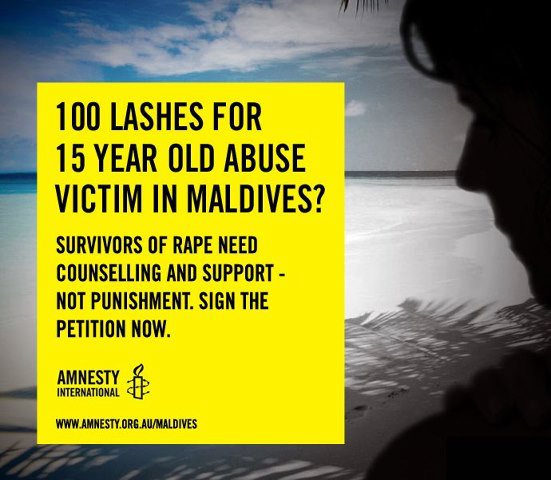
The case has attracted widespread criticism from the international community, with Amnesty International launching a petition demanding the government repeal the sentence.

The Maldivian government – which is currently vying for re-election to the UN Human Rights Council, launched its campaign in Geneva on February 28 on a platform of “women and children’s rights and the rights of persons with disability” – has expressed “deep concern” at the decision to prosecute the girl.

“Though the flogging will be deferred until the girl turns 18, the government believes she is the victim of sexual abuse and should be treated as such by the state and the society and therefore, her rights should be fully protected,” said the President’s Office in a statement.

“The government is of the view that the case merits appeal. The girl is under state care and the government will facilitate and supervise her appeal of the case, via the girl’s lawyer, to ensure that justice is done and her rights are protected,” the statement added.

State Minister Abdulla’s comments echo similar sentiments made by the religious-conservative Adhaalath Party (AP), which issued a statement declaring that the girl “deserves the punishment” under Islamic Sharia law.

Local media reported Mohamed as saying he intended to meet with President Waheed in order to ask him to publicly apologise for his comments.

Mohamed further stated that the girl – who had also been raped by her stepfather – should be punished for committing and confessing to the sin of fornication, and that this penalty must not be challenged, local media reported.

Likes(0)Dislikes(0)

“So horrific that it’s hard to believe”: Amnesty International launches petition to overturn “disgraceful” flogging sentence

Amnesty International has launched a petition calling on the Maldivian government to overturn a court ruling sentencing a 15 year-old rape victim to 100 lashes for an unrelated fornication offence.

The story of the girl from Feydhoo in Shaviyani Atoll, who was convicted of premarital sex in the Juvenile Court February 26 and sentenced to 100 lashes and eight months of house arrest, has been reported by media around the world and been widely condemned by international NGOs and embassies.

“It’s so horrific that it’s hard to believe it’s true: a 15 year old rape survivor has been sentenced to 100 lashes for ‘fornication’ in the Maldives,” stated Amnesty International, which has followed the case since January.

“The traumatised girl was allegedly sexually abused by her step-father for many years. He has since been charged with sexually assaulting a minor. During the investigation however, authorities came across evidence to support separate charges of fornication against the girl for pre-marital sex,” Amnesty stated, demanding the government overturn the “disgraceful” sentence.

The Maldivian government – which is currently vying for re-election to the UN Human Rights Council, launched its campaign in Geneva on February 28 on a platform of “women and children’s rights and the rights of persons with disability” – expressed “deep concern” at the decision to prosecute the girl.

“Though the flogging will be deferred until the girl turns 18, the government believes she is the victim of sexual abuse and should be treated as such by the state and the society and therefore, her rights should be fully protected,” said the President’s Office in a statement.

“The government is of the view that the case merits appeal. The girl is under state care and the government will facilitate and supervise her appeal of the case, via the girl’s lawyer, to ensure that justice is done and her rights are protected,” the statement added.

Amnesty International welcomed the government’s stated commitment, but noted that “at this stage she is still facing flogging. We need to keep the pressure up to remove flogging as a form of punishment in her case and all cases in the Maldives.”

Foreign Minister Dr Abdul Samad Abdulla meanwhile announced on state broadcaster Television Maldives (TVM) that the girl had post traumatic stress disorder and certain medical issues, according to local media.

“The girl was abused since she was 12 until she turned 15, so multiple times for three years. She was abused by her stepfather. She has said that her baby was murdered. You can imagine the mental status of a child in this situation. She suffers from this condition,” local media reported Dr Samad as saying.

According to Sun Online, Dr Samad said the international community was not fully informed about the reason for the girl’s sentence, which was not due to her abuse by her stepfather, but her confessed fornication with another man.

He also warned that a failure to unite as a country during times of such international criticism would provide opportunities for “groups that want to harm the country,” Sun reported.

The government’s denouncement of the sentence is meanwhile at odds with its endorsement by the Adaathath Party, members of which make up the majority of the Ministry of Islamic Affairs.

“The purpose of penalties like these in Islamic Sharia is to maintain order in society and to save it from sinful acts. It is not at all an act of violence. We must turn a deaf ear to the international organisations which are calling to abolish these penalties, labeling them degrading and inhumane acts or torture,” the party said in a statement.

“Furthermore, Allah has decreed that expressing disapproval of issues such as this contradicts with faith in Islam,” the statement continued, quoting verses from the Quran.

“Allah has also commanded that we show no kindness when implementing these penalties,” the party added.

Flogging and politics

UN Human Rights Commissioner Navi Pillay in an address to the Maldivian parliament in November 2011 urged the government to issue a moratorium on sentencing women to flogging for extra-marital sex.

“This practice constitutes one of the most inhumane and degrading forms of violence against women, and should have no place in the legal framework of a democratic country,” Pillay stated.

Her comments were condemned by religious groups in the Maldives, with protesters urging authorities to arrest the UN High Commissioner and gathering outside the United Nations carrying signboards with slogans such as “Islam is not a toy,” “Ban UN” and “Flog Pillay”.

A presidential state apology for allowing Pillay to speak to parliament was one of the five demands of the December 23 coalition [of 2011], a mass gathering in the capital Male’ that saw the fractured opposition unite against President Nasheed on the pretext of protecting Islam.

Following the fall of Nasheed’s government on February 7 2012, government-aligned Progressive Party of the Maldives (PPM) MP Abdul Azeez Jamal Abu Bakr withdrew the Pillay apology petition in parliament.

Amnesty International’s petition:

Likes(0)Dislikes(0)