Malé school resumes classes after ‘toxic’ shutdown

A Malé school, shut down last week due to toxic fumes, has resumed classes on Sunday.

A teacher at the Kalafaanu School told Minivan News they had been told the fumes are not harmful despite the unpleasant smell.

The school was shut down after several students complained of dizziness, headaches and nausea.

The fumes are believed to originate from Malé’s power house which is located just a block away from the school.

“The education ministry officials have compiled a report on the issue, however, we have not officially received it,” said Abdul Fahthaah.

The education ministry had said it would make public a report into the source of toxic fumes by last Saturday.


Likes(3)Dislikes(1)

PPM by-election campaign underway

The ruling coalition’s campaign for the upcoming parliamentary by-election for the Dhiggaru constituency is underway while the opposition alliance is yet to decide on fielding a single candidate.

A primary of the Progressive Party of Maldives (PPM) among four candidates seeking the ruling party’s ticket is due to take place on Friday. Former president Maumoon Abdul Gayoom’s eldest son, Ahmed Faris Maumoon, is among the contenders.

The by-election, triggered by the 25-year jail sentence handed down to former ruling party MP Ahmed Nazim, is scheduled to take place on June 6.

All candidates must inform the Elections Commission of their intent to contest the by-elections by the end of April.

The by-election is expected to be hotly contested amid heightened political tension following the jailing of former president Mohamed Nasheed and ex-defence minister Mohamed Nazim as well as the alleged unfair targeting of Jumhooree Party Leader Gasim Ibrahim’s business interests.

Faris is meanwhile in Dhiggaru on a campaign trip at present.

Other contenders in the PPM primary include Meemu atoll council president Moosa Naseer, deputy environment minister Mohamed Hanim and Dhiggaru island council president Imran Ismail.

The ‘Maldivians against brutality’ alliance, made up of the main opposition Maldivian Democratic Party (MDP), Adhaalath Party (AP) and senior members of the Jumhooree Party (JP), announced last week that discussions were underway on fielding a single candidate.

AP spokesperson Ali Zahir has since announced his intention of contesting in the by-election.

Meanwhile, former MDP chairperson MP Moosa Manik has criticised his old party for not holding a primary to select a candidate.

MDP Vice President Mohamed Shifaz told Minivan News today that the party has not yet decided whether to field a candidate.

But the MDP “will definitely hold primaries” if it chooses to contest the by-election.

“As a party we have to consider many factors including the independence of the independent institution and so on. The MDP has not yet decided to compete for the seat but if we do a candidate would be selected through primaries,” he said.

MP Moosa Manik, who was expelled from the MDP last year after repeatedly voting against the party’s whip-line, said the party must hold a primary if it is to respect its rules and founding principles.

“In the local council elections I decided not to hold primaries but the decision was opposed by a lot of members. So in the end we had to hold primaries,” he said.

“So if the MDP is not competing, not holding primaries in order to make way for the Adhaalath Party, it would be going against the party’s own norms as well as democratic values. Even though I have been removed from the party’s registry I have sacrificed a lot for MDP. I can’t let MDP drift away from democracy.”

In last year’s parliamentary polls, Nazim was elected with 60 percent of the vote from the Dhiggaru constituency after competing against an MDP candidate. The PPM also won a majority of the Meemu atoll council, which has four PPM members, one MDP member and one independent member.

Likes(4)Dislikes(0)

Horns and megaphones banned in parliament chamber

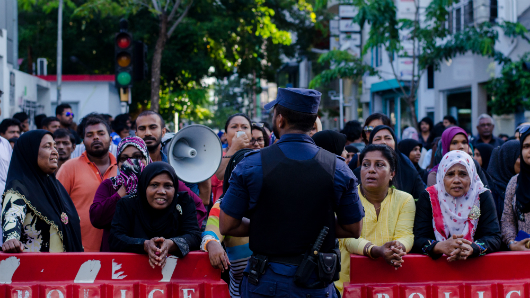
The People’s Majlis today banned the use of horns, sirens and megaphones in the parliament chamber following weeks of protests by opposition MPs.

MPs of the Maldivian Democratic Party and Jumhooree Party have been protesting since March 2 over the arrest and imprisonment of former president Mohamed Nasheed on terrorism charges.

Opposition MPs continued protests with horns and megaphones today, but Speaker Abdulla Maseeh Mohamed called for a vote on the changes proposed to the parliamentary rules despite the disorder in the chamber.

The changes were proposed by the speaker and approved with 43 votes in favour at today’s sitting.

The debate on the bill was once again inaudible to the viewing gallery and the parliament secretariat ceased providing a live feed of the sittings to television stations this morning.

“Work on bringing an end to the MDP’s horns by amending article 51 of the parliament rules is on the agenda today,” tweeted majority leader Ahmed Nihan before today’s sitting.

Nihan was not responding to calls at the time of publication.

MDP spokesperson Imthiyaz Fahmy told Minivan News today that opposition MPs will continue the protests.

With daily anti-government demonstrations and heightened political tension, the state of the nation shall be reflected in the People’s Majlis, he said.

“While democratic principles are destroyed and political leaders are jailed, the Majlis is a place where such issues can be resolved,” he said.

The MPs are calling for a resolution to the political crisis, but the “current majority party does not want to listen,” he added.

Imthiyaz also questioned the need for the changes as the rules allow the speaker to order the sergeant-at-arms to expel MPs who disrupt sittings.

He contended that laws were passed in recent weeks in violation of parliamentary rules as voting took place with disorder in the chamber.

Constituencies represented by opposition MPs did not have a say either, he added.

Previous speakers resolved disputes through dialogue with political parties, but the current speaker “is too dictatorial and doesn’t even want to talk to the minority,” he said.

Maseeh is conducting sittings in violation of the rules while insisting that there was order in the chamber despite the protests, Imthiyaz said.

But neither the speaker nor MPs were able to hear debates, he noted.

Last week, a three-month delay for the implementation of the new penal code was approved with a show of hands amid protests by MDP MPs.

Rules of procedure

The new provisions state that cases of MPs who use horns or megaphones and approach the speaker’s desk will be investigated by the ethics committee.

The committee can cut 55 percent of an MPs’ monthly committee allowance and suspend participation in an official parliament trip for six months.

Imthiyaz said the proposed punishment was “ridiculous” as it amounted to undoing or erasing committee attendance.

MPs receive a monthly allowance of MVR20,000 for attending more than 50 percent of committee meeting.

The purpose of today’s changes to impose pay cuts on opposition MPs as the ruling coalition lacked two-third majority required by the constitution for non-payment of salaries and allowances, he said.

He also noted that the MDP parliamentary group leader sent a letter to Maseeh expressing concern with sittings taking place in violation of the rules.

However, in a meeting last week, Maseeh insisted that he was following the rules.

Imthiyaz also objected to the speaker refusing to allow MDP MPs to speak during debates and advocate on behalf of their constituents.

At a previous sitting, deputy speaker ‘Reeko’ Moosa Manik refused to allow MDP MP Mariya Ahmed Didi to speak.

Imthiyaz said Mariya was seated, but the deputy speaker said the MDP MP will not be allowed to speak while her fellow MPs were protesting.

Likes(3)Dislikes(0)

Ban on pigeon feeding sparks public outrage

A ban on feeding pigeons at the Republic Square has sparked public outrage after numerous birds died of apparent starvation.

Several people have expressed strong disapproval on social media of the housing ministry’s decision to impose the ban last Wednesday (April 15).

“Stop brutality against pigeons, Feed the pigeons,” tweeted one Maldivian.

Hundreds of children and adults gather at the square every afternoon to feed raw rice to the pigeons.

However, entry to the square has now been restricted by a fence and the housing ministry has erected boards prohibiting pigeon feeding.

The housing ministry says feeding the pigeons causes damage to the grass, newly planted for an upcoming celebrations to mark the golden jubilee of independence.

Nearby buildings also appeared dirty due to pigeon droppings, the ministry said.

Local media reported yesterday that several starved pigeons pecked at tourists and passers-by.

According to newspaper Haveeru, the pigeons are dependant on humans for food and some are now too weak to fly.

Hundreds of pigeons stood on the fence while several more were crushed by vehicles while trying to cross the road.

“Arrest me for feeding the pigeons,” tweeted former environment minister Mohamed Aslam.

Former footballer Ismail Zariyand also tweeted a picture of him feeding the pigeons in defiance of the ban.

The square now remains empty except for a few starved and dead pigeons lying in the park’s corners.

The ministry will provide “alternative/more ideal locations” for pigeon feeding, tweeted housing minister Dr Mohamed Muizzu on Thursday.

However, the ministry is yet to announce the new location.

The ban comes amid renovations of public spaces in the capital in preparation of the 50th anniversary celebrations, including repairing the water fountain at the square.

Likes(4)Dislikes(1)

‘Super specialist’ doctors treat over 700 patients

More than 700 patients across the country have consulted visiting specialist doctors in four days under the government’s new ‘super specialist service.’

Arrangements have been made to send three out of the 762 patients overseas for further medical treatment, the national health insurance provider ‘Aasandha’ said today.

Under the programme, specialist doctors from neighbouring countries will come to the Maldives for one week every month and consult patients at hospitals in three different regions.

Every year, thousands of Maldivians fly to India, Sri Lanka and Thailand, seeking medical treatment unavailable in the country.

“Such a programme allows the government to provide health and social services at a lower cost, with better functioning systems in place,” said the Aasandha office in a press release.

The ‘super specialist service’ will employ neurologists, cardiologists, urologists, neurosurgeons, ENT doctors and paediatricians to provide consultations in different parts of the country.

Some 11 specialist doctors from India and Sri Lana are currently treating patients in Haa Dhaalu Kulhudhuhfushi, Laamu Gan, Gaafu Dhaalu Thinadhoo and Hulhumalé.

A haemoglobin specialist doctor meanwhile visited the Maldives Blood Services and consulted 21 thalassemia patients.

The Aasandha office said that the biggest problem faced by the travelling teams was lack of medicine from island pharmacies.

However, the National Social Protection Agency (NSPA) has assured that the medicines will be provided within five days.

NPSA CEO Mujthaba JaleelSpeaking at the inauguration ceremony of the super specialist programme last week, NSPA CEO Mujthabaa Jaleel said 22 hospitals from India and Sri Lanka will participate in providing doctors.

The visiting doctors will improve healthcare for people suffering from serious conditions, he said.

The super specialist programme is one of the key healthcare pledges in President Abdulla Yameen’s manifesto, Jaleel said.

Likes(3)Dislikes(0)

Supreme Court barred judges from penal code trainings

The Supreme Court barred judges and magistrates from attending trainings on the new penal code, Minivan News has learned.

The penal code was ratified a year ago and was set to come into force this month, but the ruling Progressive Party of the Maldives has delayed its enactment by three months.

According to judges and lawyers, the Supreme Court denied permission for judges and magistrates to attend trainings conducted by the attorney general’s office and UNDP at a special legal sector resource center, which was set up last year to train law enforcement agencies, judges, lawyers and journalists on the new penal code.

“The penal code is a large, extensive document with criminal proceedings that is new to the Maldives. I wanted to attend but the Supreme Court wouldn’t give us permission,” a judge who wanted to remain anonymous said.

The existing penal code was adopted in 1968 and has been criticised as draconian, outdated and not in line with the democratic constitution of 2008.

Former Deputy Prosecutor General Hussain Shameem, who has trained 1099 individuals on the new penal code, said the legal resource center had invited all judges and magistrates, but “none of them attended the trainings.”

Shameem says the legal resource center could train all of the 186 judges and magistrates in the country within two weeks.

Lawyers have meanwhile expressed concern over judges’ capability in implementing the new penal code without the required trainings.

“The penal code has a whole new section on sentencing. It is completely different from procedures used before,” said Hassan Shiyam Mohamed, who advised a parliament committee that had drafted the new penal code.

“It is imperative that judges be trained on its application. We don’t want to see a situation where everyone else is more fluent in it than the judges. I really don’t understand the Supreme Court’s decision.”

The Department of Judicial Administration, which functions under the Supreme Court, says it is now planning a separate training for judges next month, but an official from the DJA said the apex court has not yet approved the trainings.

“There will be a seminar on the penal code for selected magistrates next month. The seminar will be headed by the Commonwealth,” he said.

The Supreme Court was unavailable for comment at the time of going to press.

Likes(3)Dislikes(0)

Inter-generational violence and state negligence led to Ibthihaal murder, says police

Inter-generational violence and state negligence led to the abuse and death of three-year-old Mohamed Ibthihaal in January, police have said.

Chief Inspector Abdulla Satheeh said negligence by government authorities and the island community on Vaavu Rakeedhoo was partly responsible for the toddler’s murder.

“Investigating the death is not enough, wide investigation into circumstances surrounding his death is also important,” Satheeh told the press on Thursday.

Ibthihaal’s body was found with signs of severe abuse on January 28 in the worst case of child abuse in recent years. The murder shocked the nation while reports that officials had been aware of Ibthihaal’s abuse sparked public outrage.

The boy’s mother, Fathmath Afiya, was arrested for murder two days later and has since been held in remand detention.

Afiya’s stepfather, Ismail Raoof, was arrested on April 1 on suspicion of physically and sexually abusing Ibthihaal.

Satheeh said marks on the child’s neck indicated that he had been strangled.

Police also found swelling on the right side of his forehead, scrapes on his face, wounds on his right ear and scars all over his body. Some of his ribs were broken as well.

Satheeh said Ibthihaal’s death was caused by “major injuries” while some older scars remained unhealed.

“Mohamed Ibthihal had received physical and psychological harm from different individuals on different occasions, for a long period of time,” he said.

Police explained that Ibthihaal had been under the care of his maternal grandmother from the age of one and lived with her in Vaavu Keyodhoo and Meemu Madduvari.

Afiya’s stepfather is suspected of having abused Ibthihaal at the time.

Seven months before his death, Ibthihaal was brought back to Rakeedhoo to live with his mother, where his psychological and physical abuse continued.

Afiya had two other children at the time and is accused of mistreating Ibthihaal, neglecting to feed or wash the boy.

Satheeh said Afiya’s husband, Ibthihaal’s step father, took care of the boy.

On the day before his death, Afiya had not fed Ibthihaal after giving the boy a glass of juice. His stepfather fed him after coming home that night, Satheeh said.

Police suggested that Afiya’s anger towards her son stemmed from rumours surrounding his birth. Ibthihaal was reportedly born out of wedlock.

During her interrogation, Afiya confessed to severely beating Ibthihaal after waking up in the morning “because of the anger she had towards him”.

Afiya said she called for help when she saw no movement from the child.

Local media has reported that Afiya was also a victim of sexual abuse.

Afiya’s stepfather, Raoof, had previously been banished by the Vaavu Keyodhoo court after being found guilty of abusing a step-child. Afiya was reportedly the victim of the abuse.

Negligence

In its submission to the UN’s Universal Periodic Review, the human rights watchdog said children born out of wedlock face discrimination in the Maldives.

Illegitimate children were denied their father’s name, inheritance and child maintenance, the Human Rights Commission of the Maldives said.

The commission noted that the absence of requisite procedures, inconsistencies in institutional applications and lack of sensitivity among law enforcement and judiciary towards domestic violence are fundamental issues faced in implementation of Domestic Violence Act.

Limited capacity of investigators and their belief that such cases are family matters inhibit victims from getting redress.

“Reporting of domestic violence cases remain low as a result of lack of confidence in the system, fear of intimidation by perpetrators, stigmatisation and inadequate information on protection measures,” the commission stated.

“Violence against children takes place in all settings. Only a small proportion of reported child abuse victims gets justice and remains re‐victimised due to systemic failures.”

Likes(3)Dislikes(0)

Chief judge praises criminal court over Nasheed’s trial

Chief judge Abdulla Mohamed has praised judges and staff at the criminal court for the swift conclusion of former president Mohamed Nasheed’s terrorism trial which related to the judge’s arrest in 2012.

The criminal court handed Nasheed a 13-year jail term, sparking international outrage and daily protests across the country.

“The Maldivian military was brought to alert, tents set up at the justice building, scan machines were kept, and the whole country was brought to alert,” Judge Abdulla was quoted as saying by local media.

“A three-judge panel was formed, and a verdict was delivered in 19 days by criminal court judges and staff in a case that couldn’t be concluded in three years,” the chief judge said at a function held last night to mark the court’s anniversary.

Nasheed’s rushed trial was widely criticised by foreign governments, the UN, and Amnesty International for its apparent lack of due process.

Judge Abdulla meanwhile said criminal court judges and staff were awake at night and during weekends while the rest of the judiciary was asleep.

The court proved that the “judiciary is awake” after “matters reached the state where some people believed the judiciary was incapable.”

In addition to Nasheed, his defence minister Tholhath Ibrahim Kaleyfaanu, then-chief of defence forces Moosa Ali Jaleel, then-Malé Area Commander Brigadier General Ibrahim Mohamed Didi, and ex-colonel Mohamed Ziyad were charged with terrorism over the judge’s arrest.

Tholhath was found guilty and sentenced to 10 years in prison.

Nasheed has meanwhile accused Judge Abdulla of involvement in a “contract killing,” and said he had blocked an investigation into his misconduct by the judicial watchdog, and obstructed the police from carrying out their duties.

Judge Abdulla last night also said unlawful arrests by the state have not come to an end, despite six years passing after the adoption of the 2008 constitution.

Seven cases of unlawful detention were submitted to the court last year, he said.

Judge Abdulla said last year’s cases of unlawful arrest included four expatriates suing the immigration department, and one expatriate suing the police. In addition, three Maldivians sued police and the correctional services.

He also referred to the arrest of then-MP Abdulla Yameen and MP Gasim Ibrahim in 2010.

“There’s no doubt that these matters will become a lesson in Maldivian history,” judge Abdulla reportedly said.

He called for more benefits and additional security to criminal court judges.

Lack of space and facilities at the court posed difficulties in providing lawyers access to their clients and the ability to study case documents, the chief judge said.

Likes(4)Dislikes(0)