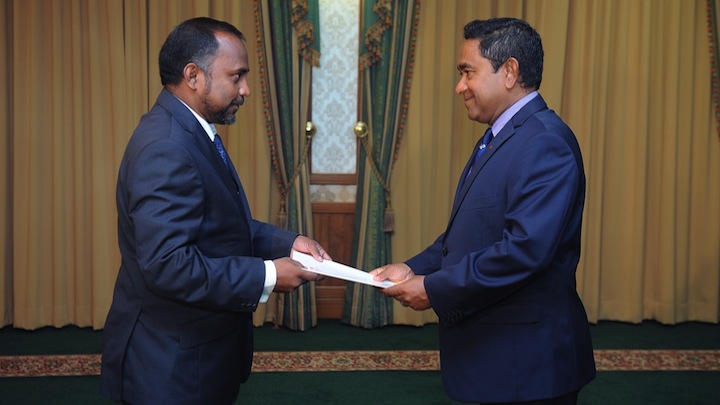
President Abdulla Yameen appointed Dr Ahmed Ziyad Bagir as the new minister of Islamic affairs today following the resignation of former minister Dr Mohamed Shaheem Ali Saeed yesterday.
The president presented Ziyad his letter of appointment while Supreme Court Justice Adam Mohamed Abdulla administered the oath of office at a ceremony held at the president’s office this morning.
Ziyad was serving as the principal of the Arabiyya School in Malé.
Former president Maumoon Abdul Gayoom has meanwhile thanked Shaheem for his “valuable service to the nation” as Islamic minister. Shaheem was appointed to the cabinet in February 2012 under ex-president Dr Mohamed Waheed and retained his post under president Yameen.
Thank u @Mohamedshaheem1 for ur valuable service to the nation as minister of Islamic Affairs over many years.
— Maumoon Abdul Gayoom (@maumoonagayoom) May 6, 2015
President Abdulla Yameen ratified amendments to the prison and paroles law today that strips ex-president Mohamed Nasheed of the main opposition Maldivian Democratic Party’s (MDP) presidency.
The changes voted through to the Prison and Parole Act last month by the pro-government parliamentary majority prohibit inmates from holding high-level or leadership posts in political parties.
Nasheed is serving a 13-year jail term following his conviction on terrorism charges related to the detention of a judge during his tenure. The opposition says the trial was a politically-motivated attempt by the government to bar Nasheed from challenging president Yameen in the 2018 presidential election.
President Yameen meanwhile ratified the Maldives Islamic university bill as well as amendments to the new penal code.
The Islamic university legislation seeks to upgrade the existing Islamic college or ‘Kulliya’ to a university while changes to the penal code seeks to bring forward its enactment to July 1.
The criminal court has ordered police to hold Jumhooree Party foreign and public relations executive Sobah Rasheed in remand detention for 15 days.
Rasheed was arrested from Sunday’s night opposition protest at the artificial beach. Police said he was arrested with a court warrant in connection with an ongoing investigation, but declined to reveal details.
Leaders of the allied opposition parties, including Adhaalath Party president Sheikh Imran Abdulla, main opposition Maldivian Democratic Party (MDP) chairperson Ali Waheed, and JP deputy leader Ameen Ibrahim were arrested with court warrants after Friday’s anti-government mass rally.
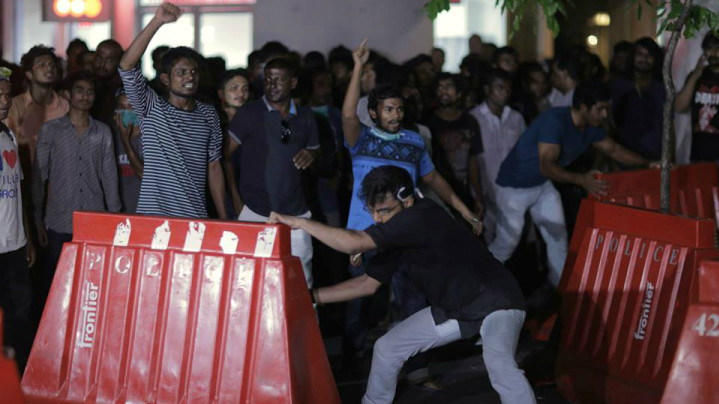
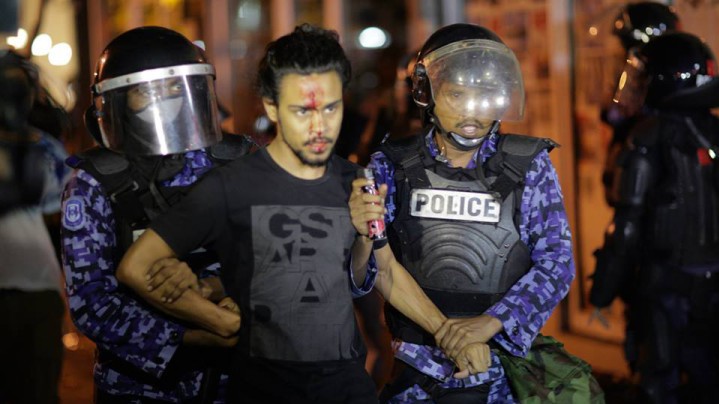
Nearly 200 protesters were arrested from the May Day protest after clashes with riot police, of which 175 are being held in remand detention for 15 days.
Rasheed is also a member of the ‘Maldivians against tyranny’ alliance’s steering committee that organised Friday’s protest.
A number of protesters, including former MDP vice presidential candidate Dr Musthafa Luthfy, was also arrested from Sunday night’s protest. However, Luthfy was released after a brief detention.
The government launched a programme to screen seventh grade students for health problems.
The programme – the first of its kind in the Maldives – began yesterday at the Iskandhar School in Malé.
At a ceremony held at the president’s office, the health ministry and education ministry signed a Memorandum of Understanding to conduct the programme in schools across the country.
The government says the programme will help identify health issues among adolescents and offer treatment for undiagnosed illnesses. The education ministry aims to screen all 5,656 seventh grade students in the Maldives before the end of the year.
The students will be screened for problems with skin, hair eyesight, spine, teeth, throat, respiration, blood circulation and blood pressure as well as diabetes and psychological issues.
Blood tests will also be conducted for haemoglobin levels, blood group, and thalassemia.
This article is by Sighpad Mohamed, who writes the the blog Hudhuhandhu.com
Vote a government in. Give them a year of two. Take to the streets. Mount pressure, topple the elected leader and change the government. Rinse and repeat as needed. Maldivians seem to have taken to this formula like a duck to water. This has to stop.
When former president Mohamed Nasheed was ousted in a coup d’état on February 7, 2012, he warned of more unlawful changes of the government in the Maldives’ future. Take in to account the events of May Day’s mass antigovernment protest #EkehFaheh15.
President Abdulla Yameen denied he was under any pressure, but the record number of press conferences he appeared in and tweets by officials indicate otherwise. The government was indeed jittery. But president Yameen’s disregard for the people was blatant when he appointed his tourism minister Ahmed Adeeb as his representative for negotiations, when the opposition had accused Adeeb of corruption and had called for his resignation.
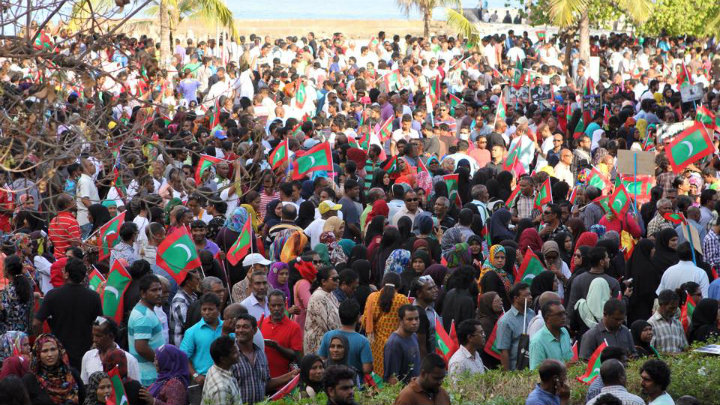
Despite intimidation and harassment, tens of thousands of people took to the streets on May Day in the largest antigovernment protest in a decade. Protesters hoped president Yameen would relent. But the police cracked down brutally and hundreds were arrested and injured. It was clear the police were targeting vocal social media critics with the arrest of Yameen Rasheed, Waddey and Hamid Shafeeu. But unlike February 7, 2012, the government remained unchanged, and the ruling party held fireworks the next day to celebrate its “victory.”
Maldivian history is rife with examples of coup d’états, and they will continue unless the elected governments listen to its citizens’ concerns, and work for their development, not for the benefit of a handful of loyalists.
I do not support coups, but when the commonwealth backed commission that investigated president Nasheed’s ouster in 2008 ruled the transfer of power legal, despite a police and military mutiny, it has opened the doors for citizens to once again resort to the same means to topple a government. But deep in our hearts, we know this is not right. The power lies with the people who cast their votes to elect a leader for five years, not one, two or even four, but five. Let us not forget that. But the elected government must not forget they are elected to do right by the people. Not to fulfill their own agenda by pocketing the taxpayer’s money. And if the government does not rectify its mistakes, there will be more coup d’états.
Prior to 2008, Maldives weathered through 30 tough years of torture and fear, where individuals who simply expressed the desire to see a different president were jailed and tortured. They came out from jail only as a shell of the person they had been. I weep over the many accounts of torture that remain untold to this day, of the various ways former president Maumoon Abdul Gayoom’s regime ruined the lives of many families by rendering their loved ones incapable of taking care of their personal needs after being “reprogrammed” at the infamous Dhoonidhoo jail.
But Maldivians rose up and they embarked on a nonviolent struggle. It was not easy, but we persevered.
Little now remains of the democratic changes we fought so hard for. The government is out to silence all dissent. With all the leaders of the opposition now behind bars, the Maldives is on the verge of becoming the next Egypt, where a revolution was undermined and a former general continues to consolidate his power by massacring his people and jailing all of his opponents.
The fear and intimidation we thought were a thing of the past is now back. Ruling party MP Ahmed Nihan has threatened to dismiss opposition supporters from civil service jobs, and urged the government to cancel the licenses of the scores of boats that had carried thousands of islanders to Malé for the protest. I for one, have a foreboding feeling that we are once again headed towards the era where Maldivians huddled in fear at every second of every day.
The Maldivian government is adamant that its foreign policy reflects its domestic tyranny, and that’s exactly what’s being conveyed through the diplomatic channels. But the single flickering light at the end of this dark tunnel is the international community and its sanctions.
President Nasheed calls for perseverance from his jail cell, where he is to spend the next 13 years of his life, all because he fought for dignity and equality for the people of the Maldives. My wish for the Maldives and my people is simple, one that aligns with the vision that president Nasheed has for this country. That we be a prosperous nation, a just and able society, one in which the government serves all of its people, regardless of their political ideology, and one where the government listens to our concerns without declaring war on us when we oppose the government.
Our future is bleak. The people continue to struggle, they continue to raise their voices, despite the fact the government celebrates the brutalizing and jailing of hundreds with fireworks. But if this tyranny continues, a civil war is not far off. The scars of the 2012 coup may have scabbed over, but the wounds are deep, festering with hatred, resentment and a deep disillusionment with a justice system that continues to fail us. Only time alone can tell if those of us, who are fighting for human rights, justice and democracy will emerge victorious, or whether we will be browbeaten to embrace a culture of corruption, nepotism, injustice and brutality for years to come.
All comment pieces are the sole view of the author and do not reflect the editorial policy of Minivan News. If you would like to write an opinion piece, please send proposals to [email protected]
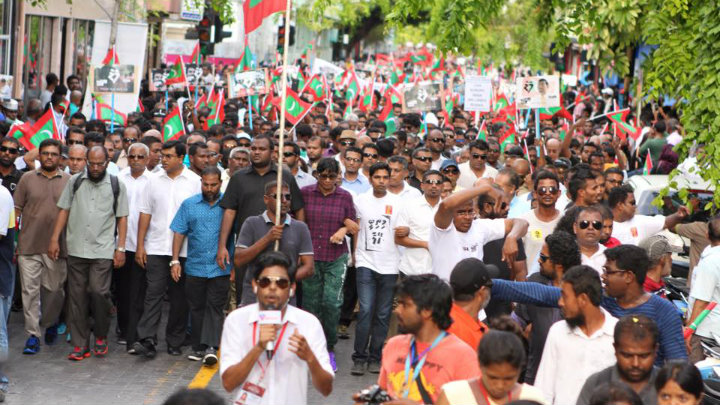
Approximately 20,000 people took to the streets on May Day in the largest anti-government protest in a decade. But protesters failed to seek the release of ex-president Mohamed Nasheed or force the government to negotiate. Instead, scores were arrested and injured in violent clashes.
What happened? Who attacked first, protesters or police? Did the security forces use disproportionate force? Minivan News recounts what we saw and heard on the streets of Malé.
Revolutionary fervour was in the air when protesters set off at 4:45pm on a march through Malé’s thoroughfare Majeedhee Magu. The de facto leader, Adhaalath Party president Sheikh Imran Abdulla, started the march saying the opposition would “emerge victorious.”
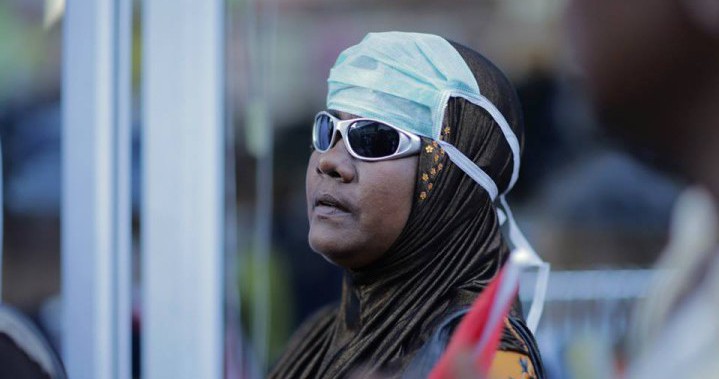
From the start, the opposition Maldivians against tyranny coalition’s plans were unclear to protesters. Many expected leaders to announce plans at the end of the march. Protesters were geared up for a crackdown, some wore swimming goggles and surgical masks and had fashioned home made masks out of plastic bottles. Many carried bottles of coca cola to reduce effects of pepper spray and tear gas.
The Qur’an was blaring over static from a lorry at the frontline, while music was playing on lorries stationed in the middle and at the end. Protesters marched at a brisk pace as onlookers applauded and waved. Several megaphones, set up on balconies at private residences, were broadcasting opposition-aligned Raajje TV and 97 Minivan radio’s live coverage of the march.
At the western edge of Majeedhee Magu, opposition leaders stopped to speak to the crowds. A nervous energy hung in the air. Speakers said Muslims were obligated to stand up against tyranny and injustice. The Maldivian Democratic Party’s (MDP) chairperson Ali Waheed said he would only go home after securing Nasheed’s release.
Protesters in the middle and at the tail end could not hear the speeches. The crowd was agitated. Some attempted unsuccessfully to get protesters to sit down on the street. When Sheikh Imran took the stage, protesters faced the setting sun and put up their hands in prayer. Many were crying when Imran tearfully prayed for courage to remain steadfast and for mercy from the security forces.
Then came the announcement that protesters were to go and perform dusk prayers at the Islamic Center located next to the city’s main Republic square and the police and military headquarters.
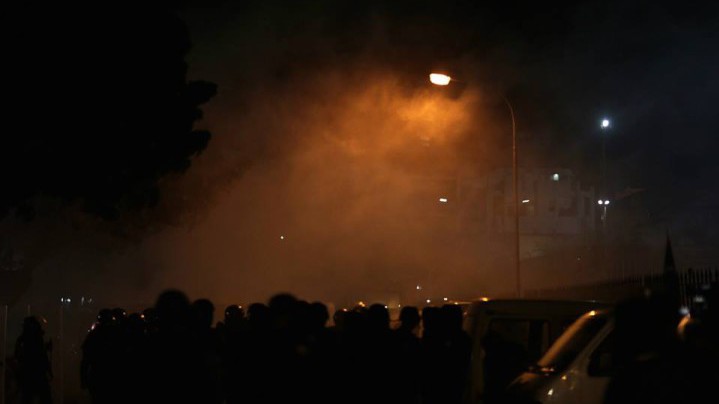
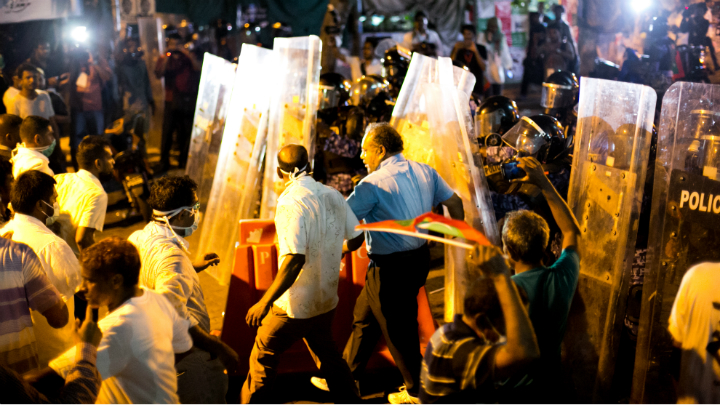
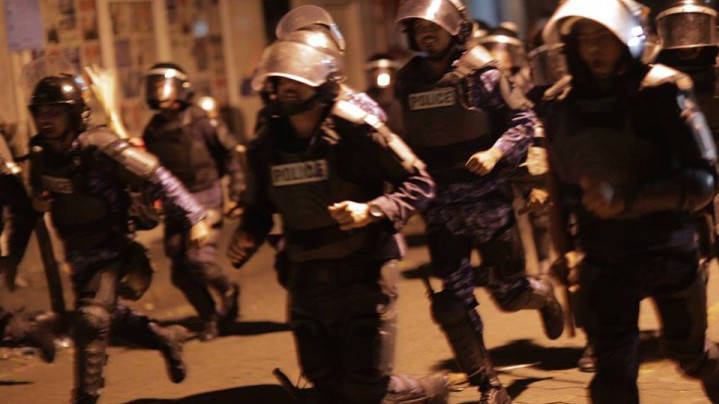
The crowd broke off chanting Allah Akbar, with groups of thousands taking various routes. Police in riot gear had blocked off all the roads leading to the Islamic center. Clashes broke out as protesters attempted to break through police lines. Security forces indiscriminately used pepper spray and beat protesters with batons.
The air was thick with tear gas, pepper spray, anger and fear.
At the fish market, blocks away from the republic square, Minivan News journalists saw Sheikh Imran and Ali Waheed turn back as others urged on protesters to march through police lines. But when the leaders turned back, protesters fell back. MP Ahmed Mahloof, however, attempted to lead the crowd, but the ranks were nervous and disorganised, falling back to police’s use of pepper spray.
Police officers were visibly tense.
In narrow lanes surrounding the square, police in riot gear pushed protesters back. Some took refuge in mosques and were pepper sprayed inside. Stun grenades were thrown. A standoff ensued at the fish market until a protest lorry drove through police lines knocking some officers to the ground, but protesters were unable to follow the lorry into the square.
Police cracked down. The crowd threw bottles and pavement bricks. Pitched battles ensued. Police had already arrested scores. Some detainees were frothing at the mouth and hyperventilating from the effects of pepper spray.
At 7pm, the protest was in disarray. Many had already gone home.
Confusion reigned. Messages began circulating, urging protesters to regroup, first at the Social Center at the western edge, then at Artificial Beach at the eastern edge, and finally on Chaandhanee Magu, the central road leading to the square.
The streets were littered with bottles, flags, placards and discarded shoes.
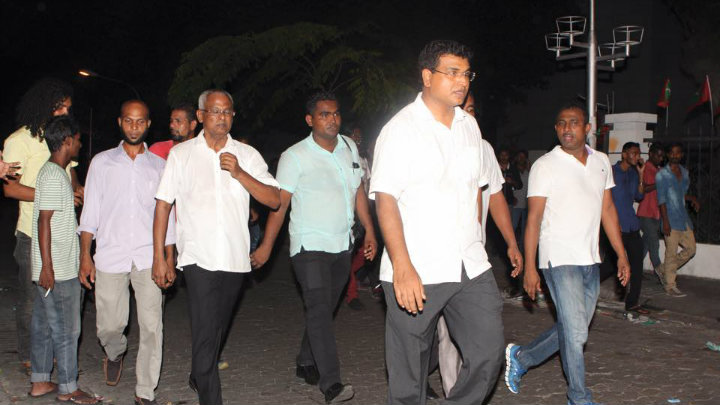
Opposition leaders, MP Ibrahim Mohamed Solih, Jumhooree Party deputy leader Ameen Ibrahim, and MDP MPs urged protesters to regroup on Chaandhanee Magu. “We are here with you, we did not hide,” they said.
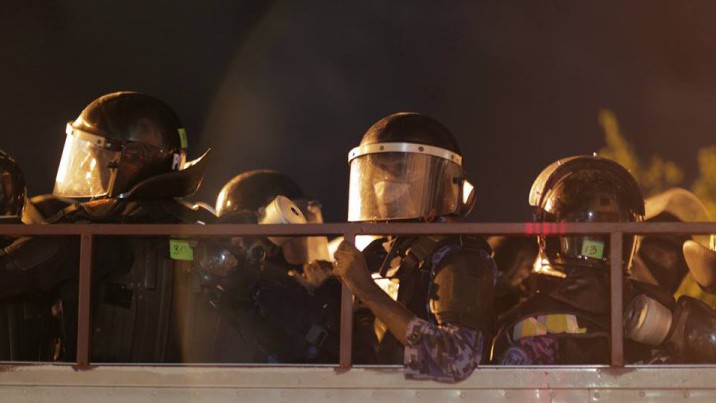
But protesters fell back when police fired thunder flashes and periodically charged into the crowd with batons. Lorries carrying dozens of police officers drove at high speed into the crowds.
Confrontations ensued with protesters throwing glass and plastic bottles. A policemen was severely beaten and was rescued by former MDP MP Ahmed Easa.
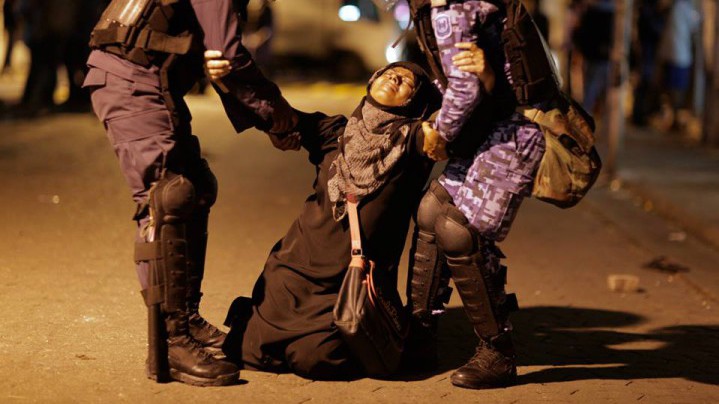
Irate police officers once again charged into the crowd, and trapped dozens of protesters in narrow blocked-off lanes and made indiscriminate arrests.
Hundreds of angry protesters remained in pockets, rallying around opposition leaders periodically, but dispersing when groups of police officers charged into the crowd. A Raajje TV cameraman was injured.
Some protesters took refuge in private homes. But police officers forcefully entered homes and indiscriminately pepper sprayed residents. Security forces and protesters hurled profanities at each other. A dozen officers also entered a building on Majeedhee Magu and took down a pair of megaphones.
Police stepped up arrests at 9pm, picking up people at random, packing them onto lorries and driving off at high speed. Easa who had helped the fallen police officer was arrested and taken onto a police lorry. He was surrounded by Specialist Operations officers and Minivan News journalists heard him scream repeatedly in pain.
At 11pm came the news that Sheikh Imran had been arrested from Ali Waheed’s apartment. Small scale confrontations continued on the streets, but the crowds dwindled as police continued indiscriminate arrests. Many who were arrested were driven to a different location in the city and released with warnings.
By 1am, the crowds had largely dispersed, but police presence remained high. By 2pm, the roads were nearly empty. Ali Waheed and JP’s Ameen Ibrahim were arrested by 3pm.
Photos by Shaari, Dhahau Naseem and Ahmed ‘Anju’ Azim.
Journalists in the Maldives face many challenges, dangers, and loss of freedom due to their role or expression of views, the state human rights watchdog has said.
“The commission has previously noted that Maldivian journalists face death threats and intimidation and that the Maldivian state has to work to establish an environment where journalists can operate freely,” the commission said in a statement issued today on the occasion of World Press Freedom Day.
Journalists should be able to report information on issues of concern “truthfully, sincerely, and without fear”.
The commission urged the media to act responsibly and respect basic rights and societal norms in providing information.
Journalists should take special care when reporting on issues involving persons with special needs, children, and vulnerable groups, the commission advised.
The commission called on all state institutions to ensure a safe environment for reporting and provide information with ease.
In a tweet with the World Press Day hashtag, Vice president Dr Mohamed Jameel meanwhile said today that “we must applaud the role of journalists & free press in establishing a fair democratic society.”
On #WorldPressFreedomDay we must applaud the role of journalists & free press in establishing a fair democratic society. #WPFD2015
— Mohamed Jameel Ahmed (@MJameelAhmed) May 3, 2015
Important to value the talented young men & women journalists, and the courageous visionary character of those in charge of media. #WPFD2015
— Mohamed Jameel Ahmed (@MJameelAhmed) May 3, 2015
Two men have been arrested for assaulting a Specialist Operation (SO) police officer during the May Day opposition protest on Friday.
The first suspect was taken into custody on Friday night while the second suspect was arrested with a court warrant yesterday, reports online news outlet CNM.
CNM identified the suspects as Abdulla Rasheed, 49, from Galolhu Keema in Malé, and Moosa Sharmeel, 35, from the Malé special registry.
Police had appealed for public assistance in identifying and locating suspects seen in video footage.
The police officer, identified as corporal Ismail Basheer, was flown to Sri Lanka for further treatment. However, officials from the Indira Gandhi Memorial Hospital had said the injuries were not severe.
Police have since posted a second video of the assault. Eyewitnesses told Minivan News that several protesters, including former opposition MP Ahmed Easa, protected the fallen police officer, helped him to his feet, and took him back behind police lines.
The economic development ministry has fined 22 businesses for employing foreigners as cashiers against new rules enforced on April 1, reports Haveeru.
Deputy minister Adam Thowfeek told the local daily that the ministry inspected 295 shops, cafés, and restaurants in Malé and found 49 with foreigners working as cashiers.
The ministry has imposed a fine of MVR2,000 (US$130) on 22 establishments.
Thowfeek said the ministry will check businesses in other islands through councils and warned that operating licenses could be revoked for repeated violations.
The government banned foreigners working as cashiers in in an attempt to boost employment among local young people. Some 26.5 per cent of Maldivians aged 15 to 24 are unemployed, according to World Bank figures from 2013, the most recent figures available.
 (1)Dislikes
 (0)
(0)