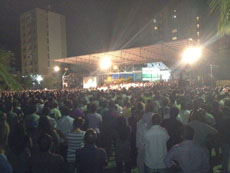
Government books February 26 to celebrate Islam

The new government of the Maldives has declared February 26 will be the date of the public holiday celebrating the nation’s conversion to Islam.

February 24 is traditionally an annual holiday across the Maldives, marking the day the Maldives embraced Islam. The government said that the reason to mark the date of the Maldives’ conversion to Islam on a later date than the official date is because February 24 falls on a Friday this year, which is during the weekend.

A statement on the website of the President’s Office stated: “The decision was made because the anniversary of the Day the Maldives embraced Islam falls on a weekend.”

Likes(0)Dislikes(0)

China respects Maldivians’ “independent choice” following transfer of power

Nearly one week later after the dramatic regime change in the Maldives, China made its first official statement regarding policies towards the new government on Monday.

“As a friendly neighbor of the Maldives, China respects the Maldivian people’s independent choice, and sincerely hopes that the country can realise national stability, social harmony and economic development at an early date,” China’s Foreign Ministry spokesperson Liu Weiming said yesterday in Beijing.

“On the basis of the Five Principles of Peaceful Coexistence, the Chinese government would like to work closely with the new Maldivian government towards the stable, healthy and smooth growth of the bilateral relations,” he continued.

China’s “Five Principles of Peaceful Coexistence” has been the basis of its foreign policy for the past six decades. It advises mutual respect for sovereignty and territorial integrity; mutual non-aggression; mutual non-interference in each other’s internal affairs; equality and mutual benefit; and peaceful coexistence.

Meanwhile, the Chinese Ambassador to the Maldives Yu Hongyao called on the new President Dr Mohamed Waheed Hassan Manik at the president’s office in capital Male’ on Monday afternoon to offer his congratulations.

“What happened recently in the Maldives are the internal affairs of the countrymen,” he said. “We respect the choice of the Maldivians.”

During the meeting, President Waheed updated Ambassador Yu on the country’s evolving political situation and informed him that the government would take all necessary measures to ensure the safety of tourists visiting the Maldives. He added he would do everything possible to resolve all issues currently facing the country.

Tourist arrivals from China last year trumped those of the traditional European market, a reminder of the East’s economic success amidst the West’s current recession.

In a move to solidify its presence in the Maldives, China last year opened its Embassy in Male’.

Likes(0)Dislikes(0)

Dr Waheed welcomes coup probe: AFP

President Dr Mohamed Waheed Hassan Manik has welcomed Commonwealth mission’s investigation into  the ousting of his predecessor Mohamed Nasheed, AFP reported on Monday.

“The President welcomes the Commonwealth mission,” president spokesman Masood Imad told AFP. “Please come here and see the exact situation. We want not only the Commonwealth, but others too to come and see what really happened.”

The nine-member Commonwealth Ministerial Action Group (CMAG), which deals with serious violations of the 54-nation bloc’s political values, decided on the mission after an emergency telephone conference on Sunday.

The Commonwealth Secretariat said the action would would “ascertain the facts surrounding the transfer of power, and to promote adherence to Commonwealth values and principles”.

Former President Nasheed insists that he was forced to resign on February 7, an opposition backed military coup, and has rejected the legitimacy of Dr Waheed’s administration.

Likes(0)Dislikes(0)

Political turmoil threatens archaeological treasures in Maldives: New York Times

Nearly a week after vandals stormed into the National Museum here and destroyed almost 30 Buddhist statues — some dating to the sixth century — the broken glass has been swept away and the remnants have been locked up. But officials say the loss to this island nation’s archaeological legacy can never be made up, writes Vikas Bajaj for the New York Times.

Amid the recent political turmoil that has racked this tiny Indian Ocean nation of 1,200 islands, a half dozen men stormed into the museum last Tuesday and ransacked a collection of coral and lime figures, including a six-faced coral statue and a one-and-a-half-foot wide representation of the Buddha’s head. Officials said the men attacked the figures because they believed they were idols and illegal under Islamic and national laws.

There were contradictory reports about whether suspects had been arrested. Mr. Waheed said five men were caught at the museum but a spokesman for the police, Ahmed Shiyam, said on Monday that investigators were still collecting evidence and had not made arrests.

The attack is reminiscent of the Taliban’s demolition of the great Buddhas of Bamiyan in Afghanistan in early 2001, and has raised fears here that extremists are gaining ground in the Maldives, a Sunni Muslim country that is believed to have converted to Islam in the 12th century from Buddhism. The country has long incorporated elements of Islamic laws in its jurisprudence. Alcohol, pork products and idols cannot be brought into the country.

On the same day that the statues were destroyed last week, Mohamed Nasheed, who was elected president in 2008 in the country’s first democratic election, stepped down in what he said was a coup and what his opponents argue was a voluntary resignation. His resignation came after nearly a month-long protest by Islamic and other opposition political parties, some of whom criticized him for not cracking down on massage parlors that operated as brothels and for proposing that hotels on islands inhabited by Maldivians be allowed to serve alcohol. Currently, only hotels on islands where no Maldivians live or at the airport are allowed to serve alcohol.

Ali Waheed, the director of the National Museum, said on Monday that officials might be able to restore two or three of the statues but the rest were beyond repair. Mr. Waheed’s staff recently moved some palanquins, beds and jugs from the last 100 years into the gallery that previously housed the statues on the ground level of the museum, built by the Chinese as a gift to the Maldives.

“The collection was totally, totally smashed,” Mr. Waheed said. “The whole pre-Islamic history is gone.”

Naseema Mohamed, a historian who retired from the museum last year, said the loss was particularly devastating because many of the country’s ancient artifacts dispersed across the archipelago had been lost or destroyed over the years by locals and rulers. “There was very little left,” she said.

Full story

Likes(0)Dislikes(0)

The speed of India’s abandonment of Nasheed is bewildering: The Hindu

The speed with which India abandoned Mohammed Nasheed and declared support for the successor government is bewildering, writes Jyoti Malhotra for The Hindu.

The speed with which the largest democracy in the world abandoned, by all accounts, the youngest democracy in the world has left several people terribly bewildered. Was this the result of an accumulated pragmatism that runs freely in the heart of New Delhi’s foreign policy establishment these days, especially as Foreign Minister S.M. Krishna is widely considered to be an absentee figure in this part of South Block?

Certainly, pragmatism has its benefits, and the art of foreign policy-making cannot be mixed with something as ephemeral as friendships, including with democrats. Certainly, too, the Prime Minister’s special envoy to the Maldives, M. Ganapathi, a top diplomat in the Foreign Office, has told Nasheed when he met him on Friday in Male, that Nasheed and his family will be safe under the new dispensation.

But as Nasheed pointed out to this reporter, on the phone from Male, this assurance is hardly enough. Meanwhile, in India and abroad, people are watching to see if India, the most powerful country in the region, can ensure that Waheed stops the savage crackdown that the Maldivian security forces are continuing to heap upon Nasheed’s hapless MDP supporters.

If all foreign policy is a function of national interest, then India must ask itself if the Waheed government is really an ideal partner in the Maldives, or if he is really a mukhauta or a mask of Gayoom. If Waheed is really Gayoom’s puppet — certainly, the new President has not one party member in Parliament, nor any councillors; he has been unable to form his own Cabinet, leave alone a government of national unity — then India should be more than worried.

But New Delhi has already decided that Waheed’s government is a legitimate one and that Nasheed’s crisis is largely one of his own making. Government sources say that Nasheed was repeatedly asked by High Commissioner Mulay, even a few hours before he resigned, whether he needed any assistance from India, and Nasheed said no.

On his part, Nasheed — on whom the realisation is beginning to dawn that his friend and partner, India, has dumped him — points out that he “resigned” because he wanted to avoid bloodshed, which would have been inevitable if he had decided to resist. Surrounded by security forces, Nasheed said, he could hardly have asked Mulay for protection.

As delegations from the U.S., the Commonwealth and the European Union set up camp in Male to figure a way out of the crisis, the world is looking to India to lead. It has all the credentials to do so — in fact, some parts of Lakshadweep even speak Dhivehi, the national language of the Maldives — especially if it believes that the Maldives is a part of its South Asian sphere of influence.

Whether or not Nasheed returns to a jail, this time under Waheed, the simple question remains: will India grasp the immensely fragile moment at hand, ensure that peace and stability return to the Maldives and that fresh elections are held, sooner than later?

If it does, it will be setting an example to the regime not only in Male or elsewhere in South Asia, but across the Asian arc littered with authoritarian rulers of all colours. If not, it could be making its second, strategic mistake in this Indian Ocean island. This time around, though, the error could take much longer to heal.

Full story

Likes(0)Dislikes(0)

Tourists barely put down cocktails: Reuters

Tourists enjoying the sun and sand at the Maldives’ luxury island resorts have barely put down their cocktails during the political crisis rocking Asia’s newest democracy, oblivious to behind-the-scenes links of tourism to the tumult, writes Bryson Hull for Reuters.

Just a 10-minute boat ride from the capital island of Male, site of a police mutiny that led to ex-president Mohamed Nasheed’s departure last week and ensuing clashes, lies the paradise most visitors associate with the Indian Ocean archipelago.

Step off the 15-metre (50-foot) power boat, replete with an air-conditioned cabin and leather seats, that whisks you to the dock at Kurumba resort on Vihamanafushi, and you are immediately in a land of luxury, water sports and relaxation.

The political turmoil, as far as American literature professor Jerzy Sobieraj was concerned, was an ocean away across the glassine turquoise waters at his feet.

“We are having a great time. We heard about the coup, but it doesn’t matter to us. It hasn’t affected us at all,” Sobieraj told Reuters, sipping a glass of white wine alongside his wife, lawyer Ewa Korzan-Sobieraj, on a chaise longue.

Full story

Likes(0)Dislikes(0)

Diplomacy Falls Flat in Maldives: Wall Street Journal

A weekend of diplomacy by US and European officials failed to douse the political crisis in the Maldives, where supporters of deposed President Mohamed Nasheed vowed to continue protesting for his reinstatement, writes Tom Wright for the Wall Street Journal.

Mr. Nasheed, who in 2008 became the country’s first democratically-elected president, claims he was forced to resign in an armed coup almost a week ago. He’s accused police of using undue force against his supporters, severely injuring some of them.

Robert Blake, U.S. assistant secretary of state for South Asia and Central Asia, attempted at the weekend to persuade Mr. Nasheed to agree to a unity government with the man who replaced him, Waheed Hassan Manik, the former vice president.

Mr. Blake met both men and urged all sides to refrain from violence. A coalition government, he said, would help to restore stability. A delegation from the European Union also urged compromise.

“It’s very important for the U.S. that all parties exercise restraint and refrain from violence,” Mr. Blake said.

Mr. Blake said there were reports of “quite serious violations of human rights” by police against supporters of Mr. Nasheed in Addu, a southern island, including beatings and detention without access to legal representation. The armed forces, Mr. Blake said, “need to restore their credibility with the Maldivian people.”

So far, the violence has had only a limited effect on tourist bookings, big operators say, in large part because the luxury hotels are on self-contained islands cut off from Male. Most tourists come to those islands direct from the airport by speedboat or seaplane.

On Karumba Maldives, the nation’s oldest luxury resort, only 10 minutes speedboat ride from Male, the manager, Abdul Samad, says he’s running at 98% occupancy and has seen no dip in bookings.

As a precaution, Mr. Samad has stopped the resort’s excursions to Male and advised guests not to go there. Over lunch Saturday, the resort was humming with Chinese and European tourists, many of whom seemed oblivious to the troubles over the water. But some guests expressed concerns.

One couple, Ajay Sharma and his wife, Chhavi, who run a nursing home in the Indian city of Varanasi, said they were returning home early. “They’re saying it’s not safe to go to Male,” Ms. Sharma said.

Full story

Likes(0)Dislikes(0)

Dr Waheed announces independent inquiry into “developments in the Maldives from Jan 14 to Feb 8”

President Dr Mohamed Waheed Hassan has announced an “independent and impartial investigation” into developments in the Maldives from January 14 to February 8, according to a statement on the President’s Office website.

Dr Waheed did not reveal who would conduct the inquiry, but he acknowledged the need for it yesterday after Germany and the UK to establish the legitimacy of his government.

The dates given include the period of incarceration of Chief Judge of the Criminal Court, Abdulla Mohamed, and subsequent protests held by 200-400 opposition-led demonstrators, which culminated in a press conference on January 31 in which opposition parties called for Dr Waheed to take over the government with the assistance of police and military. The event itself took place on February 7.

In the statement, Dr Waheed said the investigation would create “factual and legal clarity” around events with a “direct bearing on the constitutional transfer of executive power that took place on February 7.”

“The investigation would also help establish accountability for any human rights violations which have taken place and thus set the groundwork for national reconciliation and dialogue,” Dr Waheed’s statement read.

“Reiterating his commitment to free and fair elections in 2013, the President urged all political parties to work together in creating a climate of trust and confidence in the build-up to next year’s elections. The President is also hopeful that the investigation, together with his offer to create a strong National Unity Government that would provide impetus for building trust and the establishment of the rule of law, would facilitate the resumption of normal democratic processes in the country,” the statement read.

Nasheed and his Maldivian Democratic Party (MDP) maintain that Dr Waheed’s government came to power after Nasheed was forced to resign under duress, and have refused to participate in a “national unity government” they claim is illegitimate.

Likes(0)Dislikes(0)

Thousands rally as diplomats meet with press

United States’ Assistant Secretary of State Robert Blake has encouraged the coalition of “former opposition” political parties affiliated with the new government to “work with all parties to reform and improve the capacity of the judiciary, the police and the election commission to ensure the election can be held in an orderly and peaceful manner.”

Large crowds gathered at MDP rally

Meeting the press this afternoon in the National Art Gallery, Blake said that “a number of good ideas” were being explored to “try and bring former President Mohamed Nasheed’s Maldivian Democratic Party (MDP) into the national unity government.”

Blake’s suggestion follows that of new President Dr Mohamed Waheed Hassan, who said on Saturday morning that he hoped some cabinet posts would be taken by the MDP: “I hope MDP will be part of my cabinet, and I will keep posts vacant for them.”

Nasheed’s supporters have criticised the legitimacy of Dr Waheed’s government and have refused to participate in his proposed ‘national unity’ government.

Challenged by a foreign journalist as to the legality of the transition, Blake said that US commitment was to the new government of the Maldives.

““The United states remains committed to working with all Maldivian people to ensure democratic and prosperous future for this important friend of the United States,” Blake said.

However he added said that there were “some questions regarding the transfer of power” and suggested that some sort of independent Maldivian commission be formed to investigate the issue, before arriving at conclusions.

As per the constitution, the Vice President is next in line for the presidency and the speaker of the parliament “has already said that the transfer of the power was constitutional.”

“Some people say it was a coup, some people say it was a peaceful and constitutional transfer of. power. That not for the US to decide, that is for Maldivians,” Blake said.

He did express concern over the “anti-semetic commentary” and strongly condemned it, and also praised Nasheed’s government “for working to improve [the country’s] relationship with Israel and show themselves as a modern and progressive government.”

Nasheed and his party supporters gathered in their thousands at the Artificial Beach in Male’, where they were shown a chronology of videos leading up the change of government. Crowd control police or military were nowhere to be seen, and the crowd eventually dispersed peacefully.

Likes(0)Dislikes(0)