Outrage, dancing and ugly confrontations follow Maldives ex-leader’s arrest

It was around 2:00pm on March 5 when news of the arrest of former President Mohamed Nasheed became public, leading to gridlock on sections of Majeedhee Magu – the main road cutting through the Maldives capital.

Throughout the day, a few hundred demonstrators aligned to the opposition Maldivian Democratic Party (MDP) attempted to “bring the capital to a standstill” with a protest to blockade traffic following the arrest of the former president.
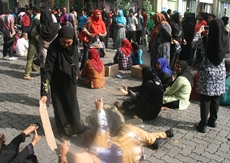
A sit-down protest on Majeedhee Magu

At sporadic points during the afternoon, in between clashes with police forces and peaceful sit downs, ugly scenes of confrontation were also witnessed where trucks, bikes and even government-aligned people deemed “Baghee” – a traitor – were swarmed and attacked by the crowd.

“Your photos will be a problem,” isolated figures explained throughout the day, following such confrontations. “Do not take pictures here. Take them from further away,” they said. “Do not give them to police.”

In the battle for international media attention, an image speaks a thousands words – so long as it is the right image.

Following the arrest of Nasheed, who is currently standing trial for the controversial detention of the Criminal Court chief judge during his time in office, men and women of all ages gathered outside the Male’ City Council building (MCC) between the intersections at Alikilegefaanu Magu and Rahdebi Magu.

Among the crowd was Mohamed Aslam, a former Environment Minister under Nasheed’s government, who claimed there was no official plan for demonstrations or a protest at the time.

“People are agitated, they are angry,” he said. “There is no plan, there is just outrage.”

Nasheed taken

It was earlier in the afternoon that 15 masked police officers had entered Nasheed’s family compound of Kenerege with a court warrant to detain the country’s first democratically elected president.

Police themselves later provided video footage of its officers taking Nasheed into detention.

Sources within the MDP later told Minivan News that the former president was taken peacefully, if reluctantly, briefly saying goodbye to his family before being escorted away by authorities. Police later returned for a second time to the compound, though no further arrests were made in the building.

However, by 2:00pm, there was clear anger among some three dozen predominantly male figures around the corner from Kenerege on Majeedhee Magu.  The tension was exacerbated as a group of officers in the back of a van quickly singled out an elderly gentleman across a crowded intersection and took him away.

Media were quick to capture the image, as angry onlookers heckled the officers over a blare of horns from taxis and other motorists now blocked by the unfolding drama.

A group of people including Nasheed’s representative on the Commission of National Inquiry (CNI), Ahmed ‘Gaha’ Saeed, soon blocked the road in what they claimed was a makeshift protest.

Perched on front of delivery vehicle, Saeed told Minivan News that demonstrators had opted to blockade the truck that he said to belonged to one of the country’s largest private retailers alleged to be one of the masterminds behind a “coup d’etat” that saw Nasheed controversially resign from office last year.

“People have waited a year since the coup and are very angry and unlikely to act reasonably now. They could bring Male’ to a standstill,” Saeed stated.

As some attempted to dissuade Saeed from his actions, other figures in the crowd attempted to limit the taking of pictures – an impossible task considering the prevalence of I-pads, camera phones and social media in the country.

By 2:30 pm, as the sun beat down intensely on the intersection, tensions continue to escalate as the crowd singled out a figure passing through the intersection on his bike. The figure was  Ali Waheed, the brother of current President Dr Mohamed Waheed Hassan Manik.

In the first of several such isolated attacks during the day, a crowd swarmed and surrounded Ali Waheed amidst shouts of Baghee, before he was pushed from his bike, surrounded and attacked. After a tense minute of confrontation, Ali Waheed was ushered from the intersection by some figures in the crowd – his bike abandoned on the street. It would not be the last vehicle left on the capital’s street during the day.
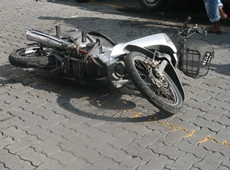
The crowd’s attention later turned to a military car with tinted windows. Isolated figures attacked the vehicle, ripping off its mirrors and smashing a rear passenger side window. Some three or four dozen young men appeal divided amidst appeals for calm from Saeed and several other figures asking to let the vehicle pass.

Heavy rainfall temporarily cleared the road and the simmering tension. As the situation calmed, Saeed explained that the crowd had sought out figures perceived to be tied either to senior government or the security forces, particularly the police’s Special Operations (SO) officers.

“They see it as you are either with us or against us,” he said. “We continue to ask for calm, but as always happens, it is the loudest in crowds who have their way.” Saeed rejected the accusation that individuals were being purposefully singled out as they passed through the barricade.

Sit down demonstrations

As the blockade continued, a growing number of men and women began to join the demonstrations, with former Environment Minister Mohamed Aslam joining a sit down in the middle of the street.

Further down the road, a single man lay in the rain soaked road outside the Male’ City Council building. The crowd suddenly appeared happy to clear to one side to let media to take a photo opportunity of the man. Meanwhile, curious and often bemused onlookers and shoppers stepped over him.
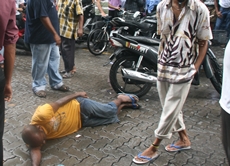
Demonstrator holds lie-down protest

However, the lighter mood was at times broken.  In one instance, a man riding a bike with a young girl on the back was heckled as a “Baaghee” – prudently he avoided the crowd and detoured down a side street.

At the height of the demonstration, some two or three blocks on Majeedhee were blockaded, with an orange rope set up across the street to stop traffic coming through.  A few motorists tried to get through to the derision of the crowd.

Shortly before 4:00pm, around 30 police officers in helmets arrive and begin to clear the intersection outside the city council building, removing Mohamed Aslam from the scene, while coming under fire from plastic water bottles and small sections of pavement stones.
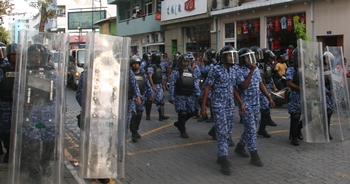
Several other figures in the crowd were also taken by authorities, as police left the scene.

Behind them, some 200 demonstrators remained on the road, continuing with their blockade and chanting.  Another group of women soon resumed their sit-down protests and anti-government chants.

The light mood again sporadically broken as another male – accused of being a member of the Police’s SO division – attempted to pass through the crowd. He was quickly swarmed as he was mobbed by a crowd divided over whether to attack or protect the figure.

Shouts of “baghee” from the crowd were punctuated by the screams of a woman travelling with the man.  Both are eventually moved to safety.

“There is hatred here,” said one protester. “He was asking for it. He could see there was a [blockade] but came through anyway. It is very hard to control some of these [demonstrators].”

Soon after, individuals once again spoke to media figures, reiterating appeals to cease taking photos as some of the group turn their attentions to breaking through a glass door of a large clothes shop – eventually they are dissuaded by others in the crowd.

At the same time, the Maldives Journalists Association (MJA) released a statement strongly condemning violent attacks said to be carried carried out against a journalist and a cameraman working from private media outlet Sun Online. Earlier in the day, a journalist for the same organisation had stayed in Nasheed’s family compound over concerns about his safety among the crowd outside.

Reinforcements

By 4:30pm, Police reinforcements once again arrived to clear the intersections, heckled by the 200 demonstrators who has sought to block sections of the road during the afternoon.

Though some officers were witnessed carrying firearms with rubber bullets, no such measures were witnessed being used by police, though one young woman arrested had appeared to have been pepper sprayed.
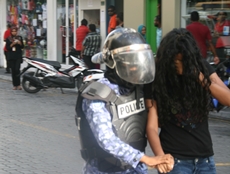
During the ongoing police operation, a further two dozen demonstrators were arrested and loaded into the back of a police van – among them a middle-aged women taken for heckling and singing songs.  she soon becomes an inadvertent hero among her fellow demonstrators. Aware of her status, she begins dancing in the back of the police truck.

As order is restored by authorities and the arrested are taken from the scene in an open topped van, the crowd cheer and wave at the figures, including an elderly woman who blew kisses and waved to the crowd.

With the police presence again gone, the crowd return to their blockade to songs and anti-government chants. The mood once again light temporarily until protesters attack and roll over a van belonging to Eydhafushi MP Ahmed Saleem, another figure unpopuler among the core MDP supporters. According to local media, milk packets are taken from the van and distributed among the protesters.

Whether demonstrators succeeded in bringing the capital to a standstill as some had claimed, for large parts of the day, one of the capital’s busiest roads was transformed into a protest site for dissatisfaction with the government.
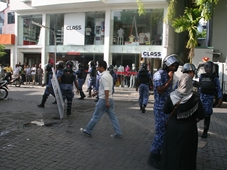
As police began to bring the crowds under control, among a blockaded section of Majeedhee Magu between Alikilegefaanu Magu and Rahdebi Magu, a shop-owner looked out from his door at the deserted road.

“It’s been a slow day for business,” he said.

Likes(0)Dislikes(0)

India “monitoring”, UK “puzzled”, Canada “deeply concerned” by Nasheed arrest

The Indian government has said it is “closely monitoring” the situation in the Maldives following the arrest of former President Mohamed Nasheed yesterday (March 5).

The court warrant to produce Nasheed before the Hulhumale’ Magistrate Court ahead of his hearing on Wednesday at 4:00pm was signed by Senior Judge Usman.

At 1:30pm the same day, several dozen police wearing riot gear and balaclavas escorted Nasheed from his family home in Male’ to the jetty, where he was taken to the detention centre on Dhoonidhoo island.

A video of the arrest released by police shows Nasheed being mobbed by several dozen riot police in balaclavas outside his home, one of whom reads from a piece of paper.

Nasheed’s Maldives National Defence Force (MNDF) bodyguard attempts to remain beside the former President, but is pushed away by the police. He is seen to follow the group, arguing with the officers.

Nasheed had evaded earlier court summons by seeking refuge in the Indian High Commission for 10 days, prompting calls from the UK, US, EU, Commonwealth and UN that the government ensure elections in September were “free, fair, and inclusive”, and that all parties be free to field the candidate of their choosing.

Nasheed emerged from the High Commission only after a purported “understanding” was reached between the government and a high-level Indian delegation including Joint Secretary of the Indian External Affairs Ministry Harsh Vardhan Shringla, that Nasheed would be “allowed to continue his social and political life” ahead of the September 7 elections.

Yesterday, the government denied such an understanding, the arrest of the former President sparked protests in Male’, a blockade of the main street, an assault on the President’s brother, the upturning of several vehicles, and by 7:00pm, 47 arrests, including 16 women.

“India expects due process and the Rule of Law would be followed; We would urge all concerned to exercise caution and restraint and not to resort to any violence or extra-constitutional means and steps which would weaken the democratic system,” said India’s Ministry of External Affairs (MEA) in a statement, following Nasheed’s arrest.

“We have received information that former President Nasheed was taken into (police) custody following an order issued by the Hulhumale’ Magistrate Court to produce him at 1600 hrs on March 6, 2013. We have been informed that former President Nasheed’s lawyers and family are going to meet him now as allowed by the authorities,” the statement added.

“We are monitoring the situation closely.”

“Puzzled”

Parliamentary Under Secretary of the UK’s Foreign and Commonwealth office, Alistair Burt, meanwhile informed the British parliament that the UK was “puzzled” over the arrest of Nasheed.

“At present we remain puzzled about the turn of events. It was widely believed that an arrangement was in place following former President Nasheed leaving the Indian high commission a couple of weeks ago, in relation to his trial and his part in the forthcoming elections,” said Burt, in response to a query from MP Karen Lumley.

“We are watching the situation carefully and have made it clear to the Maldivian authorities that no harm must be orientated towards the former President,” Burt said.

The Canadian government meanwhile issued a statement expressing “deep concern” over the “violation of clear commitments made by the current President, Mohammed Waheed, at Commonwealth Ministerial Action Group (CMAG) meetings in New York City last September.”

“[Nasheed’s arrest] also violates key Commonwealth values and principles and directly threatens the prospect of fair and inclusive elections in the Maldives this fall.,” warned Canadian Minister of Foreign Affairs, John Baird.

“Canada calls on President Waheed to release the former president and to guarantee his safety while also committing to free and fair elections. We continue to encourage Commonwealth Secretary-General Kamalesh Sharma to engage fully in defence of Commonwealth principles in the Maldives,” Baird stated.

“These developments of serious concern reaffirm the need to maintain the situation in the Maldives on the agenda of the Commonwealth Ministerial Action Group, which will have its next formal meeting in London in April,” he added.

Amnesty International meanwhile labelled Nasheed’s arrest an example of “selective justice”, which “highlights the failure of the Maldives authorities to investigate other serious human rights abuses in the country.”

“Of course political leaders, including Nasheed, should be held to account – but the targeting of Nasheed is an example of selective justice,” said Abbas Faiz, Amnesty International’s Maldives Researcher.

“Amnesty International, and many others, have documented a wide range of human rights violations committed by security forces following Nasheed’s resignation. These include police violence against peaceful protesters and the deliberate targeting of Nasheed’s supporters.

“No one has yet been held to account for these abuses despite the huge amount of documentary evidence available. The Maldivian authorities must carry out a full investigation into alleged abuses by anyone, and not just target political opponents.

“Former President Maumoon Abdul Gayoom (1978-2008) has never been investigated or held to account for alleged abuses committed during his rule. All leaders should be held to account for alleged abuses and in fair trials,” Faiz said.

The United States also expressed concern at “ongoing events in Male”, stating that “the integrity of and public confidence in the Maldivian electoral process must be maintained.”

“Accordingly, we note that all parties participating in these elections should be able to put forward the candidate of their choice. We also call upon the Government of the Maldives to implement all the recommendations of the Commission of National Inquiry (CONI) report, including the recommendations related to judicial and governmental reforms. We continue to urge all parties to chart a way forward that strengthens Maldivian democratic institutions, the rule of law, human rights and fundamental freedoms,” the US Embassy in Colombo said in a statement.

Hulhumale Court challenged

Several recent reports produced by international bodies have challenged both the legitimacy of the Hulhumale’ Magistrate Court, the charges against the former President – of detaining Chief Judge of the Criminal Court during the final days of his presidency in 2012.

Last week, UN Special Rapporteur on the Independence of Judges and Lawyers, Gabriela Knaul, criticised the “arbitrary” appointment of the judges in the Nasheed case “outside the parameters laid out in the laws.”

Knaul furthermore stated that the Judicial Services Commission (JSC) – responsible for establishing the Hulhumale Magistrate Court and appointing the three member panel of judges – was politicised, subject to external influence, and hence unable to fulfill its mandate effectively.

The UK’s Bar Human Rights Committee (BHRC) also recently published a report based on its observation of the first hearings of the Nasheed trial.

“BHRC is concerned that a primary motivation behind the present trial is a desire by those in power to exclude Mr Nasheed from standing in the 2013 elections, and notes international opinion that this would not be a positive outcome for the Maldives,” the report concluded.

Police video of the Nasheed arrest on March 5:

http://www.youtube.com/watch?v=gK_YSHtcbvI&feature=youtu.be

Likes(0)Dislikes(0)

Comment: Political scene hots up again

After a week of relative lull on the political front, Maldivian politics revved up on Tuesday, March 5, after the police detained former President Mohamed Nasheed to produce him before the suburban Hulhumale’ court in connection with the ‘Judge Abdulla abduction case’.

The arrest, possibly delayed pending the President’s customary annual address to Parliament a day earlier, came less than 10 days after Nasheed ended his 11-day sit-in at the Indian High Commission in Male, claiming that New Delhi had brokered a ‘deal’ for his contesting the presidential polls in September – denied by both governments.

If tried, convicted and sentenced to a prison term exceeding one-year imprisonment (it can go up to three years, or a fine of MVR 12,000), and he also runs out his appeals ahead of the poll notification, Nasheed will be disqualified from contesting the polls. It is in this context, his claim that India has brokered a ‘deal’ assumes significance. So has his subsequent appeal/declaration of sorts, implying that New Delhi should ensure that he contests the polls.

Defining moment

In a way the presidential polls, scheduled for September, are turning out to be as much a defining moment as the one that institutionalised multi-party democracy in Maldives. Yet, as the chips are down, President Waheed managed to address the People’s Majlis amid interruptions and in four installments. Out after the sit-in in the Indian High Commission and anticipating detention and disqualification, his predecessor would not acknowledge the legitimacy and continuance of President Waheed. A couple of days before the customary/mandatory presidential address to Parliament in its first session in the calendar year, Nasheed had an uninterrupted interview with NDTV.

The Indian television channel is accessible in Maldives and much of South Asia, and in many other parts of the world. The uninterrupted nature of Nasheed’s interview also made it cohesive and comprehensive, to viewers afar and nearer home, too – what with the local newspapers also picking it up for their readers. Against this, President Waheed’s address, disrupted constantly by parliamentarians belonging to Nasheed’s Maldivian Democratic Party (MDP), was limited in its appeal to the Maldives, at best, and political Male, positively.

As much as the content of the speech – whose text would have been anyway made readily available – the punter, if any, would have wagered on the possibility of President Waheed completing his address in the first place – and, if allowed to do, with how many interruptions. The final count was three breaks and in four innings. The score was better this time than in the previous year – Waheed’s first address to Parliament as President – when fresh for the controversial power-transfer, MDP parliamentarians did not allow him to do so on March 1, the first day in the calendar year when the House met after the long recess. Waheed had to go to the Majlis on another day, March 19, to be precise, when alone he could manage to do the honours – of course, with MDP interruptions.

This time round, the President could deliver his address, even if amidst interruptions, only after Parliament Speaker Abdulla Shahid ‘named’ a few MDP members for disturbing the proceedings, and the security people moved i  to bundle them out. Incidentally, as MDP parliamentary group leader Ibrahim Solih said later, the party, as the largest (non-government) segment in the House, has stuck to its previous year’s decision not respond to President Waheed’s address within 14 days under Article 25 (b) and 25 (e) of the Constitution, holding it an ‘illegitimate regime’.

At the same time, the presidential address on both occasions would have gone into the records of Parliament for all time to come. It is thus unclear, what benefit the MDP could have derived by disturbing Parliament, that too during presidential address, when it is felt that the party would need to win over the ranks of ‘non-party’ or ‘undecided voters’. Invariably, these are moderate segments of the electorate, and take their time, evaluating not just the motives of the contending parties but also their methods. Their numbers supposedly add up to 50 per cent of the electorate.

Certainly, it does not do any good to the kind of democracy that the MDP wants to usher in all over again in the country – going by unforgettable memories of the turn that the protest by the party MPs took this time last year. In electoral terms, it might have kept the party cadre-mood upbeat, but their votes are already for the MDP. The party needed votes from outside this constituency, and that needed greater, different and differentiated initiatives and efforts – not just the beaten path of the past year alone.

‘Aggressive’ India, defence deal with China

In his television interview, Nasheed was clearly addressing an Indian audience. He claimed that there was kind of a deal between India and the Maldivian Government for him to end his 11-day sit-in in the Indian High Commission in Male, protesting the imminence of his arrest, possibly leading to his disqualification from contesting the presidential polls, scheduled in September. He wanted India to take an ‘aggressive’ posture if the Maldivian government tried to arrest him again. He did not explain what he meant by New Delhi’s ‘aggressive’ posturing.

That Nasheed was addressing the Indian TV viewers, possibly with the hope of pressuring New Delhi into ensuring that the Maldivian government did not pursue with its current moves to have him tried and punished in the ‘Judge Abdulla abduction case’ before the presidential polls became clearer when he referred to China, which could not be contextualised either to his own predicament, or bilateral relations between India and Maldives, otherwise.

“Well, there is instability in the Maldives. So, there will always be a room for other actors to come in. Therefore that is all the more a reason why we should be able to have free and fair elections as quickly as possible,” Nasheed told the interviewer. “We did not have a military-defence agreement with the Chinese government but this government has now come up and signed an agreement,” he said.

Nasheed’s reference to an ‘aggressive’ India thus did not relate to China, but to the internal political dynamics of Maldives – and that was saying something in terms of his current perceptions about bilateral relations between India and Maldives on the one hand, and India and China, on the other.

Media reports in Maldives, citing Nasheed’s interview, also quoted Waheed government’s reiteration of the denial about the existence of any such agreement. As some reports have been recalling from time to time, Nasheed as President inaugurated the Chinese Embassy in Male in November 2011 – which was understandable – but on the very day Indian Prime Minister Manmohan Singh was landing in the country for the SAARC Summit, followed by a bilateral.

‘Small state, small justice’

Against this, President Waheed seemed to have taken off from where Nasheed had left – not the ‘China factor’ as in the latter’s interview, but the Indian angle, instead. Without naming India or any other nation, the President told parliament that the foreign policy of the Maldives will always aim at defending the country’s independence, sovereignty and Islamic values. He claimed that several groups were interested in influencing and interfering with the political independence of the country, and said that the government would (nonetheless) address the issues and concerns of the international community.

The President, as local media quoted him, said that foreign countries’ concerns will be acknowledged but their interference in internal politics of the country and calls to hold elections before a certain date, will not be accepted.

“The government will not accept ‘small justice’ because we are a small state,” he said. In context, Waheed referred to ‘certain groups’ in the country welcoming the pressure by the international community, and said that such pressure are not aimed at the government, but would affect the country’s independence.

In the same vein, President Waheed, again without any pointed reference to President Nasheed’s tenure, when he himself was Vice-President, and said that the nation’s economy had ‘fallen into a pit’ when he took over in February last year. The external debt stood at $725 million (MVR 11,179.5 million) owing to high expenditure, and his government, he claimed prioritised on early economic recovery. “Several steps have been taken to reduce Government costs, and several Bills have been submitted to Parliament related to increasing Government income and revising laws,” he said, without acknowledging the early initiatives taken in this regard by the Nasheed government.

In this context, President Waheed claimed that regaining cogtrol of Ibrahim Nasir International Airport from the GMR Group, the Indian infrastructure major, had increased foreign currency-flow into the country, and facilitated solutions to the problem of dollar-shortage. “The Government’s aim is to ensure that foreign currency that enters the country is retained,” he said. In contrast, Nasheed had said that if returned to power, he would restore the GMR contract.

‘Free and fair polls’

Alluding obviously to the international community’s call for ‘free, fair and inclusive’ presidential polls, Waheed promised as much in his parliamentary address. By referring to his government in this regard, he distanced the judiciary from the process, after his camp had repeatedly asserted that the administration did not have anything to do with the case against Nasheed at this stage. It was for the court to decide on the next course, seemed to be the government’s refrain.

“I would like to assure members that the government will put every effort to see that the Maldives presidential election this year is a free, fair, and open to all political party participation, and is held according to the Constitution and laws of the State,” local media reported Waheed as telling the Majlis. Clearly, he was countering the MDP declaration that the party would boycott the polls if Nasheed was disqualified, and was possibly indicating that it could/should nominate another candidate, instead. He also said that the government will cooperate with the Elections Commission to clear any obstacles that might oppose free and fair elections – possibly referring to anticipated street-protests by the MDP if Nasheed was disqualified.

“I also give assurance that the government will not influence an election, and will not do anything that might hinder electoral rights,” Waheed said, in an obvious reference to the exclusively role of the nation’s Judiciary in the matter from the current stage on. “The Government continues cooperate with the Elections Commission and provide any assistance they might require. If there are any obstacles to holding the election, the Government will provide whatever cooperation necessary to the Elections Commission to remove such an obstacle,” said the President.

‘Reforming judiciary’

For his part, Abdulla Yameen, parliamentary group leader of the second-largest, Progressive Party of Maldives (PPM), a presidential hopeful himself, said that President Waheed should lead the process of strengthening criminal justice system in the country. By timing and implication, his observations could be interpreted, or mis-interpreted, as the case may be, to be projected as a left-handed backing for the MDP’s charge that Nasheed would not get justice from the existing judicial system in the ‘Judge Abdulla abduction case’.

“The entire criminal justice system has problems. Regardless of the reasons behind the problems, the Head of State should take the responsibility of finding solutions if the delivery of justice is being delayed. The purpose of this isn’t to ensure that the case is concluded in a particular way. It is a responsibility of the President, under Article 115 of the Constitution,” Yameen reportedly told a local television channel.

Yameen, according to media reports, said his was only ‘constructive criticism’ of the existing system and should not be construed as a personal criticism against President Waheed. Incidentally, while suggesting that not all charges taken to the police have to be converted into court proceedings, Yameen referred to avoidable delays in the dispensation of justice, which is what the MDP seeks to imply through its demands, through Nasheed’s offer to face trial in the abduction case after the conclusion of the presidential polls. If elected President, Nasheed could not be tried while in office, followed by certain immunities, post-retirement, but unavailable to him now in the ‘Judge Abdulla case’, it would seem.

Line-up unclear, yet

For all this however, the presidential poll line-up is unclear, as yet. Nasheed’s candidacy depends upon the pending court case, which has however not made much headway in recent weeks. Despite his arrest – the third since October, if only to ensure that he presented himself before the court – there is still a chance of the case not running its due course, including possible interlocutory and appeals stages, at this pace before the Election Commission issues the required notification in due course. The Waheed camp used to assert his own candidacy until the top-rung PPM partner in his Government declared its intention to contest the presidency itself, and set its primary for the purpose for March 30.

Yameen, who is one of the two candidates in the primary – the other being former PPM vice-president Umar Naseer – and he could consider full-throttled campaign, if at all, only after the primary. The same applies to Umar Naseer, who contesting alone in 2008 presidential polls, obtained less than one per cent vote-share, before joining the Dhivehi Rayyatunge Party (DRP), founded by former President Maumoon Abdul Gayoom. Inside the DRP, Umar Naseer used to be seen as the voice of Gayoom, and used to remain so even after the latter walked out with his group, to found the PPM. Gayoom, after being unanimously elected PPM president in December, has vowed to work for whichever nominee the party’s General Council chooses.

That leaves out DRP leader Thasmeen Ali and Jumhooree Party (JP) founder Gasim Ibrahim. As elected party leader succeeding Gayoom, Thasmeen automatically became DRP’s presidential nominee as early as 2009. Gasim also announced his candidacy very long ago. Between them, however, Gasim has been seen actively campaigning for the party while the DRP leader is still busy competing with the breakaway PPM, enrolling new members for the party, to become the second largest one after the MDP – outside Parliament after it had lost the game inside the Majlis.

Otherwise, the course of the elections depends on the decision of the MDP should Nasheed be disqualified. The party’s National Council has announced that the MDP would boycott the presidential polls if Nasheed is not allowed to contest. Independent of other arguments and consequences, such a course would flag the theoretical question if the MDP if the party would continue with this position even for the parliamentary polls, which is due in May next year.

The writer is a Senior Fellow at Observer Research Foundation

All comment pieces are the sole view of the author and do not reflect the editorial policy of Minivan News. If you would like to write an opinion piece, please send proposals to [email protected]

Likes(0)Dislikes(0)

Police seek public assistance to identify four protesters

Police have asked for public assistance in identifying four men seen in a video clip captured of the Maldivian Democratic Party (MDP) protest on Tuesday near the Male City Council Office in Majeedhee Magu.

In a statement police asked the public to provide any regarding the four persons to the police criminal investigation department on 963 1696 or police headquarters at 332 2111.

Police also said that, if required, protection will be given to anyone who shared information with the police.

Yesterday the police also published the picture of MDP activist Ali Hashim, 24, from the island of Dhidhoo in Haa Alifu Atoll.

Hashim was previously arrested by police in connection with the murder of Dr Afrasheem Ali, but was released without charge.

Police said Hashim surrendered himself to the police at 10:55pm last night and was is now under police charge.

Police have not disclosed why the four suspects were being searched for.

MDP protesters took to the street after police arrested former President Mohamed Nasheed in compliance with an arrest warrant issued by the Hulhumale’ Magistrate Court.

Nasheed is to appear for his alleged unlawful detention of Chief Criminal Court Judge Abdulla Mohamed during his final days in office, charges his party maintain are a politically-motivated attempt to disqualify him from the September 7 elections.

Nasheed’s legal team filed a case at the Criminal Court yesterday requesting for a writ to habeas corpus. However the Criminal Court rejected the case without holding a hearing.

Likes(0)Dislikes(0)

Eleven parties face dissolution after parliament overrules president on political parties bill

Parliament has overruled President Mohamed Waheed’s veto on the political parties bill by a majority of 60 votes.

The political parties’ bill – which requires political parties to have a minimum 10,000 members before they are recognised as such, was passed by the parliament on December 2012.

However, President Mohamed Waheed – whose party Gaumee Iththihaadh Party (GIP) has a membership of just over 3,000 members – refused to ratify the bill and sent it back to parliament for reconsideration in January.

During Tuesday’s session, both parliament’s minority leader and majority leader unanimously supported to pass the bill without any amendments, forcing it through.

Out of the 67 members present during the vote, 60 voted in favor of the passage of the bill while six voted against the bill and one MP abstained.

During the debate on the matter, the government-aligned Progressive Party of Maldives (PPM) and Dhivehi Rayyithunge Party (DRP) MPs both alleged that President Waheed had rejected the bill because it involved his personal interests and that his party GIP would be one of the first few parties to be dissolved after soon the law came into force.

However, Deputy Leader of Dhivehi Qaumee Party (DQP) MP Riyaz Rasheed spoke in favor of President Waheed’s decision to reject the bill, claiming that the top four parties are trying to destroy the remaining political parties operating in the country – including the DQP, of which Home Minister Mohamed Jameel and Waheed’s Special Advisor Hassan Saeed are members.

According to the constitution, if a bill sent back to parliament by the president is passed again without making any changes, the bill automatically becomes law without the need of a presidential ratification.

Upon ratification, the bill will provide a three month period for any political party with fewer than 10,000 members to reach the required amount or face being dissolved.

Article 11 of the bill states that at least 10,000 signatures would be needed to register a party at the Elections Commission (EC), which would be mandated to ensure that membership does not fall below the figure.

Parties unable to sign 10,000 members would be dissolved.

The legislation passed today also stipulates that the Male’ City Council (MCC) must provide a 1,000 square feet plot in the capital for parties with membership exceeding 20,000.  The plot would be used as an administrative office or meeting hall, for which the party would be required to pay rent.

Earlier, an amendment proposed by MP Ibrahim Muttalib to lower the figure to 5,000 was defeated 59-6.

Of the 16 parties currently in existence, only five parties now have more than 10,000 registered members, including the formerly ruling Maldivian Democratic Party (MDP) as well as the government-aligned parties DRP, PPM, Business tycoon MP Gasim Ibrahim’s Jumhoree Party (JP) and most recently, the religious conservative party Adhaalath Party (AP).

Following the passage of the bill, Adhaalath Party leaders claimed the legislation was a direct attempt to dissolve the party and in the long run “eradicate” Islamic ideology from Maldivian politics and “defeat” the party’s efforts to oppose alleged attempts to secularise the country.

“This is a big political and legal challenge [they] placed before Adhaalath Party. The way the political sphere in the country is shaped today, it is very important for a political party like Adhaalath Party to exist,” said its leader Sheikh Imran Abdulla at the time.

However, on Monday, the Elections Commission informed the party that it had attained the needed 10,000 members. The party had carried out a vigorous membership campaign during which slogans such as “sign for Adhaalath party for Islam” and “defend Islam” were used.

DQP Leader Hassan Saeed followed the Adhaalath Party in warning that he would seek to invalidate the bill through the Supreme Court if it was ratified. Latest statistics shows that the DQP’s membership currently stands less than 3,000 members.

“While it is a constitutional right for anybody to form political parties, I do also believe that a right could be limited through legislation. But such a limit should be placed in accordance to principles justified in other free and democratic societies. The current bill demanding a certain membership size in order for a political party to be registered is a big problem,” Saeed was quoted saying in local media.

Political parties were first authorised in the Maldives in May 2005 following an executive decree by then-President Maumoon Abdul Gayoom.

The regulation required 3,000 members for registration and did not stipulate whether parties with membership numbers falling below the figure would be dissolved.

Likes(0)Dislikes(0)

Tension surges in Male’ as police arrest former President Mohamed Nasheed

Photo courtesy Jaawid Naseem, Jade Photography

Former President Mohamed Nasheed has been arrested by police ahead of his trial hearing at Hulhumale’ Magistrate Court, scheduled for 4:00pm tomorrow (March 6).

Police Spokesperson Chief Inspector Hassan Haneef confirmed that Nasheed had been arrested and taken into police custody at 1:30pm today (March 5).

“We have received the order. Police have taken Nasheed into custody in order to produce him at Hulhumale’ Magistrate Court 16 hours from now,” Haneef told Minivan News.

Photos of the arrest showed several dozen police wearing balaclavas and black riot gear, several armed with rubber bullet guns, entering Nasheed’s family home in Male’ and emerging with the former president.

Shortly after the arrest, Minivan News observed President Mohamed Waheed’s brother Ali Waheed forced off his motorcycle by several dozen angry demonstrators on the main road Majeedee Magu, at the turnoff to Nasheed’s house. A second, larger group pulled Ali Waheed to safety, abandoning his motorcycle. The first group then attacked a parked military vehicle, smashing a window.

A group of people including Nasheed’s representative on the Commission of National Inquiry, Ahmed ‘Gaha’ Saeed, blocked the road, trying to calm the more violent protesters. One man had laid down in the middle of the street as part of a silent protest.
“People have waited a year since the coup and are very angry and unlikely to act reasonably. They could bring Male’ to a standstill,” Saeed said.
Former Environment Minister Mohamed Aslam, arriving at the scene, said “There is no plan. People are agitated, they are angry. There is no plan, there is just outrage.”

Nasheed’s latest trial hearing follows his exit from the Indian High Commission last month, after the Maldivian and Indian government came to an alleged “understanding” that he would be able to conduct a peaceful campaign and participate in an inclusive election.

The former president told Indian media on Sunday (March 3) that while he had ended his 11-day stay in the Indian High Commission, he was still not entirely free and feared an arrest warrant would be issued against him any day soon.

Maldivian Democratic Party (MDP) Spokesperson Hamid Abdul Ghafoor confirmed to Minivan News that there were Special Operation (SO) officers outside Nasheed’s residence earlier today prior to his arrest.

“He has been taken away to Dhoonidhoo [prison], we are still in a state of shock,” Hamid said.

The former President sought refuge inside the High Commission building on February 13 after Hulhumale’ Magistrate Court ordered police to produce Nasheed at his trial hearing scheduled for later that day.

Nasheed has maintained that the charges against him – of detaining the Chief Criminal Court judge during his final days in office – are a politically-motivated effort to prevent him contesting the 2013 elections.

Nasheed spent 11 days inside the commission building before making an unannounced exit on February 23.

Following his exit from the High Commission, the Hulhumale’ Magistrate Court issued a travel ban to Nasheed, preventing him from leaving the country.

UPDATES

2:30pm: Shortly after Nasheed’s arrest, Minivan News observed President Mohamed Waheed’s brother Ali Waheed being pulled off his motorcycle by several dozen angry demonstrators on the main road Majeedee Magu. A second, larger group pulled Ali Waheed to safety, abandoning his motorcycle. The first group then attacked a military vehicle, smashing a window as it tried to move past the group.

3:00pm: More people are arriving outside the City Council Building near the demonstration, nearing a hundred people or so in size. Shops in the vicinity are closed, and one man is lying down in the middle of the road, stepped over by the occasional pedestrian. People on motorcycles are stopping to look, and turning around to find another route.

3:10pm: A separate group of two dozen men are turning away traffic at the next intersection, in an apparent attempt to shut down Male’s main road. No sign of police presence yet. A man passes through the blockade with a young girl on a motorcycle, to shouts of “baghee” (traitor).

3:12pm: Nasheed’s brother Dr Nashid tweets: – “given all clear to go to Dhoonidhoo [detention centre]. Waiting for Laila [Nasheed’s wife]”. In a second tweet, he adds that Nasheed’s bodyguards “were changed this morning.”

3:28pm: President Waheed tweeted: “Assaulting my brother Ali Waheed will not help Nasheed escape justice.”

3:30pm: A pickup truck is circling Male’ calling on people to come out on the streets. Light rain earlier has since cleared up.

3:37pm: Photos circulating on social media appear to show one of Nasheed’s bodyguard being restrained by police as the former President was escorted outside his family home.

3:39pm: Approximate 30 police have arrived at the scene. Demonstators threw plastic bottles at officers, who subsequently departed after detaining former Environment Minister Mohamed Aslam. The crowd numbers around 200 people.

3:42pm: SunOnline reports that protesters on Majeedhee Magu have pushed off a uniformed police officer from his motorcycle as he was driving through the protesters. The policeman abandoned his motorcycle and left on foot when the crowd moved to attack him, Sun reports.

3:44pm: Abbas Faiz, South Asia Specialist for Amnesty International tweets: Amnesty investigating concerns that former prez Nasheed arrest politically motivated and his safety uncertain.

3:46pm: A masked man climbed up the posts on which CCTV cameras are mounted on the junction of Majeedhee Magu and Alikilegefaanu Magu and spray-painted the camera, reports Sun Online.

4:01pm: A video of Nasheed outside his house has emerged on DhiTV, titled ‘Anni’s Quarrel’. In the video, a Special Operations police officer states: “We will accompany you there.” Nasheed: “Well, let’s go then. I won’t go in that way. I am doing what is good for you… I will know better than you. Let’s go already.” [Former Foreign Minister] Naseem: “He is going, isn’t he? What is wrong with you baaghees (traitors)?” “Nasheed: Sigh. What more can I say? Even I would know these laws and responsibilities. For God’s sake, let’s just go. Let’s go quickly. Let’s just go quickly.”

4:03pm: The Maldivian Democratic Party has issued a statement condemning the arrest:

President Nasheed was arrested while walking down the street in Male’ at approximately 13:45 local time today. He was apprehended by numerous armed and masked police officers, who did not identify themselves, nor produce an arrest warrant or court summons. Nasheed’s lawyers were not informed of the arrest, or of any court summons.

President Nasheed was taken to Dhoonidhoo Island detention centre – the facility in which he was tortured during the former regime of Maumoon Gayoom.

Commenting on the arrest, the MDP’s international spokesperson Hamid Abdul Gafoor said: “Once again Dr Waheed has proven that he can’t be trusted to hold a free and fair election – despite his assurances to the international community.

“Nasheed was supposed to be on an election campaign trip but instead he is languishing in jail.

“This arrest comes just days after the UN Special Rapporteur on the Independence of Judges and Lawyers, Gabriela Knaul, said the judges overseeing President Nasheed’s case had been appointed “arbitrarily”.

“Dr Waheed, in collusion with his friends in the judiciary, is pulling out all the stops to prevent President Nasheed competing in the elections.”

The UN Special Rapporteur also said that the Judicial Services Commission, which established the court trying President Nasheed, was “politicised” and subject to “external influence”.

4:07pm: The Maldives Journalists Association (MJA) has issued a statement condemning an attack on Sun journalist and a VTV cameraman:

Maldives Journalists Association (MJA) strongly condemns the violent attacks carried out against a journalist and a cameraman while covering the arrest of former President Nasheed today.

The journalist from sun.mv was attacked and tore his shirt and snatched his mobile phone while VTV cameraman was attacked and snatched his video tape in his camera. Both the incidents was happened near former president Nasheeds residence. We strongly call on all parties to allow media to do its duty without any harrasements. And also call on all responsible authorities to investigate the above incidents and call on media regulatory authorities to not to allow ‘hate speech’ on media.

4:11pm: President’s Office Spokesperson Masood Imad told Minvan News: “I have already told Indian and local media that the Maldives government has made no deal with the Indian government over Nasheed’s exit from the Indian High Commission. It was never said there would be a delay in Nasheed’s trial hearing, or his court case or any other matter involving him.”

“[The government] cannot make any delay or decision based on legal matters because it is not our business, it is the judiciary’s decision,” Masood said.

Asked if Nasheed’s arrest would harm relations between Maldives and India, Masood said: “If we had made a deal and broken it, then that would be an issue. But we have not made any deal, and there has been no deal between India and the Maldives regarding Nasheed’s case. There was no understanding between the respective governments. If Nasheed thought there was an understanding, it must have been something he understood. There is no dealing between us and the judiciary on Nasheed’s judgement, It is totally up to the judiciary, we will have have no interference with the court. I did not know that the court would order police to summon Nasheed today.”

4:21pm: Scuffles are breaking out between protesters and passerbys they deem to be “baghees” (traitors). One woman clung to a man screaming as the crowd surrounded them. “There is hatred here,” said one protester. “He was asking for it. He could see there was a [blockade] but came through anyway.”

The attitude of the crowd is divided between the angry and those appealing for calm. Around 20 riot police have arrived with shields.

4:30pm: Police reinforcements have arrived at an nearby intersection, heckled by the crowd of 200 demonstrators blocking the road.

4:31pm: A middle-aged women was arrested after heckling and singing songs, and was dancing in the back of the police truck. A further five or so individuals have been arrested.

4:36pm: Police have brought the area under control and are now directing traffic.

5:30pm: The US Embassy in Colombo has issued a statement:

The United States is increasingly concerned about ongoing events in Malé. We understand that both the Police Integrity Commission and the Human Rights Commission are monitoring the situation, and that the Human Rights Commission has requested access to Former President Nasheed.  We urge all sides to remain calm, reject the use of violence, and avoid rhetoric that could increase tensions. Former President Nasheed must be accorded due process under the law regarding his pending court cases.

We urge that the Presidential elections scheduled for September 7, 2013 be free, fair, credible, transparent and inclusive. The integrity of and public confidence in the Maldivian electoral process must be maintained. Accordingly, we note that all parties participating in these elections should be able to put forward the candidate of their choice. We also call upon the Government of the Maldives to implement all the recommendations of the Commission of National Inquiry (CONI) report, including the recommendations related to judicial and governmental reforms.  We continue to urge all parties to chart a way forward that strengthens Maldivian democratic institutions, the rule of law, human rights and fundamental freedoms.

5:30pm: Sun Online reports that protesters have rolled over a Redwave van (owned by shop owner Eydhafushi MP Ahmed Saleem) near Male’ City Council. The van was broken into, milk packets were taken and subsequently distributed to protesters.

5:51pm: British entrepeneur Richard Branson has tweeted on the Nasheed arrest: “Maldives former president Nasheed arrested, in court tomorrow. Hope he is treated with respect & fairness”.

6:31pm: Local media has reported that police have once again left Majeedee Magu.

7:10pm: Some 150 demonstrators remain on Majeedee Magu, situated around 20 metres from the Male’ City Council building. No police presence is witnessed by Minivan News at the current time, although traffic is still being diverted as a result of the makeshift blockade.

8:52pm: At a press conference held this evening, the Maldives Police Service have said that a total of 47 people were arrested so far during demonstrations today on Majeedee Magu.  Of those arrested 31 were male, 16 females were also detained.  Among those arrested was MDP MP Ahmed Easa, who authorities said was later released.

Likes(1)Dislikes(0)

“Illegitimate address by coup president warrants no official response”: MDP PG Leader Ibu Solih

Maldivian Democratic Party (MDP) Parliament Group Leader Ibrahim Mohamed Solih (Ibu Solih) has stated that the party will not be responding to the presidential address delivered by President Mohamed Waheed Hassan during Monday’s parliament opening ceremony.

Solih said the statement held no legitimacy as Waheed himself was an illegally installed president, and hence warranted no official response.

“Waheed is in his position through a coup d’etat. A year having passed since does not change that fact. That is what we demonstrated in parliament today,” Solih told local media.

“We are only obliged to respond to a presidential address given by a legitimate leader.”

If Waheed were to be a legal president, then he would be representing MDP. Were it so, then MDP would not need to respond to the address, and the task would be for some other party. So, in either of those instances, MDP has no obligation to respond to Waheed’s statement,” he continued.

MDP also refused to respond to Waheed’s address in 2012.

Parliament regulations state that the majority and minority parties in the parliament besides the one that the President represents must issue a response to the presidential address within a period of 14 days after it being issued.

Solih furthermore expressed concern over some actions during Monday’s parliamentary session.

“While the session was in a recess, an MNDF officer attacked one of our MPs. I saw this happen with my own eyes. I have already lodged a complaint about this with the parliament speaker. The security officer was removed from the parliament halls at the time. Incidentally, we have also identified him,” Solih alleged.

Solih also alleged that the party’s objective during this parliamentary year was to pass many of the important bills that have been pending for long periods of time.

“I believe this year we will see a lot of productive work being completed here. One of these pending bills is the Penal Code. Hopefully, this bill will be passed as law within the month,” Solih stated.

Presidential Address in six hours, six attempts

President Mohamed Waheed Hassan delivered the presidential address in parliament on Monday through six separate attempts made through nearly six hours.

The Maldivian Democratic Party (MDP) MPs staged protests inside the parliament chambers while simultaneous protests by party supporters carried on outside parliament, with thousands of supporters chanting “coup president resign now” and “we want an interim government now”.

While normal procedure during previous instances where a president speaks in a parliament is to fly the presidential flag alongside the national flag and the parliament flag, no such flag was hoisted during Monday’s session.

Waheed was prevented from entering the main parliament hall twice, and he proceeded to deliver the presidential address in four separate installments. Local media reported that Waheed had omitted much of the 17 page speech that had been distributed to media ahead of the parliament meeting.

Three of these times, he was led out of the hall by Parliament Speaker Abdulla Shahid due to disruptions caused by MDP MPs who were echoing the chants of “baaghee” [traitor] inside.

After Waheed concluded his presidential address, MDP MPs joined the street protests which were being carried out on Sosun Magu.

Former President and MDP Presidential Mohamed Nasheed joined to greet the MPs as they entered the gathering to the sound of loud cheering from party supporters.

Before the protest was concluded, MP Ali Waheed addressed the crowd, stating that the party would continue protesting against what he alleged is a “coup government.”

“What we have witnessed is the beginning of the end of Waheed’s coup administration,” MP Waheed told the gathered crowds.

“Just like the old dictator Maumoon had to retreat into his cave, Waheed will have the same fate,” he said.

“The events we saw in Majlis has proven a lot of things. The fact that members from all the other parties stayed quiet and did not attempt to intervene in our protests say a lot. They have said ‘no to Waheed’ in the loudest form that they can while they are still part of this current government,” Ali Waheed said.

“Around 30 of our MPs managed to hold Waheed back from speaking in parliament for over five hours despite him coming surrounded by police and army. There is hope that we will be victorious,” Ali Waheed said in conclusion of his address before the party marched off, bringing an end to Monday’s protests.

Likes(0)Dislikes(0)

President delivers address to parliament after six hours of heckling

Additional reporting by Mohamed Naahee.

President Dr Mohamed Waheed Hassan Manik has delivered his opening address to a boisterous parliament amid protests inside and outside the parliament chamber.

Waheed, who was due to deliver the address at 10:00am this morning, finally finished it at 4:00pm on the fourth attempt after repeated obstruction by opposition Maldivian Democratic Party (MDP) MPs.  Representatives from the party waved pieces of paper at him with phrases such as “illegitimate president” and “coup boss”.

Under the 2008 constitution, the head of state is required to deliver the opening address at the first sitting of parliament each year. The MDP contend that Waheed’s presidency is illegitimate, following the resignation of President Mohamed Nasheed on February 7, 2012, amid a police and military mutiny. The party disrupted last year’s opening session by blockading the chamber doors from the inside, while outside supporters clashed with police in the streets.

A sit-down protest in the afternoon at the Sosun Magu intersection appeared peaceful, although police had barricaded the roads around the parliament building. Inside, local media reported that five MPs left the chamber voluntarily after being ordered to do so by Speaker of Parliament Abdulla Shahid.

Deputy Parliamentary Group Leader of MDP Ali Waheed announced on Sunday that “usurpers don’t get to deliver presidential addresses”.

In his address, an English summary of which later appeared on the President’s Office website, President Waheed emphasised “independence and territorial dignity” and described his highest priority as “strengthening the principles of Islamic faith among the people.”

“Underscoring that the Maldivians have always defended their independence from foreign influence, President Waheed stressed on the sacrifices made by our ancestors with their lives and blood,” read the statement.

“In his Presidential Address, the President noted that the keystone of our independence is the allegiance of our forefathers to the ideals and integrity of the Maldives, and that the foundation of our unity lies in Islam. The President said that our common faith, language and ethnicity were the reason why our nation should not disintegrate into opposing factions.

“Continuing in this regard, the President reminded the people to be vigilant of the patience and determination necessary to maintain our independence and individuality, and to unwaveringly hold on to our Islamic faith,” the statement concluded.

According to local media, Waheed also remarked that the economy had “fallen into a pit” at the time he took over the presidency, with external debt of US$725 million.

Expropriating the airport from Indian infrastructure giant GMR – at the time the country’s single largest foreign investment at US$511 million – had increased foreign currency coming into the country and relieved the dollar shortage, Waheed said according to Sun Online.

Speaking to Minivan News, Deputy Parliamentary Group Leader of government-aligned Dhivehi Rayyithunge Party (DRP) MP Abdulla Mausoom said that the party would not support such “extremist” activities on the parliament floor.

“DRP will never support such activities. We will support to uphold rule of law and therefore the party would behave and strictly follow the parliamentary regulations,” he said.

He further claimed that “irresponsibility” and “stubbornness” within the parliament would not favour the MDP, and said the party should replace its leadership with “democrats” instead of “rogue extremists”.

“There are a lot of democrats working with the MDP. Many of them are in the parliament as well. But their hands are tied, their mouths taped and their pens capped. They should not bow down to the extremist elements within MDP,” Mausoom said.

Likes(0)Dislikes(0)

Former JSC Member calls on Parliament to review JSC’s 2010 appointment of judges

Former President’s Appointee to the Judicial Services Commission (JSC) Aishath Velezinee has called on parliament to review the appointment of judges and to begin to make the JSC accountable.

Speaking at a press briefing on Sunday, Velezinee pointed out that while a week has passed since UN Special Rapporteur on the independence of judges and lawyers Gabriela Knaul had released her preliminary findings, the JSC, Supreme Court, Attorney General, the Law Community and the Judges’ Community had failed to make any official comments on the findings.

She added that while it was important for all relevant actors to reflect and act on the recommendations, she especially hoped that the parliament would review the concerns raised by Knaul upon the beginning of its new session.

“Most serious case of corruption yet”

“Article 13 of the Act Against Corruption states that it a very serious form of corruption to obstruct citizens from receiving any benefits or good,” Velezinee said. “what is a more serious case of corruption than cheating citizens out an independent judiciary?”

Velezinee stated that since the complaints on the matter she had filed with the parliament in 2010 had never been examined, dueto political reasons, she had then submitted the case to the Anti Corruption Commission (ACC).

“In light of the background information I had, I saw a coup d’etat being rolled out when the then opposition set to the streets to ‘find Ablo Ghazi’ [Criminal Court Chief Judge Abdulla Mohamed] in January 2012,” Velezinee said.

“Therefore, I wrote to the ACC about these observations and enquired how far the case I had submitted had proceeded.”

“I got a response on February 6, 2012. The ACC said they had sent the details to the Independent Institutions Oversight Committee of the parliament on September 9, 2010,” she continued.

“Why then was the chair of this committee, independent member of parliament Mohamed Nasheed seen among the opposition group on the streets looking for Judge Abdulla Mohamed in January last year? Until the case at the committee is properly investigated there is no Judge Abdulla. What I see is Abdulla Mohamed of Bahaaruge from the island of Hulhudhufaaru just passing himself off as chief judge of the Criminal Court.”

“If we are to refer to the ‘rule of law’ and ‘due process’ that Home Minister Mohamed Jameel Ahmed keeps referring to, then no judges were appointed during my time serving in the JSC,” Velezinee stated.

Parliamentary initiative

“I have been continuously saying that numerous criminal offences have been committed within the JSC. The allegations I make against them are not matters that can be taken lightly. Hence, it cannot be at all acceptable to let the JSC continue with their duties without the parliament’s Independent Oversight Committee investigating these claims,” stated the former JSC member.

“One action that can be taken by the parliament even immediately is to enforce transparency in JSC proceedings and make their sessions accessible to the public,” she said.

“If the JSC meetings are seen by the public, no one else will need to run around like I did with concerns about the commission. Citizens will witness proceedings themselves. This in turn would ensure they do not get any opportunities to do wrong in there,” Velezinee recommended.

JSC politicised and ineffective

“Many of the recommendations shared by Knaul are matters which the JSC, initially constituted after the ratification of the new constitution in 2008, was mandated to do. Incidentally, I was then a member of this commission,” Velezinee said.

Velezinee stated that she had put in a lot of effort during her time at the JSC to align the commission’s work to the mandate it was constitutionally given, but said she had failed to achieve her goal.

“The JSC failed to establish a free and independent judiciary as detailed in our constitution. You must have seen the oath taking ceremony held on 4th August 2010 of the existing judges who had not been screened as per the due process. As a result of this failure, we have been hearing since that day, in local media and in various international forums, comments about how there is no justice in the Maldives, how judges lack freedom, and how the judiciary is politicised,” Velezinee stated.

While Knaul recommended that the JSC be reconstituted to free it from the current political influences which inhibited it from fulfilling its constitutional duties, Velezinee said she felt the failure of the commission was more a result of the members’ refusal to abide by the disciplinary guidelines than the nature of their political backgrounds.

“They [JSC members] always say that the constitution provided us with two years to build up the judiciary. But that is an outright distortion of what really is in our laws,” Velezinee stated.

“The constitution gave us two years to lay the foundation. It, however, allows us a period of 15 years in which we are to build an independent judiciary to an internationally acceptable standard. Nevertheless, even this article has been discarded without fulfillment by the JSC.”

Stating that the International Committee of Jurists (ICJ) had made similar comments in 2010, Velezinee said that Knaul’s findings indicated that the problems which had existed then had continued to elevate.

Velezinee alleged that the public were left unaware of the seriousness of the problems in the judiciary due to the highly politicised dialogue around the issues in the judiciary that were being put forth by various politicians.

“Article 285 is the foundation on which the constitution of the Maldives is based on. I sincerely hope that the parliament members will take a step back and review the events that took place when this article was breached in 2010 – matters that no state body previously paid any attention to – and that the parliament will this time around ensure that the people of the Maldives is guaranteed an independent judiciary free from any form of influence, and a proper democratic system,” Velezinee continued.

Velezinee furthermore criticised local media’s coverage of Knaul’s remarks, stating that some articles had sought to make implied political statements by picking out a single concept that Knaul had referred to, instead of focusing on the main issues.

Asked for a response to Jumhooree Party MP, leader, presidential candidate and member of JSC Gasim Ibrahim’s remarks about Knaul’s findings being “lies, jokes”, the former member dismissed these remarks as irresponsible.

“A man of Gasim’s status should not be making comments like this. Being an MP, a JSC member and a presidential candidate, it could prove dangerous to him to make irresponsible comments of this nature,” she said.

Unlawfully appointed judges

“Since there are so many contentious issues around the appointment of judges, we must keep a keen eye on events that unfold in the next couple of months,” Velezinee stated.

“We are now in the midst of some very strong political battles. I, for one, suspect that the current judiciary may abuse its powers to orchestrate political plots planned to interfere in the independence and fairness of the approaching presidential elections, and use the Supreme Court to issue rulings in favour of a particular side,” Velezinee predicted.

Adding that many citizens held similar doubts about the judiciary, Velezinee called on political leaders to set aside differences, engage in dialogue with international experts to find a lawful means to carry on all proceedings related to the elections through a system other than the existing Supreme Court.

“We must find a way to have inclusive presidential elections here, one that will be widely accepted by all. Perhaps one way might be to consult with international experts and then set up a judicial bench. This bench can be tasked with presiding over all cases relevant to the elections,” Velezinee said.

“Yes, this is an extraordinary idea. Then again, no other country has seen anything like Article 285. No other country has had the need to completely overhaul a judiciary,” she stated.

Velezinee served as President’s Appointee to the JSC from April 2009 to May 2011. She has been vocal about the problems in the commission and the judiciary, and in early 2011, was stabbed three times in broad daylight.

Likes(0)Dislikes(0)