180 days later: GMR at the helm of Male’ International Airport

Rising prices for aviation fuel and increased ground handling charges made by GMR, the Indian infrastructure giant that is now managing and developing Male’ International Airport, are in line with international prices, the airport’s CEO Andrew Harrison has told Minivan News.

The price of fuel at the airport has increased 35.39 percent at the airport and 35.67 percent internationally, Harrison said, in an update on progress at the airport during an initial 180 day strategy period following the company taking the reins.

“We are not even passing over the full increase in prices of fuel – we’re sensitive to airline customers and what the price of fuel means to them,” Harrison said. “The escalating price is affecting the whole global economy, and affects airlines directly not just here but at all other locations.”

Harrison sought to head off concerns aired recently that the cost of fuel at Male’ International Airport was impacting airlines’ willingness to fly to the destination.

“No airline has come forward and said they are unhappy with our pricing, but they are concerned about the global price of fuel,” he said. “With all the volatility there are challenges there.”

“We are working on some strategies to reduce the cost of providing fuel to them. We’ve spent the last six weeks meeting airlines – some want credit terms, others a set supply criteria – we are trying to meet the need of the majority.”

“The pricing of fuel is not something we compare one place to another, because there are many variables including the method of delivery and the volume you’re buying. The size of the berth we have limits the size of vessel we can charter, and these factors affect the price we can buy and supply fuel at.”

GMR had signed a US$140 million contract with the State Trading Organisation (STO) to supply fuel, he added, switching the contract over from Dubai-based Galana Petroleum.

“Our sense was it was better to use a company right here with us that would share in the risk and opportunity and try to get us the best possible price – for instance, the STO has its own vessel, and may not need to charter one. They made an extremely competitive bid.”

Many airlines, he explained, used a middleman reseller who bought fuel and sold it by offering components such as credit terms.

“Resellers may be in a better position to do that, as we are not a company in the business of providing credit terms to airlines. But what we are saying is that because the airline is our direct customer we prefer a direct relationship with them.”

This had led, Harrison said, “to a number of airlines leaving intermediaries and coming to us directly. They have a choice – but they are coming to us.”

Ground handling spikes

GMR has significantly increased ground-handling charges to bring the price in line with other international airports, Harrison said.

The ground-handling charge for a B777, used by many airlines flying to Male’, was recently raised from US$1990 to US$2985 ( at daytime) and US$3585 ( at night) – an increase of over 50 percent.

“It’s not necessarily unreasonable or overpriced –  it may seem like a jump but there’s been no increase in 12 years, and we are still more competitive than a number of international markets,” he claimed, noting that the comparable cost in an Australian airport was US$4286 and US$4388 in Europe.

Most other services, such as the provision of ground power, were either cheaper than comparable rates in India or included – airports such as Hyderbad charge airlines for services such as the provision of wheelchairs, or use of a scissor-lift for people unable to climb the stairs to the plane.

Free storage of airline baggage containers had actually resulted in the airport being inundated, “but instead of charging we are asking airlines to reduce them to realistic levels.”

Ground-handling charges were less that four percent of an airline’s operating cost, he noted, “but that doesn’t mean we want the issue to escalate.”

Corruption allegations

Despite persistent allegations from opposition parties that there was corruption in the airport bidding process, including several cases forwarded to the Anti-Corruption Commission which vowed to investigate, “we have not been approached by the ACC,” Harrison said.

“There has been no formal communication [with the ACC], and we are extremely confident of standing up to any scrutiny because of the way the bid was scrutinised by the World Bank’s International Finance Corporation (IFC).

“They been here recently as part of their due-diligence process, meeting members of the public, ministers and stakeholders, and holding a community meeting in Hulhumale’ about the impact of the development. They wouldn’t be here doing that if they felt they were part of something that had not been done properly. We are confident that irrespective of what is being discussed in the media that we followed a legal and due process that was transparent and respected.”

There were, he acknowledged, “people who believe in what we doing, people who feel they haven’t seen sufficient evidence of what we’re doing, and people who will never be convinced no matter what we do.”

Cultural construction

The first 180 days, Harrison explained, had been spent merging the cultures of the three organisations now operated under GMR Male’ International Airport – the former Maldives Airport Company Limited (MACL), Island Aviation’s passenger check-in and passenger handing operation, MIC’s interior cleaning, “as well as GMR’s culture.”

The company’s organisational structure had been unveiled with an emphasis on staff training, involvement in decision making and addressing issues such as a noticeable gender imbalance.

“We found a gender imbalance in the workplace – there were not many ladies operating at levels where they had significant levels of responsibility,” Harrison observed. “So we tried to address this – the new Head of IT Operations is a very qualified lady who is very good at her job, but she was many levels below and wasn’t being allowed to operate at a level that matched her potential.”

GMR was making an effort to communicate in both Dhivehi and English, he said, launching Dhivehi language classes for non-Maldivians and producing documents in both languages.

Staff suggestions and involvement had led to the creation of a non-punitive safety system, encouraging reporting rather than punishment, upgrade of the airport’s sea rescue capabilities and the replacement of 350 unbranded assembled computers with a consistent Dell IT infrastructure – and paid software licences.

Glitches in communication emerged as well – GMR took a dim view at the beginning of March when security staff began conducting pat down searches of every passenger trying to enter the terminal.

“A pat-down check is more efficient when people are experienced, but not when you introduce it on a peak morning with queues all the way down to the seaplane check in area, with no notification to the airlines or us,” Harrison said. “As a result of that we had unprecedented delays – nearly every flight that morning was delayed. Security took a line that nothing new was introduced, but after an emergency meeting the pat downs were stopped and the queues disappeared.”

He was, he said, happy to look at industry best practice and whatever technology was required, “but [I] am not prepared to introduce something not in line with international standards. Heathrow and Gatwick search 25 percent of those who don’t set off the alarm. Here we were searching 100 percent.”
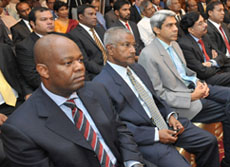
CEO Andrew Harrison (left) at the airport handover

Physical infrastructure

Harrison was very conscious of public expectations regarding the airport upgrade – following the release of artist impressions of the airport, GMR has kept a low profile while introducing its organisational structure and attempting to win over staff to its nearly US$400 million vision for the airport.

Managing such expectations had been one of the key challenges, he said: “A lot of people felt there would be changes to the terminal the day we took over – but there have been many considerations, such as impact of work in peak periods, and understanding what work we want to do.”

Many physical improvements were scheduled to begin as the Maldives leaves peak travel season: “We weren’t in a position to remove even a single baggage carousel,” Harrison said.

GMR has a lot of work ahead of it if it plans to meet its target of upgrading the existing terminal by October.  The refurbishment is “essentially throw-away” considering it will have  less than a three year lifespan until the new terminal is completed in 2014.

During a tour of the present airport terminal Harrison provided a running commentary of planned improvements – including a food court (selling, among other foodstuffs, Turkish kebabs – a Male’ first) and raising the ceiling of the arrivals area so tourists could see the sea from the gate.

Harrison admitted that the scale of investment in the upgrade made it tempting to just bring forward the date of the new terminal, however he acknowledged the local appetite to see quick improvements.

“People will see changes in the coming months. For example, we’re about to start work on the domestic terminal, increasing the space available by 50 percent. This falls outside the concession agreement, which mostly concerns international travellers – but a lot of domestic passengers are Maldivian and deserve to benefit from the improvements as well.”

Other improvements will include redesigned and standardised tourist counters that are branded individually by resorts, a left luggage service, baggage wrapping service (“this is popular for a number of destinations, especially Eastern Europe”), porter service (“people particularly from the Middle East want the services of paid porters”), ‘fast-track’ immigration and customs as well as the potential for a ‘premium’ jetty.

There will also soon be a spa in the departure area offering 20 minute shoulder and foot massages, and possibly a nap and shower facility. Moreover, ‘soft skills’ trainers loaned from Singapore Airlines, “some of the best in the world”, had been invited to help train front-of-house staff at the airport.

Following construction of the new terminal, Harrison said the goal was to turn Male’ into one of the top five airports in the 1-5 million passenger category (the airport presently sees 2.4 million visitors through its gates a year).

“Look at the kind of experience a tourist coming to the Maldives goes through,” he said. “The natural beauty of the resort environment, and then the airport experience they go through at the end – it’s not right, standing in extensive queues, with a level of service so far apart from that of the resorts.”

Economy and marketing

Asked whether GMR had concerns about operating in the Maldives given the state of the country’s economy, Harrison said he believed the improved airport itself was part of the solution.

“An airport is an economic engine for a country,” he explained, “allowing trade, travel – both passenger and cargo – and employment. If the processes are made efficient, it has positive impact on the economy.”

Moreover, GMR’s involvement provided resources and expertise in opening up new tourism markets for the Maldives, Harrison explained, particularly undeveloped markets such as the United States.

“We want to talk to resorts, the Ministry of Tourism and the airlines about possibly marketing the Maldives in the US,” Harrison said.

“The US is the most underrepresented market in terms of direct tourism, however 14 percent – the highest single percentage – of tourists arriving coming into Delhi hold US passports. If they are willing to fly to India it’s only a short hop to the Maldives – I think it’s a matter of awareness and understanding connectivity and flight options, and most importantly, what’s here at end of the journey.”

The Maldives, he said, represented a “more interesting prospect” than traditional nearby island destinations visited by US tourists, such as the Bahamas and the Caribbean, adding that GMR was keen to explore this untapped market.

“We didn’t go to ITB [the recent travel industry trade show held in Berlin] this year because we didn’t think we had anything to say and I didn’t really want it to just be a jolly,” Harrison said. “But next year we’ll have a stand showcasing what we are doing here.”

Likes(0)Dislikes(0)

“I am majority leader now”: Reeko Moosa

The fractured main opposition Dhivehi Rayyithunge Party (DRP) is no longer the majority party in parliament with its coalition with minority opposition People’s Alliance (PA) on the verge of collapsing, claims ruling Maldivian Democratic Party (MDP) Parliamentary Group Leader “Reeko” Moosa Manik.

“I am very sad that they have broken the coalition,” Moosa told reporters outside parliament today. “They [DRP MPs] have said as much in the media. But they are hesitant to show that in the Majlis registry. They are still waiting. If so, [DRP Leader Ahmed Thasmeen Ali] won’t be Majority Leader anymore. I am the parliament’s Majority Leader now.”

Of the 77 MPs in parliament, the MDP currently has 33 MPs to the DRP’s 27 and PA’s seven.

The MDP MP for Hulhu-Henveiru suggested that his party’s new majority was evident in this week’s vote on ministerial appointees after Home Minister Hassan Afeef was narrowly approved in spite of the DRP declaring that it would reject three nominees.

Meanwhile PA Leader Abdulla Yameen, half-brother of former President Maumoon Abdul Gayoom, revealed on private broadcaster DhiTV last week that the party would be reviewing its coalition agreement with the DRP – which “exists only in name” – in light of recent events.

In a move that strained the relationship further, PA Deputy Leader Ahmed Nazim recently sued DRP Leader Thasmeen in Civil Court to recover almost Rf2 million (US$155,000) allegedly owed to him.

Internecine strife

Moosa’s remarks today come a day after DRP Deputy Leader Ali Waheed publicly called upon the party’s council not to “maintain a coalition [with PA] only in name.”

Referring to yesterday’s vote on approving members to the Broadcasting Commission, Waheed alleged that the PA together with the ‘Gayoom faction’ MPs struck a deal with the MDP to vote through an agreed upon list.

Moosa however denied the allegations of collusion with the PA, claiming that “the only deal we will make them is an agreement for a [formal] coalition.”

Yesterday’s parliament sitting grew heated during the vote on members to the Broadcasting Commission when DRP MP Ahmed Mahlouf broke the party’s three-line whip on the fifth nominee, prompting Waheed to raise a point of order demanding to know whether the voting machines were malfunctioning.

After repeatedly advising the Thohdhoo MP to take his seat and then ordering him out, Speaker Abdulla Shahid called a short recess when Waheed refused to leave the chamber.

Waheed revealed afterward that three nominees chosen by the DRP were defeated in yesterday’s vote.

The intensifying allegations and counter-allegations highlight the growing distrust between the rival opposition factions, split between supporters of DRP Leader Thasmeen and loyalists of former President Gayoom.

Earlier this week, DRP MP Ali Azim accused the PA and Maamigili MP Gasim Ibrahim of conspiring to send two DRP MPs abroad ahead of Monday’s vote on cabinet appointments.

Gasim told newspaper Haveeru yesterday that he was not obliged to follow the DRP’s whip line, putting the accusations down to “failure to digest their internal problems,” adding that “those feelings are now exploding like a bomb.”

The former presidential candidate asserted that “if we elect a government it should also have a cabinet.”

Gasim had abstained in the vote on Hassan Afeef while he had voted for Transport Minister Adil Saleem.

Likes(0)Dislikes(0)

Civilian shootings and talk of civil war as unrest grows in Syria, Libya and Yemen

Syrian authorities are reported to have opened fire on protesters gathered outside a mosque in the city of Deraa killing at least five people under a government crackdown on protests, as political struggles continue to rock a number of Middle Eastern and African nations.

News of the deaths reflects continued uncertainty in Syria, Yemen and Libya, where reports of dissatisfaction and uprisings by swathes of their respective populations has led to violent confrontations, which in certain cases have led to bombing interventions by foreign military.

The BBC today said that five people were believed to have died as Syrian security forces opened fire on protesters in the streets outside Deraa’s Omari mosque as anti-government protests that begun in the country on Friday have continued to rage, leading to at least 10 fatalities.

The British news service also reported that Libyan leader Colonel Muammar Gaddafi used his first public address in a week to speak within a compound that appeared to have been destroyed during air strikes from a coalition of western nations, where he stated his continued defiance to rebels and foreign armed forces working to oppose him.

Following the UN Security Council’s resolution authorising military intervention in Libya, France, the UK and the US have attacked targets across the country in an effort to dismantle Gaddafi’s ability to contest a no fly zone, and prevent a retaliatory attack on targets like the rebel–occupied city of Benghazi.

According to the BBC, the Libyan leader called on “all Islamic armies” to join his opposition of rebels and foreign forces that have claimed to be attacking strategic points of Gaddafi’s governance and military power.

“Long live Islam everywhere. All Islamic armies must take part in the battle, all free [people] must take part in the battle… We will be victorious in the end,” he was quoted as saying by the BBC.

Meanwhile, the New York Times has claimed that the rescue by US troops of an American pilot and a weapons officer who crashed in Libya has led to some difficult questions for the foreign coalition in the country. The paper reported that American forces stood accused of dropping two 500-pound bombs during the rescue operation raising the possibility of civilian casualties.

The rescued soldiers remain aboard a US vessel in the waters surrounding the African nation, but the paper reported that the Pentagon did not know whether any civilians were killed by the bombs dropped in Yemen.  An unnamed Marine Corps officer in the Mediterranean denied that any shots had been fired at civilians during the incident, according to the paper.

Al Jazeera meanwhile reported that air strikes instigated by foreign powers from across Europe and America – provisionally under the basis to try and enforce a no-fly zone over Libya – have not appeared to halt Gaddafi’s attacks on rebel forces made up of fellow countrymen that oppose him.

“Undaunted by air strikes launched by coalition warplanes aimed at enforcing a no-fly zone, pro-Gaddafi forces have pressed ahead with their assaults on the towns of Misurata, Ajdabiya and Zintan in the past 24 hours,” the news agency has said.

In trying to oppose the Libyan leader’s military muscle, Al Jazeera claimed that rebel forces were outgunned and had “little command structure” to oppose state attacks.

Meanwhile, amidst the conflict in Libya, Yemen’s President Ali Abdullah Saleh, who also faces criticisms and calls to step down from his own people, has claimed that the country could potentially face civil war if he was forced from office.

Saleh, who also stands accused of using security forces to violently suppress protests among his people, is reported to have offered to stand down from his post at the end of the year under what he has said would be a “constitutional” transfer of power.

Al Jazeera reported though that the offer coincided with the president imposing a national state of emergency following violent “crackdowns” on anti-government protests with unconfirmed reports of 41 people having died in the capital of Sanaa alone due to the unrest.

According to the news agency, skepticism remains over Saleh’s reported offer after similar vows to stand down from the presidency back in 2005 did not come to pass. Saleh has been president since 1978.

The 22-member Arab League, which has previously called for a no-fly zone across Libya on the grounds that Gaddafi has been bombing his own people, has also moved to condemn Yemen’s leader for “crimes against civilians”, calling for a peaceful resolution to the country’s unrest.

The political unrest has continued following the fall in February of Egyptian President Hosni Mubarak and Tunsian President Zine al-Abidine Ben Ali, spreading to potential uprisings in other nations including Jordan and Algeria to Syria, Libya and Bahrain.

Mubarak, who was in power for 30 years, finally gave in after weeks of protests and stepped down from the presidency, handing power to an interim military government last month.

Swiss authorities announced following his resignation that they were freezing assets belonging to Mubarak and his family, pressuring the UK to do the same. Mubarak is thought to have a personal fortune of US$70 billion stashed across various bank accounts and property holdings all over the world.

That the people of one of the Middle East’s largest, oldest and most populated countries could not only overthrow but seek justice against a 30 year autocracy has sparked a wave of political dissent in the region.

The UK’s Guardian newspaper reported one senior western official of claiming at the time that “there has been an awakening of political awareness among the young who have been waiting for solutions that have never come and are not really in the menu now. They are saying: ‘Why should we carry on like this?’”

Likes(0)Dislikes(0)

MDP dismisses rumours of DRP MP Mahlouf defecting to MDP

Maldivian Democratic Party (MDP) Chairperson Mariya Ahmed Didi has denied that leader of the opposition’s Dhivehi Rayyithunge Party (DRP) Youth Wing, MP Ahmed Mahlouf, has signed to join MDP, after rumours to that effect began circulating yesterday.

Mahlouf yesterday broke the three line whip of his party and voted with MDP, sparking rumors that Mahlouf had signed with the ruling party. Former DRP MP Alhan Fahmy controversially switched to the MDP last year prior to facing his party’s disciplinary committee over voting against the party line on the dismissal of then Foreign Minister, Dr Ahmed Shaheed.

The Maldives National Broadcasting Corporation (MNBC) yesterday reported that Mahlouf had signed to MDP, after the incident.

MDP’s official website quoted Mariya as saying that the rumor was spread by DRP Ahmed Thasmeen Ali’s faction after Mahlouf broke the party’s three line whip in a vote taken by the parliamentarians to appoint members for the Broadcasting Commission.

”Mahlouf has always had a close relationship with some of the senior members of the MDP. But the news that he had signed to join MDP is just a rumor,” Mariya said according to MDP website.

Mariya said that Mahlouf broke the three-line whip during the vote to appoint his aunt for the Broadcasting Commission, whose name was proposed to the parliament and supported by MDP.

Mahlouf has told Haveeru that he will join MDP only if former President Maummon Abdul Gayoom joined MDP.

After yesterday’s parliament session speaking to the press outside the parliament DRP Deputy Leader MP Ali Waheed has called on DRP Council to terminate the coalition agreement with Peoples Alliance Party (PA).

Waheed claimed that during all the recent votes PA had discussed with the government and voted according to how it will benefit both the government and the PA, ignoring DRP’s side.

He also heavily criticized Mahlouf for voting on MDP’s side.

Likes(0)Dislikes(0)

MDP requests parliament dismiss Dr Afrasheem from JSC

The Maldivian Democratic Party (MDP) Parliamentary Group has sent a letter to the parliament requesting the removal of DRP MP Dr Afrasheem Ali from the Judicial Service Commission (JSC).

The letter was signed by the leader of MDP Parliamentary Group MP Moosa ‘Reeko’ Manik.

In the letter, Moosa alleged that Dr Afrasheem had violated Judicial Service Commission’s Act, Act number 10/2008 Section 20[a] and [b] which states that a meeting of the JSC could be held only if more than half of the total number of members were present and 20[b] which requires majority vote of present JSC members to make any decision.

Moosa referred to the incident where Dr Afrasheem allegedly phoned JSC member Fahmy Hassan also head of Civil Service Commission (CSC) to ask whether he was fine with Dr Afrasheem speaking in the Supreme Court on behalf of the JSC in the trial conducted after Criminal Court Judge filed a case against the JSC’s appointment of Judges to the High Court.

”Records of the JSC shows that Dr Afrasheem Ali has made that decision against the policy that the law state,” Moosa said in the letter. ”Although Article 164 of the constitution very clearly states that persons appointed to the JSC who is not a member of the parliament shall receive allowances and salary as decided by the parliament, records of the JSC shows that Dr Afrasheem Ali has been paid such allowances.”

Dr Afrasheem had played a role in the unlawful and unconstitutional activities the JSC had conducted, and he has been insincere in carrying out the responsibilities of the JSC, Moosa claimed.

”Therefore, [we] find Dr Afrasheem is not an appropriate person to represent the parliament in the JSC, [we] hereby present this complaint according to article 165 of the constitution and request his dismissal,” Moosa said in the letter.

Minivan News understands that parliament is currently conducting a closed door investigation of the JSC, however no information on the progress or outcome has been provided.

The International Commission of Jurists (ICJ) recently published a report on the JSC critical of the commission’s independence, among other observations. The JSC has not tabled the report.

Dr Afrasheem was not responding to calls at time of press. JSC interim Secretary General, Abdul Faththah, also the JSC’s legal representative, referred Minivan News to the JSC’s media spokesperson, Hassan Zaheen. Zaheen said the JSC had no comment on the matter, but noted that “the parliament decides which MP represents it on the commission.”

Faththah has previously told Minivan News that while there “should be quorum”, in time-sensitive matters such as court summons members sometimes had to make decisions outside formal meetings, with the approval of other members.

“This is not a matter so important to take a decision with the discussion of the members,” he said at the time.

JSC members had also previously decided who should attend court hearings, during a meeting of full attendance, he added, “[but] that day the Chair was not in Male’, so members decided instead that the Deputy [Afrasheem] should attend [court],” acknowledging that “they may not have had quorum that time.”

“These kind of things happen with things like court attendance issues, but no other decisions,” he said.

Likes(0)Dislikes(0)

Voice clip of MDP T-shirt negotiations leaked to local media

A voice clip of a conversation has between Special Envoy to the President Ibrahim Zaki and a person named Anandhu, purportedly in the UK, has been leaked to the local media, concerning negotiations for the delivery of T-Shirts for the Maldivian Democratic Party ahead of the Presidential election.

In the voice clip that first appeared on the website of local radio station SunFM, Zaki and Anandhu speak about payment for the T-shirts ahead of the 2008 presidential elections.

The General Elections Act article number 70 states that “products or money” given by foreigners shall not be used by a Presidential Candidate or any person on behalf of a Presidential Candidate, and article 70[a] states that ”Products or money given by foreigners, foreign parties or foreign administrations shall not be used.”

Zaki told Minivan News that he had provided ”many T-shirts” to the Maldivian Democratic Party (MDP).

”No foreign party has directly contributed the MDP, it all came to me and from the things I received I gave things that I felt like giving to MDP,” he said. ”The General Election Act prohibits political parties accepting offers from foreign parties.”

Elections Commissioner Fuad Thaufeeq did not respond to Minivan News at time of press, while Vice Commissioner’s phone was switched off.

Director General of the Elections Commission Mohamed Tholal said he was out of the country and was unable to comment.

The leaked conversation:

Anandhu: Yes, Zaki. On the 1st I will make the transfer. Now, I understand from you, from the email I got also, that I got to do it directly to Elements (?) Garment.

Zaki: Yes, because that makes things very easy for us. That means by wire transfer.

A: Ok, no problem. The rest, I mean you can count me. On the 1st it will be done by wire transfer, ok? And I will then send you an email on the 1st itself to say it’s done and chase it up with Elements Garments to make sure everything goes according to plan. But if I do it on the 1st, say we receive the funds on the 2nd, I mean, do you know the company very well? Does Mausoom know the company very well?

Z: Mausoom knows very well.

A: OK, tell Mausoom to tell then that the funds are coming. Prepare everything and as soon as they receive the funds they can just send it. Because what my fear is that by the time it comes to Male’ – I don’t know how long it will take.

Z: I think it will not take more than about five, six days.

A: Five, six days, ok. As of today, when do you envisage the date of the election will be? It will be around the 11th of September?

Z: Well, you know, the original contemplation of the government was to have the first round on the 20th of September and to have the second round on the 4th of October.

A: Then we have enough time. Because what my worry was, I didn’t want the t-shirts to get to you too late.

Z: Yeah, and in the meantime, an EU delegation came here a couple of days ago.

A: Yes, yes.

Z: And they met us and they said they’ve been talking to Gayoom also and talking to us. And they said their idea is that the 1st of September to the 30th is the month of Ramazan, the fasting month. So their suggestion is why don’t we have the first round on the 4th of October and the second round after two weeks.

A: It makes sense. I don’t know how you feel, but it makes sense. It gives you a bit more time to prepare.

Z: No, our reply was very simple. We cannot agree that the current regime can be extended more than the 11th of November.

Likes(0)Dislikes(0)

President appoints ministers after parliament approves four out of five ministerial appointees

President Mohamed Nasheed has appointed State Minister Ahmed Naseem as Foreign Minister and Solicitor General Abdulla Muizz as Attorney General hours after parliament approved four out of five ministerial appointees.

Housing Minister Mohamed Aslam had been acting Foreign Minister after parliament rejected the reappointment of former Foreign Minister Dr Ahmed Shaheed in November.

The new Ministers were sworn in by High Court Judge Yousuf Hussein. After presenting letters of appointment, Nasheed expressed confidence that the newest additions to the cabinet would receive parliamentary consent.

Earlier in the day, parliament approved four out of five ministerial appointees, rejecting the reappointment of Attorney General Dr Ahmed Ali Sawad for a second time.

Dr Sawad received 36 votes in favour and 37 against from the 73 MPs in attendance.

Home Minister Hassan Afeef and Transport Minister Adhil Saleem were narrowly approved in spite of the fractured main opposition Dhivehi Rayyithunge Party (DRP) declaring that it would impose a three-line whip to reject the two nominees.

Afeef and Saleem were approved after a few independent MPs along with Dhivehi Qaumee Party (DQP) MP Riyaz Rasheed and Republican Party MP Gasim Ibrahim sided with the ruling Maldivian Democratic Party (MDP) – Saleem was approved with 39 votes in favour while Afeef received 37 votes from the 73 MPs present and voting.

Briefing press after yesterday’s DRP parliamentary group meeting, Majority Leader Ahmed Thasmeen Ali noted that Sawad had already been rejected once while Afeef “acted outside the law” during the transfer of powers to the newly elected local councils.

Thasmeen however announced that the party would give consent to Education Minister Shifa Mohamed and Tourism Minister Dr Mariyam Zulfa.

Shifa was approved with 66 votes in favour and six against while Dr Zulfa received 71 votes in favour and none against.

“Secret meeting”

Addressing accusations from the opposing DRP faction that Thasmeen secretly met President Nasheed over the weekend at Raa Atoll, the DRP Leader asserted that he was ready to meet the President at any time.

“Even if [the President] calls and asks for a meeting at [Raa Atoll] Alimatha tonight, I will go because he is the President of the Maldives,” Thasmeen told reporters outside parliament yesterday, attributing the allegations of collusion with the ruling party to an internal campaign to discredit his leadership.

“In truth, they are talking about this because they don’t have any other way to responsibly carry out political activities,” he claimed.

However, asked if the alleged meeting took place, Thasmeen replied “thank you very much” and walked away.

In November 2010, parliament rejected seven ministers reappointed by President Nasheed after the entire cabinet resigned in protest of alleged obstruction and vote-buying in the legislature.

President Nasheed appointed then-Political Advisor Hassan Afeef as Home Minister in December, replacing Mohamed Shihab, who was appointed Advisor on Political Affairs.

Shifa Mohamed was meanwhile promoted from Deputy Minister of Education to Minister in place of Dr Musthafa Luthfy, recently appointed Chancellor of the Maldives National University.

Both Afeef and Shifa were appointed on December 11 while AG Sawad was reappointed two days later.

Transport Minister Adil Saleem and Tourism Minister Dr Mariyam Zulfa took their oaths of office on November 7, 2010.

Likes(0)Dislikes(0)

MDP MP withdraws controversial death penalty amendment moments before vote

Maldivian Democratic Party (MDP) MP Ahmed Rasheed has withdrawn his amendment to the Clemency Act at the last minute, hours before a vote to send the bill to committee. The controversial amendment would have required implementing agencies to execute murderers if the Supreme Court upheld a guilty verdict.

After the preliminary debate over the past three sittings, MP Rasheed was given the opportunity to say his last words on the amendment, which he used as an opportunity to withdraw the bill.

Presenting the bill to the parliament earlier this month, the Hoarafushi MP explained that he was prompted by the recent increase in assaults and murder cases, which had “forced the living to live amid fear and threats.”

In 2008, said Rasheed, 104 cases of assault were sent to the Prosecutor General’s Office (PGO), rising to 454 cases in 2009 and 423 cases in 2010.

”In Quran, Sural Al Baqarah verse 178, God says: ‘O ye who believe! the law of equality is prescribed to you in cases of murder: the free for the free, the slave for the slave, the woman for the woman. But if any remission is made by the brother of the slain, then grant any reasonable demand, and compensate him with handsome gratitude, this is a concession and a Mercy from your Lord. After this whoever exceeds the limits shall be in grave penalty’,” he then said. ”During broad day light in this very city of Male’ people have been chopped, sliced and crushed using axes, machetes – just like fish are chopped.”

While he did not specify reasons for his decision to withdraw the amendment, Rasheed claimed that he would resubmit the amendment once belated bills on evidence laws, criminal justice procedures and the penal code were enacted. Criticism of the amendment had centered around the capacity of the Maldivian justice system to rule fairly and impartially in such cases.

Unlike most parliamentary debates, MPs were not divided on the issue of death penalty along party lines. Several MPs of the ruling MDP as well as some opposition MPs argued that the fledgling Maldivian judiciary did not have the capacity or public confidence to dispense justice fairly.

The decision comes after 21 year-old Ahusan Basheer was murdered on the streets of Male’ during a gang attack on Thursday night.

The last person to be executed by Maldivian state was Hakim Didi in 1953 for the crime of practicing black magic.

Likes(0)Dislikes(0)

Moral complexities of Libyan intervention rising as Gaddafi prepares for “long war”

Forces loyal to Libyan President Muammar Gaddafi are in retreat from the rebel stronghold of Benghazi after two nights of sustained bombing by coalition forces.

Following the UN Security Council’s resolution authorising military intervention in Libya, France, the UK and the US have attacked targets across the country in an effort to dismantle Gaddafi’s abilility to contest a no fly zone, and prevent a retalitatory attack on Benghazi.

The first night after the collapse of a short-lived ceasefire, US vessels stationed off Libya fired 112 Tomahawk cruise missiles into the gulf nation destroying much of its ability to fight back against NATO aircraft.

French aircraft then destroyed a column of Gaddafi’s tanks converging just 40 miles from Benghazi, which had steadily pushed the rebels back across the country after their initial surge caught the regime off-guard.

“In their panic, many of the soldiers had left engines running in their tanks and trucks as they fled across fields,” reported Kim Sengupta for the Independent. “Some raided farmhouses on the way to swap their uniforms for civilian clothes. But others did not make it, their corpses burning with their vehicles or torn apart by spraying shrapnel as they ran to get away.”

The Guardian reported rebel claims that Gaddafi was now forcing demoralised soldiers to fight by handcuffing them to their tanks, and forcing them to fly planes without parachutes.

“We found 13 men wearing the military uniform of Gaddafi,” the Guardian reported rebel spokeperson Khaled al-Sayeh as saying.

“Some were handcuffed and we believe they were executed possibly for defying orders.”

The AFP has meanwhile reported that the US is now using satellitse to monitor 9.5 tonnes of mustard gas Gaddafi has stored in the Libyan desert, in an effort to prevent a potential terror attack.

“We believe that it’s secure,” Pentagon spokesman Colonel David Lapan told AFP. “Even if not weaponised, there’s still a threat, but it’s a smaller threat than if it is weaponised.”

Air strikes last night destroyed Gaddafi’s residence in Tripoli and a building the coalition claimed was Gaddafi’s command and control centre. Gaddafi has responded to the attacks by claiming on state television that he was prepared for a “long war”.

“We will not leave our land and we will liberate it,” he said, over the telephone.

“America, France, or Britain, the Christians that are in a pact against us today, they will not enjoy our oil,” he claimed. “We do not have to retreat from the battlefield because we are defending our land and our dignity.”

Despite the coalition’s vastly superior firepower, the moral complexity of the intervention is fast rising. In his justification for war to British Parliament, UK Prime Minister David Cameron said intervention “is right because we believe we should not stand aside while this dictator murders his own people.”

However media present in the capital Tripoli were reporting that Gaddafi was loading civilian ‘human shields’ into military infrastructure across the city, including women and children.

Gaddafi’s strategy has resulted in wavering support from the 22 member Arab League, when Secretary-General Amr Moussa condemned “the bombardment of civilians”.

The Arab League had pressed for a no-fly zone in a rare authorisation of force against one of their own member states – a deciding factor for intervention, according to US Secretary of State Hillary Clinton – however the Pentagon had emphasised even a no-fly zone would require destroying Gaddafi’s ability to fight back.

Veteran war correspondent Robert Fisk, writing for the UK’s Independent newspaper, observed that the West had largely ignored the fact that the powerful tribal group leading the rebellion in Libya, the Senoussi, were overthrown in 1969 when Gaddafi deposed their King Idris.

“Now let’s suppose they get to Tripoli. Are they going to be welcomed there? Yes, there were protests in the capital,” Fisk wrote, “but many of those brave demonstrators themselves originally came from Benghazi. What will Gaddafi’s supporters do? ‘Melt away’? Suddenly find that they hated Gaddafi after all and join the revolution? Or continue the civil war? The red, black and green ‘rebel’ flag – the old flag of pre-revolutionary Libya – is in fact the Idris flag, a Senoussi flag.”

President of the Maldives Mohamed Nasheed, who called for UN peacekeeper intervention in Libya at the start of the demonstrations,  welcomed the international coalition’s enforcement of United Nations Security Council Resolution 1973.

“The Maldives reiterates its desire to see a swift end to Gaddafi’s regime and hopes that the people of Libya will soon enjoy fundamental human rights as enshrined in the Universal Declaration of Human Rights,” the President’s Office said in a statement.

Likes(0)Dislikes(0)