Severe flooding in Hoarafushi damages 95 households

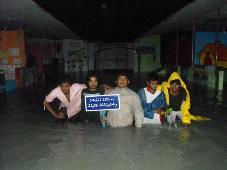
Severe flooding caused by heavy rainfall on Monday has forced several residents of Hoarafushi in Haa Alif atoll to evacuate their homes after flood waters damaged furniture and electrical wiring in 95 households.

Speaking to Minivan News today, Hoarafushi Island Council Chair Ahmed Mauroof said 95 households were flooded, affecting an “estimated 600 people.”

“The cost of the damage caused by flooding is expected to rise to millions,” Mauroof said, explaining that furniture and electronic equipment were damaged in the affected households.

While some families have since returned to their homes, Mauroof said the island council has provided housing and food for a number of islanders at a public building while others have found shelter with relatives.

The flood waters have now receded or been pumped out by the joint efforts of the island council, the island’s youth, police, the Maldives National Defence Force (MNDF), officials of the Maldives Transport and Contracting Company (MTCC) and staff from the nearby Manafaru resort, Mauroof said.

The joint efforts included putting up sandbags, moving furniture and other items to safe locations and pumping water from clogged roads, police said in a press release yesterday.

Heavy rains that started in the late afternoon on Monday caused flooding of up to five feet, according to police. Thick torrential rains that started around 4:30pm on Monday reportedly lasted non-stop until dawn on Tuesday.

The MNDF Northern Area Command meanwhile launched efforts in collaboration with island councils on Monday to pump water from the affected northern islands, including Haa Alif Baarah and Haa Dhaal Hanimadhoo in addition to Hoarafushi.

Hoarafushi, one the of the northernmost islands in the Maldives, has a population of over 2,000 people.

Task force

In addition to households, Mauroof said flooding also caused damage to the island’s health centre.

“The flood water damaged the computer system and some documents there as well as medical equipment,” the councillor said, adding that electric wiring in “the very old building” was also damaged.

Moreover, as there was no sewerage system in the island, “the septic tanks, owned by the people of the island, burst, overflowed and spread waste into the island.”

Mauroof said he received information today that children and adults were being treated at the health centre for diarrhoea.

The island’s youth together with the island council have formed a task force to coordinate relief efforts and seek assistance, Mauroof said, adding that he was currently in Male’ with a number of youth from the island to seek donations.

The deputy chair of the island council was coordinating efforts back at Hoarafushi, he explained.

“We formed the task force because our aim is to recover from this as quickly as possible,” the council chair said.

As the only usable water in the island at the moment was rainwater stored in tanks – privately owned wells were also contaminated – Mauroof said the task force in Male’ was working with the Disaster Management Centre (DMC) to send water supplies to Hoarafushi.

Hoarafushi
Hoarafushi residents appeal for help on social media

On the efforts to seek financial assistance, Mauroof said business magnate and Jumhooree Party (JP) MP Gasim Ibrahim has donated MVR 250,000 while ‘Champa’ Mohamed Moosa has pledged the same amount on behalf of private broadcaster DhiTV and its sister network DhiFM.

Other wealthy individuals in Male’ have pledged financial assistance, he added.

Mauroof said he believed that assistance from “affluent persons” was necessary as it was “unlikely” that the island could recover from the flooding solely through the efforts of the council and central government in Male’.

Hoarafushi youth have meanwhile made appeals on social media for assistance. Mauroof said the task force planned to launch a hotline and a relief fund later today.

President Waheed visits Hoarafushi

President Dr Mohamed Waheed Hassan Manik meanwhile arrived in Hoarafushi this morning and pledged government assistance to the families affected by flooding.

State broadcaster Television Maldives (TVM) reported that two people were being treated at the health centre for diarrhoea.

A TVM reporter at Hoarafushi explained that canals have been dug out on two locations of the island to draw flood waters out to the sea.

According to TVM, the DMC has set up an ’emergency working group’ with the MNDF, Maldivian Red Crescent and the Local Government Authority to assess damage caused by flooding and coordinate relief efforts.

Emergency Response Officer Mohamed Didi said that arrangements have been made with the State Trading Organisation (STO) to provide foodstuff to the affected islands, which also included two islands in Haa Dhaal Atoll.

“At 3:00pm today, an STO boat will leave Haa Dhaal Kulhudhufushi for Haa Alif Hoarafushi with 90 bags of rice, flour and sugar,” Didi told the state broadcaster.

Moreover, a second STO boat would leave from Male’ at 6:00pm with medicine, water supplies, pillows and mattresses, the DMC official said.

Meanwhile, in a statement today, former President Mohamed Nasheed noted “with happiness, the good example and Islamic principle showed by citizens to provide assistance to those in need at this time.”

In addition to the northernmost islands, the former president’s statement noted that severe weather has caused damage in the Hulhudhoo and Feydhoo wards of Addu City as well as Fuvahmulah in the south.

The Department of Meteorology yesterday warned of “rough seas, heavy rain and strong winds for the next two days.” The current weather conditions were believed to be linked to low pressure left by a cyclone currently active in the Bay of Bengal.

The BCC reported today that cyclone Nilam was expected to make landfall on the Tamil Nadu state of India.

Meanwhile, in an announcement yesterday, the MNDF coastguard urged travellers to take extra precautionary measures and stay updated on weather conditions.

The coastguard also advised against non-essential travel as heavy rains and rough seas were forecast for the next 24 hours.

Likes(0)Dislikes(0)

Capital Market Authority and Islamic Ministry unite to promote Islamic finance

The Maldives Capital Market Development Authority (CDMA) has signed a memorandum of understanding with the Ministry for Islamic Affairs to further develop an Islamic capital market in the country.

Among the most prominent details of the agreement was a joint commitment to establish the ‘Maldives Centre for Islamic Capital Market and Finance’.

“This is going to help in promoting the various services available in Islamic financial services under one organisation,” read a press release from the CDMA.

Other features of the arrangement include the scheduling of meetings between the CDMA’s Capital Market Shariah Advisory Committee and the Ministry’s Fiqh academy, a program of training events on the practice, and the ministry’s endorsement of Shariah advisors registered with the CDMA.

The CDMA is an independent body charged with regulating the capital market and the pension industry in the Maldives, with statutory powers to license brokers, asset managers, and investment advisors.

“The vision of CMDA is to develop an Islamic capital market parallel to the existing conventional capital market in Maldives,” reads the authority’s website.

The country’s first shariah-compliant bank opened just over 18 months ago, when the Maldives’ Islamic Bank (MIB) first began offering services to the public after what the company’s head described as strong demand.

MIB is part owned by the Ministry of Finance and Ministry (15 percent), with the remaining 85 percent owned by the Islamic Corporation for the Development of the Private Sector (ICD) – a Saudi based multilateral organisation designed to promote Islamic finance globally.

2011 also saw the first public offering for a Shariah compliant company on the Maldives Stock Exchange – Amana Takaful (Maldives) Plc – for which shares were oversubscribed, report the CDMA.

Amana Takaful offers Shariah compliant insurance services, including third party vehicle insurance, which became mandatory in the country earlier this month.

Director of Amana Takaful Osman Kassim explained at the time that Islamic finance was “a phenomenon worth 1.4 trillion and growing at a rate of 20 percent annually,” which functioned through the prohibition of riba, or interest.

“Taking a return without participating in the risk of the return is not allowed, be it 1 percent or 99 percent. Any additional revenue is riba,” he said. “Even if you give a loan and he gives a gift, and is not in the habit of giving a gift, that is also riba.”

Islamic finance in its current form emerged 40 years ago, Kassim explained, first in Egypt and the Arab Emirates.

“It promises to be a just system. Interest is oppression – the charging of something where nothing is due,” he said, noting that in the wake of the global financial crisis, “All major banks now have Islamic financing products, and the more adventurous have their own Sharia Councils.”

Islamic finance and financial products also differ from conventional services in that they abstain from ‘Maisir’ and ‘Gharar’ – speculative transactions – considered akin to gambling under Shariah.

Minivan News was unable to gain further comment from the Ministry of Islamic Affairs at the time of press.

Likes(0)Dislikes(0)

Cyclone in Bay of Bengal causing adverse conditions in the Maldives

Heavy rains and strong winds experienced in the Maldives over the past few days have been linked to low pressure left by the cyclone currently active in the Bay of Bengal.

“Bad weather will be experienced from Huvadhu Atoll to Raa Atoll today. We have received information that Laamu Atoll has faced damage due to heavy rain. We also expect rough seas, heavy rain and strong winds for the next two days,” said Deputy Director General of Department of Meteorology Ali Shareef.

After heavy rains over the Eid holiday, weather conditions have deteriorated further in recent days reportedly causing damage to some property in the country’s southern atolls as well as flooding in Male’ in recent days.

The Meteorology Department has forecast heavy rains for at least another 24 hours with winds of between 25-35 miles per hour predicted as well as gusts between 50 and 60 miles per hour.

The department has advised against any maritime activities owing to the harsh conditions – which are said to include waves of between 4 and 6 feet on the open sea.

Sun Online has today reported the roofs of three houses were blown off by strong winds in Addu atoll. The MNDF are said to be lending assistance and no injuries have been reported.

The National Disaster Management Centre (NDMC) has requested atoll and island councils to inform it of any damage caused by the weather as well urging people to take precautions against the strong winds and anticipated floods, reported Haveeru.

“We advise you to maintain cleanliness at waste areas to avoid diseases that can arise from flooding, and also to remove overhanging branches,” said the statement.

The Sri Lankan meteorological department today called off an evacuation order along its periphery as the cyclone, situated in the south-east of the Bay of Bengal, changed course 100km from the coast and headed towards India.

India’s meteorology department is predicting winds of up to 90 miles per hour to hit the country’s south east, with local authorities in Tamil Nadu urging fisherman to stay on land and shutting down hundreds of schools.

“We have declared a holiday in all the schools, colleges, government offices in five districts of Tamil Nadu. Fishermen have been warned not to go out into the sea,” a government administrator told AFP.

Poor weather conditions in the Maldives last month resulted in over a dozen incidents of people stranded or capsized in the ocean, reported the Maldives National Defence Force (MNDF).

Likes(0)Dislikes(0)

Government cannot pay state salaries without Indian cash: Finance Minister

Minister of Finance Abdulla Jihad has said the government is unprepared to meet its recurrent expenditure – including salaries – for the final three months of 2012 without the US$25million loan promised by the Indian government.

Jihad, who was not responding to calls at the time of press, told local media outlet Sun Online that he believed the loan  is being delayed due to the ongoing controversy over Indian infrastructure company GMR’s development of Ibrahim Nasir International Airport (INIA).

The Ministry’s Financial Controller Mohamed ‘Kuday’ Ahmed was also not responding to calls at time of press.

India’s High Commissioner to the Maldives DM Mulay told Minivan News that “India stands by every commitment and hopes Maldives will reciprocate. We have excellent rapport with the GOM [Government of Maldives] and issues, if any, are sorted out amicably.”

India’s Ministry of External Affairs publicly expressed concern over the political stability and the investment climate in the Maldives earlier this month.

Sun meanwhile reported Jihad as saying he had made repeated requests via the High Commission for the loan to be expedited.

Jihad’s comments come during a week in which President Dr Mohamed Waheed Hassan has been campaigning in Faafu and Dhaalu Atolls, reportedly reassuring the people that the economy was running smoothly whilst crticising those who he claimed sought to weaken it.

A concerted campaign by government-aligned parties to annul the US$511million concession agreement with GMR – the single largest foreign investment in the country’s history – has sparked concerns over investor confidence with damaging implications for the long term development of the economy.

Waheed is also reported as saying that he would not resort to borrowing from foreign governments in order to finance government activities.

“I will not try to run the government by securing huge loans from foreign parties. We are trying to spend from what we earn”, he was reported to have told the people of Nilandhoo.

“The Maldivian economy is fine. Don’t listen to whatever people say. We don’t have to [worry] about the Maldivian economy being in a slump,” he was quoted as saying during a rally in Meedhoo.

Minivan News was unable to obtain comment from President’s Office spokesmen on this issue before going to press.

The US$25 million was agreed upon last month as part of the $US100 million standby credit facility signed with Prime Minister Manmohan Singh in November 2011.

Unpaid bills

Despite Waheed’s reassurances, this month has seen a number of state owned institutions face disconnection from the capital’s power grid as bills amounting to around MVR150million (US$9.7million) were said to be owed to the State Electricity Company (STELCO).

Responding to the institutions’ blaming of his ministry, Jihad told Sun that the finances were simply not there.

“We are not receiving foreign aid as was included in the budget. How can we spend more than we receive? That’s why those bills are unpaid. We can’t spend money we don’t have,” he told the paper.

He mentioned that the government would have difficulties paying the salaries of civil servants in the final quarter of this year.

Since coming to power in February, the government has committed to reimbursing civil servants for wage reductions made during the austerity measures of the previous government, amounting to Rf443.7 million (US$28.8 million), to be disbursed in monthly installments over twelve months from July.

A MVR 100million (US$6.4 million) fuel subsidy for the fishing industry was also approved by the Majlis Finance Committee earlier this month, with the hope of stimulating the ailing sector.

The overall deficit for government expenditure has already reached over MVR2billion (US$129million). Jihad has told the Majlis’ Finance Committee that he expected this figure to rise to MVR6billion (US$387million) by year’s end – 28percent of GDP – alleging that the previous government left unpaid bills equal to over one third of this anticipated deficit.

Former Minister of Economic Development Mahmood Razee told Minivan News that this increased expenditure in the face of a pre-existing deficit represented the government “ignoring reality.”

“If they don’t get the loan, they will have to cut travel expenses, stop certain programs – take drastic measures or get another loan,” said Razee, claiming that the only alternative would be to sell treasury bills.

Following reports in August that the government was attempting to raise funds through the sale of treasury bills, former Finance Minister Ahmed Inaz said that this would not address the concerns of the IMF, prolonging economic uncertainty.

China has made large commitments towards the Maldives’ economic development in recent months, although Razee said he believed that current changes within the Chinese government in the upcoming month made this an inopportune time to look there for additional financial aid.

In August, the current Finance Ministry announced its own austerity measures intended to wipe over MVR2.2billion (US$143million) from this year’s budget deficit though few of these propositions have as yet been followed through.

Likes(0)Dislikes(0)

Police arrest six protesters from Kudahuvadhoo during President’s visit

The Maldivian Democratic Party (MDP) has condemned the arrest of six protesters from Kudahuvadhoo in Dhaal Atoll during President Dr Mohamed Waheed’s visit to the island on Sunday.

In a press release last night, the former ruling party condemned “in the harshest terms” the arrest of “participants of a peaceful protest” against Dr Waheed’s government and called for their “immediate release”.

Police made the arrests “brutally and with no prior warning,” the MDP statement alleged.

The party also expressed concern over the alleged use of pepper spray and “disproportionate force” to take the protesters into custody as well as the use of obscene language towards demonstrators.

The MDP statement concluded by calling on the Human Rights Commission, Police Integrity Commission and the Prosecutor General’s Office to investigate and take legal action concerning the “illegal arrest of peaceful protesters and efforts by the police to restrict freedom of expression.”

Speaking to Minivan News, a police media official confirmed that six people were arrested from the island on Sunday but noted that only one person was arrested during Dr Waheed’s visit.

Three men were arrested around 11:00am for “obstructing police duty” during security preparations for the President’s visit.

One of the men allegedly assaulted a police officer while the other two were arrested for “obstructing police duty,” the media official explained.

A police officer sustained minor injuries during the confrontation, the official said, but the injuries were “not too serious.”

A woman was arrested at the time when President Waheed alighted on the island but has since been released.

Two men arrested during a protest outside the Kudahuvadhoo police station after President Waheed left the island have also been released, the media official said.

Of the six arrested during the day, only the three men arrested before noon were still in custody, the official said.

On the allegations concerning excessive use of force, the police media official insisted that no force was used when President Waheed alighted on the island.

However, he added that police used force earlier in the day to control a disturbance that followed the arrest of the individual who allegedly assaulted a police officer.

Banners taken down

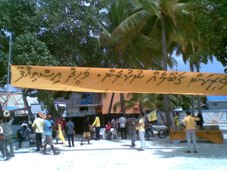
Meanwhile, Shathir Abdul Rahman, head of the MDP Kudahuvadhoo branch, told private broadcaster Raajje TV yesterday that a large number of police from other stations in the atoll arrived ahead of the President and took down anti-government banners.

The police media official confirmed that police took down banners put up at the harbour area.

Dhaal Meedhoo
Protest preparation in Dhaal Meedhoo

The banners were put up at a cordoned off area “closed for security reasons” and were taken down as they were put up by islanders who “broke through the police lines”, the media official said.

Meanwhile, a protest also took place at Dhaal Meedhoo on Saturday to coincide with the former vice president’s visit.

President Waheed left Male’ on Friday for Faafu Nilandhoo and some islands of Dhaalu atoll.

Private broadcaster Villa Television – owned by Jumhoree Party (JP) leader and business magnate MP Gasim Ibrahim – reported Dr Waheed as saying in his speech at Kudahuvadhoo yesterday that his government would be “harsh” towards those who attack senior government officials and create unrest.

A bottle was reportedly thrown at Housing Minister Dr Mohamed Muiz at Dhaal Meedhoo during the President’s visit.

Referring to the incident during his speech at Kudahuvadhoo yesterday, Dr Waheed reportedly characterised it as “an act of terrorism” and promised “harsh action” against those responsible.

Meanwhile, according to MDP officials on social media, two men were arrested today from Dhaal Hulhudheli during a protest greeting President Waheed’s arrival on the island. Both men have however been released after the President’s departure.

Since the controversial transfer of presidential power on February 7, visits by President Waheed to islands have been marked by protests calling him a “traitor” and demonstrators clashing with police.

Following reports released by Amnesty International alleging police brutality since February’s transfer of power, police in June this year denied “use of excessive force” against demonstrators.

Likes(0)Dislikes(0)

Comment: Election-phobic politicians cowering behind judiciary

“So you are proposing to incarcerate Mr Nasheed, are you?” a reporter recently asked a leader in the so-called Maldives Unity Coalition.

“Yes, we are. We will keep him in prison for a long time,” he replied.

The reporter winces.

“I see,” he says, just managing to look respectful. “So, you won’t have him to compete with your candidate to win elections?”

Ingenious, these people must think themselves.

“It’s one way to force you to the top, of course. But I shouldn’t call it civilised, or democratic,” he blurts out. “Justice has to be enforced, so, we don’t look at it like that,” the politician says. “Posterity will.”

The defeat of 2008 common amongst them, political losers of that election have tripped up and toppled the elected government in just three years.

Getting the peculiar lexicon right – the so called “harmonious diplomatic narrative” about the police mutiny amidst-coup and the actions of politicians leading up to the regime-change – took the Commission of National Inquiry (CoNI) a while, and eventually they had to ‘selvam’ the whole thing.

The so-called Unity Coalition that toppled the elected government comprises leaders of parties that have ostensibly not conducted organisational or internal elections in a transparent or an all-inclusive manner since inception. Despite having to resort to stark and obvious giveaways of election-phobia, they are looking to hunker down and stay on in power, obviously for as long as possible.

Getting on about it through the judiciary

Almost all senior MDP members are political victims of the previous regime, many having undergone torture and time in their prisons. However the new democratic regime, seeming to steer clear of paving the way and facilitating transitional justice, probably led opponents to cut up rough and go on talking openly about putting Mr Nasheed away in prison again.

Maldivians know that sitting presently in the Judicial Service Commission (JSC), the oversight body for the judiciary, are political opponents of President Nasheed – opponents in whose personal and political interest it is to incarcerate and disqualify their main challenger prior to elections. They have been publicly talking about it for months.

While members of the DRP, PPM and others in that bandwagon actively work to regularise discrepancies in the house, political leaders involved in regime-change such as MP Gasim Ibrahim and Majlis Speaker Abdulla Shahid continue to be influential members of the Judicial Service Commission.

Meanwhile, breaches of the Constitution by the Judicial Service Commission, such as the nullification of Article 285 – which stipulates qualification criteria for judges – by declaring it as a “symbolic article”; the subsequent reappointment of the pre-2008 Constitution judges without required checks; the prevention of meaningful changes and the establishment up of an independent judiciary are all pending in parliament without further inquiry.

The legitimacy of Chief Judge of the Criminal Court Abdulla Mohamed’s re-appointment as a judge can only be determined by an inquiry into the Judicial Service Commission and its actions over Article 285. All attempts to address issues of the Judicial Service Commission – especially with regard to its contravening Article 285 and pending complaints against Abdullah Mohamed – have been blocked by the opposition MPs of the DRP, PPM, and the DQP, by systematically disrupting every sitting in which these matters are raised. These MPs have gone so far as to publicly state that they will stonewall and prevaricate all pending issues concerning Article 285.

Ethical misconduct

While Article 285 embodies qualifications for judges, the case ofAbdulla Mohamed, glorified by the opposition as ‘Abdulla Gazi’, the hero of regime-change and victim of Nasheed’s government, have been widely published.  In 2005, then Attorney General Dr Hassan Saeed first forwarded to the President’s Office concerns about the conduct of Abdulla Mohamed after he allegedly requested an underage victim of sexual abuse to reenact her abuse in open Court.

In 2009, the new democratic government forwarded those documents to the Judicial Service Commission (JSC), which was requested to launch an investigation into the outstanding complaints as well as the alleged obstruction of “high-profile corruption investigations”.

The JSC decided not to proceed with the investigation on July 30, 2009. However in November that year, the JSC completed an investigation into a complaint of ethical misconduct against the judge.

The case was presented to the JSC in January 2010 by former President’s member of the JSC, Aishath Velezinee, after Abdulla Mohamed appeared on private network DhiTV and expressed “biased political views”.

Velezinee observed at the time that it was the first time the JSC had ever completed an investigation into a judge’s misconduct.

“There are many allegations against Abdulla Mohamed, but one is enough,” she said at the time. “If the JSC decides, all investigation reports, documents and oral statements will be submitted to parliament, which can then decide to remove him with a simple two-thirds majority”, she said.

Weeks later, Ibrahim Shahum Adam of Galolhu Cozy, listed by police as one of the nine most dangerous criminals in Maldives, and in prison for his alleged involvement in a stabbing near Maafannu “Maziya Grounds” during July, 2010 that killed 17-year-old Mohamed Hussein of Maafannu Beauty Flower,  was abruptly released by ‘Abdulla Gazi’ saying he wanted to hold the Health Minister accountable, as police had claimed a difficulty in obtaining a health certificate.

Shahum had also earlier attacked a fellow student attending an Imam course inside a teashop, and the victim, Ahmed Naeem of Carnationmaage, Alif Alif atoll Thoddu, had testified in court .

Days after Shahum was released by Abdullah “Gazi”, he was arrested again by police for the alleged  stabbing murder of 21-year-old Ahusan Basheer of Varudheege, Hithadhoo, Addu City, while the young man was walking along a street in Male’.

In October 2011, the ruling Maldivian Democratic Party (MDP) appealed for assistance from the international community over the “increasingly blatant collusion between politicians loyal to the former autocratic President, Maumoon Abdul Gayoom, and senior members of the judiciary – most of whom were appointed by Gayoom during his 30 years of power.”

On October 26, Judge Abdulla ruled that the arrest of Gassan Maumoon – son of former President Maumoon Abdul Gayoom – on suspicion of hurling a wooden block at protesters leading to a participant being disabled for life, was unlawful. This established a precedent that police could not arrest suspects without an arrest warrant “unless the arresting officer observes the offence being committed”.

The contentious ruling led police to release 11 suspects while the Prosecutor General’s Office (PGO) sought legal clarification on criminal justice procedures.

JSC a stakeholder in trial

It is laughable that the Judicial Service Commission is itself a stakeholder in the ongoing case against President Nasheed, as it is the very failure of that Commission to uphold the rule of law and fulfill its Constitutional mandate that underlies the creation of “Judge” Abdulla Mohamed, the subject of the trial.

Thus it is difficult to ‘selvam’ the fact that it is contradictory to the principle of natural justice for the Judicial Service Commission to decide the bench or in any way interfere and/or influence the trial.

The Judicial Service Commission intervened in Nasheed’s trial with blatant impunity, by abusing its powers to appoint judges to courts and deciding the bench for the trial itself. The Judicial Service Commission temporarily transferred three magistrates from other magistrate courts specifically to create the three member panel that is presiding over President Nasheed’s trial.

Some months earlier, the Anti Corruption Commission was widely quoted in the press on the appointment of the wife of a JSC member, Magistrate Shiyama, to the so-called Hulhumale’ Court, and the allegations continue that the Hulhumale’ Court is kept by the Judicial Service Commission in violation of the Judicature Act as a reward to Shiyama who, with a diploma in legal studies, does not qualify for appointment as a magistrate to a superior court.

Meanwhile, many people who attended the enforced first hearing of this so called trial believe that the Prosecutor General filed the case against President Nasheed invoking Article 81 of the Penal Code in open contravention of Article 17 of the Maldives Constitution under which every citizen is entitled to rights and freedoms without any discrimination, regardless of their political beliefs.

There has been no previous instance of a magistrates’ panel being convened to prosecute any case or individual charged under Article 81 of the Penal Code. Thus, it is common belief that appointing a magistrates’ panel to prosecute this case, by appointing magistrates from different jurisdictions including one who is currently under investigation by the Judicial Services Commission, is a direct violation of Article 17 of the Maldives Constitution.

Calls for Judicial reform get louder

Calls for judicial reform in Maldives are getting broader acceptance with talk rife these days in tea shops, coffee houses and Usfasgandu, of widespread corruption and corruptibility among judges.

Meanwhile some lawyers are publicly detailing tactics used by various judges to deny litigants due process.  Alleged such tactics include intimidation, muzzling, ignoring court rules, creating new rules, fabrication of facts, testifying for a party, issuance of absurd legal opinions, torturing the law as well as other creative means that have boggled the minds of numerous laypeople, lawyers and even judges.

These discussions are removing the halo of honorability that surrounds many “respected” judges and demonstrating how, for many judges, the canons of judicial conduct and Article 285 were enacted only for public consumption. It also demonstrates how certain judges, when challenged to explain their decision or stance, act no different than the same common criminals they were appointed to judge.

Judges accused of being corrupt are acting with the knowledge that their decisions will most likely be affirmed by fellow judges on appeal, pursuant to a tacit “fraternity” code. In other words, trial court judges openly utter absurdities in their opinions with the knowledge that fellow judges at the appellate court are not too keen on reversals.

They are also accused of acting with the knowledge that any commission charged with investigating judicial misconduct at the state level can at present ‘selvam’ such reports and dismiss any complaints against fellow judges.

Can they ‘selvam’ the vote?

Out in Singapore and Bangalore, schemes are going on at full blast to ‘selvam’ a submission in procuring Dr Duhbuhlyoo a good international job, after his much lauded and ruthless puppet role here. After all, the deputy, Duhbuhlyoo D, other friends among glorified foreign touts, and merchants of blood-oranges, all parodying here in the guise of diplomats and others flaunting professional respectability, are thinking of questionable money transactions in the PR, hospitality, border control and other deals pegged to Maldives.

Here in the Maldives, those who have faith in human ingenuity and meaningful change for the good, those who consider it necessary every once in a while for the right-thinking element of the community to slip it across certain of the baser sort – are at it regular like these days. They exude the confidence that all this will begin to come right again soon, through ballots proving the best weapon, against both a shady judiciary and those cowering behind it.

Mohamed Zuhair was former President Mohamed Nasheed’s Press Secretary from November 2008 to February 2012.

All comment pieces are the sole view of the author and do not reflect the editorial policy of Minivan News. If you would like to write an opinion piece, please send proposals to [email protected]

Likes(0)Dislikes(0)

Maldives’ celebrates Eid with record number of goats sacrificed

This year’s Eid celebrations in the Maldives saw the holiday’s traditional prayers and feasting accompanied by a record number of goats slaughtered in the capital Malé.

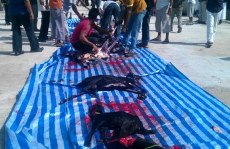
The Islamic Foundation of Maldives (IFM) arranged for the importing and slaughter of over 175 goats on Thursday, a record number for a country in which this large-scale practice was uncommon just a few years ago.

Signs appeared around the capital in the days leading up to the holiday advertising the ‘uluhiya’, or slaughter – a word previously unfamiliar in the Dhivehi lexicon – providing a telephone number for anyone who wanted to join in the festivities.

A representative of the IFM explained that the organisation had surpassed its previous efforts this year after its founding in 2009.

“In 2010, we only had 20 goats. In 2011, we slaughtered 80 goats and two cows,” he explained.

“Next Eid we will slaughter a camel – this will be good for the public as it will be the first time this has been done.”

Combined with the activities of other Islamic organisations in the country – most notably the Jamiyyathul Salaf – the number of animals sacrificed came to well over 200.

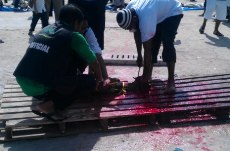
Traditional practice dictates that the animals be slaughtered by having their throats cut, before the body is drained of blood. After this, the animal is cut up with some meat divided amongst friends and family and some distributed to the poor and needy.

The foundation member explained that, owing to the relative affluence of the Maldives , it was difficult to determine needy individuals and so the meat was distributed to whoever was in attendance.

Local media reported that some meat was being sold for MVR 400 a piece (US$25), but the IFM member said he did not know about this, saying: “Selling [the meat] is not encouraged.”

He explained that, due to the practice being uncommon to the Maldives, Bangladeshis were employed to do the butchery after the animal was killed, although locals were given the opportunity to cut the animal’s throat themselves if they had paid for the animal first.

Goats are often kept in the Maldives’ smaller islands but are an unusual sight in the capital. They are often sacrificed in naming ceremonies.

“People who bought the animals were given the opportunity to slaughter them,” he said, explaining that the animals cost around MVR 3500-4000 (US$227 – US$260) each to purchase in Male, more than double their cost prior to shipping from India.

“When sacrificing, the condition is to kill it at once without damaging or hurting in any other way,” he said, adding that the animals were prevented from seeing the others being slaughtered and that they were adequately fed and watered before the sacrifice.

“I find it hard to watch,” he added, “but others come and watch it for entertainment.”

The animals were brought into the country three days prior to the sacrifice, being kept near to the petrol shed on the south of the island before being sacrificed on an adjacent plot of land.

The foundation member said that three goats had given birth after being brought to the country, making them unsuitable for sacrifice.

Those animals that were not bought and slaughtered by individuals were sacrificed on behalf of the foundation. The IFM then arranged for a large feast at the nearby Maafanu Madrassa for which 2,000 people were expected. Inclement weather on the day was blamed for the smaller attendance – estimated at around 1,200.

The act of sacrifice and the giving away of the meat – practiced throughout the Muslim world – is intended to symbolise the Prophet Ibrahim’s willingness to sacrifice his only son to show his obedience to Allah.

The IFM was founded with the stated aim of raising Islamic awareness and organising social activities within the Islamic framework in order to “ensure the religious and social development of each and every individual of Maldivian society,” according to its website.

The Maldives has embraced Islam with increasing fervour in recent years. The 2008 constitution saw the practice of Sunni Islam become mandatory for Maldivian citizens as well the establishment of a state ministry to handle Islamic affairs.

Likes(1)Dislikes(0)

Police seek criminal charges against 18 year-old pair for refusing to submit to search

Police have requested the Prosecutor General’s Office (PGO) press criminal charges of “disobedience to an order” against a pair of 18 year-olds who refused to submit to a search by police officers on patrol.

According to police media, officers on patrol attempted to search Hussain Hassan, of Ghaaf Dhaal Thinadhoo Semy, and Ahmed Sanij Sodiq, of Gaaf Dhaal Thinadhoo Melon House, around 9:30pm on September 26 near the old Jamalludheen School building in Male’ “based on their [suspicious] behaviour”.

The pair allegedly refused to submit to the search and “obstructed policy duty.”

Article 88(a) of the Penal Code states, “It is an offence to disobey an order issued lawfully within the  Shari’ah or Law; a person guilty of this offence shall be subjected to a punishment of exile or imprisonment or house detention not exceeding 6 months or fine not exceeding MVR 150.00.”

Article 47(a) of the constitution however states, “No person shall be subject to search or seizure unless there is reasonable cause.”

While in government, the formerly ruling Maldivian Democratic Party (MDP) accused former President Maumoon Abdul Gayoom of using his influence on the judiciary to target MDP members using article 88(a) of the outdated penal code, which was drafted in the 1960s.

“What we are seeing today is, quite simply, a concerted attempt by the old guard to reassert itself. Having lost the presidency, and having recently lost control of the parliament, Gayoom and his allies are trying to win back power through the last non-violent channel open to them: the courts,” MDP Chairperson ‘Reeko’ Moosa Manik said in a statement on October 25, 2011.

“Worse, Gayoom’s allies and the courts are using the notorious article 88(a) of the Criminal Code – a broad catch-all provision on ‘disobedience to order’ used by Gayoom when he was President to attack and imprison political opponents. Mohamed Nasheed, now President, was arrested and prosecuted dozens of times under article 88(a), as were many other pro-democracy activists.”

Meanwhile, at a press briefing on Wednesday, Assistant Commissioner of Police revealed that officers on patrol after midnight have questioned 2,930 individuals in the past few weeks and prepared their profiles.

The Head of Central Operations Command explained that police have been “questioning people awake and out on the street without a purpose after midnight” as part of an ongoing operation to curb crime in the capital.

Saudhi also claimed that the government’s decision to revoke licenses of businesses to operate 24-hours has led to a decrease in the crime rate.

Likes(0)Dislikes(0)

Police seek FBI, Singaporean police assistance to analyse evidence in MP Afrasheem homicide case

The Maldives Police Service (MPS) is seeking assistance from the US Federal Bureau of Investigation (FBI) and the Singaporean police to analyse about 200 items collected as evidence during the ongoing investigation into the brutal murder of MP Dr Afrasheem Ali, Superintendent of Police Mohamed Riyaz said at a press briefing on Wednesday.

Superintendent Riyaz said that the murder of the Progressive Party of Maldives (PPM) MP and moderate religious scholar on October 2 was premeditated and meticulously “planned in advance”, adding that the case was unique and “unprecedented” in the Maldives.

Police have questioned everyone who spoke to the Raa Ungoofaru MP on the night of October 1 after his final appearance on state broadcaster Television Maldives (TVM), Inspector Riyaz said. Dr Afrasheem reportedly left the TVM studios around 11pm on October 1.

Evidence gathered so far included recordings of phone conversations, forensic samples and over 300 hours of CCTV footage, Riyaz continued, which were being analysed at the police forensic laboratory with the help of foreign experts.

CCTV footage showed the MP driving his car on his way home, Riyaz revealed. He added that two experts from the FBI were in the Maldives to assist the police investigation.

Addressing complaints over the lack of information made public and the delay in concluding the case, Riyaz said police wanted to conduct a full and thorough investigation instead of “rushing the investigation.”

“Our aim to carry out a thorough investigation and bring everyone involved in this heinous crime to face justice. We are working patiently towards that goal. We assure the media and the public that the police will patiently investigate the case and reveal information in due course,” he said.

Full details of the case would be made public upon conclusion of the investigation, the police superintendent added.

Asked if Maldivian Democratic Party (MDP) activist Mariyam Naifa – one of six suspects arrested in the case – was released by the Criminal Court due to lack of evidence, Riyaz explained that as a rule the court released suspects in cases where it deems the police investigation could proceed without keeping the suspect in custody.

Five suspects in the homicide case currently remain in detention. Riyaz meanwhile added that police could only reveal information at this stage to an extent that would not compromise or hinder the ongoing investigation.

Meanwhile, in a separate briefing on Wednesday, Head of Central Operations Command, Assistant Commissioner of Police Abdulla Saudhi revealed that police were providing 24-hour security to 81 individuals using 170 police personnel.

Saudhi noted that police were constitutionally obliged to provide security to MPs and members of the judiciary, adding that police began providing round the clock security following the brutal murder of MP Afrasheem while security measures for some individuals were increased based on assessed threat levels.

Noting that police have increased patrolling of streets, the assistant commissioner revealed that officers on patrol have questioned 2,930 individuals in the past few weeks and prepared their profiles.

Saudhi praised the government’s decision to revoke licenses of businesses to operate 24-hours and said that the move was producing results in terms of the number of people out on the streets after midnight.

Likes(0)Dislikes(0)