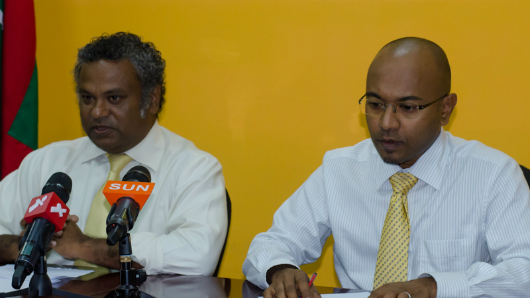
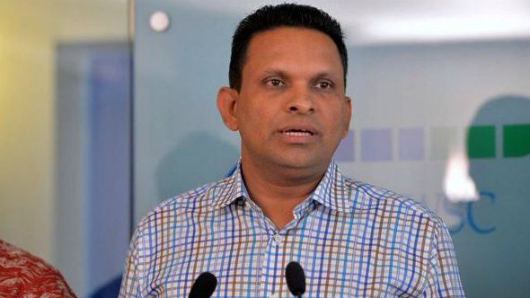
President Yameen appeals for volunteers to tackle gang, domestic violence

President Abdulla Yameen has called on the Maldivian Red Crescent (MRC) and youth volunteers to take the initiative in tackling violence against women and gang violence.

Speaking at a function held by MRC at Dharubaaruge last night to mark the International Day of Volunteers, President Yameen said the country would be “eternally grateful” to volunteers if the two “serious issues” were solved through their efforts.

“Volunteers must step forward, youth leaders should be formed amongst us, to advocate, raise voices, and put a stop to things,” he said.

Maldivian youth should be led away from violent assault and activities of criminal gangs through preventive efforts, he added.

As no family member would wish for a young man to be “brutally murdered,” Yameen said the “viciousness” in Maldivian society should be eradicated.

Similarly, no family member would wish for any harm to come to their mothers, daughters, and sisters, he said.

Yameen suggested that advocacy, awareness raising and an “education process” was needed to stop violence against women.

He urged the MRC and volunteers to assume a role in tackling the two issues.

Earlier this month, a 28-year-old man stabbed to death in Malé became the fifth murder victim during the year.

At a rally held last month to celebrate the current administration’s first year in office, President Yameen pledged to crack down on violent crime and implement the death penalty.

“We have peace and order in Malé and all regions of Maldives. We have peace. However, this is not to say that isolated and significant dangerous crimes do not occur,” he said.

President’s Office Spokesman Ibrahim Muaz assured local media today (December 18) that the government would not hesitate to implement the death penalty, once those sentenced to death had exhausted all of their legal appeals.

Earlier this week, President Yameen welcomed restrictions on the constitutional right to remain silent and right to retain a lawyer for suspects arrested for violent assault.

President Yameen meanwhile went on to quote Hubert Humphrey on volunteerism.

“The moral test of a society is on how that society treats those who are in the dawn of life, that is children, those who are in the twilight of life, those are the elderly, and those who are in the shadows of life, and those are the sick, the needy, and the handicapped,” he said.

Yameen observed that the Maldives led other countries in the region in volunteerism in terms of man hours, noting that the majority of volunteers were youth.
Yameen also praised the MRC’s key role in relief efforts during the recent water supply crisis in the capital.

At last night’s event, President Yameen presented commemorative plaques and certificates to exemplary volunteers from each branch of the MRC, five exemplary national volunteers of the year, and the most proactive volunteer of the year.

Established in 2009, the MRC was recognised by the International Committee of the Red Cross as the 187th National Society of the International Red Cross and Red Crescent Movement in November 2011.

The MRC’s Strategic Plan for 2011–2015 encompasses disaster management, health and social care, youth, and institutional development as its main strategic objectives.


Related to this story

Domestic violence accepted and justified in the Maldives, says report

Government uses gangs for its ends, alleges former President Nashed

Likes(1)Dislikes(1)

Funds for water crisis relief continue to pour in

The Government of Malaysia has pledged US$200,000 to the ‘Malé Water Crisis Management Fund’, while Japan is also reported to have given MVR13.9 million (US$903,000) to the Malé Water and Sewerage Company (MWSC).

The Maldives Ministry of Foreign Affairs has announced the Malaysian contribution via Twitter.

The government hopes to raise US$20 million to protect against future incidents, though the opposition and civil society groups have raised questions over the transparency of the fund.

China has already donated US$500,000 to the fund, while an anonymous Saudi donor immediately pledged US$1 million during the crisis, which left 130,000 residents of Malé without running water for seven days this month.

From within the Maldives, Universal Chairman Mohamed Umar Manik, Champa Brothers, Trans Maldivian Airways, and the Maldives Tourism Development Corporation have all donated US$100,000, while telecoms company Ooredoo has donated US$200,000.

Haveeru has reported that Japan has gifted the MVR13.9 million to fully repair the damage caused by the December 4 fire, though it is not yet clear whether the money has been given to the government’s fund or directly to the state-owned MWSC.

“Japan hopes that because of its donation, the residents of Malé City will have continuous access to clean drinking water,” Haveeru quoted a Japanese statement as saying.

Additionally, US Assistant Secretary of State Nisha Biswal has this week said the US intends to work with the Maldives on “long-term water production and distribution assessments” and to develop rain-water catchment and desalinisation projects to ensure clean drinking water.

Relief efforts included the arrival of fresh water supplies in multiple Indian military aircraft as well as passenger aircraft from China and Sri Lanka. Additionally, India sent two naval vessels, with China and Bangladesh also sending ships.

Both the UN in Maldives and the Human Rights Commission of Maldives praised domestic relief efforts during the crisis, which were led by the Maldives National Defence Force, alongside volunteers from the Maldives Red Crescent, who distributed free water throughout the capital.

Singapore provided technical assistance in repairing the damaged panels in the MWSC’s desalination plant.

Malaysia was among the countries thanked by Minister of Foreign Affairs Dunya Maumoon earlier this week.

“The people and the Government of Maldives are heartened by the strong show of solidarity and humbled by the generosity of our friends,” wrote Dunya.


Related to this story

Government seeks US$20 million in donations to repair Malé’s desalination plant

Both Transparency Maldives and MDP call for greater transparency in water crisis fund

Water distribution to stop as Malé water crisis nears end

Likes(1)Dislikes(0)

Maldives falls in press freedom index for fourth year

The Maldives has fallen in the Reporters Without Borders (RSF) Press Freedom Index for the fourth consecutive year, dropping 5 places to 108th out of the 180 countries ranked.

The index reflects the degree of freedom that journalists enjoy in each country and the efforts made by authorities to ensure respect for this freedom.

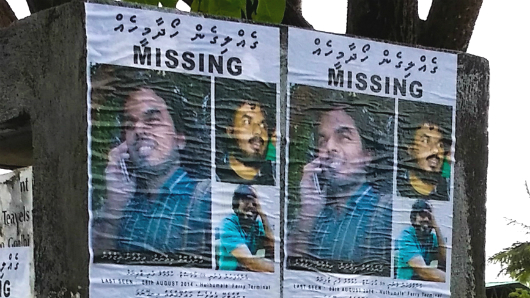
After serious attacks against opposition-aligned journalists last year, 2014 marked a new low in Maldivian journalism as the Minivan News journalist and blogger Ahmed Rilwan disappeared in what is widely regarded as an abduction.

The RSF index is again topped by European nations – Finland, Norway, and the Netherlands – while Eritrea, North Korea, Syria, Somalia, and China are again among the lowest scoring countries.

After the Maldives rose as high as 51st in the index in 2009, recent years have seen a steady decline, slipping to 73rd by 2011, 103rd in 2012, and 108th last year.

RSF also released its annual indicator of the global level of media freedom for the second time this year, which increased by 61 points – or 1.8 percent, suggesting a slight decline in respect for freedom of information worldwide.

With over 700 journalists killed worldwide over the past decade, UNESCO last year launched the International Day to End Impunity for Crimes against Journalists, which was observed on November 2.

Rilwan’s disappearance

In early November this year, the Police Integrity Commission accepted a case filed by Rilwan’s family alleging police negligence in the investigation into the 28-year-old’s disappearance.

The Maldivian Democracy Network has also asked the police watchdog to investigate the police’s failure to investigate dangerous criminal activity outlined in a report into the disappearance.

The report by UK-based private investigators concluded radicalised gangs to have been the most likely culprits in the abduction.

Police immediately dismissed the document as politically motivated, though they have yet to make significant progress in the investigation, with Home Minister Umar Naseer telling the media that some cases just could not be solved.

Publication of the details of the MDN report by the media also resulted in threats against journalists, which have frequently followed the publication of stories about the capital’s growing gang problems.

Minivan News journalist Ahmed Rilwan - missing for 131 days

A landmark “Threat Analysis Report” carried out by the Maldives Broadcasting Commission in May found that 84 percent of journalists surveyed reported being threatened at least once, while five percent reported being threatened on a daily basis.

2014 also saw the first criminal proceedings initiated against a journalist since the introduction of the 2008 constitution, though charges of obstructing police duty against Channel News Maldives journalist Abdulla Haseen were later dropped by the state.

Rilwan’s disappearance is the first such instance of its kind in the Maldives, although near fatal attacks were carried out on the blogger Ismail Hilath Rasheed in 2012 and the Raajje TV reporter Ibrahim ‘Asward’ Waheed in 2013.

Noticeable problems

Following Rilwan’s disappearance in August, journalists from across the Maldives joined to declare that his abduction was a threat to all, calling for an end to persistent intimidation faced by the press.

“As intimidation of press grows, and attacks against journalists, equipment, and buildings continue, we are extremely concerned over the delays in bringing to justice those who commit these acts,” read the landmark statement.

Meanwhile, oversight of the industry – one of the key measures in the RSF index – continued to be negatively affected by internal problems within both the Maldives Journalist Association (MJA) and the Maldives Media Council (MMC).

After the last three attempts to hold new elections for the MJA were disrupted, Vice President Ali Shaman said that the continued absence of members had left the association unable to form a quorum for meetings.

“Due to the delays, the MJA’s functions have not been that effective,” said Shaman, who suggested that the introduction of a working journalist’s act could improve the conditions for journalists in the country.

An MJA meeting in August resulted in accusations of assault against one editor and the resignation of MJA President Ahmed ‘Hiriga’ Zahir, while the editor accused subsequently received a death threat via SMS.

Meanwhile, the work of the 15 member MMC – established under the 2008 Maldives Media Council Act to establish and preserve media freedom – has also been hindered this year by delays to internal elections.

All members of the council were confirmed in early December after issues regarding the eligibility of inactive media outlets had delayed the MMC elections by four months.

Observers sent from the EU to oversee this year’s Majlis elections suggested that lack of clarity in the media regulatory framework should be addressed, suggesting a merger between the Media Council and the Maldives Broadcasting Commission.

The council did, however, hold the first Maldives Journalism Awards this year, although the absence of government officials appeared to contradict pledges to respect and protect journalists.


Related to this story

RSF urges government to deploy all necessary resources to find missing journalist

Maldives slides on Press Freedom Index for third consecutive year

Death threats lead to self-censorship, says Reporters Without Borders

Likes(1)Dislikes(0)

Water distribution to stop as Malé water crisis nears end

Distribution of free water will stop today in the capital Malé, says the Maldives National Defence Force (MNDF), as the water crisis nears an end.

After a fire in the Malé Water and Sewerage Company (MWSC) on December 4 left the capital’s 130,000 inhabitants without running water, 24 hour service was resumed to homes yesterday.

An MNDF spokesman confirmed to Minivan News today that the mobile units had ceased operation, and that distribution of bottled water from 10 designated points in the city would stop today.

The Maldives Red Crescent – which has played a key role in relief efforts – has also confirmed that its operations have shut down.

“We have closed down our operations centre as things are more or less back to normal,” explained Senior Programme Officer Fathimath Himya.

Minister of Defence Colonel (retired) Mohamed Nazim – who leads the president’s water crisis task force – told the media on Thursday night that full services would be resumed for three days in order to test the repairs.

“The water treatment plant is functioning on a temporary setup,” Haveeru reported Nazim as saying. “But we must ask you to not stress the water supply and manage by making some adjustments”.

Custom built panel boards arrive in the Maldives from Singapore on Wednesday via a Sri Lankan Air Force flight.

Sri Lanka has been among a number of international donors who have provided bottled water and desalination facilities over the past 8 days – most notably India which was first to respond, sending military aircraft with fresh supplies within 24 hours of the fire.

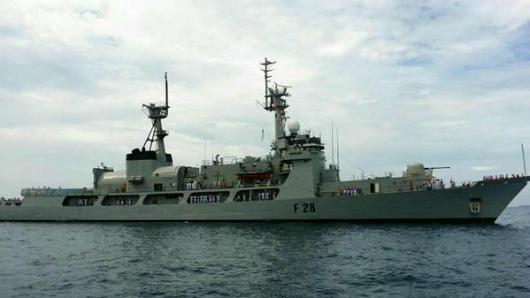
The Bangladeshi naval ship Samudra Joy became the third vessel to arrive in Malé on Thursday (December 11), joining the Indian and Chinese ships already docked near Malé’s main port.

BNS Samudra Joy

While Nazim had announced on Wednesday (December 10) that free water would no longer be distribute as stocks returned to local shops, long lines continued to be seen around the capital on Friday evening.

The crisis has raised questions regarding the city’s preparedness for such an instance, although President Abdulla Yameen has described the situation as unforeseeable.

During the crisis, Yameen’s task force revealed it was to seeking US$20million in donations to the ‘Malé water crisis management fund’.

After the opposition and civil society groups expressed concerns over the lack of detail regarding the fund, Nazim explained on Wednesday that it would cover the uninsured costs of relief efforts as well as the construction of the 20,000 ton water reserve.

The President’s Office explained earlier this week that MWSC plants produce 20,000 tonnes of water per day at full capacity, while the population of Malé consumed around 14,000 tonnes per day.

The government has revealed that private donors have contributed US$5.5million to the fund so far, pledging to disclose full details of fund. China is reported to have donated to the fund, as well as private donors from Saudi Arabia and from within the Maldives.

Both the UN in Maldives and the Human Rights Commission of Maldives have commended the government’s response to the situation, though the opposition has called for a full inquiry into the causes of the crisis.


Related to this story


Government scales down water relief effort

UN Maldives commends government’s response in water crisis, opposition condemns

No fall back for disaster of this magnitude: President Yameen

Likes(3)Dislikes(0)

Government scales down water relief effort

President Abdulla Yameen’s administration has scaled down water relief efforts today by ending the distribution of bottled water to residents of capital Malé.

“We decided to stop the bottled water distribution because there is no shortage of drinking water at the moment. There is also enough water at corner shops for purchase,” Minister of Defense Colonel (retired) Mohamed Nazim said at a press conference last night.

The government had set up water distribution centers after a fire at Malé Water and Sewerage Company (MWSC) on December 4 gutted the sole desalination plant in Malé, leaving 130,000 people without drinking and running water.

The opposition Maldivian Democratic Party (MDP) condemned the government’s decision with party Chairperson Ali Waheed saying that the decision will lead to further hardship and claimed the Maldives is currently seeing its worst days since the 1970s.

A Bangladeshi navy ship, the BNS Samudra Joy, arrived in Malé today with 100 tonnes of bottled water and five reverse osmosis plants, the Foreign Ministry has said.

Meanwhile, custom built panels to replace the damaged panel boards connecting electricity generators and desalination plants at MWSC arrived in Malé from Singapore today.

MWSC has now started releasing water once in the morning and once at night. Water was available for four hours this morning and will be available from 7:30 pm – 12:00 am tonight.

The government has also decided to establish a 20,000 ton ‘strategic reserve’ of water to prevent another crisis, using funds gathered through the US$ 20 million ‘Malé water crisis management fund.’

Nazim, who also heads the water crisis task force, said that funds would mainly be used to recover costs which are not covered by insurance, the construction of the 20,000 ton water reserve and to cover the cost of relief operations. Individuals and corporations who contributed to the relief effort will all be reimbursed, he said.

The fund’s establishment has garnered criticism from the opposition and civil society groups, who have demanded transparency in the fund’s utilization.

In response, Nazim said the fund was set up with “very good intentions.”

“Information about the fund would be released in a very transparent manner. I urge the public to refrain from politicizing the fund.” he added.

Anti-corruption NGO Transparency Maldives has demanded a break down of the US$20 million and said “the decision to seek donations from the public raises questions given that MWSC is a private, profit-making corporation with 80 per cent government shares.”

Private donors have contributed US$5.5million to the fund so far.

Protests demanding free water continued in Malé last night, but were disrupted for the third time by a group of seven young men.

Minivan news observed six to seven young men who were hiding within the protesters jump on a truck and start vandalizing the generator powering the sound system. One attacker lifted up the generator and threw it on the ground.

Police immediately moved in and arrested the attackers. Minivan news saw little to no resistance from the attackers during the arrest.

Several eyewitnesses later told Minivan news that the attackers were praising President Yameen as they waited for a police vehicle to take them to the police head quarters.

“President Yameen is the best thing to have happened to the nation,” one of the attackers was reported as saying.

Another eyewitness told Minivan News that he heard one Special Operations (SO) police officer insulting Former President Mohamed Nasheed while stating those arrested would be released the next day.

A police media official confirmed to minivan news that seven men were arrested last night in relation to the attacks at the protest.

A similar incident occurred on the previous night when three young men attacked the protest armed with box cutters.

On Wednesday, Mirihi Island resort has donated a temporary desalination plant capable of producing 100 tonnes of water to the Indhira Gandhi Memorial Hospital.

The MNDF has also started distributing disposable cups, plates and cutlery to cafés in Malé.

Likes(2)Dislikes(0)

Custom built MWSC panels to arrive in the Maldives

A Sri Lankan Air Force flight is currently on its way to the Maldives from Singapore with custom built panels to replace the damaged panel boards connecting electricity generators and desalination plants at the Malé Water and Sewerage Company (MWSC).

The capital Malé was  plunged into crisis on Thursday (December 4) as a fire at MWSC gutted the desalination plant, leaving 130,000 people without running water, leading to the dwindling of bottled drinking water supplies.

Defense Minister Mohamed Nazim said the two boards will arrive in Malé tonight. Of the nine panel boards, five were functional on Monday and MWSC had started releasing water to households in two three-hour periods in the morning and at night.

However, residents living above the second floor of buildings have said they only receive water for a very short period of time. The MWSC has asked individuals to report issues with water leakages and booster pumps to send an SMS to 1050 with the client’s name and water meter number.

Previously, the government rejected an offer by the Indian government to provide technical assistance in fixing the panels, saying it is seeking assistance from countries that are more technologically advanced.

The government has today announced it has received US$ 5.5 (MVR 84 million) for the ‘Malé water crisis management fund.’

The crisis management fund – which has seen donations from several local corporations and foreigners – was set up by the government with an aim of collecting US$ 20 million (MVR 308 million) to repair the damages at the desalination plant and to fund relief efforts.

Notable local businesses such as Champa Group and Universal enterprises donated US$ 100,000 to the fund, while an unnamed Saudi Arabian donor provided US$ 1 million.

Telecomms company Ooredoo donated US$ 75,000 to the fund. Trans Maldivian Airways (TMA) and State Trading Organization (STO) have also donated funds.

Anti-corruption NGO Transparency Maldives called on the government to display more transparency in order to avoid “economic and political repercussions stemming from the water crisis”.

In a press statement, the NGO urged the government to provide a breakdown of the estimated US$ 20 million needed to overcome the crisis and how the government intends to spend it.

“Furthermore, the decision to seek donations from the public raises questions given that MWSC ins a private profit-making corporation with 80 percent government shares,” said Transparency Maldives.

An Indian flight is also due to arrive today with 50 tons of water while the INS Deepak supplied 400 tons of water straight to MWSC tanks on top of the 1250 supplied two days ago.

Indian High Commission said today that the water relief operations resumed on the request of the Maldivian government.

Opposition Maldivian Democratic Party (MDP) also criticized the fund stating that the government should only demand US$ 20 million after they have decided how it is going to be spent.

“Where is the money going to go to? Why have we not seen a breakdown on how the money is going to be spent? Will this be a new ring in the chain of corruption by the government?” questioned party Vice Chairperson Ali Niyaz.

Former President and opposition leader Mohamed Nasheed has also called for an inquiry into the fire, suggesting that the Danish government previously recommended keeping 21 days of water reserves in the capital.

Transparency  Maldives noted that the crisis had demonstrated “the interminable relationship between good governance and citizens’ right to essential human needs,”  and called for greater regulation of state-owned enterprises.

With 130,000 citizens of the capital left without water, the government has said it could take up to two weeks to fully repair the damage. President Abdulla Yameen has said that there could have been no back up plan for a “disaster of this magnitude”.

Likes(3)Dislikes(0)

Both Transparency Maldives and MDP call for greater transparency in water crisis fund

Transparency Maldives has called on the government to display more transparency in order to avoid “economic and political repercussions stemming from the water crisis”.

“The Government must publicly provide a breakdown of the estimated US$20 million (more than MVR300 million) needed to overcome the crisis, and how the government intends to spend it,” read a press release from the anti-corruption NGO.

Transparency’s statement follows the announcement this week that the government is seeking donations in order to meet the costs of the fire that crippled Malé’s sole desalination plant on December 4.

“Furthermore, the decision to seek donations from the public raises questions given that MWSC is a private, profit-making corporation with 80 per cent government shares,” said Transparency.

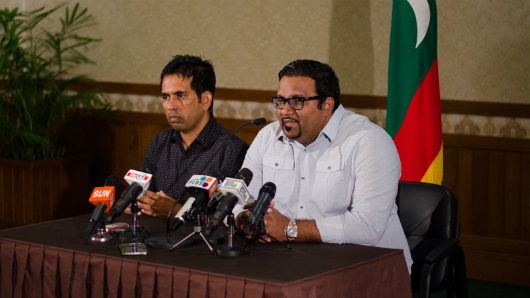
Minister of Tourism Ahmed Adeeb said today that the fund – which has already received support from both foreign and domestic donors – was not intended for the MWSC, but would be utilised by the government.

The opposition Maldivian Democratic Party (MDP) has also criticised the fund, stating that the government should only be able to demand US$20 million after they have decided how it is going to be spent.

“The MDP along with the people of the Maldives demands answers from the government regarding the US$ 20 million fund,” said party Vice Chairperson Ali Niyaz at a press conference today.

“Where is the money going to go to? Why have not seen a breakdown on how the money is going to be spent? Will this be a new ring in the chain of corruption of the government?” he asked.

Additionally, party lawyer Hassan Latheef expressed concern that unnamed donors were giving large amounts of money to the fund.

“Relevant details should be provided as per the law on money laundering and corruption prevention law. Money laundering and financing for terrorism through donors is something which exists in the Maldives.”

Transparency has also called for an independent technical investigation to be conducted, and results to be made public before effective and preventative mechanisms are put in place.

“The investigation must scrutinise MWSC’s risk mitigation policy and asset management plan,” said the NGO.

With 130,000 citizens of the capital left without water, the government has said it could take up to two weeks to fully repair the extensive damage. President Abdulla Yameen has said that there could have been no back up plan for a “disaster of this magnitude”.

Former President and opposition leader Mohamed Nasheed has also called for an inquiry into the fire, suggesting that the Danish government previously recommended keeping 21 days of reserves in the capital.

Transparency noted that the crisis had demonstrated “the interminable relationship between good governance and citizens’ right to essential human needs,” calling for greater regulation of state-owned enterprises.

“Transparency Maldives believes that it is the responsibility of the government to hold accountable and to ensure that MWSC and other companies that provide essential services, such as the State Electric Company Limited (STELCO) and FENAKA Corporation  Limited, have mechanisms in place to review their working procedures so that similar incidents can be avoided in the future.”

MDP lawyer Latheef also criticised what he perceived to be the government’s attempts to pass the constitutional responsibility for water provision to the MWSC.


Related to this story

No fall back for disaster of this magnitude: President Yameen

Government seeks US$20 million in donations to repair Malé’s desalination plant

People’ Majlis disrupted after disorder over water crisis

UN Maldives commends government’s response in water crisis, opposition condemns

Likes(2)Dislikes(2)

UN Maldives commends government’s response in water crisis, opposition condemns

The United Nations in the Maldives has commended relief efforts during the Malé water crisis, though the opposition has attacked the governments preparedness and subsequent handling of events.

In a press release today, the UN in Maldives commended the “outstanding response” of the government, noting that measures were also being taken to address the needs of vulnerable and special needs population.

“The situation does not warrant any humanitarian assistance at the moment. UN is working with the Government to monitor closely that there will be no deterioration of the situation,” the statement continued.

The President’s Office announced today that the closure of government offices would continue for the rest of the week, while offers of foreign assistance have continued to pour in.

Meanwhile, the opposition Maldivian Democratic Party (MDP) condemned government efforts – in particular the decision to continue billing residents for water usage.

“Water should be provided free of charge until the water crisis is resolved,” said Rozaina while speaking at an MDP press conference.

Minister of Defense Colonel (retired) Mohamed Nazim said this morning that the Malé Water and Sewerage Company’s (MWSC) board of governors have decided to implement a 30 percent discount on water transactions for the month of December.

Addressing the public for the first time during the crisis yesterday, President Abdulla Yameen noted that getting water supplies to the upper floors of buildings had been problematic.

MWSC’s decision contradicts a company statement released two days ago (December 6) saying customers would not be charged until the current crisis is over in order to provide relief for the ground floor level residents who have been donating water.

MWSC charges a progressive rate on the water usage, which rises as the usage increases over a MVR30 fixed monthly charge. The rate can go as high as MVR95 per cubic meter when usage increases over 500 liters.

Relief

Nazim also revealed governments plans to set up a ‘Malé water crisis management fund’ to collect donations in order to recover the MVR300 million (US$20 million) spent on the management of the crisis.

Rozaina criticised the estimated figure of US$20 million by saying that the MDP demanded a technical viewpoint on the damages and an explanation of why US$20 million is required for the repairs. The party has asked whether MWSC’s facilities were insured.

An unnamed Saudi Arabian has already donated US$ 1 million to the fund while local business group Champa Brothers pledged to provide US$100,000.

The MDP has also slammed the government’s failure to give a set date for the resumption of normal services, with members of the president’s task force telling local media yesterday that the issue could not be solved within a “politically desirable” timeframe.

Continuing its extensive relief efforts, Indian navy fleet tanker INS Deepak arrived yesterday bringing with it 1,250 tons of water. The water was then pumped to tanks in Malé through 400 meters of pipe.

The ship – which also has RO capabilities – is now at anchorage near Malé where it be producing 100 tons of water per day which will then be transported to the capital via barges.

Indian High Commissioner to the Maldives, MR Rajeev Shahare – speaking aboard INS Deepak yesterday – said that the Indian government had offered technical assistance with the repairs which was refused by the government saying that they are consulting a Japanese firm.

So far, 10 Indian military airplanes have landed at Ibrahim Nasir International Airport (INIA) bringing with them more than 200 tons of water.

State Bank of India (SBI) also joined relief efforts today, distributing 7.5 tons of water.

A Chinese vessel which arrived last night capable of producing 90 tons of water per day delivered 600 tons of water today to the capital. Two Chinese military flights landed last night with 40 tons of water in between them.

A Bangladeshi military vessel with 5 desalination plants and one hundred tonnes of water is also due to arrive on Thursday (December 11).

Meanwhile, President’s Office Spokesperson Ahmed Muaz announced today hat the government has decided to close all its offices in Malé for the rest of the week after considering the difficulties people could face as a result of the current water problems in Malé.

Muaz noted said that the President’s Office will be open from 10 am to 1pm,while the Maldives Monetary Authority has also announced that it and other banks will be between 11am to 2pm to provide banking services for the public.


Related to this story

No fall back for disaster of this magnitude: President Yameen

Government seeks US$20 million in donations to repair Malé’s desalination plant

President Yameen to return to Maldives as water crisis enters third day

Nasheed calls for inquiry into MWSC fire

Likes(3)Dislikes(0)

No fall back for disaster of this magnitude: President Yameen

President Abdulla Yameen has spoken to the public for the first time regarding the Malé water crisis, saying that there could have been no fall back plan for such a crisis.

“We did not have any fall back plan for any disaster of this magnitude. However, we have done extremely hard work to try and bring the situation back to normal,” said the president.

Remarking that the extremely low odds of such an incident occurring had prevented the state-owned Malé Water and Sewerage Company from making plans to deal with the current situation.

Yameen said that five of the nine panel boards at the MWSC had now been fully repaired, estimating that the relief effort would cost US$20m million.

The Maldives’ capital was plunged into crisis on Thursday (December 4) as a fire at MWSC gutted the desalination plant, leaving 130,000 people without running water, leading to the dwindling of bottled drinking water supplies .

“I am not trying to make any excuses for the disaster at MWSC but the company was formed in the early 1980s. The design of the company and the water demand has changed with the population increase in Male.”

“There should be no difficulties with obtaining drinking water. However, there are problems with getting water for washing up and cleaning for people in high rise buildings,” said Yameen.

Large amounts of fresh water have been supplied via a number of international donors, who were thanked by the president.

“I would like to point out that even after some very difficult times for the foreign relations of the country, many nations are aiding the country in this heart wrenching time.”

The government will look into various ways to prevent such an occurrence maybe by dividing up the water grid by wards.”

Meanwhile, members of the president’s task force have told local media that the problem could not be fixed within a “politically desirable” timeframe.

In an interview with Haveeru, Minister of Defence Mohamed Nazim said that it would take two weeks to completely recover from the crisis, saying that 50 percent of this would be achieved by the end of the week.

Minister of Fisheries and Agriculture Dr Mohamed Shainee said that, while MWSC has utilised a backup plan after the fire, a completely foolproof system was financially prohibitive.

“If we were to look for a 100 percent foolproof system, it would need to be built far from MWSC – in another area.  This occurred within one year this government came into power. We had been preparing for water security,” Shainee told Haveeru.

Minister at the President’s Office Mohamed Hussain Shareef told Minivan News earlier that the residents of Malé consumed around 14,000 metric tonnes of water a day, with the fully functioning plant able to produce around 20,000 tonnes.

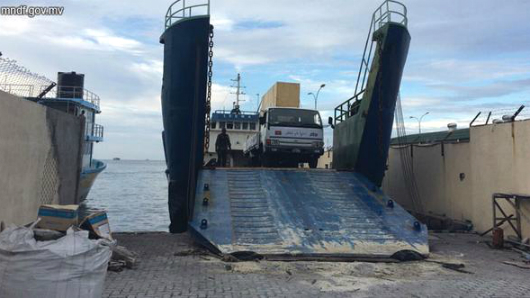
The Maldives National Defence Force, working alongside volunteers from the public and civil society, continues to distribute water brought from abroad and from desalination plants on nearby islands.

Bangladesh became the latest country to announce it would send naval vessels with fresh water and desalination capacity, following the arrival of two Indian ships as well as the expected arrival of the Chinese navy.

The INS Deepak was the latest Indian ship to arrive, with 800 tonnes of water and the capacity to desalinate 200 tonnes per day. Deepak’s arrival follows ten Indian aircraft which have brought regular supplies of fresh water since Friday.

The Maldivian Red Crescent today received the first shipment of 5 tonnes of fresh water today, while the UN in Maldives has said that 180 tonnes stored under its premises in Malé requires treatment before it can be handed to the public.


Related to this story

Government seeks US$20 million in donations to repair Malé’s desalination plant

President Yameen to return to Maldives as water crisis enters third day

Indian aircraft arrives to ease Malé water crisis

Nasheed calls for inquiry into MWSC fire

Likes(2)Dislikes(0)