National Security Committee investigating local media spreading JP’s claims against Elections Commission

Parliament’s National Security Committee summoned the Elections Commission (EC), the Maldives Police Service (MPS), the Maldives National Defence Force (MNDF), and the Maldives Broadcasting Commission (MBC) to appear for questioning today in regard to its investigation into an EC case filed against the Jumhoree Party (JP).

An EC letter requesting the National Security Committee provide the commission an opportunity to share their concerns about local media spreading JP’s “baseless and unfounded” claims, was presented yesterday (September 13) by committee chairperson MP ‘Reeko’ Moosa Manik and unanimously approved, according to local media.

“The National Security Committee is concerned that the [presidential] contestants unfounded claims of corruption against the EC are a threat to national security,” Maldivian Democratic Party (MDP) MP and Spokesperson Hamid Abdul Ghafoor told Minivan News today.

MBC has been summoned to the parliamentary committee for allegations that Villa TV (VTV) – owned by resort tycoon and JP presidential candidate Gasim Ibrahim – was spreading information to incite hatred against the EC, while the MPS and MNDF will be questioned to determine whether current events pose a threat to national security, according to Sun Online.

Meanwhile, MBC has launched an investigation into VTV broadcasting unsubstantiated content in violation of the broadcasting code of practice. The commission stated that it was investigating the matter after a case was filed by a private individual, according to local media.

VTV has been continuously broadcasting the live program ‘Olhuvaalee Vote Ge Namugai’ (‘fraud in the name of the vote’) as well as reports against the EC and MDP ever since Gasim placed third in the first round of the presidential election with 24.07 percent, a total of 50,422 votes, reports CNM.

Asked about the confusion over the voting figures in the media not matching those of the EC during counting, Elections Commission Vice Chair Ahmed Fayaz criticised local media’s role in the matter.

“Politicians and newspapers have reported this [10,000 votes issue]”, he said, singling out the online publication Times.mv for particular criticism.

Meanwhile, during an elections National Advisory Committee meeting held Thursday (September 12), the JP, along with representatives of the PPM and President Mohamed Waheed, agreed they all want a vote recount of all ballot boxes conducted.

However, the MDP’s representative on the Advisory Committee insisted there were no grounds to warrant a vote recount and accused JP of not noting any issues during polling.

“It’s a matter of principle – this was a democratic election held under a democratic system. All parties were given an opportunity to send observers and monitors, and their observations [of the voting and counting process] were done in front of the people, as per the law,” said Ghafoor.

“This was an elaborate, laborious process with each count confirmed and then exhibited at each voting centre,” he continued.

“A recount would set a bad precedent that is not in the national interest. It would create a loss of faith in the system,” he emphasised.

Ghafoor noted that international observers have praised the transparency of the election process, including four former Election Commissioners hailing from India and the Commonwealth.

“The EC is one of the [only] effective, independent commissions we have. It has a very clean track record, which everyone knows,” declared Ghafoor. “An elaborately developed legal process [for elections] has been in place since 2008, there have been at least 11 by-elections conducted to date and none of them have been contested.”

He noted that the election results are being contested “by people like Gasim Ibrahim, who are from a culture that has rigged votes all their lives.”

Meanwhile, Elections Commission Vice Chair Ahmed Fayaz told local media the JP had requested a recount without any legal basis. He noted that if all the ballot box seals were broken for a recount, this could create election confidence issues and set a dangerous precedent for future elections. He proposed recounting boxes randomly as an alternative.

Likes(1)Dislikes(0)

Police conduct witch hunt on Thakandhoo after children allegedly possessed by evil spirits

Additional reporting by Ahmed Nazeer

A police team have been searching for black magic practitioners on Thakandhoo Island in Haa Alif Atoll after some islanders “purposefully” contacted the Maldives Police Service (MPS) and claimed Maldivian Democratic Party (MDP) supporters were responsible for the possession of four local children by evil spirits, according to an island council source.

The police arrived on the island around 10:00am yesterday morning and started inspecting houses. Their search is based on information police intelligence received, Thakandhoo Island Council Vice President Ibrahim Shaheed told local media.

The police team is inspecting individual houses under a court warrant, a police media official told Sun Online.

Four children from the same family began behaving strangely earlier this week, prompting islanders to call in ‘fanditha’ (magic) men who practice ‘ruqyah’ (Islamic exorcism) from the nearby island of Ihavandhoo, a Thakandhoo island council source told Minivan News today (September 12).

The MPS was called to investigate the black magic case after some of the islanders perceived the incident to be politically motivated, the island council source explained.

“Some of the islanders purposefully sent police officers to homes of MDP supporters on the island,” said the island council source. “The police came and gave them each documents that said their houses had to be searched regarding reports police intelligence received.”

“The documents also noted that police officers were unable to find anything related to the matter after searching their houses,’’ he added.

The Thakandhoo Island Council “wishes to get rid of this black magic issue forever and has asked the fanditha men to determine exactly who is responsible [for contacting the police],” the source noted.

Because the four children living in the same house on the island were believed to be possessed by evil spirits the islanders brought fanditha men to the island on Tuesday (September 10), and they immediately started reciting ‘maithiri’ (Quranic verses recited to end spiritual possession).

“When the recitation of maithiri started three days ago the kids situation got worse,’’ the island council source said. “But we were told by the fanditha men that it will be like that until the seventh day.”

The fanditha men also determined the general location of the buried black magic items and asked people to dig in the area.

They discovered the black magic objects buried in front of a gate located inside the Thakandhoo Island School, which leads to the playground outside school grounds.

‘’When we dug up the area we found these objects and now we have thrown them away,’’ said the island council source.

The black magic objects were reported to be clay tablets by local media.

Last night the island council met with the community to talk about this issue as people were feeling “scared and uncomfortable”, he added.

Police Spokesperson Chief Inspector Hassan Haneef was not responding to calls at time of press, however a police media official told Minivan News that the MPS was not revealing any information about the case as the investigation was ongoing.

Possessed children

“The police arrived yesterday and have been checking houses for black magic books, writing, or a witch – anything suspicious,” a Thakandhoo island resident told Minivan News.

“They checked three or four homes and are still here today, but are supposed to be leaving in the evening,” she added. “So far no one has been arrested, but they have taken some books into their possession.”

A 14 year-old girl, and boys aged 12,10, and nine – none of whom have had any previous behavioral problems – have been behaving very erratically and are difficult to control, the source explained.

“I’m not a believer [in black magic], I never have been, but it’s happening. And it’s so weird to see happening,” she said.

“It just started suddenly. The children began speaking and behaving in a very strange way. Their outbursts happen randomly – any time of day for the girl, but with the boys it happens mostly in the evenings,” she continued.

“The girl has been seeing black shadows, acting weird, complaining of ‘frozen’ hands and teeth, and saying strange things, ‘I’m going to kill you and somebody’s coming,’ and has fainted,” she explained. “She was admitted to the island’s health centre screaming uncontrollably not to remove the [clay] stones because it would kill her, and not to kill her.”

“[Additionally,] the 10 year-old boy has been continuously running super fast all over the island trying to get into the school and he also fainted,” she continued.

During the community meeting last night islanders had an opportunity to voice their concerns and were also instructed about how to be safe and what precautions to take against black magic, the island source noted.

“Everybody’s worried about the children and they’re concerned because there hasn’t been a black magic incident here for a long time, not since my grandmother was a child,” she said.

“We were advised to recite the Quran and for children not to go out after 6:00pm or go to isolated places unsupervised,” she added.

According to the source the island school has remained open, but some parents have not been sending their children to class for the past two days.

This prompted the school principal to tell parents attending the community meeting that “they should be sending their children to school because if we [islanders] don’t go out [of our homes] it will be more of a risk,” said the island source.

“People are not openly saying much about it because that will put them in danger as well,” she added.

In addition to reciting verses from the Quran, blessed water can also be used to conduct an exorcism, Spiritual Healers of the Maldives President and Exorcist, Ajnaadh Ali, explained Minivan News today.

He noted that the minimum period of treatment for those afflicted by black magic is seven days, but it can take up to one or two months depending on the case.

Thakandhoo islanders contacted the Spiritual Healers of the Maldives to assist with healing the possessed children, however because they are currently “taking treatment themselves”, the organisation has decided to conduct workshops on the island at a later date, added Ali.

Politics and black magic

This is the third island in two weeks to have reported black magic incidents related to political party rivalries.

Police were summoned to investigate an alleged black magic doll after it was discovered at the Shaviyani Atoll School polling station on Kanditheemu Island during the presidential election vote counting.

Coconuts with black magic spells were allegedly being used to sway voters’ political party allegiance and incite confrontations between MDP supporters and police on Fuvahmulah, ahead of the Presidential Election’s first round held September 7.

Additionally, police summoned a white magic practitioner to evaluate a young coconut believed to have been cursed by a black magic spell, after it was found near the Guraidhoo Island presidential election polling station.

Likes(2)Dislikes(0)

Two arrested on Kulhudhufushi for allegedly printing ballot papers

Police have arrested two individuals from the island of Kulhudhufushi in Haa Dhaalu Atoll for allegedly printing ballot papers.

A police spokesperson told Minivan News today that police could only confirm that a case involving the printing of ballot papers was under investigation.

“That’s the only comment we can give at the moment,” he said, declining to provide further information.

An island council member of Kulhudhufushi, who spoke to Minivan on condition of anonymity, said the printed ballot papers in question were bigger than the actual ballot papers and were also laminated.

“I heard they were printed by some pro-Maldivian Democratic Party (MDP) supporters to make people aware of what the ballot papers would look like,” he said. “Two men were arrested in connection with the case.”

One of them was arrested on Tuesday (September 10), the council member said, while the other was arrested yesterday (September 11). He also confirmed that they were taken to the island court, which extended their remand detention period to three days.

According to the council member, the ballot papers were printed at a major bookshop on the island which is owned by a pro-Adhaalath party supporter.

“They did not make it an issue at first but when they were defeated in the elections they reported it to the police as a complaint,” he said. “If the police arrested the people who printed it, the police will also have to arrested the people who helped them print it.”

He said that the case was reported to police by “anti-MDP people” on the island.

“They are trying to mislead people and claim that the elections result was not right,” he said, adding that he himself believed that the election was free and fair.

He added that there were no issues with the ballot boxes placed on the island.

The Elections Commission (EC) told local media yesterday that the commission would have been aware if fake ballot papers were cast and dismissed allegations of fraud.

“The ballot papers we printed has strong security features. If other papers were used in ballot boxes, we would know it very clearly,” EC Vice Chair Ahmed Fayaz was quoted as saying by newspaper Haveeru.

Fayaz explained that the EC printed 2,407 extra ballot papers, which was one percent of the total number of ballot papers, and that Novelty Printers would bear witness to the number of papers that were printed. Each polling station was sent 11 extra ballot papers, he added.

Meanwhile, MDP MP Imthiyaz Fahmy tweeted this afternoon that police have allegedly arrested a “third MDP activist in Kulhudhufushi.”

The party has also issued a press release strongly condemning the arrests.

“We believe that our campaign event manager Ahmed Athif was arrested based on completely false allegations for the purposes of bringing the party into disrepute, creating fear on the island, and intimidating senior campaign activists,” the statement read.

The party identified the second individual as Ahmed Abdul Raheem ‘Beney,’ an MDP youth activist. The MDP contended that the arrests were intended to divert attention from the defeat suffered by pro-government parties, calling on police to “cease intimidating the public with such uncivilised allegations.”

Likes(0)Dislikes(0)

EC Chair dismisses JP allegations of vote rigging: “A small child would not believe what they are talking about”

The Elections Commission has dismissed as “baseless” the Jumhoree Party’s (JP’s) allegations of vote rigging, pointing to the commission’s transparency, ongoing complaints investigations, and praise from a broad spectrum of election observers.

While local and international election observers have praised the conduct of Saturday’s (September 7) presidential elections, JP presidential candidate Gasim Ibrahim, who was placed third in Saturday’s vote with 24 percent, has contested the results and accused the EC of tampering with the outcome.

Hours ahead of a delayed EC briefing to unveil the provisional election results, which tool place in the early morning hours of Sunday (September 8), a small group of JP supporters demonstrated outside the Dharubaruge convention centre alleging a 10,000 vote discrepancy.

On Monday (September 9), Gasim claimed 20,000 unlawful votes had been cast, while the former deputy leader of the Progressive Party of Maldives (PPM) Umar Naseer – who backed Gasim in the poll – accused the EC of giving Maldivian Democratic Party (MDP) members 30,000 additional ballot papers to tamper with the outcome of the election.

“The allegations by the Jumhoree Party are wasting our time actually. They don’t understand democracy or how to accept defeat, it’s a very unfortunate thing,” EC Chair Fuwad Thowfeek told Minivan News yesterday (September 10).

“People who cannot accept defeat should not face an election,” he continued. “It’s a contest so there’s a chance they will win or lose. In this case there were four contestants and only two could advance to the second round. Gasim Ibrahim doesn’t understand [this] and his followers are making a fool out of him,” he contended.

“Gasim wants to tell people that he has more than 50,000 supporters, but the 50,422 [who voted for him] are his real support, he should be grateful to the people who voted for him. There is no way he’s going to find any more, even if a recount is conducted,” he added.

Thowfeek expressed confidence that Maldivians would understand that the JP’s allegations are “baseless”.

“They are just making all these false and fake allegations, there is no truth in anything they are saying and the public will know it is all lies,” stated Thowfeek. “No person who knows the [Elections Commission] system will believe any part. [Particularly] people who know me professionally and personally. A small child would not believe what they are talking about.”

The EC Chair explained that he has been in contact with Gasim and the JP and addressed their concerns.

“Gasim Ibrahim called me Monday (September 9) and I explained all the details to him. I also spoke very clearly to [MP Ahmed] Ilham when he came to meet on September 7,” said Thowfeek.

“Everything has been so transparent and we have readily provided all the results and what the JP has asked for, including soft copies [of results sheets from all 470 ballot boxes],” he noted.

“The only thing we cannot by law release is the list of who did and did not vote. The list contains confidential personal information – full names, dates of birth, ID card numbers – and can only be released with a court order,” he added.

Yesterday the High Court rejected a case filed by the JP seeking the release of the voters list and result sheets from the EC.

Speaking at a JP rally last night, Umar Naseer reportedly said the case would be resubmitted to the High Court today.

He said that it was dismissed due to “technical issues” as the court required additional information to be cleared from the EC before it could hear the case.

The JP is seeking the voters list to identify the number of allegedly “fraudulent votes” and determine if it could change the outcome of the election, Naseer said.

“We are certain that 95,000 people in the Maldives will not vote for Nasheed,” he was quoted as saying by newspaper Haveeru.

The JP coalition has so far learned that 1,188 people had been registered in homes without the knowledge of the owner while the names of 173 voters were repeated or doubled on the voters list, and the names of 569 deceased were also on the gazetted registry, Naseer claimed.

Thowfeek meanwhile appealed for international and domestic scrutiny of the EC to ensure transparency and public confidence.

“The EC would appreciate if international and local observers continued to keep a close watch on EC and voting activities to see how everything proceeds,” Thowfeek said.

He believes their monitoring will continue to demonstrate the transparent work of the EC because “after the second round result we don’t know what type of [inaccurate] talk will come out.”

“We met with international observers on September 8th and they were very pleased about what they had seen and noted [of the election process],” said Thowfeek. “There were many observers from various countries – the Commonwealth, EU, US, UK, Australia, Japan, Thailand, Malaysia, and India – and everybody praised the work we have done.”

Complaints investigation proceeding

The EC’s complaints investigation process is ongoing and will be completed “as soon as possible, probably by the end of this week,” Thowfeek said.

“The Complaints Bureau is attending to all complaints, and replies have [already] been sent to most of the complainants,” he said.

“There are some cases that may [be] prolonged because [identifying and speaking with] additional witness takes time, but these issues will be addressed before the next round [of the presidential election process],” he continued.

The discrepancies which the JP have alleged include: double voting, votes cast in the name of people who died prior to the election, inaccurate voter registry, lack of transparency during ballot counting, election officials being biased and aligning themselves towards MDP candidate Mohamed Nasheed and Progressive Party of the Maldives (PPM) candidate Abdulla Yameen.

“With [election] officials from different sources [working] in front of [election] observers, there was no way the type of fraud [JP is alleging] could be made,” said Thowfeek.

“Polling station officials were not all from the EC. We hired various officers from public sector organisations, as well as young people looking for work,” he noted.

“Every ballot box had a combination of all types of individuals, selected at random, and a balance was kept between females and males, young and old,” he explained. “Many met for the first time during training or [polling station] duty. All the people belonging to [and responsible for] each ballot box were not trained together [as a group].”

Thowfeek also addressed the voter registry concerns raised by the JP – and previously raised by the PPM prior to elections.

“The voter’s list was published two weeks before voting and the lists were [also] sent to all ballot box locations in addition to EC officials, presidential candidate representatives, observers from each political party,” said Thowfeek. “Anyone who has this [list] will know that they will not be able to show a single person who voted under a false name.”

He explained that the EC obtained the voter registration lists from island council offices as well as the Male’ municipality office. This data was compiled and the lists cross-checked with the Department of National Registration to verify its accuracy.

Thowfeek also emphasised that many individuals are not aware or are misunderstanding the Male’ Dhaftharu – a special registry for people who are Male’ residents, but are from other islands – registration process.

“In the past people were placed on the Dhaftharu with the municipal council [listed as their residence], but this time they put the places where they live,” said Thowfeek.

“7,000 people were registered on the Dhaftharu using the places they were residing at the time. Some people asked why add these names to a particular house [for voter registration] because these people were [previously] registered under the municipal list,” he continued.

“These individuals are originally from different islands, but if they live in Male’ over five years they are eligible for Male’ residency, however many don’t own a home in Male’, they rent or stay with relatives,” he noted.

“They are Maldivian citizens [from the islands] residing in Male’ but they don’t have a permanent residence – they have the right to vote,” he declared.

“In front of all those people – as well as election monitors and observers – there is no way anyone can do any sort of mischief,” he concluded.

During the September 8 early morning press conference, Vice Chair Fayaz addressed vote counting issues that resulted in police intervention at Majeedia and Amadiya Schools in Male’.

“One of the very important steps we will be taking is to replace such heads of polling stations. In the next round of elections we will not appoint such people as heads,” he said.

“The [vote] counting was done properly, but what was lacking was the polling station head not showing the ballot papers to the observers the way they wanted,” he continued.

“According to the figures revealed by Transparency Maldives there were monitors at observers in 80 percent of polling stations. We cannot force the observers to go and observe, it is something that they [must take the initiative to] do,” he noted.

“Counting is the most critical phase, sometimes during this phase there is a tendency where some monitors/observers try to intervene in the process, in such a case unless the police are in the vicinity, they cannot immediately help,” he emphasised. “That’s why you may have seen in some polling stations the police presence.”

Likes(1)Dislikes(0)

Swedish national acquitted of charges related to death of British couple in quad bike crash

Swedish national Filip Eugen Petre has been acquitted of all charges pressed against him during a Criminal Court trial, concerning his alleged role in a quad bike accident that resulted in the death of a British couple at Kuredu Island Resort in August 2011.

Emma and Jonathon Gray from Yorkshire in the UK, who had been staying on the resort for their honeymoon, were reported dead on August 6, 2011, after the quad bike they were riding was believed to have collided with a tree.

Petre, a son of a shareholder at the resort, was later charged with ‘disobedience to order’ by state prosecutors over his alleged decision to transport the couple on a vehicle not intended for passengers.

Criminal Court Media Official Ahmed Mohamed Manik confirmed that the presiding judge had ruled the suspect was not guilty, based on statements and evidence produced during the trial. The decision was made shortly before the presidential election held on September 7.

Manik said he was unable to provide Minivan News with further details of the case at time of press.

Local media reported on September 6 the presiding judges’ conclusion that, although the quad bike was not intended to carry passengers, staff on the resort had said the vehicle had previously been used to transport more than one person at a time.

According to Haveeru, the Criminal Court also ruled that the state could not conclusively prove Petre was directly responsible for the incident on the property.  He was therefore acquitted of the charges.

Local media reported that Kuredu’s management had offered to cover all the expenses for the upbringing of the Gray’s son, who was just six months old at the time of the incident.

A spokesperson for Kuredu Island Resort declined to comment on the case, referring media enquiries to the Criminal Court.

Case stalled

Minivan News reported in March this year that Petre’s case was at a standstill as the Criminal Court claimed it was waiting on responses from the parents of the deceased regarding their preferred form of punishment for the accused.

However, both police in the UK and the families of the deceased previously insisted that their decision had been submitted and re-submitted to the court in 2012.

Director of the Department of Judicial Administration Ahmed Maajid at the time said that, although the trial hearings were over, a final verdict would not be delivered by the court until all family members had been consulted on their preferred form of punishment for the accused.

A relation of the Grays previously told Minivan News that their statements had been submitted multiple times on different occasions to the courts.

“On the last hearing, which was held on February 27, closing arguments were given by the state and the defense. The judge has stated that the final verdict of the charge would be delivered at the next scheduled hearing,” the relative said the family had been told.

Under Islamic law, the family of the victim is given the option to sentence the accused to execution, blood money or to forgive them.

The same relative added that, while they did wish to see some form of punitive sentence for the driver if he was convicted, the family did not want any severe or long-term action to be taken against the defendant.

“He’s just a young guy. We don’t want to see his life ruined,” the relative said.

Jonathan Grey’s mother Cath Davies told UK-based newspaper the Halifax Courier in March 2012 that the prospect of Petre facing the death penalty was “shocking. It’s absolutely horrendous.”

Previous hearings

In previous hearings of the trial, prosecutors claimed that the charge of ‘disobedience to order’ Petre was accused of had resulted from his decision to carry people on a vehicle which was not intended for passengers.

The prosecution contended that his criminal action began from the moment he allowed the couple to ride with him on the vehicle.

Presiding Judge Abdul Baary Yousuf declared in court during earlier hearings that Petre’s lawyer had himself confessed during the trial that his client had driven the quad bike carrying Emma and Jonathan Gray as it crashed on the tourist property.

As a result of this confession, the judge said the state did not have to produce any evidence to prove Petre was the driver of the vehicle during the collision.

Representing the prosecution, State Attorney Aishath Fazna also contended that because Petre had “confessed” to driving the quad bike, she did not believe the state had to produce evidence to support this assumption.

However, Petre’s lawyer Areef Ahmed responded at the time that his client had not directly confessed to driving the quad bike and argued that his client continued to deny the charges against him.

Petre’s lawyer has also contended that his client could not be charged under Islamic Sharia because his client is non-Muslim.

Likes(2)Dislikes(0)

Maldives’ police investigate suspected black magic doll at polling station

Police were summoned to investigate an alleged black magic doll after it was discovered at the Shaviyani Atoll School polling station during the presidential election vote counting.

The suspicious ‘fanditha’ (black magic) doll was first noticed on the school’s wall by an Maldivian Democratic Party (MDP) election observer as well as polling station officials on Kanditheemu Island during the vote counting process Saturday (September 7). They contacted local police to investigate the suspicious doll.

“The police just checked whether the doll was real [fanditha],” MDP Kanditheemu Campaign Manager Mohamed ‘Mox’ Fahumee told Minivan News today (September 9). “They did not actually want to get involved in such [black magic related] things.”

After the police were called to the polling station they – and local islanders – asked community members, the Shaviyani Atoll School’s site supervisor, and Bangladeshi labourers working at the school to try and discover who made the doll and with what intention, explained Fahumee.

“One of the laborers told us he made it ‘just for fun’ to pass the time, since they do not have very much work to do,” said Fahumee. “He made the doll from wool, putty, and wall paint and then placed it on the wall to dry.”

The Maldives Police Service had not responded to enquiries at time of press.

Fanditha fear

“On this island [Kanditheemu] people always talk about black magic during elections. They claim that government aligned parties – the Political Party of the Maldives (PPM), Dhivehi Rayyithunge Party (DRP), etc – practice fanditha to gain votes,” said Fahumee.

“When people talk about fanditha they become afraid,” noted Fahumee.

“Black magic might work, there are so many stories of people dying because of fanditha. During elections people talk about that and it spreads [around the island] very quickly, but they talk in secret,” he continued.

Swing voters who are not strongly in favor one candidate or political party versus another are particularly susceptible to fearing black magic will influence their vote, he explained.

“If they are finding it difficult to select a candidate and they are afraid [of black magic influence], they might vote for someone who does not represent their best interests,” he added.

Fahumee explained that while most island residents talk about possible incidents of fanditha, the discussions are conducted in secret, out of fear the island’s black magic practitioner will “come after” the person(s) talking about him.

Although not everyone believes in the power of fanditha, or “accepts those kinds of things”, it is still an issue – and precautions are taken – because it sows fear and uncertainty about the impartiality of the voting process, noted Fahumee.

More cursed coconuts

Concerns of black magic being used for election vote tampering have been raised on several islands in the Maldives.

MDP supporters on Guraidhoo Island in Kaafu Atoll reportedly began lining up to vote at 2:00pm Friday (September 6), after rumours began circulating of a black magic coconut buried at the front of the queue.

It is thought the candidate chosen by the first person in line standing over the coconut would then be the candidate picked by all remaining voters.

“We don’t believe in these things, but some MDP supporters waited just in case,” 25 year-old Guraidhoo resident Hussain Nadheef told Minivan News. “We will never let PPM [use black magic].”

Last week, police summoned a white magic practitioner to evaluate a young coconut believed to have been cursed by a black magic spell, after it was found near the Guraidhoo Island presidential election polling station.

Coconuts with black magic spells were allegedly being used to sway voters’ political party allegiance and incite confrontations between MDP supporters and police on Fuvahmulah, ahead of Saturday’s Presidential Election.

Given the widespread reporting of black magic election tampering and the cursed coconut issues on Guraidhoo and Fuvahmulah, Minivan News asked Elections Commission Vice Chair Ahmed Fayaz whether the issue was raised by any election observers.

Fayaz noted that he had not discussed the issue with any of the observers, and had first read about the story on the UK’s Guardian website.

Asked if he felt that the additional international media spotlight on the election triggered by the coconut may have had a positive impact on the election process, Fayaz laughed and said “maybe”.

Likes(3)Dislikes(0)

Campaigns conclude as Maldives prepares for watershed polls

The Maldives’ second-ever multi-party democratic presidential election will take place tomorrow (September 7).  With the campaigning deadline set at 6:00pm today, party supporters in the tens of thousands were out in full force to make every last second count.

Events were held throughout the country for the Maldivian Democratic Party (MDP)’s final campaign push to re-elect former President Mohamed Nasheed- although none surpassed the scale and energy of the final march through the nation’s capital island Male’.

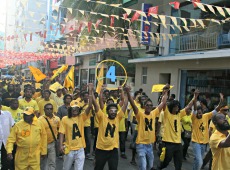
The carnival atmosphere was charged with nervous energy as MDP supporters bedecked in yellow, sporting a variety of Nasheed-themed t-shirts gathered near the tsunami monument before beginning their final campaign parade.

Despite rumours running rampant that hired thugs, police, and military would clash with MDP supporters, creating unrest as an excuse to declare a state of emergency and thwart the scheduled election, the MDP’s march was peaceful.

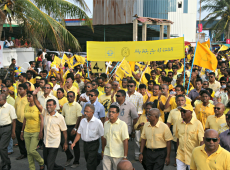
Jovial supporters in their thousands danced, cheered, and even ran their way along Male’s thoroughfares. Participants of the march surpassed MDP’s eighth anniversary parade, with people packed the entire length and width of Majeedhee Magu, Male’s nearly two kilometre-long thoroughfare.

Voices from the parade

The streets were also lined with supporters and spectators, while people could be seen hanging from their balconies, almost all with smart phones and cameras to capture the spectacle.

“I’m very excited to vote tomorrow – Nasheed is going to win” said 18 year-old first-time voter Ishan.

It seemed like every MDP supporter Minivan News spoke to was confident of Nasheed winning the first round, and holding up the number four, symbolic of Nasheed’s placement on the voter ballot.

“Tomorrow will surely be a victory,” said 23 year-old Edam. “Ehburun (one round) for sure,” added 24 year-old Ahu.

“For 30 years we suffered under Maumoon, but ‘Raees’ (President) Nasheed did so many things for us – he brought development, social security, and freedom,” she continued.

“Anni only had three years [in office] because of the coup – he deserves at least two more,” added her 30 year-old female friend.

Lorries interspersed between the MDP supporters carried live bands performing political rock songs, while others blasted techno music that remixed dance beats with phrases from former Nasheed’s speeches.

The lyrics are well known with even small children singing along, dancing on the sidewalks, and marching with their parents in the parade.

As with previous MDP protest marches and campaign walks, a variety of demographics were represented – participants and spectators alike – including children, youth, the elderly, disabled, women and men, organised into groups, some carrying giant MDP flags, while others waved yellow ribbons, fans or pom poms.

Even opposition party supporters were seen peeking out from campaign ‘haruge’ (headquarters), while some traffic and special operations police gathered on the balcony and at the entrance of their station to watch the passing parade.

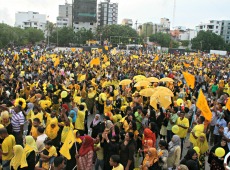
The march ended on a high note after circling around the capital to end back at the Tsunami Monument with Nasheed addressing thousands of his enthusiastic supporters.

Tomorrow’s vote will provide MDP’s supporters a chance for catharsis, coming almost 20 months after the former president controversially resigned from power on February 7, 2012.

“Voting tomorrow is important because we want change. We want peace and all this turmoil to end,” said a 32-year old woman. “Once Nasheed is elected everything will get back to normal.”

Jumhoree Party campaigning

The Jumhoree Party (JP) concluded its own election campaign with a march commencing at the artificial beach area of Male’ shortly before 5:00pm this evening.

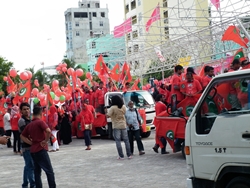
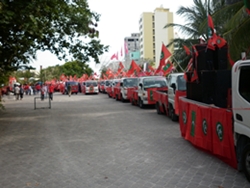
Hundreds of supporters draped in red – the party’s colour – rode atop some three dozen trucks as the rally set off around the capital to support JP candidate MP Gasim Ibrahim.

Hundreds of JP supporters prepare to embark on final rally before polling

In one truck, populated almost exclusively by cheering young women – some wearing headscarves, others not – the group exclaimed their reason for participating.

“Of all four candidates Gasim is the best,” explained one young sitting in the back of the truck to loud cheers from her fellow passengers. “He’s the best,” they reiterated in unison.

Further down the JP’s campaign convoy, in a somewhat more somber truck carrying a group of middle aged men, Minivan News asked why they chose to support the JP’s candidate, an MP and resort and media tycoon.

Looking at first perplexed by such a question, one middle-aged gentleman responded matter of factually: “There is no one else.”

Show of strength

JP Policy Secretary Mohamed Ajmal today told Minivan News today that the party’s march was designed as a show of strength by supporters before all campaigning is legally mandated to finish at 6:00pm.

With campaigning finished, he said the party was presently sending some 480 observers to islands across the country alongside the international observers from organisations such as the Commonwealth.

A convoy of trucks set to carry JP supporters

“Situations of violence”

Ajmal said that although JP was confident of peaceful polls tomorrow, he claimed the party was concerned there might be “situations” of possible violence should the opposition MDP lose.

“We do not want problems, our leader the honourable Gasim Ibrahim has supported equal opportunities for [former President] Nasheed to participate in this election,” he said. “We believe that violence could be triggered across the country though.”

Ajmal claimed that with MDP representatives and supporters currently facing alleged corruption cases totaling MVR4.7 billion (US$307 million) filed by the auditor general, the stakes would be high for tomorrow’s election.

The MDP has continued to maintain that state prosecutors have singled out opposition party members since the last year’s change in government, this week accusing Prosecutor General (PG) Ahmed Muizz of sacrificing his impartiality in return for job security.

The current government came to power on February 7, 2012, after former President Nasheed controversially resigned from office following a mutiny by sections of the police and military in a series of events the MDP has alleged was a “coup d’etat.”

Considering the nature of the power transfer, Ajmal said that the JP, which the governing coalition after the power transfer , would have “no problems” in the MDP potentially returning to power, despite the party “hating [Nasheed’s] attitude of responding to the people”.

“We know not enough people will support Nasheed this time. His party supporters alone are not significant enough to win,” added Ajmal.

Opting not to hold a rally ahead of tomorrow’s polling, incumbent President Dr Mohamed Waheed instead visited a ‘jagaha’ (meeting hall) established by his ‘forward with the nation’ coalition to campaign by phone from 5:15pm after conducting a number of tours of the country in recent months.

The Progressive Party of the Maldives (PPM) concluded its campaign with an event on the nearby island of Vilimale, attended by running mate Dr Mohamed Jameel and over 600 people, according to PPM MP Ahmed Nihan.

The event was also intended to officially inaugurate a PPM office on the island.

Polling opens tomorrow at 7:30am and closes at 4:00pm. 239,593 people are registered to vote in the 2013 presidential election, according to the final register. This is a 15 percent increase (31,000 people) on 2008’s 209,294 eligible voters.

Of these, 65,745 voters have registered to vote at a location other than their home island. Voting will occur at 459 ballot boxes stationed on local islands, resorts, and overseas Maldivian High Commissions.

Registration can be easily checked using the EC’s 1414 SMS system: text 1414 in the format ‘VIS [National ID #]’

Likes(0)Dislikes(0)

Comment: Who will best protect our children?

This article first appeared on DhivehiSitee’s Election 2013 hub. Republished with permission.

What kind of a country do you want your children to grow up in? What are the values you want them to have? What does it mean to be a citizen of the Maldives? Why would your children be proud to be Maldivian?

As the Maldives prepares for Presidential elections, scheduled for 7 September 2013, political parties promise the population many policies geared to advance social progress and economic growth: more job opportunities, technologically advanced health care services, better access to education, and a reduction in poverty.

At face value they all pledge a promising future. Nonetheless as active citizens, it is important to analyse them in terms of their effectiveness given that the Maldives is a small island developing state and shares many characteristics with other such states: grappling with security issues, both internal security – gang violence, drug use, child sexual abuse – and external – global warming and sea level rise, tsunamis, recession in tourism source countries – and the smallness and remoteness creating high costs associated to goods and services.

From a total population of 330,652 about 43 percent are under 18 years. It is the children of our nation who one day will steer our country into the prosperous, fair and tolerant society we all seek.

For that reason alone, they deserve nothing else but our very best efforts towards a society where they can grow up free from poverty, abuse and fear and with high standards of health, safety and education. While this is a generational task that will keep future Maldivian governments occupied for years to come, it is important in every election to ensure we do not lose sight of this.

An unpublished UNICEF report in 2007 recommended the government to establish a comprehensive social protection system including access to social housing and special assistance for the unemployed in order to prevent a crash in the child protection system.

With the ratification of 2008 constitution, Maldivians (Dhivehin) now have a better understanding of their right to social protection (haqq al-damān ijtimā’ī) and its benefits, mainly credited to efforts of the Maldivian Democratic Party administration with its aim to eliminate of the feudal practice of begging for assistance by the poor.

All political parties cover the Right to Education (haqq al-Ta’līm), the Right to Work (haqq al-‘Amal) and the Right to Social Protection (haqq al-damān ijtimā’ī) in varying levels.

Twenty percent of girls and 11 percent of boys in secondary school have experienced sexual abuse during their childhood as established by a study conducted by UNICEF in 2009. Many of those accessing drug rehabilitation report a history of childhood abuse.

It is evident that in order to tackle drug abuse in the Maldives, it is important to address issues such as child abuse. Child protection is a contentious area where the state has to intervene in the private sphere of the family, often balancing children’s rights and parents’ rights. Even so, to realize the prosperous future we seek, any government should be willing to proactively protect its children and families.

Fundamentally, we should ask ourselves, who would be willing to do this for us? Answers to these questions come through examination of past practices, current atmosphere and pledges.

For a child protection system to be effective and sustainable it needs to be supported by effective legislation and social policy, integrated infrastructures, institutions, therapeutic services, trained professionals such as judges, lawyers, policemen, doctors, teachers and social workers, strategic resource allocation, financial investment, and a well-informed and supportive general public. Research shows that the wealth of a country alone does not achieve effective child protection. Maldives should aim to attain effective child protection through affordable means.

Vaudhu (Pledge)

Jumhooree Party

The Jumhoree Party does not explicitly state that they will provide universal health care insurance but promises that when the allocated amount dedicated to an individual is exhausted the government would cover the shortfall.

It remains unclear if the party intends to reinstate all the benefits introduced during former President Nasheed’s Administration, whether it would be a comprehensive system with universal benefits or whether it would meet the needs of only the most vulnerable. Jumhooree party’s presidential candidate on various public platforms has proved unsuccessful to elaborate on this.

Additionally, the introduction of a holistic tax system (vasha jehi) that will fund social protection and government services leaves individuals unsure of the percentages on income tax that might be levied on them and whether we would be able to accommodate this burden with the rise in costs of living.

In relation to housing, the party asserts that the government will provide housing for every newlywed couple. Apart from this, the party has expressed no other policy relating to housing and hence neglects the majority that already struggle to meet their housing needs.

In Male’, it is usual that one household occupies only one room, so several households reside in a house. This room, or one-household-unit, usually contains a kitchen, toilet facilities and sleeping arrangements. A UNICEF study in 2007 found that that couples that inhabit these households struggled to meet their needs of intimacy especially those with children.

This overcrowding often leads people to take shifts to sleep. This in turn leads adolescents to sleep during the day to let younger children sleep during the night. These adolescents are then sometimes forced to spend time on the streets at night, getting into gang activities and drugs and missing school.

While these are the only two promises pertaining to social protection the party focuses largely on developing the tourism sector by creating opportunities to opening a further 70 resorts where work has been suspended, open three new schools for Hotel and Catering, to “make millionaires into billionaires”, and to build an international Transhipment Port on Kulhudhufushi [Island in Kaafu Atoll].

While these goals are important and aspirational, more than half the population continue to live below the poverty line preventing them from accessing appropriate healthcare, education and employment opportunities.

The party proposes to increase job opportunities for the indigenous population with the aim of reducing the expat population. However, how this is going to be achieved has not been explained yet.

In relation to market opportunities for local products the Jumhooree party promises to increase the production of fish canning with 100 fishing boats a year to match the increased production. The party proposes to offer short and long term farming courses but does not express how they intend to create job opportunities in this area.

Overall, the policies of Jumhooree party does not outline an extensive social policy and risk that the gap between the rich and the poor will increase further and fail to reach those that require social protection.

Progressive Party of the Maldives (PPM)

PPM offers a number of social protection measures that are child focused: a mechanism for supporting single mothers with childcare subsidies, acquiring the rightful share of assets that was attained during the marriage in occasion of divorce, create Internet-based work for women to assist them to work from home, establish a system by which persons with disabilities and the elderly can lead a life without discrimination and have equal access to services.

While, it is important to create opportunities for Internet-based work at home this excludes the majority of women living in the rural areas of the Maldives without easy access to modern computers. PPM has not announced any policy addressing opportunities for rural women.

Additionally, the party asserts their objective to bridge the gap between the urban centre Male’ and the rural Maldives by establishing services that are at the same level as Male’ in all the islands. This is a policy that aims at equality, however its feasibility and how this is going to be achieved remains to be communicated.

Although a newly registered party, most of PPM’s policy makers belong to President Maumoon Abdul Gayoom’s administration responsible for 30 years before losing the election in 2008. Despite a number of economic and social advancements during these 30 years, the gap between the rich and poor, urban and rural populations widened. Many relied on handouts from the wealthy or writing directly to the President if they required traveling abroad for health.

PPM’s policies promise to further women’s rights, but lack a commitment to investigate the systematic torture documented by the Human Rights Agency REDRESS in 2012. Without taking necessary action against the aggressors the new promises lack credibility. Further its leadership had proved lethargic in advancement of the social protection system at the helm of power and this casts a very reasonable doubt in its ability to fulfill it now.

PPM asserts that they will establish extra security and protective mechanisms for the police force and the military, which suggests an increase in the defense and police budget. Research has shown that increased defense spending often leads to lower levels of child protection.

Maldivian Democratic Party (MDP)

Awareness among the population about the benefits of social policies grew during the 3 years of President Nasheed’s administration when a strong emphasis was laid on social protection with a total budget allocation of MVR 1,250,203,404 (US$81 million) in 2011 alone. This spending in the social sector was the highest recorded in Maldivian history (Statistical Yearbook 2010).

This protection extends to protection of children in general. The budget included welfare assistance, a national health insurance, single foster parent allowances as well as several subsidies for housing.

MDP’s objective is to reduce the gap between the “haves” and the “have nots”. In a 2010 survey, “Assessment of the Elderly receiving “Madana” and the Pension”, 73 percent of the elderly reported that their relationship with their children had improved as they can take care of their own needs and some reported having assisted to setting up savings account for their grandchildren, while also indirectly improving children’s lives.

MDP along with PPM has has expressed intentions to reform the judiciary. However, MDP is the only party that provides specific plans how to achieve this. The judiciary plays a crucial role because judgements that pertain to children can work in the best interests of the child or against it. The International Commission of Jurists (ICJ) in 2011 found breaches of the separation of powers – executive, legislative and judiciary.

Islamic law lays importance on making the judiciary accountable for its conduct. Neglecting this office therefore places the “body of Muslims in a state of sin, as they are enjoined to support this office, or to support those who endeavour to maintain it.”[1] Islamic law also emphasises the honesty and piety of judges.[2]

The youth policy of the MDP focuses on engaging with the whole youth population without discrimination. It covers various aspects of cultural and artistic life, which is crucial for increasing the connection to the culture of the Maldives that has made us unique. It also encourages a sense of inclusiveness and ensures that academically ‘weak’ children and youth are not marginalized and form an integral part of society.

In its Right to Work policy, the party proposes a right to fair wages, a right to employment, work and accident liability for loss, a right to fair work regime and leisure. This promotes equality and tolerance.

The housing policy introduced between 2008 and 2012 has instilled the importance of working towards owning ones own property. It encourages citizens to take responsibility for their own future and to build their family. For those who are unable to afford housing, subsidies were offered to reach a point that made it possible to buy. It creates opportunity for those individual who do not have the possibility to inherit land. Provisions for those who are most vulnerable through the social housing policy have further strengthened this policy.

MDP’s policy on strengthening family ties is central to children’s rights and child protection. This policy ensures that government efforts were not only concentrated on tertiary interventions (protection from abuse) but building families and preventing breakdown.

Prior to Nasheed’s administration children were removed from their families prematurely and placed in residential state care facilities. This practice increased incidences where parents gave up on children too quickly, deprived them of their right to grow up in a family environment and at the same time increased state spending.

MDP had put in many measures to reduce removing children prematurely by increasing social work assistance and providing social protection benefits. Valuing the family unit is fundamental in Islamic law and hence this policy not only mirrored our religious values but strengthened the right to a healthy family environment as afforded by the UN Convention on the Rights of the Child. Even taking into consideration these policies, there is still a long way to go. Yet it is safe to assume that the path is right.

Waheed coalition

The coalition government has been characterized by widespread, systematic and institutionalized brutality. The level of mass aggression by the state party in recent history of Maldives has never been as severe as today. Many women and men suffered direct physical and sexual assaults. Testimonies from many victims have been documented and presented to the International Covenant on Civil and Political Rights (ICCPR) Committee in 2012.

Neither the state structures nor the Human Rights Commission have acknowledged the brutality or taken steps against those responsible; instead many police officers were rewarded with promotions and extra benefits. Children internalising the violence from the state party perpetrated on innocent civilians by those who are meant to protect them have caused long-lasting psychological damage.

Additionally, the Coalition government has discontinued social protection benefits that were established by President Nasheed. The government also proposed a 14 percent increase in the defense budget in 2012. All these factors are not conducive to effective child protection.

It is maybe for these reasons that the Coalition’s promises present a confusing mixture of social protection policies. What is most concerning, as far as children are concerned, is the promise to establish three extra shelters for children and for women who suffer domestic violence.

Family and Child Protection Services receive on average seven cases per week on issues relating to minor family conflict, behavioural issues or various forms of abuse. Most cases are not considered in the extreme categories requiring immediate removal of children into State care. Even if cases that require removal into state care, it is in child’s best interest to reintegrate them with a family as soon as possible.

On 17 August 2013, The Economist, in its article “Children’s Homes – The Nanny State” published figures around the world illustrating that institutions are being closed and family-based care is being favoured. This global movement is due to the fact that children who grow up in institutions are far more likely to offend, end up in prisons, develop adjustment issues and so on.

The Maldives does not need more institutions, especially with limited experience and services in place for resocialisation back into the community. This policy alone outweighs the other policies as this policy assumes that more and more children need to be institutionalised and there will be an increase in women being abused. There is no attention on preventing such incidences.

Conclusions

The above discussions show that the Jumhooree Party focuses largely on economic gains, PPM focuses on conservative provisions of welfare where individuals continue relying on the government, Coalition government believes that there will be an increase in children requiring institutional care, and MDP emphasises balance of economic growth and social protection. It is advisable that all parties would benefit from developing policies relating to mental health, as currently the systems in place are grossly insufficient.

The increasing budget deficit has been a struggle for the Maldives. The Majlis Budget Committee estimated the Maldives budget to reach 27% of the GDP by the end of 2012. In response, the International Monetary Fund (IMF) has warned that the country ‘risks running out of reserves and miring the country in poverty.’[3] Therefore to bring about the change we seek, we need to start looking at the evidence on the ground.

Most parties, apart from MDP, from the policies announced, have promised policies without considering the already existing deficit. What we need is a sustainable mechanism through existing means to fill the void. Not aspirational pledges that risk debilitating the state. Although every individual wants the future to be prosperous, fanciful pledges or going into further debt is not what the population deserves. The society and its children deserve to be built on constructive, not destructive, policies and pledges. We need to start acting upon a code of ethics that benefit the larger social needs, relationships and groups rather than one based on individual needs and relationships.

It is time that we take the moral step of progress and set the good of many before the interests of the few and be concerned for the welfare of the community without hope of an individual return.

Dr Mariya Ali is a former Deputy Minister of Health and Family, with a 20 year background in child welfare in the Maldives

All comment pieces are the sole view of the author and do not reflect the editorial policy of Minivan News. If you would like to write an opinion piece, please send proposals to [email protected]

[1] El-Shafi, H. A. L., (2003), “Judicial Training in Islamic Jurisprudence”, in Haleem, A. M., Sherif, O. A., & Daniels, K., (Eds) (2003), Criminal Justice in Islam: Judicial Procedure in Sharia, I.B.Tauris, p. 168

[2] ICJ, supra note 19, p. 169; Velezinee, A., (2012), Constitution Breach by the Judicial Service Commission, Hijack of the Judiciary, and link to 7 February 2012 Coup d’ etat.

[3]Bosley, D., (7th May 2012), “IMF predicts dire consequences if deficit reduction fails”, Minivan News.

Likes(0)Dislikes(0)

Cursed coconuts on Fuvahmulah allegedly used to disrupt elections

Additional reporting by Ahmed Nazeer

Coconuts with black magic spells are allegedly being used to sway voters’ political party allegiance and incite confrontations between Maldivian Democratic Party (MDP) supporters and police on Fuvahmulah, ahead of Saturday’s Presidential Election.

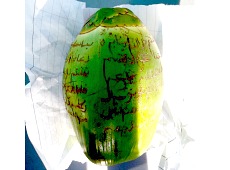
A ‘kurumba’ (young coconut) suspected to have a ‘fanditha’ (black magic) curse, with Arabic writing and suspicious symbols burned into the husk, was found in the garden of a home located in Fuvahmulah’s Dhiguvaadu ward yesterday (September 4), a source from Dhiguvaadu ward told Minivan News today.

The woman who found the suspicious coconut in the early hours of the morning intended to inform the police, however the homeowners – “hard core” Progressive Party of the Maldives (PPM) supporters – told her not to do anything until an expert investigated the coconut first, said the source.

“Neighbors supporting President Mohamed Waheed’s Gaumee Ihthihad Party (GIP) live in the area, so they heard about the fanditha coconut and wanted to create problems, so they contacted the police,” the source continued.

“MDP and PPM have been running strong campaigns and have many supporters in the area, however GIP only has about 15 members,” the source noted.

“Since GIP has very few supporters, they are trying to redirect attention away from the other political parties to gain votes,” alleged the source. “GIP has told PPM that MDP planted the fanditha coconut, however they are telling MDP that PPM is responsible.”

“Neighbors a few houses away were awake around 3:00am that night and did not notice any suspicious activity,” said the source.

The source believes that GIP, PPM and Jumhoree Party (JP) supporters are trying incite unrest among MDP activists on Fuvahmulah – especially GIP by involving the police in the fanditha coconut incident.

MDP supporters on Fuvahmulah remain very upset about the violent police crackdown that happened after the controversial transition of power in February 2012, according to the source.

“When MDP activists see local police they are not good with them, they do not keep calm, there is always a huge scene, shouting, etc.,” the source explained.

“[However,] these days MDP [Island] Councilors are trying to the max to keep supporters calm,” the source continued.

“And the situation is very calm right now. It [the fanditha coconut incident] was nothing huge, just a very simple thing,” the source said. “There won’t be any impact on voting.”

Fuvahmulah police did not want to get involved in the black magic incident, instead they preferred to allow the family to take action independently, a police source told Minivan News today.

“If we get involved, it will turn into a big thing,” said the police source, in reference to inciting unrest among MDP supporters.

However, local media reported that police took possession of the black magic coconut.

The Maldives Police Service was not responding to calls at time of press.

Black magic sabotage

A black magic practitioner from Fuvahmulah allegedly cast spells on five yellow young coconuts – kurumba can also be green or orange – and gave them to another man to deliver to a specific key location, a Fuvahmulah island council source told Minivan News today.

The island council source alleged a person named *Easa cast a spell on five coconuts and gave them to *Moosa to deliver. However, Moosa left the coconuts on his bed covered with a sheet before going to work.

“Moosa’s wife was not told about the cursed coconuts, so she was shocked to find coconuts on their bed and called the police immediately,” said the island council source. “The police went over to the house and took the coconuts.”

“She thought MDP had cast the black magic spells because the coconuts were yellow,’’ the island council source explained. “Once Moosa found out what his wife had done, he told her it was very bad that she had reported it to police.’’

Moosa and his wife then went to get the cursed coconuts back from the police, but police refused to return them, according to the island council source.

The island council source noted that Easa made a typographical error when cursing the coconuts. The coconut curse says to “get rid of [PPM presidential candidate Abdulla] Yameen”, but was supposed to read “get benefits from Yameen”.

Furthermore, during the 2008 presidential election Easa also started practicing black magic a month before the election day, noted the island council source.

“Every day after dawn prayer he went to the beach and did black magic stuff. He also went near the polling station and threw cursed objects at people,’’ said the island council source. “[But] Easa’s spells did not work the last time.”

“This hasn’t been taken too seriously by the islanders, but the MDP supporters are very concerned,’’ the island council source said.

No arrests have been made in connection with the case, the source added.

Earlier this week, police summoned a white magic practitioner to evaluate a young coconut believed to have been cursed by a black magic spell, after it was found near the Guraidhoo Island presidential election polling station in Kaafu Atoll.

*Names have been changed

Spiritual healing

This is the second cursed coconut incident reported in as many days, related to the presidential election. To better understand this “very common practice”, Minivan News spoke with Spiritual Healers of the Maldives President and Exorcist, Ajnaadh Ali.

“During elections black magic is used to gain votes and make people ill,” explained Ali.

Ali suspects a spell was read over the Fuvahmulah fanditha coconut instead of inscribed, because the coconut reads “May Allah protect us from Abdulla Yameen”.

The black magic spell cast to influence voting “is a spell of separation. It’s the same idea as a love spell. It can either bring people together or split them apart,” Ali noted. “The black magic will attack them mentally, by demanding the individual think a certain way even if they would normally know something is bad. It makes them blind in the mind.”

“While any object can be used, because coconuts represent a life structure (like eggs) they use those objects to make the spell powerful, with the advice of the devil,” noted Ali.

“There is a long history of the practice in the Maldives, but it is still very common nowadays on every island,” he continued. “There is a lack of knowledge regarding the religion. Some people who do black magic think it’s right because the Quran is used.”

“In Dhivehi, fanditha means magic – black or white – but the way it is practiced is what makes it good or bad. Black magic is when people worship or invoke jins or devils to cause harm to others,” Ali explained.

“Black magic is practiced by misusing the Quran, chanting or writing verses and the names of devils or jins (spirits) to summon their help. It cannot be done unless someone has some disbelief of Allah,” he continued. “It it also disrespectful of the Quran.”

The best protection against black magic is reading Quranic verses, particularly the last two chapters of the Quran, said Ali. ‘Ruqyah’ is a form of white magic, specifically an Islamic exorcism where Quranic verses are read and prayers recited to heal.”

“Ruqyah will neutralise black magic to rid of the evil eye or any other spiritual matter, like jin possessions or mental illness,” he explained.

It can also be conducted for the benefit of worshipping Allah, he added.

“Any Muslim can practice ruqyah by themselves, however its more effective if they have knowledge of jins and the Quran. Also, they must be following the religion,” he noted.

The five pillars of Islam are prayer, fasting, alms for the poor, pilgrimage to Mecca, and declaring belief in one God, Allah.

A 1979 law requires persons wishing to practice fanditha to “write and seek approval from the Ministry of Health.”

Likes(2)Dislikes(0)