The Judicial Services Commission (JSC) has issued a statement amending the educational and experience criteria for the appointment of judges.
Judges appointed to courts in Male’ must have either a degree, masters degree or PhD in Islamic Shariah, law or Shariah law, and at least three years/two years/six months experience in a law-related field, depending on their respective level of qualification.
President Nasheed’s member on the JSC, Aishath Velezinie, said the criteria did not apply for existing judges and would only affect new appointments, a condition not mentioned in the JSC’s press statement.
“Of the 207 of the judges currently in office, 39 have degrees or higher. Some left school before grade seven, meaning they haven’t completed primary school,” she noted.
“The rest have certificates that were tailor-made to familiarise them with the previous constitution. Judges do not have the means, resources or access to knowledge to enforce the current constitution, and this [statement] looks like a way of confusing people into thinking that the JSC is addressing the issue.”
President Mohamed Nasheed recently made an official request to the JSC to review and amend the guidelines governing the educational qualifications of judges, criticising the existing criteria as setting the bar too low.
“For the standard to determine educational qualification, they are saying [judges must possess] a certificate in either law or Shariah, and even if the certificate is not accredited by the Maldives Accreditation Board, it must be a certificate of at least level three or higher accepted by the government”, he said.
The minimum educational qualification for judges approved by the JSC was therefore “essentially grade seven”.
The Judges Association of Maldives (JAM) condemned President Mohamed Nasheed criticism of the JSC decision on determining guidelines for the reappointment of sitting judges, warning his interference could “render the separation of powers obsolete”.
Velezinie meanwhile said she had hope that all sides of parliament would come together to address the matter.
The JSC had not responded to Minivan News at time of press.
President Mohamed Nasheed has said that the Maldives intends to be “the best country in the world in terms of press freedom.”
In a message to the Commonwealth media development workshop, a four day training event that started this morning at Holiday Inn in Male’, Nasheed said the government wanted the Maldives to have “the most free and most professional media in the world.”
”We strongly believe that press freedom is important for consolidating democracy,” said Nasheed. ”We also believe that development can only be achieved through a transparent and free discussion of ideas.”
Minister of Tourism, Arts and Culture, Dr Ahmed Ali Sawad, and President of Maldives Journalists Association (MJA) Ahmed ‘Hiriga’ Zahir also addressed participants in the workshop.
Secretary General of Commonwealth Kamalesh Sharma, in his message to the participants, highlighted the role of journalism in the society and explained how important a balanced news article was.
”Journalism is an honourable profession,” Sharma said. ”You can hold accountable both the government and the private sector.”
He said that members of the press played a pivotal role in revealing the truth and upholding the values and principles that would lead to a just society.
In his address, Dr Sawad said journalists in the Maldives “are not responsible”, and urged them to be more professional, sophisticated and accountable.
Dr Sawad said that in the past the free pens of the Maldivian journalists were held hostage.
”But today we are seeing what we dreamed we would see in the 80s,” Sawad said. ”Now we have a new constitution and new legislation.”
He urged journalists at the workshop to convey the truth with their pens, adding that ”the government will not let you down.”
The Commonwealth media workshop is a four day event being conducted by the Commonwealth in collaboration with Maldives Journalists Association (MJA). Around 25 local journalists are taking part, including Minivan News.
A fund to help shark fishermen find alternative livelihoods has been launched by the Ministry of Fisheries and Agriculture on World Ocean’s Day, June 8th.
The fund was inaugurated less than a month before a total ban on shark fishing and export of shark products comes into effect on July 1.
The ministry had originally deferred the ban, citing the need to facilitate alternative livelihoods for the 200-odd shark fishermen and middlemen involved in the industry.
Money for the fund
“As we had not pre-planned for this ban, we hadn’t included it in our budget,” said Hussain Sinan, Senior Research Officer at the ministry.
Sinan said the urgent need to declare a total ban arose following a report from the Marine Research Center (MRC), which noted that the number of reef sharks sighted by divers had declined in recent years, that shark stocks were and vulnerable to exploitation due to their slow growth, late maturity and low fecundity.
“We had one year to prepare for this ban, and so we had discussed this with the fishermen involved,” says Sinan.
The ministry plans to raise money to fund the ban through NGOs and the tourism sector.
“The World Wide Fund for Nature (WWF) has promised US$300,000 and some resorts have also pledged money,” he said, but declined to name those involved.
Influential lobby group the Maldives Association of Tourism Industry (MATI) meanwhile said it is not aware of any resorts contributing to the fund. MATI’s Secretary General ‘Sim’ Mohamed Ibrahim says the group has heard of the fund but had not been approached by the ministry.
“Resorts might have been approached directly,” Sim speculated.
The fund to support an alternative livelihood for shark fishermen was a good idea, he suggested.
“We lobbied for a shark fishing ban five years ago, after which a moratorium was placed by the government banning shark fishing in areas close to the resorts.”
A study carried out in 1992 revealed that tourists paid a total of US$ 2.3 million for shark watching dives, while in the same year export of shark products earned a revenue of US$0.7 million.
“If they come to us and say this issue needs to be addressed, we will help of course,” Sim said, but maintained that MATI could only talk to resorts “as on financial issues [such as this] resorts will decide how they spend their money.”
Funding alternative livelihoods
“Shark fishing is not a year long activity, it lasts for about five months” Sinan explained, therefore fishermen already practiced another form of livelihood for the rest of the year like “reef fishing and yellowfin tuna fishing.”
The funds are going to be spent on training opportunities for fishermen, agricultural projects and to boost the “secondary livelihoods” of shark fishermen, he stated.
“It will not be distributed directly to fishermen,” he added. Already the ministry has received requests from islands to help them find markets to sell reef fish and help them to keep fish fresh for longer.
Fourteen islands to receive the fund have already been identified by the ministry.
“We are also floating the idea of buying back long line fishing gear from the fishermen – this way we can identify those involved also,” he said.
Each dhoni would be assessed separately, and owners compensated “taking into account the current market value and depreciation.”
Implementation
Fisherman’s Union’s President Ibrahim Manik says the ministry has made no contact with the body.
Agreeing that sharks needed protection, he said the issue of compensating the shark fishermen was crucial.
He is supportive of how the money will be spent: “everyone wants money, but a one-off payment is not going to reap positive results in the long run.”
“Even if we were not included in the discussion stage, what the Fisheries Minister is saying is a good thing; the funds need to be spent in a sustainable manner,” Manik said.
However he points out the contradictory nature of announcing a shark ban while on the path to introducing long line.
“Let’s face it: sharks are going to be caught with long lining, and a lot of them are going to die,” Manik said.
Long lining was necessary if local fishermen were to survive, he said.
“Fishermen need to survive and right now we are suffering,” he said, adding that a lot of fishermen were questioning the logic of the ban.
“According to some estimates, there are about 300 Sri Lankan fishing boats that do long lining near the Maldives. They are killing sharks by the dozens, so does having a ban only in the Maldives help? We have no idea how they are going to implement this, but we support the move.”
Vice President Dr Mohamed Waheed attended the award giving ceremony of the 25th National Qur’an Competition, held on Saturday evening at Dharubaaruge.
Dr Waheed complimented the large number of parents who placed a high priority on ensuring their children were able to study the Holy Quran. He emphasised the importance of learning the proper way of reading the Quran, which, he said would strengthen Islamic faith and understanding.
The President’s awards for the students who won first place in different age categories, as well as the President’s trophies for the schools that won first place in different categories were given out at last evening’s function.
The white sand atolls and coral islands might soon be buttressed with concrete as rising sea levels force the Maldivian President into drastic action, said ABC Radio presenter Monica Attard, in an interview in Sydney last week with President Mohamed Nasheed.
Protesters outside last December’s Copenhagen climate change conference, where one of the world’s smallest nations – the Maldives – went asking the worlds richer nations to curb their carbon emissions.
The result was, as we all know, a very imperfect accord.
Dhiraagu has extended its 3G Plus network to Fuvah Mulah in Gnaviyani Atoll, one of the more densely populated islands in the Maldives.
The expansion gives residents of Fuvah Mulah access to high speed mobile broadband internet, the company said in a statement.
Mobile broadband, along with WiMax technology, is thought to be one of the most economical ways of connecting the scattered population of Maldives to the internet, rather than laying extensive cabling for small populations.
“We are also pleased to reveal today that the work of extending Dhiraagu 3G Plus network and Broadband service to cover more islands, is progressing rapidly,” the company said.
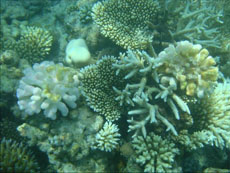
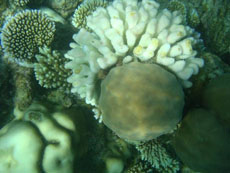
The Maldives is currently suffering the most serious incidence of coral bleaching since the major 1998 El Niño–event that destroyed most of the country’s shallow reef coral.
Coral bleaching is caused when rising water temperatures stress the coral, leading it to expel the algae it uses to obtain nutrients. When water temperatures rise even slightly, algae leaves the coral polyp and enters the water column, causing the coral to lose its colour and eventually die.
Reports of bleaching have been trickling in from marine biologists and researchers across the country.
Hussein Zahir from the Marine Research Centre (MRC) has been collecting reports of the bleaching, and said that based on his estimates, “10-15 percent of shallow reef coral is now completely white, while 50-70 percent has begun to pale.”
Senior Marine Biologist Guy Stevens, based at the Four Seasons Resort in Landaa Giraavaru, said that he had noticed that bleaching was beginning to occur last year “after a change in the weather linked to El Niño. The last one in 1998 was pretty catastrophic, and reefs in the Maldives have been recovering ever since.”
“It had a huge impact across the Indian Ocean, and the Maldives was most affected – pristine reefs suffered coral mortality rates of 95 percent,” Stevens explained. “At the time people were mortified and scientists were predicting the end of the reefs – coral is the foundation of the whole reef ecosystem.”
Coral in North Male Atoll at different stages of bleaching
Since the devastating El Niño in 1998, marine biologists in the Maldives “have been holding their breath for the next one. In the meantime the coral has been slowly recovering. It was pretty depressing in 2003, but roll forward to 2010 and it’s starting to look good again. It recovers exponentially.”
Meanwhile, colleagues of Stevens based in Thailand, which escaped largely unscathed in 1998, have reported coral mortality rates “of up to 100 percent.”
“The hot spots move around, but they cover a big area and the coral here could easily take another hit,” Stevens commented.
Zahir noted that temperatures this year were following similar patterns to those of 1998, with a surface temperature in April of one degree above the long term average.
However the recent drop in temperature, brought on by rain and the onset of the southwest monsoon, has lowered the surface sea temperature and brought some relief, “and may give the coral time to recover.”
“Now the temperature has dropped from 32 degrees to 29-30 degrees, so hopefully things will improve. The conditions are right for the coral to become healthy again,” Zahir noted, however he emphasised the need for the tourism industry to assist with monitoring the bleaching.
“Here in the Maldives we have a vast reef area, and the MRC has very little capacity to do surveys. From the very beginning we’ve been running a bleach-watch reporting programme with the dive industry, but for some reason the feedback has been very disappointing. There’s a hundred resorts, but I can count on my fingers the ones who are working to raise awareness. I know it might impact on their marketing, but this needs to be documented.”
All the MRC required was GPS coordinates and an indication of how much bleaching was occurring, he explained.
In the meantime, both Stevens and Zahir noted that there was little that could be done to prevent further bleaching.
Cooler temperatures may have averted disaster
“There is very little we can do, especially in a resort environment, other than reducing human impact on the reef while it recovers – that means ceasing things like sand-pumping and beach renewal on a daily basis, while the reef is especially vulnerable to sedimentation,” Zahir explained.
Verena Wiesbauer, a marine biologist at Male-based consultancy Water Solutions, said she had just returned from visiting two islands in North Male’ Atoll and had documented heavy coral bleaching.
“The reefs had only just recovered, and now it’s struck again. It’s a big setback,” she observed.
“Fortunately it’s not as bad as 1998, and now the temperature is dropping. But I hope someone will keep track of the paling coral, to see if it gets its colour back.”
Wiesbauer added that the bleaching did not appear to have affected fish numbers yet, and suggested that “many fish don’t need live coral as long as the structure is there for them to hide in, and many algae feeders don’t mind [bleaching] at all. But there are some specialist coral feeders we need to watch for changes.”
Meanwhile, like Zahir, Stevens observed that the tourism industry appeared to have been in no hurry to report that bleaching was occurring.
“That’s something the resorts obviously don’t want to publicise,” Stevens commented. “But I don’t think it’s any good burying our heads in the sand, when there’s going to be no sand left to bury our heads in.”
The artificial coral breeding programs run at many resorts were well-intentioned, “but rather like putting a band-aid on a gushing wound.”
“It doesn’t address the issue. Rather [breeding programmes] are a tool to raise awareness and alleviate pressure on the local reef. But there are things like sand-pumping that resorts should halt during periods of bleaching because it makes the problem worse,” he said, concurring with Zahir.
“Otherwise there’s very little we can do – it’s really a global issue. We haven’t seen a reduction in fish life, turtles and mantas, and it seems those parts of the ecosystem can survive while the reef structure is at least in place, but overall I think we’re going to see a gradual decline. Coral reefs may be the first ecosystem we’ll lose on our planet.”
Images courtesy of the Marine Research Centre (MRC).
The cemetery (Aa-sahara) in Male’ has reached capacity and Male’ municipality council has begun burying dead bodies on top of one another, by adding six feet of soil to the burial ground.
Islamic burial practices state that bodies must be buried six feet under the earth, and must not be stacked above other bodies – a logistical challenge for densely-populated Male’, where space is at a premium.
Head of Municipality Council Adam ‘Sarangu’ Manik said the council had no other choice because there was no other land in the city to bury dead bodies.
”We have to do it like this because every day one or two people need be buried there,” Adam explained.
”The soil was put on top of the graves and prepared by the former government,” he said. ”We have no other place to bury dead bodies, so we continued burying them there.”
State Islamic Minister Sheikh Mohamed Shaheem Ali Saeed reiterated that under Islam it was prohibited to bury dead bodies in this manner.
”It is allowed only if there is no other way,” Sheikh Shaheem said, noting ”it is not a must to only bury dead people in Male’ – there is space in Hulhumale and Villingili. We should take the dead bodies in a speed boat to Hulhumale’, Villingili or another nearby island,” he said.
A strong wind blew down a 500 year-old Banyan tree in Kuribi of Haadhaalu Atoll, which was believed to be among the ancient relics remaining on the island.
Island Councilor Abdul Wahid told Minivan News that the tree fell down on Friday afternoon at around 3:00pm due to a strong wind that came with the rain clouds.
”The wind was blowing faster than 70 km/h,” said Wahid. ”Many coconut palm trees and other trees in the area fell down,”
Wahid said the tree was 125 feet long and was used as a landmark for travelers, as it was visible on the horizon before even the island appeared.
”It would have a diameter of 15 feet and a spread of 200 feet,” Wahid said.
He said that nobody was injured during the incident.
”It fell and hit the outer wall of Hukuru Miskiy [Friday mosque] and damaged the wall,” he said. ”Some other trees in the area were also pulled down.”
He said that the ancient Banyan tree would be put up for auction tomorrow.
An official at the Department of Meteorology (MET) said that its bureau on Hanimaadhoo in Haa Dhaalu Atoll has recorded that Hanimaadhoo experienced strong winds blowing at almost 90 km/h on Friday afternoon.
She said that the heavy rain and strong winds was due to the southwest monsoon, and added that no tornadoes had been recorded recently.
Floods
A solid two days of rain in Nolhivaram, also in Haa Dhaalu Atoll, has caused shin-high flooding.
Island Councilor Hussein Areef said the deluge lasted from Friday morning to 10pm last night, and had caused the water level to rise to to 1.5 feet in some areas.
Eight houses on the island had been flooded, he said, and some trees had died.
Areef said that schools were closed today due to the flood.
”Many trees on island also fell due to the rain and strong wind,” Areef said. ”We are trying to drain the water and we hope we can reopen the schools by tomorrow.”
”Now it is not raining, but the sky is overcasts and by 6:00pm it would start showering again,” he added.
 (0)Dislikes
 (0)
(0)