Chinese artist to exhibit in National Art Gallery

Chinese artist Yuan Xikun will present an artist’s talk at the National Art Gallery in Male’, in conjunction with the Maldives’ Embassy in China and the Jin Tai Art Museum in Beijing.

Xikun is a prominent Chinese artist, curator, environmentalist and the founder of the very first private museum in China. He will be accompanied by Chinese Representative Zhang Zhenshan of the United Nations Human Settlements Programme (UN-HABITAT), Project Official Hu Shaofang from the United Nations Environment Programme (UNEP), and young soprano singer Liu Bing.

Chinese media including CCTV (Central China Television), CETV (China Education Television) and Xinhua News Agency are also attending.

Yuan Xikun’s 11 paintings, 6 posters and 2 sculptures will continue to remain on display at the National Art Gallery until (Tuesday) October 18, 2011. Opening hours are 10:00am to 4:00pm.

Likes(0)Dislikes(0)

Audience involvement in news changing journalism, observes visiting professor

“No matter how technologically advanced things are, you can’t take away the journalist’s role as a traditional gatekeeper of the truth.”

Dr William Silcock used these words to describe Maldivian journalism student Lujain Ismail Shafeeq’s video, “The Future of News”. Shafeeq’s video was a finalist in the Joan Shorenstein Center on the Press, Politics and Public Policy’s 25th Anniversary video contest at the Harvard Kennedy School in the United States.

Dr Silcock is an assistant professor at the Walter Cronkite School of Journalism in Arizona, one of the largest universities in the US. He was selected as a Fulbright Scholar in Ireland and Sweden, has received several awards over his 25 years of broadcasting, and is considered a pioneer in the research of global television news culture. Dr Silcock has previously organised workshops for journalists in Croatia, Bosnia, Albania, Macedonia, and Montenegro, among others.

He spoke to journalism students at the Maldives’ National University on Sunday, October 16 regarding topics in communications such as ethics and the evolving nature of the press.

He observed that Lujain’s video presented modern journalism as a function of technology: using phones, cameras and global positioning systems (GPS), the journalist covering a story is relieved of the tasks of identifying a story, verifying sources or selecting quotes.

“In his vision, machines do a lot of the work for us. The traditional facts of who, what, where, when and why don’t need to be asked anymore.” But as Silcock points out, one flawed Tweet could jeopardise the journalist’s value as a messenger. “The audience contributes to the story, but what if the information is bad?”

Silcock used this and other videos at Sunday’s lecture, “Social Media and Online Journalism”, sponsored by the United States State Department in Colombo, to explore the concept of free expression.

Silcock began by identifying the original meaning of a message.

“Sacred texts were the first ‘Word’. Across the spectrum of religious belief we have lots of varieties of sacred texts. I once asked a Muslim student to teach me the value of the Word in the Qur’an. She taught me this: words are synonymous in Islam with responsibility. She quoted from the Qur’an: ‘Man does not utter any word except that with him is an observer prepared to record. Each word we utter we are responsible for in front of Allah.'”

Today, however, the nature of a message and the responsibility it entails is morphing.

“We are in an era of the ‘visual village'”, said Silcock. “We all want more images across the news.”

Although visuals have been attached to words in many religious and mythical texts throughout history, Silcock pointed out that those detailed images required attention and appreciation. Today, however, audiences want immediate satisfaction.

Noting that “journalism is market-driven” and “advertising is fundamental to the free press,” Silcock observed that, “we now have so many devices, so many platforms to communicate, that the audience attention has become fragmented and fractured.”

The impact on journalism, he said, was serious.

“There’s the traditional legacy media, papers such as the New York Times which have been around. But now we have ‘down in the valley’ media. The audience is actively engaging in and contributing to the news.”

Referring to the blogs and websites that many news outlets use to provide further information about their stories, including the process of creating them, Silcock also highlighted the effect of Twitter: “It’s microblogging, a story comes out in under 140 characters.”

Turning the focus on Facebook, Silcock suggested that social media outlets were adapting to a growing concept of “tribal journalism: people sharing information across platforms.” In the interest of free expression, everyone’s voice is given room for consideration.

Yet it remains the journalist’s task to navigate the possible pitfalls of so much information. Not only can journalists get false information through social media, they can also get too close to the spotlight.

“It’s important to put up a firewall between show business and journalism,” Silcock said. “TV news in the US, for example. Anchors sit in front of a fancy desk with all kinds of monitors that make the place look like something from Star Trek or outer space. But we don’t need all that.”

Silcock consolidated the ethics of ambushing a source for a story-breaking quote in the following terms: “Heat for light’s sake. You want to clarify the story. The negative side to that is heat for heat’s sake.”

In his concluding remarks, Silcock recognized the impressive and useful influence of social media on the news industry.

“Historically, we got through lots of transitions with technology. The typewriter, radio came along and then the television,” said Silcock, showing slides of these items. “But notice this picture of America’s famous pioneer of television Edward R Murrow. What is he doing? He’s reading a newspaper.”

Silcock advised his audience to apply social media forums in innovative ways for positive results. Referring to American documentary maker Ken Burns’ concept of the computer as “the electronic campfire,” he said, “we can compare people sitting at a campfire late at night, to people at a computer. They’re fueling the fires of free expression.”

Likes(0)Dislikes(0)

Kulhudhufushi islanders protest plans to sell reclaimed land

A group of islanders on Kulhudhufushi in Haa Dhaal Atoll gathered outside the island council office this morning to protest plans to sell plots of land from the reclaimed area of the island.

The protest was organised in response to the Kulhudhufushi Development Corporation putting up 20 plots of reclaimed land for sale through a bidding process. Plots measuring 1,000 square feet were to be sold at a rate of Rf300 per square foot.

Speaking to Minivan News, Ibrahim Ahmed, 43, a resident of Kulhudhufushi who participated in the protest said that islanders gathered outside the council office at 8:00am this morning and were met with police officers in riot gear.

“We prepared a petition or a letter expressing our concerns with the plans to sell land and were going to submit it to the chair of the island council,” he explained.

The gathering was peaceful until two protesters attempted to enter the council office, he continued, alleging that police used force and pepper spray to disperse the crowd.

“They used pepper spray without any warning and took away people in handcuffs,” he claimed, adding that police used disproportionate force against the protesters.

“It was a completely peaceful gathering before that,” he added. “But that was how it turned into a protest.”

The islanders then met with Council Chair Jamsheed Mohamed, who asked for a three-day period to discuss with the relevant government ministries.

The ruling Maldivian Democratic Party (MDP) made a clean sweep of the seven-member Kulhudhufushi island council. The island is the largest population hub north of Male’.

Ibrahim said the MDP councillor assured the protestors in writing that the council would seek to find a solution in the next three days.

The Kulhudhufushi resident explained that the main concern of the protesters was the decision to register the reclaimed plots under the Kulhudhufushi Development Corporation.

“We want that land to be registered under the council,” he said. “We don’t mind if it leased for 99 years, but selling the plots is completely unacceptable to the people of this island.”

Islanders were not consulted before the land use plan for the reclaimed area was drawn up, Ibrahim said, adding that the people of Kulhudhufushi would prefer the area to be used for industrial or business purposes.

Meanwhile, opposition Dhivehi Rayyithunge Party (DRP) MP Dr Abdulla Mausoom, the party’s deputy parliamentary group leader, held a press conference this afternoon and called on the government to “not test the people to see how much their blood will boil.”

The protest in Kulhudhufushi today was the result of the government’s failure to consult with the public before formulating policy, Mausoom argued.

Island development plans should “come from the people” and not from the central government, Mausoom said, adding that the government’s actions were defeating the purpose of the landmark Decentralisation Act.

Likes(0)Dislikes(0)

PPM approves party constitution, council and logo at inaugural convention

The incipient Progressive Party of Maldives (PPM) approved the party’s constitution, manifesto, interim council, leadership posts, logo and colour at its inaugural convention last night.

Party figurehead former President Maumoon Abdul Gayoom was elected acting leader while his half-brother MP Abdulla Yameen was elected parliamentary group leader.

Gayoom was the only candidate who stood for the post of party leader.

The convention took place at Dharubaaruge with 971 delegates and was assisted by officials of the Elections Commission (EC). A minimum of 300 participants were required for the inaugural meeting.

Large number of supporters queued outside Dharubaaruge before 8:00pm while registration difficulties caused a delay of almost two hours. As voting went on late into the night, the convention concluded shortly before 6:00am this morning.

Prior to the inaugural convention, the EC had verified and approved the membership forms of 3,019 party members.

The convention was chaired by former Speaker of Parliament ‘Seena’ Ahmed Zahir, who also served as Justice Minister in the previous government.

PPM logoA crescent and palm tree logo designed by Hussein Mazin and MP Ahmed Mahlouf was adopted with 751 votes while the colour magenta was chosen with 603 votes.

The senior members elected to the interim council were Umar Naseer (fromer Dhivehi Rayyithunge Party deputy leader), Mohamed Hussein Shareef ‘Mundhu’, Aishath Azima Shukoor (former Attorney General), Mohamed Waheed Ibrahim, Faris Maumoon, Aneesa Ahmed (former MP and minister), Ahmed ‘Maaz’ Saleem, Ibrahim Nazim, Rashida Yousuf (former minister), Dr Aishath Shiham (former minister), Ahmed Siddeeq, Dr Abdul Samad Abdulla, Mohamed Nimal, Asma Rasheed, Ibrahim Muaz Ali and Ahmed Naseem.

A provision in the party constitution required that at least four women be elected to the council.

Eleven MPs were meanwhile elected to the council through the parliamentary group. They were Abdulla Yameen (Mulaku), Ahmed Mahlouf (Galolhu South), Ahmed Nihan (Vili-Male’), Abdul Raheem Abdulla (Laamu Fonadhoo), Hamdhoon Hameed (Raa Inguraidhoo), Ilham Ahmed (Gemanafushi), Ahmed “Redwave” Saleem (Eydhafushi), Dr Afrashim Ali (Ungoofaru), Mohamed Mujthaz (Hanimaadhoo), Ali Arif (Vaikaradhoo) and Abdul Muhsin Hameed (Nilandhoo).

In his closing remarks at the end of the convention, former President Gayoom insisted that PPM “does not belong to a particular person.”

Former President Maumoon Abdul Gayoom enters the meeting to a standing ovation.

“PPM is not going to try to create opportunities in the political arena for a particular person or group,” he said. “PPM is being formed for the whole nation. It is being formed for the holy religion of Islam. This party will always serve Islam and the Dhivehi nation.”

Likes(0)Dislikes(0)

BML compares staff performance to company goals

Bank of Maldives (BML) is collaborating with leading UK consultancy firm Hunter Roberts to incorporate a performance management system into its operations.

The system is said to measure bank management by evaluating employees performances and comparing them with the bank’s overall goals, a bank official has told Haveeru News.

The performance management system will be introduced by 10 “Performance Management Champions”, who have been trained to instruct executive team and department heads.

Likes(0)Dislikes(0)

Suspect in Sultan Park bombing arrested in Sri Lanka

Sri Lankan police on Thursday apprehended Maldivian national Mohamed Ameen, 27, who has an Interpol red notice for his alleged involvement in the Sultan park bombing incident in 2007.

According to Sri Lankan media, a Colombo magistrate court yesterday ordered Ameen to be remanded in custody for two weeks.

Sub-Inspector Ahmed Shiyam confirmed the arrest today. The suspect was arrested based on information provided to the Sri Lankan authorities by Maldivian police, he said.

Ameen was arrested after he traveled to Sri Lanka from Pakistan on a fake passport, Shiyam explained.

Sri Lankan media reported that Ameen was arrested at Payagala level crossing on Galle road and had two fake Maldivian passports as well as a Pakistani passport in his possession.

The 27-year-old had reportedly fled the Maldives before the bombing took place on September 29, 2007. The bomb blast from a homemade IED (improvised explosive device) was the first bombing incident in the country.

The bomb blast at the Sultan park – a major tourist attraction in the capital located in front of the Islamic Centre – was triggered using a mobile phone and washing machine motor attached to a gas cylinder.

The attack injured 12 tourists, including eight from China, two from Britain and two from Japan. The incident received widespread publicity around the globe, damaging the country’s tourism industry.

The attack meanwhile prompted the authorities to declare a state of high alert and police arrested 12 suspects within 48 hours.

Terrorism charges were filed against 16 suspects, including ten who had fled the country.

In addition to Mohamed Ameen, Interpol red notices were issued for Hussain Simaad, 25, of Baa atoll Dharavandhoo; Hassan Riyaz, 21, of Haa Dhaalu atoll Nellaidhoo; Mohamed Imad, 27, of Baa atoll Dharavandhoo; Abdul Latheef Ibrahim, 25, of Laamu atoll Kalhaidhoo; Mohamed Iqbal, 42 of Maafannu Naseemee Manzil; Moosa Manik, 20, of Seenu atoll Hithadhoo; Hassan Yoosuf, 24, of Laamu atoll Kalaidhoo; Ali Shameem, 25 of Shaviyani atoll Komandoo; and Ibrahim Maslamath of Maafannu Gold Ring.

Three men – Mohamed Sobah, 19, Moosa Inaz, 21, and Ahmed Naseer, 20 – were sentenced to 15 years imprisonment in December 2007 after they confessed to the crime.

In August 2010, the current administration commuted the sentences of Ahmed Naseer and Mohamed Sobah from incarceration to three year suspended sentences under observation.

Press Secretary Mohamed Zuhair told Minivan News at the time that the pair “were not the people who were in charge of doing this, they did not having the highest involvement.”

He added that the government wished to “provide an opportunity for everyone to be involved in the society, and the opportunity to rehabilitate and recover.”

Likes(1)Dislikes(0)

Airfrance to introduce scheduled flights to Maldives, says President

French flag carrier airline Airfrance is in the process of introducing scheduled flights to the Maldives in late 2012, President Mohamed Nasheed announced yesterday in his weekly radio address.

Delivering the radio address Friday morning shortly after his return from an official visit to France last week, President Nasheed said he met the Vice-President of Airfrance and was informed that preliminary preparations for the scheduled flights would take six months.

“Nevertheless, we expect that God willing an Airfrance scheduled flight will begin operations to the Maldives in Europe’s winter of 2012,” he said.

The government delegation also met with French tour operators to discuss ways to increase tourist arrivals from France, Nasheed added.

Prominent resort businessman and Independent MP Ahmed ‘Sun Travel’ Shiyam was part of the Maldives delegation.

“As you know, at the moment about 40,000 tourists from France visit the Maldives [annually],” Nasheed said. “Our aim is to double that figure and undertake efforts to attract French tourists in the same numbers as British tourists come to the Maldives right now.”

Tourist arrivals reached a record high in 2010 with 791,917 arrivals, a 20 percent increase compared to 2009. Tourists from the United Kingdom accounted for 15 percent of the total arrivals at 118,961.

While arrivals from France were considerably lower than England or the UK as a whole, the French market grew by nine percent in 2010 from the previous year. Some 50,373 French tourists visited the Maldives in 2009.

The Maldives meanwhile signed the Paris-Nairobi Initiative during the visit, Nasheed continued, which would facilitate French assistance for renewable energy programmes and adaptation measures for beach erosion.

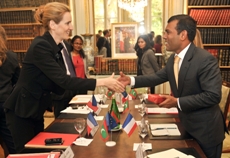
Nathalie Kosciusko-Morizet, the French Minister of Ecology, Sustainable Development, Transport and Housing.President Nasheed signed the accord on behalf of the Maldives at a meeting with Nathalie Kosciusko-Morizet, the French Minister of Ecology, Sustainable Development, Transport and Housing.

The Maldivian delegation also met with senior officials of the Agence Française de Développement (AFD), a French bilateral development finance institution, who “gave the green light” for more water and sewerage projects in addition to the sewerage projects AFD has undertaken in Gaaf Dhaal Thinadhoo and Laamu Gan.

“Additionally, good discussions took place with the French Foreign Minister,” Nasheed continued. “He welcomed our standing together with France on the issue of Libya. I thanked the French government on behalf of the Maldivian people for their efforts to help the people of Libya.”

Likes(0)Dislikes(0)

Maldives’ carbon neutral goal proving formidably hard and expensive: Telegraph

Though simple to articulate, the [Maldives’] zero-carbon goal looks difficult to achieve, and it is easy to be led astray, writes Geoffrey Lean for the UK’s Telegraph newspaper.

Wind power companies descended on the country soon after the goal was announced and Manmohan Singh, prime minister of India – which has a large wind industry – briefly persuaded Nasheed. But the wind scarcely blows in the islands for months on end, and the country’s new plan – drawn up with the help of a British engineer, Mike Mason – gives it short shrift.

The biomass plant is best suited for Malé, which is probably the world’s most densely populated city, with 100,000 people packed into just two square kilometres (if everyone came down from its forest of high-rise buildings at the same time, they say, there would be no room for them in the streets). And solar power, which is almost as cheap, looks the best bet for the 200 inhabited islands and 100 resorts scattered through the archipelago.

Meanwhile, the government is eliminating import duty on electric cars and motorbikes, leaving petrol and diesel ones subject to a 200 per cent mark-up. This month it will scrap the tax on renewable energy equipment and super-efficient appliances like fridges. And it has introduced a feed-in tariff to pay those who generate their own clean power.

All the same, it looks as if it will fail to meet its goal, for – while providing half the country’s power from renewables is relatively straightforward, and getting to around 80 per cent is possible – it is proving formidably hard and expensive to go all the way.

For the Maldives has no reliable, constant form of clean power – like hydroelectric or tidal energy – and though the sun rises every day, it sets at night and occasionally hides behind clouds.

Thus, solar energy has to be stored in batteries and it is prohibitively expensive to provide enough to cope with a string of sunless days, though costs are expected to fall. Replacing diesel for fishing boats and ferries will be tricky. And to cap it all, the government has just contracted with a Chinese company to provide a gas power station, partly to provide back-up for an ill-conceived windfarm, decided upon before the plan was drawn up.

So the bold zero-carbon goal is being quietly downgraded to 80-90 per cent carbon free, still an extraordinary achievement in just a decade, with the hope of completing the job later. As the plan puts it: “We can do it – almost!”

Full story

Likes(0)Dislikes(0)

Maldives a good ear for SAARC think-tank pointers

“A lot of countries in South Asia don’t see solar energy as a main power source – yet. Let’s put it this way: Maldives does.”

Tomislav Delinic, Director for Regional Program SAARC at German political organisation Konrad Adenauer Stiftung, believes the Maldives has a significant role to play in improving environment and energy policies across South Asia.

“Every country needs to find its own most suitable solutions, but it should also share these solutions with others,” he said. “Since the Maldives is pushing forward the renewable energy sector, it can be an asset for the region.”

Renewable energy has been a leading issue for researchers at the Consortium of South Asian Think-Tanks (COSATT) this year. COSATT is an informal non-profit organisation convened by the Institute of Peace and Conflict Studies (IPCS) to bridge policy research in South Asia.

Since 2008 COSATT has developed annual SAARC summit themes into year-long research projects for and by South Asian think-tanks. Previous topics include trade, connectivity, and counter-terrorism.

Delinic was one of several participants in COSATT’s third and final meeting held at Bandos Resort between Tuesday, October 11 and Thursday, October 13.

“We know South Asia lacks connectivity and we try to bridge it by bringing together leading think-tanks which are politically engaged to discuss the most important issues of connectivity,” said Delinic.

Last year’s topic, ‘Green Asia’, lead COSATT to organize a 12-month international research project on environmental security and renewable energy. Research institutes from all SAARC countries have contributed to a summary publication, released yesterday, as well as an eight to ten page letter of recommendations, to be submitted to policy makers prior to the SAARC summit in Addu this November.

The Maldives is figuring into COSATT’s 2011 recommendations in important ways.

The President’s Office last week hosted the release of COSATT’s 2011 report “Energy and Environmental Security: A Cooperative Approach in South Asia”; Vice President Dr. Mohammed Waheed delivered the keynote address.

Delinic said significant potential for action was in store for the Maldives over the next two SAARC summits. Partnership, however, is thin.

“We released the book here not only because SAARC summit will be held here but also because environment is so important for the Maldives. But we lack partners in the Maldives and are looking for researchers to contribute to our work. This is now even more crucial because we will soon pick up next year’s SAARC summit topic, ‘Building Bridges’. Since this has been initiated by the Maldives, their participation at COSATT would be very good.”

Delinic said several Maldivian policy makers and think tank members had met with the COSATT team during last week’s meeting to discuss opportunities, although no agreements have been reached.

While COSATT does not implement policies according to its findings, proposing suggestions is a key step.

“Cooperation has to start somewhere,” Delinic said. “If you’re lacking common ideas, you can’t develop concepts. So we don’t want to allow that our politicians are saying ‘We don’t have the concepts.’ We will give them the concepts. Leading think tanks from the region agree on that.”

Delinic said think tanks are the key to getting recommendations from groups such as COSATT off of paper and into action.

“Countries might have issues with each other, but if you see the think-tanks in many of these places, they’re doing very well. They’re cooperating, they’re agreeing, sometimes they even oppose their own government. This is the future, and we need to work on it further,” he said.

COSATT takes its biggest test at the government level.

According to IPCS research officer and COSATT report editor, J. Jeganaathan, bureaucratic processes tend to block efficiency. “I see the bureaucratic process in each South Asia member countries as an issue. They are rooted in traditional thinking, they cannot move beyond traditional values, and that is an obstacle to progress. Political will is also an issue, it leads to lack of commitment for common funds and cooperation in implementing new policies.”

Jeganaathan added that although international organisations such as the World Bank (WB) and United Nations Development Program (UNDP) have funds to support SAARC regional resolutions, poor cooperation among country officials prevents these funds from being applied.

However, India’s retired Major General Dipankar Banerjee, a mentor at COSATT, was optimistic about the Maldivian government’s support.

“Energy is a vital and immediate concern for the Maldives and for all of coastal South Asia. The Maldivian government ministers are particularly keen that our recommendations be put on the agenda at the summit,” he said.
Banerjee cautioned that implementation is a slow process. Agreeing with Jeganaathan, he said getting recommendations past the suggestion phase was difficult.

“One can’t expect the recommendations of a think-tank to immediately translate into official government policy. But our goal is to sensitize our respective governments, to show them the options as to how we can move forward, and show them a direction. And that’s a slow learning process, nothing happens instantaneously,” said Banerjee.

Delinic was keen to identify the COSATT recommendations as “an incentive of South Asia for South Asia,” and said maintaining close relationships with governments was important. He did note that follow-up has been a constant issue, and said the group’s final meeting today aimed to resolve it.

“Naturally we cannot push the governments further than offering ideas. But still, one can remind them of this. Keeping contact with the policy makers, dropping information through the media, and connecting with local NGOs on certain topics. For example, in the Maldives we feel sure we can find partners in civil society for certain issues,” he said.

Policy recommendations will be released on 9 November, however they will be distributed to the appropriate government ministries and departments prior to the summit.

Likes(0)Dislikes(0)