Comment: Burning bridges – SAARC Summit exposes depths of Maldivian intolerance

Democracy strips a people naked by giving them the freedom to be who they really are. Recent events reveal that the Maldivian so exposed is not a pretty sight: she is bigoted, xenophobic, and ignorant.

First came the gutter press hullabaloo about an illustration of Jesus on a banner welcoming leaders of the SAARC region which, as it happens, is home to the largest collection of deities known to man.

Pardon me if I am bordering on the verge of apostasy here, but is Jesus not Easa? You may know him from such books as the Qur’an.

Perhaps the good people of the Sun magazine, which ‘broke’ the ‘news’, are not too familiar with the book. Be that as it may, truth is, Sun writers had not been this excited about alleged ‘anti-Islamic activity’ since they went under covers in a brothel.

When the public failed to foam at the mouth (not about the brothel, about Jesus), other plans had to be hatched to ratchet up hatred. Along came MP Ahmed Mahloof, our saviour from the unlikely Second Coming of Jesus as a line-drawing flapping about in the warm breeze of a tropical island.

The ex-footballer as a public figure is an interesting (side)step in the evolution of man. To begin with, he possesses a brain that accepts kicking a ball into a net for money is a life well lived. The capacity of such brains to adjust to other styles of living is minimal, though not non-existent.

It has been proven, for instance, that they can successfully switch from playing ball to building a career of provocatively displaying one’s own balls for couturiers of men’s underwear. But a career in politics? Mahloof is proof that electing ex-footballers to political posts is an own goal of epic proportions.

As if the MP and his idiocy were not enough to make us the laughing stock of South Asia, we then set about destroying a monument installed by Pakistan because it contains idolatrous images.

Maldivians destroying a Pakistani creation for alleged anti-Islamic imagery. Now, tell us – does that not make it clear once and for all who is the more Islamic of the two states: the Islamic Republic of Pakistan with its 97 percent Muslim population, or Always Natural Maldives, the tourist destination extraordinaire with a hundred-percent-minus-one-Muslim population? Surely we have won this religious pissing contest that Pakistan probably did not even know they were engaged in.

At least we cannot be accused of bias in our India-Pakistan foreign policy. Last month we deported an Indian for having on his laptop a religious hymn. This week we destroyed a religious display from Pakistan.

In fact, we are very even-handed in our policies and attitudes towards all our neighbours. Just ask any of our hundred thousand Bangladeshi Muslim brethren: we treat them all with equal inhumanity and cruelty.

And surely Sri Lanka would attest to just how seriously we take the commandment to love thy neighbour: for didn’t we, while on the UN Human Rights Committee, describe the UN’s condemnation of Rajapaksa’s war policy as ‘singularly counter-productive’?

Somewhere in this unpalatable exposé of the 21st century Maldivian is a lesson, not just for Maldivians but also for democracy itself. And it is not just that ex-footballers should not be elected to public office but also that, given the freedom, a majority of people are just as likely to choose intolerance as they are to choose tolerance.

That is the tragedy of three years of democracy in the Maldives: we have chosen to use its liberties to exercise our freedom not to be free.

All comment pieces are the sole view of the author and do not reflect the editorial policy of Minivan News. If you would like to write an opinion piece, please send proposals to [email protected]

Likes(1)Dislikes(0)

Retreat for leaders’ spouses held in Fuvamulah

A Maldivian musical on water and a cultural village perched high on the beach were the highlights of the spousal retreat held in Fuvamulah today.

Fuvamulah, co-host of the 17th SAARC summit along with Addu City, has been the venue of activities for the SAARC Festival since the start of November.

These have included a kite festival, bashi competition (a game played exclusively by women using a badminton racket and tennis balls), and the ‘Cricket 20Twenty Cup Tournament’ among seven SAARC member nations. Beach volleyball and futsal tournaments meanwhile took place in Addu City.

“We are very happy to be part of this SAARC summit as this will open Fuvamulah to the world. Our famed thundi (southern beach) and the beauty of this island will be visible for all to see” said Ali Zaeed, Fuvamulah Councillor, ahead of today’s events.

Fuvamulah is located in the south of Maldives near Addu City, which together makes up the Southern Province. Fuvamulah is both an atoll and an island and is geographically considered to be one of the most unique islands in the Maldives, with two fresh water lakes and beaches lined with black stones, white flat pebbles, white sand and rocks located on different sides of the island.

“Indian prime minister Mr Manmohan Singh’s wife and Sri Lankan president’s wife along with spouses of foreign ministers present…is expected to come to Fuvamulah in the afternoon tomorrow” said Zaid last week. Though preparations for the spousal retreat were in full swing during the week, Zaid expected the preparations to be completed on schedule.

The spouses flew into Fuvamulah on the day that the first scheduled flights started in the newly built domestic airport.

A musical

200 secondary students performed a welcome dance near the tarmac of the domestic airport. A rehearsal of the events took place on Tuesday with first lady Laila Ali in attendance.

The dance choreographed by Munko featured a traditional dance to the song ‘Rashu Vehi’ (Island environment). The song is the first three couplets of an old Fuvamulah poem extolling the virtues of the island and its uniqueness.

After arrival the spouses proceeded to the biggest lake in Fuvamulah ‘Bandaara Kulhi.’ A newly built platform offered a splendid view of the lake where a romantic Maldivian musical was displayed.

“Performers in 11 boats in traditional attire, will depict a love story, which will show a couple falling in love, the pain of separation, before finding each other again,” said Mifraah (Mifu) Abdul Muhaimin, Fuvamulah coordinator for the official event, speaking to Minivan News last week.

“Fuvamulah has been isolated for very long, so once the hero leaves, he can’t come back easily,” Mifu said.

Coordinating rowing boats for a performance was not an easy task, though the performers from all walks of life, and ages were very enthusiastic about the musical. Though the one thing they all have in common is that they know how to swim, essential for a performance over water.

The musical takes inspiration from the story of Dhonhiyala and Alifulhu, Maldivian equivalent of Romeo and Juliette.

The soundtrack was a fusion of Maldivian songs and old forms of poetry. Among them Raivaru, a form of poetry that takes place as a dialogue between two or more people and that was used in the past to woo prospective partners.

Apart from the hero and heroine, the performers on the other boats showcased Fuvamulah handicraft, like rope weaving, weaving thatch, and making kasabu (the neckline of traditional Maldivian garment made using gold stitches)

“We have made sure that we use traditional garments and authentic stuff for all the events,” said Mifu.

Cultural display

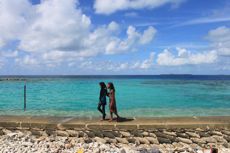
The southern beach of Fuvamulah was the last stop for the spouses. The wide beach famous for its beauty is made up of small flat white pebbles in contrast to the white sandy beaches commonly found in Maldives.

The cultural village is on the high end of the beach with eight thatch roof huts that depicts Maldivian life of yesteryears.

“We did a lot of research to get the authentic look of each hut,” said Ali Amir, who did the concept and design of the village. MNDF created the village based on a detailed sketch of the village. Research consisted of reading what little written account was available and in reference to oral history.

“We talked to elderly people in this island. This required a lot of patience as some of them are very old and sick in some cases, so we had to meet them at times convenient to them” said Amir.

The antique furnishings inside the huts, like ashi (bench beds), swings and a 200-year-old farivalhu (container decorated with lacquer work used to serve food) among others, were sourced from different houses in the island.

The village consists of hut of fisherman, farmer, blacksmith, island chief, edhuruge (house of the only teacher) and places like a boat building hut, a yam storage place and hut of a Vaaruveriyaa (governor from central government). The latter vaaruveriya was the person charged with governing individual islands for a brief time in history until Maldives became a republic in 1953.

“The sultan would send an edict to a person he chooses appointing him as the Vaaruveriya of that island” said Ali Didi, the consultant for the project and Fuvamulah island’s resident history expert.

From that moment the Vaaruveriyaa would take charge of the running of the affairs of the island and trade from the comfort of his own house. All produce of the island, be it vegetables or fruits from trees in islander’s own backyard, had to be presented to him.

“He would not have a fixed income, but would get to keep 1/10 of all items he trades,” Didi explained.

“Most of us live in a concrete jungle now, it’s a respite to go back to the days of the past, and see the simple life again” said Amir.

The retreat come to an end with evening tea served Shiranthi Wikremasinghe, soaking in the simplicity of Maldivian lifestyle in a cultural village in one of the most beautiful spots in a unique island atoll.

Likes(1)Dislikes(0)

South Asia’s ability to shape its future never stronger: leaders address SAARC

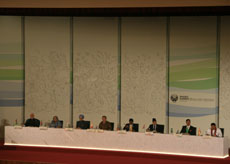
The 17th SAARC Summit was opened this afternoon in Addu City by Prime Minister of Bhutan, Lyonchhen Thinley.

The leaders of Nepal, Pakistan, Sri Lanka, Afghanistan, Bangladesh, Bhutan and India arrived at the purpose-built Equatorial Convention Centre in motorcades, escorted by police outriders in ceremonial uniform, dozens of bodyguards and an ambulance.

The Maldives National Defence Force (MNDF)’s Rehendi helicopter hovered overhead, while arriving heads of state emerged from their vehicles to be greeted by President of the Maldives Mohamed Nasheed and First Lady Laila Ali. They entered the convention hall to the sound of bodu beru drums and the sight of local girls waving paper garlands.

“South Asia is more powerful and prominent than any other time in its history. The future is ours to shape,” President Mohamed Nasheed said, in his inaugural address as the new Chairman of SAARC.

“Our economies are booming. Our political influence is growing. And our ability to shape the course of world affairs has never been stronger. Our populations are youthful and energetic. Our thinkers, researchers and scientists are globally renowned. Our culture is internationally acclaimed. Our private sector companies are some of the world’s largest and most profitable,” Nasheed said.

Citizens in SAARC countries had similar aspirations, he noted: “They want to live in societies based on the rule of law, in which basic freedoms are protected. They want the chance to succeed in our region’s economic miracle. They want what everyone wants: a decent life to live in dignity.”

Nasheed raised three key areas of focus: trade, transport and economic investment, security against piracy and climate change, and good governance.

However climate change, he said, was the greatest long-term threat affecting the region, “causing havoc, threatening our development and prosperity. But the solution to climate change is not cutting back. Rather, it is investing in the new, clean technologies that not only reduce pollution, but also improve energy security and provide long term economic growth.”

President Nasheed also noted the potential for a human rights mechanism in SAARC, “not to point fingers, or open historic and painful wounds, but because we have a duty to improve the lives of citizens.”

Nasheed welcomed the proposal to set up a SAARC Independent Commission on Gender, commenting that South Asian women “suffer from a wide range of disadvantages and discrimination. Women in our region have some of the world’s lowest rates of property ownership and political representation.”

He finished on an optimistic note: “The fundamentals of our region are strong. We have young, energetic populations. We live in a region of vibrant democracies, with strong civil societies.”

“As our economies race ahead, our political importance increases ever more. Let us not be held back by history or convention. Let us be the leaders our people want us to be. Let us change our region for the better. Let us change the world,” Nasheed said.

Leaders address SAARC

In his address to the SAARC delegates, Prime Minister of Nepal Baburam Bhattarai observed that SAARC nations were situated “in the cradle of human civilisation, with abundant natural and human resources. But despite this, our potential is unfulfilled. We face widespread poverty, unemployment and inequality.”

The largest number of world’s poor “live in our region”, Bhattarai said, but the “flow of growth, people and ideas has been hindered and our potential remains unfulfilled.”

Pakistani Prime Minister Yousaf Raza Gilani congratulated Nasheed on hosting the first SAARC Summit in the southern hemisphere.

In bilateral talks on Thursday morning with Indian Prime Minister Manmohan Singh, the historically tense relationship between the two nuclear-armed nations lightened after the two leaders took measures to ease trade limitations. Singh even described Gilani as a “man of peace” following the meeting.

In his speech to the assembled delegates, Gilani emphasised that Economic development was linked to the availability of energy at a reasonable price, an and urged investment “in harnessing indigenous energy sources such as solar, wind, biomass and hydro power.”

President of Sri Lanka, Mahinda Rajapaksa, meanwhile prioritised education in his speech, stating that as leaders, “we have a sacred duty to develop our people.”

“In Sri Lanka we believe in social mobility. Education, communications and healthcare must be made available to all,” said Rajapaksa, adding that “ignorance, deceit, and poverty” were “common evils” facing SAARC nations.

“Social equality goes hand-in-hand with economic progress,” he stated, emphasising that this could only be achieved through peace and security.

President of Afghanistan, Hamid Karzai, also highlighted the importance of education in his address.

“Despite the progress we have made, lack of education and unemployment is a vicious cycle that is creating fertile ground for extremism,” he said.

A stable Afghanistan would enable its use as a land bridge between many countries and greatly improve trade links in the region, he said.

While terrorism was the biggest cause of suffering for the Afghan people, he said, the violence was not only limited to Afghanistan, but also affected Pakistan and India.

“We need to overcome the trust deficit that exists and learn to cooperate,” Karzai said.

He noted that Afghanistan was pursuing a strategic long term partnership with the United States, but said he wished to “reassure our neighbours that such a partnership is no threat to the region.”

The theme of education was continued slightly differently by Prime Minister of Bangladesh, Sheikh Hasina, who in her address emphasised the need for SAARC countries to promote cross-border educational cooperation by institutions such as universities. Bangladesh was interested in opening a university in the Maldives, she added.

Like the Maldives, Bangladesh was also very vulnerable to climate change, Sheikh Hasina said.

“Along with the global economic crisis, we are vulnerable to factors beyond our region,” she said. “Increases in fuel and food prices due to climate change jeopardise a sustainable way of life for our people.”

Another priority for Bangladesh was the expansion of the SAARC convention of the prevention and combat of trafficking in women and children.

“We want to ensure our migrant labour is well treated when working in other countries,” Sheikh Hasina said.

Prime Minister of Bhutan, Lyonchhen Thinley, expressed hope for “youth and dynamism” now the chairmanship of SAARC had been passed to President Mohamed Nasheed and the role of Secretary General to Fathimath Dhiyana Saeed, both the first female and youngest person to assume the role in the organisation’s history.

Despite the distance between the Maldives and Bhutan, the two countries had a surprising number of similarities, Thinley said – and not just because they were the two smallest SAARC nations.

“Rising temperature is a threat to our ecology, and while our GDP is improving, we need to diversify our economy,” he said.

As former SAARC Chairman Thinley was among the most vocal about the effectiveness of SAARC, warning against empty rhetoric and noting “that there is a feeling that cooperation should yield more concrete results.”

“There has been a failure to resolve geopolitical realities, and we have allowed ourselves to be guided by the politics of the past. Good intentions have been foiled, or remain only in documents. Progress has stalled, depriving South Asia of the opportunity to flourish as a peaceful region with people free of poverty,” he said.

Intra-region trade was not more than five percent of the total volume, and cultural interaction between countries was limited, he said.

Furthermore, antagonists such as the “mischevious media” confined goodwill to symbolic gestures.

“We have half the world’s poor. We need be bigger and bolder than those who are holding us back,” he said.

“At the same time, mankind is hurtling toward self-annihilation, and the planet’s capacity to provide for a growing population is declining day by day. We extract, sell, consume, waste and pollute, while our financial system is unravelling.

“We need to act before global order is compromised and a frightened world falls into disarray. We cannot allow natural resources to fall to a level where there is a violent struggle for control.”

GDP was adopted as an indicator of social progress 70 years ago, Thinley said, and was an ineffective measure of human happiness. Bhutan had shifted its perspective towards sustainable development and was taking a more holistic approach, he said.

Indian Prime Minister Manmohan Singh was among the most direct of the leaders, reeling off initiatives India was pursuing.

He announced India’s willingness to facilitate the development of a regional telecommunications infrastructure and promote broadcasting exchanges.

Singh offered India’s scientific and technological base to assist SAARC countries in their development, “and above all our young population who will drive consumption and investment in the years ahead.”

India also proposed establishing a travelling exhibition on the ancient history of South Asia, with pieces drawn from each SAARC member country, hosted in each country’s national museum for three months.

Singh announced the doubling of scholarships offered to post-graduate courses in South Asian University, from 50 to 100, and a further 10 scholarships for doctoral studies in forestry.

“We have to learn to trust each other and to learn from each other. The security of our countries are closely interlinked,” Singh said. “None of us can prosper in isolation. We cannot afford to allow the many problems we face to stand in the way of our ambitions and dreams.”

The Summit is being observed by Australia, China, the European Union, Iran, Japan, South Korea, Mauritus, Myanmar and the United States, as well as many international institutions.

Eighty percent of Commonwealth in SAARC

Outside the convention centre following the meeting, Commonwealth Secretary General Kamalesh Sharma observed to Minivan News that 80 percent of the population of the Commonwealth live in SAARC countries.

“Five of the eight SAARC countries are in the Commonwealth,” he noted.

While acknowledging that this meant there was “a lot of overlap” between the two organisations, the Commonwealth could offer its experience in developing areas such as the rule of law.

“For me it has been very useful to meet the leaders in person. This year is pioneering – this is the first time the head of the Commonwealth has been invited to SAARC,” Sharma said.

Many of the goals of SAARC countries, expressed by their leaders during their respective addresses, boiled down to “a better deal for their people”.

“One remark that particularly stuck me was that ‘no country is working in isolation’,” Sharma said, adding that in developing as a regional body SAARC could learn from the “bitter lessons learned in Europe.”

“As for speed, you can’t change the facts on the ground. There are competing ideologies, and pace is determined by politics,” he acknowledged.

There was space within SAARC for a human rights mechanism, he said, and while many of its concerns related to trade, once the vehicle existed it could be used to talk about human rights as well.

“If SAARC wanted help with this, we would provide it,” he said.

On Friday the Heads of State will attend a Summit Retreat at the Shangri La resort, while their spouses are entertained in Fuvahmulah, before the Summit resumes in the afternoon.

Statements will be made by SAARC observer nations, and agreements will be signed. President Nasheed will present his concluding address, and the delegates will depart in the evening.

Likes(0)Dislikes(0)

Protesters knock over “idolatrous” Pakistani SAARC monument

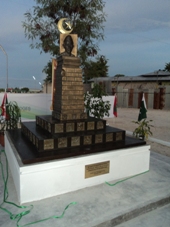
A group of protesters on Wednesday night knocked over the SAARC monument designed by Pakistan, during a demonstration over that “idolatrous” carvings engraved on the monument.

The monument, which was erected at Hithadhoo in Addu City ahead of the SAARC Summit and features pagan symbols of ancient civilisation of Pakistan and a bust of the country’s founder Mohamed Ali Jinah, was removed by the Addu City Council on Tuesday night but placed back with a cover the next day ahead of today’s unveiling ceremony.

An eyewitness to Wednesday night’s incident told Minivan News that two men from the protesting group ran up to the monument near the Power Park in Hithadhoo and knocked it over.

One of the men was reportedly taken into custody. A police media official in Addu City however could not confirm the arrest but said the incident was being investigated.

The eyewitness claimed the group was led by an opposition Dhivehi Rayyithunge Party (DRP) member, who tried to restrain the protesters.

The group was protesting the engravings of pagan symbols, he explained, which they contended could be considered objects of worship and demanded its immediate removal.

He added that there were two police officers stationed at the monument when it was knocked over, who were later reinforced by riot police. The monument was placed back and covered shortly after the incident.

Opposition parties, including the religious conservative Adhaalath Party, have condemned the government for over the incident and accused the current administration of pursuing an agenda to introduce freedom of religion in the Maldives.

Meanwhile, two opposition MPs were arrested last night at Ibrahim Nasir International Airport while attempting to take down SAARC banners featuring allegedly Christian imagery.

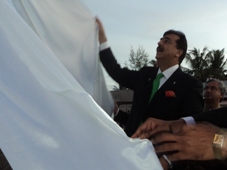
The monument, designed and approved by the Pakistani government, was officially unveiled by Prime Minister Yousuf Raza Gilani at 6pm today. A sizable crowd of Hithadhoo residents gathered at the area with Maldivians and Pakistani flags and took photographs after the event.

Monuments representing the culture and religion of the eight SAARC nations have been placed across Addu City for the summit, which were unveiled by the heads of state and government over the past two days.

Likes(0)Dislikes(0)

Council of Foreign Ministers agrees to inaugurate Indian Ocean ferry service

The Council of Foreign Ministers concluded its meeting today, with a draft of the SAARC declaration to be sent for approval by Heads of State and Government on Friday.

The Ministers “reached a consensus” on the main agenda items, Foreign Minister Ahmed Naseem said today.

Speaking to press at the Equatorial Convention Center (ECC) in Addu City, Naseem, who chaired the meeting, explained that the draft proposed by the Maldives was endorsed by the foreign ministers with some amendments while the format has been “completely changed” from previous summits.

“We have very swiftly concluded our deliberations at the foreign minister’s council,” he said. “We have reached consensus on all the main agenda items we deliberated on. There’s obviously certain issues that will be discussed by the heads of state.”

Among the decisions made today, said Naseem, the council agreed to inaugurate an ‘Indian Ocean Cargo and Passenger Ferry Service’ before the end of the year.

The council agreed to conduct feasibility studies and submit proposals in six months, he added.

On the South Asia Free Trade Agreement (SAFTA), Naseem said the foreign ministers were in agreement that cross-border free trade and connectivity were “the most important issues for SAARC today.”

“The theme for SAARC this year is building bridges,” he said. “We believe that through these bridges we can improve the lot for the people in the SAARC region.”

Naseem observed that the implementation of the regional free trade agreement had been “delayed over the years,” adding that the council decided to “re-emphasize” the importance of implementation.

“Domestic issues” were an impediment to successful implementation, he suggested, and the Maldives as chair would be seeking consensus at the next foreign minister’s meeting due to take place in six months.

The foreign ministers also decided to hold next year’s SAARC Trade and Tourism Fairs in Kulhudhufushi in Haa Dhaal Atoll, Naseem revealed, which is the largest population hub to the north of the capital Male’.

The council also deliberated “strengthening the administrative framework of SAARC” to improve its functions, he said, including granting “more powers to the SAARC secretariat.”

“As Maldives is the chair, we feel that without strengthening the secretariat, progress we make in SAARC will always be hampered by administrative difficulties,” he said, adding that studies would be undertaken to identify reforms.

Asked if China had proposed becoming a member of SAARC, Naseem said he did not “know if China has requested full membership.”

Likes(0)Dislikes(0)

Scale of the SAARC Summit

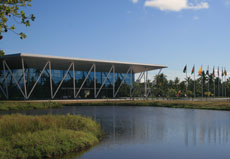
Addu’s new convention centre, purpose-built for the SAARC Summit, looms out of a deserted patch of swampy marshland in Hithadhoo like some kind of spaceship, thoroughly incongruous with the background.

When Minivan News first visited yesterday, a large crowd of local residents stood by the road leading to the giant building, staring at it dumbfounded as if waiting for extraterrestrials to emerge.

Past the polished lobby, the cavernous chamber inside is warmly lined with wood and resembles a modern concert hall. Opposition media outlets have ungenerously suggested the structure is sinking into the swamp, while assorted government officials were quick to attribute this to political jealousy.

Addu is a fiercely independent atoll, neglected by successive governments following an abortive attempt to secede from the Maldives alongside Huvadhu Atoll and Fuvahmulah as the United Suvadive Republic in 1959. This was brutally crushed in 1962 by then-President Ibrahim Nasir using a gunboat borrowed from Sri Lanka, and the entire island of Havaru Thinadhoo was depopulated and its inhabitants dispersed, killed or imprisoned.

The presence of the British airbase at Gan ensured steady employment, English proficiency and free medical treatment. Even today a disproportionate number of the country’s most successful businessmen are from Addu.

The departure of the RAF in 1976 hit the atoll’s independence hard, and the tourism boom beginning to take hold in other parts of the Maldives was slow to develop in Addu despite the presence of an airport and some of the country’s best dive spots.

President Mohamed Nasheed’s decision to declare Addu Atoll a city prior to the local council elections, the declaration that it would be hosting the SAARC Summit, and the building of the convention centre has played to the atoll’s independent sentiment and given it unprecedented political recognition.

There are 30,000 votes in that sentiment – and an additional 8000 with the opening of the new airport at Fumuvalah, a single-island atoll and the country’s most isolated, surrounded by rough and inhospitable seas.

As a domestic political strategy, SAARC appears to be working. Driving along the link road from Gan to Hithadhoo yesterday, Minivan News observed amid the country flags of SAARC nations an abundance of yellow buildings, the colour of President Nasheed’s Maldivian Democratic Party (MDP).

A local woman, sweeping up weeds with a rake under a large billboard, described her work as a “national duty”. The billboard read: “Thank you President Nasheed, you led us to believe in dreams.”

Development after SAARC

Speaking to Minivan News in between juggling mobile phones, Foreign Minister Ahmed Naseem observed that conferencing and event tourism had “huge potential” in the Maldives, given the country’s already “five star personality”. It would shift the Maldives from its reliance on beach and sun tourism, he suggested.

There were, he noted, some “tabloid” opinions about the centre, but said there was already interest in the tender for running the centre post-SAARC and the construction of a nearby hotel from hoteliers around the country and region.

“The infrastructure has been developed and people have been trained to run this kind of event,” he said.

SAARC dignitaries have been staying at the upmarket Shangri-La Villingili resort, while journalists around the world from London to Bangladesh have taken over Equator Village, the former RAF Sergeant’s mess, moaning about the sporadic shuttle bus and opportunistic US$10 taxi fares.

The locals have meanwhile launched a campaign of parades and evening entertainment, with music performances and enough fairy lighting along the link road as to give the place a festive feel. Participation was initially muted, acknowleged one official – “everyone still seems surprised. It hasn’t sunk in yet.”

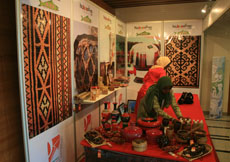
Among the most successful local operations is the Hubasaana 2011 Arts, Crafts and Food festival, which has set up stalls at major venues and been doing a brisk trade in T-shirts, local handicrafts, and peppery Adduan short-eats and banana-leaf wrapped medicines all made by local producers. Trails of foreign journalists crunching their way through packets of homemade spicy gulha are a common sight.

Stalls have been selling local foods and handicrafts to visitors

SAARC Summit

The key day of the Summit is November 10, the opening ceremony during which SAARC heads of state will give their address. During the two-day Summit all traffic in the atoll will be stalled, divers pulled out of the water, and travel on the link road restricted. Last night checkpoints backed up as police logged the registration of every passing vehicle.

During the presence of the world leaders mobile communications around the centre will be jammed; foreign journalists became flustered after being told they would be unable to take laptops or phones into the convention centre during the opening and closing ceremonies due to tight security.

Foreign Minister Ahmed Naseem told Minivan News the most important objective of the Summit was to improve and promote trade in the region, and remove existing barriers and impediments: “only three percent of trade among SAARC countries is regional.”

“We should adopt SAFTA (South Asian Free Trade Area) as soon as possible,” he said.

Economically, the Maldives is most concerned about developing ferry transport connections with countries in the region, reducing its dependence on air travel, and on the climate change front, “promoting renewable energy investment”.

Naseem also raised the prospect of introducing a human rights mechanism into SAARC, but acknowledged that it was ambitious and that SAARC had “an embedded system.”

There was, however, “a lot of good will on all sides”, he said. SAARC would be a success “even if we can agree on the issues to be solved.”

For Addu, the outcome of SAARC has already been assured.

Likes(0)Dislikes(0)

“It’s not as friendly as it used to be”: the price of politics on Maalhos

Eid brings Muslims worldwide together in a shared sense of celebration. It is also a litmus test for change.

Earlier this year councils were elected for the first time on Maldivian islands. Although they allegedly give islands a larger voice in the national dialogue, in some places the shift has rearranged community life.

“The activities are less common – women don’t play and men do less for Eid,” said Haleema Adam, a Maalhos resident.

Her daughter Nazeera attributed the shift to the advent of multi-party democracy.

“The democracy and party systems created divisions, now people don’t always agree on things,” she said. “Now, people make distinctions by party lines. They still go to the celebrations and help cook for big events, but it’s not as friendly as it used to be. If [our family] plans a party, the others won’t come,” she said.

In keeping with most reports from Maldivian islands, Maalhos residents do not find solutions in aggression. “They don’t show anger in the face,” said Nazeera. “But in the heart it’s there, so they don’t want to play at Eid.”

Eid activities are a favored pastime – ask most islanders on Maalhos about the festivities and they will smile as they recollect a favorite food, game or performance. Yet as young people move to Male’ and technology becomes more accessible, the strongest memories seem to rest with the elderly.

At Ramazan, a conche shell is traditionally blown to signal to other islands that the holiday is being observed. Lately, television and radio have eliminated the need, and therefore the tradition.

Electricity has been a useful advent, however. According to Nazeera, boys and girls no longer have to wait for a full moon to play gon kulhun, a night time game of tag and capture.

Aneesa Adam has many grandchildren, and has lived on Maalhos for most of her life. She remembers a swing that was traditionally hung from a tall palm tree before Eid prayer and used by children throughout the holiday.

“Now, the really tall palm trees have gone,” she said. “They were cut down to build the jetty. A nearby resort bought the trees and in exchange built our jetty.”

The game of fankulhun, a palm leaf version of dodge ball played by women, has fallen in the wake of uncompromising fashions. “Now, we’re too fashionable, too western to play those running games,” said Aminath Nasiha. Another girl gestured to her hijaab.

The changes in Eid traditions are most noticeable by women, who note that activities faded with the rise of Islamic fundamentalism.

“Religious people don’t like activities that gather men and women together. Those who are in charge of the activities have also become more religious, so they can decide what happens,” said Haleema. “Islanders like the activities, women especially, but most have stopped with religion. We don’t like the change.”

“We used to have Women’s day and Fisherman’s day and all those days,” said Haleema. “The women would cook and we’d bring the food in a keyn (large dish) to the school, because it was the only communal space big enough for everyone to gather.” She said the practice stopped four years ago when sheikhs disapproved.

Maalhos residents used to cook on the 40th day after a death to remember the life of the deceased. “We thought it was a Muslim tradition, but now they are saying it is a waste and not good,” said one resident.

Mosques have been gradually segregated over the years, but now women report being told to pray at home. Maalhos has four mosques, two for men and two for women.

Entertainment has been restricted as well. Haleema said local authorities oppose concerts and dance shows as well as a variety of traditional activities. On a quiet island, few options remain.

Several sports-based games featuring women are less common, or are played on a quieter level within families or household units. Women interviewed said they used to play bodu beru, a traditional drumming music still featured at most events. None could explain why they had stopped.

At a bodu beru celebration this Eid girls encouraged onlooking foreigners to dance. When asked if they would join, most girls gestured to their hijaab or burqa and shrugged. “You should have come two years ago, I was dancing then, oh!” said one girl. “But then I took up this [burqa], and that changed.”

“It’s just not very comfortable to dance with this long dress,” said another.

Likes(0)Dislikes(0)

“I wanted to get rid of Gayoom at any cost”: Abdulla Luthufee’s Sri Lankan interview

Sri Lankan newspaper The Island has published a two-part interview with Abdulla Luthufee, a Maldivian businessman once sentenced to death for his role in the 1988 coup attempt.

“I wanted to get rid of [former President Maumoon Abdul] Gayoom at any cost. As the election process in my country never gave a reasonable opportunity to the opposition, I felt an outside force should be used to oust Gayoom,” The Island reported Luthufee as saying, on the 23rd anniversary of the November 3 coup attempt.

“Due to my close association with the then PLOTE (People’s Liberation Organization of Tamil Eelam) leader Uma Maheswaran, I negotiated for the deployment of an 80-member strong PLOTE raiding party. In fact, we discussed the sea-borne raid since 1987 after the deployment of the Indian Peace Keeping Force in the Northern and Eastern Provinces of Sri Lanka in line with the July 1987 Indo-Lanka peace accord.”

Eighty Tamil mercenaries land on Male’ on November 3, 1988, and quickly took over the airport. However they were caught in a shoot out with military forces in Male’ and were forced to retreat after India deployed 1600 paratroopers to the Maldives on Gayoom’s request.

“Luthufee and another Maldivian had joined a heavily-armed PLOTE contingent on the night of October 29, 1988 on the Mollikulam beach,” writes Sri Lankan journalist Shamindra Ferdinando.

“They left the north-western shores at about 8.30am in two 40-foot long fishing trawlers. Luthufee had the support of several key persons in the Maldivian military, ex-Major Abbas Ibrahim, ex-Corporal Abdulla Shahid and Umaru Jamaal. The trawlers reached Male at 4:30am on November 3, 1988, and having secured the beach without a fight, the group divided into over half a dozen groups and moved to specific targets, including the army barracks, the President’s house and the Deputy Defence Minister’s residence,” Ferdinando writes.

Despite Luthufee’s professed confidence that the coup would be bloodless, nineteen were killed in heavy fighting after the plan fell apart when the PLOTE contingent tasked with taking over the army barracks opened fire on the base rather than entering through a lightly-guarded entry point.

“Had they entered the barracks, the majority [inside] would have thrown their weight behind us. We lost the group leader, and thereby the initiative,” Ferdinando reported Luthufee as saying.

“I didn’t want to kill anyone. I believed those loyal to Gayoom would give up quickly. They wouldn’t have been a match for the experienced PLOTE cadres. Unfortunately, due to hasty action on the part of the group tasked with seizing the army barracks, we gave the game away.”

Further support from rebels already in Male’ failed to materialise, “and the absence of their support made us vulnerable and automatically strengthened Gayoom’s position. But still we could have achieved our military objectives if those assigned to seize Gayoom had succeeded.”

Gayoom eluded the PLOTE team sent to his residence, and was able to contact the Maldivian ambassador in Colombo, Ahmad Abdulla “and Ali Manisha, his Singapore-based advisor.”

The-then Sri Lankan government offered elite troops to quell the coup attempt. Gayoom also reportedly requested assistance from both the UK and US governments.

Then US State Department spokesman Charles Redman told US media at the time that the Maldivian government had asked for assistance in putting down the coup attempt, prompting it to establish a working group to monitor the events.

“The United States and India want to protect the interests of the Maldives government because this is an elected government subject to attack and it has requested assistance,” Redman said at the time.

However eventually it was India that was able to quickly deploy paratroopers and force the rebels to flee.

“We didn’t have a way to escape as we allowed the trawlers to leave as we were confident of seizing control. There was total chaos,” Luthufee told The Island.

“During gun battles we lost two PLOTE personnel, while several received gunshot injuries. We retreated towards the Male’ harbour as Indian paratroopers landed in the capital. We didn’t have any other option other than to seize the Maldivian vessel, MV Progress Light. We got away at about 11am and left the bodies of two PLOTE cadres killed in action. Three PLOTE personnel trying to get away in a rubber dingy were captured.”

The retreating PLOTE group took a small group of hostages, including serving Transport Minister Ahmed Mujuthaba and his wife, and attempted to flee towards Java in Indonesia via waters between India and Sri Lanka.

“We believed the presence of hostages, particularly a minister and his wife, gave us an advantage over those pursuing us,” Luthufee told The Island. “An Indian military helicopter maintained constant surveillance, while we proceeded towards our target. But on the following day at about 4:30pm our radar picked up two objects, and we knew the Indian navy was on its way to intercept us. One of the vessels, subsequently identified as INS Gadavari fired at our ship, though it didn’t cause any serious damage. We kept on course. They contacted us over the ship’s radio and demanded the immediate surrender or face the consequences. A five-member Maldivian defence team, including Major Adam Saheer, was on the Indian warship.”

The pursuing vessel demanded that the fleeing rebels set course for either an Indian or Maldivian port.

“We refused to give in. We demanded mid-sea negotiations to settle the dispute. The Indians started firing at our ship at the behest of the Maldivians onboard their vessel. The PLOTE commander got in touch with their headquarters in Sri Lanka and sought instructions. They received instructions to execute one hostage and throw his body to the sea. In spite of the Maldivian minister in captivity making a desperate bid to avoid the execution of one of the hostages, the PLOTE took one person to the deck and shot him. They threw the body [overboard] and the Indians recovered it. The remaining hostages volunteered to come on the main deck in a bid to discourage the Indians from firing at us. But the Maldivians onboard the Indian warship wanted all of us killed,” Luthufee claimed.

INS Gadavari gave the rebels three hours to surrender unconditionally “or face the consequences.”

“We didn’t stop but proceeded towards Sri Lankan waters. We were about 30 nautical miles away from our position when the Indians opened up with big guns. The minister was among the persons hit during the initial fire. We didn’t fire back as Indian ships were out of the range of our guns. I directed the Filipino engineer to stop the engine. As I was watching him killing the engine, he was hit. We were ordered to jump into the sea and were rescued by the Indians immediately after we raised a white flag.”

Luthufee told The Island he was blindfolded and locked in a toilet on board the Indian vessel as the warships turned back towards Male’, leaving the MV Progress Light to sink behind them.

Speaking to Minivan News in November 2010, South Asian security expert Professor Stephen Cohen recalled his time at the US State Department and noted US involvement in tracking suspected players in the failed 1988 coup.

“It’s a little known fact,” he said. “A passing American vessel transiting in the area picked up the escaping ship and pointed [the pursuers] towards it. I had only just left the State Department but I heard about it. It was a pivotal moment in the country’s history, and its purpose was never quite clear.”
The INS Gadavari reached Male’ to a waiting crowd of Indian journalists a senior military officials, Luthufee recalls, and their presence “prevented Gayoom loyalists from harming us.”

According to The Island’s story, Luthufee was first taken before Gayoom and then to another island, where he was interrogated by Indian intelligence.

“I had an opportunity to tell Indian intelligence what was going on in my country. I have no doubt the Indians realized that the vast majority of people hated Gayoom and his cronies. I won the confidence of the Indians and I have no doubt those in charge of handling the Maldivian issue quickly recognized the need for reforms. Gayoom resented the Indian attitude and moved me to another prison on a different island, where I was held for 11 months,” Luthufee was reported as saying.

Once the Indian witnesses had departed he alleged he was tortured and humiliated in custody. He along with Ex-Major Abbas Ibrahim, ex-Corporal Abdulla Shahid, Ahmed Nasir and 12 captured Tamils received the death penalty, while three others received prison terms: Umaru Jamaal Sikka, Ahmed Ismail Maniku, and Mohamed Naeem.

“Under Gayoom the Maldivian judiciary was nothing but a farce. It was a tool in the hands of Gayoom and his cronies, who used and abused Maldivian law to pursue their agenda. They sought to consolidate their power at the expense of the freedom of the ordinary Maldivians, the vast majority of whom lived a simple life,” Luthufee was reported as saying.

Luthufee credited his survival to the intervention of Indian head of state Rajiv Gandhi, who reportedly summoned Gayoom to New Delhi on September 16, 1989, less than a month after the death sentences were passed, and demanded that they be repealed .

“All of us are grateful to those Indian intelligence officers for briefing the Indian political leadership regarding the Maldivian political crisis. Thanks to them, Gayoom couldn’t deceive the Indian leader,” Luthufee told The Island.

“Gayoom flew back to Male on September 17, 1989. Obviously, he was a dejected man. He declared that he didn’t want to shed anymore blood in Male and commuted capital punishment imposed on us to life imprisonment. We were moved to special cells, which were surrounded by a steel fence at the same facility where we were held. Gayoom’s men enjoyed torturing prisoners. They were rewarded by their masters for being beastly to their fellow countrymen.

Luthufee was reported in The Island as expressing no regret for his role in the failed coup.

“Even now, Gayoom is not happy being an ordinary Maldivian. The ousted leader wanted power at any cost and was trying to undermine the present leader. Maldivians should be cautious of those seeking to play politics at their expense.”

Read the article as it originally appeared in The Island:

Part one (English)
Part two (English)

Likes(0)Dislikes(0)

Comment: Relevance of SAARC in a multi-polar world

As the geo-politics at the international stage is moving towards from a uni-polar to a multi-polar world with the rise of countries such as Brazil, India and China, it is worth studying the relevance of regional multi-lateral organisations such as the South Asian Association of the Regional Co-operation (SAARC) and how they supplant United Nations objectives such as eradication of poverty, counter-terrorism measures and the establishment of international peace and security.

It’s especially important in the Republic of Maldives as it hosts the 17th SAARC Summit in Male from 10th to 11th of this month.

Regional organisations within the scope of the UN

When the victorious world allied leaders were discussing the scope of new world order after the World War II, the newly would-be independent nations in Asia and Africa wanted to have regional scope for solving their disputes. It’s said that apart from the issue of veto among the permanent members, the issue that member-nations had when joining the United Nations was whether their sovereignty would be compromised by joining an international mutli–lateral organisation.

In that context, many regional organisations were formed after 1945. Some of the organisations such as African Union, North Atlantic Treaty Organizations, Australia New Zealand United States Treaty and Arab Union were formed for regional understanding of the political issues. Some of the regional organisations such as NATO were military and some like the African Union or the South Asian Association of the Regional Co-operation are meant to address regional issues amicably.

However, all the regional organisations per se needed to be within the scope of the UN and should comply with the UN mandate of establishing international peace and security.

History of the SAARC

The South Asian Association for Regional Cooperation (SAARC) is an organisation of South Asian nations, founded in December 1985 and dedicated to economic, technological, social, and cultural development emphasising collective self-reliance. Its seven founding members are Bangladesh, Bhutan, India, the Maldives, Nepal, Pakistan, and Sri Lanka. Afghanistan joined the organization in 2005.

Meetings of heads of state are usually scheduled annually; meetings of foreign secretaries, twice annually. It is headquartered in Kathmandu, Nepal. The 11 stated areas of cooperation are agriculture; education, culture, and sports; health, population, and child welfare; the environment and meteorology;rural development (including the SAARC Youth Volunteers Program); tourism;transport; science and technology; communications.

The SAARC Secretariat was established in Kathmandu on 16 January 1987 and was inaugurated by late King Birendra Bir Bikram Shah of Nepal. It is headed by a Secretary General appointed by the Council of Ministers from Member Countries in alphabetical order for a three-year term. He is assisted by the Professional and the General Services Staff, and also an appropriate number of functional units called Divisions assigned to Directors on deputation from Member States. The Secretariat coordinates and monitors implementation of activities, prepares for and services meetings, and serves as a channel of communication between the Association and its Member States as well as other regional organizations. Iran is an observer nation in SAARC. Afghanistan became a SAARC member in 2007.

The representation of SAARC as major regional block is increasing and is rivaling the Association of Southeast Asian Nations (ASEAN), African Union and European Union. China has sought to become a member of SAARC, besides four other countries – Mauritius, Iran, Australia and Myanmar want to graduate from observer nations to permanent ones.

Second, SAFTA was set up in 2004 to ensure a gradual reduction of trade tariffs between South Asian countries, and came into force in 2006. India, the biggest nation in the region, would make attempts to phase out non-tariff barriers with SAARC countries. India believes that non-tariff barriers are “irritant force in trade relations with member nations. Afghanistan joined SAFTA in February 2008.

With the dawn of the twenty-first century, the South Asian region has undergone radical transformation. Many countries have expressed their willingness to join SAARC. Australia is an observer nation, New Zealand wishes to become one and Vietnam and Malaysia have expressed their willingness to be observer nations
.
Over the years, the SAARC members have expressed their unwillingness to sign a free trade agreement. Though India has several trade pacts with the Maldives, Nepal, Bhutan and Sri Lanka, similar trade agreements with Pakistan and Bangladesh have been stalled due to political and economic concerns on both sides. India has been constructing a barrier across its borders with Bangladesh and Pakistan.

In 1993, SAARC countries signed an agreement to gradually lower tariffs within the region, in Dhaka. Eleven years later, at the 12th SAARC Summit at Islamabad, SAARC countries devised the South Asia Free Trade Agreement which created a framework for the establishment of a free trade area covering 1.6 billion people. This agreement went into force on January 1, 2008. Under this agreement, SAARC members will bring their duties down to 20 per cent by 2009.

Relevance of SAARC

With the rise of China and other Middle Powers such as Brazil, Australia, India, Turkey and Indonesia, the world of politics is slowly moving from the uni-polar hegemonic United States world to a multi-polar world. In that context, the regional organisations able to understand the sensitivity of their member countries assume political significance.

Take for example the Bhutan’s SAARC summit held last year, the first South Asian multi-lateral forum meeting after the Mumbai 26/11 attacks on India.

In 2011, India will use the summit as leverage to put pressures on its neighbours, such as Pakistan and Bangladesh, to dismantle the infrastructure for terrorism, including actions to be taken against non-state actors harbouring extremist sentiments. According to a Ministry of Foreign Affairs official, Nepal will push for an effective regional mechanism to cope with climate change. Bangladesh and Maldives are likely to support Nepal’s effort to set up a regional body, as both the countries will face the most drastic effects of climate change.

SAFTA

The representation of SAARC as major regional block is increasing. Including India, other countries in SAARC are wooed to trade with China which is geographically more proximate. China has sought to become a member of SAARC, besides four other countries – Mauritius, Iran, Australia and Myanmar wants to become from a observer nation to a permanent one.

Second, SAFTA was set up in 2004 to ensure a gradual reduction of trade tariffs between South Asian countries, and came into force in 2006. India the biggest nation in the region would make attempts to phase out non-tariff barriers with SAARC country India believes that non-tariff barriers are “irritant force in trade relations with member nations. Afghanistan joined SAFTA in February 2008.

With the dawn of the twenty-first century, South Asian region has undergone a radical transformation. It has witnessed a strong democratic sweep. Most of the South Asian economies have registered impressive growth trajectories. Some of its countries have also emerged as hubs for global terrorism. The international community has become far more involved in South Asian affairs due to the nuclearisation of the region.

SAARC cannot but keep pace with the changing regional dynamics. It has moved ahead on its economic agenda and expanded its reach not only by adding new members (Afghanistan ) but also by opening itself to the participation of many other countries, including China , Iran and the US, as observers.

In conclusion

With the emergence of a multi-polar world in which India is poised to play a major role in international institutions such as the United Nations, it will be interesting to see how India strengthens regional institutions such as the SAARC. On the other hand, SAARC will also test itself against other regional institutions such as the BIMSTEC, ASEAN, APEC and the SCO and the 17th SAARC summit in Addu Atoll will be the high point of it.

All comment pieces are the sole view of the author and do not reflect the editorial policy of Minivan News. If you would like to write an opinion piece, please send proposals to [email protected]

Likes(0)Dislikes(0)