US encourages all parties to accept first round results

The US has hailed the results of the first round of the presidential election in the Maldives as a “victory for the democratic process”.

In a statement, Deputy Spokesperson for the US State Department Marie Harf noted that the results had been “widely hailed as a success” by the Commonwealth, United Nations, and local Maldivian observers.

The comment comes as Jumhooree Party candidate Gasim Ibrahim, who placed third with 24.07 percent and narrowly missed a place in the run-off, contests a case in the Supreme Court seeking annulment of the results, alleging electoral irregularities.

The JP was supported in the ongoing court case by the Progressive Party of the Maldives (PPM), while Attorney General Azima Shukoor also intervened and criticised the conduct of the Elections Commission.

“As the country prepares for the second round on September 28, the United States and the international community again stand ready to assist Maldivians as they exercise their fundamental right to choose their own government,” declared the US State Department.

“For this final round to be as successful as the previous round, all political parties must respect the democratic process and continue to allow for a free, fair and peaceful vote to take place. We encourage all parties and all presidential candidates to respect the results and work together for a peaceful transition for the benefit of the Maldivian people,” the statement concluded.

Likes(0)Dislikes(0)

India expresses hope that second round will go ahead as planned

“India believes that it is of utmost importance that the electoral process is allowed to proceed unhindered so that the second round is conducted according to schedule and the will of the people of Maldives is fully recognised,” the Indian Ministry of External Affairs has said.

“It is important that all sides respect the verdict and aspirations of the people of Maldives. We hope that the second round of Presidential elections will be held as scheduled on September 28, 2013 in a similar transparent, organised and peaceful manner.”

The statement, released in response to media enquiries, again praised the conduct of a first round it describes as “unblemished by any notable incident”.

The statement also reiterated the observations of Indian election observers, who had praised the Maldives Elections Commission as being “logistically well-prepared for this election”, as well as describing the much-criticised voter registry as “accurate and robust”.

Likes(0)Dislikes(0)

Statements by election observers “have not much weight”, JP running mate Hassan Saeed tells Supreme Court

Former Attorney General Dr Hassan Saeed, running mate of resort tycoon and presidential candidate Gasim Ibrahim, has told the Supreme Court that positive assessments of the September 7 presidential poll by local and international election observers “do not carry much weight”.

Dr Saeed – who is now leading the Jumhooree Party (JP)’s legal bid to annul the election results in the Supreme Court – made the remarks during the second hearing of the party’s case against the Election Commission (EC) held on Wednesday.

Dr Saeed told the Supreme Court that statements made by both local and international observers that the election had proceeded smoothly and freely did not reflect the reality of the situation.

“Yes, I even agree that the voting process went very smoothly. But those foreign observers don’t know the depth of the issues. Their words do not carry much weight. Some of the elections which have been observed by the international observers, some people have died, but yet they have reported the election went smoothly,” Saeed told the court.

He also claimed the JP – which narrowly missed a place in the run-off with 24.07 percent of the vote – had sufficient evidence and witnesses who would testify in court that electoral discrepancies and irregularities had taken place.

Dr Saeed also declared that Attorney General (AG) Azima Shukoor’s acknowledgement of electoral discrepancies during the first round of presidential elections gives weight to the party’s allegations  of electoral fraud.

During the first hearing of the case, Attorney General Shukoor told the court the AG’s Office had also found discrepancies in the voter list, including underage people listed as eligible for voting, and the mixing up of voter information – including gender, address, and date of birth.

Addressing the seven-member Supreme Court bench, Saeed also alleged the EC was not following a High Court order issued Tuesday (September 17) to allow viewing of the original voter list at the commission. Saeed claimed that despite repeated requests – both verbal and written – the commission was yet to give any response.

The High Court ruled that it was a right of all presidential candidates and their affiliated political parties to view the original voter list and ordered the EC to allow this to take place at the commission in presence of its officials.

Instead, Saeed claimed, the EC lawyers had dismissed as baseless and unfounded JP’s evidence suggesting electoral fraud, without giving the party the chance to verify it evidences against the commission’s data. This action by the EC, the former Attorney General contested, disregarded the doctrine of ‘Clean Hand’.

The ‘Clean Hand’ doctrine is a rule of law that a person coming to court with a lawsuit or petition for a court order must be free from unfair conduct (have “clean hands” or not have done anything wrong) in regard to the subject matter of his/her claim.

During the hearing, Saeed also criticised the EC’s Ballot Progress Reporting System (BPRS) – a web based application that tallied the number of voters who had cast their vote or are in the queue to vote – contesting that it had several weaknesses and loopholes.

He claimed that the entire application was built without due consultation with the National Center for Information Technology (NCIT) – a government agency responsible for management of IT systems within government institutions. Instead, Saeed claimed the system had been built and designed by Indian IT specialists.

Saeed also noted that the EC members had previously acknowledged that the BPRS were having problems and yet, at the same time the EC had claimed that there was no possibility of double voting. This, Saeed contested, did not make any sense, and he alleged there was a difference between the number shown by the BPRS that had voted and the EC’s figures obtained through manual counting. He challenged why the commission had not shifted to the manual system when the electronic mechanism collapsed.

In response to the arguments raised by the EC lawyers during Tuesday’s hearing, Saeed said the country would not go into a constitutional void even if a new president failed to take the oath of the office on November 11 – the date on which the term of incumbent President Mohamed Waheed Hassan expires.

Reflecting on the delay in electing the new parliament in 2009, Saeed claimed that no one had challenged the legitimacy of the parliament even when it had been elected months after the date mentioned in the constitution.

“We need to ensure that the person who is elected by the popular vote of the people takes the oath as the president. Not someone who has found their way to it by deception and cheating. Right now, we are no longer sure whether it is the person who the people voted is taking the office,” Saeed told the court.

Saeed also requested the court issue an order to the police to investigate the party’s allegations of electoral fraud.

EC’s counter argument

EC Lawyer and former Attorney General Husnu Al Suood responded to Saeed’s arguments claiming the Attorney General’s acknowledgment of issues during the voting process did not substantiate the JP’s baseless allegations.

He repeated his arguments claiming that the JP has till to this day, failed to produce any substantial evidence to support their claims, let alone annul the elections.

Suood also claimed that the General Elections Act – the parent legislation on general election procedures and issues – did not envision the annulment of an entire election, but rather only allows the annulment of the results of ballot boxes in which discrepancies were proven in court.

He claimed that factors that could lead to annulment of the results of a ballot box were criminal offences such as bribery and illegal influencing of voting, and therefore any claim of electoral discrepancies must be proved by the standard of proof required for criminal offences: beyond reasonable doubt.

Suood also reiterated that the JP’s claim that its evidence was based on information obtained from the party’s own hotline and private investigations lacked any value as evidence, and that it was not sufficient to annul elections.

He also criticised the request made by the Attorney General Azima Shukoor to order the Elections Commission to suspend holding the run-off elections until the issues had been resolved, describing it as a request for an indefinite order that could put the entire state in a state of limbo.

Suood also claimed that if the Supreme Court went on to issue such an order as requested by the Attorney General, it would lead to the suspension of the entire constitution.

“We are not aligned towards the JP” – Attorney General Azima Shukoor

Speaking during the hearing, Attorney General Azima Shukoor told the court that the State was not taking sides in the legal dispute between the JP and the EC, while maintaining that it had not admitted to any claims made by the JP.

However, the Attorney General repeated her claims that the AG’s Office had come across discrepancies in the voter registry published by the EC prior to the election.

“There were names of underage people in the list. There were names repeated in the list. Unless these issues are not resolved before holding the second round of the elections, rights of many voters will be undermined,” Shukoor told the court.

She also claimed that the State should and would be concerned when a group of 50,000 people came up to it seeking justice.

“What is happening here is that one party is claiming that there were discrepancies in the voting process while the other party is simply questioning the authenticity of the claim,” Shukoor said.

“How can those allegations be verified unless the Elections Commission allows access to the information of the voting? Here, we are speaking about one party who has the information but is refusing to share it in order to verify the claims,” Shukoor claimed.

She also questioned the panel of judges as to whether the EC should go on to hold the second round of elections with the allegations and claims unanswered.

However, the Attorney General claimed that she still had faith in the Elections Commission’s ability to resolve the issues, but said this could only be done if the commission gave up its “defensive approach” and showed openness to look into the claims.

Shukoor also said the Attorney General’s decision to intervene in the case was only to bring the issues it had found to the notice of the judges and to seek a remedy to them, and that the government did not wish to take a stand on whether the election should be annulled or not.

Meanwhile, the opposition Maldivian Democratic Party (MDP)’s lawyers told the court that the party had accepted the outcome of the results and had not come up with any discrepancies during the elections that would affect the outcome.

The party also echoed similar sentiments as that of the EC’s lawyer Suood, claiming that the JP’s evidence could not be considered as admissible evidence by the courts.

The next hearing will be held on Thursday morning (September 19) at 11:00am.

Likes(1)Dislikes(0)

MBC, broadcasting commission summoned to parliamentary committee over televising “politicised” religious sermon

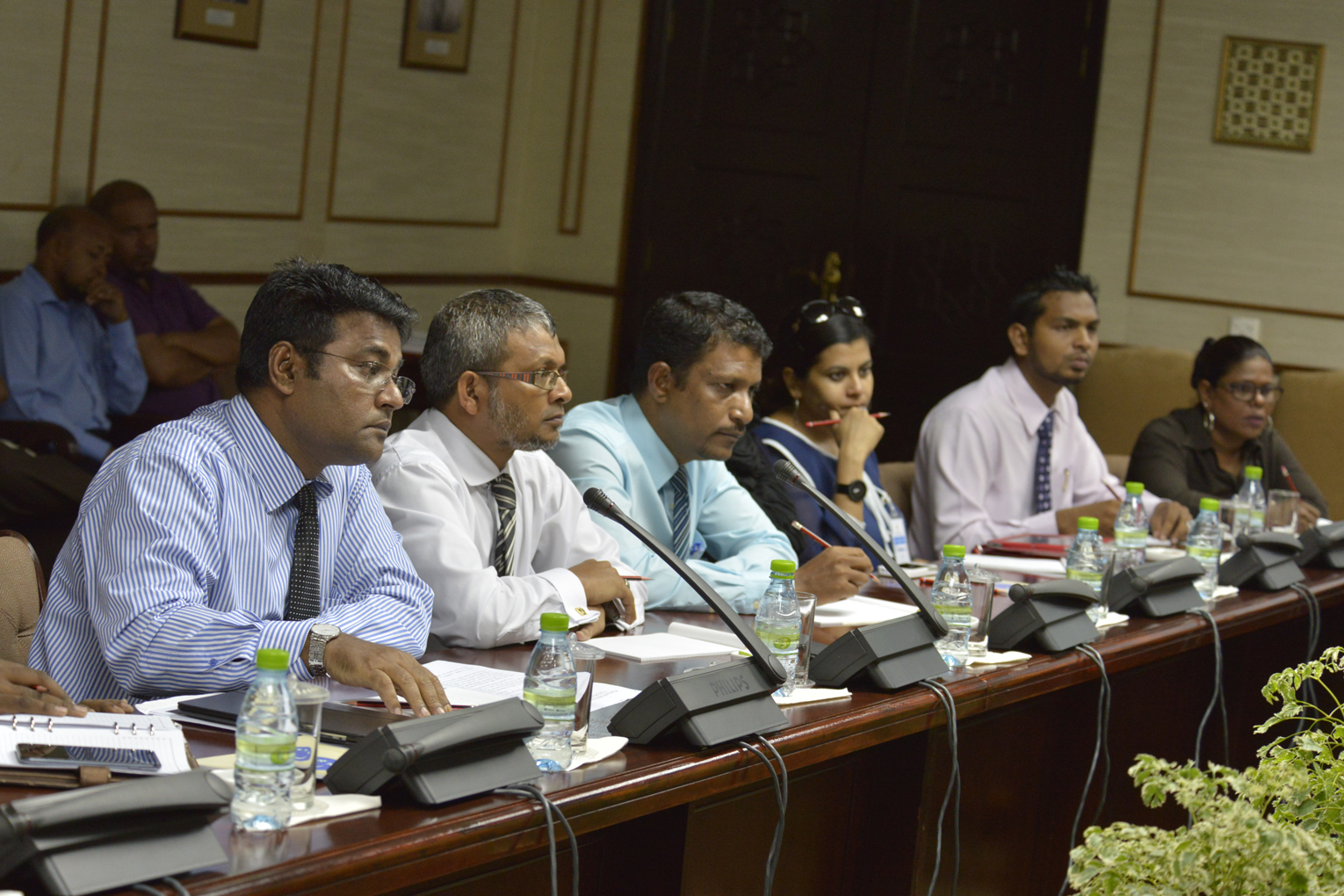
A religious sermon televised live on Television Maldives (TVM) was interrupted for violating the state broadcaster’s guidelines, Maldives Broadcasting Corporation (MBC) Chairman Ibrahim Umar Manik told a parliamentary sub-committee today.

The MBC chairman along with members of the Maldives Broadcasting Commission were summoned before the Independent Institutions Committee following complaints by MPs of the Maldivian Democratic Party (MDP) that the sermon by religious NGO Jamiyyathul Salaf preacher Sheikh Adam Shameem Ibrahim infringed the rights of the party’s presidential candidate.

“We definitely do not consider [televising the sermon] as anti-campaigning against a particular candidate using religion. [But] around 11:35pm, because his talk was changing a little, we stopped the live [broadcasting],” Manik was quoted as saying by local media.

The state television decided to approve the live broadcast after considering whether it involved either a politician or political party and after determining if the Islamic Ministry had authorised the sermon, Manik explained.

Asked by MPs whether he had heard the Sheikh’s criticism of the MDP’s guest house policy, Manik said MBC will evaluate the content of the sermon and take measures.

Speaking to Minivan News today, Dhivehi Rayyithunge Party (DRP) MP Rozaina Adam, a member of the sub-committee, explained that the complaints alleged that the religious scholars politicised the sermon titled ‘Andhalus,’ which MDP MPs contended resembled negative campaigning more than a religious sermon.

Rozaina said that MBC Chairman Manik told the committee that the MBC did a background check on the two sheikhs that delivered the sermon to determine if they had previously been in any political parties or if they were affiliated with any political party. Manik claimed that the background check showed that the sheikhs were not involved in political activities.

According to Rozaina, MDP MP Ali Waheed in the meeting noted that Sheikh Shameem had recently visited his constituency and told the people of the area that MDP would kill him if former President Mohamed Nasheed was re-elected and openly campaigned against the party’s candidate.

Rozaina observed that Sheikh Shameem last night talked against MDP policies such as introducing mid-market tourism but did not reflect on more important issues in terms of religion such as murder, gang violence and drugs.

“The MBC Chairman told the MPs that they cut the live feed when the Sheikhs speech was getting politicised,” Rozaina said. “But I don’t know if they actually cut the live feed.”

The sermon last night was organised by NGO Salaf, attended by senior Adhaalath Party members and broadcast live on all local television channels with the exception of MDP-aligned Raajje TV.

The sermons were delivered by Salaf preachers Sheikh Adam Shameem and Sheikh Ahmed Sameer under the title “The Fall of Andalus (Spain).”

Advertisements on social media stated that “the fall of Andalus (Spain) is an event Muslims will never forget. Why did it happen? What lead to the fall of this great Muslim state and what lessons can we draw from this. We present to you ‘Andalus’ by Sheikh Adam Shameem and Sheikh Ahmed Sameer.”

Likes(0)Dislikes(0)

MDP condemns Attorney General’s intervention in JP’s Supreme Court effort to annul election results

The Maldivian Democratic Party (MDP) has condemned the intervention of Attorney General (AG) Azima Shukoor in the Jumhooree Party’s (JP’s) case at the Supreme Court seeking annulment of the September 7 presidential election, expressing concern over the AG’s support of the JP’s stance at Tuesday’s hearing.

In a press release on Tuesday night (September 17), the MDP accused Azima Shukoor of advocating against “the interests of a state institution or the state and in favour of the Jumhooree Party’s self-interest.”

As the Attorney General represents the state, the MDP contended, Azima Shukoor should advocate on behalf of the state and protection of the public interest.

“Therefore the party calls upon the Attorney General – appointed by Dr Mohamed Waheed Hassan Manik, who got only five percent of the vote – to cease advocating on behalf of the state to nullify the votes cast by the people in the first round of the presidential election, and annul the election to dis-empower the people and the constitution,” the statement concluded.

Azima meanwhile told newspaper Haveeru today that article 133(d) of the constitution allows the Attorney General to intervene in such cases. The article states, “The Attorney General shall have authority, with the leave of the court, to appear as a friend of the court in any civil proceedings to which the Government is not a party, where in the opinion of the Attorney General the interests of the State or the public interest dictate.”

“The government decided that we have to say something for the sake of public interest since we can see all this information,” Azima was quoted as saying.

Azima also denied seeking annulment of the election at yesterday’s Supreme Court hearing. She had however asked the apex court to order the Prosecutor General and the police to investigate alleged electoral fraud as “serious issues” had been noted.

The AG told the court that her office had uncovered discrepancies in the voter registry, including underage people listed as eligible for voting, and the mixing up of voter information – including gender, address, and date of birth.

High Court ruling

Meanwhile, in its judgment (Dhivehi) yesterday in the JP’s case against the Elections Commission (EC), the High Court ordered the commission to allow the JP supervised access to the voter lists in lieu of ordering the EC to release hard copies of the list to the party.

The JP had claimed that the registry included hundreds of ineligible voters (underage citizens), names of voters doubled or repeated, and thousands of people registered to houses without the home owner’s knowledge.

The High Court ruling however stated that the JP was unable to offer any evidence to substantiate the claims of electoral fraud.

The ruling stated that election complaints “should not be submitted based on suspicion,” noting that the EC’s lawyer, former Attorney General Husnu Suood, had addressed each of the JP’s arguments.

Of the seven people the JP claimed were deceased but had voted, the EC proved to the court that four were alive.

On the JP’s complaint regarding people registered to houses in Male’ allegedly without the home owner’s knowledge, the EC explained that people who were originally on the Male’ Municipality’s Special Register – a special registry of people residing in the capital without owning homes – were registered to vote in ballot boxes closest to their current residence. They were registered upon written request, the EC lawyer noted.

Moreover, Suood said that the EC depended heavily on data provided by the Department of National Registration (DNR) in compiling the voters registry. The 170 names that the JP claimed were doubled on the list would have different identity card (ID) numbers and dates of birth, he noted.

DNR Director General Fareeda Yoosuf insisted yesterday that there was no chance forged IDs could be used to vote.

Each individual identity card is unique and does not change even when renewed and, even in cases where lost IDs are replaced, the same identity number is used, Yoosuf noted.

“The card number will remain the same for each individual no matter how many times the card is renewed,” she explained. “We haven’t issued identity cards with two different numbers to the same person, so I’m certain that can’t be done.”

“When each person has a unique number and is allowed to vote based on that number, there is no chance a person can vote more than once by using different ID numbers,” she continued.

No complaints of forged identity cards have been received by the DNR so far, she noted.

“Vote Rigged!”

According to the official results of the first round of voting, MDP candidate Mohamed Nasheed finished top with 45.45 percent (95,224 votes) of the vote, followed by Progressive Party of Maldives (PPM) candidate MP Abdulla Yameen in second place with 25.35 percent (53,099).

JP candidate Gasim Ibrahim narrowly missed out on a place in the second round run-off on September 28 with 24.07 percent (50,422 votes). The JP coalition however disputed the results at both the High Court and Supreme Court and launched a “Vote Rigged!” campaign of rallies – complemented by special programmes on Gasim’s Villa TV – alleging that the EC rigged the polls.

“God willing, it will be Gasim Ibrahim who will be the President of the Maldives on 11 November. Allah willing, do not doubt this. I tell you, do not doubt this,” the business tycoon declared at a recent rally.

Early on Monday morning , police acting on a tip-off from the JP, barricaded streets around the EC and took its garbage into custody. The JP accused the commission of disposing of evidence, though police later reported that the rubbish contained nothing affecting the outcome of the election.

EC Chair Fuwad Thowfeek has emphatically denied allegations of vote rigging, pointing to the commission’s transparency, ongoing complaints investigations, and praise from a broad spectrum of election observers.

The UN Resident Coordinator in the Maldives, Tony Lisle, issued a statement yesterday encouraging “all presidential candidates to respect the results” of first round of presidential elections – in line with those of all other observers on the September 7 polls including delegations from the Commonwealth, UK, India, Australia, Malaysia, US, EU, Japan and Thailand.

Likes(0)Dislikes(0)

Body of Madifushi’s former island chief discovered in island’s lagoon

Islanders on Madifushi in Thaa Atoll discovered the body of the former island chief Mohamed Rahaa in the island’s lagoon.

A member of the island council told local newspapers the body was discovered at 1:00pm this afternoon.

The council member told the paper that Rahaa was more than 65 years old, and that his body was found naked.

He said Rahaa’s family has advised the council that it was the deceased’s practice to go to the sea every afternoon to take a bath before attending prayers.

Likes(0)Dislikes(0)

CSC withholds former chair’s salary in compliance with Auditor General’s advice

The Civil Service Commission (CSC) has decided to withhold the salary of former chair, Mohamed Fahmy Hassan, who was dismissed by parliament over allegations that he sexually harassed a female staff member.

The Supreme Court reversed parliament’s decision and Fahmy continued to sign in for work every day.

CSC Media Officer Ali Nizar confirmed to Minivan News that the commission has now suspended Fahmy’s salary and allowances.

“He does not have access to the commission,” Nizar said.

He said that government authorities including President Dr Mohamed Waheed had not responded to the commission when it requested the executive resolve the issue.

According to Nizar, Dr Waheed failed to reply to a letter sent by the commission asking him to resolve Fahmy’s issue.

Auditor General Niyaz Ibrahim told local newspaper Haveeru that his office had given advice on the CSC’s request.

Niyaz told the paper he advised the commission withhold Fahmy’s salary and allowances until the matter was resolved, as it would not be easy to recover once it was paid. He said this was the normal procedure followed in the Maldives.

Minivan News contacted the newly appointed president of the CSC, Ibrahim Latheef, who referred Minivan News to the commission’s secretary general, Mohamed Faizal. Faizal was not responding at time of press.

On August 13, parliament appointed a new member to the CSC to replace Fahmy with 51 out of 54 MPs present voting in favour of appointing Fathimath Reenee Abdulsathar as Fahmy’s replacement, while the remaining three MPs abstained.

In November last year, parliament voted 38 – 32 in favour of removing Fahmy after the Independent Institutions Committee investigated a complaint of sexual harassment against the CSC chief by the employee.

However on 14 March 2013 the Supreme Court ruled that parliament’s decision to remove Fahmy from his position was not based on reasonable grounds and invalidated the decision.

On August 15, the Supreme Court issued an injunction to halt parliament’s appointment just as the President’s Office prepared to give credentials to Reenee.

However, the following day Chief Justice Ahmed Faiz Hussain accused his own court of issuing the injunction without his knowledge.

Likes(0)Dislikes(0)

French film screening in Male’ tonight

The Alliance Française (AF) de Male’ will tonight host the first of its monthly screenings of French films (subtitled in English), at the Centre for Higher Secondary Education (CHSE) by Sultan Park in Male’.

After a short introduction in English, ‘Tout ce qui brille’ (‘All that glitters’) will be shown at 8pm, and comments on the film will be welcomed afterwards.
Entry is free for AF members and MVR50 for non-members.
Likes(0)Dislikes(0)

Maldives heading towards stability, democratic governance: former President Nasheed

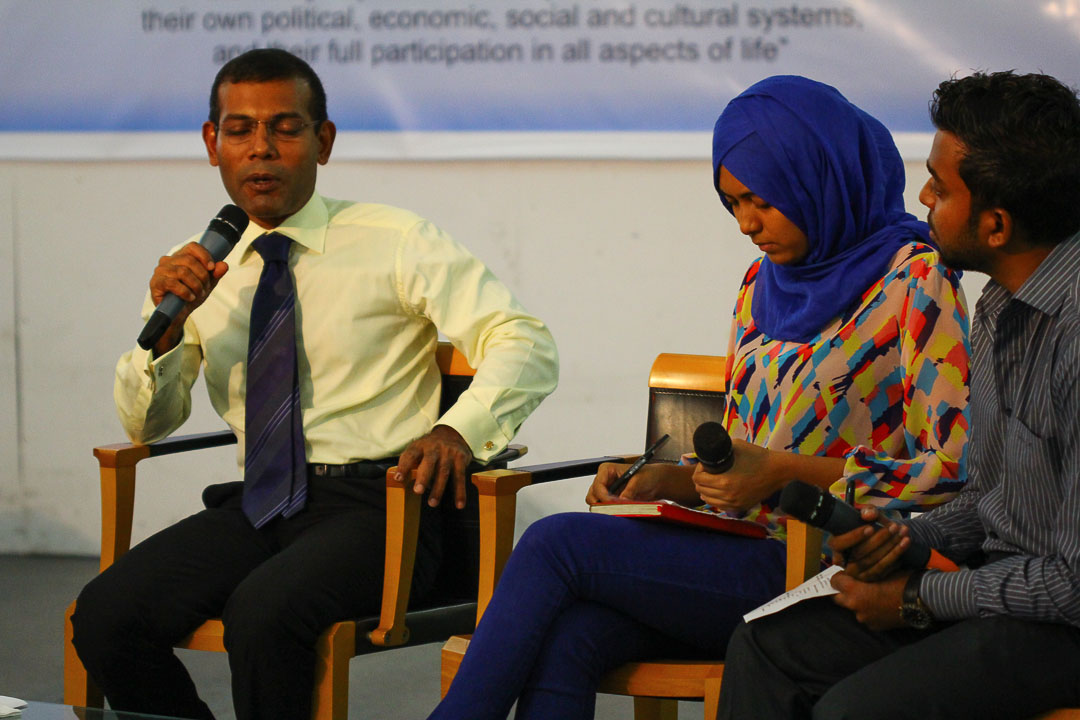
The Maldives is heading towards peace, stability and consolidation of democracy after ten tumultuous years, former President Mohamed Nasheed said at a youth forum organised by the Junior Chambers International (JSI) chapter of Maldives and Dhiyouth at City Hall on Monday night (September 16).

“I don’t really see much room for going wayward now. People might try to rig two or three elections. [They] might try to arrest some people. And there might even be three or four coup d’etats. But, overall, I don’t see this curve slumping too much,” the Maldivian Democratic Party (MDP) presidential candidate said in his keynote speech at the event, which was held to mark the International Day of Democracy.

“The Maldives will become stable and democratic principles will continue to be instilled. Neither the youth of this country nor everyone else are willing to let go of the rights we have now. In my view, tonight we are celebrating the victory of the youth. Through your efforts, the elderly have received social security, and through your efforts, a prosperous future has been secured for your children.”

The impact of the momentous events of the past ten years would be far greater and more significant than any other ten years in the history of the country, Nasheed observed, advising youth to “build a better Maldives in light of that experience.”

Nasheed was elected president in the Maldives’ first multi-party democratic election in 2008 following the adoption of a democratic constitution. The 2008 election and liberal constitution was preceded by a pro-democracy movement led by the MDP in the wake of unprecedented civil unrest in September 2003, which was precipitated by a brutal custodial death exposed to the public and subsequent fatal shootings in prison.

Free expression and dissent

In his speech, Nasheed argued that the most important prerequisite for youth development was an atmosphere conducive to exercising the rights of free expression, assembly and participation in peaceful political activities.

As 60 percent of the Maldives’ population is youth, Nasheed said political parties have to explain their policies to the youth demographic.

It is also the duty or responsibility of youth to have their say in the formation of a government that would pursue the best policies for young people, their families, and their communities, he said.

Freedom of speech and expression of dissent are “essential bases for nation-building,” he added.

Democratic practices were introduced in the Maldives between 2005 to 2008, Nasheed continued, noting the role and “sacrifices” of youth in pro-democracy activism.

“It was quite recently that people were arrested for a gesture or an expression,” he said. “Even in 2004, 2005, a lot of people were arrested and given serious punishments because of what they said. As long as that practice persisted, most Maldivian citizens were unable to participate in the affairs of the country. When that practice or principle changed, the participation of youth broadly increased.”

In formulating the MDP’s manifesto for the 2013 presidential election, Nasheed said the party believed that the bulk of the policies should target youth.

In contrast, he said, the 2008 manifesto was focused on establishing a social security system.

The 2013 manifesto reflects “the extent to which youth have raised their voices concerning their needs during the past five years,” Nasheed said.

The MDP manifesto – the “result of conducting a democratic exercise of consultation” – includes creating 51,000 job opportunities, conducting a skills training programme, setting a minimum wage, providing higher education opportunities, offering grants and scholarships, growing the entertainment sector, and establishing sports facilities, Nasheed noted.

Nasheed also stressed the importance of rehabilitating youth incarcerated for drug abuse through a “Second Chance” programme and implementing policies for reintegrating drug addicts into society as gainfully employed youth.

Q&A

Following his remarks, Nasheed participated in an hour-long question and answer session on topics ranging from civic education, family planning, minimum wage, job creation, policies for persons with special needs and feasibility of infrastructure projects.

On the issue of negative campaigning, Nasheed predicted that political parties would learn ahead of future elections that defaming rivals was ineffective and focus instead of presenting comprehensive policies.

“I predict that political parties will present policies much more in the next election rather than do what they’re doing now, which includes attempting to buy votes – people are learning each election that [vote buying] is unsuccessful,” he said.

As a “crude survey” has estimated that seven percent of the Maldivian population are persons with special needs, Nasheed said the MDP will pursue policies to amend building codes to ease access and establish at least one school in each atoll to provide specialised education for students with special needs.

A minimum wage of MVR4,500 (US$292) a month would meanwhile incentivise local businesses to hire Maldivians in lieu of foreign workers who were often paid only US$150 a month, Nasheed explained, adding that small businesses would be exempt from the legally mandated wage.

Asked by “a youth leader currently representing the Maldivian youth to the Commonwealth” whether an MDP government would consider “a democratically-elected youth council and youth parliament” as a forum for youth leaders, Nasheed invited youth interested in politics to forgo “ceremonial” and “superficial” activities in favour of direct participation.

“The real thing is better than superficial activities. Step up to a podium no matter how young you are and participate in real activities – 17, 18 or 19 years is not really that young. At the time I turned 20, I had been in the pillory for 30 days,” he said.

Likes(0)Dislikes(0)