Supreme Court issues ruling allowing reporting tools into polling stations

The Supreme Court has issued a new ruling Saturday (October 12) allowing reporters and observers to carry “necessary items to perform professional duties” into polling stations.

The ruling follows a media outcry over the apex court’s prohibition on carrying any item except a pen into polling stations, stipulated in its 16 point guidelines for the holding of new presidential elections on October 19. The Supreme Court annulled the first round of polls held on September 7, following a petition by the third-placed candidate, Gasim Ibrahim.

The latest statement, signed by Chief Justice Ahmed Faiz, read: “[The Supreme Court] orders there not be any obstruction from any party to journalists and observers from using necessary objects to carry out their professional duties.”

“The purpose of the Supreme Court guidelines was to ensure elections proceed free and fairly [without intimidation, aggression, undue influence or corruption], not to impede professional duties of journalists and observers who act within the law,” the ruling read.

The Elections Commission welcomed the Supreme Court’s ruling at a press conference on Saturday night, stating that the media will now be allowed to carry cameras and observers will be allowed to carry items necessary to monitor the election.

Elections Commissioner Fuwad Thowfeek said the commission was working around the clock to abide by the Supreme Court guidelines and ensure elections took place within the 12 day time-frame the Supreme Court had given to hold elections.

A midnight ruling from the Supreme Court on October 10 ordered the commission to disregard re-registration efforts for the annulled presidential elections, and restart the entire process with fingerprinted forms for all voters who wish to vote in a location other than their permanent address.

However, despite requiring fingerprinted forms, the Elections Commission said it did not have the capacity to verify if the forms carried the correct fingerprints.

“The Supreme Court verdict does not say we have to verify [fingerprints]. We don’t have the capacity to do that. No institution does. But if we notice a problem, we can take those particular forms to the police for investigation,” Elections Commission member Ali Mohamed Manik said.

The 24-hour period for re-registration expired at 4:30 pm today. Manik said the commission had re-registered 10,340 people by 7:30 pm, but expected to process over 60,000 forms by Sunday evening. 65,000 people re-registered to vote ahead of the annulled September 7 poll.

Manik said over 3000 re-registration tokens required processing at 7:30 pm, but said the commission would honor all tokens. Ten forms can be submitted on every token, but political parties are allowed to submit any number of forms on tokens.

“Some political parties have bundles of 10,000 to 15,000 forms,” Manik said. The Maldivian Democratic Party (MDP) said it had prepared over 33,000 forms.

Once the re-registration process is completed the voter registry will be publicised, and three representatives from each presidential candidate will be asked to approve voter lists for every single ballot box, Manik said.

The voter registry is expected to be ready by October 14, Monday, he added.

The Progressive Party of the Maldives (PPM) had criticised the EC’s 24 hour re-registration window as an act to “ridicule” the Supreme Court guidelines.

In response Thowfeek said: “We are not ridiculing anyone. We are working 24-hours to abide by the Supreme Court guidelines. No matter what time you come, whether its 12:00am, 1:00am, 2:00am, you will see everyone here is hard at work, they are staying up.”

The Elections Commission will be holding information sessions for media and observers on Sunday and Monday. The names of officials who will be acting on behalf of the elections commission on polling day will be sent ahead of the election for vetting to presidential candidates as per point eight of the Supreme Court guidelines, Thowfeek said.

Point eight states that all officials must be appointed with the knowledge of candidates or their representatives to ensure that all officials in voting districts are safe from allegations of supporting or representing a particular political ideology or candidate.

New ballot papers with improved security features are also being printed as per point 12 of the Supreme Court Guideline. The EC is printing 242,625 ballot papers, and is currently in discussion with the Maldives Police Services on transporting ballot papers to polling stations.

“We couldn’t do this by ourselves. All institutions are helping out. The police, the Department of National registration, the Civil Service Commission,” Manik said.

He also said that the commission was “positive” it would be able to ensure elections took place on October 19.

Likes(0)Dislikes(0)

UK MPs highlight “deteriorating situation” in the Maldives

An early day motion has been tabled in the UK Parliament calling upon the House of Commons to support the UN secretary general’s call for a “credible and peaceful second round of voting” in the Maldives.

The motion, sponsored by MP Grahame Morris, also called upon members of the House of Commons to declare that it “condemns those who are seeking to prevent President Mohamed Nasheed from participating in any future elections in the Maldives; further condemns the perpetrators of the arson attack that destroyed the opposition-supporting Raaje TV station in Male’; and demands that the authorities take all necessary steps to bring the perpetrators to justice.”

Attempts to disqualify Nasheed’s candidacy – reportedly now backed by the religious Adhaalath Party – have already been criticised by incumbent President Dr Mohamed Waheed.

Rarely debated on the floor of the house, early day motions are used as a way to publicise topics of interest to certain MPs, with fellow members invited to add their name to the motion.

Robert Buckland MP this week also asked the leader of the house if time could be made available in the commons’ schedule for discussion of the current political crisis in the Maldives.

“May we find time for an urgent debate on the deteriorating situation in the Maldives, where the first round of a presidential election has been annulled and it is feared the authorities are trying to obstruct the return to power of President Nasheed, who was ousted in a coup last year and who clearly won an election that was described by international observers as free and fair?”

Leader of the House Andrew Lansley assured Buckland that he would request the Foreign and Commonwealth Office (FCO) to brief the house on the current situation during the next oral question session, if not earlier – the next FCO question time is scheduled for October 29.

Following the Supreme Court’s decision to annul the first round of voting earlier this week, UK Foreign Minister William Hague called upon the government of the Maldives to respect the democratic process, and to create conditions for a free and fair poll.

“It is imperative that there are no further delays and the elections be free, fair and inclusive, and that international observers are invited,” said Hague.

The United Kingdom remains one of the Maldives tourism industry’s biggest markets, although recent arrival figures show negative growth of a fall of  -6.4%  in UK arrivals this year when compared with 2012.

The FCO updated its travel advisory for the Maldives after growing unrest following the delaying of polls.

The guidance urged visitors to keep away from demonstrations: “There is no indication at present that any political unrest will affect tourist resorts or airports, but if you have any concerns you should check with your hotel or tour operator,” the statement read.

Voting for the rescheduled first round will begin at 7:30am on Saturday, October 19 and polls will be closed at 4:00pm, the Elections Commission announced at a press conference last night.

Likes(0)Dislikes(0)

Voters, monitors, media banned from taking phones, cameras, files into polling area as per Supreme Court guidelines, advises EC

All eligible voters who wish to vote on Oct 19 somewhere other than their permanent address must re-register using the new fingerprint forms.

Voter re-registration will close at 4:30pm today. Forms are available at all island council offices, Addu City Council departments, diplomatic missions and at www.elections.gov.mv. In Malé forms will be accepted at the Elections Commission’s registration center on Handhuvaree Hingun.

Check your registration status online, or by SMSing 1414 ‘VIS ID#’, or call the hotline on the same number.

Voting will begin at 7:30am on Saturday, October 19 and polls will be closed at 4:00pm, the Elections Commission (EC) announced at a press conference last night. Those in the queue at 4:00pm will be allowed to vote, said EC Commissioner Fuwad Thowfeek.

Two ballot boxes will be placed in Sri Lanka and one each in India, Malaysia, Singapore and the United Kingdom.

The previous requirement for more than 100 voters to register for a ballot box to be kept overseas would not be enforced this time, Thowfeek said, adding that ballot boxes would be placed in resorts and industrial islands whether or not the registration exceeds 50 persons.

The re-registration deadline for persons voting outside their home islands is 4:30pm today, after the Supreme Court ordered the EC to restart the registration process in line with the court’s guidelines.

Thowfeek explained that while forms submitted on October 9-10 with fingerprints in accordance with the Supreme Court guidelines would be valid, re-registration forms processed before the annulled September 7 presidential election as well as for the postponed second round scheduled for September 28 would be invalid.

Among the 16-point guidelines imposed on the EC by the Supreme Court judgment annulling the first round of the presidential polls was a requirement to include fingerprints of persons submitting re-registration forms as well as the fingerprints of two witnesses, if the form was submitted by a third party.

“Registration by forms submitted in September have been invalidated now. So until registered, a person’s name will be under his or her permanent address [on the voter registry]. Until a person registers elsewhere they have to vote in the place of the permanent address,” Thowfeek said.

“We do accept that this is a very short period we are offering to citizens. But as you know, because of the Supreme Court verdict we cannot provide a long period for any process. The verdict states that the first round of the presidential election must be held before the 20th of this month.”

In line with the Supreme Court guidelines, Thowfeek said voters would not be allowed to take phones, handbags or any other item into the polling station, advising voters to keep phones at home.

“The Elections Commission and relevant authorities should make it illegal for any person (including officials) who enters the polling station to carry phones, handbags, files or any item (excluding pens) that could be considered to infringe upon the rights of candidates and ensure that no such action takes place,” reads point 10 of the Supreme Court guidelines.

To abide by the guideline, EC member Ali Mohamed Manik revealed that media monitors would not be allowed to bring cameras or phones into the polling station.

“We sincerely apologise to you for this because in the past monitors took cameras and phones but we have to abide by the [Supreme Court] judgment,” he said.

The EC was given legal advice recommending that “any persons” stated in the guideline included media monitors as well, Manik said.

As elections officials would not be allowed to carry phones either, Manik said a communications official would be stationed outside each polling place.

In addition to a communications official, a second official would be added to supervise the handing out of tokens.

Asked if the EC could provide assurances that the voter registry would not include underaged citizens or the deceased, Thowfeek explained that in line with the Supreme Court judgment, the main source of the registry would be the database at the Department of National Registration (DNR).

“The department is tasked with maintaining [records] of births and deaths. So if they are maintaining the list correctly, I believe it shouldn’t include the names of any deceased,” he said.

In the past, Thowfeek said, the EC sought lists from the DNR and island councils, which were cross-checked to compile the voter registry.

The DNR has provided regular access to its database as well as identity card (ID) photos for the EC, Thowfeek said, adding that the ID card photos would be used along with the voter lists at polling stations.

Regarding the recent resignation of EC member Ibrahim ‘Ogaru’ Waheed, Thowfeek said Waheed informed the commission that he was advised to resign by doctors as it was “not advisable to work in a stressful environment” due to his health.

Likes(0)Dislikes(0)

Political parties launch last minute re-registration drive, ahead of 4:30pm deadline

All eligible voters who wish to vote on Oct 19 somewhere other than their permanent address must re-register using the new fingerprint forms.

Voter re-registration will close at 4:30pm today. Forms are available at all island council offices, Addu City Council departments, diplomatic missions and at www.elections.gov.mv. In Malé forms will be accepted at the Elections Commission’s registration center on Handhuvaree Hingun.

Check your registration status online, or by SMSing 1414 ‘VIS ID#’, or call the hotline on the same number.

The Elections Commission has opened up a 24-hour re-registration window for all eligible voters, after the Supreme Court ordered the EC to disregard re-registration efforts for the annulled presidential elections, and restart the entire process with fingerprinted forms for all voters who wish to vote in a location other than their permanent address.

With the new ruling, the EC opened up a 24-hour window for fingerprinted re-registration starting at 4:30 pm on Friday, October 11 and closing at 4:30 pm on Saturday, October 12.

Political parties have started re-registration drives throughout the country with hundreds of volunteers working around the clock filling out forms, copying identification documents and submitting forms to the EC headquarters.

On October 7, the Supreme Court annulled the first round of presidential elections held on September 7 2013, citing electoral fraud, and ordered the EC to hold a revote by October 20. In its verdict, the apex court provided guidelines for the revote including fingerprinted re-registration forms.

However, with only 12 days for the new polls at the time of the verdict, and more than 65,000 registered to vote in locations different to their permanent address in the annulled first round, the EC said re-registration would only be required if a voter would be voting in a different location than that already registered for in the annulled vote.

But the Progressive Party of the Maldives (PPM) filed a complaint at the Supreme Court on Thursday claiming the EC was not following the SC guidelines.

The Supreme Court then opened at midnight on October 10 and issued a second ruling, ordering the Elections Commission to disregard previous reregistration efforts and restart the entire elections re-registration efforts.

Read the 16 point Supreme Court guideline here.

Likes(0)Dislikes(0)

President Waheed withdraws from October 19 election

President Dr Mohamed Waheed has announced his withdrawal from the rerun of the 2013 presidential election scheduled for October 19, after polling held last month was annulled by the Supreme Court.

Waheed, who came in last place during the now defunct first round of polling held on September 7 with 5.13 percent of the popular vote, said he had taken his decision in the “greater interest”of the Maldives, citing concerns about the integrity of the independent Elections Commission (EC).

“The court found serious flaws with the election register and considered other allegations of irregularities,” stated the President’s Office yesterday (October 11).

Despite both local and international observers praising the September 7 polls and the conduct of the Maldives’ EC, the Supreme Court ruled in favour of the Jumhoree Party (JP) – whose candidate MP Gasim Ibrahim finished narrowly in third place with  24.07 percent of ballots cast – by ordering a rerun of last month’s poll in its entirety.

Subsequent Supreme Court rulings have since overturned the Election Commission by ordering it to give candidates the choice whether to stay on the ballot paper or withdraw from the election, as well as demanding the entire elections re-registration process be restarted less than 10 days before polling.

While Dr Waheed has stood down from contesting the election rerun, the President’s Office said he would continue with his duties until his term expires on November 11, when the constitution requires a new head of state to be sworn in.

“Disputes arising out of the first round have caused serious disagreements among the political parties, the Elections Commission and the Supreme Court. During the remaining time, the President will do his best to maintain peace and stability, to ensure the election process continues with greater fairness, and to steer the country through these difficult times,” read the statement.

“Although President Waheed scored the least number of votes in the first round, he continues to be highly respected for the calmness with which he has managed the country, and for maintaining peace and stability in the nation.”

President’s Office Media Secretary Masood Imad was not responding to calls at time of press to clarify whether the incumbent would be lending his support to another candidate standing in the election.

President Waheed last month announced he would be backing Progressive Party of Maldives (PPM) candidate Abdulla Yameen in the second round run-off vote that was scheduled for September 28.  The run-off was delayed and later cancelled by the Supreme Court.

Yameen had finished in second place on the cancelled September 7 poll with 25.35 percent of the votes cast. He was scheduled to compete against Maldivian Democratic Party (MDP) candidate former President Mohamed Nasheed, who secured  45.45 percent of the popular vote – falling short of the 51 percent needed to secure the presidency during the first round.

Likes(3)Dislikes(0)

US “deeply concerned” about legal actions potentially delaying Maldives’ October 19 election

New voters and voters who wish to vote from a location other than their home island must submit the NEW fingerprint re-registration form by 4:30pm Saturday October 12, in line with Thursday night’s Supreme Court ruling. People who re-registered prior to the Sept 7 election will need to complete the process again, or may be unable to vote. Fingerprint forms submitted on Oct 9-10 will still be valid.

Forms are available at all island council offices, Addu City Council departments, party offices, diplomatic missions and at www.elections.gov.mv. In Malé forms will be accepted at the Elections Commission’s registration center on Handhuvaree Hingun.

Check your registration by SMSing 1414 ‘VIS ID#’, call the hotline on the same number, or visit http://elections.gov.mv/index2715.html

The US has said it is “deeply concerned” about continued legal actions “that could further delay the Maldivian presidential election”.

The Supreme Court opened at midnight on Thursday in response to a petition from the Progressive Party of the Maldives (PPM), and ordered the Elections Commission to redo the entire voter re-registration process, despite previously ordering polls to be held before October 20.

Earlier in same day the PPM had sought to file another petition to bar former President Mohamed Nasheed from the polls on the grounds of him being “irreligious” and critical of the judiciary, although this appeared to stall following dissent within the party.

“It is important that the [election] go forward unimpeded in a fair, inclusive and transparent way,” said Deputy Spokesperson for the US State Department, Marie Harf, in a statement.

“The basis of any democracy is for citizens to choose their government, for political differences to be decided at the ballot box in an environment free of violence and for election results to be respected,” the statement read.

“We continue to urge a peaceful political process that is inclusive of all candidates in order to ensure the Maldivian election that will meet international standards of an elected, legitimate democracy,” it concluded.

The statement followed UK Foreign Secretary William Hague’s urging of presidential candidates “to act in line with the interests of the people of Maldives”.

“It is imperative that there are no further delays and the elections be free, fair and inclusive, and that international observers are invited,” the Foreign Secretary said.

“Cynical attempt to delay election”: MDP

Nasheed’s Maldivian Democratic Party (MDP) has meanwhile begun the task of re-registering tens of thousands of voters, in line with the Supreme Court order. Re-registration is required for new voters or people wishing to vote at a location other than their home island, with almost 65,000 people re-registering in the annulled first round – almost 30 percent of the voter turnout.

At the same time the MDP condemned Thursday’s ruling, warning that it risked further delaying the elections.

“The MDP is extremely concerned that the Supreme Court is interfering in the electoral process for political reasons, issuing unconstitutional rulings and acting with impunity,” said the MDP in a statement.

“The MDP fears that the PPM is seeking to delay the elections and also disenfranchise overseas and resort-based voters, who will now likely have to re-register and who tend to vote overwhelmingly in favour of President Nasheed,” the party stated.

“This is a cynical attempt by the PPM and the Supreme Court to prevent elections from taking place next week,” said the party’s spokesperson, MP Hamid Abdul Ghafoor.

“The PPM is running scared of the voters because they know they will lose a free and fair election., and the Supreme Court is facilitating the subversion of the democratic process.”

The party reaffirmed its confidence in the embattled Elections Commission, and called on security forces and the international community to ensure the Commission’s protection.

PPM MP Ahmed Nihan meanwhile told Minivan News last night that he believed the Supreme Court’s latest order would mean additional delays to the voting, currently scheduled for October 19.

Likes(3)Dislikes(1)

Comment: Maldives’ judiciary an impediment to democratic consolidation

This article first appeared on Dhivehi Sitee. Republished with permission.

In September 2003, 30-year dictator Maumoon Abdul Gayoom declared a state of emergency after the dictatorships guards killed an inmate named Evan Naseem in Maafushi jail. Security services on duty resorted to the use of firearms to defuse the revolt, killing three others and injuring 17.

The riots that erupted forced Gayoom to initiate a reform agenda. The security forces and the judiciary came to the forefront of the discourse on democratic transition. The constitutional assembly, which proposed democratic restructuring of the system of governance and the report published by legal expert Professor Paul Robinson in 2004, highlighted these reforms needed for the criminal justice system. Professor Robinson concluded that “the reforms needed [for the Maldivian judiciary] are wide-ranging, and that without dramatic change the system and its public reputation are likely to deteriorate further.”

The Constitution ratified in August 2008, which paved way for the first democratic elections won by Mohamed Nasheed in October that year, consisted of a mechanism to re-appoint sitting judges during the interim period from August 2008 to 2010 and ensure judicial independence for the first time in Maldives’ history.

During the interim period, in accordance with sub-article (b) of Article 285 of the Constitution, the Judicial Service Commission (JSC) was mandated to ascertain whether all sitting judges possess mandatory characteristics and standards prescribed under Article 149. Aishath Velezinee, former JSC member appointed by Nasheed, who publicly spoke out about JSC’s failures, claims that judges appointed during Gayoom’s regime secured their positions on the bench through a “Failed Silent Coup” in 2010 which subverted the Constitutional processes to re-appoint judges. In January 2011, her criticism of the manipulation of the Constitution by judicial actors made her the victim of a knife attack.

The interim Supreme Court judges, who were also subject to Article 285, wrote to the Nasheed administration as early as June 2010, declaring that they would permanently remain on the bench. Velezinee recalled the appointments to the Supreme Court as a “grave blunder.” The JSC defied Article 285, declaring it “symbolic” and swore-in all sitting judges, securing their tenure for life. A report published by the International Commission of Jurists in February 2011, also raises concerns about “the politicisation of the judicial vetting process.”

Coup to undo democratic gains

The first democratically elected government of Nasheed was forcefully brought to an end on 7 February 2012 by a televised coup d’état, led by loyalists of dictator Gayoom’s regime, and facilitated by Nasheed’s deputy Mohamed Waheed. The international community was quick to recognise the post-coup government headed by Waheed. A Commission of National Inquiry [CoNI] backed by the Commonwealth declared the chaotic transfer of power “lawful”.

The CoNI report published at the end of August 2012 was heavily criticised by the MDP, and with good reason, claiming that the inquiry selectively ignored evidence that did not fit its contrived conclusion.

International legal experts also echoed MDP’s concerns with regard to the report. The MDP, however, accepted the report with reservations as it acknowledged police brutality on 6, 7, and 8 February 2012. To date its recommendations regarding police brutality have not been implemented, resulting in impunity for Special Operations officers who were involved in the violent crackdown in early February 2012.

During the onset of the political turmoil, MDP maintained that elections should be held that same year, without letting the post-coup regime “entrench itself.” International community supported calls for an early election in 2012, although Waheed’s administration stated that “earliest an election could be held under the Maldivian constitution was July 2013.”

In July 2012, MDP’s presidential candidate Nasheed was prosecuted for the arrest of chief judge of the Criminal Court, whom the Judicial Service Commission (JSC) failed to take any action against despite his prior criminal record and misconduct in 2011.

Nasheed also faced proceedings against him at the Civil Court over allegations of defamation made against him by dictator-loyalists Minister of Defence Mohamed Nazim and Commissioner of Police Abdulla Riyaz who led Nasheeds ouster. Over 20 MDP parliamentarians and some 800 active members and supporters were also subjected to various politically motivated criminal proceedings against them. In hindsight, the period leading up to elections was used by the post-coup regime to create shock and awe among the electorate, characterised by manufactured incidents and political persecution of MDP supporters in order to dissuade them from taking part in political activity and deflect attention away from the disputed legitimacy of the regime.

The juridical system continues to act as the means by which the regime achieves these ends under a democratic façade. Without a constitutional mandate to regulate lawyers, the Supreme Court issued a resolution for all practicing lawyers and prosecutors in April 2012. The resolution restricted lawyers’ freedom of expression, ordering that lawyers shall not discuss or criticise judicial proceedings or judges.

Lawyers were pressured to sign the resolution since the courts refused right of audience to those who didn’t. Ahmed Abdul Afeef who was part of Nasheed’s legal team was not able to represent him in court since he had protested the resolution and remained without signing it.

The muzzling of lawyers didn’t end there; Abdullah Haseen who represents a huge number of pro-democracy protestors was suspended for appearing on a TV show on Raajje TV disseminating information of the law.  Although there is no legislation that prohibits sketching inside the courthouse, a lawyer named Shafaz Wajeeh was fined by the Supreme Court for his sketch. Lawyer and MDP parliamentarian Imthiyaz Fahmy is currently being prosecuted for contempt of court due to remarks he has made against the judiciary, although his comments are in line with international bodies such as the United Nations Human Rights Committee.

Nasheeds prosecution further revealed the state of Maldives’ judiciary to the international community. Trial observer Blinne Ní Ghrálaigh from Bar Human Rights Committee of England and Wales noted in her report that the panel of judges in the Hulhumale Magistrates’ Court was “cherry-picked for their likelihood to convict by a highly politicised JSC.”

The 2012 report by United Nations Special Rapporteur on Independence of Judges and Lawyers Gabriela Knaul detailed the crisis Maldives’ criminal justice system is faced with. The report expressed concerns over the “politicised and inadequate” JSC, noting that “the concept of independence of the judiciary has been misconstrued and misinterpreted in the Maldives, including amongst judicial actors” to benefit judges, enabling a culture of unaccountability. The UN Special Rapporteur also questioned legitimacy of the Hulhumale Magistrates’ Court since it contravened the Judicature Act 2010 and was declared invalid by a parliamentary oversight committee in November 2012.

The selective manner in which the JSC has taken disciplinary measures against judges suggests that the judicial watchdog refrains from taking action where it suits its political needs to shield loyalists of the former regime. In 2009, then Chief Judge of the High Court was removed from his position, and the JSC suspended a Civil Court judge for sexual misconduct. In 2013, a Criminal Court judge was suspended for sexually harassing a public prosecutor and Chief Judge of the High Court who was hearing Nasheeds appeals was also suspended.

However, it has not occurred to the JSC to take any form of action against Justice Ali Hameed of the Supreme Court whose scandalous escapade in Colombo with three prostitutes have become public knowledge with leaked video footage of him doing the deed. The Bar Association of Maldives called for the immediate suspension of Justice Hameed back in July 2012. JSC’s inconsistency in penalizing  Justice Hameed is left unscathed so he can sit in the Supreme Court hearing the motions filed by Qasim Ibrahim who has close family ties to Gayoom’s family. It is also worth remembering the motion filed by Gayoom’s half-brother Abdulla Yameen Abdul Gayoom at the Supreme Court.

Ballots to restore democracy

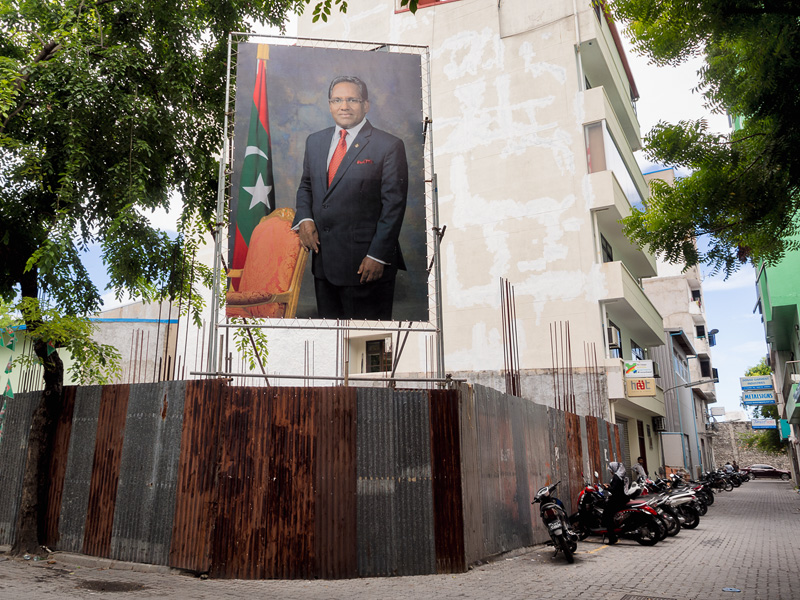
One of many gigantic posters of incumbent Mohamed Waheed put up across Male' ahead of 7 September polls. Waheed got 5%. Photo: Aznym

One of many gigantic posters of incumbent Mohamed Waheed put up across Male’ ahead of 7 September polls. Waheed got 5%. Photo: Aznym

February this year, the Elections Commission of the Maldives (EC) announced the presidential election to be held on 7 September 2013. On 28 July 2013 the EC officially announced the order of the candidates on the ballot paper, after approving the candidacy of all four candidates; Qasim Ibrahim with his Jumhooree Party (JP) and Islamist party Adhaalath (AP) coalition; Dr Waheed, independent, incumbent president, endorsed then, by Dhivehi Rayyithunge Party (DRP); Abdulla Yameen Abdul Gayoom from the Progressive Party of Maldives (PPM) in a coalition with Maldivian Development Alliance (MDA); and Nasheed from Maldivian Democratic Party (MDP).

Foreign and local observers such as the Commonwealth, the European Union, Transparency Maldives, Human Rights Commission of the Maldives declared that the first round of polls were “peaceful and inclusive” with a markedly high voter turnout of 88%. Transparency Maldives, which observed the election across the country, stated “none of the incidents reported on Election Day would have a “material impact on the outcome of the election”.

The chair of the Commonwealth observer group, former Prime Minister of Malta Dr. Lawrence Gonzi stated, “the vote count at the polling station was highly transparent with media monitors, party observers, and national and international observers able to scrutinize the process closely.”

In accordance with sub-article (a) of Article 111 of the Constitution and sub-article (a) of Article 19 of the Presidential Elections Act 2008, the EC began preparations for the presidential election’s runoff as none of the four candidates secured 50% of the votes; Nasheed had 45%, Waheed an embarrassing 5% and Qasim who had 24% came closely behind Abdul-Gayoom who secured 25%. The third place JP coalition refused to accept the first round of elections, and filed a motion at the Supreme Court requesting annulment of first round of polls. The JP also filed a motion at the High Court, requesting the Court to release the voters’ list.

JP produced three documents as evidence for their motion at the High Court, which indicated three lists of alleged discrepancies in the voters’ registry. Out of the first list that JP claimed consisted of deceased people who appeared on the registry, only seven were found on the original voters’ registry, and five were found to be alive. The other list consisted of allegedly repeated names of eligible voters. The EC’s legal counsel later proved in court that these were not repeated names but in reality different people with different national identification numbers and dates of birth. The third list consisted of people who were on Male Municipality’s Special Register who have mailing addresses registered in the capital. The High Court decided that there was no evidence of fraudulent activity with regard to the motion. However, it allowed supervised viewing of the electoral registry.

Supreme tyranny of the electoral process

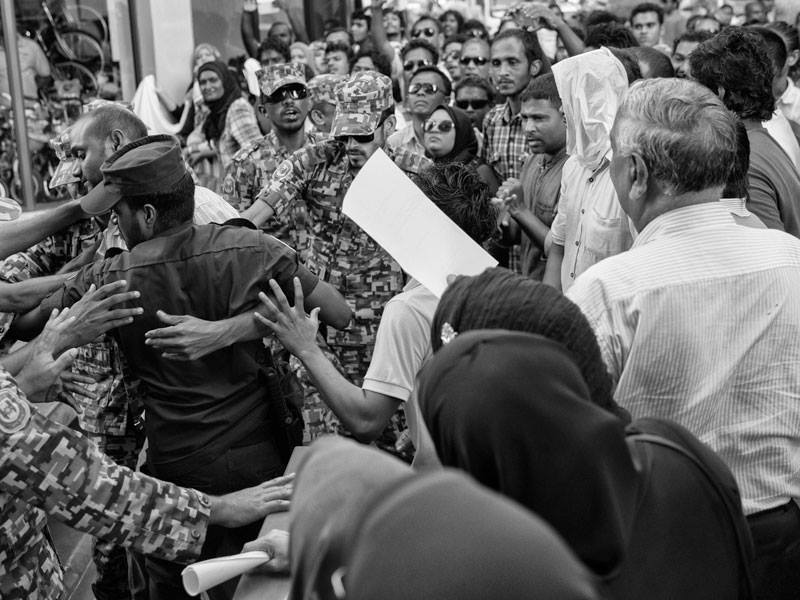
Protests near the Supreme Court in Male' as it deliberated JP's case to annul 7 September election Photo: Aznym

Protests near the Supreme Court in Male’ as it deliberated JP’s case to annul 7 September election Photo: Aznym

Article 172 of the Constitution indicates that the High Court has the appellate jurisdiction for electoral motions, while Article 113 states the Supreme Court shall have final jurisdiction over such motions. Regardless, JP filed their motion directly at the apex court. MDP, the Attorney General (AG) and PPM made inter-partes claims to the motion, with PPM supporting JP’s claim and with the AG calling for the Court to order the Prosecutor General and Maldives Police Service (MPS) to investigate the alleged “irregularities” in the electoral registry.

The request by the AG is contrary to electoral laws and the Maldives Constitution, which clearly outlines the forum and mechanism to investigate and adjudicate on disputed results of an election. Sub-article (b) of Article 64 of the Elections Act 2008 states that if electoral laws have been violated, only the EC has the legal authority to initiate criminal proceedings through the Prosecutor General. Article 62 stipulates that the electoral complaints mechanism shall be established by the EC, and if a party is not satisfied with the recourse given by the complaints bureau, he or she may file a case at the High Court in accordance with sub-article (a) of Article 64.

The EC’s lawyer, former AG Husnu Al Suood noted an astounding lack of evidence to back JP’s claims. Suood also claimed that any delay could result in a constitutional void, citing US Supreme Court case Bush v. Al Gore 2000. MDP’s lawyers Hisaan Hussein and Hassan Latheef expressed concern at the lack of substantial evidence to claim electoral fraud, and stated that JP had not submitted complaints to the EC regarding the registry when the EC had publicly requested for complaints with regard to the publicized list of eligible voters.

JP’s lawyer and its presidential candidate Qasim’s running mate Hassan Saeed stated that the JP had thirteen reasons for annulment, reiterating claims made at the High Court. At the proceedings Saeed requested that; the security services oversee a fresh round of elections after nullifying the first round and for the Court to issue an injunction halting the EC’s work to hold the runoff dated 28 September 2013. The AG Azima Shakoor echoed JP’s criticism over the EC, but refrained from vocally supporting an annulment. The international best practice where either a public prosecutor or state attorney does not support actions of a state institution would be to refrain from commenting.

It is of importance to note such procedural irregularities that took place during the proceedings for this extraordinary motion. Despite the case being deemed a constitutional matter by the Supreme Court, and anonymous witnesses whose identities are protected by courts are only very rarely admitted in serious criminal cases, the apex court acted as a court of first-instance, admitting 14 witnesses submitted by JP who gave their testimonies in secrecy. Out of the three witnesses submitted by the EC, only one was admitted.

The AG also withheld certain evidence and this was left unquestioned by the Court. The AG’s office requested to submit a police intelligence report as “confidential” evidence – solely submitted as evidence to the Court’s Bench. The Chief Justice responded on behalf of the Bench, inquiring whether the intelligence report (or at least parts relevant) should be disclosed to the EC since their lawyers requested it. In her response to the Chief Justice, the AG stated that she will not submit the police intelligence report if the contents of the report would be disclosed to the EC.

“Where is my vote?”

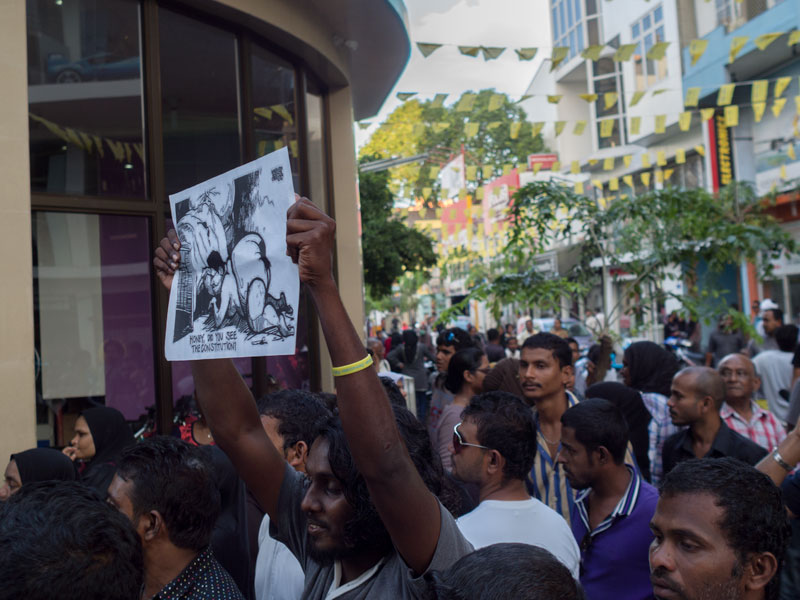
Protesters near Supreme Court hold up cartoons making fun of disgraced Justice Ali Hameed Photo: Aznym

Protesters near Supreme Court hold up cartoons making fun of disgraced Justice Ali Hameed Photo: Aznym

At approximately 8:00 pm on 23 September 2013, four justices from the apex court signed and issued a stay order indefinitely postponing the runoff election until the court reaches a verdict. After the issuance of the stay order, the Commonwealth, European Union, Transparency Maldives, Human Rights Commission of Maldives, the United Kingdom, United States of America, Canada, Russia, and India all expressed concern over the postponement of the second round, calling Maldivian authorities to hold the second round according to the timescales stipulated under the Maldivian constitution.

At the proceedings the next day, the Supreme Court ejected and suspended lawyers Suood representing the EC, Hussein and Latheef representing MDP as a third party to the case, claiming that they were in contempt of court for their comments on social media regarding the Court’s stay order. Subsequently the MDP revoked its inter-partes claim to the case, claiming that the Court cannot guarantee the rights of over 95,000 of its supporters.

MDP’s chairperson Moosa Manik sent an open letter to the Chief Justice, criticizing the apex court’s contravention of the Constitution by denying fundamental right of reply and issuing a stay order indefinitely suspending sub-article (a) of Article 111 of the Constitution. The chairperson also called on the Chief Justice to restrain the Court to the “legal ambit of the Constitution” and “uphold Article 8 of the Constitution, which states that all powers of the State shall be exercised in accordance with the Constitution.”

After weeks of countrywide protests against indefinite postponement of the runoff election, the four Justices; Abdullah Saeed, Ali Hameed, Adam Mohamed Abdullah and Ahmed Abdullah Didi who infamously legitimised the Hulhumale Magistrates’ Court earlier this year, also issued the stay order halting elections, and on 7 October 2013 decided to annul the first round of elections held on 7 September 2013. Chief Justice Ahmed Faiz and Justices Abdullah Areef and Ahmed Muthasim Adnan gave dissenting judgments, which claimed that the Court has adjudicated based on “inadmissible evidence” which the EC, the respondent in the motion, was not privy to, and questioned the Court’s jurisdiction in accepting the motion prior to the High Court.

The confrontations the judiciary continue to have with the legislature and executive from 2008 to present day is proof that elements within the Maldives’ judiciary is adamant on holding onto the power structures that existed during the former dictator Gayoom’s regime. The dregs of dictatorship continue to impede realisation of democratic governance in Maldives as envisioned in the Constitution.

The final chance to consolidate democracy through universal suffrage is at risk due to justices in the Supreme Court who have assumed supreme powers unto themselves, in order to benefit those politicians who unequivocally support their tenure, and are against overhauling or reforming the judiciary.

Mushfique Mohamed is a former Public Prosecutor and a member of MDP’s Electoral Complaints Committee. He has an LLB & a MScEcon in Post-colonial Politics from Aberystwyth University.

All comment pieces are the sole view of the author and do not reflect the editorial policy of Minivan News. If you would like to write an opinion piece, please send proposals to [email protected]

Likes(0)Dislikes(1)

Supreme Court orders Elections Commission to restart re-registration process

The Supreme Court opened at midnight on Thursday to issue a ruling ordering the Elections Commission (EC) to restart the entire elections re-registration process.

“[The Supreme Court] orders the Elections Commission to start anew the process of compiling the voter registry and abide by the Supreme Court guidelines in the re-registration process for those who individuals who wish to vote in a location other than their place of domicile, and start anew re-registration process according to new procedures, disregarding previous re-registration,” read a verdict posted on the Supreme Court’s website.

The court also ordered the Elections Commission to give candidates the choice whether to stay on the ballot paper or withdraw from the election, contrary to the EC’s previous announcement.

“Elections Commission’s announcements (A) EA-2013/539 and (A) EA-2013/540 [concerning the re-registration process] contravene the guidelines put forth in the Supreme Court Verdict no 2013/SC-C/42,” read the ruling, signed by Chief Justice Ahmed Faiz.

“The Elections Commission must without further justifications proceed according to the guidelines put forth in the Supreme Court Verdict no 2013/SC-C/42,” the ruling stated.

The PPM today sought an order at the Supreme Court blocking Nasheed’s legitimacy to contest the election on the grounds of his criticising the judiciary and being “irreligious”, although this appeared to split the party, with State Foreign Minister Dunya Maumoon declaring it was “not the right time”.

According to local media, the PPM also requested the court order the annulment of the voters’ list used in the first round on September 7, threatening that the party would not accept the result if the existing list was used. Prior to the first round, the PPM had called on the Elections Commission to make the voter registration process “more lenient”, requesting the EC not to reject voter registration forms missing details such as the name of a voter’s parents or a phone number, that could not be verified during random checks.

The 17 member Commonwealth election observation team in particular praised the final voter registry, describing it as “accurate and robust”.

“Fears expressed by some political parties regarding possible large numbers of deceased voters and voters registered in the wrong geographic area seem to be unfounded, based on the low incidence of election day complaints,” said the group’s head, former Prime Minister of Malta Dr Lawrence Gonzi.

The verdict

In its verdict on the Jumhooree Party’s case annulling the first round of the election, the court ordered the EC to hold an election by October 20, requiring the commission to prepare for polls as the government shuts down for the Eid al-Adha break.

The EC scheduled the election for Saturday October 19, sending the ballots for printing on October 9 and opening the list on October 10 for re-registration.

In a statement on October 9, Transparency Maldives noted that the Elections Commission had yet to receive the details of the Supreme Court verdict regarding the supposed discrepancies noted in the secret police report, between the voter registry and voting records (such as the claimed ID card number mismatches, permanent address mismatches, and name mismatches).

The Supreme Court’s majority ruling this week to annul the first round contradicted the positive assessments of more than a thousand local and international election observers, and hinged on a confidential police report submitted to the court claiming that 5623 votes were ineligible.

The report has not been made public and the legal counsel of the Elections Commission was never given the opportunity to present a counter argument.

In the majority verdict, Supreme Court Judge Dr Ahmed Abdulla Didi also declared that if a new president was unable to be sworn in on conclusion of the presidential term on November 11, the “principle of continuity of legitimate government would override any repercussions faced by failure to adhere to constitutional deadlines.”

The latest Supreme Court ruling follows a statement from UK Foreign Secretary William Hague stating that “It is imperative that there are no further delays and the elections be free, fair and inclusive, and that international observers are invited.”

“ It is important now that the democratic process proceeds in accordance with the Constitution,” Hague stated, calling on presidential candidates to respect the democratic process “and create conditions for free, fair elections.”

PPM MP Ahmed Nihan told Minivan News that he believed the latest order would mean additional delays to the voting, currently scheduled for October 19.

With growing international pressure for voting to take place without further delay, Nihan claimed that the party believed that the 24 hours for re-registration provided by the EC would have been a “disaster” for the election.

“Even here in Male’ no one was aware of what was going on [regarding re-registration],” he said, adding that the occasion of the Eid holidays had meant voters were expected to be more likely to want to vote on different islands from where they were registered: “I am sure it is important to let everyone else have the right to vote in free and fair elections. The verdict clearly says the EC has to perform within guidelines,” he said.

Nihan claimed the views of various international groups such as the UN and Commonwealth reflected the MDP’s stronger connections with foreign governments, whom he accused of believing the views of the opposition party without listening to others.

“The international community are champions of democracy and we have to thank them for efforts to spread it throughout all corners of the globe,” he said. “However, the EU and Commonwealth must make sure they are getting the proper and full information from all sides including the government and opposition as well.”
Meanwhile earlier today Sun Online reported that one of the five EC members, Ogaru Ibrahim Waheed, had suddenly resigned.

According to Sun no reason was given, although ongoing death threats received by the Elections Commission (EC)’s permanent staff and polling station officials have prompted the commission to file a report with the Maldives Police Service (MPS).

Likes(3)Dislikes(0)

Imperative no further delays in polls: UK Foreign Secretary Hague

UK Foreign Secretary William Hague has called on presidential candidates in the Maldives to respect the democratic process “and create conditions for free, fair elections.”

“I note the Supreme Court’s annulment of the first round of Presidential election results in Maldives, despite the assessment by both international and domestic monitors that proceedings were transparent, fair and credible,” said Hague, in a statement.

“The Elections Commission has now confirmed that the first round will be re-run on 19 October. It is important now that the democratic process proceeds in accordance with the Constitution. It is imperative that there are no further delays and the elections be free, fair and inclusive, and that international observers are invited,” the Foreign Secretary added.

Hague urged presidential candidate “to act in line with the interests of the people of Maldives”, and expressed hope “that the process will enable the President elect to be inaugurated by 11 November, in line with the constitutional framework.”

The Foreign Secretary said he was “worried by recent reports of intimidation, violence, arrests and arson attacks which have taken place in the past days.”

“We are deeply concerned that Transparency Maldives, as a domestic election monitoring mission, should not be subject to an unwarranted investigation and threats of dissolution. I further call on all parties to take action to create conditions which are conducive to free, fair and transparent elections,” he added.

UK Foreign Office Minister Alistair Burt has previously said the country was “extremely concerned” when the Supreme Court ordered the second round of presidential elections delayed.

“I recognise the right of the Maldivian courts to ensure legitimate allegations of electoral malpractice are investigated appropriately. However, it is vital to avoid any unnecessary disruptions to the national electoral process, and for representatives from all sides to be represented during any legal proceedings,” Burt stated, prior to the court’s annulment of the first round’s results.

Presidential election should be “fully inclusive, credible and peaceful”: Commonwealth

The Commonwealth Secretary-General’s Special Envoy to Maldives, Sir Donald McKinnon, has also “noted” the Supreme Court’s decision to annul the first round of the election.

“A Commonwealth Observer Group was present in Maldives from 31 August – 14 September and reported positively on the credibility of the electoral process,” McKinnon stated.

“I encourage all Maldivians again to ensure that the Presidential election is fully inclusive, credible and peaceful, so that the people of Maldives are free to choose their President from among those candidates already officially approved, and the inauguration can take place on November 11,” the Special Envoy urged in a statement today.

He also “acknowledged positively” the preparations being undertaken by the Elections Commission to enable a new election to be held on October 19, 2013.

The international community expressed alarm over the Maldives’ sudden suspension of the second round of presidential elections, initially scheduled for September 28. The election was later annulled by the Supreme Court in a 4:3 majority decision over allegations of electoral impropriety, despite unanimous positive assessments of the process by more than 1000 local and international election observers.

The majority verdict hinged on a secret police report alleging 5600 improper votes – evidence dismissed by the dissenting judges as the report was not shown to the Elections Commission, which was therefore unable to present a counter argument.

The judges also challenged the court’s jurisdiction to hear the case, and the rationale for annulling the entire election, rather than just the allegedly affected boxes.

The petition was filed by third-placed candidate Gasim Ibrahim who sought annulment of the first round in which he received 24.07 percent of the vote, alleging that he received at least 20,000 more before declaring that “God Willing, Gasim will be President on November 11″.

Travel advisory updated

Protests and strikes followed the suspension of the second round of elections, prompting countries including the UK, Australia, Canada and China to issue travel advisories to their nationals visiting the luxury holiday destination.

The UK updated its travel advisory yesterday, noting that “the first round of the Presidential elections will now be re-run on 19 October. There have been frequent demonstrations in the capital, Malé, and on some non-resort islands. These have led to arrests, attacks on private and commercial property, including arson, and limited violence. Further demonstrations are possible. Friday afternoons are potential flashpoints.”

Likes(3)Dislikes(0)