Supreme Court accepts filing of Jumhooree Party’s case requesting annulment of presidential elections

The Supreme Court has given permission to resort tycoon Gasim Ibrahim’s Jumhooree Party (JP) to file a case requesting the court annul the first round of the presidential election, after the JP alleged irregularities in voting after placing third and narrowly missing the run-off.

The JP has also reportedly requested an injunction to delay the second round of voting, currently scheduled for September 28.

An official from the Supreme Court was quoted in local media confirming that the seven-member judges’ bench of the Supreme Court had decided to grant permission for the case to be filed and had informed the petitioners.

The official also told the local media that the court would schedule the hearings as soon as the original lawsuit was filed in the court.

According to the procedures of the Supreme Court, if a party wishes to file a lawsuit, they must first seek the permission of the judges.

The Supreme Court procedures also dictate that, once the permit to file the lawsuit is issued, it must be filed at the court within a period of three working days.

Following a third place finish during the presidential polls, the Gasim announced that he believed he “should have finished the race in first place”, and denounced the results released by the Elections Commission (EC).

The EC, however, has dismissed the allegations, pointing to near unanimous agreement among local and international election observers that the elections were free, fair and credible, and that the minor issues noted would not have had an impact on the final results.

Speaking to Minivan News earlier, JP Policy Secretary Mohamed Ajmal said that the party would attempt to prove via the courts that the first round had been “rigged”.

The JP also filed a similar suit in the High Court earlier this week requesting the court order the EC to hand over the original voting lists placed at the ballot boxes during voting.

During the first hearing of the High Court case held yesterday (September 15), attorneys from the JP produced three documents allegedly showing fraudulently registered voters that included names which had been repeated, lists of deceased people found in the voter list, and a list of voters who had been “unlawfully registered” to houses in Male from the Male’ Municipality Register – a special registry of people belonging to Male but not having their own houses in Male’.

However, the legal team of the EC led by veteran lawyer and former Attorney General Husnu Al Suood, in response to the claims, dismissed the authenticity of the documents submitted by the JP in the court.

During the hearing of the case, in which both the Maldivian Democratic Party (MDP) and the Progressive Party of Maldives (PPM) intervened – Suood went on to describe the whole lawsuit as a “fishing expedition”, with the JP hoping to file another lawsuit based on any evidence they collected from the current case.

If the Supreme Court goes on to decide the case in favour of the Jumhoree Party (JP), it would mean fresh elections with all four candidates, Gasim Ibrahim from JP, former President Mohamed Nasheed from opposition MDP and the incumbent President Mohamed Waheed Hassan.

The final results of the first round of the presidential election showed the MDP finishing the race on top with 45.45 percent of the popular vote or 95,224 votes.

The PPM came second with 53,099 votes – 42,125 votes less than the MDP – while the Jumhooree Coalition led by resort tycoon Gasim Ibrahim came third with 50,422 votes and incumbent President Mohamed Waheed Hassan finishing the race at the bottom with just 10,750 votes – 5.13 percent.

With the results showing no candidate being able to secure the required ’50 percent plus one vote’ to secure a first round election victory, means the winner is to be decided through a run-off election contested by the two top candidates in the first round of elections.

However, if the Supreme Court decides to invalidate the elections, it would mean cancellation of the run-off election scheduled for September 28.

It could also mean that the nation might head into a constitutional void, should the electoral process be dragged past November 11 – the date on which incumbent President Waheed’s term expires.

Likes(1)Dislikes(0)

Police confirm no documents affecting election outcome found in EC’s trash

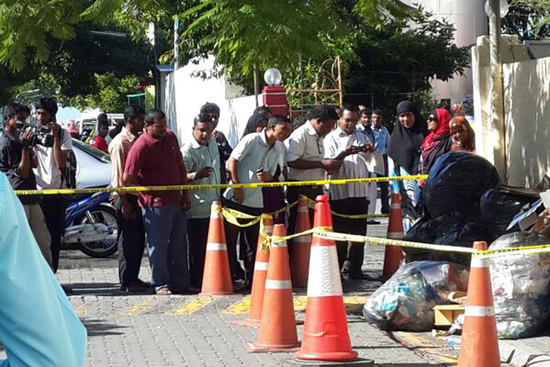
Chair of the Elections Commission (EC) Fuwad Thowfeek has rejected allegations from the Jumhooree Party that it had disposed of official documents relating to the presidential election, after police last night acted on the JP’s claim and barricaded the commission.

The JP came third in the September 7 election with 24 percent of the vote, narrowly missing out on a place in the run-off election.

Police barricaded the entrance to the EC secretariat in the early hours on Monday morning, after the JP alleged the commission was attempting to destroy documents “that would unveil discrepancies in the last elections”.

When Minivan News journalists arrived at the premises, police had barricaded the road which led to the EC’s office, and put up police lines around a couple of black plastic bags that had been intended to be thrown out as garbage.

EC officials – including the commission’s Secretary General Asim Abdul Sattar – were standing outside. Police officers in both uniform and civilian dress were standing outside the premises.

An official of the commission who was inside the building confirmed to Minivan News the police had not entered the building.

When asked about the trash bags left outside the premises, the official said nothing important was inside.

“Like every office, we too have papers that need to be thrown away. Those bags had just shredded waste paper. I don’t understand why people are making such a big fuss out of it,” the official told Minivan News.

At about 10:45am, a police truck came to the premises and took away the garbage.

A police media official confirmed to Minivan News that the trash bags were currently under police guard, and said they were now “processing” the bags.

“The case was reported to police by the Jumhooree Party (JP) and the police were present at the premises from the time the matter was reported,” the official confirmed.

In a subsequent press statement, police confirmed no documents that would affect election results were found among those disposed of by the elections commission.

Meanwhile Ibrahim Khaleel, Spokesperson for JP’s Presidential Candidate and resort tycoon Gasim Ibrahim, told Villa Television (VTV) – a station owned by Gasim – said the party had reported the matter to police around 3:00am in the morning.

Speaking to local newspaper Haveeru regarding the matter, EC President Fuwad Thowfeek said the commission used draft documents for administrative purposes, noting that such documents were unofficial documents that had no legal effect.

Thowfeek said the papers spotted in the trash bags were such draft documents and that this was not “something new”. Some of those papers, he said, would include empty envelopes.

“It is our legal duty to protect official documents relating to the elections. Those that people are claiming to have seen are just draft documents. Those were not used for any election purpose. We are very certain about that. We regularly throw away used papers and rough documents,” Thowfeek told Haveeru.

Thowfeek said he had learned that the trash bag may have included a slip issued after voter re-registration, and said this may have been thrown away.

The EC Chair also said the commission had given permission to police to check the contents of the trash bags in the presence of EC officials.

“We have informed the police that they can check the trash bags to assure themselves as to whether they contain any official documents relating to the election. We are looking after the documents regarding the presidential elections round the clock. We have not thrown away any official documents and the allegations levied against us are outright lies,” Thowfeek explained.

Thowfeek went onto claim that such allegations levied against the commission at such a critical time were made with the intent to undermine  public trust and confidence in the institution. Such baseless allegations would not deter the commission members from executing their legal duties, Thowfeek added.

“We assure you that we have not done and will not do anything to manipulate the outcome of any election. We will fully protect all documents relating to the elections and the voting process,” Thowfeek claimed.

The conduct of the election has been broadly praised by local and international election observers from Transparency Maldives, India and the Commonwealth, as well as observers from other nation states.

Local NGO Transparency Maldives – which ran the most comprehensive observation operation on the day – also announced prior to the release of the provisional results that none of the incidents reported on election day would have a “material impact on the outcome of the election”.

The UK and the EU have both issued statements praising the conduct of Saturday’s presidential election, describing them as “transparent and competitive”.

Likes(1)Dislikes(0)

DRP condemns sacking of State Minister for Health Ali Shareef

The Dhivehi Rayyithunge Party (DRP) has condemned the sacking of State Minister for Health Ali Shareef yesterday (September 15), after the DRP council member voted in favour of endorsing the Maldivian Democratic Party (MDP) candidate – former President Mohamed Nasheed – in the second round run-off of the presidential election.

The DRP said in a press release yesterday that the reason stated by the President’s Office for dismissing Shareef was his vote in the party’s council meeting last week and his participation in the MDP’s campaign.

“The party does not believe that the DRP’s participation in Dr [Mohamed] Waheed’s government is a reason for not being able to engage in activities to gain support for the [candidate] the party supports,” the press release stated.

“The party notes that officials of Dr Waheed’s government belonging to different parties were not fired from their jobs while they were [campaigning] behind different presidential candidates.”

Former Home Minister Dr Mohamed Jameel Ahmed, however, was also sacked from the cabinet by President Waheed two days after he was unveiled as the running mate of the Progressive Party of Maldives presidential candidate Abdulla Yameen in May.

Ali Shareef is currently campaigning for former President Nasheed in Haa Alif and Haa Dhaal atolls with Speaker of Parliament Abdulla Shahid.

The DRP would not be intimidated by “constraints and threats,” the statement added, advising the current administration to “not step out of bounds during the short period left in government.”

President’s Office Media Secretary Masood Imad was not responding at the time of press.

Meanwhile, at a press conference yesterday, DRP MP Mohamed ‘Colonel’ Nasheed – who defected to the government-aligned party from the MDP in March this year – slammed the decision to dismiss the state minister as “irresponsible” as Shareef was exercising his constitutional right to free expression and participation in political activities.

The MP for Haa Dhaal Nolhivaram noted that Education Minister Dr Asim Ahmed, also a DRP council member, was relieved of his duties as acting Foreign Minister on the day that the DRP council voted to endorse former President Nasheed.

“This is not something we can accept,” he said. “We will always have political differences of opinion. But we should be able to conduct affairs of the nation even with these differences of opinion.”

Sacked via SMS

The former state minister for health participated in the MDP rally on Friday night, which was attended by senior DRP members. MP Nasheed revealed that Shareef received a phone call from the President’s Office following his attendance at the rally and was “warned that he would be sacked if he participates in political activities.”

“But Ali Shareef is resolutely going forward. He was sacked via an SMS today [Sunday],” he said.

The DRP’s former coalition partner, Dr Waheed’s Gaumee Ihthihaad Party (GIP), has reportedly decided to back PPM candidate Yameen in the second round run-off on September 28.

President Waheed, backed by the GIP-DRP coalition, finished last in the September 7 presidential election with 5.13 percent of the popular vote or 10,750 votes – a figure significantly lower than the DRP’s 21,411 registered members.

In the wake of the election defeat, the DRP council on Thursday (September 12) voted 12-3 – with seven abstentions – to back the MDP candidate in the second round run-off. In a brief statement to the press following the council meeting, DRP Leader Ahmed Thasmeen Ali said the party came to the conclusion that re-electing former President Nasheed was in the best interest of the nation and ensuring peace and stability as he would not pursue “political vengeance.”

The MP for Baa Atoll Kendhoo also participated in a campaign event in Vili-Male’ on Saturday night with MDP vice presidential candidate Musthafa Lutfi.

Addressing Vili-Male’ residents, Thasmeen reportedly said that bringing back the rule of former President Maumoon Abdul Gayoom by electing his half-brother Yameen would weaken the nascent democratic system ushered in by the 2008 constitution.

In his first speech at an MDP podium on Friday night, Thasmeen said he had decided to back Nasheed “because I want to see peace in this country after these elections, [and] because I want to see the democratic system strengthened and sustained.”

“I believe that it would be an irresponsible and cowardly act to back away from doing what must be done to ensure that democracy is upheld in this country due to some words I might have said in the past. And therefore, tonight I assure all of you that DRP will do everything we possibly can to help Nasheed win these elections,” he declared.

Likes(0)Dislikes(0)

Government paying Grant Thornton £4.6 million to halt STO oil trade investigation

The Maldivian government has reportedly been paying millions of dollars in penalty fees to forensic accountancy firm Grant Thornton, after last year terminating its contract to recover assets allegedly stolen during the 30 year regime of Maumoon Abdul Gayoom.

Under the terms of the contract, signed by the former Nasheed administration in July 2010, Grant Thornton would charge no fee for the investigation beyond costs such as flights and accommodation, instead taking a percentage of the assets recovered. At the same time, Grant Thornton was entitled to charge a penalty fee of up to US$10 million should the government terminate the investigation, such as in the event it arrived at a political deal.

One of the first acts of President Dr Mohamed Waheed’s government after 7 February 2012’s controversial transfer of power was to dissolve the Presidential Commission which had been overseeing Grant Thornton’s investigation, and terminate the agreement with the forensic accountants.

In August 2012, Attorney General Azima Shakoor issued a statement announcing that her office had received two invoices totalling US$358,000 and GBP£4.6 million from Grant Thorton, charges she claimed were for legal advice provided to Nasheed’s government.

Azima had not responded at time of press, but Finance Minister Abdulla Jihad confirmed to Minivan News last week that the government has been paying the charges, though he said he did not have the exact amounts to hand.

Minivan News understands from a source familiar with the matter that the government paid an initial GBP£1.5 million (US$2.4 million) on 24 April 2013, with the remaining amounts to be paid in monthly installments of GBP£300,000 (US$476,000) each.

According to the source, the Maldives Monetary Authority (MMA) remitted these monthly payments to Grant Thorton on May 22, June 27 and July 17.

STO and the Maldives-Burma oil trade

On 1 February 2012, a week before Nasheed’s government was toppled by opposition demonstrators and a mutinous section of the police, the Presidential Commission had forwarded a case for prosecution against Gayoom’s half-brother MP Abdulla Yameen over his alleged involvement in an oil trade of up to US$800 million with the Burmese military junta, during his time as chairman of the State Trading Organisation (STO).

“As of February 2012, Grant Thorton were ready with a criminal complaint, having obtained a number of documents relating to financial dealings from Singapore banks through court orders issued by Singapore courts,” stated Dr Ahmed Shaheed, former Foreign Minister and head of the Presidential Commission, shortly after the contract’s termination.

Yameen is contesting the presidential run-off against Nasheed on September 28. He has publicly dismissed the allegations on repeated occasions, distancing himself from the Singapore branch of the STO where the trade to Burma took place, as well as disputing any illegality in the trade.

The allegations first appeared in February 2011 in India’s The Week magazine, which described Yameen as “the kingpin” of a scheme to buy subsidised oil through STO’s branch in Singapore and sell it through a joint venture called ‘Mocom Trading’ to the Burmese military junta at a black market premium price.

That article drew heavily on a leaked draft of an investigation report by Grant Thorton, dissecting the contents of three hard drives containing financial information regarding transactions from 2002 to 2008. No digital data was available before 2002, and the paper trail was described as “hazy”.

Grilled by parliament’s National Security Committee over the matter in November 2011, Yameen denied any involvement in “micro-management” of STO subsidiary companies during his time as chairman until 2005.

Jumhooree Party vows to reopen investigation

In the lead up to the first round of the presidential election – in which the Jumhoree Party (JP) narrowly missed second place in the run-off to Yameen – JP vice presidential candidate Dr Hassan Saeed vowed to “reopen” the investigation into the STO oil case “as an issue of the highest priority.”

Dr Saeed was President Waheed’s Special Advisor at the time the Presidential Commission was dissolved, and the Grant Thornton contract terminated.

“Abdulla Yameen’s case was started under the previous government. While it was being investigated this government came into office, canceled the contract [with Grant Thornton] and paid 4.6 million pounds on the condition that it not proceed with the investigation, of which a large portion has now been paid,” Dr Saeed declared, during a press conference on August 31.

Saeed claimed that Grant Thornton attempted to communicate with Dr Waheed’s administration regarding the investigation but had received no reply. The accounting firm therefore decided that the contract was at an end and hired a debt collection agency, he revealed.

Asked by media if he had any role in terminating the contract as Waheed’s special advisor, Saeed claimed the contract was already cancelled when he became aware of it.

He further claimed that Dr Waheed was forced to reappoint STO Maldives Singapore Pvt Ltd and Maldives National Oil Company (MNOC) Managing Director Ahmed Muneez because of “pressure from Yameen.”

“Dr Waheed said he had to do it because of extreme pressure from Yameen,” Saeed said.

President Waheed, who polled 5.13 percent in the vote, has since declared he will back Yameen in the second round of the presidential election.

“I say this because in my opinion, the best path for this country cannot be the weakening of the constitutional framework, breaking the law, arson, or the creation of conflict,” Waheed said, explaining his decision to back Yameen in a statement published on the President’s Office website.

Likes(2)Dislikes(0)

Maldives must address “deteriorated” tourist services to protect industry: Chamber of Commerce

The Maldives National Chamber of Commerce and Industry (MNCCI) has warned that the “deteriorated” and “outdated” amenities used to support the Maldives’ lucrative resort industry will negatively impact growth across the tourism sector, if left unaddressed.

MNCCI Vice President Ismail Asif told Minivan News that despite the “seven star” reputation of the country’s exclusive island resorts, the group was receiving growing complaints that the service, amenities and treatment afforded to guests by the country’s public and private sector threatened to significantly damage the destination’s reputation.

The comments were raised after several multinational hospitality groups alleged earlier this month that the sale of the Maldives’ two main seaplane operators to US-based private equity fund Blackstone in February was having a “significant” negative impact on the wider tourism industry as a result of the monopoly created.

MNCCI Vice President Asif told Minivan News that the chamber had not received any “particular concerns” related to the Blackstone deal, but had instead noted growing criticisms of standards of service from state and private institutions vital to the country’s resort industry.

“We have had e-mails from foreign investors and business people about the general service and standards at the country’s airport as well as the quality of transportation [available to tourists],” he said. “We are not able to distinguish [whether the complaints] are about seaplanes or speedboats.

Airport condition

Asif also identified the current condition of Ibarahim Nasir International Airport (INIA), a general lack of amenities, and the attitude of customs and immigration officials towards foreigners visiting the country as major concerns needing to be addressed by the wider industry.

Late last year, the present government controversially scrapped a US$511 million contract signed under the previous administration with India-based infrastructure group GMR to develop and manage an entirely new airport terminal.

The state is subsequently facing a US$1.4 billion compensation claim from GMR for its decision to terminate the contract over allegations of corruption, claims ultimately rejected by the country’s Anti-Corruption Commission (ACC).

The MNCCI has nonetheless maintained that the government’s decision to abruptly terminate the GMR contract did not hurt foreign investor confidence, with Asif claiming that the existing airport structure could be modified to improve service standards. With the eviction of GMR construction of the new terminal is stalled at 25 percent complete, according to the government’s own engineering assessment.

“Foreign businesses don’t want to get into politics here. In the meetings we have had there are two major concerns raised. Internationals want the Maldives to remain as it is. The feedback we get is they want the airport as it is, but with improved services,” he said. “This doesn’t mean a new five story building is needed. For instance free wifi is not [at the airport at present]. Certainly not at the standards visitors would expect.”

Criticisms had also been raised over the conduct of customs officials and regulations banning tourists from bringing alcohol into the country to consume on the country’s resorts, according to the MNCCI.  Asif claimed there was minimal information provided to visitors about restrictions on alcohol and pork products outside of resorts.

“Expensive wine is often confiscated from guests, who are not getting it back. I understand visitors must act within local laws, but it is also important to correctly inform them as well,” he said. “Often these are very expensive gifts given to people while they are travelling, and I don’t see why they cannot bring such items to their resort.”

“It’s not like tourists will bring large amounts of liquor with them. Often the value of the goods they are holding is high, but a customs person will have no idea of the goods or the culture. Their response is ‘liquor is prohibited here’,” he claimed, accusing police and other state authorities of favouring restrictive laws on tourists to reduce their own levels of responsibility.

Asif argued that all national bodies needed to take greater responsibility to ensure treatment of tourists matched the services being provided by the resort industry.

“If it is too much hassle for tourists to visit, people will not come here [on holiday] and will look to other destinations,” he said. “Tourism is is based around trying to make clients happy. We are concerned about this and the need to make things easier here.”

Stability concerns

The MNCCI has also stressed the need for political stability, the lack of which he had alleged has had a considerable impact on investor confidence and business development since the controversial transfer of power on February 7, 2012.

With a run-off vote scheduled for September 28 expected to decide whether former President Mohamed Nasheed or MP Abdulla Yameen will take office over the next five years, Asif said it was important to have an elected and head of state – no matter the candidate.

He argued that a Commonwealth-backed Commission of National Inquiry (CoNI) last year dismissed Nasheed’s allegations that he was removed from office in a “coup d’etat” had led to an increase of larger-scale investment – particularly with resorts.

However, with a number of properties remaining under construction, stability within the country’s domestic politics and court system was a huge problem needing to be addressed, he said.

Tourism Minister Ahmed Adheeb was not responding to calls at time of press in response to the MNCCI’s concerns.

Meanwhile, the government earlier this month said it hoped to secure longer-term financing to plug a shortfall in annual revenue that has seen the number of 28-day Treasury Bills (T-bills) sold by the state almost double in July 2013, compared to the same period last year.

Finance Minister Abdulla Jihad told Minivan News at the time that the state’s increased reliance on short-term T-bills between July 2012 and July 2013 reflected the current difficulties faced by the government in trying to raise budgeted revenue during the period.

Likes(1)Dislikes(0)

High Court holds first hearing of Jumhooree Party’s case against Election Commission

The High Court has held the first hearing of the case filed by the Jumhooree Party (JP) against the Elections Commission (EC) over alleged discrepancies and irregularities, requesting that the court order the commission to hand over the voters list.

Prior to the commencement of the hearing today (September 15), attorneys representing both the opposition Maldivian Democratic Party (MDP) and the Progressive Party of Maldives (PPM) had intervened in the case.

In arguing their case, the attorneys representing the JP claimed that, despite having raised issues concerning the discrepancies within the voter list, the EC had refused to hand over the list to the party so it could verify the issues.

To support their case, the JP produced three documents – each document consisting of lists of alleged fraudulent votes.

The first document was a list of 568 people that, according to the party, had died before the elections but whose names were still present on the voter list. Of the 568 in the JP’s list, 144 people had passed away on January 1 at exactly 12:00am.

The second document was a list of 172 people, which the JP claimed had their names repeated twice on the voter list.

The third document, the party claimed, was a list of people who were originally on Male’ Municipality’s Special Register – a special registry of people belonging to Male but not having their own houses in Male – but who had been registered to different houses in Male’ without the permission of the house owners.

The party claimed that the evidence it had gathered regarding the first round of presidential election suggested serious wrongdoings that undermined the credibility of the election.

The JP pleaded at the court to issue the mandatory order required by the law – to release the voter list which the party has been seeking.

EC lawyer’s response

In response to the JP’s argument, the lead attorney representing the EC’s legal team – veteran lawyer and former Attorney General Husnu Al Suood – contended that the entire lawsuit filed against the EC lacked any legal grounds to back its claim.

Suood went on to claim that the JP had filed the case like that of a “fishing expedition”, hoping to file another lawsuit based on any evidence they collected from the current case.

The former Attorney General claimed the reason the law explicitly stated that the voter list can only be issued through a court order was to protect private information of the voters such as their date of birth, the place they had voted, and whether they actually had gone to vote or not.

Suood further claimed that any order from the High Court to issue the voter list must be based on very strong evidence supporting the release of the document. If not, he claimed, the list would otherwise be used to manipulate the outcome of the upcoming elections including that of the run-off election.

Through the voter list, a political party can easily identify a specific voter and those who had not turned up for voting, meaning that the list could easily be used for unlawful activities, Suood argued.

Responding to the first document the JP produced as evidence, Suood questioned the authenticity of the list, raising questions over how the names of 144 people who had died in the 19th century were present on the voter list of the 2013 elections. He also challenged the JP to reveal the source of the information it had presented to the court.

Of the 568 registered people whom the JP alleged to have died, Suood claimed that seven people were found on the original voter list, of which four were actually alive. The status of the three remaining identities are currently being verified stage, said Suood.

In response to the second document, Suood said that when the EC had verified the allegedly repeated 172 names in the list, each name had a different national identification number or date of birth, meaning that the supposedly repeated names were simply different people.

Responding to the final document, Suood claimed that the voters had been registered under their current addresses to allow them easy access to vote. He added that the EC had intended to ensure that all those eligible to vote would be able to do so.

In summary, Suood pleaded the court not to issue any order based on simple claims and doubts, but rather based on substantial evidence, which he claimed the JP had failed to produce.

The PPM meanwhile during the hearing spoke in favor of the JP, alleging that the EC had been “negligent”. The PPM’s lawyer Adam Zaneen requested the court to issue an order on EC to issue the voter list, and send the PPM a copy.

The MDP echoed similar remarks to Suood, claiming that the JP had failed to produce any substantial documentary evidence to support its claim. The party also suggested the JP had failed to follow due procedure and had not complained to the EC regarding the list.

Concluding the hearing,the presiding panel of judges said that the court would hold the next hearing very soon during which it would decide the case.

Likes(1)Dislikes(0)

Elections Commission announces final first round election results

The Elections Commission (EC) has announced the final results from the first round of the presidential election held September 7.

The EC announced the results yesterday (September 14) after the High Court rejected the Jumhooree Party’s (JP) request for an injunction to halt the announcement.

Maldivian Democratic Party (MDP) presidential candidate and former President Mohamed Nasheed placed first, winning 95,224 votes, or 45.45 percent.

Progressive Party of the Maldives (PPM) candidate Abdulla Yameen – an MP and half-brother of former autocratic President Maumoon Abdul Gayoom – received 25.35 percent,or 53,099 votes, to place second.

While the EC’s final results page showed these figures – identical to those released preliminarily on September 8 – local media outlet Sun Online reported that Yameen had received 54,099 votes – a discrepancy of 1,000 votes.

Gasim Ibrahim – resort tycoon, owner of Villa TV (VTV), MP, and JP leader – placed a close third at 24.07 percent, with 50,422 votes.

Gasim and his Jumhooree ‘Gulhun’ (coalition) – consisting of the Islamist Adhaalath Party (AP), the Dhivehi Qaumee Party (DQP), as well as former PPM Vice President Umar Naseer – have contested the election results and are seeking a recount through the High Court and Supreme Court, in addition to staging protests accusing the EC of negligence and vote rigging.

Incumbent President Dr Mohamed Waheed suffered a resounding defeat, securing 5.13 percent or 10,750 votes. Waheed contested the election as an independent candidate, following controversy over whether his Gaumee Ithihaad Party (GIP) had the minimum 10,000 members required under new political party regulation.

Yesterday Waheed announced GIP will support the PPM in the presidential election run-off, although he will be stepping down as head of the party.

The announcement of the GIP backing the PPM comes days after the Dhivehi Rayyithunge Party (DRP) announced its support for Nasheed and the MDP during the second round of voting. The DRP had backed Waheed in the first round vote, with party leader Ahmed Thasmeen Ali standing as the incumbent’s running mate.

Since no candidate received more than 50 percent of the total turnout, a second round run-off election between the top two candidates – Nasheed and Yameen – will be held on September 28.

Dead voters found alive

The EC also announced that eight deceased individuals the JP had claimed to be on the electoral register had been found alive.

The JP had submitted the alleged list of deceased individuals to court, according to local media.

The commission has determined that the eight people did cast ballots and have confirmed that five are living, EC Vice Chair Ahmed Fayaz told local media.  The commission has received information that the other three individuals are also alive, but the EC has not yet been able to meet them.

Fayaz told local media last week that the EC had previously rejected a voter list provided by the Department of National Registration prior to polling because it listed people who are still alive as deceased.

“They give us a list, [stating that] these 1,200 people are dead. If we deduct these 1,200 people [from the voter registry] without reviewing, an extra 400 people will come to vote,” said Fayaz.

However, the Jumhooree Party has now accused the EC Vice Chair of “outright lies”, claiming that the coalition did not submit a list of eight supposedly deceased individuals included in the electoral register to the EC.

“We call on Fayaz not to engage in such lies. We ask the EC to work independently,” said Ibraim Khaleel, Gasim’s spokesperson and former Villa TV chief executive officer.

No grounds for recount

Meanwhile, in response to representatives from the JP, the PPM, and President Waheed calling for a recount of all ballot boxes during an Elections National Advisory Committee meeting held Thursday (September 12), the EC stated that the alleged vote discrepancy was not enough to call for a recount of all 470 ballot boxes.

The law states there are two instances where ballot boxes may be recounted: 1) If the EC decides the voting process was compromised and decides to conduct a recount to address a complaint(s); 2) If there is a court order issued for a recount, EC Vice Chair Fayaz explained to local media.

MDP’s representative on the National Advisory Committee insisted there were no grounds to warrant a vote recount and argued that the JP noted no issues during polling.

President Waheed has said he is “very concerned” about “some very serious allegations regarding the election” and urged these issues be resolved “by the respective legal and judicial venues”.

However, EC Chair Fuwad Thowfeek has emphatically dismissed the JP’s allegations of rampant vote-rigging, pointing to the commission’s transparency, ongoing complaints investigations, and the praise from a broad spectrum of election observers who noted peaceful voting throughout the day and the preparedness of the EC.

Local NGO Transparency Maldives – which ran the most comprehensive observation operation on the day – also announced prior to the release of the provisional results that none of the incidents reported on election day would have a “material impact on the outcome of the election”.

The UK and the EU have both issued statements praising the conduct of Saturday’s presidential election, describing them as “transparent and competitive”.

Likes(1)Dislikes(0)

Guraidhoo Island Council stops ballot boxes inside schools citing “too much black magic”

The Guraidhoo Island Council has passed a motion against keeping any ballot boxes inside schools on the island after islanders complained about “too much black magic”, the President of the Island Council Hussain Yameen Mohamed has said.

Speaking to Minivan News today, Yameen said that the council have been receiving a lot of complaints from parents and local islanders regarding the issue.

“This time two parents and one man and a woman were affected by the black magic and had to be treated,’’ he said. “The islanders and parents are concerned that if the ballot boxes are kept inside the schools, the black magicians will target the schools and students will be affected.”

Yameen said that the council and the Elections Commission will discuss and decide upon a place to keep the ballot boxes for the second round of presidential election.

“Friday night there was unrest on this island where Maldivian Democratic Party [MDP] supporters confronted the police,’’ he said. “The MDP supporters thought that two spiritual healers on the island were casting spells on the island school and confronted them and police went to the area.”

He said that one person was arrested on charges of attacking a police officer at the scene but have been released now.

“The island council will try its best to make sure that the ballot boxes are not placed in any of the schools,” he added.

Voters on Guraidhoo were reported to have queued for over 17 hours in order to stand on the location of a black magic coconut, ensuring that all voters would choose the same candidate as the first in line.

Multiple reports of ‘fanditha’ (magic) have accompanied the election, ranging from cursed coconuts and witches to black magic dolls.

It was reported on social media today that police on Velidhoo Island, Noonu Atoll, were taking down MDP flags, alleging they had black magic symbols on them.

Minivan News has also learned of individuals in Male’ attempting to purchase conch shells – revered for their alleged magical properties – for large sums of money.

Spells and accusations cast

A MDP supporter on Guraidhoo, who spoke to Minivan News on condition of anonymity, said that the spiritual healers on the island were supporters of Progressive Party of Maldives (PPM) and the MDP supporters went against him when they saw him spilling water around the island school.

“The MDP supporters tried to stop him and the police came and tried to stop the MDP supporters, and then there was a little confrontation between the police and MDP supporters,” he said.

He said that the spiritual healers had left the island the same night.

However, Yameen told Minivan News that the spiritual healers were on the island for a completely unrelated purpose.

“They were here to take pictures of some Quran books that were buried on the beach,” he said.

On September 4, Guraidhoo police station summoned a white magic practitioner to evaluate a young coconut believed to have been cursed by a black magic spell, after it was found near the Guraidhoo school, where the presidential election polling was set up.

In July this year, a Guraidhoo islander said parents of the island have been refusing – and raising their voices against – keeping ballot boxes inside island schools because black magicians were casting spells on the school for election and later it affects the students.

“After the local council election,  the school students started fainting inside the classrooms and this became a huge issue,” the islander told Minivan News at the time. “The parents knew this was related to something like this and called in a group of spiritual healers.’’

He said the spiritual healers forced the spirits to talk to them through the body of the possessed students, who told the healers that they were unable to leave the students as long as the products of sorcery remained inside the school grounds. The spirits reportedly told the healers the exact locations where the sorceress had placed the spells.

Last week, a police team were sent to search for black magic practitioners on Thakandhoo Island in Haa Alif Atoll after MDP supporters were accused of being responsible for the possession of four local children by evil spirits.

Likes(1)Dislikes(0)

Blood and money: stabbing attack follows campaign deal gone wrong

Maldivians across the atolls were glued to state broadcaster Television Maldives (TVM) one week ago, awaiting the results of the country’s second multi-party presidential election.

As counting from the 470 ballot boxes continued throughout the evening, live updates were accompanied by news bulletins keeping all up to date on this historic event – even the deaf.

Members of the Maldives’ deaf community were glued to the bottom corner of their television screen, where Shaheez Abdulla communicated in sign language for those with impaired hearing.

What was not communicated through Shaheez’s hands that day was the intense pain still coursing through his legs, his arm, and his back – the result of a stabbing just 72 hours earlier that he alleges was linked to one political party’s election preparations.

I met Shaheez on the roof of his building. On my way up to the terrace, traces of blood were still visible outside the lift where three youths attacked him the Wednesday (September 4) before the election. The first witnesses to the scene describe a bloodied but furious Shaheez, keen to expose those he sees as responsible for his assault.

He sits awkwardly, shifting in his seat – his determination to expose his wrongdoers unabated.

“They tried to kill me, but they could not. I am not afraid – for the truth, I will do anything,” he said.

Learning to interpret

Eight years ago Shaheez worked in one of Male’s CD/DVD shops and – like many Maldivians – dreamed of travelling abroad to study. Eventually however it was his interactions with the deaf customers he encountered that would decide the direction of his career – in particular, meeting his future-wife, Adhila.

Having admired her from afar, it was only when Shaheez plucked up the nerve to approach her that he realised she too was deaf.

“I finally approached her and tried to talk to her, but she didn’t respond – finally, a woman came over and said to me, ‘Don’t you know she’s deaf?’ I was shocked,” Shaheez explained.

This marked the point at which Shaheez began to learn sign language, leading to eventual fluency in British, Arabic and international signing, as well as the more unusual Dhivehi dialect. He also got married to Adhila and they now have two children.

Shaheez soon became one of the first deaf interpreters in the Maldives and today offers interpretation assistance in the courts, hospitals, and even trains members of the police force to sign. Shaheez regularly lectures at the Education Development Centre, and is contracted by the Maldives Broadcasting Corporation (MBC) to provide interpretation services on TVM.

During our interview, Shaheez proudly shows Minivan News the registration certificate for his new project – the Maldives Disabled Federation – which will act as an umbrella organisation for the country’s separate disability civil society groups.

Shaheez’s tireless activity across Maldivian civil society  – working on many different disability related projects – could have been halted on September 4, however, as his work became tangled with the country’s internecine politics.

Warning signs

The events leading to the attack began around one month prior to the elections, when Shaheez says he was contacted by the Jumhoree Party (JP) about potential projects for disabled people. Full of ideas, and never without a sheaf of papers outlining his many projects, Shaheez was able to produce proposals for a number of schemes at the very first meeting.

“I told them I can help, but I can’t be a political tool,” he recalled. “There are so many projects that need doing.”

Two days after this initial meeting, Shaheez claimed that a JP member gave him just under MVR 300,000 (US$1,948) for three projects – including an instructive video to help deaf people learn the Salaath prayer, the creation of a Dhivehi sign-language dictionary, and the development of a sign-language font.

A call on speakerphone to a JP member during the interview confirmed that the party had given this cash to Shaheez. He was also able to show paperwork outlining the agreed projects and their cost, as well as a contract which agreed the projects would be launched by JP leader, Gasim Ibrahim.

However, Shaheez claimed the relationship started to go sour when he was given two day’s notice to prepare for the official launch of the projects.

“After I told them the launch could not be done in that time, they asked for all of the money back,” Shaheez recalled, despite much of the work having already been carried out.

“I said I would give the money back, but that I would also then do anti-campaigning against Gasim.”

It was on his way home from this meeting on September 3 that Shaheez says two young men on a motorbike threatened him.

“They said ‘Don’t even dare do anti-campaigning – if you do, you’d better watch out’, ” he alleged.

The following day, on his way to return to the cash – moments after arranging to meet with a JP member over the phone – Shaheez was confronted by his attackers on the way out of his building. After demanding Shaheez’s bag – containing the JP’s money – the youths attacked, taking the bag with the money inside.

Shaheez was keen to point out that his blame for the attack was not aimed at Gasim himself, noting that the leader’s close associates had warned Shaheez not to return the money to anyone other than them.

Response to threats

Minivan News was unable to obtain a response from the JP member named by Shaheez as the person responsible for his attack, and so his name has been left out of this account. Another senior party member, cited as being involved in the initial agreement, has denied all knowledge of any projects involving the JP and disabled organisations.

Shaheez is aware of rumours that he had stolen the party’s money himself, but rejected these accusations, citing his lack of a criminal record.

“I know who I am and God knows who I am,” he says.

Asked whether he was intimidated by the threats, he said that this was not the first time this tactic had been used, as he seeks to expose the persistent abuse of disabled people in the Maldives. He recalled one shocking example of such abuse he encountered when conducting surveys in Haa Daalu Atoll.

“There was one lady everyone said was mad. When I spoke with her, I found that she was just deaf. But the men in the island had already been abusing her – she had seven or eight children with unknown fathers. Men had used her, raped her, and even drugged her.”

“I will hold a big event one day and all these abuse cases will be publicised,” he vowed.

When asked about the difficulty of interpreting for the election coverage so soon after his ordeal, Shaheez remained defiant.

“I don’t care if both legs are stabbed, if even one of my hands can move I will interpret for the deaf until my last breath.”

Video taken by a bystander following Shaheez’s stabbing on September 4:

Likes(1)Dislikes(0)