Chief suspect in Afrasheem murder case retracts confession, claims to have been coerced

The chief suspect alleged to have murder parliament member and prominent religious scholar Dr Afrasheem Ali, Hussain Humam, has retracted his previous confession to the crime, claiming it was obtained by police through coercive means.

Humam – who has been linked with smuggling drugs, gang violence and several other high profile crimes – confessed to the killing on May 22, answering “yes” in court when state prosecutors produced a statement detailing the murder and asked him if it was his.

According to that statement, Humam claimed the idea of killing Dr Afrasheem was given to him by Maldives National Defence Force (MNDF) officer Azleef Rauf, whom he met at a baibalaa tournament held in 2012.

The pair later met in person again at a coffee, according to the statement, along with two other individuals Humam identified as Abdulla ‘Jaa’ Javid (son-in-law of opposition Maldivian Democratic Party (MDP) Chairperson ‘Reeko’ Moosa Manik) and his brother ‘Jana’.

According to the prosecutor’s statement, Humam was promised a sum of MVR 4 million (US$260,000) for murdering the religious scholar. The statement said Humam later asked Azleef Rauf why Afrasheem was to be murdered, and was told that one of the reasons were Afrasheem’s remarks during the day former President Mohamed Nasheed controversially resigned.

State prosecutors accused Humam, along with Ali Shan – who is also facing the same charges – and a minor identified as ‘Nangi’, of going to the residence of Dr Afrasheem and murdering him with a machete and a bayonet knife.

Humam’s retraction of his statement during yesterday’s court hearing is the second time he has denied committing the murder.

Court denies request for psychological testing

During the hearings, Humam’s defence lawyer requested the judge allow Humam’s sanity and mental stability be tested, claiming that Humam’s father had told him that the suspect had a mental disorder. He stressed that Humam himself had told Haseen that he wanted to consult a psychologist.

Haseen also took an oath swearing that he had never asked Humam to deny the charges levied against him, in response to ongoing public rumour that Haseen was behind Humam’s new denial.

Responding to the request made by Haseen, Judge Abdulla Didi denied the request for psychological testing, stating that Humam’s lawyer had not mentioned such a psychological disorder during the hearings held to extend Humam’s detention.

The judge further claimed Humam had pleaded with him to continue the trial behind closed doors.

Humam’s defence lawyer was allowed to enter the court only after Humam stood up without the permission of the judge and requested that his lawyer be present , and that he wished to proceed with his lawyer.

Speaking in the defence of the accused, Haseen contended that Humam had told him that the confession that he had given during the previous hearing was a result of threats by police.

His lawyer said Humam was warned that should he fail to comply with the deal offered by the police, they would charge him with other crimes of which he was accused.

The police also assured Humam that he would not be sentenced to death should he confess to the crime, Haseen alleged.

Witness’s narrative of the incident

During Saturday’s hearing the state presented two witnesses, included a minor alleged to have gone with Humam to Afrasheem’s residence, and the doctor who inspected the body.

The minor, who gave evidence over a distorted audio link and responded to questions from Humam’s defense lawyer Abdulla Haseen, said he knew Humam even before the events that led to the murder of the MP.

According to the minor, Humam had called him and told him that there was a ‘mission’. On the day the murder was carried out, Humam called him and requested him to meet up at Usfasgandu, while informing him that he had received briefings of what they needed to do to complete the said mission.

The witness told the court that he had gone to Usfasgandu, where he met with Humam and Ali Shan. After meeting up, the three then headed to ‘pad-park’ near Usfasgandu, where he claimed he saw Shan wielding a knife.

The witness told the court that they left the park and headed to ‘Kuda Kudhinge Bageecha’ – a children’s park located in front of Dr Afrasheem’s house. He claimed that Humam entered the residence and seconds later, a man carrying a stack of books entered into the same house, followed by Ali Shaan.

After a short while, Shaan called him. When he had entered the premises, he told the court he saw the man with the books brutally injured, lying on the floor.

The witness claimed that Humam was wielding a bloody knife and holding the hand of the injured man, which was also covered in blood. He also claimed that Ali Shan too had a knife.

Responding to the questions posed by Humam’s defence lawyer, the witness claimed  he had given evidence to the court on different occasions during November 2012.

When Haseen questioned whether the witness had been involved with previous criminal activities carried out by Humam, he answered stating that he had not, but said he had knowledge of what Humam had been doing.

As soon as Haseen began questioning the witness about his own criminal records, Judge Abdulla Didi stopped him stating that the questions did not have any relevance to the case at hand.

The doctor who had inspected the body of the deceased Afrasheem told the court through the assistance of a translator that there was no sign of life in Afrasheem’s body when he was brought to the hospital.

Explaining his observations, the doctor said that Afrasheem’s body had suffered severe injuries of the kind which could lead to death.

Next hearing

State prosecutors argued that Humam had confessed to the crime during the last hearing, as well as during a hearing held to determine the extension of his custody.

Therefore, the prosecution contested that it was a legitimate confession according to the constitution, that that therefore they felt that the court could issue a verdict based on the confession.

The judge concluded the hearing without announcing the date for a next hearing.

Likes(0)Dislikes(0)

Government uncertain over waste management future as Tatva negotiations continue

The government remains locked in negotiations to find a “permanent” waste management solution in the Maldives following concerns about a recent build up of garbage in Male’, State Environment Minister Abdul Matheen Mohamed has said.

Matheen told Minivan News that although immediate concerns about garbage levels in the capital had been dealt with by Male’ City Council (MCC), which was in the process of “clearing” waste disposal sites on a daily basis – uncertainty remained on a long-term solution to dealing with trash.

At present, waste from across the country is shipped over to the island of Thilafushi near Male’ – an island that serves as the country’s key site for processing and burning garbage.

Certain councillors and MPs from Male’ last week claimed that a failure to deal with a build up of waste in the capital in recent months had escalated into a “national disaster” that could have potential health and safety implications for the public if not addressed.

However, Matheen added that the Finance Ministry’s decision last month to provide an estimated MVR 7 million (US$454,000) in funding to the MCC to try and clear trash from waste sites in the capital had already shown positive results.

“The MCC is clearing waste daily, the crisis is over,” he said. “Right now I believe that trying to manage waste in Male’ is not the best solution. If this waste can be shifted to Thilafushi that may be for the best.”

State negotiations

Matheen said that the government was committed to seeking financing for alternative waste management schemes, while also renegotiating a deal signed by the former government with Tatva Global Renewable Energy.

The government of former President Mohamed Nasheed signed a contract with Tatva in 2011 to allow the India-based company to take over handling of waste in the capital – as well as from nearby inhabited islands and resorts properties.

The agreement also outlined a means of generating power from recycling waste products brought to Thilafushi in an attempt to cut down on trash being burned.

By December last year, President Dr Mohamed Waheed’s administration announced it was in the process of renegotiating Tatva’s agreement in a bid to replace the deal with what Environment Minister Dr Mariyam Shakeela at the time called a “mutually beneficial” agreement.

Just last week, Finance Minister Abdulla Jihad said that although the new agreement with Tatva was yet to be signed, a deal was expected to be finalised in the coming days.

However, Matheen today claimed that no agreement had been reached as yet over the negotiations, which he claimed appeared to be nearing some form of conclusion.

“The process has taken so much time. We will have to take a decision soon [on whether to sign the Tatva deal],” he said.

According to Matheen, the discussions with Tatva Global Renewable Energy had been complicated by having to find an agreement between a number of different parties; including the government, the MCC, service providers like the State Electric Company Limited (STELCO) and management at Thilafushi.

He alleged that another concern about the deal was the need for Tatva itself to find sufficient investment to back its own part of the proposed waste management scheme.

A spokesperson for Tatva was not responding to calls from Minivan News at time of press.

Matheen said that the government was waiting to see if an agreement could be reached with Tatva over the deal, adding that authorities would otherwise seek to open discussions with other service providers to try and find an alternate means of waste management.

Male’ clean up

While the negotiations continue, Male’ Councillor Mohamed Abdul Kareem confirmed to Minivan News that despite difficulties earlier this month, the council had now almost dealt fully with waste build-up in the capital after receiving funding from the Finance Ministry.

“The only problem we have had with waste management has been the budgeting issues, other than that, we have the technical expertise to clean the waste,” he said.

Kareem claimed that upon receiving funds from the government, the MCC had been able to hire special dhonis (boats) to clear garbage from disposal sites in Male’ that had been allowed to build up over a period of several months. The build up of waste had led to disputes between the council and various state bodies over responsibility for clearing the waste.

Waste being cleared from Male' Saturday (June 1)

With a proportion of funding now having been received by the MCC from the Finance Minsitry, Kareem said the council had been able to clear waste yard number two in Male’ of rubbish.  The site was now being “treated” to try and reduce odours that had built up at the site as a result of recent wet weather, before it would again start receiving waste.

He added that the site was presently being cleared and would not be temporarily open for use until the council completed its treatment and renovation.

Kareem claimed that as long as the government continued to provide funding for the MCC to handle waste management in and around the capital, the MCC did not expect to have any similar problems cleaning waste in the future.

He alleged last month that following the initial signing of the Tatva waste management deal under the previous government in May 2011, the MCC had not been provided with a budget for waste management – even after the deal was stalled by the present administration.

Waste concerns

In April, divisions were reported to have arisen between different ministerial bodies and the private sector over who should take responsibility for garbage being dumped into the sea.

Earlier this year, Minivan News reported that government authorities were working on trying to create functional waste management projects that would serve as an alternative to shipping waste to Thilafushi, despite numerous failed attempts in the past.

Likes(0)Dislikes(0)

JSC “fully controlled by political figures”: lawyer for Chief High Court judge

Judicial Service Commission (JSC) is set to face another court battle after attorneys representing Chief Judge of High Court Ahmed Shareef announced on Thursday that they would challenge the commission’s decision to suspend the judge.

Chair of JSC, Supreme Court Justice Adam Mohamed, had earlier held a press conference declaring the commission had decided to “indefinitely suspended” Chief Judge Shareef, over a complaint filed against the judge last year.

That decision came hours after the High Court temporarily halting the hearings of a case against the JSC lodged by former President Nasheed – who has accused the judicial watch-dog of exceeding its mandate in appointing the three-member judges panel to the Hulhumale Magistrate Court currently hearing a criminal case against him.

According to the JSC Chair, the suspension of Chief Judge Shareef – who is among the three judges presiding over the Maldivian Democratic Party (MDP) presidential candidate Mohamed Nasheed’s case – was a “precautionary” measure while investigation of the complaint was proceeding.

Judge Shareef in the new Civil Court lawsuit against the JSC will be represented by former Attorney General and veteran lawyer Husnu Al Suood and his law firm, Suood, Anwar and Co.

Briefing the media about the court case which is set to be filed on Sunday, Suood said that Chief Judge Shareef was suspended in contrast with the existing laws and the decision undermines the independence a Judge requires in executing his legal duties.

He said the Chief Judge’s team of counsels will plead in court that the decision by the JSC was an attempt to unduly exercise influence over judges.

He also added that once the case is registered at the Civil Court, a request will be made at the Supreme Court to take over the case, as has been the previous practice.

The Supreme Court previously took over the case filed at Civil Court by prominent lawyer Ismail Wisham against the JSC, challenging the legitimacy of the Hulhumale Magistrate Court it created.

The case was also represented by Suood, which eventually led to the Supreme Court endorsing the legitimacy of the controversial court in a 4 to 3 majority decision in which Chair of JSC and Supreme Court Justice Adam Mohamed cast the controversial deciding vote, despite initial pleas against the judge sitting on the bench by Suood on the ground of ‘presumption of bias’.

“Not a small thing”

Speaking of the JSC’s decision, Suood – who is also the President of Maldives Bar Association – said the suspension coming after the JSC sitting’s on the case for a year was “not a small thing”.

“That is not a small thing when you get a suspension after one year. Suspending a country’s Chief Judge of High Court is not a small thing,” he said.

JSC Chair Adam Mohamed has meanwhile said “there are no legal grounds to stop looking into a complaint submitted [to the commission] or halt proceedings”.

According to local media reports, the call for an indefinite suspension of the Chief Judge was proposed to the JSC by the incumbent Attorney General Aishath Bisham – who is yet to receive parliament’s consent following her appointment – and was passed by the vote of three members out of the 10-member commission.

Those who voted in favour included two representatives of the executive branch, the attorney general herself, the President Mohamed Waheed Hassan’s representive Mohamed ‘Reynis’ Saleem, and a third vote by Criminal Court Judge Abdulla Didi.

The public’s member to the JSC Sheikh Shuaib Abdul Rahman opposed the motion while lawyers’ eepresentative Ahmed Rasheed and Civil Service Commission (CSC) Chair Mohamed Fahmy Hassan abstained. High Court Judge Abdulla Hameed did not participate in the vote.

Both the Speaker of parliament Abdulla Shahid and Parliament’s representee to the commission MP Gasim Ibrahim did not attend the meeting.

Politically motivated and influenced

Suood said the JSC’s passing of a motion to suspend the judge with a vote of just three members – two of whom represented the executive – lead to presumption that the vote had been influenced.

He said that such a grave motion being passed by the support of just three members also led to the belief that the JSC was seeking to undermine the independence of the judges.

“There is reason to believe this decision had political motives behind it,” said the veteran lawyer.

Suood further said the decision could also be perceived as a way to prevent a further delay of the case filed by Nasheed, who is contesting the legality of the three-member judges panel appointed to Hulhumale Magistrate Court by the JSC.

“The JSC is one party to the ongoing High Court case of which Chief Judge Shareef is among the judges who presiding over the case. It is wrong in every aspect for JSC to take action against the judge,” he said. “Due to such actions, public confidence in state institutions is being lowered day by day.”

“Entire judiciary under the influence of retired Supreme Court Judge Mujthaaz Fahmy” – Suood

Suood also alleged that two parliament members and a retired Supreme Court judge have long been influencing the work of judges and their verdicts on several cases.

Suood claimed that the presidential candidate for the government-aligned Progressive Party of Maldives (PPM) Abdulla Yameen Abdul Gayoom, the Deputy Speaker of Parliament and PPM MP Ahmed Nazim, and retired Supreme Court Judge Mujthaz Fahmy have long been in the business of influencing the judges and the verdicts they had been issuing.

He further contested that his allegations were based on evidence, and said he would do everything possible to make the judiciary free from such undue influences.

“The entire judiciary is under the influence of [retired Supreme Court Judge] Mujthaaz Fahmy ,” he alleged.

Suood further alleged that Deputy Speaker Nazim had close ties with members of the JSC, and said several judges had told him that Yameen Abdul Gayoom – half brother of  former President of 30 years, Maumoon Abdul Gayoom – had on several occasions given instructions to the judges over the phone as to how their sentences should be phrased.

Despite claiming to have strong evidence to support his allegations, Suood admitted that it would be extremely difficult for the authorities to take action against the three individuals.

JSC juggling judges to appease politicians

Suood further contended that the JSC had been taken over “dark powers”, and that it was fully under the control of certain political figures.

He alleged that in a bid to serve the interests of a few politicians, the JSC was planning to juggle judges from court to court and even had planned to give salary increments to certain judges.

Among the planned switches, Suood claimed that Chief Judge of Criminal Court Abdulla Mohamed – who was taken into military detention during former President Nasheed’s administration over allegations of gross judicial misconduct – is set to be transferred to Civil Court, while JSC member and Criminal Court Judge Abdulla Didi will become the Chief Judge of the Criminal Court.

Among other changes, Suood claimed that JSC had been working to transfer the two “best serving” Civil Court Judges – Judge Aisha Sujoon and Judge Mariyam Nihayath to the Drug Court.

“These things are carried out under a great plan. They are installing judges to courts as they please,” Suood said.

Denial

All the three individuals accused by Suood have dismissed the allegations in responses given to local media.

Speaking at a membership event held in PPM’s headquarters on Friday night, PPM’s presidential hopeful Yameen Abdul Gayoom denied the allegations, describing them as an “outright lie”.

“The JSC is taking action against a judge. They don’t have judges sitting on the JSC. Therefore I do not believe anyone can influence the JSC,” Yameen said.

He further expressed his frustration over the allegations claiming that it had become common for people to make erroneous and slanderous remarks against political figures.

“This would not have happened if defamation had been kept as a criminal offence. All this is happening because defamation has now been changed to a civil wrong,” he said.

He further said that even though he did not influence judges and their work, he admitted to speaking about lapses within the judiciary and the delaying of cases on public forums.

“It would be better for Suood to stop making such irresponsible comments and focus on working for his clients,” Yameen responded.

Likes(0)Dislikes(0)

Comment: The private eye?

This is the second of a series of articles as I attempt to unpack the Naaz Report, Access to Justice in the Maldives: Through the Eyes of a Colourless Lens published in May 2013.

Part one of Velezinee’s critique of the Access to Justice report is available here.

1. Naaz was a warden of Vice President Waheed Deen who taught and groomed her. He sponsored her study in Australia where she read Law, and lived and worked in Australia before returning home in late 2009.

2. I was first introduced to Naaz in 2009 by a mutual friend, a judge, who was a school friend of Naaz, and my closest friend at the time. As I understood, Naaz had been away for a long period, returned to the Maldives for a “break year,” and was excited by the changes she was seeing in the Maldives. She wanted to contribute to the nation with her knowledge and experience, and at the same time build her CV. Maldives lacks people of the knowledge, experience, exposure and grooming Naaz has, and she could help fill the gap. Naaz was living in Bandos Island Resort, courtesy of VP Deen, and was exploring opportunities. It was an exciting time.

3. She met with the then Vice President Dr Mohamed Waheed by appointment to introduce herself, and express her interest, and met others whom she knew from earlier, looking for a way to contribute.  I was aware of the issues in child protection and the lack of expertise in law or human rights in the then Department of Gender and Family Protection (DGFPS) and thought Naaz could contribute much to strengthening the child protection system, and encouraged her to take up the challenge.

4. In the end, Naaz joined the UNDP office in Male as a Project Director to lead the Access to Justice project, an ongoing UN program with the government.  With the UNDP, Naaz had privileged access to all institutions that few others had.

5. The author’s introduction in the publication, Access to Justice in the Maldives: Through the Eyes of a Colourless Lens (May, 2013) reads somewhat different.

6. In it she informs the reader she was the “Protecting Human Rights and Access to Justice Project” Program Specialist as well as the Project Manager with UNDP Maldives”, and that she is “a practicing lawyer in Australia” who has been “in the legal field for over 12 years”. All facts.

The “framing”, however, is misleading. It gives the reader the impression that the author is an Australian lawyer practicing in Australia, who happened to be in the Maldives working with the UN between 2010-12. A Maldivian would have “interests”, but what interests, as such, would an Australian have in rewriting a narrative? The framing, thus, gives a false impression of author as standing outside.

7. Second, the tag “Lead Researcher and Author: Naaz Aminath (LLB, GDLP, LLM)” implies the report is the work of a team. This too is misleading. There is no research team mentioned elsewhere in the report or credits, nor is there a reference list or bibliography included in the report.

8. Copy editing is credited to Maaeesha Saeed and Aishath Rizna, who was the Registrar at the Interim Supreme Court during the transition period, and is currently working for the Department of Judicial Administration.

10. Could the author be deliberately misleading the reader? Are these all innocent omissions and/or typos? Maybe. Or maybe not. What is the purpose of the Naaz Report?  What influence could it have on the political processes in the Maldives today? Everything, depending on the winners in the presidential elections scheduled for September 7, 2013.

11. Naaz’s long standing patron, Waheed Deen, a businessman, resort owner, and society-man of wide social contacts known for his philanthropy and gift-giving, is the current Vice President, handpicked by Dr Waheed following the February 7, 2012 coup d’état. And the fact is, with all the plotting and re-plotting, it was “on a judges’ back” that Dr Waheed rose to office.

What went on in the JSC during 2009 and 2010 is clearly linked to events of January and February 2012, as I tried explaining to the Commission of National Inquiry (CoNI) in my testimony.

So, what does Naaz say?

1. On “access to justice”, Naaz argues that the urban-rural disparity, the “deficiency in development and lack of access to justice creates inequality and injustice while giving an advantage to politicians to ‘buy’ their ideas rather than sell it.”  Access to Justice as a fundamental right, and the broader definitions of it, and the constitutional guarantees and requirements are not recognised.

2. There is no mention of the crucial role of an independent judiciary in democratic government, or necessity of independent judges and public trust in the justice system to protect human rights and provide access to justice.

3. The fact that a UNDP Study (2000) of governance found the judiciary to be “the weakest link” in transitional constitutional democracies; and that Article 285 of the Maldives’ Constitution provided exactly for this challenge, is not recognized by Naaz.

This, despite her position as the Project Director of the Access to Justice project with the UNDP in Male’ during the Maldives’ transition from a constitutional autocracy to a constitutional democracy.

4. The Maldives, I maintain, lost an independent judiciary and the independence of judges through the high treason of the Judicial Service Commission (JSC), on which I sat a member under oath.

The JSC nullified Article 285 unconstitutionally in an elaborate game of lies, deception and drama. The state refused to officially acknowledge the dispute in the JSC, or the alleged treason and constitution breach, with the Majlis majority unashamedly covering up the hijack of the judiciary in what I have since called the Silent Coup.

5. Post coup, the JSC has become exposed as it never was in 2010. The frequent public appearances of the JSC, especially the Chair, Supreme Court justice Adam Mohamed Abdulla, has revealed more about the Commission than any other intervention could.

Concurrently, renewed interest in transitional matters, and inquiries into the JSC and its functioning by independent experts have exposed the secrets of JSC: the JSC does not act to uphold the Constitution, is highly politicised, and misconstrues constitutional concepts and law for its own ends and the benefit of judges. In short, the JSC acts against the Constitution and the State.

6. The latest report on the Maldives’ judiciary and access to justice by the UN Special Rapporteur on the Independence of Lawyers and Judges, Gabriella Knaul, provides a substantive summary of the challenges Maldives faces, and highlights where a UN-led Access to Justice program must focus.

7. On the ground in 2010, Naaz was a sympathetic ear to my complaints against the JSC, and my grievances against the Parliament for their failure to hold the JSC accountable, and to ensure Article 285 was fulfilled meaningfully. I was advocating for substantive and meaningful action on Article 285 aimed at judicial reform as envisaged by the Constitution, and Naaz agreed with my interpretation and opinion.

8. Naaz always left with me a standing offer of assistance, which was much appreciated, as I do not have a background in law. In retrospect, that assistance never materialised, as Naaz was occupied when and where I did request help. My requests mainly were for assistance in reading through some of my drafts, and in translating to English and/or preparing briefs in English to share some information of the ongoing dispute, and the dozens of pages I was putting out in Dhivehi at the time.

9. With all attempts to get an inquiry into Article 285 and the JSCs’ constitution breach blocked, the judges took their infamous “symbolic” oath, en masse, on August 4, 2010. No one, neither the state institutions nor the media, questioned the oath or its legitimacy despite what was witnessed live and the questions it raised. It was the public left with unanswered questions.

10. The UN was satisfied. Naaz was on the ground, and was active in the efforts that followed to legitimise the judiciary, appointed unconstitutionally and without due process,  by the will of the majority. No one mentioned rule of law. Not until 2012.

Aishath Velezinee (@Velezinee on twitter) is an independent democracy activist and writer. She was the Editor of Adduvas Weekly 2005-07 and served on the Maldives’ Judicial Service Commission (2009-11). She claims the Commission she sat on breached constitution in transition; and advocates for redress of Article 285, and a full overhaul of the judiciary as a necessary step for democracy consolidation.

All comment pieces are the sole view of the author and do not reflect the editorial policy of Minivan News. If you would like to write an opinion piece, please send proposals to [email protected]

Likes(2)Dislikes(0)

Elections Commission publishes eligible voters list, provides 10 days to report discrepancies

The Elections Commission (EC) has published the list of eligible voters for the presidential election scheduled for September 7, in the government’s online gazette.

Speaking to local media today, the EC said public would now have 10 days to ensure that people included on the list were correctly registered – or else  risk invalidating their right to vote come polling in September.

Local NGO Transparency Maldives, which will be monitoring the upcoming election, said it would not have time to audit the eligible voters list before the vote, with members of the public being required to verify the details of themselves and relatives on the list.

Beyond concerns at the relatively short amount of time given to voters to check their eligibility, the NGO said it believed ensuring voters were correctly registered to vote near their current place of residence once the election was officially announced was a particularly pressing concern.

Under the regulations on presidential elections published earlier this month, any complaints concerning the status of the 240,302 voters included on the register should be raised with the EC within the next 10 days.

Speaking to local media, EC President Fuad Thaufeeq said it was possible that the published list would include individuals who had since died without their records being updated with the commission.

“We believe we have not received accurate information regarding people who have passed away. We obtain the information from whichever relevant authority holds the information at that time,” he was quoted as saying by Sun Online.

Thaufeeq said the public were requested over the next 10 days to inform the EC of any discrepancies on the list such as the inclusion of names of the deceased, a failure to include eligible voters on the list, or an incorrect national identification card number.

“If the person is dead, the procedure is that it can verified by statements from two family members. The persons who are not included on the list cannot vote. Persons also cannot vote if their names are spelled wrong, or if their addresses are wrong, or if the name on their ID cards and the name on the list does not match,” he was reported as saying.

Thaufeeq was not responding to calls from Minivan News at time of press.

NGO response

Addressing the possibility of discrepancies, Transparency Maldives Project Director Aiman Rasheed said the NGO would not have time to conduct the lengthy audit required to ensure the list was fully accurate, given the time constraints.

He said that under Article 15 (A) of the new Presidential Elections Regulations, it would not be possible to make any changes to the registry beyond the first ten days of its publication. Additionally, any person absent from the registry would not be eligible to be re-registered for September’s vote unless the EC was notified in the next ten days.

While the registry has been published “early” ahead of elections expected in early September, Rasheed said the NGO was aware of “issues” being raised that the EC has previously provided the minimum required length of time allowed under regulations to clarify any vote discrepancies or errors.

He added that the 10 day period was another example of this.

According to Rasheed, another concern held by Transparency Maldives regarding voting in September was the issue of re-registration for members of the public living in different islands or countries from their permanent address held by the EC.

Taking the case of a Maldives national living abroad in Malaysia or Sri Lanka, he claimed that unless a voter re-registered their details with the EC to use a ballot box in that country, they would need to return to their place of permanent residence in order to vote.

Rasheed said the EC had already travelled to islands across the country to try and raise awareness over the issue, which reflected what he said were “progressive improvements” in the commission’s work to keep voters informed.

Transparency said a timeframe by when voters would need to re-register their new addresses had not been outlined by the EC at present, but was expected to be set after the election was officially announced.

Likes(0)Dislikes(0)

JSC suspends Chief Judge hours after High Court postpones case against JSC

The Maldivian Democratic Party (MDP) has announced that the High Court has temporarily suspended the hearings of the case against Judicial Service Commission (JSC) filed by the party’s presidential candidate, former President Mohamed Nasheed.

Nasheed is challenging the legitimacy of the JSC’s appointment of the three-member judges panel to the Hulhumale Magistrate Court to hear Nasheed’s criminal trial.

The party’s remarks come just a day after High Court cancelled a hearing of the case in which local media reported that the court was to decide on counter-procedural issues taken by JSC. The JSC has contended that the High Court did not have the jurisdiction to look into a matter.

Member of Nasheed’s legal team, Hassan Latheef, told Minivan News on Wednesday that the hearing was cancelled after the judge who was presiding over the case opted to “take leave” for the day.

However, shortly after the cancellation, the JSC declared that the commission had indefinitely suspended the Chief Judge of High Court Ahmed Shareef – who also happened to be among the judges presiding over Nasheed’s case against the JSC.

JSC Chair and Supreme Court Justice Adam Mohamed Abdulla insisted at a press conference yesterday that the disciplinary action had no relation to the former president’s case.

In a press conference held today at the party headquarters, Vice Chairperson of MDP Ali Shiyam said the party saw the High Court’s decision to withhold the hearings until next July as an encouragement for Nasheed and the party to continue its nation-wide presidential campaigning.

Shiyam added that if no further disruptions came from the courts, it would mean an additional strength to the party in their bid to secure the presidential elections in the first round. Shiyam also described the move as an end to the obstructions leveled against Nasheed by the courts and the judiciary.

“President [Nasheed] will not have to halt the campaign and come to Male to appear before the court. That is a new strength, a new encouragement to our campaign,” Shiyam said.

Meanwhile, another member of Nasheed’s legal team, Hisaan Hussain, tweeted that despite the indefinite suspension of Judge Shareef, neither the JSC nor the acting chief judge appointed to fill the vacancy of Judge Shareef would be allowed to reshuffle the judges presiding over the case.

Speaking to Minivan News, MDP Spokesperson MP Imthiyaz Fahmy said the move to hold the hearings was also an assurance to the public and the international community that former President Nasheed would be able to take part in the elections, as was unlikely that Nasheed would be given a criminal sentence.

He added that the party were facing a lot of challenges compared to other political parties who are also campaigning for the election.

“Because of the ongoing case concerning President Nasheed, the party has had to spend equal time and resources on its legal battles while running a nation wide presidential campaign. The MDP is battling with everything including the judiciary, the Prosecutor General and all the injustices faced by ordinary people,” he said.

Fahmy further added that the previous scheduling of Nasheed’s cases and sudden cancellations resulted in severe financial losses to the party, as each campaign event is organised by the hard work of party members across the country.

However, Fahmy also echoed Shiyam’s statement that the suspension of the case marked the end of Nasheed’s legal battle, stating that the High Court’s decision would allow the party to focus its energy on campaigning rather than winning court battles.

The Hulhumle-based magistrate court is currently hearing the case against the former President over the controversial detention of Chief Judge of Criminal Court Abdulla Mohamed by the Maldives National Defence Force (MNDF) during the last days of his presidency.

During the first trials of the hearing, Nasheed’s legal team contested the legitimacy of the magistrate court.

However, in a Civil Court case filed by lawyer Ismail Wisham, which was subsequently taken over by Supreme Court – and to which Nasheed’s legal team also intervened – endorsed the legitimacy of the much-debated Hulhumale Magistrate court.

As soon as the trials resumed, Nasheed’s legal team challenged the legitimacy of the appointment of the three-member judges panel to the magistrate court. The former president’s counsel is arguing that appointing judges to specific cases was not the JSC’s responsibility, but that of the chief judges of respective courts.

Minivan News contacted a High Court media official but was told the court had no comment on the case.

JSC suspends High Court Judge, appoints acting replacement

The JSC has meanwhile appointed Judge Abdul Rauoof Ibrahim as acting Chief Judge of High Court until the JSC concludes its inquiry into complaints filed against the suspended Chief Judge of High Court Ahmed Shareef.

Speaking to Minivan News, JSC Media Official Hassan Zaheen confirmed the appointment and said that Judge Abdul Rauoof would be in charge of running the High Court until the JSC concludes its inquiry.

The JSC on Wednesday issued Judge Shareef an ‘indefinite suspension’ following a complaint filed by the remaining judges of the court against him during last year.

The ruling came hours after the High Court suspended hearings against the former President.

similar case was lodged last April in which eight judges of the High Court’s nine-member bench lodged a case with the JSC against Chief Judge Shareef, for suspending the Hulhumale Magistrate Court’s trial of former President Mohamed Nasheed without registering the case in court.

The suspension coincided with the cancellation of a hearing of a High Court’s case in which Nasheed challenged the legitimacy of the JSC’s appointment of the three member panel of judges to Hulhumale Magistrate Court.

High Court Chief Judge Shareef was summoned to the JSC earlier this month, almost a year after the complaint was lodged.

According to local media reports, the decision was approved at a JSC meeting today with three votes in favour and one against. Attorney General Aishath Bisham, President’s Member Mohamed ‘Reynis’ Saleem and Criminal Court Judge Abdulla Didi voted in favour while Public Member Shuaib Abdul Rahman voted against the motion.

Lawyers’ representative Ahmed Rasheed and Civil Service Commission (CSC) Chair Mohamed Fahmy Hassan reportedly abstained while High Court Judge Abdulla Hameed did not participate in the vote.

Speaker Abdulla Shahid and Majlis Member MP Gasim Ibrahim did not attend the meeting.

Shuaib told private broadcaster Raajje TV following the meeting that the decision was made in violation of due process and JSC procedures as a report regarding the allegations against the chief judge was not presented to the commission members.

The motion or petition to suspend Shareef was proposed by Attorney General Bisham, who is yet to receive parliamentary consent for her appointment.

Meanwhile, at the press conference this evening, Justice Adam Mohamed refused to reveal either the details of the vote or the members in attendance despite repeated queries from reporters.

He also refused to state which High Court judge would take over the chief judge’s administrative functions.

The opposition Maldivian Democratic Party (MDP) – of which Nasheed is the presidential candidate – described the actions by the JSC as attempts to influence the case filed by Nasheed against the JSC.

“We condemn the actions of the Maldivian courts, which violate the electoral rights of nearly 50,000 Maldivian Democratic Party members. The disruption to President Nasheed’s campaign trip to Raa atoll is an unnecessary, politically motivated challenge,” the party contended yesterday.

“The JSC continues to try and cover up the unconstitutional manner in which they appointed the Hulhumale’ Magistrate Court bench through attempts at influencing the judiciary, while the Courts create logistical challenges such as today’s.  However, it does not stop affect the spirit of President Nasheed’s campaign,” said MP Mariya Ahmed Didi.

Likes(0)Dislikes(0)

Comment: One of Maldives’ biggest killers entirely preventable

It is indeed sad that one of the biggest killers of people in Maldives is an addiction that is entirely preventable, but requires a good will to act from everyone.

In 2010, the Government of Maldives, in a commendable move, passed a Tobacco Control Law and in January 2013 introduced its first regulation to reduce the amount of public real estate on which smokers can indulge in their harmful habit – it banned smoking cigarettes inside all government buildings, private restaurants, cafes and other public places.

It further bans smoking tobacco at rehabilitation centres, children’s parks and spaces often visited by children, aboard transport vehicles and at any area where residents have to wait in a line to receive services. Individual violators can be fined MRF500 and proprietors MRF1000 for not enforcing the law on their premises.

Of course, with any law, enforcement is key and we know that the government is aware of the need to encourage law enforcement to not only uphold the law but to become better educated on the details. WHO has suggested incentivising law enforcement so that they will take a more active role in upholding this crucial piece of legislation. There is work to be done to gazette certain provisions, and provide support for more training and awareness-raising activities.

The statistics themselves are alarming enough:

  • According to the 2009 Maldives Demographic and Health Survey (DHS), 42 percent of people in the between the ages of 20-24 are smokers in the country, one of the highest in the region.
  • Although importation figures are showing some decline, in 2011 about 454 million cigarette sticks were imported. This represents a retail value of about MVR 910 million.
  • Globally – tobacco kills nearly 5.4 million people each year; and by 2030 it will kill more than 8 million people each year.
  • If no serious action is taken, up to 1 billion people could die from tobacco use in the 21st century.

There is well-established evidence: tobacco kills and its use carries many negative effects on health and quality of life.

However, despite efforts globally by governments, NGOs and individuals to curb tobacco smoking, it is no secret that the opposition backing the tobacco industry is well-organised and well-funded. Some of the firms will stop at nothing to silence the anti-tobacco lobby. Even for small nations such as Maldives, introducing anti-tobacco legislation and measures can face fierce resistance from those who promote their commercial interests.

The theme of World No Tobacco Day 2013 is “Tobacco advertising, promotion and sponsorship.” The WHO position is clear: all forms of tobacco advertising, promotion and sponsorship should be banned – full stop. We believe that banning tobacco advertising, promotion and sponsorship is one of the most effective ways to reduce tobacco use. In fact, this is a requirement under Article 13 of the WHO Framework Convention for Tobacco Control (FCTC), the international treaty that was developed in response to the globalisation of the tobacco epidemic.

Why is this measure so important? Nearly three in four children between the ages of 13 and 15 are exposed to pro-cigarette ads on billboards and to pro-tobacco messages at sports and other events.

The link between such messages and the uptake of the habit are indisputable. Our figures show that a comprehensive ban on all tobacco advertising, promotion and sponsorship could decrease tobacco consumption by an average of about 7 percent, with some countries experiencing a decline in consumption of up to 16 percent.

I commend the Government of Maldives for introducing a total ban on tobacco advertising, promotion and sponsorship. The Tobacco Control Law (Law15/2010), with the first regulation introduced in January 2013 and more underway, provides a base for reinforcing such a ban.

I know that the Government of Maldives is taking this matter very seriously and continues to place an importance on introducing a full set of regulations, coordination of efforts in multiple sectors and educating small traders and communities on the provisions of the law.

The evidence is clear: such bans work and help us to protect our youth from this deadly addiction.
The time to act is now.

Dr Magtymova is the World Health Organisation (WHO) Representative to the Republic of Maldives.

All comment pieces are the sole view of the author and do not reflect the editorial policy of Minivan News. If you would like to write an opinion piece, please send proposals to [email protected]

Likes(0)Dislikes(0)

JSC suspends Chief Judge of the High Court

The Judicial Service Commission (JSC) has indefinitely suspended Chief Judge of the High Court, Ahmed Shareef, over a complaint filed against the judge last year.

JSC Chair and Supreme Court Justice Adam Mohamed Abdulla insisted at a press conference today that the disciplinary action had no relation to the ongoing High Court case filed by former President Mohamed Nasheed contesting the legitimacy of the Hulhumale’ Magistrate Court bench appointed by the commission.

The suspension was a “precautionary” measure while investigation of the complaint was proceeding, he claimed.

“There are no legal grounds to stop looking into a complaint submitted [to the commission] or halt proceedings,” he said, adding that ongoing court cases and disciplinary proceedings at the JSC were “two completely different systems.”

High Court Chief Judge Shareef was summoned to the JSC earlier this month almost a year after the complaint was lodged.

Meanwhile, a hearing of Nasheed’s case scheduled at the High Court today was cancelled after one of the judges took a leave of absence.

The chief judge – who is among the three judges presiding over the Maldivian Democratic Party (MDP) presidential candidate’s case – was suspended over a complaint filed by seven other High Court judges, Justice Adam Mohamed revealed.

The decision was approved at a JSC meeting today with three votes in favour and one against.

According to local media, Attorney General Aishath Bisham, President’s Member Mohamed ‘Reynis’ Saleem and Criminal Court Judge Abdulla Didi voted in favour while Public Member Shuaib Abdul Rahman voted against the motion.

Lawyers’ Representative Ahmed Rasheed and Civil Service Commission (CSC) Chair Mohamed Fahmy Hassan reportedly abstained while High Court Judge Abdulla Hameed did not participate in the vote.

Speaker Abdulla Shahid and Majlis Member MP Gasim Ibrahim did not attend the meeting.

Shuaib told private broadcaster Raajje TV following the meeting that the decision was made in violation of due process and JSC procedures as a report regarding the allegations against the chief judge was not presented to the commission members.

The motion or petition to suspend Shareef was proposed by Attorney General Bisham, who is yet to receive parliamentary consent for her appointment.

Meanwhile, at the press conference this evening, Justice Adam Mohamed refused to reveal either the details of the vote or the members in attendance despite repeated queries from reporters.

He also refused to state which High Court judge would take over the chief judge’s administrative functions.

In June 2012, the Anti-Corruption Commission (ACC) was asked to investigate allegations that Chief Judge Shareef met officials of Nexbis in Bangkok, Thailand while a case concerning the controversial border control project awarded to the Malaysian mobile security firm was scheduled at the High Court.

According to newspaper Haveeru, Shareef had applied for a leave of absence from May 30 to July 1 before the JSC made its decision today.

The local daily also reported that today’s hearing of the former president’s case was cancelled after Judge Abbas Shareef took a last minute leave.

Former President Nasheed’s office said in a statement today that the hearing was “unexpectedly cancelled three hours prior” to the scheduled time.

“We condemn the actions of the Maldivian courts, which violate the electoral rights of nearly 50,000 Maldivian Democratic Party members. Today’s disruption to President Nasheed’s campaign trip to Raa atoll is an unnecessary, politically motivated challenge. The JSC continues to try and cover up the unconstitutional manner in which they appointed the Hulhumale’ Magistrate Court bench through attempts at influencing the judiciary, while the Courts create logistical challenges such as today’s.  However, it does not stop affect the spirit of President Nasheed’s campaign,” MP Mariya Ahmed Didi, Nasheed’s spokeswoman, said after the cancellation.

Nasheed meanwhile returned to Raa Atoll today to resume his presidential campaign.

“Undue influence”

The MDP organised a march against the JSC on Saturday (May 25) to protest JSC Chair Adam Mohamed’s alleged attempts to unduly influence the trial of former President Nasheed.

The party contended that Justice Adam Mohamed was abusing his power and authority as head of the judicial watchdog body to intimidate judges on the High Court bench.

On April 1, the High Court ordered the Hulhumale’ Magistrate Court to suspend Nasheed’s trial pending a ruling on the legitimacy of the panel of judges appointed by the JSC to preside over the case.

In the first hearing of the High Court case, the JSC contested the High Court’s jurisdiction to rule on the legality of the Hulhumale’ Magistrate Court bench constituted by the commission.

The JSC has sent letters to the High Court requesting expedition of Nasheed’s case, the party noted in a press release.

The MDP objected to the judicial oversight body summoning the Chief Judge of the High Court for questioning over a complaint filed a year ago.

The move amounted to intimidation of judges and undue influence on judicial processes, the party contended, calling on the JSC to cease its “dirty and cowardly” efforts as the commission was the adverse party or respondent in the High Court case.

“Actions such as these are seen as thinly veiled attempts at influencing the Judiciary,” the former president’s office said today.

The JSC responded to the protest march with a statement of its own the following day, appealing against “obstruction” of the commission’s constitutional and legal responsibilities.

The JSC noted that the constitution and Judicial Service Commission Act of 2008 mandated the commission to investigate complaints against judges and enforce disciplinary measures.

The commission was entrusted with powers to summon and question persons and take witness testimonies, the JSC stated.

There were “no legal or constitutional grounds” to interpret carrying out the commission’s legal responsibilities as intimidation or exerting undue influence on judges, the statement added.

The JSC statement concluded by calling on all parties to “not commit any act or participate in any activity that could obstruct the constitutional and legal responsibilities and duties of the commission.”

Meanwhile, in her report to the United Nations Human Rights Council following a visit to the Maldives in February 2013, UN Special Rapporteur on Independence of Judges and Lawyers Gabriela Knaul wrote that “the trial of the former President raises serious concerns regarding the fairness of proceedings.”

Knaul questioned the constitutionality of the Hulhumale’ Court and the appointment of the three-member panel of judges, “which seems to have been set up in an arbitrary manner, without following procedures set by law.”

She also expressed concern with “the significant backlog of complaints with the Judicial Service Commission that are not dealt with or at least are perceived as not being dealt with. Some judges that have several complaints and cases for misconduct against them are still sitting.”

Moreover, Knaul wrote that according to several judges, “disciplinary procedures before the Commission lead to public humiliation and damages to their reputation.”

“Some even said that, when summoned by the Commission, the principle of presumption of innocence is not respected and they do not have appropriate time and access to information to prepare for their cases. Judges are also often not told for what allegations they are being investigated. It is common that, after an appearance before the Commission, judges are not informed if their case was dropped, if a decision was taken, or if it is still pending,” Knaul wrote.

“The Special Rapporteur is worried that disciplinary proceedings before the Judicial Services Commission are not in line with international law and principles, and may sometimes be used to expose and question the integrity of judges and magistrates before the media and the general public before the conclusion of a proper investigation into the allegations. She wishes to underline that, according to the Basic Principles on the independence of the judiciary, judges are entitled to a fair hearing under an appropriate procedure, which should be subject to an independent review.”

Among a number of recommendations to reform the Maldivian justice system, Knaul suggested taking “appropriate measures to enforce the code of conduct of judges in a transparent and consistent manner, with full respect for the fundamental guarantees of fair hearing and bearing in mind the importance of the reputation of judges and magistrates.”

Likes(0)Dislikes(0)

Island politics: on the MDP campaign trail

This article was first published on DhivehiSitee. Republished with permission.

Only 102 days left until the presidential elections. Four candidates are in the running – Mohamed Nasheed of the Maldivian Democratic Party (MDP); Abdulla Yameen of the Progressive Party of Maldives (PPM); incumbent Mohamed Waheed Hassan Manik (of no party); and Gasim Ibrahim of the Jumhoree Party.

There are a record number of eligible voters to persuade: 240,302, to be exact, including over 30,000 additional voters since the first ever democratic elections in 2008.

There is little time left, and much to play for. None of the parties have officially launched their campaigns yet but several candidates – incumbent Mohamed Waheed and tourism tycoon Gasim Ibrahim, most notably – have been travelling the country ahead of the official campaign. The MDP, however, is the only party so far with a clear manifesto, a campaign strategy, and an open-door policy towards the media.

MDP’s initial plan was to take in all atolls in the country in what was called the Vaudhuge Dhathuru (Journey of Promise). March and April were turbulent times with the ‘Opposition Coalition’ doggedly pursuing the aim of putting Nasheed behind bars.

Vaudhuge Dhathuru was suspended, and in its place emerged Dheythin Fahethi (Five From Three) – mostly weekend visits scheduled around the erratic court orders to arrest Nasheed. The move of DRP MP Speaker Abdulla Shahidh to MDP in April, despite his role in the events of 7 February, gave MDP’s travels across the country a new boost and a new name: Eh Burun (In One Round).

In fact, MDP’s elections campaign began unofficially almost as soon it became clear it was the only option left for restoring democracy after the authoritarian reversal of 7 February. In December 2011 came its nationwide Door to Door strategy. Initially conceived of as arecruitment campaign to get ‘every existing member to recruit one more member’, it has now become one of the MDP campaign’s chief strategies.

It has also been a highly rewarding exercise for the party, with 125,000 people already indicating it will vote MDP in September. The pledged 125,000 votes are ‘no folklore’, the MDP has said. They are votes that members have actually pledged during its Door to Door visits to tens of thousands of households.

In a country yet to be introduced to the science of polling or ways to measure approval ratings of candidates, the Door to Door strategy has provided MDP with a wealth of information about potential voters. Currently there are almost a 1000 volunteers across the country, visiting households in every island of every atoll and every area in Male’, discussing MDP manifesto, individual policies, and gauging people’s political attitudes, affiliations and needs.

According to the official party line, this is also the information on which MDP has based the four main policy pledges it has made: the beginning of an agri-business; guesthouses in inhabited islands putting tourism industry wealth within reach of all locals for the first time; mariculture business; and the empowered worker initiative.

Part of MDP’s strategy has been to make each policy launch a colourful event hosted at a different island each time. All atolls participate by releasing it simultaneously in their areas. Each policy is presented in attractive packaging depicting utopian visions of MDP’s ‘Other Maldives’ full of industrious shiny happy people.

Only one atoll, Meemu, remains on Nasheed’s list of atolls to tick-off as having visited since the unofficial campaign began. Nasheed keeps a gruelling schedule, out in the atolls on average 15 days a month, three islands each day, 45 islands each month.

I joined Nasheed’s trip to Haa Alif and Haa Dhaal from 19-21 May to launch MDP’s Agri-Business policy as part of the accompanying media. Continue reading for a behind the scenes, island-by-island (page by page) look at Nasheed’s trips to Hanimaadhoo, Kulhudhuffushi, Kelaa, Filladhoo and Baarah.

Hanimaadhoo

We arrive at Hanimaadho International Airport around 8:30am. The Maldives is experiencing seasonal rains, made especially heavy by a typhoon in the Bay of Bengal. Still, this Saturday morning, the 18 of May, the rain keeps away. The sun is watery, saturating the islands with a softer light than normal. After a night of rain, the lush green vegetation all around looks and smells freshly washed. The sea, just behind the airport’s little coffee shop, is a calm, quiet blue.

After breakfast under a Nika tree with branches that spread wide, we are driven to, Faalsaage, a guesthouse run by Dhonthu (Ibrahim Abu Bakuru) and his wife Ameena, a Male’ couple in their sixties.

Ameena and Dhonthu are typical of a group of core MDP members and activists willing to spend all their available time and energy on securing a win for the party. Dhonthu and Ameena travelled to Hanimaadho the day before Nasheed so they could prepare the guesthouse for the campaign team. MDP bears the cost of renting the rooms and feeding its team, but the rest of what is involved in ensuring the team has a place to call a base during their time in Hanimaadhoo is all effort Ameena and Dhonthu expends willingly, without charge, for the party’s success.

The presence of such people across various atolls of the country, and the successful and strategic exploitation of that rich resource, has emerged as one of the MDP campaign’s core strengths.

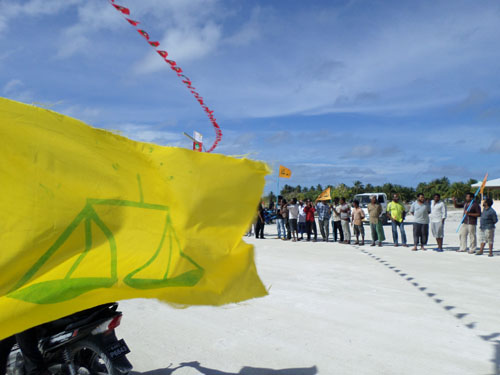
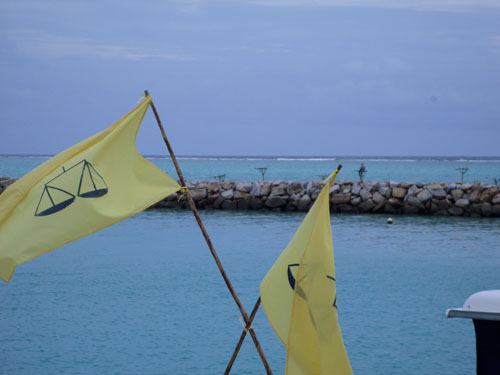
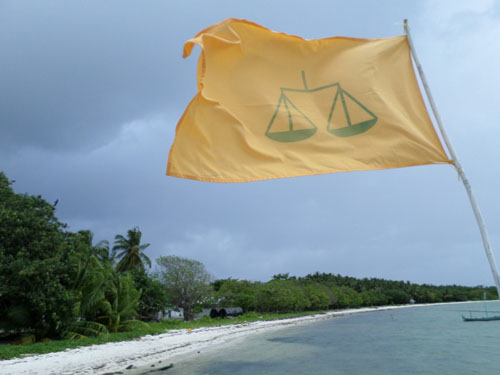
At Ameena and Dhonthu’s place there are about a dozen or so men busy festooning the house and its neighbour opposite with yellow MDP flags.

A woman wearing a hijab with only her eyes uncovered is standing under a palm-umbrella weaving a frangipani garland to present Nasheed with. Some men are trying to set up a temporary shelter of sea-blue canvas to provide shade during lunch.

Nasheed is due to arrive in about two hours, and there’s a feast being prepared here and in several kitchens across the island. Ameena is in charge of gathering it all in one place and serving it up. About twenty or so women have volunteered to cook – the plan is to prepare the dishes at home in their own time, and bring them over to Ameena’s for lunch.

As far as the official business of the campaign goes, Shifa Mohamed, Minister of Education in Nasheed’s cabinet, is in charge. The MDP campaign has divided the atolls into seven regions, with one designated head in charge of co-ordinating all efforts in a deignated region. Shifa is the head of the Northern Provices, and area containing the atolls of Haa Alif, Haa Dhaal and Shaviyani.

It is very easy to take to Shifa. She works without pretensions or fuss, and has an easy way with people. Having spent several weeks visiting houses in the area and co-ordinating Door to Door, ‘Shifa Madam’ is familiar to the people. On several occasions, women open up to her, voluntarily speaking of family woes and social troubles without reservation. Shifa is a good listener.

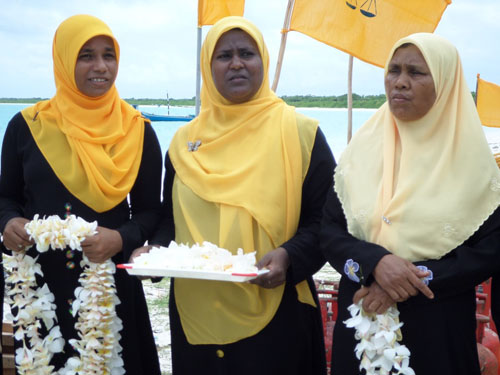
In the garden of Faalsaage, a wheelbarrow full of coconuts appears. One of the men shaves and cut the tips off the young kurumba to serve as a welcome drink when Nasheed and his team arrive. A woman sits at the corner of a table in the garden, frangipani garland in hand. She will be the one putting it around Nasheed’s neck when he comes.

To her right is another smaller table on which now stands a cake. ‘Happy Birthday, our hero,’ says the green and yellow cake. Two women stand near, swatting away flies with the intention of landing on their creation. One of the women is the same one in a hijab I noticed earlier.

“It was Nasheed’s birthday yesterday,” she tells me. There is excitement in her eyes, the only part of her I can see.

“He is our hero,” she repeats what they have already said in confectionary. With only eyes as a guide, I guess her to be anywhere between fifty and sixty years of age. A group of women collected MVR 20 (US$1.30) each, bought the ingredients, baked and decorated the cake, she tells me.

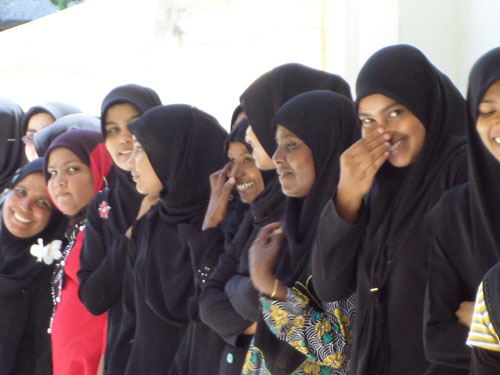
By noon, the steady trickle of women turn into a stream. Having cooked and delivered the food, all the women have returned in their best dresses to greet Nasheed. Almost all are wearing black from head to toe.

It is an astounding change from about a decade ago, when any gathering of Maldivian women would have brought together every colour of fabric under the sun. Today, the only relief from the monotone of black are bolts of canary yellow—women accessorising with yellow burugaas or children dressed in yellow.

When Nasheed arrives there’s close to a hundred women at the guesthouse. There are also about half that amount of men.

Nasheed shakes hands with them all, chats to people over his drink of fresh coconut, cuts the cake to the obvious delight of the women, and disappears upstairs with Shifa, a group of councillors and Hanimaadhoo’s resident campaign team. They will discuss the area’s Door to Door strategies.

Lunch is the feast that it promised to be. There is garudhiya, kulhimas, roshi, all sorts of mas-huni, faiy riha…a whole range of Maldivian dishes that taste as delightful as only island-home-cooked Maldivian dishes can taste.

As Nasheed rests, prays and strategises, I spend the time chatting to some women who still linger. They are waiting to say goodbye when Nasheed leaves for Kulhudhuffushi in a short while.

It is easy to chat with the women. Despite their attire, and the appearance of conservative religiosity, the women were as mischievous and their banter as full of flirtatious double-meanings as women in the region were famed for before Islamists began exercising control over the conduct of their daily lives and faith.

I learn from the women that this part of the island, closer to the airport, is where the people of Hon’daidhoo settled when they were relocated after the 2004 Tsunami wrecked their island. ‘The indigenous people of Hanimaadhoo live over on the other side,’ one of the women tell me.

Most of them, says Mariyam Nazima (35), are also on ‘the other side’ politically—that being supporters of PPM and Gayoom loyalists.

The women are eager to gossip. They tell me Waheed and Ilham have a holiday home on Hanimaadhoo and visited recently. ‘Waheed made it seem like he’s from the island,’ Nazima laughs. ‘But we knew they got land during an earlier decentralisation plan.”

I ask why they like Nasheed. “He’s like one of us. He treats us like equals,” she says. Other women on the jolis beside us agree. “He visits all the houses, rich and poor alike.”

On all islands that I visit with the MDP campaign team, this is what supporters point to as the reason they like Nasheed most: ‘he is one of us’.

Kulhudhuffushi

We arrive in Kulhudhuffushi at about 3:30pm in the afternoon by speedboat from Hanimaadhoo. People line the harbour area to welcome Nasheed. Here there are more men than there were in Hanimaadhoo, but the women still out number them by far. Nasheed will launch the Agri-Business policy at the school hall in Kulhudhuffushi in about half an hour. Close to 200 people attend.

The MDP’s Agri-Viyafari policy is ambitious. The plan is for the government to lease plots of land on various inhabited islands in each atoll, along with equipment, seeds, fertilisers and labourers to anyone interested in setting up a farm. The government will operate a mobile shop, a vessel called Fresh-Isles, which will be perpetually travelling to the islands and buying their produce.

“This way, all farmers will always be guaranteed a market,” Nasheed pledges.

Transporting local products to Male’ and other relatively large markets from their own islands is one of the biggest problems Maldivian farmers encounter today, Nasheed says.

This is a week in which such statements hit home. Newspapers are full of reports lamenting hundreds of thousands of lovely ripe mangoes from Fuammulaku that went rotten for lack of transport in the unusually rough weather. MDP’s AgriBusiness policy means a reduction in such losses.

“Farming should put Rufiya in the pocket, not just food on the table. It’s not about having enough muran’ga leaves to put in your omelette in the morning.” Over the course of the trip Nasheed warms to the muran’ga analogy and repeats it on different islands.

Currently the Maldives imports MVR 245 million (US$18.8 million) worth of agricultural products a year. AgriBusiness aims to slash the amount down to MVR 108 million (US$7 million), Nasheed tells Kulhudhuffushi.

“If we are going to reduce the amount of products we import, then we must increase the duty for those products” ensuring an attractive price for local products.

With plots of land, seeds, equipment and labour readily available for farmers to hire from the government, Nasheed says the AgriBusiness policy would increase national productivity by 1.7 percent. MDP will ensure the creation of at least a thousand agricultural experts in the country and will create 2500 new jobs for implementation of the policy alone.

Nasheed tells the people of Kulhudhuffushi that his government would have the farms and markets up and running within two and a half years. What MDP wants, Nasheed says, is the empowerment of people through their own industry, in public-private partnerships that opens up the country to the globalised market place, and puts money in all local pockets.

As Nasheed’s campaign has progressed, the gist of his speeches at policy launches has been this: Maldivians deserve better than their current hand-to-mouth existence. If people only stop to think about it, the Maldives has rich resources that can make the entire society wealthy rather than a handful of individuals filthy rich. People must reject habits of patronage ingrained in the ‘Maumoonism’ of the last 30-years and vote for an MDP government to, instead, work for a better life for themselves.

Agri-Business offers attractive prospects, and Nasheed is on top form in Kulhudhuffushi, bristling with energy and enthusiasm. Yet, the reaction among the crowd is somewhat muted. Nobody asks any questions when he opens up the floor. There’s applause at some points during the speech, but there is very little spontaneity among the audience.

“Kulhudhuffushi is always a difficult island. People are peculiar,” a campaign team member observes later, when I ask about the muted reaction. What ‘peculiar’ means is not defined by any of the several people who gives me the same response about the people of Kulhudhuffushi—‘eiee varah faadegge baeh’ [they are a very peculiar people].

A more likely explanation is the turbulent politics in the island’s recent history. On 8 February, when the police cracked-down brutally on MDP supporters in Male’, Kulhudhuffushi is one of several islands where people reacted with violence. There was an arson attack on the police station, and a further two incidents of unrest since. When Nasheed visited the island on 27 February 2012, tensions between MDP and PPM supporters broke out into direct confrontations.

At the moment, 28 MDP members (including two councillors) from the island currently stand accused of various charges ranging from terrorism to obstruction of justice. Eleven hearings were held on May 19, the day after Nasheed visited Kulhudhuffushi.

Kelaa

Kelaa is stunningly beautiful. It has long wide roads lined with lush vegetation, and beautiful houses on large plots of land with lovingly tended gardens rich with tropical flowers and fruits. There are several hundred more people gathered at the harbour as the sun sets to welcome Nasheed to Kelaa. The Kelaa crowd is the biggest, and the most unreservedly welcoming so far. In what I can identify as a pattern at this stage, men out-number women. Here, the gender gap is much smaller, though.

In Kelaa, there’s dinner, followed by a campaign speech by Nasheed at the main school hall at 9:30 pm. This rally is apart of Eh Burun (In One Round) segment of Nasheed’s campaign.

There’s excitement in the air. Kelaa supporters of MDP are enthusiastic and passionate about winning the elections. The councillor, Haulath Mahira, is on fire. She loudly denounces policies of the previous government, condemns the February 7 coup, and rallies the crowd to vote for Nasheed.

“We must not let ourselves be dragged back to those days,” she screams into the microphone. The crowd erupts into applause.

Kelaa welcomes the Agri-Business policy with loud hoots, cheers and claps. They are enthusiastic about the prospects and the potential it has for making their farming businesses more successful. The people of Kelaa are already committed farmers.

“We’ll buy everything. Everything,” Nasheed tells them to loud applause. He argues for public-private ownerships that opens the island up to numerous opportunities in the globalised world. Like in Kulhudhuffushi, he talks about forming partnerships with fast developing countries in the region and the rest of the world, and argues against protective nationalism and isolationism.

“We have been too hung up on ownership. Whether our partner in business is foreign or not, Kelaa will always belong to the people of Kelaa.”

Nasheed’s supporters lap up his digs at the opposition’s isolationist approach that has alienated several foreign investors during the last year. This is what the opposition media coverage of Nasheed’s campaign focuses on the next day.

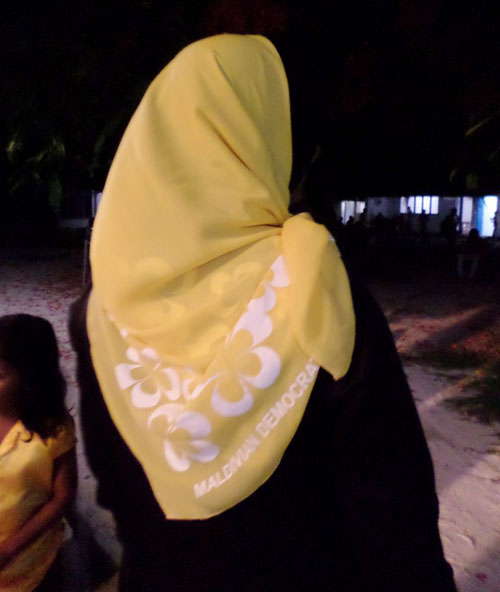
There’s bon’dibaiy after the hugely invigorating rally. I notice a woman wearing a yellowburugaa that has Maldivian Democratic Party printed on it. I wonder if it is unique, this new Maldivian habit of making their Islamic headgear also a political statement.

One woman from Filladhoo told me that there is a brigade of women on the island who support anyone but Nasheed. They change the colour of their burugaa according to party colours of whichever non-Nasheed candidate is visiting the island. Blue for Thasmeen, Pink for Gayoom Yameen, and so on. Talk about a mish-mesh of religion and politics.

We are leaving after breakfast, scheduled for 8:30am. I wake up early and use the time to catch up with an old Kelaa friend, a 44-year-old mother of four, and explore the island a bit. Kelaa is clearly more prosperous than other islands in the atoll.

The houses are large, well-built and modern. Several, however, are empty. Many families are forced to leave their life on the island for Male’ once their children near the end of their secondary school years.

“If we stay, what will happen to my daughter?” Shadiya asks me.

Shadiya, in her forties, lives in a beautiful house, painted completely yellow and boasting all mod-cons of modern luxury with her two daughters. Her husband works on a resort island near Male’, and can only visit occasionally.

Their older daughter is sitting GCE O’Level exams this year. “I want her to get an education, so we must go.” Reluctant to send their children to Male’ on their own for higher eduction, all parents who can afford it leave their comfortable houses for a cramped and difficult life in the city so their children can get the education necessary for university.

It is a sad sight to see, all the lovely houses in Kelaa standing empty and lifeless.

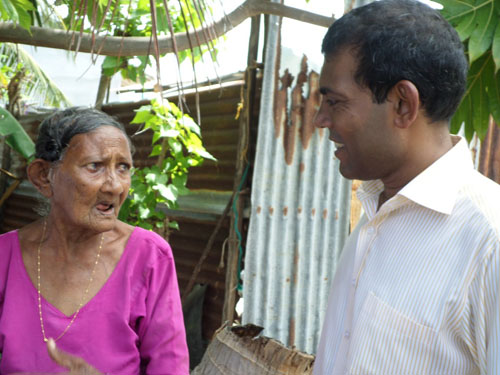
Along the way, we meet my friend’s 8 year-old mother-in-law. She is hobbling slowly with the help of a walking stick. Her mood seems despondent.

“I wanted to go to the harbour to greet Nasheed, but my bad knees won’t let me walk that far,” she explains. “I don’t know if I will live long enough to see him again.”

I have run into an elderly fan of Nasheed. Over the course of the day, I run into many more. Over 65s, I find out, are one of Nasheed’s core support groups.

Breakfast is at the Kelaa MDP Haruge. Yet another feast of Maldivian food prepared by women supporters who had stayed up the night to ensure everything on their candidate’s plate this morning is fresh. There is roshimashunikulhimas, sweet black tea and various kinds of curry. About twenty women are busy serving, exchanging easy banter, and glowing from the excitement of meeting Nasheed. “He is one of us,” they tell me.

Perhaps this excitement and adoration that Nasheed seems to evoke in his supporters is what incites the opposition’s frequent accusation that MDP is a cult led by Nasheed.

Filladhoo

Filladhoo is a small island with a population just over a thousand. On arrival, like on other islands, there’s coconuts waiting, and the news that forty people had signed for MDP overnight. Twelve of them were waiting to sign their membership forms in front of Nasheed.

Later he holds a policy meeting in the cramped living room of a small house—unlike Kelaa or Hanimaadhoo, there is no dedicated campaign headquarters for the team on this less well-off island.

Just as in Hanimaadhoo, here too, Nasheed’s voice carries loud and clear outside the room onto the street where we wait. The first stop in the door-to-door round of the afternoon is a house owned by an MDP family like Ameena and Dhonthu’s.

The woman of the house, Shaheedha Ismail, 50, has prepared a snack of aveli [an old Maldivian dish] for the team. Nasheed takes gamely to mixing the aveli and chatting to MDP members Shaheedha has invited to join.

One wall of the entire living room is filled with pictures of Shaheedha’s seven children at their respective weddings. Shaheedha, too, is an ardent fan of Nasheed and makes it a point to tell me that she always opens her doors for any activity that will benefit the party.

Why does she like Nasheed so much? “I want someone who lives like us,” Shaheedha says. “He has been very good to my parents.”

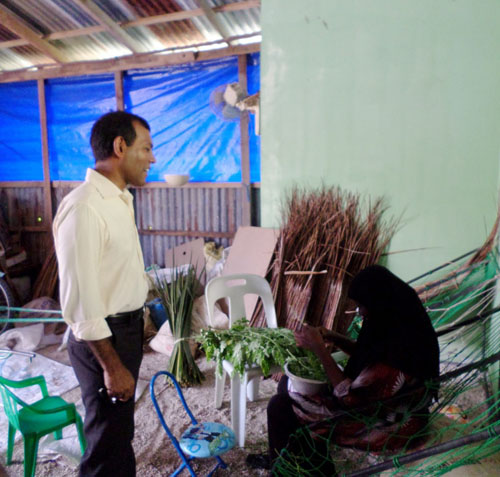
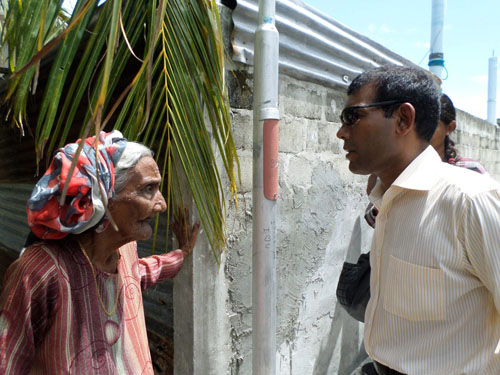
During the door to door visits, Nasheed catches up on the fate of a sick child, listens with concern to a woman’s worries about the treatment of her child at school, and is delighted to meet a woman cutting muran’ga leaves.

“This is a picture I want,” Nasheed says. “This is what I have been talking about – when our Agri-Business policy gets going, farming won’t be just about having enough muran’ga to put in your omelette.” There’s childish glee on his face to have come across what he sees as the actualisation of a picture he had earlier created with his words.

In one house Shifa listens to a woman tell her about a 35-year-old daughter with special needs that the State refuses to recognise as being in need of state benefits.

I learn that Filladhoo has been without a doctor, or even a community health worker for over three months. “The Health Ministry says it will send a doctor when it can,” she tells me. There is no knowing when that will be.

What happens in case of emergency?

One of the MDP volunteers tells me there were two emergencies in the last month – a school boy broke his arm and a man fell off a coconut tree breaking his leg. Both had to be taken to Kulhudhuffushi, all costs born by the patients and their families.

Previously, the people of Filladhoo could take a ferry to the island of Dhiddhoo for Rf20. Dhiddhoo has a hospital. But the ferries have been discontinued since the coup and anyone in Filladhoo unfortunate enough to suffer an illness or injury must hire a Dhoni for over 2000 Rufiyaa to take them to Kulhudhuffushi.

“Filladhoo’s pregnant women now travel to Kulhudhuffushi in their eighth month – with no doctor on the island, none of the women want to risk labour complications. Most have to stay in rented accommodation, accumulating huge expenses families find hard to bear”.

On the road back to the jetty, we meet a woman well in her eighties who cannot recall her exact age.

She is out on the street, holding her daughter’s hand to steady herself, on the off-chance of running into Nasheed. Nasheed chats to her easily, and tries to calculate her age from her earliest memories. She remembers Hassan Fareed very clearly, she says. Nasheed calculates her age to be roughly around eighty-five.

He’s still muttering about Hassan Fareed when he runs into another woman of about the same age. She, too, is lingering on a side street on the off-chance of running into Nasheed.

Before we get to the jetty, we meet a third woman in the same age group, waiting in a lane-way, alone.

“She has a tough time, that Dhaththa [older sister, generic term used for older women],” an MDP councillor explained. Her children do not want her supporting Nasheed.

Intimidation by children who do not want their elderly parents to support MDP or vote for Nasheed is a trend common to several of the islands. The women I talked to in Hanimaadhoo recounted several such stories, as did the ones in Filladhoo.

Some grown-up children, I learn, also confiscate their parents’ ID cards and bank cards, keeping the parent a virtual prisoner both politically and financially.

Baarah

The island of Baarah is shaped like a C, with the jetty right at the centre. On both sides is turquoise blue sea and a long white strip of beach lined with tall coconut palms and other large tropical trees. It is the island where national hero Boduthakurufaanu met his wife, and the island of Ramlah, the winner of the first Maldivian beauty pageant held back in the glory days of Mohamed Amin Didi.

Lunch is at a small restaurant attached to a house which opened its doors for MDP on Baarah. There is the usual splendid array of Maldivian food—rihaakuru garudhiyabambukeyo lee baiy,lonu mirus, even kan’doo from the kulhi with fresh grated coconut and grilled reef fish.

Over a dozen women move in and out of the restaurant area. Like on other islands, they have pooled their efforts to cook up the feast.

The men of Baarah are also surprisingly hands-on in serving food and overseeing lunch. We meet a most interesting man as we linger over the meal. Moosa Bey (Moosa Ibrahim) is a 75-year-old man who bursts into loud uncontrollable tears suddenly and without warning.

“I have a very big and very soft heart,” he tells us before beginning to cry loudly. It takes a few of us media people a good half hour of trying to console Moosa Bey to realise what the whole island already knows: Moosa Bey likes to act.

Still, he is a very likeable man, and we visit his house to meet his wife Faathuma. En route, he flirts  with the twenty-something year old volunteer who joined us from Kulhudhuffushi. He wants his picture taken with her.

Moosa Bey proudly claims that his house, almost complete now, is being built with the MVR 2000 (US$129) benefit for the elderly that he and his wife receives from the government every month. Moosa Bey’s house is modest, and there is no furniture just yet.

Walking around, I notice people here are even more polarised than on all the other islands we have been to. Non-MDP supporters are openly hostile, even to us ‘media people’ walking around with neither Nasheed nor any member of the MDP campaign team anywhere in sight. They refuse to smile or greet us, choosing instead to look on glumly, staring daggers.

It is sad to see traditional Maldivian hospitality vanishing in the strong emotions of partisan politics. I meet a twenty-something year old woman who is not an MDP supporter but is willing to talk. Only because she has a friend among the media.

I learn that on Baarah the PPM and/or ‘opposition coalition’ supporters are more forceful in intimidating MDP supporters than the men I heard about on other islands. “MDP members hired a woman’s Bodu Beru group to welcome Nasheed.

The group is composed mostly of members of DRP and supporters of Gayoom. The women were willing to play for money, though, Nasheed or not. But the men intimidated them into pulling out at the last minute. “They were going around making all kinds of threats,” she tells me.

It is around 4:00 p.m now and the trip is coming to an end. Nasheed leaves for Male’ at 7:30 pm and we need to be in Hanimaadhoo airport by 5:00. At the jetty, a fishing boat has docked. Women gather to buy the catch. One by one, they come back with varying amounts of fresh fish which they will cook at nightfall.

Nasheed will leave for Noonu Atoll tomorrow.

Dr Azra Naseem has a PhD in international relations

For more photos of the trip, visit Dhivehi Sitee Facebook Page

Likes(5)Dislikes(1)