Candidates to file for presidential election on July 15: Elections Commission

Candidates for the upcoming presidential elections scheduled for September 7 will be invited to file their candidacy with the Elections Commission (EC) from July 15, the commission has stated.

Along with opposition leader former President Mohamed Nasheed of the Maldivian Democratic Party (MDP), leaders of several political parties currently aligned with the current government of President Mohamed Waheed Hassan – including the incumbent – have publicly announced they will be competing for the office.

Leader of the Dhivehi Rayyithunge Party (DRP) Ahmed Thasmeen Ali, Leader of the Jumhoree Party (JP) and business tycoon MP Gasim Ibrahim and Parliamentary Group Leader of former President Maumoon Abdul Gayoom’s Progressive Party of Maldives (PPM), MP Abdulla Yameen Abdul Gayoom – who won the party’s controversial presidential primary beating rival Umar Naseer – have publicly announced their bids for the presidency.

Speaking Minivan News on Sunday, President of the EC Fuad Thaufeeq said that the opening of the candidacies was not a “new announcement” as the constitution required the commission to announce the presidential election 120 days prior to the end of the current presidential term, which expires in November 2013. Therefore, he said the opportunity to file for formal candidacy needed to be opened on July 15.

“From July 15, all prospective candidates will get a 10-day period to file their candidacy with us. This period will include public holidays as well. So the due date to file candidacy will be July 24,” he said.

According to Thaufeeq, the commission has begun preparations for the presidential poll and is currently working on finalising “regulations” concerning the election which he claimed would be completed within a week’s time.

During the period in which the commission opened the regulation for public commenting, the EC president said it had received significant support from major political parties including the MDP, PPM and DRP.

Apart from the political parties, Thaufeeq also said that local NGO Transparency Maldives had also given very “constructive comments” on the draft regulation.

Transparency recently published a comprehensive pre-election assessment, highlighting vote-buying, political polarisation, and credibility as critical challenges for the 2013 elections.

The election was set to take place “against a context of uncertainty, crises of political legitimacy and unprecedented levels of political polarisation,” the NGO noted.

The Elections Commission has meanwhile revealed that this year’s presidential elections – which will be the country’s second multiparty presidential poll since the formation of political parties in 2005 – will see 31,000 new voters casting their vote.

According to the statistics from the commission, the total number of eligible voters for the election stands at 240,302 – 31,008 more than the number of eligible voters in the 2008 presidential elections (209,294).

The commission in March also opened registration for voters who are currently not residing on the island where they are initially registered to vote, in a bid to increase voter turnout for the 2013 election.

According to the statistics published at the commission’s website, voter turnout for the first round of the 2008 Presidential Elections stood at 85.38 percent with a slight rise in the second round of polling, at 85.58 percent.

The President is elected through a universal suffrage ballot where a candidate must obtain a minimum margin of 50 percent plus 1 vote to secure an election victory. Should any of the candidate contesting in the election failed to get the required number of votes, a run-off election is held after a 20-day period contested by the two candidates with the largest share of votes, to decide the winner.

Former President and the opposition MDP’s presidential candidate Mohamed Nasheed predicted that he would win the election in the first round while the remaining government-aligned candidates have maintained the winner of the elections will be decided in a run-off election, where losing parties form coalitions with either of the two remaining candidates.

Despite the claim, the opposition MDP have claimed that they do not plan to go into a power-sharing coalition with parties, elaborating that coalition governments were incompatible with the country’s presidential system of governance.

Nasheed – who was elected as the President in 2008 with the backing of then-coalition of parties “Wathan Edhey Gothah Iththihaadh” which fell apart within the first year of his presidency – previously claimed that he along with all political leaders of the country had tasted the “bitter lesson” of incompatibility of coalition governments and described that the idea of coalition governments contrasted with the spirit of the constitution.

Likes(0)Dislikes(0)

Coalition governments incompatible with presidential system, contends former President Nasheed

A coalition government with cabinet posts divided among parties is not compatible with the presidential system envisioned in the Maldivian constitution, former President Mohamed Nasheed reiterated during campaign rallies at Fuvahmulah and Addu City this weekend.

Addressing large crowds in the two southernmost atolls, the Maldivian Democratic Party (MDP) presidential candidate accused mogul politicians of forming political parties only to offer its members “on a platter” to negotiate coalition agreements.

“[They say] my party will enter a coalition with your party if I can get this many seats in cabinet, that many judges, as well as a large warehouse and two resorts,” Nasheed said in Fuvahmulah on Thursday night (April 25), adding that “business” deals were made between leaders while party members remained “oblivious.”

Nasheed had previously characterised the cabinet of President Dr Mohamed Waheed as less of a team committed to shared goals than a group of individuals with divided loyalties and disparate ideologies often working at cross-purposes.

Both the Maldives’ own experience of ruling coalitions as well as lessons from “human experience” have established the conditions whereby such alliances could govern effectively without becoming unstable, Nasheed observed.

“In a presidential system, dividing the cabinet into four or five parts is not something we could do under any circumstances, [and] it is not something permitted by the Maldivian constitution either,” Nasheed said in Fuvahmulah.

According to the constitution, Nasheed continued, cabinet ministers are appointed by the president and are sworn to serve at his pleasure.

The constitution does not permit cabinet ministers to take orders from their parties instead of the president, Nasheed added.

Coalition governments therefore went against “the spirit of the constitution,” said Nasheed, and could not function under a presidential system.

Nasheed repeated the criticism of power sharing coalitions in his speech the following night (April 26) in Hithadhoo, Addy City.

The incentive for the proposed “broad coalition” to compete against the MDP was the hoped-for rewards of government posts and the country’s resources, such as uninhabited islands, to be divided among coalition partners, Nasheed contended.

Power sharing agreement

Nasheed’s remarks came while parties in the ruling coalition led by President Dr Mohamed Waheed are reportedly engaged in discussions over power sharing agreements.

However, in addition to President Waheed’s Gaumee Ihthihad Party (GIP), all major government-aligned parties have fielded presidential candidates, including MP Abdulla Yameen from the Progressive Party of Maldives (PPM), MP Gasim Ibrahim from the Jumhooree Party (JP) and MP Ahmed Thasmeen Ali from the Dhivehi Rayyithunge Party (DRP).

Smaller parties such as the religious conservative Adhaalath Party and the Dhivehi Qaumee Party (DQP) – led by Special Adviser to the President Dr Hassan Saeed – have entered into a coalition with Dr Waheed’s GIP.

While business magnate Gasim Ibrahim is reportedly in talks with Dr Waheed over a potential power sharing agreement, the JP presidential candidate has said he would not consider becoming the running mate of any other candidate.

At its recently-concluded fourth congress, DRP Leader Thasmeen meanwhile dismissed the possibility of a coalition with either the PPM or MDP.

The PPM was formed in 2011 by DRP founder, former President Maumoon Abdul Gayoom, following months of factional squabbling and an acrimonious war of words between the PPM figurehead and his successor at DRP.

MDP rally in Addu City

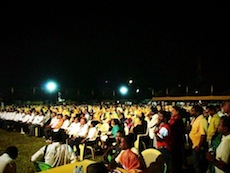
PPM MP Ahmed Nihan told Minivan News last week that parties in the ruling coalition needed to reassess their views on power sharing after thousands of people attended a MDP rally on April 19 to celebrate the signing of Speaker of Parliament Abdulla Shahid.

In his speech at the MDP rally in Addu City last night (April 26), Shahid meanwhile said that 1,300 people have signed for the party during the past week.

Speaking at his first MDP rally on April 19, Shahid pledged to carry out a recruitment drive across the country to bolster the party’s membership strength ahead of the September presidential election.

Likes(0)Dislikes(0)

Umar Naseer dismissed from PPM, local media reports

Umar Naseer has been dismissed from the the government-aligned Progressive Party of Maldives (PPM) over allegations made following his unsuccessful bid to become the party’s presidential candidate, local media has confirmed today.

The Sun Online publication today reported that Naseer has been sent an official notice of dismissal invalidating his PPM membership.

Following the PPM primary last month, Naseer alleged that his opponent MP Abdulla Yameen controlled all of the party’s organs, including the council and election committee, and had “rigged” the vote in his favour by ballot stuffing, falsifying the count and “pouring black money” to buy votes.

He further alleged that Yameen, half-brother of former autocratic ruler, Maumoon Abdul Gayoom, was fully backed by the former president’s family and PPM parliamentary group, as well as criminal gangs, convicts and drug smuggling “networks”.

A case against Naseer was heard by the PPM’s internal disciplinary council on April 14 over the nature of possible action taken against him after he refused to apologise to Yameen or defend himself at the subsequent disciplinary hearing.

When contacted by Minivan News today, a spokesperson for Umar Naseer refused to confirm if such a notice had been received.

“I’m sorry, but we do not give interviews to Minivan News,” the spokesperson said.

PPM MP Ahmed Mahloof was meanwhile not responding to calls from Minivan News. Fellow MP Ahmed Nihan had his phone switched off at time of press.

“Not in the mood”

Nihan told Minivan News earlier this week that Naseer had failed to respond, either verbally or in writing, during a seven day period provided by the PPM’s disciplinary hearing to retract the allegations he had made.

“It seems he was not in the mood to follow the party’s charter,” Nihan added, pointing to several media reports that Naseer had taken a role in discussions to form a broad coalition of government-aligned parties behind current President Dr Mohamed Waheed ahead of the presidential election scheduled for September 7 this year.

However, local newspaper Haveeru has reported that Naseer himself has questioned the legality of any action to remove him from the PPM while the Civil Court is in the process of hearing a case on whether to invalidate the outcome of the PPM primary.

PPM member Rahma Moosa lodged the case earlier this month claiming 8,915 people who were not officially registered as members of PPM had been allowed to vote in the primary.

The PPM has previously said that although the additional persons had not been registered at the Elections Commission by March 10, they were allowed to vote as they had submitted membership forms to the party.

PPM formation

The PPM was formed by former President Gayoom back in 2011 together with a breakaway faction from within the Dhivehi Rayyithunge Party (DRP).

The DRP – the first political party formed by Gayoom back in 2005 – was split into two factions of supporters backing former president Gayoom and those supporting his successor as DRP Leader, Ahmed Thasmeen Ali.

Infighting in the party had intensified from back in December 2010 after Umar Naseer was dismissed as the DRP’s Deputy Leader following a vote by the party’s disciplinary committee.

Likes(0)Dislikes(0)

Airport’s 2014 refurbishment was 25 percent complete prior to GMR’s termination: Auditor General’s Special Audit

The government has released a Special Audit by the Auditor General (AG) into the former government’s concession agreement with Indian infrastructure giant GMR, ahead of upcoming arbitration proceedings.

The two parties agreed to commence arbitration proceedings in mid-2014, following a preliminary meeting in London on April 10 this year.

GMR is seeking US$800 million in compensation for the sudden termination of its 25 year concession agreement, while the Maldivian government has contended it owes nothing as the contract was ‘void ab initio’, or invalid from the outset.

The AG’s report notes that Axis Bank is separately seeking repayment of US$160 million in loans to GMR, which were guaranteed by the Maldives’ Finance Ministry.

“Under the terms of the direct agreement, these loans would be repayable if the concession was terminated early, as defined in the direct agreement. The government contends, however, that if the concession agreement is void ab inito, then these terms do not apply.”

Report

The AG’s report reveals that concession revenue due the government plummeted fourfold in 2012 as a result of the Civil Court case – filed by the Dhivehi Qaumee Party (DQP) in 2011 – blocking the charging of an Airport Development Charge (ADC) to outgoing passengers as stipulated in its concession agreement.

Net concession revenue in 2011 of US$25,424,877 fell to just US$6,058,848 in 2012, after GMR Male’ International Airport Limited (GMIAL) deducted the ADC from the concession fees due to the government – a stopgap measure approved by the Nasheed government while it sought to appeal the ruling. However, the DQP, in coalition with other opposition parties, came to power following the controversial transfer of power on February 7 2012, before the appeal was complete.

“The new government took the view that it would not be proper for it to intervene in the legal process for the benefit of a private concern,” the report stated. Instead, on April 19, 2012, MACL informed  GMIAL it was “retracting the previous agreement [to offset the ADC] on the grounds that the then Chairman of MACL did not have the approval of the MACL board to make the agreement.”

GMIAL asserted that this decision was a political event as defined within its concession agreement, and warned that “this would amount to a breach of the agreement by the government. The government did not accept this argument.”

By the end of 2012, GMIAL had withheld a total of US$22.9 million from the concession fee paid over to MACL, 79 percent of the total fee that would otherwise have been due, the report noted, adding that the decision by the Transport Minister and MACL Chairman to agree the offset had been sent to the Anti-Corruption Commission on the grounds that the decision had required presidential approval.

Prior to the court ruling, GMIAL’s audited net profit for the period November 25, 2010 to December 31, 2011 was US$26,141,438. During this period GMR paid US$30,327,644 in concession fees to government.

GMIAL’s pre-tax profit for the first nine months of 2012 was US$31,668,384, on total revenue of US$184,641,985 (US$125,193,817 of this consisting of fuel sales).

MACL’s own net profit was US$14.9 million in 2008 and US$16.6 million in 2009 – the last two full years in which it operated the airport prior to the concession agreement coming into force. In 2010, this increased to US$21.4 million, and in 2011, US$27.4 million.

Fuel sales

The AG’s report examines fuel sales at the airport in light of the new government’s criticisms of GMIAL’s management, in particular an increase in prices it claimed had driven away airline operators.

The analysis showed “a mixed picture”, according to the AG’s report. Sales had dropped to 143 million litres in 2009 from 160 million litres in 2008, but rose from 166 million litres in 2010 to a five-year high of 173 million litres in 2011. The figure dropped to 152 million litres in 2012 – almost entirely due to a decision by SriLankan Airlines to stop fueling its London-Colombo route in Male.

“Until 2012, Sri Lankan Airlines’ daily London-Colombo flight called at Male’ to refuel but no longer does so; SriLankan Airlines told us that the increased price of fuel at Male’ was one of the reasons they stopped doing so. In 2011, Sri Lankan Airlines bought some 18 million litres of fuel, so this change along represents a significant reduction in airport fuel sales,” the report suggested.

It also noted that the Ministry of Tourism had blamed a 25 percent decline in seat capacity on routes from Europe between 2010 and 2012 on higher fuel prices, although this hypothesis did not appear to be reflected beyond SriLankan Airlines in the amount of fuel sold in 2012.

Bidding process

The report examined the bidding process conducted by the World Bank’s International Finance Corporation (IFC) in which the airport was awarded to GMR. The report stated that evidence to back allegations of “improper interference” during technical bidding process “is not conclusive on this point”, and deferred the matter to the Anti-Corruption Commission (ACC).

However, the report noted that the IFC’s terms of reference involved “securing the best deal for the government in terms of the concession fee paid to the government and MACL, and did not consider impacts on the Maldivian economy.”

“Such impacts could be both negative and positive,” the report suggested.

“For example, there has been concern that Maldivian businesses working at the airport might not have their contracts renewed, and that proposed commercial development at the airport would take business away from existing local businesses. Conversely, Scott Wilson’s work in 2008 suggested that successful development of the airport could benefit employment both at the airport itself and more widely in the Maldivian economy, and the rents from commercial development could increase the concession fee paid to the government,” it explained.

Future

The report noted that at time of publication, the government had not announced how it intended to take forward development of the airport, but noted that Universal Chairman Mohamed Umar Manik and four other directors had been appointed to the board of Male’ International Airport Limited (MIAL). Bandhu Ibrahim Saleem has meanwhile been appointed Managing Director.

According to an independent engineering report, as of October 31 2012 GMR Male International Airport (GMIAL) had completed 25 percent of the refurbishments and upgrades to Ibrahim Nasir International Airport planned for the end of 2014, and had been invoiced by its contractor for US$69 million.

“Significant progress had been made in some areas – for example, 87 percent of the material for land reclamation had been dredged,” the AG’s report noted.

However, according to the engineering report, work was 155 days behind schedule after the new government order GMIAL to stop work “pending regulatory approvals”.

“In the meantime, all work on the ground on the improvement to the airport has ceased. Sensitive elements of the new structures that had been planned by [GMR] are incomplete and exposed to the weather and at risk of damage – possibly closing off the option of re-using these elements to reduce the cost of any future development of the airport,” the report concluded.

Read the full report (English)

Likes(0)Dislikes(0)

Maldives resumes CMAG participation ahead of presidential elections

The Maldives government said it has been “welcomed” back as a fully participating member in the Commonwealth Ministerial Action Group (CMAG) during the group’s 39th meeting held in London yesterday (April 26) following its suspension last year.

Minister of State for Foreign Affairs Dhunya Maumoon stated this week that the invitation for the Maldives to attend the CMAG meeting reflected the “recognition” of the work by President Dr Mohamed Waheed government’s in “strengthening democracy in the Maldives”.

The opposition Maldivian Democratic Party (MDP) meanwhile said it understood the country’s participation in CMAG was a diplomatic attempt to ensure free and “inclusive” elections went ahead in September of this year. The opposition party contended that the elections were also expected to be scrutinised by a number of international groups including the Commonwealth.

The Maldives was suspended from CMAG – the Commonwealth’s democracy and human rights arm – back in February 2012 following the controversial transfer of power that saw former President Mohamed Nasheed resigning from office after a mutiny by sections of the police and military.

By September 2012, the suspension was revoked after a Commonwealth-backed Commission of National Inquiry (CNI) concluded the previous month that the transfer of power was legitimate, that former President Nasheed was not under duress, and that there was no police mutiny.

The findings were later accepted by former President Nasheed, albeit with reservations over evidence and witness statements he claimed had not been considered in the final report.

The stance was claimed to have been taken by the former president in order to facilitate the CNI’s recommendations concerning judicial independence and a strengthening of democratic institutions.

According to the Maldives government, CMAG is charged with reviewing “serious and persistent violations of the Commonwealth’s fundamental political values”.

Return to CMAG

Taking his place at the CMAG meeting on Friday, Minister of Foreign Affairs Dr Abdul Samad Abdullah joined his counterparts from Australia, Bangladesh, Canada Jamaica, Sierra Leone, Tanzania, Trinidad and Tobago and Vanuatu to review developments in Fiji as part of the group’s formal agenda.

According to a commonwealth statement, CMAG’s latest meeting was focused predominantly on ensuring democratic developments in Fiji, including calls for constitutional reform to uphold the rule of law, while also ensuring structures were in place for hosting “credible elections” where all political parties and candidates can contest fairly.

CMAG alos used the meeting to welcome the adoption of the Charter of the Commonwealth by various heads of government, as well as other key figures in the intergovernmental organisation.

“The charter reaffirmed the Commonwealth’s commitment inter alia to democracy, human rights, the rule of law, separation of powers, freedom of expression, good governance, tolerance, respect and understanding and the role of civil society,” read an official statement. “As the custodian of the Commonwealth’s fundamental political values, [CMAG] pledged to continue to promote these commonly agreed goals.”

Political solution

Following yesterday’s meeting, MDP MP and Spokesperson Hamid Abdul Ghafoor told Minivan News that considering national democratic developments, he believed the Commonwealth continued to expect three key requirements of the Maldives ahead of elections.

Ghafoor claimed that along with conducting the CNI last year, the Commonwealth has also required free and “inclusive” elections that would allow former president Mohamed Nasheed to stand as the MDP’s candidate. He added that September’s elections were also required to be monitored by experts such as a Commonwealth team in the run up to, and during polling.

Nasheed’s participation in the elections has been in doubt over his ongoing trial for the controversial of a Criminal Court Judge while he was in power – charges that could see him unable to contest in polls this year should he be found guilty. The trial is presently suspended pending a court ruling on the legitimacy of the establishment of the court and panel of judges chosen to overhear the case.

Ghafoor claimed that the MDP, despite previous concerns about the CNI, welcomed the Commonwealth’s commitments for “inclusive” elections, especially considering findings by a number of international legal experts disputing whether Nasheed could expects a free trial as a result of alleged politicisation in the country’s courts.

However, he added that the party also hoped for a transitional administration to replace President Waheed’s government ahead of September’s voting.

“The Commonwealth’s three requirements are welcome, but we would also like to see an interim arrangement that would see this coup administration out,” he alleged. “This is something we believe that can be achieved.”

Ghafoor said that he remained unsure if the Maldives, which last September was retained on the CMAG agenda under its “Matters of Interest”, was still being monitored by the body in terms of the nation’s commitments to human rights.

Ahead of the Maldives removal from suspension of CMAG last September, former Foreign Minister and current UN Special Rapporteur to Iran, Dr Ahmed Shaheed said at the time that the country’s removal from the agenda would be “a travesty” – accusing the government of committing “reprehensible actions” following the CNI report’s release.

“Things are not going well in the Maldives – the government is intent on persecuting Nasheed and the MDP (Maldivian Democratic Party)”, he claimed at the time. “They seem hell bent on repressing the people.”

Ahead of Friday’s CMAG meeting, several NGOs complied a so-called joint human rights brief accusing the Maldivian government of failing to create conditions conducive to free and fair elections

The International Federation for Human Rights (FIDH) and the Maldivian Democracy Network (MDN) alleged there were “clear signs indicating that the coalition government in power since February 2012 has so far failed to set the conditions for free and fair elections in which ‘all parties and leaders are able freely to conduct election campaigns’.”

Meanwhile, Back in January this year, the Maldives was one of two countries to have been dropped from NGO Freedom House’s list of electoral democracies following the release of an annual survey of political rights and civil liberties.

Freedom House is an independent, non-government watchdog organisation dedicated to the expansion of freedom around the world. The NGO assesses and scores countries for political rights and civil liberties each year, and labels them ‘free’, ‘partly free’, or ‘not free’.

Contested inclusion

The Maldives government has continued to contest whether the Maldives should have ever been included on the CMAG agenda.

Minister of State for Foreign Affairs Dhunya Maumoon has previously claimed that the country’s inclusion has been a result of a “lack of understanding of the true events that transpired in the Maldives.”

“Some countries” had realised this error and accused Nasheed of influencing CMAG members, she alleged.

In April 2012, Maldives’ permanent representative to the EU Ali Hussein Didi criticised the Commonwealth’s involvement in the Maldives, telling the European Parliament that CMAG lacked a clear mandate to place the Maldives on its agenda.

Likes(0)Dislikes(0)

Comment: Gloomy outlook for CMAG

Outside Marlborough House on London’s Pall Mall yesterday, the sun shone brightly. Then the clouds rolled over bringing rain. There was a brief shower of hailstones before the skies cleared again to bring more sunshine.

Further down the street, I saw paint drying. I digress, but only to due to the fact that events outside of the 39th meeting of the Commonwealth Ministerial Action Group (CMAG) were eminently more interesting than those occurring inside.

After a short meeting, the group released a bland statement which would have disappointed both Maldivians and Sri Lankans who waited outside, urging the group to take action against their respective governments. Neither country even made it onto the ‘official agenda’ disclosed to the public, with discussions on Fiji being the only content that saw the shifting light of day.

After an allegedly dramatic meeting in New York last September, the Maldives was informed that it would be allowed to resume its current (rotating) membership of the group “in the absence of any serious concerns”.

The complete failure to mention the Maldives yesterday suggested that it had resumed its seat, a move which suggested the group was satisfied with the Maldives implementation of CoNI’s recommendations. However, the fact that the country is now placed on CMAG’s confidential ‘matters of interest’ list alongside Sri Lanka – a country facing universal condemnation for its failure to adequately investigate war crimes that have killed up to 40,000 people in 2009 – is hardly a ringing endorsement.

The secretive and often counter-intuitive nature of CMAG signifies a major dilemma as it attempts the private and painstaking art of diplomacy in the full glare of the world’s media. During Friday’s press conference, Secretary General Kamalesh Sharma batted away suggestions that the Commonwealth was out of step with the international community, whilst one disgruntled minister was reported to have commented during the meeting that they should not be held to ransom by human rights groups.

Throughout the press conference, there was a clear (but diplomatic) frustration with the media’s inability to appreciate the Commonwealth’s work.

“If anything, the Commonwealth is making a contribution to the international community because, if you look at who is making statements and who is doing the real work on the ground, you will be able to tell the difference. It is the Commonwealth who is on the ground and making a difference on those issues which most people are talking about,” bristled Sharma.

Diplomacy is by its very nature dull. It is about taking small steps, confidence building, discretion, and, above all, dialogue. The art of diplomacy and partnership is how the Commonwealth has always operated, and these are methods to which the supposedly beefed up CMAG is an anathema.

Apparent difficulties with the Maldives and Sri Lanka have made it abundantly clear that CMAG is doing the Commonwealth more harm than good. Steady (and secret) progress may well have been made in both cases, but without the ability to communicate this progress to the world, the Commonwealth’s credibility will inevitably suffer.

Sharma yesterday argued that the organisation’s “real work on the ground” was in fact increasing its credibility. This might true in the murky realms of statecraft, but any boosts to the Commonwealth’s integrity will come in spite of, rather than thanks to, the work of CMAG.

Sharma told the press that CMAG was choosing to work via his own ‘good offices’; diplomatic-speak for ‘behind closed doors’. Perhaps this is where the Commonwealth’s ‘real’ work should stay, as its attempt to be more proactive and relevant risk nullifying its strengths. Maybe the Commonwealth’s inner workings should be kept private and we could talk about the weather instead.

All comment pieces are the sole view of the author and do not reflect the editorial policy of Minivan News. If you would like to write an opinion piece, please send proposals to [email protected]

Likes(0)Dislikes(0)

Gross state reserves to reach US$310 million by June, MMA Governor warns parliament

The head of the Maldives’ central bank, Fazeel Najeeb, has warned parliament that the country’s gross state reserves will drop to US$310 million in two months due to outstanding debts.

The statement by the governor of the Maldives Monetary Authority (MMA) follows confirmation from Finance Minister Abdulla Jihad this week that the government had suspended new development projects due to shortfalls in revenue, and was in the process of drawing up a supplementary budget.

“This is not a healthy level. The existing amount is equivalent to that needed for imports of the next two months. The best practice is to have funds for imports needed for six months,” local media reported Najeeb as telling parliament’s finance committee.

The government trying to address the problem by selling bonds to foreign countries, he said, noting that the overdrawing of the state account was “common” as a result of cash flow constraints.

He dismissed rumours that the MMA had recently frozen the state’s current account, but said there were ongoing discussions to increase the state’s overdraft limit from MVR 140 million (US$9 million) to MVR 200 million (US$13 million).

Earlier this month, India’s Financial Express publication reported that Axis Bank had initiated an arbitration process to recover US$160 million in loans granted to infrastructure developer GMR, which were guaranteed by the Finance Ministry during the former administration.

The developer was given a seven-day eviction notice late last year after the new government declared that its 25 year, $US$511 million contract to upgrade and manage Ibrahim Nasir International Airport (INIA) was ‘void ab initio’ (invalid from the start).

The Attorney General (AG’s) Office at the time denied receiving any notice of arbitration from Axis Bank.

Maldivian President Dr Mohamed Waheed meanwhile told a rally on Thulusdhoo last Saturday that there was no cause to worry about the budget or rumours of impending bankruptcy.

“The Maldivian economy is not really that bad,” he declared.

However, the president acknowledged that as a consequence of deficit spending financed by loans, the government had to spend an amount almost equal to the state’s wage bill on interest and loan repayments.

“We Maldivians are not indebted to anyone. We are proud people. We pay back what we borrow. We don’t have any outstanding payment, to any party,” Dr Waheed said in his speech, according to the President’s Office website.

Likes(0)Dislikes(0)

Independent MP Ali Mohamed joins MDP

Independent MP for Noonu Velidhoo Ali ‘Alibe’ Mohamed joined the opposition Maldivian Democratic Party (MDP) on Thursday, the former ruling party’s Parliamentary Group Leader MP Ibrahim ‘Ibu’ Mohamed Solih has confirmed.

Solih told newspaper Haveeru that MP Ali Mohamed’s membership form would be sent to the Elections Commission (EC) by the end of the day.

MP Ali Mohamed’s signing has given new strength to the party, Solih added, and expressed confidence that the MDP would get a majority of votes from the new MP’s constituency.

MDP won four out of five island council seats in Velidhoo in February 2011. At a recent rally on the island, a large number of youth signed for the MDP during a visit by former President Mohamed Nasheed.

Solih told Haveeru that the party was confident of winning a majority in Holhudhoo as well, the other island island in MP Ali Mohamed’s constituency.

Ali Mohamed – who is among senior MPs who chairs parliamentary sittings in the absence of both the speaker and deputy speaker – was elected to parliament on a DRP ticket.

He resigned from the party in mid-2011 and began working as an independent MP. Ali Mohamed voted with the MDP to pass the previous administration’s tax bills.

He however voted against the MDP to appoint Jumhooree Party (JP) presidential candidate and MP Gasim Ibrahim to the Judicial Service Commission (JSC).

Solih meanwhile suggested that several politicians were closely observing the changing political landscape, predicting that more MPs would join the MDP in the near future.

Ali Mohamed’s signing to MDP comes shortly after Speaker of Parliament Abdulla Shahid also made the switch from the government-aligned Dhivehi Rayyithunge Party (DRP).

Addressing MDP supporters at his first rally, Shahid said he joined the opposition to “prevent the window to democracy from being closed”.

“As our hearts yearned to stay in these gardens for good, an attempt was made to try and close this window. An attempt was made to extinguish that glow of hope in people’s hearts. It was the courageous members of MDP who obstructed the powerful forces that tried to close this window to democracy.” Shahid said during the rally held by MDP to announce his arrival.

“Today, I am here with all of you brave, steadfast warriors to prevent that window from being closed,” he added.

Earlier this month, local media speculated that a number of MPs were on their way to join the opposition, including MPs Alhan Fahmy (Independent), Abdulla Abdul Raheem (JP), Mohamed ‘Colonel’ Nasheed (DRP), Ali Azim (DRP) and Hassan Adil (JP).

Minivan News was unable to confirm the reports at time of press as none of the MPs were responding to calls.

MDP Spokesperson MP Hamid Abdul Ghafoor previously speaking to Minivan News claimed that “a re-alignment in favour of the opposition was definitely happening”.

“I can confirm for you as I am a parliamentarian myself that several parliamentary groupings who previously stood behind the old dictatorship are slowly dismantling now. They have now started to realise that backing an old dictatorship is wrong,” said Ghafoor at the time. “I can guarantee you that a re-alignment is definitely happening and dismantling of the old dictatorship is imminent.”

Ghafoor however declined to reveal any names.

Following the signing of MP Ali Mohamed and Speaker Shahid, the number of MPs representing the opposition MDP now stands at 31, eight short of a simple majority in the 77-member house.

Parliament breakdown by party (prior to rumoured defection of five DRP MPs):

MDP 31

PPM 19

DRP 10

JP 3

PA 1

DQP 1

Independent – 10

Likes(0)Dislikes(0)

No US base under discussion, only joint training exercises: Defence Minister

Defence Minister Mohamed Nazim has said there is no proposal to establish a US base in the Maldives, and that a ‘Status of Forces Agreement’ (SOFA) currently under discussion only concerns joint military training exercises between the two nations.

“It is an agreement signed to carry out military training exercises with other countries. There is no proposal to establish a US military base in the Maldives. The government won’t give that opportunity to any country,” Nazim told local media.

“The US has proposed joint military training exercises with our forces. The proposal is being discussed with the relevant authorities of the Maldives. The agreement will be signed on the advice of the Attorney General,” he added

The US Embassy in Colombo has also refuted reports of a planned US military presence in the Maldives.

“There are no plans for a permanent US military presence in Maldives. SOFAs are normal practice wherever the Unites States cooperates closely with a country’s national security forces. SOFAs generally establish the framework under which US personnel operate in a country when supporting security-related activities and the United States is currently party to more than 100 agreements that may be considered a SOFA,” an Embassy spokesperson told Minivan News on Wednesday.

An apparent draft of the SOFA agreement was published by Maldivian current affairs blog DhivehiSitee on Wednesday.

The draft outlines conditions under which US personnel and civilian staff would operate in the Maldives, granting them freedom of movement and the diplomatic immunities of the Vienna Convention, authority to carry arms, use naval and aerial base facilities, and the radio spectrum. US personnel in the Maldives would be subject to US laws and exempt from paying taxes and any undergoing any form of customs inspections.

Under the proposed 10 year agreement outlined in the draft, the Maldives would moreover “furnish, without charge” to the United States unspecified “Agreed Facilities and Areas”, and “such other facilities and areas in the territory and territorial seas of the Republic of Maldives as may be provided by the Republic of Maldives in the future.”

“The Republic of the Maldives authorises United States forces to exercise all rights and authorities with Agreed Facilities and Areas that are necessary for their use, operation, defense or control, including the right to undertake new construction works and make alterations and improvements,” the document states.

The US Embassy in Colombo was unable to verify the authenticity of the leaked draft, “as the agreement has not been finalised.”

Likes(1)Dislikes(0)