MP allowance debacle “not a mix-up”: State Finance Minister

The Finance Ministry today rejected implications that yesterday’s release and recall of the controversial Rf20,000-a-month committee allowances against a court injunction was a mistake which had caused confusion in the government.

“I don’t think it’s a mix-up,” said State Minister of Finance Ahmed Assad today. Assad was unclear about the court injunction.

“Releasing that sort of money is not a big procedure, I think this is just people trying to follow the general rules and experiencing an administrative error,” he said.

Assad didn’t believe anyone deserved blame, and said that “if anything, it is the ministry at large that was at fault.”

Local daily Haveeru yesterday reported that the allowances had been issued “by mistake.”

Finance Minister Ahmed Inaz had not responded to Minivan inquiries at time of press.

The court injunction, which was issued on September 26, ordered the Finance Ministry not to release funds for the committee allowance until the court rules on a case filed on behalf of a civil servant, contending that the allowance could not be given before deducted amounts from civil servants salaries were paid back.

The injunction has since been appealed by the Attorney General’s Office at the High Court, which is due to hold a first hearing on Sunday.

Parliamentary privileges

Meanwhile parliament yesterday debated a motion without notice proposed by Vilufushi MP Riyaz Rasheed claiming that a civic action campaign launched by concerned citizens in late August violated MPs’ special privileges.

MDP MP Ahmed Easa told Minivan News yesterday that colleagues had said the allowance was being released to the parliament secretariat, but he was told that it had been held back by the Minister of Finance.

“I don’t think there was any wording, anything in what the court said indicating that they couldn’t release the money,” said Easa. “But no money has been going in to my account today, I can tell you that.”

Easa elaborated on the allowance, saying that the amount of staffing support and allowances other government branches received justified MPs accepting the proposed allowance.

“The MP point of view is that some of the independent wages and allowances are greater than MPs. The MPs are expected to do research and other duties, but we don’t have an office, a supporting staff, a phone allowance, a travel stipend to visit constituents or other things to support our work. Seven percent of our salary is taken out for a pension fund, and Male’ is an expensive place to live,” said Easa.

Easa said he will accept the allowance, but pointed out that he had always objected to it in parliament on the grounds that all payrolls should be streamlined.

“But if these other government groups are taking an allowance, why not the MPs? This is a democracy, so I always respect the majority decision.”

Lawyer Mohamed Shafaz Wajeeh, one of two lawyers involved in the civil case, argued that the number of people benefiting from the allowance does not justify the sum released, which amounts to Rf18 million (US$1.1 million).

“It’s greed. Just greed,” Shafaz said. “MPs and higher-ups in the government are probably more aware of their own power than they should be. The thinking behind this goes against everything we know.”

Shafaz suggested the government consider other options, such as releasing the allowance in installments to lighten the burden on the state budget and other subsidiaries.

“But I’m not sure how much political will there is to do this. Everyone says the allowance is a good idea.”

Civil society

Although members of the civil sector earlier issued a statement objecting to the allowance, which they called “a gross injustice to the Maldivian people,” they have not articulated an official position on the issue of late.

Maldives Democracy Network (MDN) Director Fathimath Ibrahim Didi said that individuals in the organization were involved at the beginning, but that they did not represent MDN.

“Now, I think there may be a group working against the allowance, but it is loosely formed involving people from NGOs, lawyers and individuals,” she said.

Transparency Director Ilham Mohamed told Minivan News that a volunteer team was addressing the matter, but that large protests had not been organized among local non-government organizations (NGOs).

“I believe there may be sporadic gatherings in different places,” said Mohamed. “I do know that the NGOs that were involved in the original statement opposing the MP allowance are unified on this issue.”

“Symbolic”

The decision to approve the Rf20,000 (US$1200) monthly allowances in December 2010 was met with  protests and widespread public indignation. However in June this year, parliament rejected a resolution proposed by opposition Dhivehi Rayyithunge Party (DRP) MP Ahmed Mahlouf to scrap the allowance.

Meanwhile the current civic action campaign was prompted by parliament’s Public Accounts Committee (PAC) deciding in late August to to issue a lump sum of Rf140,000 (US$9,000) as committee allowance back pay for January through July this year.

Article 102 of the constitution states that parliament shall determine the salaries and allowances of the President, Vice President, cabinet ministers, members of parliament, members of the Judiciary, and members of the independent institutions.

The Rf20,000 allowance was initially approved on December 28, 2010 as part of a revised pay scheme recommended by the PAC.

During yesterday’s debate on a privileges motion regarding the anti-committee allowance campaign, MP ‘Colonel’ Mohamed Nasheed, a member of the PAC, explained that the committee felt that MPs should earn a higher salary than High Court judges.

“But even then the honourable members of the Public Accounts Committee believed that MPs were receiving a sufficiently large salary in relation to the country’s economic situation,” he said, adding that a decision was made to institute a “symbolic” committee allowance.

“The thinking at the time was to give it to MPs who attend committee meetings as a very symbolic thing, for example one laari or 15 laari. But to ensure that take-home pay for MPs would be Rf82,500,” he said.

However, he continued, this “noble effort” became politicised and the subject of “an anti-campaign programme.”

Colonel called for legal action against the activists “when they go beyond the boundaries of free expression” and the right to protest, claiming that MPs’ families and children had been targeted.

Echoing a claim made by a number of MPs yesterday, Colonel said none of his constituents had asked him to decline the allowance.

Likes(1)Dislikes(0)

Sri Lankan special forces bring bark to SAARC

Sri Lanka will provide security from its Special Task Force (STF) units for the South Asian Association for Regional Cooperation (SAARC) summit to be held in Addu City this November.

STF is an elite special forces unit of the Sri Lankan police which was formed in 1983, and focuses on counter-terrorism and counter-insurgency operations. It was the lead unit engaged with the Tamil Tigers during the Sri Lankan civil war.

The Foreign Ministry and the Maldives National Defense Force (MNDF) confirmed today that STF will be sending police dogs to support unidentified security matters.

“Previously, security dogs were allowed at the international airport, I’m not sure if they are still there but Maldivian law allows dogs to be used for security measures,” said MNDF Spokesperson Abdul Raheem.

“The dogs will clear the same areas as the event and other security forces, but I can’t say what they will be looking for,” he added.

Dogs are considered haram in Islam, and are prohibited as domestic pets in the Maldives. An exception was made for drug-sniffing and security dogs at Ibrahim Nasir International Airport, however sources familiar with the issue say local staff were unable to provide proper care for the dogs and they fell ill.

Allegations of religious intervention were denied.

President’s Office Press Secretary Mohamed Zuhair told Minivan News that the STF dogs would not be an issue for the SAARC event. “We had dogs earlier for security without any trouble, I don’t see why anybody should object because the government has officially employed dogs before,” he said.

All countries participating in the SAARC convention are providing security forces. According to Zuhair, Bangladesh has donated trucks to the army, India is contributing police forces, and equipment with an estimated value of US$400,000 will be arriving from Pakistan in the next few days.

China will provide CCTV equipment for surveillance.

“It’s a well-integrated and cooperative effort with MNDF and all participating members,” said Zuhair, who pointed out that Addu was a unique site for an event of this magnitude.

“The last SAARC was held in Male’, but this time the event will be spread across several islands. Transportation logistics will be different,” said Zuhair.

Raheem said security preparations are under way for SAARC, and that MNDF “is sure that things will be to our satisfaction.”

Heads of state from the region will be attending SAARC, several of which are currently high-profile figures in the international community.

“We have to look at this as a high-risk event. Some heads of state are high-risk, but we are treating each and every head of state as high-risk to ensure their security,” said Raheem.

Local media reports that STF forces have been having special training programs in the Sri Lankan capital Colombo to prepare for the Addu event.

Correction:

The previous version of this article stated that Pakistan would provide US$4,600-worth of equipment to the SAARC summit security measures.

It should have read, “equipment with an estimated value of US$400,000 will be arriving from Pakistan in the next few days.”

Likes(1)Dislikes(1)

Government plans to sell Dhiraagu shares to foreigners, claims PPM

The government’s decision to offer 15 percent of its shareholdings in local telecom giant Dhiraagu for sale to the general public is intended to benefit foreign parties, the incipient Progressive Party of Maldives (PPM) alleged today.

At a press conference this afternoon, PPM Spokesperson MP Ahmed Mahlouf claimed that the party has learned through “inside information” that the government planned to sell a large portion of the shares up for sale through the Initial Public Offering (IPO) to British company Cable & Wireless, which currently owns the majority stake of Dhiraagu.

The government sold seven percent of its shareholding in Dhiraagu to Cable & Wireless in 2009 for US$40 million.

“While claiming to sell 15 percent to Maldivian citizens what they’re doing now is selling shares to Cable & Wireless again,” Mahlouf said. “We received inside information long ago that a large part of that 15 percent is going to be bought by Cable & Wireless.”

The MP for Galolhu South expressed concern with the shares being open for purchase by both foreigners and international companies.

He added that the Maldivian people would have to face “the bitter consequences” of the Maldivian Democratic Party (MDP) government “selling off state assets built up by the former government through a lot of hard work.”

Economic Development Minister Mahmoud Razi however dismissed the allegations as completely unfounded.

“Why would we register with the CMDA (capital market development authority) and go for an international public offering if we wanted to do that?” he asked. “We’ve already sold them the majority stake.”

If the government wished to sell shares to C&W, he added, there would be “no need of a charade.”

In a press release issued after a ceremony to launch the IPO this week, Dhiraagu stated that 11,400,000 ordinary shares having a nominal value of Rf2.50 each at the offer price of Rf80 per share would be made available to the public.

The subscription period will open on October 25 and close on November 30. Formed in 1988 as a joint venture between the government and Cable & Wireless, Dhiraagu has since invested US$155 million in developing its network and operations within the Maldives. The company employs more than 600 people, 99 per cent of whom are Maldivians.

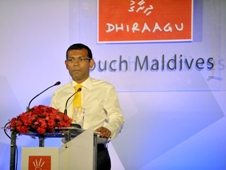
President NasheedSpeaking at the IPO launching ceremony Tuesday night after releasing the Dhiraagu prospectus, President Mohamed Nasheed said the government’s aim was to divest its remaining 33 percent to the public at a later date.

The MDP government’s policy was to ensure that the government would no longer be involved in business, said Nasheed, reiterating the government’s commitment to free market principles and economic liberalisation.

“The government is very much certain that profits increase manifold when the government is not involved [in doing business],” he said. “This became most clear when the airport was privatised. Did you know that before [Indian infrastructure giant] GMR took over [management of] the airport, in the year that the government received the highest amount from the airport company to the state budget, it was Rf100 million (US$6.4 million). Usually it is Rf75 million (US$4.8 million). This year the government will receive Rf600 million (US$39 million).”

Likes(0)Dislikes(0)

Finance Minister condemns Public Accounts Committee Chair

Finance Minister Ahmed Inaz has said that the Rf456,000 (US$31,000) issued to Maldives Media Association (MMA) according to the Finance Report sent by the ministry to parliament was actually issued to Maldives Media Council (MMC) and not to the dissolved NGO MMA.

”It was technically a typing error, we sent the Public Accounts Committee a report consisting information about some of the recent transactions, and the Public Accounts Committee’s Chair MP Ahmed Nazim [who is also the Deputy Speaker of the Parliament] asked us to send detailed information of all the transactions mentioned in the report,” Inaz explained.

He said the ministry then sent the committee details of the transactions in the report, which still had the typing error uncorrected.

”We did not identify that error, and after we sent the details, the chair of the committee told the media that we have used Rf456,000 from the contingency budget to pay salaries of MMA staff,” he said. ”Actually it was used to pay the salaries of MMC staff.”

Inaz said he regretted that Nazim had not verified the typing error with the ministry before going to the media.

”We send the report to the parliament to cooperate with them and to assist them in making us accountable, I attended the committee three days in a row this week and we do not have a policy of withholding information,” he said, adding that he condemned Nazim’s actions and hoped that he would not repeat such things in the future.

”I also apologize to MMA members, but the responsibility goes to the Chair of the Public Accounts Committee as well,” Inaz said. ”Things like this make the ministry lose the confidence we have in the Chair of the committee.”

Nazim told local media this week that a report submitted by the Finance Ministry showed that over Rf450,000 from the state budget was issued to the MMA.

In the wake of the revelation, the Maldives Journalists Association (MJA) and senior members of the now-defunct Maldives Media Association (MMA) called on the Auditor General and Anti-Corruption Commission (ACC) to investigate the alleged Rf456,000  released from the state’s contingency budget.

Likes(0)Dislikes(0)

DRP threatens disciplinary action against two councillors

The opposition Dhivehi Rayyithunge Party (DRP) has threatened disciplinary action against two of its councillors in Fuvahmulah after the pair voted against the party line in a no-confidence motion against the Dhadimagu ward council chair.

A press statement from the party noted that Hussein Ihsan and Mohamed Farish ignored instructions from the party’s administration.

The DRP council will discuss possible disciplinary action against the pair at its next meeting, the statement said.

Likes(0)Dislikes(0)

Campaign against committee allowance violates privileges, say MPs

Parliament today debated a motion proposed by Vilufushi MP Riyaz Rasheed claiming that a civic action campaign against controversial Rf20,000-a-month committee allowances approved last year violated MPs’ special privileges.

Presenting the motion without notice, Riyaz Rasheed, the sole Dhivehi Qaumee Party (DQP) representative in parliament, contended that the campaign by the group of concerned citizens was intended to bring MPs into disrepute and undermine MPs’ honour and dignity.

Riyaz said he proposed the motion in protest of the activities against the committee allowance because “no one has said anything while they’re putting up pictures of MPs all over Male’.”

A loose association of concerned citizens and members of local NGOs launched a campaign in late August after parliament’s Public Accounts Committee (PAC) decided to issue a lump sum of Rf140,000 (US$9,000) as committee allowance back pay for January through July this year.

“The chapter on rights and freedoms in the constitution guarantees right to [respect for] private and family life [article 24],” Riyaz continued. “Therefore no one could try to defame us. We have not betrayed the public. We have done things for the benefit of the people.”

Riyaz proposed that parliament should officially ask police to investigate the activists after the Privileges Committee reviews his motion.

After the motion was presented, MPs voted 16-3 with nine abstentions to open the floor for a debate.

Honour and dignity

Most MPs from both the ruling and opposition parties supported Riyaz’s motion, criticising the methods employed by the social activists, which they argued incited contempt towards MPs.

Several MPs claimed that they had not received any complaints or angry phone calls from constituents demanding that they refuse the allowance.

MPs also alleged that unsuccessful candidates for parliament were behind the campaign, which was motivated by “personal grudges” and a desire to diminish the standing of sitting MPs in a bid to defeat them in 2014.

Moreover, several MPs argued that unlike government ministers and judges, MPs did not have office space, staff or state vehicles.

While MP Ali Waheed characterised the campaign as “a military attack,” MP Ilham Ahmed criticised the activists for misleading the public into thinking that the “unborn allowance” had already been given.

Ilham alleged that activists in the campaign were “three or four kids that Ibra [President’s Advisor Ibrahim Ismail] sends out,” adding that “making my wife’s ID card number public” went beyond the right to free expression and protest.

Other opposition MPs criticised the NGOs for not launching similar campaigns or protests against the government’s contentious decisions, such as refusing to reimburse civil servants, floating the exchange rate or not handing over the state broadcaster to the parliament approved Maldives Broadcasting Corporation (MBC).

“The main intention of the people who are protesting is to bring Majlis into disrepute among the public and violate privileges,” claimed Independent MP Ahmed Amir, backing Riyaz Rasheed’s proposal to investigate the campaign and take legal action.

MP Ahmed Rasheed of the ruling Maldivian Democratic Party (MDP) meanwhile revealed that the activists met him to discuss the allowance and he had declined to refuse it.

“I am saying very clearly, these people who have come out in the name of civil society organisations are working with the hope of contesting and winning a seat in the 2014 parliamentary election,” he claimed.

MP Ibrahim Muttalib, who recently signed for the Adhaalath Party, meanwhile said he had pledged to decline the allowance if the activists would agree to join him in protesting “on issues of national importance.”

Muttalib repeated claims by other MPs that former MP Ibrahim Ismail was orchestrating the campaign.

“I don’t believe that the constitution of this country was sent down in a revelation to the chairman of the drafting committee [Special Majlis MP Ibrahim Ismail] by the Vatican city,” said MDP MP Mohamed Musthafa, adding that he would decline the allowance only if President Mohamed Nasheed asked it of him, but the President had not done so to date.

MP Ahmed “Redwave” Saleem, who recently signed for former President Maumoon Abdul Gayoom’s Progressive Party, implied that Ibra lost the use of his legs as “a punishment from God.”

“He [Ibra] says I’m the one who drafted the constitution, tomorrow he might say I’m the one who drafted the holy Quran,” said Saleem.

MP Ahmed Mahlouf, who submitted a resolution to scrap the allowance in June, criticised the social activists for not defending or backing him at the time when he was accused of self-aggrandizement.

Freedom of expression

Only a few MPs, including MDP MPs Mariya Ahmed Didi, Imthiyaz Fahmy, Ilyas Labeeb, Eva Abdulla and Hamid Abdul Gafoor, spoke against the motion and disputed the notion that the civic action campaign violated MPs privileges.

Hamid proposed a comprehensive review by parliament of salaries and allowances for state employees, which was seconded by MP Mahlouf.

Mariya, former chairwoman of the MDP, said it was “regrettable” that criticism of MPs had prompted a motion claiming violation of parliament’s privilege.

Prior to the parliamentary election, said Mariya, her constituents had complained that the Rf62,500 monthly salary for MPs was too high.

“So I definitely accept that the people will criticise us taking an additional Rf20,000,” she said. “So when the people talk about it on the media, and even if they draw our cartoons, we have to accept it since we come here to advocate on their behalf and we live in the public eye.”

Likes(0)Dislikes(0)

MJA calls for investigation into release of Rf456,000 to defunct media association

The Maldives Journalists Association (MJA) and senior members of the now-defunct Maldives Media Association (MMA) have called on the Auditor General and Anti-Corruption Commission (ACC) to investigate an alleged Rf456,000 (US$31,000) released from the states contingency budget.

The MMA – not to be confused with the Maldives Media Council (MMC) which is currently facing legal action for paying members almost Rf 1 million in ‘living allowances’ -was registered as an NGO in 2007 and was active for a year. However the NGO ceased its activities and many of its board members resigned.

Deputy Speaker of Parliament and Chair of the Public Accounts Committee, MP Ahmed Nazim, told local media this week that a report submitted by the Finance Ministry showed that over Rf450,000 from the state budget was issued to the MMA.

“According to the NGOs Act, the Maldives Media Association was supposed to be dissolved for being inactive for a long time, but the Home Ministry has not yet announced it has been removed from the NGOs list,” the MJA said in a press release. “It is astonishing to hear that such a large sum of money has been given to the MMA from the state budget to pay their staff.”

The MJA said it understood that information on assistance given to the MMA was stored at the Information Department, and called for an investigation.

State Tourism Minister Mohamed Thoyyib was the last President of the NGO, and other figures such as Mohamed ‘Hiriga’ Zahir, who is the current editor of Sun Online and Maldives Media Council member, along with Maldives National Broadcasting Corporation (MNBC) Sub-Editor Ahmed Muhsin, were all senior members of the MMA.

Finance Minister Ahmed Inaz told Minivan News that he was not sure how the allegations surfaced.

“We are currently trying to determine whether it actually happened,” Inaz said, adding that the ministry would put out a press statement explaining the incident.

Hirigia, who was a senior member of the MMA, told Minivan News that the NGO had received no money from the government when it was active.

“We call on the Auditor General and Anti-Corruption Commission (ACC) to investigate this matter and we call on the government to tell everyone where the money really went,” Hiriga said. “It’s been almost 24 hours since the Public Accounts Committee told the media about this, and still the Finance Ministry has not said anything about it.”

The emergence of the issue indicated that the government may have been misusing funds out of the contingency budget, he said.

“There will be still more than Rf60,000 of the Maldives Media Association’s money stored in the Information Department, we want to know what happened to that as well,” Hiriga said.

The then-President of the Maldives Media Association, currently State Minister for Arts and Culture Thoyyib Mohamed, said that the association received no money from the government.

”We did not receive any money from the government, maybe there is confusion in the Finance Ministry,” Thoyyib said.

Likes(0)Dislikes(0)

Dhiraagu launches IPO

Telecommunications giant Dhiraagu launched its Initial Public Offering (IPO) last night to offer 11.4 million shares (15 percent of the company’s stake) to the public at a rate of Rf80 per share from December 25 onward.

At a launching ceremony last night, Customer Services and Sales Director Ali Riyaz explained that application forms as well as the prospectus would now be available from Dhiraagu front offices and Bank of Maldives branches.

The forms would not be available for download for security reasons, he said. Completed forms are to be submitted between October 25 to November 30.

Meanwhile special seminars in Male’ and the atolls are being planned to provide information to the public.

The company revealed this week that it earned Rf968 million (US$62.7 million) as profit in 15 months with an income of about Rf2.5 billion (US$162 million).

Speaking at the ceremony, President Mohamed Nasheed revealed that the government intended to sell its remaining 33 percent share of the company to the public.

Likes(0)Dislikes(0)

US funds digital preservation of traditional Maldivian love ballad

The United States Embassy in Sri Lanka has awarded Maldives’ Hulhevi Media US$25,000 towards their project, “Research, Documentation and Preservation of the Buruni Ballad.” Over the next five months, the team will produce the first digital recording, transcription and documentary video of the traditional love epic, “Buruni Kamana Raivaru.”

The 6-hour oral history has never been transcribed. It has generally been considered the Maldives’ version of “Romeo and Juliet.”

The tragic love story of Dhon Hiyala and Alifulhu is set against a background of magic, jealousy and revenge. After rejecting the king’s advances, the heroine Dhon Hiyala and her lower-class lover Alifulhu are forced to commit suicide by jumping onto a giant, poisonous jelly fish.

Experts view the epic as more than a literary treasure; it is also a guide to cultural history. Told in great detail, the epic describes ancient Maldivian customs such as feasting, marriage, fishing, and arts.

The US Ambassador’s Fund for Cultural Preservation has supported over 640 cultural heritage preservation projects in over 100 countries for the past 11 years, donating approximately US$26 million to these endeavors.

“Heritage is a reminder of the historical experiences and achievements of humanity,” said US Ambassador to Sri Lanka and the Maldives Patricia  Butenis at today’s ceremony. “The more we know about each others’ traditions, the more common ground we share.”

The ambassador noted that this is the first time the fund has supported intangible heritage. “This project in the Maldives is about culture in its most basic form – the spoken word,” said Butenis.

This year, the Fund for Cultural Preservation awarded funding to three projects, two in Sri Lanka to preserve historic sites and one in the Maldives. Director of the American Center in Colombo Christopher Teal called the Buruni Ballad project an original and exciting first for the fund.

“We believe this is important, and we strive to provide funding to support the desire and expertise that is already there,” said Teal.

Hulhevi Media is an independent film group which produces documentaries on a wide range of issues including domestic violence, sexual abuse, and disabilities. The group has worked with NGOs including the Red Cross and the United Nations, and has been selected at several international film festivals. The team of four will travel to islands related to the oral history to record it in digital format, along with interviews.

Sharif Ali, Ibrahim Yassir, Ahmed Shafeeu, and Yumna Maumoon will be working on the project, which they described as “urgent.”

“There are only a handful of people who can tell the story today, and many of them are quite old, so time is critical here,” said Ali. “Working on a cultural preservation project, we will be going back to see what we have lost.”

The team aims to produce an audio CD and a transcription of the epic. “We do hope the book will be used extensively for literary analysis, and can be integrated into the education system,” said Shafeeu.

The epic has been used in secondary schools, but the team hopes it will be used more broadly in the education system.

The story was published as prose in 1976 by the renowned Dhivehi language scholar Abdullah Sodiq.

“I heard this same ballad (raivaru) being sung by the famous Kafa Kuda Thakkaan in a house in the Galolhu ward of Male’. As I listened my heart went through inexplicable feelings. This was no longer just a ballad, it was a fascinatingly beautiful romantic story told in a special raivaru form of rhyme and rhythm,” Sadiq said in a press statement.

Sadiq will advise the Hulhevi team on the Buruni Ballad project. “I never thought it would get this kind of help, I am very excited about this,” said Sadiq after today’s ceremony.

The Hulhuvi team said they were “elated” to receive the award after submitting their proposal a year ago. “It came out of the blue. And it’s great because it’s different from what we normally do. We are essentially a video production group, but with this project we’ll also be collaborating on linguistics and audio,” they said.

In September, the Maldives signed the UNESCO Convention for the Safeguarding of the Intangible Cultural Heritage. It is already a participant in the World Heritage Convention and the Cultural Diversity Convention.

At the time, Minister of State for Tourism, Arts and Culture Ahmed Naseer said no efforts had been made in this department. “It is very easy to see things like poetry, music, language, and dance disappear if they are not practiced. We need to have a law enacted to outline these practices.”

A draft of new legislation promoting the preservation of intangible cultural heritage is currently before parliament, Naseer said previously.

Likes(1)Dislikes(0)