MP Nihan elected chair of budget review committee

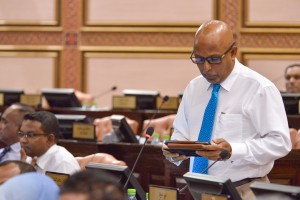
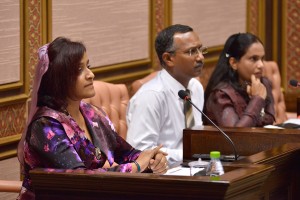
Progressive Party of Maldives (PPM) MP Ahmed Nihan has been elected chair of parliament’s budget review committee at the first meeting of the committee today.

Coalition partner Maldives Development Alliance (MDA) MP Ali Mauroof was meanwhile elected deputy chair.

The 24-member budget review committee is comprised of the economic affairs committee and public accounts committee.

While Nihan – PPM parliamentary group leader and majority leader – was elected with 21 votes in favour, Mauroof was elected with 15 votes.

The committee has 13 MPs from the ruling PPM-MDA coalition, seven opposition Maldivian Democratic Party MPs, and four Jumhooree Party MPs.

At its first meeting today, the committee decided to complete its review of the record MVR24.3 billion annual state budget presented at yesterday’s sitting by Finance Minister Abdulla Jihad by December 1.

Article 96(b) of the Constitution states, “The People’s Majlis may approve or amend the budget submitted by the Minister of Finance as in its discretion it deems fit.”

Likes(0)Dislikes(0)

Maldives not obliged to consult neighbours before joining China’s Silk Route, says foreign minister

The Maldives, as an independent and sovereign nation, is not obliged to consult other countries before making foreign policy decisions, foreign minister Dunya Maumoon told the People’s Majlis today.

The foreign minister appeared in parliament to respond to a question tabled by opposition Maldivian Democratic Party (MDP) MP Ahmed Nashid concerning the Maldives’ participation in the Chinese ’21st Century Maritime Silk Route’ initiative.

President of the People’s Republic of China Xi Jingping has called on the Maldives “to get actively involved” in the creation of a maritime trade route linking China to the east coast of Africa and the Mediterranean.

Nashid, MP for Shaviyani Komandoo, asked whether neighbouring countries in the Indian Ocean were consulted before the decision was made.

“If we join this project, is it likely that the longstanding close relations we have with neighbouring countries could be adversely affected?” he asked.

In response, Dunya noted that the agreement signed with the British in 1965 to secure independence “states in clear language that the Maldives is not obliged to consult or seek consent or approval from any other nation to implement Maldivian foreign policy.”

Former Presidents Ibrahim Nasir and Maumoon Abdul Gayoom did not join any “military or political alliance” during the Cold War, she added, out of fear of losing the independence gained in 1965 as the Maldives would be obliged to consult major powers before making foreign policy decisions.

“We should all know that the interest of any foreign country should not take precedence over Maldivian national interest,” she said.

MDP MP Ibrahim Mohamed Didi – a retired brigadier general – asked whether relations with India could deteriorate if Chinese naval activity is conducted in a Maldivian port, which would threaten Indian “geopolitical interests”.

Dunya declined to answer citing national security concerns and advised raising the issue through parliamentary committees.

Asked if India has expressed concern with the decision, Dunya said the Indian government also welcomed the Silk Route initiative during Chinese President Xi’s visit to New Delhi in September.

Foreign policy

Dunya said President Abdulla Yameen’s foreign policy was based on Article 115(d) of the Constitution, which states that the president has a duty “to guarantee the independence and territorial integrity of the Maldives, and to promote respect for national sovereignty in the international community.”

The government decided to participate in the Silk Route initiative as it would promote national interest and benefit the Maldivian people through trade and commerce, she said.

Dunya referred to a joint communique issued during President Xi’s state visit in the Maldives in September, which declared that the Maldives “welcomes and supports the proposal put forward by China to build the 21st Century Maritime Silk Road, and is prepared to actively participate in relevant cooperation”.

Fostering ties with South Asian countries and ensuring national security was one of the most important aims of the government’s foreign policy, she continued, noting that Maldivian security was intertwined with Indian Ocean regional security.

The Maldives would consult all nations and work together to ensure regional security and stability, she assured.

Former President Mohamed Nasheed has criticised the decision to join the Silk Route initiative, contending that it would threaten Indian Ocean security and risk putting the Maldives in the middle of war or disputes between Asian powers.

China’s rising economic presence in the Indian Ocean region has stoked concerns in New Delhi that China is creating a “string of pearls” to encircle India, including Chinese investments in ports and other key projects in Sri Lanka and Pakistan.

Asked if closer ties with China would adversely impact relations with India or Japan, President Yameen told reporters upon returning from a visit to China in August that Sino-Maldives economic cooperation would not affect “the very friendly, close relations with India”.

“All these projects are also open to India and we are doing a lot of diplomatic work with India,” he said, referring to his administration’s decision not to sign a Status of Forces Agreement (SOFA) with the United States as an example of cooperation.

Likes(2)Dislikes(0)

President Yameen inaugurates Hoarafushi sewerage project

President Abdulla Yameen officially inaugurated a sewerage project on the island of Hoarafushi in Haa Alif Atoll yesterday.

The Ministry of Housing and Infrastructure awarded the project to the Malé Water and Sewerage Company (MWSC).

After the inauguration ceremony, President Yameen also visited Haa Alif Kulhudhufushi yesterday. He is due to return to the capital, Malé, today.

Likes(1)Dislikes(0)

Missing Maldivian surfaces in Bangkok

A Maldivian citizen reported missing in Malaysia five months ago has handed himself into consular staff in Bangkok.

Hamdhan Mohamed made himself known to Maldivian consular officials yesterday, with Malaysian High Commissioner Mohamed Fayaz telling local media that the 28-year-old was in good health.

Authorities began the search for Hamdhan in June after he failed to board two booked flights back to the Maldives. Interpol later issued a missing persons notice.

Fayaz told media that the cause of the disappearance was still unknown, but that a team from the High Commission in Malaysia would now travel to Thailand to meet with Hamdhan.

Likes(1)Dislikes(0)

Amendments to Clemency Act sent to committee

Amendments to the Clemency Act submitted by Progressive Party of Maldives (PPM) MP Ahmed Thoriq was accepted for consideration at today’s sitting of parliament.

Following preliminary debate, MPs voted unanimously to send the amendment bill (Dhivehi) to the national security committee for further review with 62 votes in favour.

According to Thoriq’s amendments, convicts would be eligible for presidential pardon or reduction of sentences after serving one-fourth of a jail term. The period is currently one-third of a sentence.

Thoriq also proposed adding drug trafficking to crimes for which convicts would not be eligible for pardon.

Likes(1)Dislikes(0)

Public debt to reach MVR31 billion by end of 2014, reveals finance minister

Public debt is expected to reach MVR31 billion (US$2 billion) or 67 percent of GDP at the end of 2014, Finance Minister Abdulla Jihad has revealed.

“Despite achieving economic progress, the Maldivian economy is fragile and the Maldives’ financial situation is not in the most appropriate state at present,” Jihad cautioned in his budget speech at parliament today.

“The main reason for this is the year on year increase of the budget deficit and the state’s debt because of expenditure being higher than state revenue in recent years,” he explained.

The country’s balance of payments worsened and foreign currency reserves dwindled as a result of both the persisting fiscal deficit as well as outflow of foreign currency, Jihad added.

He noted that the dramatic increase of expenditure on public sector wages, subsidies, and social security programmes was also responsible for the fiscal imbalances.

Expenditure on state employees in 2014 would reach MVR15.8 billion (US$1 billion), Jihad observed, while MVR3.2 billion (US$207 million) would have been spent on subsidies and social security benefits.

Out of every MVR100 collected as revenue or income, Jihad explained that MVR40 was spent on employees and MVR22 on social protection and subsidies.

Consequently, the government was facing serious difficulties in “managing the state’s cash flow and financing the budget” as well as securing loans for budget support, Jihad said.

The budget was mainly financed by selling and rolling over treasury bills (T-bills), he said, which involves repayment at high interest rates.

According to the central bank, the total outstanding stock of government securities was MVR13.6 billion (US$881 million) at the end of September.

The growth in government securities was contributed by the increase in the amount of T-bills issued by the government to manage its cash flow requirements,” reads the Maldives Monetary Authority’s (MMA) latest monthly economic review.

Targeting subsidies

In May, Jihad continued, the government ceased obtaining funds from the central bank to finance the budget and the inflation rate has remained low as a result.

The government has also decided to freeze hiring new employees in 2015 in favour of conducting training programmes and optimising productivity. The defence minister last week criticised civil servants, saying they were providing “poor service” to the public.

Parliament needed to pass legislation on the state’s wage policy for a lasting solution to discrepancies in pay among state institutions, Jihad suggested.

He also revealed plans to revise the electricity subsidy, which he said currently benefits the affluent more than the needy.

Targeting the electricity subsidy to low-income families or households would save 40 percent of the government’s expenditure on the subsidy, Jihad explained.

The government was also working on revising the Aasandha health insurance programme – expanded by the current government – to ensure sustainability, he added, in addition to plans to target food subsidies in 2015.

In May, MMA Governor Dr Azeema Adam called for “bold decisions” to ensure macroeconomic stability by reducing expenditure – “especially the un-targeted subsidies” – and increasing revenue.

The MMA had previously warned that shortfalls in revenue and overruns in expenditure could jeopardise the country’s debt sustainability.

The International Monetary Fund (IMF) has also recommended targeting subsidies to the poor.

“The electricity subsidy is one that goes to even the richest strata of society. Basic food subsidies are being enjoyed now by the resorts, and never mind the resorts, are being enjoyed by wealthy foreign visitors who stay at the resorts,” Dr Koshy Mathai, resident representative to Sri Lanka and Maldives, told MPs on the public accounts committee in February.

“That to us seems like a totally unnecessary policy.”

He added that “substantial savings” could be made from the budget by targeting subsidies to those most in need of assistance.

Despite the cost-cutting measures, Jihad cautioned today that the government’s recurrent expenditure could not be reduced while people reside in 188 geographically dispersed islands.

Providing services to small populations was difficult and costly, he observed, stressing the importance of formulating and implementing a population consolidation policy.

On plans to tackle the high rate of unemployment, Jihad noted that MVR332 million (US$20 million) was allocated in the 2015 budget for higher education programmes, with special emphasis on training doctors and health sector professionals.

The implementation of the government’s economic policy – with the introduction of special economic zones – would spur job creation and attract foreign investment, he added.

Jihad appealed for support from MPs for the government’s proposed revenue raising measures, warning that public services could be disrupted if anticipated revenue is not realised.

“The estimated budget for 2015 is a budget that lays the foundation to build the future of the current generation and future generations,” he said.

Likes(2)Dislikes(0)

Government decides to implement a ‘green tax’ on tourists

Tourism minister Ahmed Adeeb has told local media that a bill detailing proposed ‘green tax’ for tourists will be sent to parliament this month.

“Levying this tax is necessary given Maldives’ fragile environment. Revenue generated from the tax will go into managing the waste from local resorts and other islands,” said Adeeb who also serves as the co- chair in the cabinet’s Economic Council.

The exact percentage to be levied will be decided after consultations with relevant stakeholders, he added.

Earlier this month, Adeeb said he would aim to resolve waste management issues within the next two years using state-owned companies, after announcing the termination of the deal with India based Tatva Global Renewable Energy.

Minister of Finance and Treasury Abdulla Jihad also spoke of the proposed green tax while submitting a record MVR24.3 billion (US$1.5 billion) state budget for parliamentary approval today.

Jihad noted that the tax will form part of revenue raising measures, which also include the addition of ten resorts to the current 112. The proposed changes are anticipated to raise MVR3.4 billion (US$220 million) in new revenue.

Levies on the tourism industry – which accounts indirectly for up to 90 percent of the country’s GDP – formed a major part of proposed revenue raising measures in 2014.

An IMF-recommended hike on Tourism Goods and Service Tax (T-GST) from eight to 12 percent was approved by parliament in February and came into force last Saturday (November 1), prompting concerns from industry insiders.

Speaking to Minivan News today, former Managing Director of Maldives Tourism Development Corporation (MTDC) Mohamed Matheen said that the budget issues could not be resolved without addressing the structural issues within the budget.

“The budget deficit cannot be resolved regardless of how the tax regime is set without addressing issues like the high recurrent expenditures of the government, which is a lot higher than the majority of the countries,” said Matheen.

One general manager from a prominent resort told Minivan News last weekend that bookings appeared to be down for November, with both guests and operators aware of the “double tax” as the T-GST increase combines with the bed tax – a measure also continued this year as a way to boost government coffers.

“November will be tough,” he explained. “Top end resorts will really feel this. There’s no way further increases could be stood.”

He also expressed concern that the resorts were being asked to carry the fiscal burden of the government’s failure to curb expenditure.

Former President Mohamed Nasheed has also criticised the hike in the T-GST saying that it would cause immense difficulties to the general public.

“Now a [ticket] to a flight to Addu has gotten more expensive than a flight to Colombo. This is not, in any situation, how it should be priced,” Nasheed told local media.

Likes(2)Dislikes(0)

Government unveils integrated resort project at World Travel Market

The Maldives Marketing and PR Corporation (MMPRC) has unveiled its integrated resort development project at the World Travel Market in London this week.

Representatives from the Maldivian government’s tourism promotion department – as well as local tour operators – are taking part alongside 146 representatives from 54 countries.

“A press conference was held on the first day of the fair, where the highlight of the conference was the recently launched Integrated Resort Project which was disseminated to the audience,” read an MMPRC press release.

The new scheme, described as ”communal tourism development” or “vertical tourism” by President Abdulla Yameen is being overseen by the MMPRC.

Sixteen bids were reported to have been received earlier this year for the first 20 plots made available as part of the Thumburi guest house island project – designed to attract small and medium business to an industry dominated by high-end island resorts.

Also present in London this week are representatives of the Maldives Association of Travel Agents and Tour Operators (MATATO), which is acting as an associate partner for the second year.

“This partnership opens new doors for MATATO members,” explained the association – the only Maldivian group to be given associate partner status.

”We believe that the growth and sustainability of our members, local travel agents and tour operators and other industry stake holders, require continued exploration and networking efforts in the emerging markets along with strengthening the presence in the lucrative markets for Maldives.”

The World Travel Market was launched in 1980, and has grown from 350 exhibitors to around 5,000 and 50,000 participants – agreeing deals worth $3.7 billion last year alone.

The Maldives tourism industry welcomed over one million tourists for first time in 2013, with the government expecting the 1.5 million arrivals in 2015.

The MMPRC visited China last month in an effort to further boost the now-dominant Chinese market, which makes up over 30 percent of the market share.

Recent statistics show that visitors from the UK – traditionally one of the largest sources of tourists to the Maldives – rose to 8 percent of the total in the first three quarters of 2014.

“The Maldives delegation will be meeting with the Top Travel Agents and Travel trade media to identify opportunities to build strong ties between two countries and to identify strategies to increase the number of tourist arrivals from UK,” said the MMPRC today.

Likes(3)Dislikes(0)

Suspect acquitted of Ayyube murder

The Criminal Court on Sunday (November 2) acquitted Mohamed Fauzan of murdering Ali Hassan ‘Ayyube’ in Dhaalu Kudahuvadhoo in January 2012.

The court decided that the evidence submitted by the prosecution was insufficient to prove Fauzan was guilty of murdering the 76-year-old.

In March 2013, two minors charged with Ayyube’s murder pleaded guilty to aiding the murder in court. The two minors were charged with spying on Ayyube before the murder, and assisting the assailants to hide the murder weapon.

The Juvenile Court subsequently sentenced the pair to death.

Ayyube’s body was discovered with multiple stab wounds in an abandoned house on Kudahuvadhoo on January 8, 2013. Police arrested six individuals in connection to the case.

The victim had previously been accused of using sorcery on Fauzan’s 37 year-old mother. She was reported missing at 2am on December 4, 2011 and her body was found floating in Kudahuvadhoo lagoon later that morning.

Likes(1)Dislikes(0)