Letter: JSC claims to have been endorsed by US Ambassador

Dear Madam Ambassador Michele J Sison,

I write to you as a member of the Maldives Judicial Service Commission 2009 to 2011, and as an advocate for rule of law and constitutional democratic government in the Maldives, to express my concern following the recent remarks attributed by the Maldives’ Judicial Service Commission to yourself, Madam Ambassador, in a statement published on the said Commission’s website on May 8, 2013.

The original statement in Dhivehi is to be found on http://jsc.gov.mv/2013/05/1561.

The Dhivehi statement claims that “Ambassador Michele J Sison approves of the functioning of the Maldives’ Judicial Service Commission”, and agrees the actions of the Commission are up to the “best possible standards”.

The statement further suggests that, thus, the Commission is cleared of all the long standing, very serious allegations against it.

The statement appears to be another attempt by the Maldives Judicial Service Commission to cover up its breaches, political activism, abuse of powers, and continued actions against Constitution and State through political activism, misconstruing dialogue, and misleading the public.

Hence, I would like to recall to your kind attention the very serious allegations against the Maldives’ Judicial Service Commission that remain pending without proper Inquiry by the State. These include:

  1. Breach of trust, refusal to uphold its constitutional duties, and cover up of judicial activism and corruption;
  2. Unconstitutional nullification of Constitution Article 285, and the deliberate and willful corruption of the Judiciary, the silent coup;
  3. Corruption of the High Court by cherry picking judges;
  4. Corruption of the Supreme Court by the Judicial Service Commission failing to follow due process, and fulfill its constitutional duties and responsibilities.

Further, I would also like to bring to your attention the reports of some major independent fact finding missions and international bodies which consistently conclude that the Judicial Service Commission acted outside its mandate, failed to respect Constitution or the democratic principles therein, misconstrued law and legal concepts, is highly politicised and partial, and is not fulfilling its constitutional mandate of building trust in the judiciary by holding judges to account.

  1. Report of the International Commission of Jurists (February, 2011)
  2. Dialogue and Concluding Observations of the UN Human Rights Committee, Geneva (June, 2012)
  3. Report of Professor Tom Ginsburg supported and funded by the United States Embassy and UNDP, and prepared for Raajje Foundation (December, 2012)
  4. Observations by the UN Special Rapporteur on the Independence of Judges and Lawyers at the conclusion of visit to the Maldives (February, 2013)
  5. Press Release and Report of the South Asians for Human Rights (SAHR) mission led by Justice Leila Seth (India) to the Maldives in August 2012 (April, 2013)

Having been a part of the Judicial Service Commission, and being very familiar with the modus operandi of the Commission and its current Chair, Supreme Court Justice Adam Mohamed Abdulla, it is plausible to me that the statement of the Judicial Service Commission is its own politics and does not necessarily reflect the United States’ endorsement of the Maldives’ Judicial Service Commissions’ constitutional breaches or the sitting bench permitted to continue without check or due process as required by section 285 of the Maldives’ Constitution (2008).

Further, the Judicial Service Commission’s role leading up to the February 7, 2012 transfer of power, and in its close personal engagement with prosecuting President Mohamed Nasheed has only confirmed to the Maldives’ public that the Commission is not deserving of public trust, and that the Judiciary is hijacked as I have consistently maintained.

It is also very telling that I have continued to strongly and continuously criticize the Judicial Service Commission and Courts without any legal action whatsoever against myself for “contempt of court” or “tainting the image of the Courts and judges” in a situation where others have been investigated and prosecuted for the said “crimes” for saying far less than I have and continue to do.

It stands to reason the Maldives cannot consolidate democracy with a flawed judiciary; or the questions that hang upon it, and haunt us in the Maldives today.

Yours sincerely,

Aishath Velezinee

Velezinee is a former member of the Judicial Services Commission (JSC) and an outspoken whistleblower on judicial corruption. She was stabbed three times in the street in broad daylight in early 2011.

All comment pieces are the sole view of the author and do not reflect the editorial policy of Minivan News. If you would like to write an opinion piece, please send proposals to [email protected]

Likes(1)Dislikes(0)

Fioyree Island suffers storm damage due to bad weather

Ongoing stormy weather in the Maldives has damaged another island in the south, Fiyoree, located in Gaafu Dhaalu Atoll.

Fiyoree has suffered storm related damage, including flooding, fallen trees and roofs of some homes have been blown off by strong winds, reports local media.

Fiyoree Island Council President Mohamed Ahmed told local media that Sunday’s (May 12) bad weather had also destroyed yam crops planted in preparation for Ramadan and flooded parts of the island.

The Maldives National Defence Force (MNDF) is working to drain the flooded areas, including the yam farms.

Since 2009, Fiyoree has been visited by “several groups” conducting surveys on flood prevention in the yam-growing areas, which flood each time there is heavy rain, according to Ahmed. He expressed concern that despite four years of surveys, a drainage system has not yet been established on the island.

Likes(0)Dislikes(0)

UN expresses concern about local groups claiming affiliation for political polling

The United Nations in the Maldives has expressed concern about “individuals and groups” reported to be visiting homes to conduct political surveys, claiming to be UN affiliated.
“The UN system in Maldives expresses concern over reports that individuals and groups purporting to be affiliated with the United Nations in Maldives have been visiting homes to canvas opinion and views on a number of issues of political significance,” the UN’s country office in the Maldives said in a statement.
“The UN system is not undertaking any surveys or opinion polls of this nature, and have not authorised any individual or group or organisation to undertake any survey of this nature in the country,” the statement added.
Likes(0)Dislikes(0)

Authorities plan museum of finance

Financial authorities and service providers in the Maldives yesterday (May 13) reached an agreement to establish a museum of finance within the capital over the next two years, local media has reported.

The agreement, which was signed by the Tourism Ministry, Maldives Monetary Authority (MMA), the Bank of Maldives (BML), the Capital Market Development Authority (CMDA) and private enterprise Allied Insurance, was reached during a Pension Office meeting held at the Kurumba Maldives resort.

Pension Office Chief Executive Officer Hussain Manik was quoted in Sun Online as claiming that obtaining funding for the project, expected to be established in a corner of the existing National Museum building in Male’, would begin soon.

Tourism Minister Ahmed Adheeb told local media that the museum of finance would aim to provide visitors with an overview of the economic history of the Maldives.

Likes(0)Dislikes(0)

Maldives dominates Indian Ocean travel awards, host and sponsors among winners

The Maldives dominated this year’s Indian Ocean World Travel Awards (WTA) event, scooping a number of prizes during the ceremony hosted yesterday (May 12) at the country’s Paradise Island Resort and Spa – itself a winner on the night.

The Ministry of Tourism, Arts and Culture said the event, estimated to have cost around US$30,000 in shared expenditures for corporate sponsors and local authorities, will play a significant part in promoting the Maldives internationally this year.

Authorities have previously stated the ceremony would also provide a major boost to the reputation of the destination’s resorts for hosting events and conferences.

However, one senior local travel industry figure in attendance at yesterday’s ceremony told Minivan News that despite providing “great publicity”, concerns remained over the credibility of the WTA voting process – pointing to the high number of collaborators and sponsors receiving accolades.

The source, who asked not to be identified, said that without discrediting the night’s “worthy winners”, the announcement of certain accolades were met with “audible groans” by those in attendance during the ceremony.

Winners

According to the WTA website, the Maldives was awarded the accolades of the Indian Ocean’s leading beach, cruise and overall regional destination, beating competition from Madagascar, Mauritius, Reunion Island and Seychelles.

However, the country lost out to Mauritius in the categories of the Indian Ocean’s leading dive and honeymoon destinations for the year.

Maldives-based properties including the Conrad Rangali Island resort, W Retreat and Spa, Gili Lankanfushi, Baros Maldives, Sun Island Resort and Spa and Ayada Maldives all claimed accolades across a number of categories.  These categories included the ‘Indian Ocean’s Leading Green Resort 2013’ and the ‘Indian Ocean’s Most Romantic Resort 2013′.

The evening’s winners also included Ibrahim Nasir International Airport (INIA) in Male’, which was recognised as the ‘Indian Ocean’s Leading Airport 2013’. The Maldives Marketing and PR Corporation (MMPRC) was also honoured as ‘Indian Ocean’s Leading Tourist Board 2013’, while Minister of Tourism, Arts and Culture Ahmed Adheeb was recognised as the ‘Indian Ocean’s Travel and Tourism Personality’, according to the WTA.

Other winners included the ceremony’s host venue, the Paradise Island Resort and Spa, which took several awards during the evening. Local operators including Atoll Paradise and Lets Go Maldives were also awarded. A new award in the category of ‘Outstanding services to the Tourist Industry, Indian Ocean’ was presented to Sri Lankan Airlines.

The WTA said in promotional material that Sri Lankan Airlines, Lets Go Maldives, the MMPRC and Jumhoree Party (JP) MP and presidential candidate MP Gasim Ibrahim’s Villa Group – operator of Paradise Island Resort and Spa – had all collaborated in bringing the awards to the Maldives.

Positive headlines

A senior tourism industry source present during the event said that the WTA ceremony would no doubt generate much needed positive headlines for the Maldives as a destination.

However, the source raised concerns about the credibility of some of the winners during yesterday’s ceremony.

“The nominees who put the most [money] into it often seem to get awards. Yet guests hang their hat on the outcome of such things,” said the senior industry figure.

The same source alleged that while there were winners on the night who deserved their accolades, the decision to grant awards to numerous key collaborators and sponsors of the event raised questions over the ultimate credibility of the event.

“I believe whichever destination is chosen has to pay to host the awards. This is part and parcel of such an event. It needs sponsors like airlines to cover transportation of staff and organisers and a place for them to stay. I guess this is how it works in terms of the economics, but this also creates a problem of credibility when the same groups win,” the industry insider alleged.

“Some of the the winners last night were certainly warranted, others not so much. I think most will take the awards with a pinch of salt.”

The source claimed that one award winner, alleged to be facing severe financial difficulties and failing to make substantial payments to creditors, nonetheless managed to scoop the top award in its category.

WTA response

A spokesperson for the WTA, which is this year celebrating its 20th anniversary, rejected any allegations of wrongdoing in its voting system.

“We are a totally transparent organisation and, in the last 20 years of World Travel Awards, have been regarded with the highest integrity in the tourism and hospitality world, hence our longevity,” the spokesperson stated.

The organisation added that details of how its voting system worked were available on its website.  Minivan News was awaiting further response from organisation’s global business directors at the time of press.

Event hosting

Deputy Tourism Minister Mohamed Maleeh Jamal told Minivan News that hosting the WTA regional event would send a signal around the world concerning the country’s ability to host events and conventions.

“Last night was very important for expanding event-based tourism in the country and we are proud to host the awards,” he said. “This is not about dollars and cents, the event is about goodwill. Through his network, WTA President Graham Cooke last night ensured efforts would continue to promote the Maldives.”

Maleeh said that the total expenditure behind hosting such an event, which was shared with several corporate partners, was “quite minimal”, focusing on areas such as the transportation of guests and printing promotional materials. By comparison he said the rewards for the industry such as international media coverage and global publicity would be significant.

Tourism authorities over the last year have looked to bounce back from the perceived negative impacts of political uncertainty in the Maldives back in 2012 – narrowly missing out on obtaining one million visitors to the country during the course of last year.

With a recent high-profile campaign by petition site Avaaz.org potentially calling for a boycott of the country’s lucrative travel industry, Maleeh said events like the WTA award were an important means to leverage publicity.

He said that the event was especially important at a time when the country was officially celebrating 40 years since the inception of its tourism industry, helping authorities to overcome a limited promotional budget provided by parliament in the state budget.

Maleeh added that the success of hosting the WTA ceremony now paved the way for the country to host other high-profile events with a capacity of between 200 – 300 people in the future, as part of a planned expansion into meetings, incentives, conferencing and exhibitions (MICE) tourism.

With a number of the country’s exclusive island resorts offering convention facilities on site, Maleeh added that MICE would allow the Maldives to attract an entirely different segment of travellers – many likely to be first time visitors – to help generate word of mouth about the country.

“What we need to work on is more resorts to cater for this market, this will include trying to ensure that such events can be hosted beyond the Male’ area,” he said.

Maleeh claimed ahead of the WTA ceremony last month that the emergence of new regional airports around the country would open up a wider number of properties and businesses to potentially benefit from demand for MICE tourism.

He added that senior representatives from the World Tourism Organisation (UNWTO) were also scheduled to travel to the Maldives in September for a special high-profile panel discussion.

Likes(0)Dislikes(0)

Comment: Travel awards for the less privileged

The World Travel Awards event held at Paradise Island on Sunday night was a resounding success for tourism in Maldives.

Out of a possible 57 awards in the Indian Ocean category, the Maldives won 35 including the ‘Leading Destination’ title. All the wins listed on the worldtravelawards.com site seem to solidify Maldives’ position as the leading travel destination in the region.

In fact, this success certainly disproves the theory that the tourism industry has taken a hit from the February 2012 transfer of power.

So how does the pageant touted by some as the Oscars of the travel and tourism industry stack up against the likes of British Guild of Travel Writers’ (BGTW) Tourism Awards or the Michelin Green Guide?

The obvious difference between World Travel Awards and most of its competition is the former’s expansive list of categories and titles. The BGTW Tourism Awards has fewer categories in which thousands of potential businesses across the globe compete.

In contrast, businesses have a much better chance of taking a win from competing in the World Travel Awards. However, that maybe the only thing the World Travel Awards has going for it, because behind the veil of all the glitz and gala is a highly questionable business.

The first item of interest is the contact address given on the worldtravelawards.com website. The address ‘SE1 8SJ, London’ comes up as a stall in the visitor centre in London’s Waterloo Station.

For an awards show with 20 years of history, a stall in a visitor centre seems a little too modest. What is more surprising is that the address is home to another 33 companies under the same ownership as the World Travel Awards Limited, the company running the awards.

The World Travel Awards Limited is currently owned by a single shareholder, a Mr Graham Edward Cooke, who has listed Bayham Hall, Bayham Abbey in Kent as his address in the company’s articles of association. The company was originally registered with four shareholders holding a total of 200 shares worth a total value of GBP£200.

In the latest annual return filed by the company, the capital situation remained the same whilst Mr Graham Edward Cooke had become the sole owner. The company secretary is a Miss Manyoung Han.

Like the registered address of the company, Mr. Cooke and Miss Han also have highly quizzical places of residence. The website companiesintheuk.co.uk lists 101 other individuals and 24 other companies sharing the same address as Mr Cooke, and 46 individuals and 8 companies sharing Miss Han’s address. This clearly indicates that both addresses are for mail forwarding services.

As for the company’s address, 33 other companies sharing it suggests that it too may be another mail forwarding service. As for the 33 other companies owned by Mr Cooke, they have all posted little or no profits and have had dozens of dissolution notices served across the lot of them.

Why then did the Maldives Tourism Promotion Board enlist the services of this company given its questionable reputation?

Perhaps the lack of reputation is in itself an advantage. Since the company never declared a capital greater than GBP£200 throughout its existence it would not be difficult to incentivise the declaration of more wins for the Maldives. This leaves two questions to be answered.

Firstly, did the government of Maldives truly know that the company they were dealing with was really a shell corporation? If it did not, then did they really pay exorbitant sums to advertise on the awards website?

The second question is, if the government did know the nature of the company, why then were they given such broad coverage?

Could that not be interpreted as the country’s admission of the weakness of its tourism industry? Should it not be engaging a stronger partner like Michelin instead?

All comment pieces are the sole view of the author and do not reflect the editorial policy of Minivan News. If you would like to write an opinion piece, please send proposals to [email protected]

Likes(1)Dislikes(0)

Inequality and climate change threaten Maldives’ human development improvements

The UN’s 2013 global human development report has highlighted inequality and climate change vulnerabilities as major concerns for the Maldives, despite the country’s “significant economic growth” in recent years.

“Although the Maldives’ performance in human development in the South Asian region is quite commendable, the country continues to face a number of risks and vulnerabilities,” said UN Resident Coordinator Tony Lisle during the report’s launch on Sunday (May 12).

The 2013 UN human development report is entitled: “The Rise of the South: Human Progress in a Diverse World”.

The findings have positioned the Maldives in the medium human development category, where it was ranked 104 out of 186 countries and territories.  The ranking is based on the human development index – a composite measurement of life expectancy, education, and income.

According to Lisle, the country’s human development index value increased 30 percent between 1995 and 2012, an average annual increase of about 1.6 percent.

The Maldives graduated to the status of a middle income country in Jan 2011.

However, when inequalities are factored into the Maldives’ human development index ranking, the country’s “value falls to 25.2 percent indicating that addressing inequalities continues to warrant significant national attention in the years ahead,” he added.

“Risks and vulnerabilities faced by the Maldives include effects due to climate change and of course the financial global crisis, which is still with us,” said Lisle.

“The nation has also been maturing in its democratic processes, including the creation of independent bodies, the establishment of a multi-party political system, and rolling out of decentralised governance.”

The 2013’s human development report focused on issues such as increasing access to schools, improving access and quality of health services, promoting inclusive growth and putting an emphasis on improving conditions for women globally.

“These are also qualities espoused by the government of Maldives, which deserve our vigorous support,” said Lisle.

To ensure this support, he explained that the Maldivian government was currently collaborating with the UNDP and UN country team to formulate the second national human development report for the Maldives, which will focus on inequality and vulnerability.

“We must go beyond GDP to measure development. The UNDP defines development as a process of enlarging people’s choices to realise their potential and enjoy the freedom to lead lives they value. Some will do better than others with the choices they have, but the challenge is to ensure everyone has a fair and equal chance, equal opportunity to improve quality of life,” said Lisle.

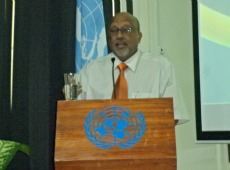
Meanwhile, Vice President Mohamed Waheed Deen, also speaking at the launch, criticised government policy failures for failing to correct numerous development challenges in the Maldives.

Deen therefore emphasised the need to learn from the UN’s latest human development report to address the sustainable development challenges posed by geographically isolated, small island populations.

Women and children suffer

Although Deen proposed “population consolidation” – relocating small island communities to larger landmasses – as a means to improve democratic practices, he also emphasised the benefits of sustainable development.

He also highlighted the need to listen to communities and young people, while providing them opportunities to express themselves in “forums and different platforms” to utilise their ideas for development and to prevent “wilder activities” from occurring.

“The best method is to let a person express himself or herself and not to hide the real problems of the country, domestic violence, child abuse, and many other issues related to gender. Unless we accept that we have these problems, we cannot bring changes,” Deen said.

“Quite unfortunately we pretended we did not have these problems. We pretended these things never existed in our society. ‘What a wonderful clean society we have’, but the truth is we have these problems and people suffered, children suffered, women suffered,” he lamented.

Deen explained that “sadly” many presidents and politicians have not directly addressed problems within island communities or Maldivian society generally to bring about change. As a result, the recent democratisation process, including the related constitutional changes, have led to protests protests regarding development and human rights issues.

“The only way for our country to progress is to listen to the people. We have learned that the voice of the people must be heard,” Deen stated.

The vice president also discussed the “very important need” to educate the populace about democracy. He stated that it was “almost impossible” to run a democratic nation with “changing constitutions and presidents”.

“The mindset the people must understand what democracy is and how we can sustain it. Unless we do that we won’t be able to sustain a democratic system,” said Deen. “Educating the people is extremely important, more than building harbours.”

Vice President Deen added that economic inequalities have been perpetuated by the lack of planning, job creation for youth, and and a proper tax system.

“We didn’t plan ahead. what has happened to us today, our situation, is not something that has happened overnight. It took time, many years,” he said.

He emphasised the need to establish a “proper tax system” to reduce economic inequalities and bridge the disparity between the wealthy and less fortunate.

“The huge level of discrepancy can create social unrest, misunderstandings, hatred, anger, and frustration and these are bad for any nation,” noted Deen.

“I’m not a believer of expecting donations and support all the time. These funds must be utilized in a context as a catalyst for sustainable development,” he added.

“Please understand the Maldives will never never go back, we will go forward,” Deen declared.

“I hope the presidential candidates seriously consider these [human development] reports when they are deciding their manifestos and bringing changes to our beautiful country,” he added.

UN human development recommendations

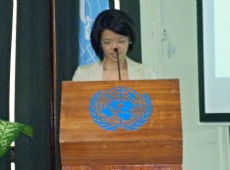
Giving her own summary on the 2013 human development report, UNDP Deputy Resident Representative Azusa Kubota said there were four key areas needing to be addressed by governments to facilitate sustainable human development.  She said these factors included enhancing equity; enabling voice and participation, managing demographic change and confronting environmental challenges.

“We all know environmental threats such as climate change, air and water pollution, natural disasters, deforestation affect everyone globally, but they hurt poor countries the most,” Kubota added.

Sustaining human development gains is difficult in the face of “natural disasters which are increasing in frequency and intensity that cause enormous economic damage and loss of human capacities,” she said.

“International governance structures can be held to account, not only by member states but governance by global civil society which is on the rise.”

At the national level, Kuota explained that human development required support by a “developmental state” with an activist government and a political elite that sees record economic growth as their primary aim.  She added that job creation and investing in people’s capacities to sustain the gains of economic growth via health, education and other public services were also key elements. Additionally, governments need to actively nurture sectors that would not otherwise emerge to do global competitions and incomplete markets.

Kubota further emphasised that to sustain human development “substantial public investment, in [social services] not just infrastructure, as well as bold proactive, targeted social policies are required. It is not just economic growth alone.

“Human development doesn’t come without targeted policy interventions and carefully crafted national visions,” said Kubota.

The developed north and developing south are connected “more than ever”.

“The challenges faced by the multilateral system in response to the rise of the south [do not pose] a false choice between globalism, regionalism, and sovereignty. We all have to work together. Human development is not a zero sum game, we all benefit equally,” Kubota concluded.

Likes(2)Dislikes(0)

Adhaalath Party demands educational certificates of Penal Code Committee MPs

The Adhaalath Party has sent a letter to Parliament Speaker Abdulla Shahid requesting he clarify the educational qualifications of MPs in Penal Code committee before 10:00am tomorrow (14 May).

The letter was sent following the Penal Code Committee’s decision to summon Chair of Adhaalath Party’s Scholars Council, Sheikh Ilyas Hussain, after alleging he had made misleading comments about provisions of Penal Code bill during a religious sermon.

In a statement issued today, the Adhaalath Party confirmed the letter was sent because the Penal Code Committee had “invited” Sheikh Ilyas before  the committee.

This is the second time the parliament has sent summons to Sheikh Ilyas over his comments, after he failed to show up the first time.

According to local media, on March 22 Sheikh Ilyas held a religious sermon dubbed the ‘Purpose of Islamic Sharia’ at the Furuqan Mosque after Isha Prayers, where he swore to God that the new Penal Code was “made to destroy the religion of Islam”.

Local media reported that during the sermon Ilyas declared the Penal Code did not have penalties for fornication, theft, corruption, forgery or robbery, and that if a person committed a crime while intoxicated, they were not to be subjected to punishment. He also claimed that according to the new penal code, it was not a crime for two people to have consensual sex.

Ilyas declared that the Penal Code was “a trap made by the West” to erase Islam in the name of Muslims, and vowed that he was ready to argue the point even if all the country’s lawyers came out against him.

After being summoned to parliament for the second time, Sheikh Ilyas told local media  the committee continued to summon him only because they were ignorant of the Islamic way regarding the matters he had raised.

Ilyas stated that the parliament members who sat in the committee had insisted that the Penal Code did not have any clauses against Islamic principles, but only because none of them possessed sufficient religious education to understand the reality. He added that he will would explain the matter to the MPs through verses of the Quran and the sayings of the Prophet when he attended the committee meeting.

Ilyas further stated that the bill had a number of clauses which contradicted the penalties defined in Islamic Sharia, and that it had many “deceptive clauses”.

Likes(0)Dislikes(0)

Minor arrested in connection with Dr Afrasheem’s case sentenced for misleading investigation

The Juvenile Court has sentenced a minor arrested in connection with Dr Afrasheem Ali’s murder to eight months imprisonment after the court found him guilty of misleading the police investigation.

According to local newspapers, the court ruling was based on witness statement and the minor’s confession.

However no media outlet has yet been able to get details regarding the hearings inside the Juvenile Court, which were closed to the public and media. The court ruling was issued yesterday.

The trial of Hussain Humam and Ali Shan, two other men charged with the murder of Dr Afrasheem Ali, continues in the Criminal Court.

MP Afrasheem was stabbed to death on the night of October 1 2012, by the staircase of his home. Two suspects were arrested in connection with the case including Humam and a suspect identified as Ali Shan of Henveiru Hikost.

A Maldives National Defense Force (MNDF) officer and Abdulla ‘Jaa’ Javid – son-in-law of opposition Maldivian Democratic Party (MDP) Chairperson ‘Reeko’ Moosa Manik – were also detained by police over alleged involvement in the case. Both were later released by the courts.

Javid spent 45 days in detention in connection to the Afrasheem murder, after which time at the time his lawyer argued his continued detention was unconstitutional given there was no evidence to support keeping him in custody.

In December last year the MDP accused the police of attempting to pin Afrasheem’s murder on its members, instead of going after those guilty of the crime.

Police Commissioner Abdullah Riyaz has previously stated the child “deliberately misled” police by providing false information during their investigation into Afrasheem’s murder. The minor was the “lookout” during the stabbing and subsequent murder of the moderate Islamic scholar.

In accordance with the Penal Code, any person who gives false testimony can be given a jail sentence of up to a year, face two years of banishment, or receive a maximum fine of MVR 1,000 (US$65).

Minors can be given only two-thirds of any given sentence, according to juvenile crime regulations.

Likes(0)Dislikes(0)