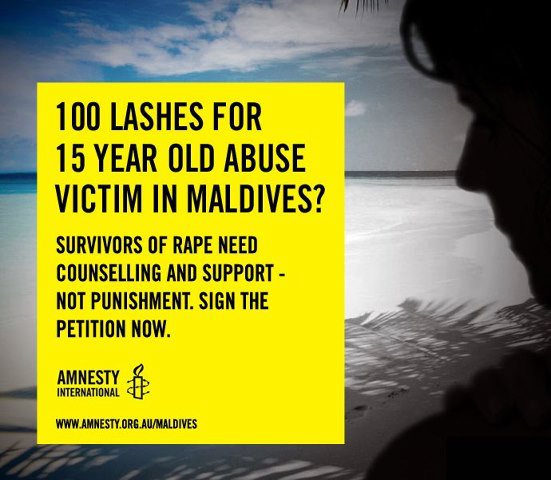
“So horrific that it’s hard to believe”: Amnesty International launches petition to overturn “disgraceful” flogging sentence

Amnesty International has launched a petition calling on the Maldivian government to overturn a court ruling sentencing a 15 year-old rape victim to 100 lashes for an unrelated fornication offence.

The story of the girl from Feydhoo in Shaviyani Atoll, who was convicted of premarital sex in the Juvenile Court February 26 and sentenced to 100 lashes and eight months of house arrest, has been reported by media around the world and been widely condemned by international NGOs and embassies.

“It’s so horrific that it’s hard to believe it’s true: a 15 year old rape survivor has been sentenced to 100 lashes for ‘fornication’ in the Maldives,” stated Amnesty International, which has followed the case since January.

“The traumatised girl was allegedly sexually abused by her step-father for many years. He has since been charged with sexually assaulting a minor. During the investigation however, authorities came across evidence to support separate charges of fornication against the girl for pre-marital sex,” Amnesty stated, demanding the government overturn the “disgraceful” sentence.

The Maldivian government – which is currently vying for re-election to the UN Human Rights Council, launched its campaign in Geneva on February 28 on a platform of “women and children’s rights and the rights of persons with disability” – expressed “deep concern” at the decision to prosecute the girl.

“Though the flogging will be deferred until the girl turns 18, the government believes she is the victim of sexual abuse and should be treated as such by the state and the society and therefore, her rights should be fully protected,” said the President’s Office in a statement.

“The government is of the view that the case merits appeal. The girl is under state care and the government will facilitate and supervise her appeal of the case, via the girl’s lawyer, to ensure that justice is done and her rights are protected,” the statement added.

Amnesty International welcomed the government’s stated commitment, but noted that “at this stage she is still facing flogging. We need to keep the pressure up to remove flogging as a form of punishment in her case and all cases in the Maldives.”

Foreign Minister Dr Abdul Samad Abdulla meanwhile announced on state broadcaster Television Maldives (TVM) that the girl had post traumatic stress disorder and certain medical issues, according to local media.

“The girl was abused since she was 12 until she turned 15, so multiple times for three years. She was abused by her stepfather. She has said that her baby was murdered. You can imagine the mental status of a child in this situation. She suffers from this condition,” local media reported Dr Samad as saying.

According to Sun Online, Dr Samad said the international community was not fully informed about the reason for the girl’s sentence, which was not due to her abuse by her stepfather, but her confessed fornication with another man.

He also warned that a failure to unite as a country during times of such international criticism would provide opportunities for “groups that want to harm the country,” Sun reported.

The government’s denouncement of the sentence is meanwhile at odds with its endorsement by the Adaathath Party, members of which make up the majority of the Ministry of Islamic Affairs.

“The purpose of penalties like these in Islamic Sharia is to maintain order in society and to save it from sinful acts. It is not at all an act of violence. We must turn a deaf ear to the international organisations which are calling to abolish these penalties, labeling them degrading and inhumane acts or torture,” the party said in a statement.

“Furthermore, Allah has decreed that expressing disapproval of issues such as this contradicts with faith in Islam,” the statement continued, quoting verses from the Quran.

“Allah has also commanded that we show no kindness when implementing these penalties,” the party added.

Flogging and politics

UN Human Rights Commissioner Navi Pillay in an address to the Maldivian parliament in November 2011 urged the government to issue a moratorium on sentencing women to flogging for extra-marital sex.

“This practice constitutes one of the most inhumane and degrading forms of violence against women, and should have no place in the legal framework of a democratic country,” Pillay stated.

Her comments were condemned by religious groups in the Maldives, with protesters urging authorities to arrest the UN High Commissioner and gathering outside the United Nations carrying signboards with slogans such as “Islam is not a toy,” “Ban UN” and “Flog Pillay”.

A presidential state apology for allowing Pillay to speak to parliament was one of the five demands of the December 23 coalition [of 2011], a mass gathering in the capital Male’ that saw the fractured opposition unite against President Nasheed on the pretext of protecting Islam.

Following the fall of Nasheed’s government on February 7 2012, government-aligned Progressive Party of the Maldives (PPM) MP Abdul Azeez Jamal Abu Bakr withdrew the Pillay apology petition in parliament.

Amnesty International’s petition:

Likes(0)Dislikes(0)

Transcript: MNDF Staff Sergeant Shafraz Naeem’s CoNI account of Feb 7 mutiny

This article was first published by Dhivehi Sitee. Republished with permission.

On 7 February 2012, MNDF Staff Sergeant Shafraz Naeem was commanding Bravo, one of the Bandara Koshi Battalion riot squads that confronted the mutinying SO police in front of the military headquarters. He resigned five days later.

“I have lost faith in the institution,” he told the Commission of National Inquiry [CoNI] later. This is Shafraz Naeem’s account of what occurred during the mutiny, reconstructed from the transcript CoNI’s interview with him on 7 July.

I was commander of the riot squad of the Bandara Koshi (BK) Battalion from the time the protests began. We were supporting the MNDF riot squad.

We were on standby till 11:30 p.m. [6 February], when we were dispatched to Artificial Beach. The police were withdrawing when we arrived. My squad placed three cordons in the area. Nobody was violent, but there was much verbal abuse.

I received an order to withdraw to Sawmill. “If we withdraw, there will be trouble,” I said to my senior, [Lt.] Ali Ihusan. We withdrew.

Shortly afterwards, we were ordered to return to the scene. Protesters on both sides—the Coalition and MDP—were hurling stones and verbal abuse at each other. We put the cordons back up.

I heard some vehicles arriving. I saw police officers screaming at everyone, the protesters, the MNDF, at everybody. They began running after MDP protesters.

“We will kill you all!” they were shouting.

We restored order, moved the media away. After thirty minutes, the police returned. They were singing patriotic songs. One officer approached me. He put his baton under my chin and let forth a string of profanities.

“You must withdraw to BK”, we were told fifteen minutes later.

“Clear the area. Get the media out. Remove everyone carrying iron rods from the scene,” Captain Amanullah ordered.

We arrived at Bandara Koshi in the early hours of the morning. About 40-50 SO officers, I am not sure exactly how many, were staging a sit-in at Republic Square. I dispatched squads to cordon off designated areas, MMA [Maldives Monetary Authority] and other spots.

Around 2:30 a.m., outside MNDF [Headquarters], I met General Shiyam. He stood watching the Republic Square.

“Why aren’t you giving orders to arrest them?” I asked.

“Go away!” he responded.

I had to ask. We had received intelligence of an intended police mutiny. After being at the Artificial Beach, I knew it was happening.

Half an hour later, all of us squad commanders received orders that no one—be it police or media—was to be allowed inside the cordons.

Some VTV or DhiTV journalists refused to leave. After an argument, we pushed them out.

“Let them in. And, let in the police once they show their ID card,” one officer,  [Major] Adil Rasheed said.

Every minute, five or six of them came in, filling up the cordoned off space. SO Officers were allowing gangsters inside the cordons, too. I saw Firusham allowing a few of them in at around 5:30.

We dispersed the crowd as far back as the Metro cafe’.

“Get the cordons inside and withdraw to HQ”, we were ordered at around 6:30.

“Why?” I asked Captain Amanullah and Major Adil. I always question orders that do not feel right to me.

“Mind your own business,” [First] Sergeant Amir Hussain said. I was told not to question orders.

“Get some sleep,” Lieutenant Colonel Fayaz told everyone once we were inside. All our armour was removed, my chest guard, everything except my shield. We had breakfast.

“The President wants to meet you,” we were told.

At the same moment, I heard police saying their Azum [pledge]. I heard screaming. And I heard the President shouting to us, “Go outside and arrest them!”

I, with about ten special forces personnel, went.

Those of us with shields were at the front, those without came behind. I was commanding from the front.

“Do not fire!” we were shouting. There were riot guns, rubber bullets, tear gas grenades.

“Do not fire until they fire!” I heard the police shouting. Each side waited to see what the other would do.

A gas canister flew towards the police.

It was fired from our side. I saw who threw it. It was Tholath, the Defence Minister.

“Do something!” he said. The canister landed. All hell broke loose.

**********

Police charged. I ordered my men to do the same. I don’t recall how many canisters we threw. Stones, all sorts of things came at us. I was hit many times. I did not give up, I stayed until I was dragged in. I was the last person in.

I was not the main lead but one of several. There were sergeants, I was a staff sergeant. I saw my lead, Lieutenant Hamid Shafeeq only inside the HQ. He was the only person I heard issuing instructions. There was no plan, all orders were ad hoc.

When President Nasheed shouted at us to go out, all command and control was lost. Nobody took charge. I don’t think anybody even cared.

We went out when the President ordered us, but once we were outside, nobody gave us orders. The Ground Commanders, who were outside with us, should have commanded. They did not. About 3-4 minutes is enough time to analyse the situation and issue orders. There would have been enough time for a plan of attack. If the canister had not been thrown.

Around 9:30, I saw a large group of men gathered near the Communications Room. “Nasheed is a criminal. Do not obey unlawful orders,” I heard them say. I reported it to my senior.

“I will handle it,” he said.

“Collect all guns!” I heard a commander saying soon after. All weapons were taken away.

Outside, I could see Riyaz, Fayaz and Nazim. Shiyam, Fayaz (Papa) and were inside.

“Tell the president he has no choice but to resign!” I heard Fayaz say to Shiyam.

“I will”, Shiyam said. He had a weird smile on his face.

I was attending to some injured soldiers when I heard joyful shouting. [Mohamed] Nazim was being hoisted up by some football coaches.

Shiyam had let Nazim in, I know.

Nazim was in the forces before. I cannot remember now, but I think he was a Colonel. He was my instructor.

“This won’t go well,” I thought. I knew Shiyam was aware of what was happening. Once, while training with Shiyam, we had a conversation about an intended naval base.

“Where are you going to get the money for it?” I asked him.

“Gasim Ibrahim will give unlimited funds for the base. He will help MNDF grow,” he replied. The naval base is Shiyam’s dream project.

I don’t know what happened after Nazim went inside.

A rumour started soon that MDP was about to torch MNDF homes. Some people began to get worked up. They wanted to go outside. Shiyam and Zayed got them into a squad, and sent them out. There was nothing, no MDP people, no thugs.

It was past 11:30 then, and we heard Nasheed had resigned.

**********

The next day, I returned at about 8:30 p.m. Nothing much was happening.

“If there is any rioting,” Papa told Shiyam, “Give me two minutes. I’ll have it all under control.”

I was in Bravo when I saw police charging the demonstrators.

“Why are they doing this?” I asked my senior [Lt. Col] Nasrullah. Even he did not know.

“Shut up,” Papa said to me.

I got a lot of flak and warnings for asking questions, for following President Nasheed’s orders. I took an oath to protect the country and the president; not to beat civilians or to mutiny. I did not take an oath to follow a mutinous general. I was never a big fan of Nasheed, but it did not matter to me who the President was that day. I would have done the same for any president.

In my view this was a coup. Why? I could see it from the way they handled everything, their attitude, how cool and calm all the officers were. I could tell from how cool General Shiyam was inside the MNDF. They did nothing. This is not how a uniformed officer should behave.

I really don’t know what [Moosa] Jaleel, Chief of Defence, was doing. He was walking around, smoking, as if in a trance, unaware of what was going on around him. I had admired Jaleel, but in that situation, his mind was somewhere else. General Nilam, too. Had I not pushed him to the ground inside MNDF, he would have been hit by bricks. I am not saying that he, too, was in a trance.

Perhaps they were in shock over the mutiny.

UPDATE: In communications with Dhivehi Sitee since the above post was published, Shafraz Naeem has said the CoNI transcript is inaccurate. Among the clarifications he would like to make are the following:

  • He arrived back at Bandara Koshi the following day [8 February] at 2:30 p.m., not 8:30 p.m. as recorded in the transcript.
  • He stated that he was not a fan of how President Nasheed handled the MNDF, not that he was ‘never a big fan of Nasheed.’
  • Parts of his conversation with General Shiyam about the naval base have been left out.
  • A heated exchange between Shafraz and Co-Chair, Ismail Shafeeu, on command and control–who was responsible for its loss and how it happened–has been omitted from the transcript.
Likes(2)Dislikes(0)

Four year-old seriously injured after two storey fall

A four-year-old child is being treated for serious injuries after falling from the second storey of a building in Male’, local media has reported.

The incident, which took place on February 28, is being investigated by police to determine the reason behind the fall.

Likes(0)Dislikes(0)

Child killed by falling television set

A 23 month-old girl on the island of Fehendhoo in Baa Atoll has died after a television fell on top of her, local media has reported.

The Sun Online news agency said the incident was believed to have occurred at 9:25am yesterday (March 1), with the child later dying from her injuries after being taken to Goidhoo Health Centre for treatment.

Speaking to local media, Fehendhoo Council President Ibrahim Shaheen stated that the mother of the girl had said that a 32-inch television set had fallen on the child as she was playing with her three year-old sister. The girl’s mother was said to have been alerted to the incident after hearing a loud noise while she was in the kitchen, Shaheen added.

Police are currently investigating the incident.

Likes(0)Dislikes(0)

Nutrition awareness a “huge challenge” for Maldivian authorities: Children’s NGO

Informing parents and educators in the Maldives of the importance of healthy nutrition and exercise remains a “huge challenge” to child development in the country, a local charity has said.

The Advocating the Rights of Children (ARC) NGO has told Minivan News that parents in the country are still not well-informed on the best ways to promote and ensure their children are engaging in more active lifestyles and enjoying a balanced diet.

The comments were made on the second and final day of a festival launched to celebrate ARC’s Healthy Eating and Active Lifestyle (HEAL) initiative held at Iskandhar School in Male’.

Festival launch

The event began Friday (March 1) with the launch of the first in a new series of books aimed at children to try and promote the five key health objectives at the heart of the HEAL campaign, ARC has said.

According to the NGO, these focuses include: ensuring a daily intake of fruits and vegetables by emphasising colour,  encouraging drinking water as an alternative to carbonated beverages and energy drinks, and cutting down on processed foods.

ARC is also calling for a greater availability of healthy snacks for children’s diets, while encouraging physical activity over watching television and playing video games.

Despite the challenges of promoting nutrition in the country, Juna Latheef, Project Manager for the 2013 HEAL Festival, claimed that schools had shown more awareness about teaching the importance of diet and healthy activity even over last 12 months. However, she added that efforts to introduce healthy eating campaigns and other similar programm through the school curriculum were limited by budgetary restrictions.

As part of its own efforts to focus on nutrition in the country, ARC said it is using its HEAL festival to launch the first in a series of children’s books that could be used by both parents or teachers to encourage healthier lifestyles.

Each book will focuses on a child-friendly character, and will detail the key aims of the HEAL strategy, while also playing up the benefits of specific fruits and vegetables to a child’s diet, according to the NGO.  The book was made available at the festival for MVR 30 (US$2).

“Adverse dietary pattern”

In May 2012, Maldives Planning Department statistics detailing household food expenditure in the country charted a shift towards an “adverse dietary pattern”, with increased intakes of high-fat and sugary products.

Health experts in the country at the time blamed the unhealthy diet of Maldivians for the high prevalence of cardiovascular diseases and metabolic disorders such as diabetes in the country. These health factors were found to account for almost 50 percent of all deaths in the country. The comparative figure for the US was then 25 percent.

According to the Household Income and Expenditure Survey, the structure of the Maldivian diet was found to have shifted towards a “higher energy density diet with a greater role for fat and added sugars in foods, greater saturated fat intake, reduced intakes of complex carbohydrates and dietary fiber, and reduced fruit, vegetable and fish intakes.”

During World Health Day in April 2012, authorities told Minivan News that the level of malnutrition experienced in the Maldives was “quite alarming” considering other national advances in the fields of health and medicine.

Public Health Programme Coordinator for the Center for Community Health and Disease Control (CCHDC) Dr Fathmath Nazla said she was specifically concerned over the national promotion of healthy diets.  She claimed that the issue of vitamin deficiency in expectant mothers and children were among her key concerns.

The consumption of high-calorie junk food and energy drinks by young people was also raised as a serious issue for local health experts to address.

Likes(0)Dislikes(0)

Education Ministry withholding preliminary O’level result figures for 2012

Preliminary results for the 2012’s Cambridge O’Level examination have not been released due to “difficulties” in analysis, the Ministry of Education has said, despite claiming “one of the highest pass rates to date”.

O’Level exam results from 2012 show “the most progress to date”, Minister of Education Dr Asim Ahmed told local media during his speech at the University Education Fair opening ceremony on February 19.

“These are preliminary results right now. It could take a little while to get the final results, we are in the process of verifying, which could change the findings,” Asim told Minivan News.

“However, this should encourage a good increase in A’level enrollments, because more students will be eligible,” he added.

The claims were upheld by Ibrahim Shakeeb from the Education Ministry’s Department of Examinations (DPE), who told Minivan News that the results from 2012 had not yet been finalised.

“This year has one of the highest pass rates. We already know it’s one of the best results this year. Students will be celebrating.

“The preliminary results are out, however the recheck process is still ongoing and will not be completed until late March. However, there won’t be a major change in the findings. The final results will probably show a slight improvement, following the recheck process,” Shakeeb stated, but was unable to provide the preliminary figures.

Shakeeb explained that the DPE acts as a mediator by providing exams to students and sends them back-and-forth to Cambridge International Examinations. Thus, DPE receives the ‘raw’ data, while the Education Ministry’s Planning and Research section conducts the analysis and disaggregates the information.

“The Planning and Research Section may be having difficulties because Ahmed Shafeeu previously handled the analysis, however he became the Minister of Fisheries and Agriculture under President Waheed’s government,” said Shakeeb.

Former Education Minister Shifa Mohamed said it was a change in Ministry of Education practice for preliminary O’Level results not to be publicly disclosed.

Preliminary Cambridge exam results arrive in January or February, with little difference between these and the final results, she explained. Additionally, information from the provinces and islands should also be available.

“By now they should have the real results. Analysis of these findings should only require three days,” Shifa stated.

“I’m waiting to receive the statistics as per my request. I can’t understand why they are holding the [result] information or why it’s taking such a long time to analyse.

“I do not think they have done the analysis. It seems the government is dragging on it because they’re scared to show the results, because they’re not sure if they’ve achieved the marked improvement they’re aiming for,” Shifa added.

Shifa said exam results should show some improvement this year given the previously implemented programs and reforms, but said this would have depended on whether these programs were continued by President Waheed’s new government in 2012.

“Under former President Mohamed Nasheed’s government, we made it very transparent. We believe people ought to know how the budget is being spent and what kind of results the government is producing.

“I don’t think the public really knows the results these kids are producing. I think that [a current government] should actually make the people quite aware of major issues within the country,” Shifa stated.

Minivan News contacted Cambridge International Examinations, however they refused to provide statistics as well.

“This is the Education Ministry’s education policy. It is not for us to comment on the Ministry’s policy on their behalf,” a spokesperson said.

A source in the Ministry of Education told Minivan News that internally, the pass rate figure being passed around was 46 percent in 2012.

“I find very difficult to believe because that is a huge increase from 37 percent in 2011. It is very unlikely,” the source said.

“The pass rate was 35 percent in 2010 and 27 percent in 2009. Even with the numerous educational reforms implemented after [former President Mamuoon] Gayoom’s 30-year authoritarian rule ended, the Maldivian Democratic Party (MDP) government was unable to reach the nine percent increase per year needed to achieve their goal of 60 percent of students passing within five years,” the source said.

Meanwhile, students are reported to have received their O’Level exam results at the end of January.

Minivan News contacted numerous people within the Ministry of Education, who either would not release the O’Level pass rate statistics, or would otherwise not respond.

Likes(0)Dislikes(0)

Will form large coalition to “shock” Nasheed if elected: PPM Umar Naseer

Progressive Party of Maldives (PPM) presidential primary candidate Umar Naseer has revealed he intends to form a multi-party coalition should he win the PPM presidential election.

Speaking at artificial beach on Friday night (March 1) as part of his campaign rally, Naseer announced that a “wide coalition” must be formed in order to defeat the Maldivian Democratic Party (MDP) in the elections scheduled for later this year, local media reported.

Latest figures from the political party registry of the Elections Commission (EC) show that PPM currently has 22,765 members signed to its party – 23,769 members less than the MDP’s 46,533 total membership.

“It is not the way these days to do things on your own. If you give me the PPM leadership, I will form a wide coalition, God willing.

“I will attain this country’s power through a coalition that will shock Mohamed Nasheed,” Naseer was quoted as saying by Sun Online.

When Minivan News attempted to contact Umar Naseer today (February 2), his secretary stated: “Umar said we are not sharing any information with Minivan News”.

Speaking at the rally, Naseer claimed that Dhivehi Rayyithunge Party’s (DRP) refusal to form a coalition during the second round of the 2008 presidential elections had been a mistake, further claiming that should DRP decided otherwise, the MDP may not have achieved power in 2008.

“It is possible that Mohamed Nasheed could not have been able to get the last three years if the DRP had reached to other parties and formed a coalition.

“It was a strategic mistake we made that day, to not work with parties. PPM shall not make such a mistake,” Naseer said.

The PPM presidential primary candidate claimed there is now a need for leaders to work against the MDP from coming to power, assuring that he will make the effort if he wins the PPM ticket, local media reported.

Last month, the Progressive Party of Maldives (PPM) called on the Elections Commission (EC) to dissolve the Maldivian Democratic Party (MDP), calling it a “terrorism party”.

“There is the fear that MDP might come to power again. They are planning it very well. They even have the money. They are still a threat.

“This country needs strong leaders. Because this country is still not rid of MDP’s threat. I would like to tell you that if you give me the votes and elect me, I will achieve this for you,” local media reported Naseer as saying.

Likes(0)Dislikes(0)

Summary: Former President’s testimony on February 7 transfer of power

This article first appeared on Dhivehisitee. Republished with permission.

On 4 July, 2012, Mohamed Nasheed, President of the Maldives until  February 7 that year, testified at the Commission of National Inquiry (CoNI) on how his government came to an end. Present were co-chairs of the Commission Justice Selvam and Ismail Shafeeu, members Dr Ibrahim Yasir, Dr Fawaz Shareef and Ahmed Saeed. Observing for the international community were Sir Bruce Robertson and Professor John Packer.

In essence, my statement is very small… I was forced to resign. I resigned under duress. I was threatened. If I did not resign within a stipulated period it would endanger mine and my family’s life. I understood they were going to harm a number of other citizens, party members. They were going to literally sack the town. I felt that I had no other option, other than to resign.

Despite CoNI being a national inquiry looking into the highly suspicious end of a government elected by the people, all testimonies collected have been kept from the public. Having come into possession of a copy of the transcript of Nasheed’s spoken testimony to CoNI on 4 July, I have summarised its contents and shared it with you here. What is contained here is not Nasheed’s entire testimony that day, but only the parts concerning the last few hours of his presidency. Care has been taken, however, to ensure no information has been taken taken out of context, added, or deleted from the text and to remain faithful to Nasheed’s words as contained in the transcript.

President Mohamed Nasheed arrived at Bandaara Koshi at 5:00 am on 7 February 2012. Operation Liberty Shield was supposedly underway, but the place was almost deserted. About 300 personnel in total, most of them in plainclothes, milled about lethargically. There were several generals present—Chief of Defence Moosa Jaleel, General Shiyam, General Nilam, General Ibrahim Didi. The military HQ was on red alert, but most of the generals looked as if they were on holiday.

From the late evening of 6 February, Nasheed had been busy trying to control the situation from Mulee Aage, his residence. Judging from police behaviour during protests on the preceding days, the President was convinced the police must be removed from the scene. He knew plans were afoot to have his government illegally overthrown in a coup. A week earlier, he received a seven page letter from military intelligence. It outlined in detail a plot to illegally overthrow the government.

Attempting to control the situation on the evening of February 6, he had two major concerns: the police might attack MDP supporters, and they might attack the military. On hindsight, the president would come to see that he could also have arranged for MDP supporters to disperse. Other actions would have led to other consequences. But, at that moment in time, he trusted his supporters to maintain order more than he did the police. He was assured by the MDP MP leading the protests there would be no disruptions.

He ordered the police to be removed and for the military to takeover.

Seven hours later, the military was yet to take any action.

The President felt he must go to the scene. He needed to see for himself, assess what was happening. That is the kind of person he was.

Before he left, he checked with the military personnel inside the headquarters.

“We have the capacity to bring out a 1000 troops,” they assured, beckoning him.

Nasheed walked to the HQ. What he found were the generals who looked as if they were on vacation, and no plan of attack. He had suspected as much. As a history enthusiast, he had studied in detail every coup that took place on the islands in the past 200 years.

He could read the signs, he knew when a coup was brewing.

**********

Inside, Nasheed met with his Home Minister Afeef, Defence Minister Tholhath, and Commissioner of Police Ahmed Faseeh.

“What should I do?” he asked them each individually.

Each replied the police must be restrained, arrested.

Twice, the military advanced only to retreat shortly afterwards. They treated the police with kid-gloves, there was no command. As the situation deteriorated, Nasheed rang the Chief Justice and the Speaker of Parliament. He felt that all organs of the state should be present at such a crisis. Both men agreed to come.

Nasheed also rang various MDP MPs, requesting their help at the scene. And, he made several attempts to contact the Vice President.

“But, of course,” those attempts were futile.

“The Vice President should be behind the President at a time like this,” Nasheed thought. “He should have come on his accord to be here.”

Waheed did not come. Nor did he answer the phone. Perhaps he was asleep? He was still up at 2:00 a.m. in the morning, Nasheed knew. The Vice President had appeared on television then, with a statement on the events.

Incidentally, Nasheed’s wife Laila and Waheed’s wife Ilham shared the same make-up artist. Whatever the whereabouts of Waheed, through his wife’s beautician, Nasheed would later learn that by 7:00 am of 7 February, Ilham was groomed for a special occasion.

In the early hours of 31 January, Waheed had met with the opposition in his home. Nasheed sought him out in the intervening period, but Waheed avoided him. The Vice President provided the President with neither advice nor assistance. When quizzed by Ministers in their government, Waheed refused to share any information about his meeting with the opposition.

Speaker Shahid and Chief Justice Faiz never turned up.

Some MPs did respond to Nasheed’s call for help. From his vantage point inside the military headquarters, Nasheed saw how each were beaten up. The attacks on individuals soon became a barrage, spreading across the entire area. It was to continue for the next two hours.

“In the net”

Inside the headquarters, the President’s phone had very little reception. It was not because the signal was jammed, although it should have been. Jamming the signal and providing him with another phone would have been a good strategy, Nasheed thought. He saw General Shiyam on the phone, sending a constant stream of text messages and receiving many phone calls. “Who but the President should Shiyam be in touch with at that moment in time?” Nasheed wondered.

Despite the bad reception, from time to time, President Nasheed received updates from members of his government and MDP. He heard about MNBC One being under attack. He heard police and military had taken over the airport, had control of the immigration counters.

He also heard Gayoom was up all night, co-ordinating the anti-government efforts from Malaysia. According to reports Nasheed received, on receiving news that he was at the military headquarters Gayoom said, “He is in the net.”

For all intents and purposes, Nasheed was now a captive, falsely imprisoned inside the military headquarters. His security detail, the Special Protection Group [SPG], were guards, not protectors. Their leadership was changed the day before, a man called Rauf replaced the former Chief. Rauf was in charge of protecting the President and his family, but, all day he languished outside the gates. No assurances of safety were forthcoming from him.

**********

Through the course of the next two hours, Nasheed went up and came down several times. He saw MP Mariya Didi being attacked. It was astounding. He saw the Deputy Minister being attacked. He saw other MPs assaulted. He saw the police headquarters being attacked.

[Between 7:00 and 8:00 in the morning] Nasheed went outside to speak to the mutinying police. His Police Commissioner no longer believed they were police, and refused to negotiate with them. Nasheed’s attempt was in vain. He could not agree to their demands for a pardon. It was not that he didn’t have the power or the authority.

“But”, he thought, “who am I to pardon before an investigation?”

Still, he promised them he would do his best for them. His promise went unheeded by the mutineers.

Inside the military HQ, he tried to talk to the soldiers. He had tried to do the same earlier, when he took a walk inside the premises shortly after his arrival. Some of the soldiers were playing chess, he noticed. Before he could conclude his walk, General Shiyam had intercepted him.

“They don’t want you to be walking around here,” the General said. He did not give a reason. It was possible soldiers of lower ranks had been told not to obey the President’s orders.

This time he met with about fifty soldiers from the lower ranks.

“You are taking the country to the dogs. You must do something,” he wanted to tell them.

“My wife is being attacked by MDP supporters,” one of them replied.

“A policeman has been murdered,” said another.

“That is not true. We don’t do that. We are a party in government and we govern,” the President responded.

“Will you come out with me to restrain a rebellious force?” he asked.

“If even 10-20 people agreed, I will lead them out,” the President thought.

Only one of them was willing. The rest said the President should resign.

*********

Nasheed saw police re-enforcements arriving in Male’ on speedboats. The boats belonged to Gasim Ibrahim’s Villa company.

“Strange,” he thought. Never in his position as Commander in Chief had he ordered the security forces to use Gasim’s vessels. All of them were in uniform.

“We will lynch you. We will hang you,” Nasheed heard them. They had ropes.

The violence escalated to a level Nasheed had never imagined he would see in the Maldives.

“I am going to die right now if I don’t resign”, he thought. Naseem [former foreign minister Mohamed Naseem] arrived.

“Mohamed Amin was standing right here when he was lynched,” Nasheed remarked. Amin was the first president of the Maldives. His bloody end in the hands of an angry mob is described in the recently published Orchid, reminding the public afresh of violence past.

Nasheed contemplated his options. He could go out and face the crowd, leave the rest to God.

“Please don’t do that,” Naseem pleaded with Nasheed. The Minister was crying. Both of them had grown up listening to the stories of Amin’s lynching. MP Riyaz joined Naseem’s plea.

“You are being silly. You don’t need to die today. There will be a tomorrow.”

**********

“Back off! We are opening the gate!” the President heard.

Nazim, Riyaz and Fayaz walked into the HQ when the gates, earlier shut under a direct order from the Presdent, were opened. There was no reason for them to be in the building, no capacity in which they could legally enter the premises.

The President knew when Nazim had arrived, he had heard the uproar with which the man’s presence had been greeted. Through the walls of the second floor room in which he was in, the President also heard Nazim address the crowds through a megaphone. He never met Nazim or the other two men inside the military HQ. Nor did he know which part of the building they were in. Once they arrived, Nasheed could not move without being restrained by someone.

“You cannot go there,” General Shiyam said when he tried to go upstairs, to the second wing. The General, whose lack of uniform at a time when the military was on red alert appeared to Nasheed as a sign of desertion, was categorical in his order. He offered no explanation.

“Someone else…someone from the opposition…Nazim? Umar Naseer? Someone was there”, the President would later speculate. “Someone was controlling operations from the other wing of the building.”

Twice the SPG, under new chief Rauf’s command, physically restrained the president. When Nasheed heard about MDP Haruge being ransacked he felt it was his duty to go. Faisal, now a major, held him back. Their excuse was that it was not safe for the president.

They checked his belongings. He had to ask their permission to use the toilet.

“Am I under arrest?” he asked.

Nasheed realised how foolish the question sounded. “I cannot be under arrest”, he thought. “But, of course, I am,” he countered himself.

Jailed several times during Gayoom’s regime for dissent, once detained in solitary confinement for 18 months, the President was familiar with arrest procedures. If he were to use the toilet without permission, they would break in. He had experienced it first hand twice before. His current guards had ‘Forensics’ written all over them.

Among them were faces he could never forget—they belonged to individuals who had interrogated and tortured him before. Soon after Nasheed’s first child was born and while he was expecting his second, one of them had ransacked his home. The man had meticulously gone through every single toy belonging to his young daughter.

“He wants to re-enact that,” Nasheed thought.

He knew these people well. He knew Abdulla Riyaz, was aware of the type of person he is. These people were not searching for anything in specific. The President knew it was an attempt to undress and demoralise him.

“They are trying to make you capitulate,” Nasheed thought. He knew torture and punishment were their preferred tactics.

“People outside are shouting and calling for you to be lynched”, they told him.

“You are going to lynch me from the inside,” he retorted.

**********

The President made the decision to resign at the precise moment he heard the gates ofBan’deyri Koshi being opened. He could hear the din of the baying crowd right outside.

“Mr President, if you don’t resign, they will kill you. They will sack [sic] Male’”, General Ibrahim Didi had told him earlier. The General sincerely believed it was his duty to defend the President with his life. Now, he was failing miserably. Twice the military had advanced and retreated. General Didi, an honourable man, offered to resign. Nasheed observed with concern that it was not beyond the General to contemplate suicide.

“I have only a few minutes to live”, the President now thought. The situation was dire, the country was under threat. Both his life and that of his wife, Laila, were in mortal danger. Laila had no protection in Mulee Aage, she had been forced to leave with their children. He was also convinced MPs Mariya, [Ahmed Easa] and Ibu [Ibrahim Mohamed Solih] had been killed.

But, Nasheed knew it was not safe for him to resign inside the military headquarters. Once the attack on the HQ began, four large bricks were thrown into the second floor room he was in. His precise location was no secret to the attackers outside. The bricks had left large holes in the glass. Shooting into the room through those holes would be easy.

Nasheed was aware there were guns all around him. The generals had guns, he was convinced. Even if the armoury was locked, they had the keys. As Nasheed would later come to understand, guns were moved that day from Coast Guard ships, from other barracks. There are pictures showing some of the movements. He heard KK [Kalhuthukkalaa Koshi] troops were going to join the police in their mutiny. He saw the troops. He heard that when the renegade police and military took over MNBC One earlier, they used guns and were in possession of firearms.

The President knew he must leave the building. He agreed to resign.

“But”, he said, “it would be better if I do not do it from here. I must have fresh clothes, a shave.” He was looking for an escape.

It did not work. His captors had the clothes and toiletries delivered to the HQ.

His resignation speech was to be made at a press conference in the President’s Office shortly.

Resignation: “The biggest rogue letter was written by me.”

Nasheed was taken the short distance to the President’s Office in a car. A large mob, composed not of the public but of police and military personnel, surrounded the car. They were screaming. They were banging on the President’s car. There was no security, no decorum.

Nazim, Riyaz and Fayaz were already at the President’s Office.

“These people should not be here,” he thought.

The President’s staff made several vain attempts to stop the three men. Defying everyone’s wishes and all protocol, they got into the dedicated President-only lift with Nasheed. Within the enclosed space, in the presence of Riyaz and Fayaz, Nazim dictated the words that should be in his resignation letter.

In his office, the President did not put the words on paper. It did not occur to him that he should, for he had never had any intention of resigning. For him, the agreement to resign was a ruse, a way of escaping death and leaving the military headquarters.

“The Speaker wants the letter,” Nazim told him. The President hesitated. He went to the window and looked outside. The situation appeared even worse than before. He looked at Nazim. There was a tell-tale bulge in his trousers.

“He has a gun,” Nasheed was convinced. He would later make out its outlines in a picture of Nazim with his back to the camera, taken after the resignation press conference.

“You cannot back out now. You have to go all the way,” Nazim said. The President knew clearly that his life was under threat, that he would not be allowed to live.

He began writing the letter. Twice he broke down. But he knew that if he did not remain composed, if he did not maintain decorum, there would be chaos. He took care composing the letter, including only the bare minimum of what Nazim had dictated. He would only write enough to keep Nazim happy. It was all an act. Theatre. A lie to save his life.

“The biggest rogue letter was written by me,” Nasheed would say later. He was baffled when Speaker Shahid accepted the letter, it followed none of the required official documentation processes. Nasheed wrote the letter himself. There were no reference numbers, its only nod to officialdom was the emblem on the presidential notepad he used.

Shahid is the type of person who takes pride in receiving letters. Normally, he would have telephoned Nasheed on receipt of the letter. On this day, he was silent. There was no contact. Official documentation rules require proof receipt. No such record exists for President Nasheed’s resignation letter.

Before the press conference, Nazim dictated to him what he should say in his resignation speech.

“Tell the people to keep calm and remain at home. Tell them no one should come out on the streets. Ask Moosa and Mariya to remain silent. Tell other party members not to say anything. Don’t say anything about me. You must say nothing about duress. Say that you are doing it of your own accord. Of your own free will,” Nazim dictated to Nasheed.

As with the letter, Nasheed did not say what Nazim wanted. Instead, he took Nazim’s ideas and polished them up and said the bare minimum needed to save his life and country. He did not state that he was resigning of his own free will. He did not include any instructions for Moosa Manik, Mariya Didi or anyone else to stay at home.

For Nasheed resigning was not the best option. It was the only option.

Dr Azra Naseem has a PhD in International Relations

All comment pieces are the sole view of the author and do not reflect the editorial policy of Minivan News. If you would like to write an opinion piece, please send proposals to [email protected]

Likes(2)Dislikes(0)

15 year-old rape victim deserves flogging for separate crime of fornication: Adhaalath Party

Additional reporting by JJ Robinson

The religious Adhaalath Party (AP) has declared that the 15 year-old rape victim who was recently sentenced to 100 lashes and eight months of house arrest “deserves the punishment”, as this is the penalty for fornication under Islamic Sharia.

The party, members of which largely dominate the Maldives’ Ministry of Islamic Affairs, stated that the sentence of flogging had not been passed against the for being sexually abused by her stepfather, but rather for the consensual sex to which she had confessed to having on another occasion.

“The purpose of penalties like these in Islamic Sharia is to maintain order in society and to save it from sinful acts. It is not at all an act of violence. We must turn a deaf ear to the international organisations which are calling to abolish these penalties, labeling them degrading and inhumane acts or torture,” the statement read.

“No one has the right to criticise any penalties specified in Islam,” the party added.

Quoting verses from the Quran, the statement said that no citizen should be allowed to express ideas and opinions about a verdict made in accordance with the religion in a court of law in a 100 percent Muslim country.

The Adhaalath Party further cautioned that criticising issues like this would “encourage enemies of Islam, create confusion among the general public and open up opportunities for people who aim to stop the practice of similar penalties commanded in Islam.”

“Furthermore, Allah has decreed that expressing disapproval of issues such as this contradicts with faith in Islam,” the statement continued, quoting more verses from the Quran.

“Allah has also commanded that we show no kindness when implementing these penalties.”

The party also stated that it was saddened by the physical and psychological abuse the girl had suffered at the hands of her parents, calling the state authorities to ensure they were given the punishments they were due as detailed in Islamic Sharia.

“If such sinful activities are to become this common, the society will break down and we may become deserving of divine wrath,” the Adhaalath Party stated.

Flogging amounts to degrading punishment or torture: UN

United Nations has expressed concern over the case of the 15 year-old being sentenced to flogging.

“The child is allegedly a victim of long-standing sexual abuse. Under international legal human rights obligations of Maldives, corporal punishment, including flogging, amounts to cruel, inhuman or degrading punishment or even to torture,” read a statement issued by the UN in the Maldives.

“ The approach to sexual abuse which has been adopted in numerous international human rights frameworks is that governments should implement prevention, prosecution of perpetrators, and protection measures to ensure that sexual abuse does not occur. Where it has occurred, governments should put in place measures for rescue, rehabilitation, and reintegration of victims.”

US “deeply disturbed”

The US Embassy in Colombo said it was “deeply disturbed” by the recent ruling, noting that the minor was “also a victim of rape”.

“We call upon the Maldivian government to recognise that she must be protected rather than punished by authorities. We welcome President Waheed’s statement that his government “will push for a review” of the decision. We urge the Maldivian judiciary to immediately drop all charges against the girl and for the Majlis to enact legislation that protects women and minors who have suffered sexual abuse.

“Promoting gender equality and advancing the status of all women and girls around the world remains one of the greatest unmet challenges of our time, and one that is vital in all countries to ensure full democratic rights, regardless of culture,” the Embassy stated.

President “saddened”

President Mohamed Waheed, who has previously insisted on the executive’s inability to interfere in judicial matters, stated on his official Twitter account yesterday: “I am saddened by the sentence of flogging handed to a minor. Govt will push for review of this position.”

The government is currently pushing for re-election to the UN Human Rights Council and launched its campaign in Geneva today (February 28), spearheaded by State Minister of Foreign Affairs Dunya Maumoon, daughter of former 30 year autocratic ruler Maumoon Abdul Gayoom.

In a statement today, the Foreign Ministry said the Maldives had prioritised its term in the Council “by focusing on women and children’s rights and the rights of persons with disability, had been a vocal campaigner for the prevention of torture, and brought the issue of the right of all to live in a safe and clean environment to the forefront of the Council’s debate.”

In a second statement later today, the Foreign Ministry expressed “deep concern by the prosecution and the Juvenile Court’s sentence to flog a 15 year-old girl on the charges of pre-marital sex.”

“Though the flogging will be deferred until the girl turns 18, the government believes she is the victim of sexual abuse and should be treated as such by the state and the society and therefore, her rights should be fully protected. The Government is of the view that the case merits appeal. The girl is under state care and the government will facilitate and supervise her appeal of the case, via the girl’s lawyer, to ensure that justice is done and her rights are protected,” the Ministry stated.

“The Juvenile Court’s verdict has brought home the critical and severe need to review existing mechanisms, especially legal framework, available for protecting the rights of the children in the Maldives. The government calls on all stakeholders to view cases of child abuse and child-sexual abuse through a human rights lens and to base each case on the best interest of the child.

“In view of the urgent attention required for protecting the rights of the children, the government has established a Committee to review the existing child protection mechanisms, particularly the legal mechanism, in view of the universally accepted norms and principles, and recommend to the state areas that require urgent changes,” the Ministry said.

Likes(1)Dislikes(0)