The Centre for Community Health and Disease Control (CCHDC) has warned of a potential outbreak of diseases caused by heavy rainfall across the country.
In a press statement today, the CCHDC said the present climate and heavy rainfall posed risks of diseases such as diarrhoea spreading in the islands.
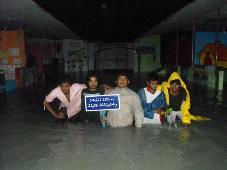
Meanwhile, newspaper Haveeru reported today that two junctions burst open in Haa Dhaal Hanimadhoo, spreading waste and feces into the island. Heavy rainfall that began at 5:00pm yesterday reportedly lasted nonstop till 4:00am, inundating 85 percent of the island with three feet of water.
Hanimaadhoo Council Chair Abdul Salam said 12 homes were flooded and household items were damaged by the rain.
Joint efforts were still underway from last night by police, the Maldives National Defence Force (MNDF) and islanders to pump water, he said.
MP for Haa Alif Kelaa, Dr Abdulla Mausoom, meanwhile tweeted today that flooding has also been reported from Kelaa, Filladhoo, Ihavandhoo and Baarah.
President Dr Mohamed Waheed Hassan Manik visited Hoarafushi in Haa Alif today, which suffered the heaviest damage due to flooding.
Agriculture fields in Haa Alif Baarah, Gaaf Alif Nilandhoo and all islands of Laamu Atoll have been damaged in the heavy rainfall experienced across the country.
Local daily Haveeru reported today that 90 percent of farmland in Laamu Atoll was “destroyed” by the rain.
Laamu Atoll Council Chair Mohamed Rasheed told the newspaper that 80 percent of farmers in the atoll would cease to have a source of income. Farmers in the southern atoll earn a monthly average income of between MVR20,000 to MVR30,000, Rasheed said.
He added that the rain also damaged some homes, including 29 households in Fonadhoo.
Of the 11 inhabited islands in Laamu atoll, only three reported no damages, Rasheed said.
Moreover, as a result of damage to a sewerage pump in the island of Gan, waste was spreading into the island from two junctions.
The rains that started on Monday evening lasted non-stop until Tuesday night, he said.
Meanwhile, Nilandhoo Councillor Asif Mohamed told Sun Online that 280 fields in the island have been completely destroyed.
Heavy rains meanwhile flooded agriculture fields in Haa Alif Baarah.
Baarah Councillor Hussain Fahmy told Haveeru that floodwaters have not receded from the farmlands as of this afternoon. Heavy rains continued to fall last night, he said.
Damage to wooden stoves was also causing difficulties for islanders, the councilor added.
Severe flooding caused by heavy rainfall on Monday has forced several residents of Hoarafushi in Haa Alif atoll to evacuate their homes after flood waters damaged furniture and electrical wiring in 95 households.
Speaking to Minivan News today, Hoarafushi Island Council Chair Ahmed Mauroof said 95 households were flooded, affecting an “estimated 600 people.”
“The cost of the damage caused by flooding is expected to rise to millions,” Mauroof said, explaining that furniture and electronic equipment were damaged in the affected households.
While some families have since returned to their homes, Mauroof said the island council has provided housing and food for a number of islanders at a public building while others have found shelter with relatives.
The flood waters have now receded or been pumped out by the joint efforts of the island council, the island’s youth, police, the Maldives National Defence Force (MNDF), officials of the Maldives Transport and Contracting Company (MTCC) and staff from the nearby Manafaru resort, Mauroof said.
The joint efforts included putting up sandbags, moving furniture and other items to safe locations and pumping water from clogged roads, police said in a press release yesterday.
Heavy rains that started in the late afternoon on Monday caused flooding of up to five feet, according to police. Thick torrential rains that started around 4:30pm on Monday reportedly lasted non-stop until dawn on Tuesday.
The MNDF Northern Area Command meanwhile launched efforts in collaboration with island councils on Monday to pump water from the affected northern islands, including Haa Alif Baarah and Haa Dhaal Hanimadhoo in addition to Hoarafushi.
Hoarafushi, one the of the northernmost islands in the Maldives, has a population of over 2,000 people.
Task force
In addition to households, Mauroof said flooding also caused damage to the island’s health centre.
“The flood water damaged the computer system and some documents there as well as medical equipment,” the councillor said, adding that electric wiring in “the very old building” was also damaged.
Moreover, as there was no sewerage system in the island, “the septic tanks, owned by the people of the island, burst, overflowed and spread waste into the island.”
Mauroof said he received information today that children and adults were being treated at the health centre for diarrhoea.
The island’s youth together with the island council have formed a task force to coordinate relief efforts and seek assistance, Mauroof said, adding that he was currently in Male’ with a number of youth from the island to seek donations.
The deputy chair of the island council was coordinating efforts back at Hoarafushi, he explained.
“We formed the task force because our aim is to recover from this as quickly as possible,” the council chair said.
As the only usable water in the island at the moment was rainwater stored in tanks – privately owned wells were also contaminated – Mauroof said the task force in Male’ was working with the Disaster Management Centre (DMC) to send water supplies to Hoarafushi.
Hoarafushi residents appeal for help on social media
On the efforts to seek financial assistance, Mauroof said business magnate and Jumhooree Party (JP) MP Gasim Ibrahim has donated MVR 250,000 while ‘Champa’ Mohamed Moosa has pledged the same amount on behalf of private broadcaster DhiTV and its sister network DhiFM.
Other wealthy individuals in Male’ have pledged financial assistance, he added.
Mauroof said he believed that assistance from “affluent persons” was necessary as it was “unlikely” that the island could recover from the flooding solely through the efforts of the council and central government in Male’.
Hoarafushi youth have meanwhile made appeals on social media for assistance. Mauroof said the task force planned to launch a hotline and a relief fund later today.
President Waheed visits Hoarafushi
President Dr Mohamed Waheed Hassan Manik meanwhile arrived in Hoarafushi this morning and pledged government assistance to the families affected by flooding.
State broadcaster Television Maldives (TVM) reported that two people were being treated at the health centre for diarrhoea.
A TVM reporter at Hoarafushi explained that canals have been dug out on two locations of the island to draw flood waters out to the sea.
According to TVM, the DMC has set up an ’emergency working group’ with the MNDF, Maldivian Red Crescent and the Local Government Authority to assess damage caused by flooding and coordinate relief efforts.
Emergency Response Officer Mohamed Didi said that arrangements have been made with the State Trading Organisation (STO) to provide foodstuff to the affected islands, which also included two islands in Haa Dhaal Atoll.
“At 3:00pm today, an STO boat will leave Haa Dhaal Kulhudhufushi for Haa Alif Hoarafushi with 90 bags of rice, flour and sugar,” Didi told the state broadcaster.
Moreover, a second STO boat would leave from Male’ at 6:00pm with medicine, water supplies, pillows and mattresses, the DMC official said.
Meanwhile, in a statement today, former President Mohamed Nasheed noted “with happiness, the good example and Islamic principle showed by citizens to provide assistance to those in need at this time.”
In addition to the northernmost islands, the former president’s statement noted that severe weather has caused damage in the Hulhudhoo and Feydhoo wards of Addu City as well as Fuvahmulah in the south.
The Department of Meteorology yesterday warned of “rough seas, heavy rain and strong winds for the next two days.” The current weather conditions were believed to be linked to low pressure left by a cyclone currently active in the Bay of Bengal.
The BCC reported today that cyclone Nilam was expected to make landfall on the Tamil Nadu state of India.
Meanwhile, in an announcement yesterday, the MNDF coastguard urged travellers to take extra precautionary measures and stay updated on weather conditions.
The coastguard also advised against non-essential travel as heavy rains and rough seas were forecast for the next 24 hours.
The Maldives Capital Market Development Authority (CDMA) has signed a memorandum of understanding with the Ministry for Islamic Affairs to further develop an Islamic capital market in the country.
Among the most prominent details of the agreement was a joint commitment to establish the ‘Maldives Centre for Islamic Capital Market and Finance’.
“This is going to help in promoting the various services available in Islamic financial services under one organisation,” read a press release from the CDMA.
Other features of the arrangement include the scheduling of meetings between the CDMA’s Capital Market Shariah Advisory Committee and the Ministry’s Fiqh academy, a program of training events on the practice, and the ministry’s endorsement of Shariah advisors registered with the CDMA.
The CDMA is an independent body charged with regulating the capital market and the pension industry in the Maldives, with statutory powers to license brokers, asset managers, and investment advisors.
“The vision of CMDA is to develop an Islamic capital market parallel to the existing conventional capital market in Maldives,” reads the authority’s website.
The country’s first shariah-compliant bank opened just over 18 months ago, when the Maldives’ Islamic Bank (MIB) first began offering services to the public after what the company’s head described as strong demand.
MIB is part owned by the Ministry of Finance and Ministry (15 percent), with the remaining 85 percent owned by the Islamic Corporation for the Development of the Private Sector (ICD) – a Saudi based multilateral organisation designed to promote Islamic finance globally.
2011 also saw the first public offering for a Shariah compliant company on the Maldives Stock Exchange – Amana Takaful (Maldives) Plc – for which shares were oversubscribed, report the CDMA.
Amana Takaful offers Shariah compliant insurance services, including third party vehicle insurance, which became mandatory in the country earlier this month.
Director of Amana Takaful Osman Kassim explained at the time that Islamic finance was “a phenomenon worth 1.4 trillion and growing at a rate of 20 percent annually,” which functioned through the prohibition of riba, or interest.
“Taking a return without participating in the risk of the return is not allowed, be it 1 percent or 99 percent. Any additional revenue is riba,” he said. “Even if you give a loan and he gives a gift, and is not in the habit of giving a gift, that is also riba.”
Islamic finance in its current form emerged 40 years ago, Kassim explained, first in Egypt and the Arab Emirates.
“It promises to be a just system. Interest is oppression – the charging of something where nothing is due,” he said, noting that in the wake of the global financial crisis, “All major banks now have Islamic financing products, and the more adventurous have their own Sharia Councils.”
Islamic finance and financial products also differ from conventional services in that they abstain from ‘Maisir’ and ‘Gharar’ – speculative transactions – considered akin to gambling under Shariah.
Minivan News was unable to gain further comment from the Ministry of Islamic Affairs at the time of press.
Police are looking for three men who were caught on video footage obtained through the security camera of Randheli Resort’s main office in Male’, after it was robbed of more than MVR 100,000 (US$6500).
According to police, the robbery took place in the early hours of Saturday morning. The thieves took MVR 80,000 (US$5194) and US$3000.
Police have released the video footage of the robbery and appealed to the public to share any information they have regarding the case or persons involved in it.
The video footage obtained by police show three men sneaking from one room to another and roaming around inside the office looking for something.
All three were covering their faces and were wearing gloves. The video shows one man was carrying an object resembling an iron bar.
The video shows the man break breaching a room inside the office using a metal tool and coming out with a bag. Soon after they leave the office.
The face of one of the three men is seen at the beginning of the video footage.
Polices Spokesperson Sub-Inspector Hassan Haneef did not respond to calls from Minivan News today.
In a statement police have requested the public to contact 332 2111 or police Serious and Organised Crime Department (991 1099) if anyone has information that might help the police investigation.
Maldivian Democratic Party on Tuesday night held a march around the capital island Male’ calling for judicial reform ahead of the next hearing of former President Mohamed Nasheed’s trial, scheduled for November 4.
Over 500 protesters marched around Male’ with banners and placards displaying messages on the importance of judicial independence and holding the judiciary accountable.
A number of leading MDP figures joined the march, including former Minister of Environment and Housing Mohamed Aslam, MP Ilyas Labeeb, former Ministers of Education Shifa Mohamed and Musthafa Lutfi, former Minister of Foreign Affairs Ahmed Naseem and former Minister of Home Affairs Hassan Afeef.
Some of the messages on the banners observed by Minivan News said: “Do not destroy justice for the sake of political gain” and “No one will benefit through spoiling the judiciary.”
The protest march began in front of the MDP office on Sosun Magu and protesters walked on the streets of Male’ despite the rainy weather. The march stopped at some street junctions where party leaders gave speeches to the gathered crowds. Speakers included Musthafa Lutfi and Shifa Mohamed.
MDP Spokesperson Hamid Abdul Gafoor said that a main focus of the protest was asserting that the judiciary too must be held accountable.
The three judges presiding over the Nasheed case have continued to refuse to attend parliament committee meeting despite repeated summons.
Trial against Nasheed
On October 9, the police presented Nasheed to the Hulhumale’ Magistrate Court for the first hearing on the case concerning his arrest of Criminal Court Chief Judge Abdulla Mohamed.
He was arrested on the island of FaresMathoda on the previous day and held in the Dhoonidhoo Detention Facility until the hearing, prompting protests by hundreds of his supporters.
After the first hearing, Nasheed was released from custody, though they maintained the previously imposed travel ban, requiring him to get a special permission from the courts prior to any travelling.
Nasheed alleged that the Prosecutor General’s sole purpose was to bar him from contesting in the upcoming presidential elections, stating, “If, as the President of the Maldives I arrested the Chief Judge of the Criminal Court, then it is not as small a crime as is stated in Article 81 (of the Penal Code). The Prosecutor General’s only objective is to ensure that I cannot contest in the next presidential elections. To do so, he has identified an article which would provide just the required period of detention to cancel my candidacy.”
Nasheed’s legal team has previously raised concerns about the trial, stating that case proceedings were against laws and norms. They raised questions about the legality of the Hulhumale’ Magistrate Court and procedural issues with the three judge panel presiding over the case.
While the next hearing has been scheduled for November 4, two among Nasheed’s lawyers have been barred from court.
Meanwhile, following an application for a temporary injunction by Nasheed’s legal team, the High Court has declared that it will hold the next hearing of the injunction case on the same day coinciding with Nasheed’s next hearing at the Hulhumale’ Magistrate Court.
Cabinet ministers advised the President yesterday to create a ‘National Institute of Education’ following deliberations on a proposal by the Ministry of Education.
According to the President’s Office, during discussions on a paper submitted by the Education Ministry to the weekly cabinet meeting on Tuesday, ministers noted “the importance of shifting governmental focus to strengthening state efforts, provided the recent expansion of the education sector.”
Ministers also stressed the need for human resource development and providing more opportunities for higher education.
“Some members drew on the stark parallels between the chief functions of Educational Development Centre (EDC) and Centre for Continuing Education (CCE), being run under the supervision of Ministry of Education. Hence, it was strongly favored that the integration of these two separate institutions to form ‘National Institute for Education’, would ultimately lead to greater progress being achieved in the education sector,” reads a press briefing by the President’s Office.
According to the President’s office, the recommendation followed intense discussion over a paper submitted by the Education Minister.
Ministers in the cabinet meeting stated that it was important that more focus be drawn towards the education sector over its expansion over the last few years. Cabinet members also highlighted that more training and higher education was required for human resource development within the education sector.
The President’s Office claimed that the merging of two institutions would mean the facilities used by both institutions and be now utilised more effectively, and would enhance the quality of training offered to teachers and the national curriculum development process.
Commenting on cabinet’s advice, former Education Minister Musthafa Luthfee raised doubts over cabinet minister’s statement that some of the works carried out by the EDC and CCED were similar.
“How can one say that it is doing similar work? One institution is responsible for development of the national curriculum, doing necessary research and providing resources for teachers, while the other is responsible for providing non-formal education and providing educational opportunities to those adults who have not had the opportunity to study. How can they be considered similar?” Luthfee questioned.
He further stated that forming a bigger institution was not a problem, but said that his fear was that the formation of a larger institute would disrupt the focus and attention needed for curriculum development.
“The biggest challenge to the Maldivian education system is that our curriculum is not as up to date as it should be. It has a lot of problems. A national curriculum is very important for the development of the country,” he said.
Luthfee stated that he was of the view that there should be a separate institution for curriculum development because it required a lot of attention and focus. He also raised doubts over whether the government had the capacity to run such an institution without losing focus on key areas.
“There may be the ease of resource sharing when the two institutions are merged, but if proper focus is not given to certain area, it could have a very negative impact on the country.”
CCED in its website describes itself as a pivotal professional institute under the Ministry of Education, which essentially carries the responsibility for improving the quality of teaching and learning in the Maldives. It promotes community education, enhances life-long learning and conducts adult literacy programs across the nation.
The role of CCED has expanded to include many professional development activities within the education sector.
Strategic changes were embraced within CCED due to the change in government educational policy in 2009. As a result, professional development programs were embedded in its mandate, which restructured the institution to facilitate the new demands of the education sector. The restructure of the centre led to the formation of units, sections and divisions with specific responsibilities for each.
Most people know the Maldives for its luxurious honeymoon suites or “How to spend it” beach villas, writes former President Mohamed Nasheed for the UK’s Financial Times.
But I write this article having spent a night in an altogether different class of accommodation: a Maldivian jail cell. I am no stranger to these institutions, having spent much of my adult life in incarceration, punishment for advocating democracy in my country, an Indian Ocean archipelago of 1,192 islands.
Most recently I was jailed in 2006 when the Maldives was ruled by the dictator Maumoon Gayoom. I faced terrorism charges for giving a speech against corruption, which the regime claimed “terrorised” listeners. After 28 years in power, Mr Gayoom had finally consented to hold a multi-party presidential election and I feared I would be barred from standing. Under pressure from street demonstrations and international protest the regime relented, and I became my country’s first elected president in 2008.
Today things have turned full circle. Once again, I have been jailed. Once again, an authoritarian regime,effectively controlled by the old dictator, is pressing politically motivated charges against me. Once again, I may be prevented from competing in a presidential election, which must be held by the end of next year.
The Maldives, a youthful, Muslim country whose people rose up and shook off decades of authoritarian rule, provides an important lesson for democrats in Egypt, Tunisia, Libya and other countries caught in the Arab uprisings. Even after the revolution, the old guard can linger on and suffocate fledgling democracy.
On Sunday I will face an extraordinary court, established especially to hear my case. I am to be tried for abuse of power, in particular for the arrest of a corrupt judge, who was an ally of Mr Gayoom. My conviction is a foregone conclusion. Mohamed Waheed, my former vice-president, may decide to pardon me, but only in a way that ensures I remain barred from seeking office next year. The Maldivian people are seeing their economy collapse and their election stolen from them. If the world is watching, it is seeing a young Muslim democracy fail.
I hope the international community pressures the Waheed regime to make good on its promises: to bring human rights abusers in the security forces to book; to cease the harassment of peaceful political activists; and to allow internationally monitored elections in which all candidates are allowed to stand.
Whether I win or lose is irrelevant. What is important is that a genuine election is held, and the will of the Maldivian people – not the military’s force of arms – is the final adjudicator of my nation’s future.
The Anti-Corruption Commission (ACC) has requested the Prosecutor General’s Office (PGO) press corruption charges against the former Managing Director of Felivaru Fisheries, Hamid Ahmed.
Newspaper Haveeru reported yesterday that Hamid was accused of abuse of authority in selling scrap material from the fish cannery without a bidding process in January this year.
While the agreement stipulated that the transaction should be made in US dollars, the ACC noted that payment was made in local currency.
Following the transfer of presidential power on February 7, Hamid was replaced by an appointee by President Dr Mohamed Waheed.
However, former Secretary General of the Dhivehi Rayyithunge Party (DRP), Hassan Rasheed of G. Sherenade, was appointed Managing Director of Felivaru last week to replace former MD Ali Ahmed, who was sacked from the post after the ACC forwarded a corruption case against the senior official for prosecution.
 (0)Dislikes
 (0)
(0)