DRP calls on government to terminate GMR agreement “no matter the cost”, but without impacting public services

The Dhivehi Rayithunge Party (DRP) has advised President Mohamed Waheed Hassan to terminate the agreement with airport developer GMR “no matter the cost”, but asked the President to ensure public services were not affected.

The move follows a meeting between GMR’s Chairman, G M Rao, and former President Maumoon Abdul Gayoom at a hospital in India where Gayoom’s wife was being treated, during which Gayoom expressed concerns over the contract on behalf of Maldivian citizens, reports local media.

Attorney General Azima Shakoor also this week asked the Supreme Court to rule on whether the laws of the Maldives could be applied to the government’s agreement with GMR concerning the development of Ibrahim Nasir International Airport (INIA).

Shakoor and three other cabinet ministers also held a press conference accusing the World Bank’s International Finance Corporation (IFC) of “negligence” and behaving “irresponsibly” in its handling of the bid under the former government.

On Tuesday, DRP Leader Ahmed Thasmeen Ali told media of the contents of a letter sent by President Waheed to the party, informing it that, while the current agreement was not the most beneficial for the country, any attempt to terminate the agreement would result in a huge financial burden on the government.

According to Thasmeen, Waheed’s letter went on to say that, owing to the economic condition of the Maldives, it would be extremely difficult to make the payment of US$700 million needed to terminate the agreement with GMR.

Waheed further advised that cancelling the agreement may have negative effects on the perception of the Maldives as a favourable destination for foreign investors. It highlighted the President’s concerns about the impact such a move may have on foreign relations, specifically the country’s relationship with India.

President’s Office Media Secretary Masood Imad said he was not aware such a letter had been sent.

DRP MP Dr Abdulla Mausoom told Minivan News that the party had earlier asked to the government to clarify the legality and validity of the agreement with GMR.

“If the agreement is not legally valid, then that is it. The airport will be back in the hands of the Maldivians. Even if it turns out to be a valid agreement, there is still an exit clause in it,” Mausoom said.

Mausoom said the party calls on the government to investigate whether there was any corruption in making the contract with GMR, and to have the concerned authorities look into any cases that may come up. The Anti-Corruption Commission (ACC) is currently investigating the deal.

“DRP holds on to the stand that we want the airport to be nationalised. All this loss is being caused by (former President) Nasheed’s blunder. We do not wish further hardship on the Maldivian people. So we call on the government to go ahead and pay whatever it takes to terminate the agreement with GMR. They must however first ensure that public services will not be adversely affected through this,” Mausoom said.

Dr Mausoom subsequently contacted Minivan News to clarify that the DRP “calls on the government to proceed fast in checking legality of the contract with GMR and to provide an assessment of financial and other costs of terminating the agreement. DRP’s council will then decide on future actions to be taken.”

Mausoom said the DRP’s council would come to a decision on a course of action based on the government’s response to the party’s concerns.

The seven political parties currently in the national unity government – apart from the DRP – held a press briefing on Monday, announcing that they were officially starting work to nationalise the airport.

Explaining DRP’s decision not to participate in the joint press briefing, Mausoom told Minivan News that he felt that “yelling in groups” would not lead to any productive results.

“These parties have just gone in front of cameras and said whatever might get them some media coverage and headlines. They have no common agreement and contradict each other. The things they say in these places are not verified, and often later proved wrong. We aren’t interested in being part of a circus or showing off. As a responsible party, we did not want to participate in the press event,” Mausoom explained.

He further said, “We aim to do things under due procedure, and have called on the government to proceed at speed with the work, through the relevant institutions. Our party works to achieve results with national interest as our priority”.

Likes(1)Dislikes(0)

Reeko Moosa to appear in court for opening ‘private court’

Police have concluded an investigation in to a case submitted to them by the Judicial Administration and Prosecutor General, regarding Maldivian Democratic Party (MDP) MP ‘Reeko’ Moosa Manik pronouncement last year that he was opening his own court.

Police Spokesperson Sub-Inspector Hassan Haneef said Tuesday that the case had been now closed and sent to the PG’s office, after an investigation was completed by the Serious and Organised Crime Unit (SOC).

Earlier this month Moosa Manik was summoned to the police headquarters for the investigation over the case.

Speaking to the press after attending police headquarters, Moosa said police had inquired about the opening the court and other two cases, but said he chose to remain silent.

He also said that police officers investigating the cases were not able to tell what laws he had violated.

More recently, the Police Integrity Commission (PIC) has investigated a case in which Moosa was brutally beaten by police officers on February 8, following the controversial transfer of power the previous day.

Moosa Manik was severely injured and was admitted to the hospital shortly afterwards, before being flown to Sri Lanka for further treatment.

The PIC has issued a statement saying that the case has been sent to the Prosecutor General for prosecution.

Meanwhile, the Prosecutor General has sent cases against former President Mohamed Nasheed and former Defence Minister Tholhath Ibrahim to court.

Nasheed and the ex-Defence Minister have been charged detaining Criminal Court Chief Judge Abdulla Mohamed during Nasheed’s final days in office.

Likes(0)Dislikes(0)

Bahraini company interested in Cable & Wireless’ Dhiraagu shares

Dhiraagu’s leading shareholder, Cable and Wireless Communications (CWC), has received an offer from a Bahraini company regarding its Monaco & Islands business unit.

This section of the multinational’s portfolio – one of four regional units – consists of Monaco, the Maldives, the Channel Islands, the Isle of Man, the Indian and Atlantic Oceans, and Africa.

The company has released a press statement confirming the approach.

“Cable & Wireless Communications Plc today confirms that it has received an approach from Batelco Group regarding a possible transaction involving its Monaco & Islands business unit,” read the statement.

“At this point, there can be no certainty that the discussions will lead to a transaction,” it added.

CWC took a controlling stake in Dhiraagu, the Maldives’ largest telecommunications company in 2009 when former President Nasheed’s government sold 7 percent of its shares, giving the British-based firm a controlling stake in the company.

Then-opposition parties criticised the sale, arguing that the acquisition of large stakes of domestic companies by foreign investors was bad for the country.

Similar arguments have been levelled against the development of Ibrahim Nasir International Airport (INIA) by Indian company GMR, sparking fears that foreign firms will be deterred from investing in the Maldives.

CWC now controls 52 percent of Dhiraagu’s shares,with the government holding just under 42 percent as of March this year.

Dhiraagu is currently the largest company on the Maldives Stock Exchange (MASEX) by market capitalisation after listing in January this year.

CWC’s 2011/12 financial report showed that it made $586million in pre-tax revenue from it ‘Monaco & Islands’ interests – 83 percent of this pre-tax revenue came from the company’s interests in Monaco, the Maldives and Guernsey.

The report mentioned that, despite strong growth which saw the Maldivian Rufiyya (MVR) revenue increase by 3 percent, the free float of the currency resulted in a 14 percent loss compared with the previous year’s US Dollar (USD) revenue.

The April 2011 decision to allow the MVR to be traded within 20 percent of the pegged rate of MVR12.85 to the USD effectively devalued the currency as the exchange rate rose quickly to MVR15.42 to the USD without moving since.

Praised by the International Monetary Fund (IMF) as “an important move toward restoring external sustainability,” although some local experts described the decision as “high risk” and “unpredictable”.

“CWC has long been seen by analysts as wanting to sell its island assets, as well as its unit in Macau, given its longer term strategy of focusing on its core business in the Caribbean,” said Britain’s Financial Times .

Batelco (Bahrain Telecommunications Company) operates in Jordan, Kuwait, Saudi Arabia, Yemen, Egypt and India, as well as its home market.

The Financial Times reported that the company was seeking to expand its foreign investments after its domestic subscribers and profitability had dipped, citing stiff local competition.

“Bahraini companies have suffered amid political unrest in the Gulf state that led to widespread protests and a security crackdown,” the paper added.

The company’s shares on the Bahrain Bourse have fallen nearly 13 percent so far this quarter.

Likes(0)Dislikes(0)

MDP confident MPs will support a parliament boycott as party seeks international pressure for reforms

The opposition Maldivian Democratic Party (MDP) has said its parliamentary group is expected to support proposals to boycott the People’s Majlis, alleging the government is failing to secure agreement on early elections or reforms to key national institutions.

MDP MP and Spokesperson Hamid Abdul Ghafoor said today that despite delaying a decision this week on whether the party’s parliamentary group would back its calls for a boycott, support would be forthcoming for “disengagement” from a political process he claimed was failing to secure reforms highlighted in the Commission of National Inquiry (CNI) report.

However, a number of government-aligned parties speaking with Minivan News have slammed any such boycott, claiming that with the release of the CNI’s findings last month, parliament was now the only place where agreement and concession on the nation’s political “differences” can be made.

MP Ghafoor said that talks scheduled for Sunday (September 16) between the MDP Parliamentary Group and its national council had failed to come to a decision on whether such a boycott would be supported.  Ghafoor added that a number of MPs were unavailable to participate either through travelling or being in their constituencies.

“Yesterday we didn’t have adequate numbers to make a decision so we wanted some more time on this matter,” he claimed.

Ghafoor said he was confident there would ultimately be support to move ahead with the boycott, which was claimed to be vital in maintaining international pressure in securing hosting early elections as soon as possible.  Several recommendations were raised through the conclusions of the CNI concerning the capacity of the country’s judiciary and “excessive force” used by elements of the police between February 6 and February 8.

The MDP has maintained that as well as highlighting a need for reforms of the country’s judiciary and certain civil society institutions, the CNI’s conclusions also called for action to be taken against key defence and military officers suspected of instigating acts of violence in the build up and aftermath of the transfer of power.

Ghafoor claimed the government had failed to show any substantial commitments meet it obligations in addressing these concerns, as well as rejecting a role for the MDP in the new president’s coalition government.

“The boycott should be viewed as a total disengagement from the process of engaging with opposition parties both through talks and the Majlis,” he said. “We hope to create a vacuum that would bring an international third party into the process.”

Ghafoor added that the party had been “engaged” since February 7 in dialogue to try and secure agreement on moving forward with the national unity coalition government of President Dr Mohamed Waheed Hassan, which it accuses of coming to power in a “coup d’etat”.

The MDP’s claims of a “coup d’etat” were dismissed by the CNI report, which was published last month and later accepted by the MDP.  This acceptance was said to be made with several reservations that were raised by the appointee of former President Mohamed Nasheed about an alleged failure to commit certain key evidence and witness accounts from the report’s findings.

Ghafoor contended that a number of concerns remained including the the government rejecting allowing the MPD to join the national coalition government as well as the inclusion of the Progressive Party of Maldives (PPM) and the Dhivehi Rayyithunge Party (DRP) in the executive following the transfer of power.

“What we have right now is a structural problem here. We are told that no coup has occurred yet, we have opposition parties in the executive, while we have now become the country’s opposition according to the Majlis,” Ghafoor said. “The onus right now is on parliament to carry forward on these talks and ensure agreements can be reached. We are not confident this can be done [through dialogue with the government and coalition parties],” he added.

Ghafoor claimed that the MDP’s strategy was aimed at ensuring a renewed role for the international community to help push for reforms, something the party earlier this week stated be a key focus for former President Nasheed during an ongoing visit to the UK.

“The international community still has a responsibility to engage the situation here and try and find a solution to the issues being faced,” he said.

Responding to the proposed Majlis boycott, Jumhoree Party (JP) Deputy Leader Abdulla Jabir said that any party – no matter their political allegiance – opting to boycott the Majlis was a regrettable development as the country sought political and economic stability.

“I would regret any party, be it the MDP, PPM or DRP deciding to disrupt the People’s Majis. We are a small country after all,” he said.

Jabir claimed that in line with “many mistakes” made by former President Nasheed whilst he was in office, the MDP’s proposal to block the work of the Majlis was a similarly “regretful” decision.

Meanwhile, Abdullah Ameen, Secretary General of the government-aligned Dhivehi Quamee Party (DQP) told Minivan News that he believed that the Majlis remained a place of “engagement” for political parties, as well as the only place where any “concessions” between politicians could be made.

“There are definitely issues that need to be addressed on all sides and parliament will remain the best place to discuss issues such as early elections or any changes to the constitution,” he said.

Ameen added that while international assistance was welcome in trying to resolve political matters, local independent institutions already existed to address any issues that arose.

“If it becomes too difficult to find resolutions through the Majlis, then international assistance is welcomed, but it is best practice to try working through the Majlis first,” he said.

“As a nation we need to sit down and talk. If you wish to pressure the government the streets are not the place to do so. The government and coalition parties are here to speak. It’s very sad that people are not choosing to do so.”

According to Ameen, Dr Waheed’s coalition government had already conceded to what he claimed were MDP demands to reform the CNI with international participation to address concerns about its independence.

“The MDP demanded international observers and we addressed these concerns. I don’t know what more we can do,” he added.

The original three member CNI was reformed under pressure from the Commonwealth Ministerial Action Group (CMAG) to include a co-chair in retired Singaporean judge, an appointee to represent former President Nasheed and international observers. The reformed body began its work back in June.

Minivan News also sought a response over the proposed boycott from DRP Leader Ahmed Thasmeen Ali and PPM Interim Deputy Leader Umar Naseer, whowere not responding to calls at the time of press.

Likes(0)Dislikes(0)

The lesson of the Maldives: can a coup win, asks Time Magazine

In a part of the world not lacking in unstable, politically fractious countries, it’s easy to overlook the Maldives, writes Ishaan Tharoor for Time Magazine.

But the Indian Ocean archipelago state of under 400,000 people, known for its paradisiac atolls and honeymoon hotels, has gone through months of turmoil after democratically elected President Mohamed Nasheed was unseated by what some observers deemed a coup in February. Prominent figures in the three-decade-old dictatorship that preceded Nasheed’s government have insinuated themselves back into the frame. All the while, human-rights groups have documented systematic abuse by security forces allied to the current regime.

“The police seem to think they’ve impunity,” says Nasheed, who spoke to TIME over the phone from the Maldivian capital, Male. “They’ve gone on the rampage and beaten up so many activists and reporters.” An Amnesty International report published earlier this month charted “a campaign of violent repression” against Nasheed’s supporters and the country’s nascent civil society. Protesters have been met with egregious force and subject to arbitrary arrests. “The picture [these actions] paint,” reads the report, “is completely at odds with the tranquility of the waters and scenic islands of this elegant archipelago.”

Nasheed says the new government, led by his former deputy, Mohammed Waheed, knows that it would lose an election to Nasheed and his allies if it was held in the near future and is doing what it can to create conditions tilted in their favor.

“It’s perfectly mapped now, they’ve got all their people exactly in the places they want,” says Nasheed, who speculates that relatives of the septuagenarian Gayoom will challenge soon for the presidency.

Meanwhile, a worrying trend has developed in the once laissez-faire archipelago: a strain of Saudi-funded Wahabist Islam has taken root. Islamists were at the forefront of those calling for Nasheed’s removal from power; some even attempted to brand him a blasphemer, a loaded charge in a country that’s technically 100% Sunni Muslim. This past week, the country’s Islamic Ministry issued an order prohibiting mixed-gender dancing, while Maldivian protesters angered by the fringe American film Innocence of Muslims attempted to storm the U.N. headquarters in Male, wielding placards that read, among other slogans, “Maldives: Future Graveyard for Americans and Jews.”

Read more

Likes(0)Dislikes(0)

Government to help 1000 students with education fees

President Mohamed Waheed has stated that Maldivians could make no greater contribution to the country than to support the education system, during the launch of four government scholarship schemes.

Sun Online reported that Waheed had expressed his concerns that the level of Maldivians going int tertiary education was not too low given the Maldives’ recent promotion from Least Developed Country (LDC) status.

It was reported that the Ministry of Education announced scholarships for 440 students, provided by the Zakat fund.

State Education Minister Aminath Ali told Haveeru yesterday that it expected the four schemes would assist around 1000 students.

Waheed said that this plan to lighten the financial burden on parents was part of a World Bank scheme that he hoped would increase opportunities for jobs and tertiary study.

Likes(0)Dislikes(0)

Chair of UK parliamentary group visits President

President Dr Mohamed Waheed Hassan today met with the Chairman of the UK-Maldives All Parliamentary Group (APG) MP David Amess.

The President’s Office reported that the discussion involved the recent political history of the Maldives and the upholding of democratic values.

Amess’s visit to the President’s Office came as former President Mohamed Nasheed met with UK Foreign Secretary William Hague in the Maldives in London.

Nasheed is expected to lobby the Commonwealth Ministerial Action Group (CMAG) regarding the recently released Commission of National Inquiry report during the trip.

He will also speak at the Royal Commonwealth Society on Wednesday evening.

Likes(0)Dislikes(0)

Marine biologist discovers turtle, shark slaughter in Maldives’ UNESCO biosphere reserve

A marine biologist working in the Baa Atoll UNESCO Biosphere Reserve has reported the discovery of the remains of a baby shark and endangered sea turtle barbecue on the uninhabited island of Funadhoo, one of the country’s 14 priority nesting beaches legally protected under Maldivian law.

Marine biologist with local environmental consultancy Seamarc, Sylvia Jagerroos, was participating in a beach clean up on August 24 with local people when the group came across the scene.

“We had removed fishing lines, nets, and other marine debris and of course all the garbage from the beach. This consisted mainly of plastic bottles, and that day we found many red bull cans,” she said.

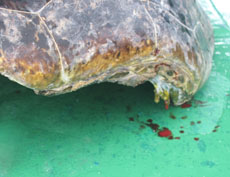
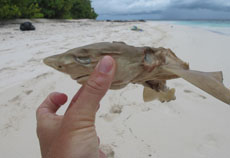
The group then discovered the slaughtered remains of a large, one metre adult nesting green turtle and 2-3 newborn lemon sharks, “still smoking on the barbecue”, surrounded by smashed eggshells.

“We found where the killing took place, there was a lot of blood in the sand, and maybe what was the trace of the turtle crawling to try and nest. I don´t know if she was killed before or after the nesting. I didn’t find any nest, so if there was one then probably all the eggs were eaten already,” Jagerroos said.

“I went snorkeling and found the remains of the turtle in the nearby waters, including the head. Some bones and flippers, were discarded a couple of meters from the barbecue. I also found the remains of baby lemon sharks on the barbecue. The lemon sharks was a newborn sized only around 50-60 cm, the meat had been removed and eaten. My theory is that they saw the green turtle nesting and killed her immediately, while slaughtering and throwing in the pieces in the ocean. The baby sharks were attracted to the smell and since they swim in very shallow waters it’s a piece of cake to catch them.”

Jagerroos noted that the Maldives had proclaimed itself the world’s second shark sanctuary in March 2009.

“For a marine biologist to find a juvenile sickle fin lemon shark on the grill when this creature is listed as “Vulnerable on the red list” with the World Conservation Union (IUCN), and is already extinct in many nearby countries, hurts,” she said.

The catching and consumption of turtles is banned across the Maldives, and turtles – together with many other species – are especially protected in the biosphere reserve.

However turtle eggs are considered a local delicacy and can fetch up to MVR 10 each – a single nest can contain between 100-200. The practice is generally not illegal, but is prohibited on the country’s nesting islands.

Marine biologists working on resorts in the atoll have also privately complained of boatloads of local poachers sneaking onto the islands at night without lights or noisy engines, after hearing of the discovery of a nest of eggs. In some instances, resorts have been forced to post security guards to protect the nests from poachers.

Baa Atoll was in June 2011 added to the UN body’s global list of biosphere reserves after five years of lobbying by the government, placing it in the company of world famous sites such as the Komodo in Indonesia, Uluru (Ayer’s Rock) in Australia and the Galapagos Islands.

The Baa Atoll Biosphere Reserve was officially launched alongside with Baa Atoll Conservation Fund by President Mohamed Waheed in July 2012 at a ceremony in the atoll’s capital of Eydhafushi. At the ceremony, the UNDP presented a cheque for US$250,000 as a contribution to the fund, on behalf of the Global Environment Facility (GEF).

Jagerroos said the team had called the Environmental Protection Authority’s (EPA) ranger at Hanifaaru Bay – a world famous habitat for mantas and whale sharks – “and he said they’d look into it. But they’d have to patrol the whole area – it’s too big,” she acknowledged.

Director General of the Environmental Protection Authority (EPA) Ibrahim Naeem said he was not aware of the incident or that it had been reported to the Hanifaaru Bay ranger, and referred Minivan News to the Ministry of Fisheries which he said was responsible for sharks and turtles.

“It is not allowed to catch and eat turtles. There is no such ban for eggs. Even in the biosphere there are actions that are allowed,” Naeem said.

Minivan News is seeking comment from the Ministry of Fisheries.

Likes(4)Dislikes(0)

Attorney General asks for Supreme Court to decide jurisdiction on GMR

The Attorney General Azima Shukoor has said she will ask the Supreme Court to rule on whether the laws of the Maldives can be applied to the government’s agreement with GMR concerning the development of Ibrahim Nasir International Airport (INIA), local media has reported.

Shukoor, who was not responding to calls at the time of press today, said a request was sent following the release of a Supreme Court statement yesterday.

“It is against the International laws and the United Nations Charter that any action that undermines any sovereign right of a sovereign state, it is clear that courts of a sovereign nation has the jurisdiction to look into any matter that takes place within the boundaries of that state as according to the constitution and laws of that state,” read the statement.

“Even though a contract has an arbitration clause giving right to arbitrate in a foreign court does not limit a local courts jurisdiction to look into the formed contract, and it is clear that such limitations are in violation of UN Charters principles of sovereign equality, principle of sovereign non intervention within domestic jurisdiction, principle of self determination rights,” read the statement.

Shukoor told Haveeru that if the case could be dealt with by the Maldivian courts, the process would become much easier.

However, she also expressed her confidence that government would be successful in the arbitration case regarding the Airport Development Charge, which was file by GMR in Singapore.

“We can win the case at the Singapore Arbitration even by biding our time. It is quite certain,” she told Haveeru.

The original agreement, argued Azima, was drafted under UK law although both sides agreed to settle any disputes through third party arbitration.

Arbitration

Third party arbitration is often used in order to gain impartial decisions from international experts whilst avoiding the uncertainties and potential limitations of local courts.

One of the world’s leading arbitration companies, the Singapore International Arbitration Centre (SIAC) gives a number of examples of why Singapore is frequently chosen for international arbitration.

Number one in its list is the country’s strong reputation for neutrality, currently placed fifth in Transparency International’s Corruption Perceptions Index, behind New Zealand, Denmark, Finland and Sweden

The Maldives is currently placed 134th in this list alongside Eritrea, Pakistan, and Sierra Leone.

The Maldives judicial system has also faced issues regarding its political independence since the adoption of the 2008 constitution.

A recent report by the International Federation for Human Rights (FIDH) said that “different sections of the judiciary have failed to become fully independent and still lack adequate expertise.”

“According to testimonies from members of the judiciary met by the FIDH team in Male’, under the successive administrations, no political party has actually ever shown any willingness to establish an independent judiciary since each seems to benefit from the existing system,” said the report.

“Moreover, the judiciary is allegedly under the influence of the business sector. For instance, the member of the JSC appointed by the Majlis is also one of the main business tycoon of the country. His presence in the body overseeing the conduct of judges, as well as the general pressure imposed upon the business sector on the judiciary, has therefore been subjected to controversy,” it concluded.

Both civil society groups as well as the current government have acknowledged the need for stronger independent institutions in the country.

President of the Anti Corruption Commission (ACC) Hassan Luthfee told local media yesterday that one of its three cases regarding the GMR deal was nearing completion.

Luthfee, who has recently questioned the ability of the ACC to fulfil its mandate, told Minivan News last week that a high profile case such as this was not easy for the institution to finish which was likely to result in delays.

“Even an international organization such as the International Finance Corporation (IFC) had provided expertise in this case. So when such an allegation of a major criminal offence has been made we must probe the matter quite extensively. This is by far the most high profile and sensitive case. So we must be certain,” he told Haveeru yesterday.

The IFC was forced to defend itself this week after being described by senior cabinet figures as “irresponsible and negligent” during the INIA bidding process.

Shukoor had said last week that as long as the agreement between GMR and the government is not invalidated, the agreement would be “legally binding” despite a “majority of the people” who wish to “terminate the agreement immediately”.

She also expressed the government’s concern about the effect on investor confidence that may result if the agreement was terminated.

Independent MP Mohamed Nasheed today told local media that, despite indicating its willingness to do so, the Majlis had not at present become a party to the 1958 New York Arbitration Convention which deals with the recognition and enforcement of arbitration awards.

Nasheed argued that the Maldivian constitution requires citizens to act in accordance with international conventions which have been backed by domestic legislation.

He added, however, that the Maldives’ Arbitration Act was still in the committee stage.

Nasheed was not responding to calls at the time of press.

Likes(0)Dislikes(0)