Thai real-estate developer to withdraw from Hulhumale’ housing project

Thai newspaper The Nation has reported that Pruksa, Thailand’s largest real-estate developer, is withdrawing its investment in the Maldives after suffering a US$3.2 million loss.

In an interview last week with Pruksa CEO Thongma Vijitpongpun, The Nation reported that the company was pulling out of the Maldives after making losses of Bt (Thai Baht) 100million.

In 2010, Pruksa formed a joint venture agreement with the Housing Development Corporation (HDC), formerly the Hulhumale’ Development Corporation, to build over 1000 houses in Hulhumale’. That company, Pruksa-HDC Housing Pvt Ltd, began construction of the first phase of the project, consisting of around 180 units, in August 2010.

Mohamed Sharah, the Assistant Director of Corporate Affairs, Marketing and Business Development, was unable to confirm whether the company had withdrawn from the agreement. Sharah also acts as Pruksa’s Company Secretary in the Maldives.

“We have not been informed [of the decision], the work on the first phase still continues and will be completed by July,” said Sharah.

The first phase, explained Sharah, consisted of nine blocks containing 180 apartments, six of which have been completed, with four already having been handed over to customers. The first phase is scheduled for completion by July.

There were some initial problems with the quality of construction work on the first two of these buildings which caused some delays to the project while work was redone to the standards required by the quality control officer.

The 180 units were pre-sold in Maldivian rufiyaa before construction. In a previous interview with The Nation, a representative from Pruksa anticipated a profitable venture.

“We started to pre-book our project in the Maldives last month for the first phase of 180 units. Demand is for more than that amount and as a result we believe our presales in the Maldives will exceed our estimate,” the company’s Chief Business Officer was reported as saying in June 2010.

However, Sharah explained that this policy had “caused significant losses” for the company due to problems with the local currency.

“They have faced devolution of the currency and a shortage of dollars in the Maldives,” he added.

The price of rufiya at the time when most of the units were sold was pegged at Rf12.85 to the US dollar. However, in April 2011, the government made the decision to introduce a managed floatation of the currency. This decision allowed the rufiya to be traded within a 20percent margin of its previous rate. The result has been the devaluation of the currency to a rate of 15.42 to the US dollar – which still remains next to unexchangable outside the blackmarket, where rates can top Rf 17-18 to the dollar.

That problem is likely to continue after the government’s budget deficit was predicted to reach 27 percent of the country’s GDP in 2012, according to figures recently released by the Majlis Finance Committee.

The International Monetary Fund (IMF)’s head of mission to the Maldives, Jonathan Dunn, recently told Minivan News: “As long as the government continues to inject substantial amounts of new spending into the economy, the foreign exchange situation in the country will not be resolved.”

The net result of Pruksa’s exposure to rufiya may account for the US$3.2 million losses the company CEO reported to The Nation.

HDC told Minivan News that 90 percent of the units were sold using the pre-booking system. The initial value of the apartments was reported to have been between Rf0.9million and Rf1.6 million.

The change in exchange rates in the period following these sales means that between US$1.8million and US$3.3million from Pruksa’s projected income may have been lost from the sale of these units alone.

During the same interview in The Nation, the CEO explained that the company was restructuring to a more profitable model, in part due to the losses suffered during last year’s flooding which afflicted much of Thailand.

However, it was mentioned that the company was considering expansion into the ASEAN nations of Malaysia, Indonesia and the Phillipines. The CEO also announced that projects in Vietnam and India, temporarily suspended in the first half of this year, would continue.

A representative of Pruksa in the company’s Bangkok office was unable to confirm the cessation of the company’s dealing in the Maldives. He did confirm that a representative of the company would be visiting the Maldives later this month, at which time more details would be made available.

The spokesperson was able to confirm that the most of the apartment sales took place 18 months ago and were transacted in rufiya.

“There were some problems with that,” the spokesman noted.

The Hulhumale’ project is regarded as the most ambitious urban development project in the history of the country. The reclamation of land and the internal migration of Maldivians to the island, which lies adjacent to the capital Male’, is seen as vital in the country’s long term plans for economic development of the nation and for the easing of congestion in the capital city.

“If Pruksa withdraws, the HDC will have to find new investment,” said Sharah.

Likes(1)Dislikes(0)

Inmates at Maafushi Prison ordered to trim beards to be eligible for parole, claims family member

Inmates in Maafushi Prison have been handed a notice informing them that they must have short hair and trimmed or shaved beards in order to be eligible for parole, a family member of an inmate informed Minivan News.

The source told Minivan News that the notice handed to inmates states that according to Prison Order 12, article 1.5, inmates shall not grow their hair and beard unless for “a medical purpose”, and hair must be trimmed or shaved, or they would not be eligible for parole.

The notice also stated that in a meeting held by the Parole Board on April 11, 2012, the board decided to consider hair as a disciplinary issue when selecting inmates for parole, and that inmates who insisted on long hair or growing their beards would have it recorded as a misdeed in their disciplinary record, according to the source.

The notice was made in compliance with Second Chance Program Office memo number 479/167/2012/113, Minivan News was informed.

When considering parole the board will check for record of misdeeds over the past six months.

Parole Board Chair Dr Ali Shahid Mohamed meanwhile denied that the Parole Board made such a decision.

‘’We are not mandated to determine the regulations and rules of the prison, we only see their disciplinary records and we will see what progress the inmate has made in prison,’’ Shahid said.

Shahid said he does not know what the prison regulations stated about beard and hair.

‘’We did not make any specific decision related to hair or beard in the meeting that day, we enhanced an earlier decision to consider the inmates disciplinary record when releasing inmates on parole,’’ he said.

Parole Board member from Department of Penitentiary and Rehabilitation Service (DPRS) Bilal did not respond to calls at time of press.

DPRS Director General Mohamed Rasheed’s mobile phone was switched off.

In November last year a group of prison guards working in Maafushi Prison filed a case at the Maafushi Court after they were ordered to shave off their beards.

Maafushi Court ruled that growing a beard for men in Islam is more than a Sunnah and almost ‘waajib’ (obligatory), and that prison officers should not be asked to shave off their beards.

In March this year the High Court invalidated the ruling saying that Maafushi Court gave no opportunity for the defendant – the Department of Penitentiary and Rehabilitation Services (DPRS) – to say anything before the case was concluded, and that therefore the ruling was unlawful.

Likes(0)Dislikes(0)

Police vehicle collides with MDP supporters on Fuvamulah, injures two

A police vehicle collided with a group of Maldivian Democratic Party (MDP) supporters while it was en-route to a crime scene on Fuvamulah in Gnaviyani Atoll, where a gang had stabbed one man, injured two others and damaged parked motorcycles.

In a statement, police said the vehicle collided with a motorcycle that had turned into Ghaazee Road.

People in the area when the incident occurred vandalised the police vehicle and assaulted police officers in the vehicle, read the police statement.

Police said two persons injured in the accident, as well as the gang attack victim, were admitted to Fuvamulah Hospital.

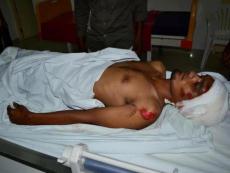
However online newspaper ‘Kattelhi’, based in Fuvamulah, reported that the  police vehicle was returning from the crime scene at around 9:30pm when it collided with a motorcyclist, causing the driver to lose control and crash into parked motorcycles. The paper alleged the vehicle was travelling at a very high speed.

Immediately following the crash, people gathered in front of the MDP Fuvamulah Office surrounded the police vehicle, broke the glass, and attacked police officers inside the vehicle, Kattelhi reported.

Kattelhi reported that its reporters witnessed some of the officers being admitted to Fuvamulah Hospital.

The paper identified the injured two persons as Ahmed Hassan, 23 and Ali Saeed, 30 both of them Fuvamulah islanders.

According to Kattelhi one man’s head was badly injured and his body bruised, however according to Fuvamulah Hospital no one was seriously injured.

Minivan News understands that the person who received injuries to his head has been brought to Male’ for treatment.

One man suffered bruises and head injuries in the accident

Kattelhi quoted people in the area as saying that the police vehicle was travelling at an unusually high speed and that there was enough space for it in the middle of the road. MDP supporters were on both sides of road attending a meeting.

The paper identified the gang attack victim as 18 year-old Ahmed Juman, who was stabbed in the head but was not seriously injured.

Supporters of government-aligned parties later gathered near Fuvamulah Hospital and Fuvamulah Police Headquarters, claiming that they believed MDP supporters were coming to attack police, according to Kattelhi. The crowd left after police requested them to leave.

Police Sub-Inspector Hassan Haneef said the police statement was issued based on the information police have received so far and that the investigation into the case was ongoing.

Likes(0)Dislikes(0)

High Court issues injunction halting Nexbis project pending outcome of ACC appeal

The High court has issued an injunction temporarily halting the roll out of the Nexbis border control system, pending the outcome of the Anti-Corruption Commission (ACC’s) appeal against a Civil Court ruling that the ACC did not have the authority to halt the project.

The ACC in a hearing last week had requested an injunction, however Judge Azmirelda Zahir stated that such a decision could only be taken after both sides had presented their cases. The ACC had expressed concern that the project could be completed before the conclusion of the High Court case.

Immigration Controller Ilyas Hussain Ibrahim said he would not comment on the matter and referred Minivan News to Deputy Contoller Ibrahim Ashraf, who was not responding at time of press.

The case was delayed last week after the High Court ruled that Deputy Solicitor General Ahmed Usham could not represent the state in the case, as he had been a member of the tender evaluation board that had awarded the contract to Nexbis.

The case concerns a 20-year Build, Operate and Transfer (BOT) agreement with the Malaysia-based mobile security solutions provider to upgrade border security in the Maldives with new technology including facial recognition and fingerprint identification, facilitating the identification and tracking of expatriate workers and eliminating the opportunity for people to enter the country with forged paper documents.

The ACC had earlier ordered a halt to the project following the signing of the contract in October 2010, announcing that it had received “a serious complaint” regarding “technical details” of the bid, and that the agreement presented “instances and opportunities” for corruption.

In December 2011, the Commission forwarded corruption cases against former – and now reappointed –  Controller Ilyas Hussain Ibrahim, and Director General of the Finance Ministry, Saamee Ageel, to the Prosecutor General’s Office (PG), alleging that the pair had abused their authority for undue financial gain in granting the contract to Nexbis.

On February 16 Illyas confirmed that the department would proceed with the border control project as there was no “legal obstruction”. He disputed the claims of corruption and insisted that the project was awarded to Nexbis through a transparent international bidding process.

The agreement stipulates that Nexbis will levy a fee of Rf30 (US$2) from arriving and departing passengers in exchange for installing, maintaining and upgrading its immigration system. The company would also charge a Rf231 (US$15) for every work permit card.

Former Immigration Controller Abdulla Shahid has contended that this would deprive the Maldives of US$200 million in revenue over the life of the 20 year contract. Comparing Nexbis’ earnings to the government’s estimated revenue of US$10 million, Shahid proposed the government instead maximize its income by operating a system given by a donor country: “Border control is not something we are unable to comprehend,” he suggested.

Minivan News reported on February 16 that Nexbis had filed a case in the Civil Court seeking Rf 669 million (US$43 million) in damages from Shahid, alleging that its reputation had been tarnished by negative media coverage.

Likes(0)Dislikes(0)

President provides account of his actions to CNI

President Dr Mohamed Waheed Hassan on Tuesday met with the Committee of National Inquiry (CNI) to provide an account of his actions during the recent transfer of presidential power.

The CNI was set up by Dr Waheed to investigate the legitimacy and legality of the events between January 14 and February 8 following the claims of the former ruling party, the Maldivian Democratic Party (MDP), that the change of power was tantamount to a coup.

The Committee which consists of Ismail Shafeeu, Dr Ibrahim Yasir and Dr Ali Fawaz Shareef, has been criticised by the MDP who argue that it was assembled without adequately consulting other parties and that it lacks impartiality. The party has refused to work with the CNI.

This criticism was backed by the Commonwealth Ministerial Action Group (CMAG) which has given the government a deadline to address its concerns over the commission’s impartiality and independence.

These calls have more recently been accompanied by the Maldivian civil society coalition Thinvana Adu which was particularly keen to encourage the involvement of international experts in the inquiry process.

The government’s response to CMAG’s criticism was, firstly, to criticise the statement as lacking in specific details, before arguing that it had asked the Commonwealth to assist in the inquiry process but had received no response.

More confusion followed as President Waheed claimed that it was not within his remit to change the compositioin of the commission. This statement was followed by a statment from the commission arguing that changes ought to be made by presidential decree and not at the behest of the commission itself.

The CMAG deadline expires in one week’s time, after which the group has threatened “further and stronger measures” which, according to Spokesperson for the Commonwealth Secretariat, Richard Uku, could include suspension.

Likes(0)Dislikes(0)

Six arrested during MDP protest against prosecution of party supporters

Police arrested six people during the Maldivian Democratic Party’s (MDP) demonstration held on Tuesday evening to protest against ongoing court cases against its supporters.

According to the party, the Prosecutor General (PG) has filed charges against 60 MDP members for obstruction of police duty during the party’s three-month series of protests. If charges are proved, the accused may be jailed for six months or fined up to Rf 12,000 (US$800) each.

The Criminal Court on Tuesday held hearings against 10 people charged with obstruction of police duty during an MDP rally on March 1.

The six arrested on Tuesday were also detained for obstruction of police duty.

The MDP has been campaigning for fresh elections in 2012 after former President Mohamed Nasheed alleged he was deposed in a coup d’état, carried out by mutinous elements of the police and military on February 7.

Speaking to MDP members on Tuesday night, Nasheed said he was “concerned about the arrest and prosecution of protesters exercising their right to freedom of expression and assembly.”

The MDP continues to rally against prosecution of its supporters with a peaceful demonstration held outside the Supreme Court building at 2:00 pm on Wednesday. At time of press MDP supporters were also gathering outside the Justice Building where the country’s lower courts are housed.

Arrests

Police Spokesperson Hassan Haneef said the six people arrested on Tuesday were detained for obstructing police duty after they broke through police barricades in front of the Maldives Monetary Authority (MMA) building. Five of the six arrested continue to remain in custody.

Haneef also said two police officers had suffered head injuries after protesters threw glass bottles at the officers.

Minivan News observed over a thousand protesters at the MDP rally.

In a statement on Wednesday, the MDP claimed its supporters were pepper-sprayed at close range and beaten with batons on Tuesday night.

Video footage of the protest shows a woman fall to the ground as police officers in riot gear attempt to arrest her.

Court cases

The ten people who appeared in court on Tuesday were arrested during an MDP protest on March 1 which had sought to obstruct new President Mohamed Waheed Hassan from delivering a presidential address at parliament’s opening session on March 1.

According to local media, two policemen gave differing statements on Tuesday’s hearing. One police officer said he had witnessed eight of the 10 men who appeared in court beating police shields, while another policeman said he had only seen five of the ten men beat on police shields during the protest.

The Prosecutor General’s (PG) Office was unable to confirm the exact number of cases filed at court for obstruction of police duty.

However, Deputy PG Hussein Shameem has previously told Minivan News that 116 cases had been filed against demonstrators regarding unrest on February 8. Riots broke out throughout the Maldives following a brutal police crackdown on MDP supporters in Malé. Court buildings and police stations were set on fire and vandalised during the riots.

“We have submitted 116 cases to the criminal court. The charges we have filed regard obstruction of police duty, assault on police officers on duty, and attempt to assault police officers on duty,” Shameem said.

Freedom of assembly

Speaking to MDP supporters, Nasheed said he condemned the charges against “peaceful” protesters while police and military officers who carried out the “coup” continued to remain free.

“Maldivian citizens cannot accept the prosecution of protesters who raised their voices against treasonous police and military, when we continue to see these officers in front of us,” Nasheed said.

“It is essential that we come out in support of those who are being tried. We gain success only when we find courage in each other to overcome fear. It will be difficult to carry out civil disobedience if we neglect those who are arrested from amongst us,” Nasheed added.

Police have also forwarded two different cases against Nasheed over the discovery of alcohol bottles at his former residence Muleeage on February 7 and the controversial arrest of Criminal Court Chief Judge Abdulla Mohamed in January.

Video footage of MDP rally on May 8:

Likes(1)Dislikes(0)

Cabinet confirms decision to take over second MDP protest site at Usfasgandu

The new Maldives’ cabinet has announced its decision to hand over the Usfasgandu area to the Ministry of Housing and Environment.

The area is currently being used for protests by the ousted Maldivian Democratic Party (MDP), after the party’s site near the tsunami monument was forcibly dismantled by police and military on March 19.

In a statement, the President’s Office said that during discussions concerning “the breach of agreement by the Male’ City Council (MCC) in utilising the land plots and other properties handed over to the City Council by the Ministry of Housing and Environment,” the cabinet had decided “to entrust the Minister of Housing and Environment with the authority to reclaim the properties from the City Council when required.”

Speaking with Mayor Ali Manik at the protest site, Minivan News was told that the government forces would arrive on May 14. Manik said he had received a letter from the Housing Ministry informing them of this plan at 1:30pm today.

Asked about the decision, Minister for Housing and Environment Dr Mohamed Muiz said that he was “not in a position to talk about that.”

The Housing Ministry informed the MCC one month ago that it intended to take control of the Usfasgandu area if the MDP activities did not cease.

During the same week in April the Housing Ministry was involved in a further dispute with the MCC after the re-allocation Dharubaaruge staff members from the MCC to the Housing Ministry.

This action prompted the council to lock the doors to the centre and send staff home. This action was subsequently described by Muiz as “unlawful” before policemen arrived to reopen the facility.

The following week the Housing Ministry informed the MCC by letter that it had less than 24 hours to remove its employees from the Huravee building in order to accommodate new government ministries.

Deputy Mayor of the Council Ahmed Falah maintains that MCC will refuse to accept these decisions and these disputes must be settled in the courts.

When asked about the current situation in the Huravee building, Falah said things were continuing “as normal. Still we are in there.”

The MDP’s international spokesman and Secretary General of the party’s parliamentary group Hamid Abdul Ghafoor, interpreted these actions as an attack on both freedom of expression and the decentralisation policies of the previous government.

“The coup administration is breaking up the decentralisation concept. The President’s Office is controlling everything – even down to the playgrounds on the islands. They are bringing back Gayoom’s policies of centralisation” said Ghafoor.

Ghafoor questioned the wisdom of the acquiescence of government-aligned parties in the face of such policies.

“They are also curtailing freedom of expression and freedom of assembly. The Dhivehi Rayyithunge Party (DRP) and the Progressive Party of Maldives (PPM) perhaps do not have a good concept of their basic human rights. Do their members consider what will happen to their freedom of expression? Their grassroots supporters may realise this too late,” Ghafoor continued.

The area behind the Dharubaaruge convention centre has been utilised by the now-opposition Maldivian Democratic Party (MDP) since security forces ejected them from their camp at the nearby tsunami monument on March 19.

Dubbed ‘justice square’, the camp in the Lonuziyaaraih Kolhu area, had become the hub for opposition demonstrations since the contentious transfer of presidential power on February 7.

The government’s allegations that these activities were of questionable legality prompted its dismantling of the camp and the subsequent court case brought by the MDP leadership.

The dismantling of the camp came at the end of a day on which MDP led protests at the reopening of the People’s Majlis had turned violent.

Multiple casualties were reported from both protesters and security forces. The headquarters of Villa Television (VTV), owned by leader of the government aligned Jumhoree Party (JP) Ibrahim Gasim, sustained significant damage.

The court case, the first incarnation of which was dismissed on a technicality, continues with the issue of land usage forming the backbone of the state’s defense.

The government has argued that the leasing of such public spaces for political activities violates the terms which govern the MCC’s stewardship of such areas.

Hassan Latheef, a member of the MDP’s legal team working on this court case, scheduled to resume on May 13, said that the government had “no grounds” to take the land from the MCC in either the case of Usfasgandu, nor that concerning Rahlugandu.

When asked about the government’s position on the use of council land for political purposes, Latheef argued that there was nothing in the decentralisation act that prohibits this.

“I do understand that anything is acceptable and expected in a police state. The country is being taken from the people by a few coup leaders. The Maldives is now a police state,” Latheef contended.

Blocking the steps leading to the raised area used for the MDP’s gatherings at Usfasgandu, a sign read: “No court order, don’t take this place.”

The original ‘justice square’ camp was leased to the MDP by Male City Council (MCC), itself established through the 2010 decentralisation act under the governance of former President Mohamed Nasheed.

In a clear refutation of this argument, the MCC made the decision to lease the Usfasgandu area to the MDP for a three month period within days of the party’s ejection from the tsunami monument area.

The MDP was widely supported by urban populations of the Maldives in last year’s local council elections, securing 100 percent of the council seats in Addu City in the south and Kulhudhufushi in the north, and nine of the 11 seats in the capital Male’.

Likes(1)Dislikes(0)

Police arrest 47 Bangladeshi nationals after raid on unregistered security firm

A total of 47 Bangladeshi nationals working for a local security firm were seized on Thursday by the Department of Immigration as part of a wider crackdown on unregistered migrant workers.

The detention of the expatriate workers comes after police late last year reported a “day-by-day” increase in human trafficking in the Maldives.  The Maldives Police Service’s claims were based on a surge in the numbers of illegal expatriate workers found in the country.

Assistant Controller of the Immigration Department Ibrahim Ashraf told Minivan News that the 47 Bangladesh nationals were all apprehended following a raid of a company providing security guards that was not registered to employ foreigners.

Ashraf claimed that the company the men had been working for had been in operation for 10 -12 years, yet no information could be found on its operations.

“During the raid, we found 47 Bangladeshi nationals all wearing security uniforms along with equipment like walkie talkies and badges,” he said. “They were not registered for this work and we could not find any records linked to the company.”

While the Department of Immigration has said that it was not cracking down specifically on security firms employing expatriate workers, Ashraf added that concerns remained about ensuring the industry had correctly licensed its foreign staff.

“Until recently, the Ministry of Human Resources did not provide [expatriate] work quotas to security firms,” he said. “There has been a growing demand among local businesses to hire security services. The Ministry of Human Resources has therefore begun issuing quotas for hiring expatriates in security services.”

Ashraf added that the Immigration Department’s concerns were not focused just on security firms, but instead on companies from various industries that had failed to obtain and then correctly register staff.

“Right now we are looking for expatriate workers on the run. We have received a lot of reports from employers about staff going missing,” he said. “This is especially true in the outer atolls, where we are getting complaints about unregistered employees travelling between islands.”

Ashraf claimed that the 47 Bangladeshi nationals who had been detained Thursday would not necessarily be deported if a sponsor could be found to provide employment and accommodation for them.

“We will try and give the employees the opportunity to stay here and work if a sponsor is willing to regularise them,” he said.

High Commission

The High Commission of Bangladesh in Male’ said it had been made aware of the 47 detained workers, who had been seized for not having proper documentation.

The commission said it was often notified regarding such cases, and was presently awaiting travel documentation for the detained expatriates before considering possible deportation.

The High Commissioner of Bangladesh, Rear Admiral Abu Saeed Mohamed Abdul Awal, said today that he believed workers from the country were regularly being brought to the Maldives to perform unskilled work, usually in the construction industry.  Awal alleged that upon arriving, expatraites from Bangladesh were suffering from the practices of “bad employers”.

“This is a real problem that is happening here, there have been many raids over the last year on unskilled [expatriate] workers who are suffering because of the companies employing them. They are not being given proper salaries and are paying the price for some of these employers,” he said.

Rear Admiral Awar added that it was the responsibility of employers to ensure expatriate staff had the proper documentation and suitable living standards.

Concerns about the treatment of expatriates from across the South Asia region were also shared by Indian High Commissioner Dynaneshwar Mulay. Speaking to Minivan News last month, Mulay raised concerns over the general treatment of Indian expatriates in the Maldives, particularly by the country’s police and judiciary.

Mulay claimed that alongside concerns about the treatment of some Indian expatriates in relation to the law, there were significant issues relating to “basic human rights” that needed to be addressed concerning expatriates from countries including Sri Lanka and Bangladesh.

Mulay’s comments were made following an alleged attack on a Indian resort worker, who was reported to have been struck with a hammer and mugged while staying in a hotel in Male’. The attack was allegedly committed by a former employee of the same resort.

Big business

Beyond concerns about the basic human rights of foreign employees in the country, labour trafficking is also believed to represent a significant national economic issue.

An ongoing police investigation into labour trafficking in the Maldives last year uncovered an industry worth an estimated US$123 million, eclipsing fishing (US$46 million in 2007) as the second greatest contributor of foreign currency to the Maldivian economy after tourism.

The authorities’ findings echo concerns first raised by former Bangladeshi High Commissioner Dr Selina Muhsin, reported by Minivan News in August 2010. The comments by Mushin were made shortly after the country was placed on the US State Department’s Tier 2 watchlist for human trafficking.

Likes(0)Dislikes(0)

STO, BML and MTDC fined over financial statements

The Capital Market Development Authority (CMDA) has fined three public companies including the Bank of Maldives (BML), State Trading Organisation (STO) and the Maldives Tourism Development Corporation up to Rf120,000 (US$7782) for failing to publish quarterly reports and financial statements.

According to the CMDA, companies – including BML, STO and MTDC – listed under under the Securities (Continuing Disclosure Obligations of Issuers) Regulations must produce a quarterly report after every three months, within the following 30 days.

However, CMDA noted that both STO and MTDC had failed to produce first quarterly report for 2012 within the given 30 day period and therefore each company was fined upto Rf30,000 (US$2000).

Meanwhile, MTDC and the BML were each fined up to Rf30,000 for failing to publish annual financial statements as stipulated under the regulations. The statistics must be published within four months after the end of a financial year.

The companies had requested for deadline extension citing difficulties in producing the report within the given time frame, CMDA said. However the extension was not granted as the reasons provided were not acceptable, the authority claimed.

All the companies have been instructed to publish the reports by May 15.

BML was fined up to Rf10,000 (US$648) in January, after the bank failed to publish the quarterly report for the last three months of 2011 before the requested due date.

The bank said at the time that the report was delayed due to a pending audit.

“The fourth quarterly report requires more work as it must be published with annual figures that must be audited prior to publication,” BML said.

Likes(0)Dislikes(0)