Rights awareness a leading concern for civil services

“Most people understand the rights themselves, but not what it means to have them. In a democracy, we hope that the people will all play a role.”

Commissioner Ahmed Tholal represented the Human Rights Commission Maldives (HRCM) at yesterday’s UNDP “Did You Know?” event at the Surf Point, the second in a campaign begun last year. The event targeted awareness building on human rights and the judicial system, particularly as provided in Chapter Two of the constitution. Over a dozen groups including Police Services, the Faculty of Shari’ah Law, Employment Tribunal, Courts, and the Elections Commission offered pamphlets and demonstrations of their social purpose.

“These kinds of things people will forget unless you keep on promoting it,” said UNDP National Project Manager Naaz Aminath. “It’s not something you can just accomplish by handing out pamphlets.”

Many groups interviewed said raising awareness of civil rights and how to exercise them was their biggest challenge.

Representatives from the Supreme Court defined the court as “part of a larger enforcement of human rights in the Maldives,” which she said “are there in the constitution but people don’t know how they can exercise them, or how they can defend them.”

She noted that though many citizens are unfamiliar with case filing procedures, the court had seen a “dramatic increase” in the number of cases filed and expected the trend to continue.

Speaking of the court as a robust institution, representatives concurred that there was room for improvement. “It’s only three years old, right, and it’s still growing. You can never reach maturity, right? There’s still room for improvement in anything, anywhere.”

Across the square, Police Integrity Commission (PIC) member Dr. Hala Hameed also reported a rising case rate.

“We are getting more reports of police misconduct than previously,” she said. “People are more aware of the commission and so they are using its services more.”

Hameed stressed that the PIC supports the police as well as the community. “We are here to empower the police and ensure that they have the appropriate resources to do their work, as well as oversee their operations.”

Saying that awareness was a concern, she said the PIC’s independent status validated its operations. “People know that if there is an independent commission to oversee the police activities then it will be effective.”
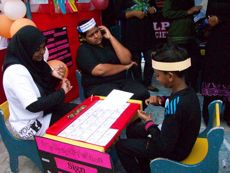
While many booths provided hard information about social services, several catered to the younger generations. Kids were invited to decorate cakes and paint pictures for various causes. At Care Society, children learned sign language from a hearing impaired instructor and familiarized themselves with disability icons over a board game.

One Care Society representative said community awareness had improved in recent years, “especially since the passing of the Disability Law last year.” But community tolerance “is an issue we are working to address. “

“There is still a fair amount of people who don’t understand the nature of various disabilities and how to interact with those individuals. It’s something that needs to be corrected,” she said.

HRCM Commissioner Tholal said social reform goes deeper than a pamphlet.

Attributing misconceptions of human rights to social instability, Tholal observed that “There’s this idea that if a prisoner has rights, it’s at someone else’s expense. But human rights are not about protecting one person’s rights and not another’s.

“The idea of self-expression and human rights is still fairly new to the Maldives under the new government, so as things stabilise I think the view of human rights could improve as well.”

According to Tholal, the HRCM has been targeted by proponents of Islamic fundamentalists, but the larger Islamic community has supported the commission’s work.

“The key thing for the public to understand is that the Maldives is a 100 percent Muslim country,” he said. “The rules and regulations that this status calls for can exist within the framework of human rights. They’re not incompatible. If anyone says otherwise, they negate the mission of the HRC. The idea that human rights are compatible with Islam, and the constitution, needs to be accepted by the people.”

Tholal did not wish to comment on the UN Human Rights Commissioner’s recent critique of the constitution’s provisions for flogging and mono-religious practice.

Calling for a more concerted media effort, Tholal said media is one of the most important factors for establishing a stable human rights framework. He criticised local media outlets for endorsing only a fraction of the rights issue.

“A lot more focus is placed on civil and political rights in the media, as opposed to social, economic and basic human rights,” he said, emphasizing that women and children are significantly under-represented. “Some media outlets, whether deliberately or inadvertently, have programs which impinge on the rights of women and rights, such as the right to work. In this environment, we need to focus on what is really crucial to people–like social rights.”

Earlier this year, a UNDP study found that gender equality is an area of development in which the country is lagging behind most.

HRCM will hold a media training program later this year.

Keeping the beat

After last year’s launch, the “Did You Know?” campaign aimed to tour Male’, Vilingili, Hulhumale, and the capital islands. “We exceeded expectations and reached 80 islands in 20 atolls,” said Aminath. “But we realized that it was just not possible to reach all the islands with the small number of volunteers we had.”

Aminath said the next phase of the campaign training approximately 10 NGOs across the country to providing information on the judicial system to islanders year-round.

“There are two main obstacles: geography, and capacity,” Aminath said. “The island geography makes it difficult for people to learn of and access all parts of the judicial system. And the Maldives has many many civil society groups, but not enough people to do the work.”

A UNDP report earlier this year found that although the civil society sector is impressive in size, it lacks efficiency and organisation. Aminath said collaborating with NGOs would support both the campaign’s purpose and the NGOs’ interest in capacity building.

Aminath said islanders are often aware of their rights, but that Maldivian culture is not traditionally litigal.

“People are used to talking and solving the problems that way. Going to court is a process, and if you appeal you have to go Male’ which takes time and money. There needs to be someone in the islands telling people how they can proceed with a complaint,” she said.

Plans to develop a mobile high court are indefinite.

This year’s event was widely attended by families and youth who enjoyed the activities, free candy, and social milling. Most booths were hosted either fully or in part by young people eagerly offering pamphlets.

Aminath said the UN strives to involve youth in most activities, and that they are the backbone to the “Did You Know?” campaign.

“Most of my volunteers are ages 19 to 30, and they’re an excellent group. They came on all 80 island trips this year. They also represent a real cross section of civil service, coming from the courts, the prosecutor general’s office, the police and other parts of society,” she said. “I couldn’t do these kinds of events without their support.”

At UNDP’s Democracy Day ceremony earlier this year, a study observed that youth in civil society were widely recognised as a key factor for democratic growth in the Maldives. Currently, youth ages 18 to 25 comprise nearly half of the country’s population.

Likes(0)Dislikes(0)

Maldivian Islamic groups call for arrest of UN High Commissioner on Human Rights

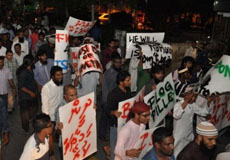
Protestors gathered outside the United Nations Building in Male’ on Friday afternoon to condemn UN Human Rights Chief Navi Pillay for her criticism of the Maldivian constitution, namely its provisions endorsing flogging and mandating that every Maldivian be a Muslim.

The protestors carried signboards with angry slogans, including “Islam is not a toy”, “Ban UN” and “Flog Pillay”, and called on authorities to arrest the UN High Commisioner.

Police Sub-Inspector Ahmed Shiyam told Minivan News that the sizeable protest was contained and there were no confrontations.

“Police cordoned off the area so people could not enter the UN building or the roads leading to the building. The protest was pretty heated, but there were no confrontations or arrests,” he said.

After a break for Sunset Prayer, protesters renewed their efforts at the Tsunami Memorial.

Shiyam said police guarded the UN building during the evening protest, and kept appraised of its movements.

No concerns have been voiced to the police by the UN.

During a press conference on Thursday evening, Pillay again called for the government and the judiciary to issue a moratorium on flogging.

“Flogging is a form of punishment that is cruel and demeaning to women. I have as High Commissioner traveled to very many Islamic countries, and apart from the Maldives and one other country that practices stoning, flogging is not a practice that is condoned,” she said.

“The issue needs to be examined, and therefore I called for a countrywide discussion. It is much better if the issue is transparent and debated.”

Challenged by a local journalist that the Maldives was both obliged to protect the religion of Islam, she replied: “You have a constitution which conforms in many respects to universal human rights. Let me assure you that these human rights conform with Islam.”

She added that the Maldives had signed international treaties that are legally-binding obligations, “and such a practice conflicts with these obligations undertaken by the Maldives.”

Pillay said she had raised this matter with President Mohamed Nasheed and the judges during her visit, “and they are all looking into this matter. The President is sympathetic because each time he travels outside the Maldives the issue is raised with him. He says he can only look at it on a case by case basis, but if there is a judicial decision, that may apply to all cases.”

She renewed her call for a moratorium, and noted that the Maldives “has an excellent track record regarding the death penalty. The death penalty is unIslamic and is not practiced in the Maldives. When I travel to places where the death penalty is used, I hold up the Maldives as an example of that.”

Asked to comment on the requirement under the Maldivian constitution that all Maldivians be Muslim, Pillay respond that “Such a provision is discriminatory, and does not comply with international standards. I would urge a debate again on the issue to open up entrance of the constitution to all.”

Asked by another local journalist to respond to the religious groups criticising her requests, “my response is that as the UN High Commission of Human Rights I look at the norms and standards that all the governments of the world have drawn up.”

“It is not that I am plucking principles from the air. I point my critics to universally accepted standards on human rights are consistent with Islam. Many governments and scholars have told be there is no conflict between human rights and Islam.”

Pillay also highlighted the plight of expatriate labourers in the Maldives, who make up a third of the population and in many cases have been lured to the country by unscrupulous employment brokers.

“The Minister of Foreign Affairs [Ahmed Naseem] is very aware of the suffering of foreign workers, and agreed that something needs to be done for these people,” Pillay said.

“You can’t have 60,000 people suffering here while performing work for the benefit of Maldivians and the tourism industry, and pretend this is invisible. The media has a role to give these people a voice so they can explain their problems.

“Many of them are trafficked and the little money they earn is exploited. This is of grave concern to me, because people like this are are protected under the UN Convention on Migrant Workers and their Families. I have urged the Maldives to ratify this, and regularise the presence of 60,000 people

“I also call for an end to the stereotyping of these people as a threat and unwanted.”

Likes(0)Dislikes(0)

Comment: Climate change and security

As South Africa and Durban get ready to host the 17th Conference of Parties to the United Nations Framework Convention on Climate Change (COP 17) from 28 November-9 December, 2011, a key question is posed to all nations: where do we stand and how does this affect us?

Climate change is one of the greatest common challenges facing the modern world. Left untackled, it will lead to more extreme and unpredictable weather conditions, including widespread drought and flooding. As two island nations, the Maldives and the UK are also particularly vulnerable to rising sea levels – in fact, as the Maldives is well aware, the effects are potentially catastrophic.

All of us – political leaders, diplomats, business people, scientists, activists and citizens – need to work together to provide solutions to this climate change challenge.

Climate change is not just an environmental threat. It is also an economic and security threat. People are concerned about the cost of action on climate change. But lack of action will have significant costs: experts predict that the costs of climate change will be between 5-20% of global GDP if no action is taken to prevent it, with developing countries expected to face the highest costs.

The reality is that action on climate change makes economic sense for all of us: there are, for example, a great variety of measures that households and businesses could take which would not only reduce their carbon emissions, but also save them money.

The human impact of climate change also extends to food, that most basic need of humankind. Changing temperatures will alter crop distributions and crop yields. There are dire consequences in store for rice production, the staple of the South Asian diet. A recent study by the International Rice Research Institute (IRRI) shows that every 1o rise in night-time temperature – a rise so small your body would barely register it – will produce a corresponding 10% decrease in grain yield.

The demand for food is predicted to grow by 70% by 2050. For the Maldives, as with many other countries, this will mean higher prices; for agrarian economies in the developing world, the consequences could be catastrophic.

Moreover, climate change is expected to lead to key developments within the South Asian region. Natural resources such as water are likely to become scarce, leading to tensions and conflict among those countries that mutually depend on these resources. South Asia is already one of the most conflict-prone regions in the world and among those most vulnerable to the effects of climate change.

The combination is combustive. Increasingly erratic weather patterns continue to threaten people’s homes and livelihoods, exacerbating social inequities and tensions, posing a real risk to peace and stability and affecting economy development. This reality was clearly recognised in the Presidential Statement issued after the UN Security Council debate on climate change in July this year.

The UK recognises that developed countries have to accept historic responsibility for creating much of the problem of climate change, and therefore, a greater responsibility for addressing it. The UK Government has committed to reducing our carbon emissions by 50% by 2025, and we are also encouraging the EU as a whole to increase the EU reduction target to 30% by 2020.

But the EU covers only some 12 percent of global emissions. We are coming to the end of the first commitment period of the Kyoto Protocol and the need now is to build an ambitious, global, legally-binding regime, involving all major emitters. Only a legally binding approach will give business and investors the confidence they need to move rapidly on low carbon measures.

We have made some progress, as the small albeit definitive results of Cancun in 2010 reveal. But this is not enough. As John Ashton, the FCO Special Representative for Climate Change who visited the Maldives in July this year, said in a recent article in The Guardian, “The International Energy Agency has set the scene, with the timely warning in its new World Energy Outlook that we are way off track to avoid dangerous climate change, and that the window for effective action is closing fast.”

We need to summon the will, not just to avert disaster, but also to seize the opportunities of low carbon growth in trade, investment and new industries. Developing new technologies for sustainable development can be a driver for future growth. The Maldives, with its strong commitment to carbon neutrality by 2020, is well-placed to foster links with the most cutting-edge technologies in this field. The UK’s own clean technology goods and services market is now worth £112 billion and employs nearly a million people.

As President Nasheed said during his opening address at the recent SAARC summit, “The future is ours to shape.” It is up to the countries who meet in Durban over the next two weeks to shape the future of the world – to protect it from being further imperiled by climate change. The theme for COP17 is “Working Together: Saving Tomorrow Today.”

Five simple words – yet, they represent a world of a difference. What we do next week will determine what happens in the Maldives in the next decade – and beyond

John Rankin is the British High Commissioner to Sri Lanka and the Maldives.

All comment pieces are the sole view of the author and do not reflect the editorial policy of Minivan News. If you would like to write an opinion piece, please send proposals to [email protected]

Likes(2)Dislikes(0)

Renewable energy prices posed with high potential

The cabinet has set prices for government-owned utilities companies to purchase renewable energy as part of an investment scheme to bring the Maldives closer to its carbon neutral goal.

“We think renewable energy has a lot of potential, it is why we are in the business. We think this is where things should be going,” said Renewable Energy (REM) Director Hudha Ahmed. Noting that diesel rates are currently higher than projected solar energy rates, she said solar energy is a more reliable source long-term.

According to the Cabinet’s decision, State Electric Company Limited (STELCO) can buy a unit for Rf3.42. South Central Utilities Limited will be charged the highest rate per unit (Rf5.39), and Upper North Utilities Limited can buy a unit for Rf4.44. Units are available to Northern Utilities Limited for Rf4.40, Central Utilities Limited for Rf3.97, and Southern Utilities Limited for Rf3.94.

The Maldives currently aims to cut carbon emissions by 60 percent using solar power. Currently, no company is carrying out a commercial renewable energy project in the Maldives.

STELCO, which just received the rates and is awaiting conditions from the Ministry of Housing and Environment, said there are plans to provide renewable energy locally.

“We have some projects which are being planned, mostly in solar and wind. One solar project is expected to be commissioned in a few weeks,” said STELCO Chief Technology Officer Mohamed Zaid.

Since signing the Copenhagen Accord in January 2010 the Maldives has focused on decarbonising the electricity sector, which accounts for over 31 percent of industrial project expenses.

Decarbonising the country is expected to cost the Maldives US$3-5 billion over the next 10 years.

The rates approved by the Cabinet were researched and recommended by Maldives Energy Authority. Deputy Director Ajwad Musthafa said the rates were calculated according to fuel prices in each region and differences in fuel efficiency.

“The amounts we set were about 10 percent cheaper than they currently are in diesel,” Musthafa said.

Over 25 percent of the Maldives’ GDP is spent on diesel used for boats alone.

Consumers won’t be affected by the plan, which currently targets investors only and is likely to be lucrative, he added.

“As it stands now, a person can put a solar panel in his home and send the power to a grid. Having invested in energy production, that person can expect a six to seven year payback period before making a profit, which are expected to grow significantly with time. Currently, there is no mechanism in place between the investor and the utility company, but I believe it is being developed,” said Musthafa.

He observed that the system would be especially attractive to people in the Upper South and South Central regions, “where energy prices and feed-in tariffs are higher.”

In September, the Maldives signed the Renewable Energy through Feed-In Tariff in an effort to reduce electricity costs by promoting a shift from oil fuel to renewable energy sources.

“The existing system is fairly inefficient in these areas,” he said. “About fourteen years back the government was charging an Rf3.5 flat rate for energy. We got complaints from investors, so now we are trying to make it more exciting for investment.”

Earlier this month the Maldivian government solicited bids from solar power companies to power 29 islands, which are facing power generation difficulties. Many small islands have small power stations, which are expensive and yield disproportionate returns.

As fuel prices increase, Musthafa explained, so will the feed-in tariff, and the overall price of diesel is unlike to drop in coming years. By comparison, locally-produced solar would be a valuable option.

Musthafa said a buyer’s mechanism was being developed and would be implemented in due time. “Right now, we want to create a market that offers transparent, confident investments,” he said, adding that foreigners are expected to play an important role.

“Foreign investors will only have to sign a power purchase agreement. Nothing has to be taken from the government’s side,” he said. Local companies are also expected to benefit from external support provided by foreign investors.

Past the investment phase, the solar plan includes capacity development, training and awareness programs on renewable energy, and methods to make the investment more affordable, including concessional loans.

“Our hope is that by early next year we will have the proper institutional set up to make this happen,” Musthafa said.

Correction:

Previously, this article stated, “As it stands now, a person can put a solar panel in his home and send the power to a grid…Currently, there is no mechanism in place between the investor and the utility company, but I believe it is being developed.”

It should have read, “As it stands now, a person can install a solar panel in his home and sell the power to a grid…We have already established a set of technical guidelines and application procedures for Solar PV installations. Additional regulations are being developed.”

Likes(2)Dislikes(0)

RF18 million vanishes from Sheesha account

Rf18 million has allegedly gone missing from a State Bank of India (SBI) account owned by the three brothers who own local motorcycle retailer Sheesha.

Police have launched an investigation into the fraud case, reports Haveeru.

The transfer, allegedly unauthorised, was made from a personal savings account, Haveeru claims. The recipient account has not been identified.

Likes(0)Dislikes(0)

Salaf asks PIC to take action against police for protecting ‘idols’

Religious NGO Jamiyyathul Salaf has sent a letter to the Police Integrity Commission (PIC) demanding it investigate and take action against police for protecting the ‘idolatrous’ SAARC monuments in Addu.

In its letter, Jamiyyathul Salaf noted that Islamic Minister Dr Abdul Majeed Abdul Bari had declared that the SAARC monuments kept in Addu were un-Islamic and unconstitutional.

Salaf said that after the Islamic Minister publicly revealed his stand on the issue, police had worked to protect the monuments and said that it showed that police “have no respect for the laws.”

Salaf claimed that some police officers had refused to go out and protect the monuments, and that those police officers were threatened and forced to protect the monuments.

In the letter Salaf also said that the police were aware that the idolatrous monuments were banned in the Maldives by more than one article of the law.

A police spokesperson today told Minivan News that police were not protecting any “idols” but was active in some parts of Addu to control possible unrest.

‘’Those were properties of other nations and police are legally obliged to protect people’s property,’’ he said.

When the SAARC Summit was held in Addu, each member state left a symbol of their nation in Addu City. Some of the monuments were determined by religious groups and the Islamic Minister as un-Islamic.

The monument from Pakistan representing the Indus Valley Civilization and Sri Lankan monument representing its nation’s lion were attacked. Some parts of the Pakistan monument were stolen and later replaced.

Opposition Adhaalath Party and Progressive Party of the Maldives [PPM] heavily criticized the government for keeping the monuments in Addu and claimed that the monuments cannot be kept in the Maldives according to the laws.

PPM Council members recently reported the Maldives Customs Department to police for allowing the monuments to be imported to the country.

The Islamic Minister recently asked the President’s Office and other institutions to remove the monuments.

Likes(0)Dislikes(0)

PPM accuses government of setting Luthfee free from prison

The Progressive Party of the Maldives (PPM) has alleged that the government has set free Abdull Luthfee, who was sentenced to life during the time of Former President, for playing a senior role in the November 3 coup attempt in 1988.

Former Deputy Leader of Dhivehi Rayyithunge Party [DRP] and current interim council member of PPM Umar Naseer yesterday held a press meeting and told the media that the government has said that Luthfee went to Sri Lanka for medical purposes and escaped.

Luthfee, Umar said, did not escape but was ‘escaped’ with the assistance of the government and alleged that the government have been still supporting his stay at Sri Lanka.

Umar said it has been years after he left for medical purposes and added that the government has not even tried to look for him.

He said he was not astonished that the government has not searched for him because one of President Mohamed Nasheed’s brothers-in-law was also a senior figure in the November 3 attack.

‘’The PPM will very seriously look in to this issue of government letting a senior figure involved in the November 3 coup attempt in which 19 Maldivians were killed escape,’’ said Umar, adding that many other figures involved in the November 3 attack were currently filling senior government posts.

Sri Lankan newspaper The Island reported Luthfee as saying on the 23rd anniversary of the November 3 coup attempt, “I wanted to get rid of [former President Maumoon Abdul] Gayoom at any cost. As the election process in my country never gave a reasonable opportunity to the opposition, I felt an outside force should be used to oust Gayoom,”

In May this year, before the PPM was created and supporters of Gayoom were in Dhivehi Rayiithunge Party as a faction, Gayoom’s faction of the opposition Dhivehi Rayyithunge Party (DRP) protested outside the Prosecutor General’s Office and marched through the streets of Male’  with coffins, demanding justice for the martyrs who died in the November 3 coup attempt.

Press Secretary for the President Mohamed Zuhair denied the allegations and referred Minivan News to State Home Minister  Mohamed ‘Monazer’ Naeem for more details.

Naeem said that Government will never help a detainee escape and denied the allegations made by PPM.

‘’The Department of Penitentiary and Rehabilitation Service [DPRS] will not hold anyone in detention if a doctor advises to send an inmate abroad for medical reasons, but that does not mean that we are making way for him to escape,’’ Naeem explained.

He said anyone can point fingers at the DPRS or Home Ministry.

‘’We are confident that no staff or anyone here will held him to escape,’’ he added.

Likes(0)Dislikes(0)

Flogging for fornication “inhumane and degrading violence against women”: Navi Pillay tells Majlis

The Maldives’ peaceful transition to democracy has “set an important precedent in the Asia-Pacific region and serves as a beacon in the broader Muslim world,” UN High Commissioner for Human Rights Navi Pillay said in parliament today.

In a keynote address titled ‘Responding to the Past while Safeguarding the Future: the Challenge of Protecting Human Rights in the context of Democratic Transition,’ Pillay observed that as democratic transitions “are always fragile,” the recent history of the Maldives contained lessons for newly-established democracies.

Pillay praised the reform milestones achieved by the Maldives since 2003, including the establishment of a Human Rights Commission, the introduction of political parties, accession to main international human rights instrument, the drafting of a “new and very progressive constitution” and the first multi-party elections that followed its ratification in August 2008.

“This year, we have witnessed the same strong aspirations for democracy and human rights in the Middle East and North Africa which have brought dramatic and positive changes to the political environment of the region,” she said.

“After decades of oppression and systemic human rights violations, men and women of different ages, political orientations and social origins have come together in an unprecedented movement to bring about political change and to demand social justice.”

Strong and stable institutions

Pillay noted that successful transition to a functioning democracy was “very much contingent on the existence of independent institutions” and separation of powers between the executive, legislature and judiciary.

While acknowledging that the new institutions started working “with limited resources and within a volatile and politicised environment,” Pillay said it was imperative for all parties to “embrace the path of reform and develop a culture of dialogue, tolerance and mutual respect.”

She urged parliament to enact long-delayed legislation and the judiciary to be “independent and forward-looking in applying the law in accordance with the constitution and international human rights obligations of the Maldives.”

The executive should meanwhile “respect the roles and independence of the other arms of the state and ensure effective implementation of the rule of law.”

Islam and democracy

The reform movement of the Maldives and public uprisings of the Arab Spring has established “the congruence between rights guaranteed by Islam and universally recognised human rights,” Pillay stated, which is “proof that Islam is not incompatible with human rights and democracy.”

She welcomed the ‘House of Wisdom’ initiative led by the Maldives, “which will help to promote an open and constructive debate, both inside and outside the Maldives, on how to reconcile international human rights standards and Islamic law.”

Social media

A third lesson for democratic transitions, said Pillay, was use of the internet and new social media to mobilise the public.

Activists, journalists and bloggers in the Maldives “opened new spaces for debate,” she observed, noting the changes to “repressive habits of the past” through decriminalising defamation and removing restriction to freedom of assembly.

The Associated Press (AP) however reported yesterday that Pillay expressed concern with reports of rising religious intolerance in the Maldives during a meeting with President Mohamed Nasheed.

The AP referred to the vandalism of monuments donated by Pakistan and Sri Lanka for the recently-concluded SAARC summit over allegedly “idolatrous” and un-Islamic imagery.

Women’s rights

While women were involved in the political mobilisation of countries in the Middle East and North Africa, Pillay stressed that “rights and opportunities for women in these societies still face many challenges.”

“I strongly believe that democracy for the half the people is no democracy at all,” she asserted.

Acknowledging efforts by both previous and current administrations to promote gender equality and the removal of the gender bar for public office in the 2008 constitution, Pillay however noted that discrimination against women and girls continued in the country.

“A powerful illustration of this trend is the flogging of women found guilty of extra-marital sex,” she explained. “This practice constitutes one of the most inhumane and degrading forms of violence against women, and should have no place in the legal framework of a democratic country.”

Pillay urged the authorities to foster national dialogue and debate “on this issue of major concern,” and called on parliament to pass legislation on domestic violence as well as other laws to ensure women’s rights.

In response to a Minivan News report in 2009 of an 18 year-old woman fainting after a 100 lashes, Amnesty International called for a moratorium on the “inhumane and degrading punishment.”

Of the 184 people sentenced to public flogging in 2006, 146 were female, making it nine times more likely for women to be punished.

“I also urge you to discuss the withdrawal of the remaining reservation to the Convention on the Elimination of all forms of Discrimination against Women concerning equality in marriage,” Pillay said. “These are necessary steps, not only for protecting the human rights of women and girls in Maldives, but securing Maldives’ transition.”

On the problem of migrant workers in the country, Pillay urged the government to enforce the non-discrimination clause in the constitution by adopting a comprehensive law and ratifying the ‘Convention on the Protection of the Rights of All Migrant Workers and Members of their Families.’

Transitional justice

Lastly, the UN High Commissioner observed that new democracies faced a common problem of transitional justice or “establishing accountability for past human rights violations.”

“Addressing the past is often a complicated political dilemma, but we should never lose sight of the right victims have to truth, justice and redress,” she said.

Without coming to terms with human rights abuses and injustices committed by ousted regimes, said Pillay, “transitional democracies will face continued challenges in the path towards democracy, respect for human rights and ending impunity.”

Referring to the Truth and Reconciliation Commission in South Africa, Pillay revealed that she urged President Mohamed Nasheed to “lead a national consultation on this important subject.”

Pillay concluded her address by predicting that the Maldives “will increasingly have a special role to play in the region and the Muslim world as it has pioneered a democratisation process that is both modern and Islamic.”

“I firmly believe that the Maldives can make history as a moderate Islamic democracy. This opportunity cannot be missed, for the benefit of Maldives and of the wider region,” she said.

“Difficult road ahead”

Pillay, a South African national of Tamil descent who served as President of the International Criminal Tribunal on Rwanda for eight years, today concluded her three-day stay in the first-ever visit to the Maldives by a UN High Commissioner for Human Rights.

Meanwhile, in his remarks after the speech, Speaker Abdulla Shahid said the parliament was “honoured to have you here, a person who has fought tremendously for human rights in your country and is committed to the promotion of human rights all over the world.”

“As you have rightly said, Maldives has pioneered many of the experiences that the Arab Spring is spreading through the Arabian peninsula and the North African region,” he said.

“I can assure you, Madam High Commissioner, that we will not let our guard down. We know how difficult the job has been. We know how difficult the road ahead of us is. And we will continue to work in the national interest of this nation and we will succeed in this endeavor.”

He added that the leadership of the legislature, judiciary and executive is “fully committed” to upholding the liberal constitution of 2008, which is “a living document which we are going through everyday.”

“The experiences that we have had are strengthening the democratic structure of this country,” he said.

Likes(1)Dislikes(0)

Jauza Khaleel earns rare President’s Badge

Jauza Khaleel, age 16, of Hiriyaa School was awarded the President’s Badge today, the highest national award for Maldivian Guides.

President Mohamed Nasheed presented the award to Miss Khaleel at the President’s Office. The President congratulated her on her achievements.

Chair Person for Awards at Maldives Guide Association, Shaheen Adam, said the award is only given every three to four years.

“Some kids start it but because of the work involved they just stop and don’t finish the program,” she said. “At most ten kids have received the Badge, I think.”

To receive the Badge Miss Khaleel had to perform a series of tasks and studies, including three months of community service, a challenge, and an oral review.

Likes(0)Dislikes(0)