Nasheed “slaughtered” democracy: Gayoom

The Maldivian people saw “democracy being slaughtered” during the administration of former President Mohamed Nasheed, former President Maumoon Abdul Gayoom reportedly said last night at a ‘Progressive Coalition’ campaign rally in Malé.

“During those three and a half years, things reached the point where we feared Islam could disappear from the country. It reached a state where we feared we might lose our independence,” the Progressive Party of Maldives (PPM) leader and figurehead said.

“We saw the economy devastated, ruined and fall into a deep pit. We also saw democracy being slaughtered.”

The Maldivian Democratic Party (MDP) government “hijacked” the People’s Majlis, locked the Supreme Court, detained a sitting judge, and arrested politicians “in the name of democracy” during its three years in office, Gayoom contended.

“We saw many such inhumane and undemocratic actions,” he added.

Gayoom also criticised Nasheed for resigning on February 7, 2012 halfway into his five-year presidential term.

The country has faced “more difficult, burdensome, sad and tragic events” in its history than the circumstances that led to Nasheed’s resignation, Gayoom continued, but leaders had not stepped down “for the sake of the nation and religion.”

Referring to the failed coup attempt on November 3, 1988 by Tamil mercenaries, Gayoom noted that no senior government official resigned despite threats to their lives.

“They did not go home. They stayed resolute,” he said.

Gayoom urged voters to choose pro-government candidates in the March 22 parliamentary polls to ensure that the PPM-led coalition government secures a majority of parliamentary seats, which he contended was necessary to carry out development projects and implement policies.

“The cooperation of the People’s Majlis can be assured by the Progressive Coalition securing a majority,” he said.

“The tree called MDP”
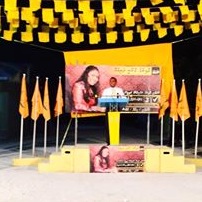
The opposition MDP has meanwhile been campaigning on a platform of reforming the judiciaryempowering local councils, and consolidating democracy.

In a speech at a campaign rally in Malé last week, Nasheed contended that Gayoom had retained his influence over the judiciary when sitting judges – the vast majority of whom were appointed during Gayoom’s 30-year reign – were controversially reappointed en masse in August 2010.

Nasheed entreated voters to study the recent past of the Maldives and consider current trends, suggesting that “you certainly don’t need to be an expert to know what could happen to this country in light of that.”

“The country is being rolled back to autocratic rule. President Maumoon is taking one step after another down that path,” he said.

Gayoom’s longstanding opposition to allowing political parties in the Maldives was elucidated on page 123 of his biography, “A Man for All Islands,” Nasheed said.

“I want to ask you, are you really confused about who President Maumoon is? Are you really going to accept him today as a man of democratic principles who loves freedom? What I want to tell the people of Malé is, don’t let yourself be stung twice from the same burrow,” he said.

Meanwhile, speaking at a rally in Baa Eydhafushi last night, Nasheed said the MDP’s objective was securing financial independence for local councils.

Councils should be able to generate revenue from publicly-owned land in the island as well as nearby uninhabited islands, he said, which would enable councils to undertake infrastructure projects.

“Our pledge is not having to make any more pledges. God willing, we will provide the [financial] wherewithal for you to fulfil your own pledges,” he said.

He added that the MDP was the only party pledging to reform the judiciary.

“I want to tell other candidates, and the many candidates participating in this election – this tree called MDP has not yet blossomed. It has to be watered. It is not yet time to cling to it and spread vines under its shade. We have to let this tree grow.”

“I won’t talk about this in the next election. God willing, by then our political system will have matured,” he said.

Likes(0)Dislikes(0)

PPM councillors allege corruption involved in “Clean Green Malé” project

Three Malé City councillors affiliated with the ruling Progressive Party of Maldives (PPM) have released a statement alleging that corruption is involved in the council’s ‘Nala Fehi Malé’ (Clean Green Male’) initiative.

“Under the ‘Clean and Sweep Male’ program inaugurated on March 16 in an event held in front of Iskandhar School, half of the ‘Thaisey Block’ [the land behind the Male’ City Council offices] has been unduly granted to the contractor Business Image Group (BIG) to conduct this work,” read the statement.

“The agreement further requires additional land to be provided to store vehicles brought in the name of being necessary for cleaning. Additionally, even accomodation for labourers brought in to do the cleaning work needs to be provided by the Malé City Council,” it continued.

“Furthermore, we condemn this act that has been done despite repeated orders from the Ministry of Housing and Infrastructure asking us to not conduct any agreements regarding any land in Malé.”

The statement also said that the granting of the contract to BIG is currently being investigated by the Anti Corruption Commission of the Maldives.

“Malé City Mayor and Deputy Mayor has challenged this institution, and regardless [of the investigation] gone ahead with the project. Two years after the granting of the contract, despite the contract with BIG being for making Malé clean and beautiful, what we are seeing is the putting up of a large number of billboards which are becoming a nuisance to the daily lives of people,” the statement continued.

“We further condemn the efforts of the Mayor and Deputy Mayor of the Malé City Council to maintain the agreement made with BIG.”

The statement concluded by saying that the press release has been issued to inform the public of the reasons behind the thee PPM councillors being absent from the ‘Clean Green Malé” inauguration event, adding “we assure you that we will cooperate with any and all efforts made for the good of the people”.

The inaugural ceremony for the programme was held on Saturday (March 15) outside Iskandar School, with the council reporting that permission to hold the event inside the school was suddenly withdrawn at short notice.

According to Haveeru, no government invitees were present at the ceremony held by the opposition dominated city council.

Today’s statement is signed by the three PPM councillors – Mahchangolhi Dhekunu councillor Ibrahim Mamnoon, MedhuHenveiru councillor Zaidhul Ameen, and HulhuHenveiru Councillor Mohamed Sajid.

Opposition Maldivian Democratic Party councillors in the council have stated that they will issue a written response to the PPM’s press release.

An official from BIG declined from commenting on the matter.

Likes(1)Dislikes(1)

Oil drilling and Maldives’ tourism “cannot coexist”, says NGO Bluepeace

Oil drilling and sea-based tourism “cannot coexist”, says Executive Director of local NGO Bluepeace Ali Rilwan, who has suggested that drilling for oil will create a number of problems.

Rilwan’s comments follow further confirmation this week from President Abdulla Yameen that that the government will commence work on locating crude oil in the Maldives.

According to local news outlet CNM, Yameen said that if the government is indeed successful in finding oil in the Maldives, the outlook for the entire country would change for the better.

These statements were made at a land reclamation ceremony held on Sunday (March 16) on the island of Meedhoo in Dhaalu atoll. Speaking at the launch, President Yameen suggested that the Maldives could be developed using available resources.

When asked which would be more beneficial to the Maldives, Rilwan said “it’s a choice of the government.”  He noted that with the large income from tourism and the spread of guest houses in local isands, the oil drilling “won’t have benefits for the people as a whole.”

“We can’t afford to go into that dirty energy,” he concluded. “When you take up the issues of drilling, we are concerned about the oil container tanks with unrefined fuel passing through.”

With this in mind,  Rilwan asked, “can we avoid a distaster in the Maldives? The Maldives is a tiny island and this can have a very negative impact, the tanks are a worrying thing.”

Famed for its luxury resorts, the Maldives has relied on tourism for an estimated 70 – 80% of its GDP. Plans to look for oil in the past had aimed to diversify the nation’s economy.

There are currently no confirmed plans for the location of the drilling, should it take place – an uncertainty which has made it difficult for environmentalists to comment on the matter.

Rilwan noted that the fact that it is not known whether drilling will be coastal or off-shore makes it difficult to predict environmental issues.

The renewed interest in the search for oil was prompted by the results of seismic reports conducted in 1991– the recent findings of which have caused authorities to seek foreign assistance.

The Maldives National Oil Company (MNOC) was founded in 2003 to take direct responsibility for the development of oil and gas industry in the Maldives.

“The fact that two leading oil exploration companies in the world had invested in exploration drilling in the Maldives, keeps up the glimmer of hope for commercial success of oil and gas exploration in the Maldives,” the MNOC has said previously.

“Today, with the remarkable improvement of technology in the area of oil and exploration such as three or four dimensional seismic survey systems etc., the Maldives National Oil Company is hopeful that oil or gas can be discovered in Maldives.”

Managing director of the MNOC Ahmed Muneez told local media last month that the government intended to start work on new exploration within a few months.

“We have contacted a Norwegian company and a German company to help us better understand the findings of the study. Based on this report, we’re hopeful of advertising the Maldives as a new destination of oil exploration,” Haveeru quoted Muneez as saying.

He explained that an outside company would be hired to conduct a global advertising campaign in order to market the country as an oil source.

Under the presidency of Mohamed Nasheed, the Maldives – famously vulnerable to the effects of climate change – had pledged to become carbon neutral by 2020.

Nasheed stated that the Maldives was a key model for other countries seeking to become more sustainable, and that an inability to meet the unilateral commitments would prove detrimental to wider arguments around the globe for adopting law carbon initiatives.

The government of Nasheed’s successor Dr Mohamed Waheed also said that it was committed to “not completely” reversing the Nasheed administration’s zero carbon strategy: “What we are aiming to do is to elaborate more on individual sustainable issues and subject them to national debate,” said Waheed.

Speaking to Minivan in October 2012, the government assured that they were adhering to their commitment to become carbon neutral by 2020 in spite of political uncertainty.

“We are continuing with the carbon neutrality program,” she said. “We are giving it our best shot,” said then Environment Minister Dr Mariyam Shakeela.

Minivan News was unable to obtain comments from the Ministry of Environment and Energy at the time of press.

Likes(1)Dislikes(0)

EC members Manik, Farooq summoned for questioning by police

Elections Commission (EC) members Ali Mohamed Manik and Mohamed Farooq were summoned for questioning by police last night.

Farooq told the press upon emerging from the police headquarters that he was questioned about the distribution of voters on the Malé municipality special register to various constituencies in the capital.

Farooq said he answered all the questions put to him by police interrogators, declining to reveal further details.

The police summons for the pair followed questioning of dismissed EC Chair Fuwad Thowfeek on Sunday night.

Thowfeek was questioned over a leaked phone conversation between himself and former President Mohamed Nasheed, during which the pair discussed the distribution of citizens on the municipal register to constituencies in Malé ahead of the parliamentary elections due to take place on March 22.

The former EC chair exercised his constitutional right to remain silent, a police media official confirmed to Minivan News yesterday (March 17).

Following the release of the phone call recording on social media, Deputy Minister of Youth and Sports Abdulla Rifau ‘Bochey’ – a candidate of the Progressive Party of Maldives (PPM) for the Maafanu South constituency in the capital – filed a case with the police alleging that Thowfeek had abused his powers as the commission’s chair.

Thowfeek, however, told local media that he had offered clarifications on the municipal registry issue to any politician who had contacted him over the phone.

The commission held a number of meetings with representatives from political parties to discuss the distribution of voters on the municipal registry, he explained.

Thowfeek also said that he shared his concerns regarding the Supreme Court’s contempt of court charges against EC members with various politicians.

“I also shared this concern with President Abdulla Yameen through a text message. In that same manner, I shared my concerns with Nasheed, too,” he said.

Municipal register

In December, the EC compiled a report on electoral constituencies for the 2014 parliamentary elections, increasing voting districts from 77 to 85 in accordance with the Electoral Constituencies Act.

Citizens on the municipal register – residents without a permanent address in Malé – were distributed among constituencies in the capital following consultation with MPs representing the 11 constituencies in Malé.

In the approximately three-minute long recording that surfaced on social media, Nasheed and Thowfeek are heard discussing the redistribution of voters.

“Some of our members went to discuss the matter of the municipal register border, didn’t they? It was agreed then that Maafannu will be kept as in the final report, yes? In short, it was agreed that some changes will be brought to Henveiru and the remaining people on the register will be distributed to the four constituencies of Maafannu, yes?” Nasheed is heard asking.

Thowfeek replies, “Yes, yes, the current borders are something that everyone has agreed on.”

Nasheed then inquires, “have any additional changes been brought to the list later on the request of Maafannu [West] constituency MP Abdulla Abdul Raheem?”

In response, Thowfeek states that no such changes had been made and that Abdul Raheem had visited the commission to discuss the issue.

MP Abdul Raheem was suspended from the opposition Maldivian Democratic Party (MDP) in January after voting to approve President Abdulla Yameen’s cabinet against the party’s three-line whip.

He did not contest in the party’s parliamentary primaries or seek re-election.

Following the leak of the phone conversation, MP Abdulla Abdul Raheem explained on Twitter that the EC “invited all members representing Malé constituencies to meet with them” on December 26 to discuss the final report on parliamentary constituencies.

“I highlighted the issue of dhafthar [municipal register] being allocated to only 1 constituency instead of distributing it equally between 4 constituencies,” he tweeted.

MPs ‘Reeko’ Moosa Manik, Hamid Abdul Ghafoor, Mohamed Rasheed, and Ibrahim from the MDP along with PPM MPs Ahmed Nihan and Ahmed Mahloof attended the meeting, Abdul Raheem revealed.

The final report was amended “after our contribution,” he added.

Likes(0)Dislikes(0)

Innamaadhoo island council asks Islamic Ministry to take action against Sheikh Shameem

Innamaadhoo island council, in Raa Atoll, has filed a complaint with the Islamic Ministry against Sheikh Ibrahim Shameem Adam after he allegedly preached inside the island’s Friday Mosque without first obtaining permission.

Speaking to Minivan News today Council President Ibrahim Fayaz said that Sheikh Shameem went to the island last Saturday and requested the council’s permission.

Before receiving a response from authorities, however, Shameem held a sermon on the island, said Fayaz.

“They announced that there will be a sermon that night on the topic of sports and entertainment and held the sermon without our permission and we did not do anything about it because then they say Innamaadhoo council had obstructed religious activities and that we are anti-Islamic,’’ he said.

He said that the first 50 minutes of the speech was very good before beginning to resemble a political campaign meeting.

“He started talking about politics and the upcoming parliament elections and people inside the mosque came out, only a few were waiting inside,’’ Fayaz said.

“More than 200 people gathered outside the mosque in protest to the speech he was giving because it was supposed to be a religious sermon and not a political rally.’’

Fayaz said that islanders came and complained to the council, warning that if the council was not able to stop him the islanders might have to do it.

“So I then went inside and turned the loudspeaker and microphone off, but he did not stop,’’ he said.

“I asked him who gave him the permission to conduct a sermon inside the mosque and he replied by saying that the ‘Higher Authorities’ gave him permission. I do not know who higher authorities were.’’

Political sermons

Fayaz said that Shameem indirectly criticised both Maldivian Democratic Party (MDP) and the Progressive Party of Maldives’ parliamentary candidates.

“He criticised them in a way that everyone knew who he was talking about, but did not mention the names,’’ he said. “We even called the police that night because there might have been unrest on the island – and five councilors will not be able to stop the islanders.’’

He said that police asked the council to take a statement from Sheikh Shameem, but that Shameem refused to come to answer questions.

Furthermore, Fayaz alleged that the Islamic Ministry would not take any action against him because he was sent by the Adhaalath Party.

Islamic Minister Sheikh Mohamed Shaheem Ali Saeed today told Minivan News that he had not received any information of the incident.

In December last year Omadhoo island council stopped Sheikh Shameem from delivering a religious lecture at the local mosque, fearing it might “disrupt the stability and social harmony of the island”.

At the time, Haveeru reported that when the council asked for a formal request for permission, the organisers sent a text message to the council president saying the lecture would go on with or without the council’s permission.

In May 2013 Sheikh Imran Abdulla and Sheikh Ilyas Hussein were obstructed from preaching in Vaikaradhoo, in Haa Dhaalu atoll, whilst Kamadhoo island council in Baa atoll prevented Sheikh Nasrulla Ali from preaching.

In Vaikaradhoo the sheikhs continued with police protection in the presence of local opposition activists.

In September 2013, Maldives Broadcasting Corporation (MBC) Chairman Ibrahim Umar Manik told a parliamentary sub-committee that the commission had stopped religious sermon ‘Andhalus’ conducted by Sheikh Shameem for violating the state broadcaster’s guidelines.

The MBC chairman,along with members of the commission, were summoned before the independent institutions committee following complaints by MDP MPs that the sermon by Sheikh Shameem infringed the rights of the party’s presidential candidate.

“We definitely do not consider [televising the sermon] as anti-campaigning against a particular candidate using religion. [But] around 11:35pm, because his talk was changing a little, we stopped the live [broadcasting],” Manik told the parliament committee at the time.

Current laws and regulations require religious preachers to obtain permission from local councils in order to preach at mosques in their administrative areas.

Likes(1)Dislikes(0)

Road Development Corporation purchased goods worth MVR2.2 million without bidding process, audit reveals

The Maldives Road Development Corporation (MRDC) purchased material worth MVR2.2 million (US$142,671) without a bidding process, the 2011 audit report (Dhivehi) of the 100 percent government-owned company made public last week has revealed.

Noting that the MRDC has not formulated procurement rules to date, Auditor General Niyaz Ibrahim recommended drafting regulations in consultation with the Finance Ministry within a period of one month.

“As a large amount of the company’s money had been spent for various purpose without establishing sound rules, and as we believe the company’s board members have been negligent in carrying out their responsibility of protecting the company’s resources, action should be taken against [the board members] to hold them accountable,” the auditor general recommended.

The MRDC was formed in August 2010 by the administration of former President Mohamed Nasheed to facilitate road construction under a sustainable business model.

As the company failed to compile its financial statement for 2011, the audit was based on a review of a sample of the MRDC’s business transactions as well as “problems related to performance and governance.”

In the absence of the financial statement, the report stated that the auditor general’s office was unable to assess the company’s financial health, assets, and the results achieved during the year.

The report further noted the lack of a mechanism to collect information required to compile the financial statement, adding that “basic documentation” of business transactions was not properly maintained.

The audit office recommended legal action against the officials responsible for failing to submit the financial statement for auditing as mandated by the company’s charter and the Company’s Act.

Moreover, as the MRDC had not maintained an updated registry of its assets, the report stated that auditors could not verify whether all assets purchased for the company’s purposes remained in its inventory.

The absence of an updated registry leaves open the opportunity to sell off the MRDC’s assets, the report noted.

The auditor general also recommended establishing a sound accounting system to record daily financial transactions.

While MVR175,039 (US$11,351) was spent in 2011 as overtime payments for staff, the report noted that auditors could not verify whether the payments were made for services received.

Moreover, upon scrutinising available financial records, auditors discovered that bills and invoices of materials sold by MRDC did not include purchase orders from customers while quotations sent to businesses were not authorised by senior officials.

The MRDC audit came on the heels of a damning report on the Works Corporations, which concluded that the government-owned corporation was mismanaged and had not served its purpose.

Of the 34 infrastructure projects awarded to the company, the report noted that only one had been completed.

Meanwhile, the audit report of the state-owned Waste Management Company released in December revealed that a board member had embezzled MVR610,000 (US$ 39,354) by doctoring cheques.

Likes(0)Dislikes(0)

HRCM attends Juvenile Court after summons, agrees to cooperate with enquiry

The Juvenile Court has stated today that all five members of the Human Rights Commission of the Maldives (HRCM) have complied with the court’s order and attended a meeting at the court this morning (March 17).

The order was sent after HRCM members had failed to attend two meetings requested by the court in recent weeks.

Juvenile Court Spokesperson Zaima Nasheed stated that the court was requesting the meetings in order to question the HRCM members about a confidential report that they shared with the court concerning the sentencing of a 15 year old rape victim to flogging and house arrest.

The court maintains that, although the HRCM has included in its report that the case was one of sexual assault and harassment, the court was in fact presiding over a case concerning the crime of consensual fornication.

Alleging that the HRCM included fabricated information in the report, the Juvenile Court spokesperson stated that the members had been summoned to a meeting, and not a court hearing.

“They [HRCM members] attended Monday’s meeting as though they were coming to a court hearing, complete with being accompanied by legal representation. It was not a hearing though, just a meeting held to clarify some issues,” Zaima stated.

Zaima said that the court requires all members of the HRCM to explain to the court’s panel of judges why “fabricated information was included in the report”, as well as “the reasoning behind the need to compile such a report”.

Zaima further revealed that HRCM President Mariyam Azra had requested that the commission be allowed to submit their answers to the court’s queries in writing.

The court refused this request, however, and insisted that the members attend meetings at the court in order to verbally respond to questions put to them by an assigned panel.

According to the Juvenile Court, the HRCM had initially objected to this, quoting Article 27(a) and 27 (b) of the Human Rights Commission Act.

Article 27 (a) states that “no criminal or civil suit shall be filed against the President or Vice President or a member of the Commission in relation to committing or omitting an act in good faith whilst undertaking responsibilities of the commission or exercising the powers of the Commission or the powers conferred to the Commission by a law”.

Additionally Article 27 (b) states “the Commission can only be questioned or a suit can be filed against the Commission in court regarding a component in a report published by the Commission following an inquiry, should sufficient evidence be available to prove the component is false”.

The court responded by quoting the same article, as well as Article 141(d) of the Maldives constitution, arguing that this made it obligatory for the HRCM to oblige with the questioning.

Article 141(d) of the constitution states that “persons or bodies performing public functions, through legislative and other measures, must assist and protect the courts to ensure the independence, eminence, dignity, impartiality, accessibility and effectiveness of the courts”.

The HRCM is then said to have agreed to cooperate, on account that it is given a period of ten days after the parliamentary elections scheduled for March 22 before the first questioning session.

Zaima then said that the court has agreed to grant the HRCM the requested period of time.

“We did this with consideration towards the work of the HRCM and the nature of this matter that we are looking into,” the Juvenile Court’s Spokesperson said.

HRCM member Jeehan Mahmoud stated that the HRCM was not prepared to comment on the matter at present.

Likes(1)Dislikes(0)

High Court issues injunction against Family Court order to return child to mother

The High Court has released a temporary injunction halting the implementation of a Family Court order asking a man to hand over his five month old baby to its Swiss mother.

The man has been identified by the police as Ahmed Sharuvan,  age 32, from Kanmatheege in Maradhoo in Seenu atoll. The information had been released when police launched a nationwide search for the man after he failed to comply with a Family Court order last week.

The superior court released the injunction after Sharuvan submitted an appeal in the court against the Family Court’s verdict.

The High Court injunction – signed by three judges – stated that the court believes it important to halt the Family Court order until after Sharuvan’s appeal has been completed.

Although the case’s first hearing was scheduled by the High Court for Sunday, it was later cancelled.

Sharuvan’s wife – identified in local media with only a first name, Tanya – also attended Sunday’s court hearing.

Sharuvan attended Sunday’s hearing at the scheduled time and was accompanied by a lawyer. Police began questioning him outside the court premises, with Sharuvan responding by showing the police the High Court’s temporary injunction.

In spite of this, police took Sharuvan to the police headquarters for further “discussions”.

“We did not have the jurisdiction to arrest him then due to the High Court injunction although we were previously looking for him,” a police media official told Minivan News today.

“So we requested him to come along with us to headquarters for further discussions and he obliged. We did not have the jurisdiction to directly question him, so we just held a discussion. He left the police premises directly after the discussion.”

Owing to the High Court injunction, police revealed that the baby remains in the custody of the father. They stated that the police cannot take any action on the matter until Sharuvan’s appeal case at the High Court reaches completion.

Likes(1)Dislikes(0)

Dismissed EC Chief Thowfeek summoned to police over leaked phone calls

Former Elections Commission (EC) President Fuwad Thowfeek was summoned to police on Sunday night for questioning in an investigation regarding a leaked phone call between himself and former President Mohamed Nasheed.

In the leaked phone recordings, Fuwad and Nasheed are heard to discuss two issues – the Supreme Court case against the EC and the distribution of persons in the country’s municipal register to various constituencies.

A police media official confirmed to Minivan News that Thowfeek exercised his constitutional right to remain silent when questioned about the case.

Thowfeek was dismissed from his post by the Supreme Court earlier this month, and given a six month jail sentence, suspended for three years.

Delivering the verdict, the court contended that Thowfeek and his fellow EC members had “openly and systematically” brought the Supreme Court into disrepute, “deliberately challenged Supreme Court rulings” and “serially held [the court] in contempt” during press conferences.

The People’s Majlis subsequently declared the ruling unconstitutional, while its independent commissions oversight committee has maintained that he remains in his post despite the apex court’s verdict.

In response to the leaked recording, Thowfeek told media that he has shared concerns about the case with many politicians in addition to Nasheed, as well as having provided clarifications on the matter of the municipal register to all politicians who had requested him to do so.

Following the release of the recording on social media, Deputy Minister of Youth and Sports Abdulla Rifau ‘Bochey’ filed a case with the police alleging that Thowfeek had abused his powers as EC president.

The case has also been filed with the Anti Corruption Commission.

Coming out of the Police Headquarters after an hour, Thowfeek declined from commenting and was not answering calls at the time of press.

“I have nothing to say on the matter at this time,” he was reported as telling media.

EC Legal Director Haneefa Khalid accompanied Thowfeek to the police station as his legal representative.

Likes(1)Dislikes(0)