Comment: No need for Speaker to take charge if elections held, results respected

The Maldives’ Constitution (Article 4) is very clear that our country is a democracy in which all the powers of the State are derived from and remain with the citizens.

In particular legislative power (the power to enact laws that govern our society) lies with a democratically-elected parliament while executive power (the power to act as executor of those laws and see the will of the people reflected in the governing of the country) should lie with a democratically-elected president.

Unfortunately, since the coup of February 2012 we have seen power flicker from one unelected institution to another, in complete disregard of the will of the people as voiced in the 2008 elections: from an unelected president to an unelected supreme court, and from an unelected police commissioner to an unelected attorney-general.

It is now time to place power back in the hands of the citizens. The 88 percent voter turnout in the September 7 polls was that power. It is imperative that November 9’s elections proceed peacefully and with the full cooperation and goodwill of all political parties and State institutions, including the police.

Certain political leaders, as well as members of the Supreme Court, have treated voters with a level of contempt that beggars belief – asking citizens to vote, and when they didn’t like the result, asking them to vote again, and again, and again.

As the UK’s MP for Redditch, Karen Lumley suggested during the Westminster Hall debate on the Maldives this week, this has been like “watching a child who cannot win at a board game tip over the board”.

If our stroppy candidates (who could put Fagin to shame), and their gang of police boys, discredited judges and the unloved President allow these elections to go ahead, and this time they do respect the result, then we will not enter a constitutional void and it will not be necessary for the parliament as the only body in the Maldives which has been democratically elected in a free and fair vote, through the person of the Speaker, to assume executive control.

If, however, unelected individuals once again demonstrate contempt for democracy, if they once again decide that the powers of the State reside with them and not with the citizens, then parliament will be forced to step in as per the Majlis resolution of October 27th 2013.

The Speaker, as the last remaining democratically elected head of the last remaining democratically elected body must take over the interim presidency and ensure a free and fair vote for the people of the Maldives.

To quote President Nasheed, “there is no Houdini to pull the rabbit out of the hat. No magic tricks. No improvisations. We follow the Constitution. We follow the spirit and letter of the Constitution.”

Eva Abdulla is the Maldivian Democratic Party (MDP) MP for Galolhu North, and Asia-Pacific Member of the IPU Committee for Women MPs

All comment pieces are the sole view of the author and do not reflect the editorial policy of Minivan News. If you would like to write an opinion piece, please send proposals to [email protected]

Likes(0)Dislikes(0)

Parties rally on penultimate day before polling

The Progressive Party of the Maldives (PPM) and the Maldivian Democratic Party (MDP) held final campaign rallies on Thursday night ahead of the first round of presidential elections scheduled for November 9.

The Jumhooree Party did not hold a full scale rally on the evening.

The PPM promoted the party as the only party that would protect Islam and Maldives’ sovereignty and hailed the PPM’s presidential candidate Yameen Abdul Gayoom as an economic expert.

The MDP focused on themes of good governance, ensuring basic services such as medical care, transport and education and ending the authoritarianism of the past.

Yameen’s speech centered on alleged corruption during the three years MDP’s presidential candidate and former President Mohamed Nasheed had stayed in power and the importance of protecting Islamic faith.

“Yellow is a colour that has quarantined our whole country. They sold our airport to foreigners, but with God’s will and the work of many united parties, we were able to get it back,” Yameen said, alleging “although it was done under a contract, it is still classified as corruption as it would have benefited the foreigners more than the people of our country,” continued Yameen.

Referring to a speech given by his Electoral Agent Abdulla Ameen – who had listed out 11 persons he alleged had gained large amounts of money through corrupt means during Nasheed’s administration – Yameen argued that Nasheed’s government had misused MVR4,700million.

“However, when Nasheed came to power, he made a Presidential Commission – outside constitutional provisions – to investigate Maumoon and his cabinet for corruption. They could not find any evidence against Maumoon, nor will they ever be able to. Is it still the thirty years [of Gayoom’s administration] that we should still be questioning?”

“We will give you the dignified life you want”: Nasheed

Speaking to thousands of supporters at Raalhugandu, MDP’s presidential candidate Mohamed Nasheed said, “We will defeat those who brought about a coup through the vote. God willing, we will win this election in one round. We will take the Maldives to safe shores.”

Saturday’s vote was a vote for a dignified life, shelter, medical care, transport, education and job opportunities, Nasheed said.

He spoke of the long journey Maldivians had traveled out of authoritarianism and the numerous setbacks along the way. He commended the determination of the Maldivian people to move forward.

He described the delay in voting as an attempt to destroy the constitution.

“It is always the people of this country who have the power to uphold the constitution. Saturday is an opportunity to use that power to save this state, this Maldives. Vote for me, god willing, we will make Maldives upright again. We will give you the dignified life you want,” he said.

The Maldives is rich in natural resources and Maldivians deserve a lot more than they currently have, Nasheed said.

He also said the Supreme Court’s annulment of the vote had in fact increased support for the MDP.

Speaking about the PPM and JP’s reluctance to sign the voter registry on Tuesday, Nasheed said the two parties had changed their minds because of international pressure.

“They say for the nation, for the country, but in truth at last they had to sign the voter list because a German tourist agency ordered them to. They had to sign because a tourist agency told them to. Because that’s where the dollars come from. [They] contest elections for dollars. [They] sign the voter lists for dollars. All of life is based around for dollars. Maldivians want to tell them I am a proud Maldivian. I will look after my children through honest work,” he said.

Likes(0)Dislikes(0)

Maldivians convey “1000 Thanks” to the Elections Commission

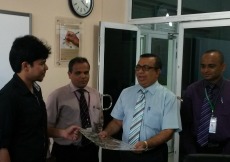
Elections Commission (EC) President Fuwad Thowfeek, member Ali Mohamed Manik and Secretary General Asim Abdul Sattar have met with a group of young Maldivians who presented the commission with a memento to express gratitude for their repeated efforts to conduct a presidential election this year.

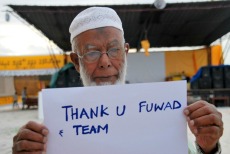
The poster, titled “1000 Thanks”, was a mosaic of photos of several hundred citizens holding messages of support for the EC.

Upon receiving the token of thanks, Thowfeek stated that the commission’s team “is very happy to know that we are not alone in this work, and that we have the support of so many people.”

“It is for you, for citizens, that we are tirelessly doing this work, without rest or sleep, and often without even time for proper meals. We are very thankful for this show of support and are further inspired to carry on doing all we can to ensure we can guarantee that the people of Maldives get to elect a leader through free and fair elections,” Thowfeek stated.

Thowfeek added that the gratitude shown by the people is deserved by the whole team at the EC, adding that this includes commission members, department heads, staff members and temporary staff members. He said that the complete team consists of about 4000 people.

“This means a lot to us, and we will cherish this sentiment of thanks. We will Do everything possible to honor the trust you have in us.”

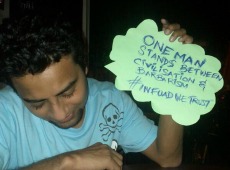
#InFuadWeTrust

According to the team who presented the “1000 Thanks” poster to the EC, the campaign is an effort initiated by a group of persons on social media via twitter and facebook. All the photos in the mosaic were submitted via these mediums, or were taken by volunteers in various islands, including capital city Male’ and Addu City.

“The main objective of this effort is to show gratitude to the EC and Fuwad for his excellent leadership, holding the team together and going forward in the face of so many strong obstacles and threats. This is a gesture of thanks from us, the electorate, to the EC team for their tireless work to defend our right to vote,” said team member Ismail Zayan Shakeeb, a first time voter in the coming fresh round of elections.

“We are still getting photos via email, facebook and twitter. We wanted to hand this token to the EC prior to Saturday’s voting, and so have printed the nearly 500 submissions we have received in just under a week. Our social media channels are still open for submission though,” said an 18 year old female volunteer.

Participants in the campaign are seen holding a variety of messages, including “#InFuadWeTrust” – a twitter hashtag which has become popular during the recent attempts to hold elections, “Fuwad – finally a man to trust”, and “Fuwad is our Batman, our very own Dark Knight”.

Presidential Election: Attempt 4

The November 9 polls are the EC’s fourth attempt to hold presidential elections – with the first round held on September 7 later annulled by the Supreme Court.

“It is a difficult time for us, but we know that Maldivians have been waiting for and wanting an election for over two years. And we believe that it is our responsibility to provide a free, fair and independent election for our people,” Thowfeek said.

“We did everything we possibly can to do this, and the best election we have had was on the 7th of September. But then, for very unreasonable reasons, the Supreme Court has annulled these elections,” he stated.

“This election won’t be as good as we want it to be, which we could have done if we had gotten the time period allocated for elections in the constitution,” he stated.

“It looks like we will be having elections this Saturday.”

Back at work

Thowfeek was admitted to ADK late Wednesday night, and hospitalized till Thursday afternoon.

Soon after his release, he returned to the EC offices to join his team with preparations for Saturday’s election, insisting that he “feels much better now”.

“I had a chest pain, and my colleagues advised me to go see a doctor. The doctor did a very thorough check up and said there’s nothing to worry about. They kept me admitted in the hospital for about 16 hours. But the doctor said upon discharge that I can come back to work, and so here I am,” Thowfeek explained.

Likes(0)Dislikes(0)

Syrian refugees show up Maldives’ immigration failings

Rising numbers of refugees seeking to use the Maldives as a transit point has laid bare the country’s need to review its immigration procedures, says the Human Rights Commission of Maldives (HRCM).

“The government needs to bring policies into line with human rights conventions,” said HRCM member Jeehan Mahmood.

“The current procedures do not ensure the refugee’s safety – this is not correct, this is not right. The government needs to review and re-visit procedures to ensure its actions to not violate human rights.”

The most recent example of the government’s inconsistent approach to the issue involved a Syrian Palestinian man named Ubaid* who travelled with his family from Dubai, arriving in the early hours of Tuesday morning.

A family member told Minivan News that Ubaid had travelled to the Maldives after seeing media reports of another family who had been granted asylum in Sweden after seeking transit via the Maldives.

The family source explained that Ubaid was a third generation refugee, with a United Nations Relief and Works Agency for Palestine Refugees in the Near East (UNRWA)-issued refugee card which shows he was formerly resident in the Yarmook camp, just outside of Damascus.

“He was injured while in his home at that camp/suburb and so his left arm is somewhat paralyzed with 20 metal screws and metal plates holding remnants of his bones together, and lots of pain-killers. He does have x-rays to show those metal screws and plates.”

“His concern is that if the Maldivian authorities do what they said they would do – send him and his family back to Dubai – then Dubai would send him directly to Syria. And with an injury like what he has, the government would suspect him of being with the rebels, which he is not. He’s too old to be fighting,” the source continued.

The previous Palestinian refugees arriving in the Maldives were eventually granted asylum in Sweden after an appeal from the UNCHR.

Despite having legitimate travel documents, Ubaid’s family was kept in detention at Ibrahim Nasir International Airport before being flown back to Dubai.

HRCM member Jeehan argued that the government’s current inconsistency was resulting in discriminatory practices inappropriate to a country aspiring to uphold its human rights obligations.

Problem in transit

Local lawyer Abulla Shaairu – who took up the family’s case – described their return to Dubai as “one of the saddest days in my career.”

Shaairu has argued the Criminal Court had denied the family was in detention, making them ineligible for the constitutional right to appear before a judge within 24 hours.

“Detention is defined as restrictions on the freedom of movement – they had no freedom of movement,” said Abdulla Shaairu – an argument that was echoed by Jeehan.

Shaairu stressed that the party had not been seeking asylum in the Maldives, but were hoping for transit to Switzerland.

He claimed that he had been denied their right to meet with him, and that the Criminal Court had refused to provide a written response detailing its decision.

“There are no specific regulations to deal with the situation. People in this type of situation don’t know how they will be treated,” he said.

“I think at this moment it is very necessary – so many people arrive because of civil war.”

The extent of the recent fallout from the Syrian civil war on arrivals to the Maldives has been revealed in a leaked document from the department of immigration.

The confidential document details the cases of 12 Syrian nationals arriving in the country since mid-July, with the document revealing that all but four have been immediately sent back to their last point of departure.

As a tourist hub granting tourist visas upon arrival – and with a large number of flights to and from the EU every day – the Maldives is increasingly attractive as a transit destination, the document revealed.

The powers of the Immigration Controller do not override the constitution, nor human rights law, argued Jeehan.

“These people are just searching for a safer place for their family and children.”

*name has been changed

Likes(1)Dislikes(0)

Supreme Court accepts case to invalidate transfer of power to speaker

The Supreme Court has accepted a petition to invalidate a People’s Majlis resolution authorizing the Speaker to assume the presidency in the absence of a president elect by the end of the current presidential term on November 11.

The case was filed by by Progressive Party of Maldives (PPM) council member and former president Maumoon Abdul Gayoom’s lawyer Ibrahim ‘Wadde’ Waheed.

Speaking to Minivan News, Wadde said that he did not believe that the parliament’s resolution constituted a resolution, and said he did not know any legal term with which to refer to the parliament’s decision as it was against the constitution and laws.

”The decision is clearly against the constitution and I have requested the Supreme Court to invalidate the decision,” he said. ”The parliament on October 27 passed that decision that says that all powers of president must be transferred to the parliament Speaker or someone in the parliament.”

He explained that he had originally filed the case on October 29 before the Supreme Court accepted it today.

On October 27, the resolution was passed at a sitting scheduled in response to a letter to Speaker Abdulla Shahid from President Dr Mohamed Waheed requesting parliament “to take initiative in finding a solution to any legal issues that will arise if a new president is not elected by the end of the current term [on November 11].”

The resolution was submitted by MDP parliamentary group leader and MP Ibrahim Mohamed Solih and supported by MDP MP ‘Reeko’ Moosa Manik.

In a Q&A with the speaker Minivan News asked his opinion on the government aligned MP’s suggestion that the Supreme Court should decide on interim arrangements.

”We have had some MPs calling on the military to take over. I think these individuals are very unfamiliar with democracy. And democratic principles. And it is a shame they sit in a house which is supposed to represent the people,” responded Shahid.

During the interview he also expressed his hope that President Dr Waheed will respect the resolution as it was he who initiated it.

”He wanted the parliament to initiate and tell him what the parliament thinks. The parliament is the representative body of the people of this country. And the parliament overwhelmingly, with the majority of the total parliament, adopted this resolution,” he told Minivan News.

The same day, Waheed also submitted another case to the court asking it to rule that the MDP MP Ahmed Hamza’s appointment to the judicial watchdog – the Judicial Services Commission  – was conducted in breach of the constitution.

Waheed also submitted a case to the Supreme Court requesting it to rule that Dhivehi Rayyithunge Party Leader and MP Ahmed Thasmeen Ali was disqualified as an MP.

In addition to these cases, Wadde – alongside Jumhooree Coalition member ‘Madhanee Ihthihaadh’ (Civil Alliance) President Sheikh Mohamed Didi – filed a case in the apex court challenging the candidacy of the MDP’s Mohamed Nasheed.

This filing of this particular case was criticised by both the president and senior PPM leadership.

Likes(0)Dislikes(0)

Maldivian pro-democracy activists hijack World Travel Market twitter hashtag

The official twitter hashtag of the World Travel Market (WTM) in London has been hijacked by Maldivian pro-democracy activists.

The WTM is one of the world’s major annual travel industry expos, attracting 5000 exhibitors from over 184 countries across the globe. The Maldives Marketing and PR Corporation (MMPRC) has said 143 representatives from 52 Maldivian companies are taking part in the event.

Dozens of Maldivian activists meanwhile on Monday began flooding the #wtm13 hashtag with images of police brutality and allegations against Villa Hotels owner and presidential candidate, Gasim Ibrahim.

The hijacking was widely reported by international travel media, just days after the UK’s Guardian newspaper broke a story about Maldivian police importing over US$100,000 in riot-control weaponry from a Singapore subsidiary of UK firm Survitec.

The twitter activists accused Gasim of funding the 2012 police mutiny that led to former President Nasheed’s controversial resignation, and then influencing the Supreme Court to annul the results of the September 7 poll despite unanimous positive assessments from local and international election observers.

Shortly after placing third and narrowly missing a place in the run-off against Nashed, Gasim alleged he had been robbed of between 20,000-30,000 votes and declared “God Willing, Gasim will be President on November 11”.

On October 7 the Supreme Court overturned the poll on the basis of a secret police report not shown to the Elections Commission (EC)’s defence counsel, and issued guidelines for a new poll on October 19 effectively giving candidates the right to veto elections altogether.

“What happened smacks to me of a child who cannot win a board game, so they tip over the board,” UK Conservative Party MP for Redditch, Karen Lumley told British parliament on November 5.

The October revote was forcibly halted by police just hours before polls were due to open. A third attempt is scheduled for Saturday, just days before the end of the presidential term on November 11.

Hashtag hijack

News of the hashtag hijack was quickly picked up international travel media, drawn by contrast tweets depicting costumed expo mascots and colourful conference hall stalls interspersed with bloodied, hosed and pepper-sprayed protesters: “For much of the day about half the Tweets using the official hashtag were from Maldives protesters,” noted one travel website.

“Travel has both a positive impact and a dark underside. And those unpleasant truths are seeping into the polished booths and buffet tables visited by WTM attendees this year, both online and in person,” wrote Samantha Shankman for the Skift travel website.

WTM tweeted distancing itself from the activists, but did not remove the posts: “We would like to apologise to our followers for the misuse of our hashtag by other accounts. We are no way linked to these tweets,” read a post from the expo organisers.

The coverage follows a downbeat assessment of the industry’s economic performance given by the Finance Ministry this week. According the report given to parliament, tourism growth as measured in terms of bed nights declined by 0.1 percent in 2012 following 15.8 percent growth in 2010 and 9.2 percent in 2011.

“The main reason for this was the political turmoil the country faced in February 2012 and the decline in the number of days tourists spent in the country,” read an accompanying statement.

Tourism Minister Ahmed Adheeb was not responding at time of press.

Likes(1)Dislikes(0)

Fuwad discharged from hospital, EC prepares for November 10 second round

The Elections Commission (EC) President Fuwad Thowfeek has been discharged from ADK hospital after being admitted with chest pains last night.

Fuwad told Minivan News via a text message that he is currently resting at home, but will return to work this evening.

Meanwhile, the EC is preparing for a second round of elections for November 10 – a day after the first round of polls on November 9 and a day before the current presidential term ends on November 11.

A second round is to be held only if no candidate wins over 50 percent in the first round. The November 9 election marks the EC’s third attempt to hold presidential polls after the Supreme Court annulled the September 7 first round and the police obstructed a second attempt to hold a vote on October 19.

The announcement comes following extensive international pressure when the Progressive Party of the Maldives (PPM) and Jumhooree Party (JP) on Tuesday threatened not to sign the voter registry – a move that could disrupt elections.

The PPM, JP and Maldivian Democratic Party (MDP) presidential candidates met with President Dr Mohamed Waheed Hassan yesterday and agreed to sign the voter registry and requested a second round if necessary on November 10 to ensure a president elect is determined by the end of the current presidential term on November 11.

The EC issued a statement last night confirming preparations for a second round on November 9. A three hour window for reregistration was given this morning from 9:00 am to 12:00 pm.

MDP’s representative to the EC advisory council Ahmed ‘Saabe’ Shahid said the EC will print a second set of ballot papers will the names of all three candidates for the second round, but the losing candidate’s name will be crossed out at the time of polling.

Official results of the first round are to be announced by 11:30 pm on November 9, Saabe said, adding that November 10 will be declared a public holiday.

Meanwhile, the MDP has now finished signing voter lists at the EC. The PPM and JP will complete signing lists by 3:00 pm today, EC Secretary General Asim Abdul Sattar told Minivan News.

The EC had planned to dispatch voter registry, ballot papers and boxes to the islands this morning, but have been delayed “because the JP is being very slow in signing the lists,” Asim said.

“Although we were able to get the lists to be sent abroad signed and sent abroad, the lists to be sent to the islands are still pending. We had scheduled to send some lists out at 9am and 11 am, but could not as the JP has not finished signing the lists,” Asim added.

Likes(0)Dislikes(0)

World wants “no further artificial impediments” to Maldives polls, Swire tells UK parliament

The Maldivian people’s commitment to democracy has not been respected by some of their politicians, the UK’s Minister of State for the Foreign and Commonwealth Office, Hugo Swire, has told British parliament.

The Westminster Hall debate on the situation in the Maldives was called on Tuesday ahead of Saturday’s scheduled election by UK Conservative Party MP for Redditch, Karen Lumley.

Lumley was a political consultant with the Westminster Foundation for Democracy in 2008, and helped train Nasheed’s Maldivian Democratic Party in political campaigning.

“What happened smacks to me of a child who cannot win a board game, so they tip over the board,” Lumley said of the Maldivian politicians’ use of the Supreme Court to annul the September 7 election result, in which Nasheed emerged the frontrunner following his controversial ousting a year and a half earlier.

Hugo Swire told the assembled MPs that politicians attempting to disrupt the elections in the Maldives had, “through various manoeuvres, including calls for military intervention, [sought] to frustrate and impede the democratic process.”

“I want to speak very explicitly and clearly, because I want to leave no one, particularly anyone in the Maldives who is listening to what I am saying or who will receive a report of it later, in doubt,” Swire told the MPs.

“The evidence is that more than 85 percent – how many of us would like to be able to cite that figure for our own constituencies? – of the electorate voted in the presidential elections on 7 September this year, demonstrating their strong commitment to the democratic process. Polls were judged by international and domestic observers to have been fair, free and credible.

“As the Maldives Elections Commission stated, the election was described by observers as ‘one of the most peaceful and best’ that they had seen. That certainly remains our view,” Swire stated.

“Following what appeared to be a weakly substantiated legal challenge from an unsuccessful presidential candidate, the Maldives Supreme Court voted to annul the election results and ordered a restart of the process,” Swire noted, before citing a recent statement from UN Human Rights Commissioner Navi Pillay in which she accused the court of “interfering excessively in the presidential elections, and in so doing is subverting the democratic process and violating the right of Maldivians to freely elect their representatives.”

“Regrettably, the controversy does not end there. On 19 October, the scheduled re-run was cancelled at the last moment, and the Maldives police service intervened to ensure that the vote could not take place. The cancellation came as a result of the refusal of two candidates to sign the electoral register – one of the 16 onerous conditions imposed by the Supreme Court. That condition in effect allows any one candidate to veto the elections, raising the possibility, as my hon. friend the Member for Redditch says, of further delays,” Swire said.

“We are frustrated and concerned, but not without hope. There are practical actions that can be taken without delay. The voter registers are due to be signed by candidates today.”

Such was the UK government’s concern at “the Maldives’ disregard for [the Commonwealth’s] values that it prompts the question – if the elections do not proceed as scheduled – of whether it is appropriate for the Maldives to be represented at the forthcoming Commonwealth Heads of Government meeting in Colombo,” Swire said.

“It is imperative that the rescheduled elections go ahead as planned. Anything short of that will be unacceptable. I say again to those people listening in the Maldives: the world is watching closely and it wants democratic elections, a democratically elected president and no further impediment to that to be created artificially by anyone in that country, which deserves so much better,” he concluded.

Following a meeting between President Mohamed Waheed and the presidential candidates this morning, Gasim Ibrahim and Abdulla Yameen dropped threats to veto the election made as recently as Tuesday night, and sent representatives to sign the voter registry.

Their sudden turnaround removes a major obstacle impeding the elections, and greatly increases the likelihood of polls taking place as scheduled on Saturday.

A growing delegation of senior international officials and state representatives are meanwhile arriving in the Maldives ahead of the election.

The diplomats arriving include UN Assistant Secretary-General for Political Affairs Oscar Fernandez-Taranco, the Commonwealth Secretary-General’s Special Envoy Sir Don McKinnon, and a team from India including the Joint Secretary of the Ministry of External Affairs.

Canadian Foreign Minister John Baird, an outspoken proponent of the need for elections in the Maldives, has meanwhile issued a statement calling for “the will of the Maldivian people [to be] recognised through a free and fair vote.”

“The international community is watching events in the Maldives closely. Canada calls on those in the current Government, security forces and the judiciary to respect the democratic process and not act to circumvent it. As voters in the Maldives go to the polls again on Saturday, they deserve to have confidence that their voices will be heard,” Baird stated.

Likes(1)Dislikes(0)

Q&A: People’s Majlis Speaker Abdulla Shahid

On October 27, the People’s Majlis passed a resolution to hand over executive powers to the Majlis Speaker if there is no president-elect at the end of the current presidential term on November 11. Subsequently, 15 MPs of the Progressive Party of the Maldives (PPM), the Jumhooree Party (JP), Maldives Development Alliance (MDA) and Adhaalath Party (AP) filed a no confidence motion against Speaker Abdulla Shahid. The vote has been scheduled for November 20.

Meanwhile, the International Parliamentary Union (IPU) is in Malé after the prosecution of several MPs and the Supreme Court’s removal of two MPs from parliament over decreed debt. Furthermore, Maldivian Democratic Party (MDP) MP Hamid Abdul Ghafoor has taken refuge inside the Majlis following efforts to prosecute him for refusal to provide a urine sample. He has now been sentenced in absentia to six months in jail for non-compliance with court summons.

The Majlis secretariat has now appointed an independent Sergeant At Arms and is recruiting an additional 104 security officers to oversee security of the Majlis – a task carried out by the Maldives National Defense Forces (MNDF) at present.

Minivan News spoke to Speaker Abdulla Shahid on his views regarding presidential polls scheduled for November 9, interim arrangements, parliamentary privileges and and security of the Majlis.

Zaheena Rasheed: What are the biggest challenges to come if elections are delayed again and there is no president elect by November 11?

Abdulla Shahid: The biggest challenge for the country will be if there is a situation in which the 2008 constitution is completely and totally undermined. The fundamental aspect of the constitution is that the people have the final say. The people have the right to express their opinion and elect a leader, a president every five years. If this does not happen, and the power holders of this country, in order to ensure the continuity of the state, decide to give reigns of power to the military or any other unelected body, then we have nailed the final nail in the coffin. Democracy will be buried. The 2008 constitution is done with then. That is my biggest concern.

ZR: If and when you take over the presidency on November 11, what is your course of action going to be, for this time period?

AS: It will be an interim role. To make sure that we hold an election as soon as possible and that the country is put back on track. That the opportunity for the people to have their say is provided and an elected leader is put in place. And then my job is done. The sooner the better. This is not an opportunity I cherish at all, to be an interim caretaker for this country. I think it is going to be a very challenging situation for the country and I would do anything to have an elected president by November 11. For the sake of this country, what we are going through is not worth it.

ZR: How would you characterize the current situation? What are the root causes of the present gridlock and what is the way forward?

AS: It is selfishness. Politicians have put themselves above the interests of this country. They have created this situation to fulfill their egos. That is it. The solution is for the people of this country to come out in large numbers on November 9 and win this election for the country in one round. The will of the people to participate in the democratic process is immense. Last time around, during the cancelled elections on October 19, only 24 hours were given for voter registration, but 71,000 people re-registered. The people of this country are not tired, they are not dismayed. They are still hoping, yes, we will get an opportunity and we will vote. I think people are going to come out in large numbers and vote.

ZR: Do you have any fears that the Majlis resolution handing over executive powers to Majlis Speaker may not be respected on November 11?

AS: I hope President Dr Waheed will respect it. Because it was he who initiated it. He wanted the parliament to initiate and tell him what the parliament thinks. The parliament is the representative body of the people of this country. And the parliament overwhelmingly, with the majority of the total parliament, adopted this resolution. So we have told the president what the elected representatives of this country views the situation. And I hope he respects it.

ZR: Some MPs have been calling for the Supreme Court to decide on interim arrangements. What do you think about that?

AS: We have had some MPs calling on the military to take over. I think these individuals are very unfamiliar with democracy. And democratic principles. And it is a shame they sit in a house which is supposed to represent the people.

ZR: If presidential polls are not held on November 9, how will it effect the parliamentary elections scheduled for next year?

AS: I think this will continue to effect the parliamentary elections, the local council elections. I think we have to do a major overhaul of how we deal with elections in this country. And how we deal with the current situation or the situation that will arise on November 11. Just for arguments sake, some are saying the sitting president will continue on November 11. This is happening because certain candidates are refusing to sign the voter registry.

My proposition is come parliamentary elections – and I for one, if I contest – I will perhaps refuse to sign the voter registry. Will I continue in my seat until such time that I feel the voter registry is OK? And if I feel that I may not win this seat, I may continue to refuse to sign for the next five years. Because it is guaranteed that I as sitting MP will continue with this seat. So I do not see elections happening for parliament or local councils because whatever precedent we set on November 11 is what is going to be the standard that will be used for local councilors as well as parliament. The 77 MPs will be more confident of their seat if they do not sign the voter registry. They get to sit for the next five years, ten years.

ZR: What kind of work have you been doing with the IPU? What do you think about the criminal charges pending against several MPs?

AS: We have an IPU delegation in town as we speak. They are trying their best to impress on the institutions in the Maldives the privileges of elected parliamentarians and the international norms in dealing with parliamentarians. In the Maldives, there is a lack in understanding of the privileges of parliamentarians, purposefully or unknowingly. The Parliamentary Privileges Bill was vetoed by President Gayoom twice, President Nasheed once, and President Waheed once. It was finally adopted by the parliament with a majority overruling the veto. It is one of the most criticized pieces of legislation in the country. It has been challenged in the Supreme Court by the Attorney General. And the Progressive Party of the Maldives (PPM) lawyers.

I think the way things are going in the country today, all the privileges enshrined in the Privileges Act are going to be taken away. At least for the time being, from what I hear and from the way things are happening, I think that is what is going to happen. People don’t believe that members of parliament should stay in parliament to take part in parliamentary work, including the right to vote in their name. They believe they could be summoned to court and investigative authorities at any given period of time.

But this is a country where we have had a parliament since 1932. And I think – off the top of my head – 97 members of parliament have been convicted and removed from office during their tenure. Including President Nasheed. So if you are outspoken enough, you are removed. There would be some excuse to remove you. The 2008 constitution tries to guarantee that this does not happen. It projected parliamentary supremacy. For the first time in history, the chapter on parliament comes first and not the President. But still, in the mentality of our country, we cannot accept it. For us as a country, we still look down on the parliament.

I have been in parliament since 1995. I have seen what the people call the good old days, where we would come in at 9 o’clock. The minister to submit a bill would come in, probably the Attorney General. He would read out the bill. There would be half an hour debate. There would be a vote and the bill would be adopted. The job is done by 10:30 and we would have tea and go back to our offices and work. In the good old days, a parliamentary session would never be held without the president and the speaker in town. Even a parliamentary committee will not be held if the president is not in Malé. Even if he was traveling in the atolls, a parliamentary committee will not be held. This is how disciplined, if I may say so.

And now we have a parliament, according to many people, there is shouting, there is disruption, disagreement, and in many cases fist fights. But democracy as we have received at this initial stage, is something of that nature. We have given the opportunity for disagreement for the first time in parliament. When a bill is submitted, even within a party itself, we see differences in opinion. So, we have received for ourselves a system whereby we provide the opportunity for disagreement and through disagreement we come to an agreement. This has been so foreign to this country that people cannot accept the parliament to be functioning like this.

They accuse us, the media and many other well wishers of the parliament, they accuse us of not working. But in the history of all parliaments – this is the 17th parliament – we have been the parliament that has adopted the most bills. The parliament that has had the most number of parliamentary committee meetings and parliamentary sittings. The parliament that has been charged by the constitution with many other mandates that we are fulfilling. But this has been brushed aside, because some people want to project the parliament as undisciplined.

Yes, I do not agree with fighting on the floor. I do not agree with some of the language that is used. But this is a phase we are going through. It’s like a clogged drain. We have been blocked for so long. It has been opened now and it will take some time to flush this out. My estimate is that the next parliament, which will hopefully come in on May 29 – if we are able to hold elections – will be better. But it will not be a perfect parliament.

ZR: What is the rationale behind hiring a Sergeant at Arms and hiring an additional 104 security officers? The Ministry of Defence has condemned it already.

AS: I am surprised the Ministry of Defense has come out against it. Because this is something we have already talked about. Number one, MNDF personnel are very uncomfortable when they are asked to come into the parliament floor and physically remove MPs. This is something MNDF did not want to do and they have been forced to do and they do it very reluctantly. I personally believe that the MNDF personnel should not be asked to come into confrontation with politicians, especially Members of Parliament. MNDF is a much higher institution.

On many occasions, the former Chief of Defense Forces, has come and seen me and we have discussed the appointment of a sergeant at arms. This is included in the Standing Orders. It just so happened that we have been able to start up this process at this time. This has nothing to do with the current political climate, crisis or recent developments. It is just a process that needs to be completed for the smooth functioning of the parliament. The security forces are mandated by the constitution to protect the parliament. But I do not believe this includes the day to day running of the parliament. It is a higher calling. I believe article 105 is a higher calling on the security forces.

You would have heard of the incident recently where some medical pills were discovered at the coffee machine. I personally believe the MNDF should not be called on to guard every individual coffee machine or equipment inside the parliament. We should have our internal security to look after such matters. Having the military to look after these types of matters, belittles the military itself and it does not go well with the democratic principles either. They are not in combat fatigues inside the parliament. Nevertheless, having the military inside the parliament itself is not good for democracy. I think the military should be in the barracks.

ZR: You’ve criticized the MNDF storming the parliament when Ali Azim was arrested. What happened on that day?

AS: I have not only criticized it. I have sent a letter to General Ahmed Shiyam that he has violated the sanctity of the parliament. According to the constitution and standing orders, the speaker commands the parliament. I was never informed of Ali Azim’s removal; I was never informed by any authority that Azim is not a member. I read many stories on news websites and Twitter. And one of them was that Ali Azim and Mohamed Nashiz had been removed from their seats. Until the following day, I did not receive any written communication from any authority. In the absence of written document, I cannot be going around removing Members of Parliament. I think it was badly handled by the military.

ZR: The Parliamentary Privileges Committee in response to the Supreme Court ruling said Azim and Nashiz’s membership continues. When you have a situation such as this, where the parliament says one thing, and the judiciary says the other, how does one proceed? What are your concerns?

AS: It is very bad for the system. It is deeply sad. Because we as a country should be able to accept the final ruling by the ultimate authority. Be it the parliament, or the judiciary or the executive. The Constitution is very clear on the mandates of the three arms of the state. And once again, I sincerely believe this fight between the judiciary, the parliament and executive will continue for many years. This is because the system we have accepted for ourselves, we are at an infant stage and we get excited too quickly. In the United States they go through it almost every day. The Supreme Court comes out and says they do not accept the actions of the executive or this piece of legislation. It will continue. But we should have a system where people accept that the people in authority are making decisions not because of personal grievances, but because the constitution says so.

ZR: You just spoke about accepting the authority of the judiciary. Hamid Abdul Ghafoor is currently taking refuge inside the Parliament. How do you plan to proceed with this case?

I’ve asked the IPU to assist me in dealing with this situation. Hamid has been sentenced for contempt of court. He has been issued court summons in violation of the Privileges Act. He has been issued a sentence because he took the privileges he is legally afforded as an MP. I have written about this matter to the Prosecutor General. The Prosecutor General agrees with me. He has written a letter to the Supreme Court. He feels that the judiciary in this case has gone out of its way to punish Hamid. One can see that things are being done unfairly and injudiciously –  it is very difficult to come to a solution. I have written to the Chief Justice to assist me in finding a solution. I am hoping that the Chief Justice will take up my appeal.

ZR: Would you extend the same assistance to any other political party MP?

AS: Definitely. I have in the past. You would recall when Yameen Abdul Gayoom and Gasim Ibrahim were arrested. I refused to conduct parliament without them because the parliament’s Standing Orders are very clear that any member who is under detention must have access to parliament. General Moosa Jaleel wrote to me then advising not to conduct parliament. I wrote to him, I told General Jaleel that it is none of his business. I will conduct my house as I would want to within the Constitution and the Standing Orders. His job is to make sure that people under his custody are brought to parliament. And he did. He did. And only then did I continue.

So my decisions will always be based on the constitution, the Standing Orders and now the Privileges Act. It is unfortunate that some MPs are trying to label me with political affiliations. Yes, I am a member of MDP. I want MDP to win this presidential election. But that is allowed in the system – the American system of government – that we have. The speaker has an active political role. The system is the Maldives is not the Westminster model where the Speaker is totally independent of any political affiliation. In our system – the American system which we are trying to simulate, the speaker is one of the most active politicians. But when I sit in my speaker’s chair, my only role is to defend the constitution, the Standing Orders, the Privileges Act and all other laws. And I will do it.

ZR: Do you think you will survive the no confidence motion tabled against you for November 20?

AS: I will. I think even PPM members, they have come out and saying all these nasty things. They sincerely believe I have done a good job as speaker under very difficult circumstances. When I was a DRP member, and the MDP submitted a no confidence motion against me. I got more votes in favor of me than when I was elected. It was an open vote, several MDP members voted for me, defying a three line whip. The current political situation is even more polarized now. I do not think any of the PPM members may support me openly. But many of them have come to me and said we appreciate what you are doing, but we on party lines, we may be forced to vote. Many of the independents have come to me and pledged their support. I am confident I will survive.

ZR: Do you feel threatened at all in this time period?

AS: Yes. I have received many death threats. My security is guaranteed by the Constitution. The MNDF is in charge of my security. And I think overall they do a fairly good job. But the latest incident has been little bit worrying. You would recall the resolution passed in the parliament on elections. There was a crowd of PPM supporters who gathered near the parliament. They were threatening to hang me, kill me, all sorts of nice things they would like to do to me. They were threatening my residence. So I called General Shiyam, the MNDF chief, and informed him of the situation. He assured me all action would be taken. Before I came back to the residence, General Shiyam called me and told me he had already informed the police commissioner and that my residence is protected.

But unfortunately around 4 o’clock I was awakened by one of the people downstairs who said the car in the garage had been torched. We have footage of someone coming in, with his face covered, and torching the cars. There were two cars. One was totally burnt. We were lucky that the fuel tank did not burst. Or else the whole building would have gone up in flames. I wrote to General Shiyam and his reply is in the parliament that he had informed the police commissioner, and the commissioner had guaranteed my house would be under surveillance. But nothing of that sort happened. Until today, I have not been informed of anybody being caught. Also, if it was under surveillance, that would not have happened in the first place. Now, the MNDF is guarding my residence.

I have received death threats in the past. On March 1, this year I received a text and forwarded it to the police and checked through the 131 service that Dhiraagu [Caller ID] has. To my surprise, this was sent by a mobile phone owned by the father of the Deputy Commissioner of Police. Mr Hussein Waheed’s father. The matter has been referred to the Police through the parliament. I don’t know what actions they have taken.

ZR: What is your appeal to the political parties in the context of the current crisis?

AS: My message to the political parties is that a political party exists to contest elections. And elections are the only way of knowing what the people want. That is the spirit of the 2008 constitution. To find out what the people of this country want. That is viable and possible only through elections. So let us have elections. If not, there is no need for political parties, no need for politicians to exist if they do not want to contest an election.

Likes(0)Dislikes(0)