Government’s revision of import duties “doesn’t make sense”, say former economic ministers

Minister of Finance and Treasury Abdulla Jihad yesterday announced the government’s intention to revise the changes made to import duties and to reduce the Goods and Services Tax (GST), after arguing that these policies had failed to improve the state’s finances.

The measures, introduced under the previous government, followed consultations with the International Monetary Fund (IMF) over how to strengthen and stabilise the economy.

These policies included introducing a general Goods and Services Tax (GST); raising import duties on pork, tobacco, alcohol and plastic products; raising the Tourism Goods and Services Tax (T-GST) to 6 percent; and reducing import duties on certain products.

The shortfall from reduced import duties was expected to be more than compensated for by Rf 2 billion (US$129.8million) in Tourism Goods and Services Tax (T-GST), effective since February 2011, and Rf1 billion ($US64.9 million) as general Goods and Services Tax (GST), introduced in August 2011.

Jihad yesterday explained that it was the failure of these taxes to cover lost import duties that prompted a revision of these policies.

“There hasn’t been an increase in State revenue by increasing GST after reducing duties. The GST had been increased from this year to cover the cut down on duty rates. But GST revenue does not even come close to covering it,” Jihad told Haveeru.

Amendments to the Export-Import Act were passed in the Majlis in November last year. The amendments eliminated import duties for items such as construction material, foodstuffs, agricultural equipment, medical devices, passenger vessels and goods used for tourism services.

Duties were raises for tobacco, whilst the motion to increase pork and alcohol duties – items considered haraam under Islam and therefore consumed only on the resort islands – was defeated.

T-GST, as well as GST, was raised to 6 percent in January this year. The IMF has more recently urged that T-GST be raised to 12 percent in order to expedite the government’s deficit reduction efforts.

Jihad is reported as having told Haveeru that the government will also look to increase T-GST as it works to reduce a budget deficit that is anticipated to reach 27 percent of GDP this year – Rf9.1billion (US$590million).

Last month Jihad told Minivan News that the government was seeking to reduce all non-wage expenditure by 15 percent. He also explained that a pay review board was to be convened in order to “harmonise” the pay of all government employees, although he was keen to add that wage cuts would only be considered as a last resort.

“It doesn’t make sense”

Haveeru yesterday reported that around Rf1 billion (US$64.9 million) had been lost after the reduction in import duties.

Former Finance Minister Ahmed Inaz, who presided over the previous government’s economic reforms, said that this figure was inaccurate. He argued that the import duties lost amounted to a figure closer to Rf500million (US$32.5million).

Inaz also pointed out that Jihad’s proposed policy revision went against the Maldives’ previous commitments to free trade.

“We are founding members of the World Trade Organisation (WTO) and members of the South Asian Free Trade Area (SAFTA). We should be increasing trade – tariffs are not the best way to do this,” said Inaz.

“GST is a more transparent system [than import duties] which also enhances opportunities for the business sector,” he added.

GST benefits companies with less initial capital as products are taxed at the point of sale rather than up front upon entry to the country.

Jihad’s assertions that the previous government’s economic reforms are failing appear not to be borne out by the Maldives Inland Revenue Authority (MIRA) figures, the most recent of which show that the state has received Rf 418 million (US$27.1million)  and Rf 789 million (US$51.2million) in GST and TGST respectively, over the first five months of this year.

Should this revenue stream continue on a similar path, the government can be expected to receive around Rf 2.9 billion (US$188.3million) from GST and TGST. The government income from import duties over the past five years has been just over Rf 2 billion (US$129.8million).

Jihad was not responding at time of press.

Former Minister for Economic Development Mahmood Razee believed that the government was “trying to confuse the issue”.

“They are trying to create the illusion that this is the case but the calculations were confirmed and passed through the Majlis,” he said.

Failing a large reduction in the amount of goods coming into the country, Razee continued, these calculations should  still be valid. He added that he had been unable to get specific details on such figures from customs.

Both Razee and Inaz were confused as to the merit of the seemingly contradictory measures of increasing import duties whilst reducing GST.

Speaking to Minivan News separately, both said: “It doesn’t make sense.”

Inaz last night Tweeted: “Rationalising state expenditure and increasing revenue from tax is the only way forward”.

“We need political agreement to reduce expenditure in order to achieve maintainable economic stability,” he told Minivan News today.

Likes(0)Dislikes(0)

Police deny “witch-hunt” of officers who contributed to MDP ‘coup report’

Police have denied arresting or investigating any police officers who provided information to the former ruling Maldivian Democratic Party (MDP) for use in its recently released report, entitled “Military and Police coup”.

The report claims to cite primary sources, including police officers, who reported the “unlawful and criminal activity” of mutinying police officers in the events leading up to former President Mohamed Nasheed’s resignation on February 7 afternoon, in what the party alleges was a opposition-backed military coup. The report named those oficers it alleged were the key conspirators.

“We have not arrested anyone or any officers regarding the MDP’s report,” Sub-Inspector Hassan Haneef told Minivan News, following reports that a police officer was arrested this morning.

He added, “I am not aware of any such investigation. But we have numerous ongoing internal investigation relating to several officers.”

Nasheed’s party has however claimed police are on a “witch-hunt”  against key police witnesses who provided crucial information to the investigative report, co-authored by former Environment Minister Mohamed Aslam and National Security Advisor Ameen Faisal (also former Defence Minister).

According to the MDP’s Facebook page Yellow Force, an officer identified as Staff Sergeant Ahmed Naseer was arrested this morning on suspicion of aiding MDP’s investigation.

Pictures circulating over social media show Sergeant Naseer being taken to a police vehicle by two plain-clothed police officers.

Meanwhile, a copy of a court warrant dated June 13 was posted on the same page indicating that police are investigating another officer, Mohamed Hameed, for “violating police duty” and “abusing authority to provide information to help specific people gain political benefit”.

He is suspected of “assisting the compilation” of MDP’s report, which the police alleged “is misleading and has tarnished public confidence in the institution.”

According to the warrant, an email containing MDP’s draft report with amendments was sent to Hameed’s gmail account, and further messages were found suggesting that he had discussions about the report prior to its release.

Asked about the warrant and the apparent arrest, Sub-Inspector Haneef repeated that no one was arrested: “That’s all we can confirm at the moment,” he said.

Sub-Inspector Haneef however stopped short from denouncing the authenticity of the court warrant.

Evidence of  police brutality on February 7

As violence escalated in capital Male’ on the early morning of February 7, the country witnessed police and military officers siding with opposition protesters who had been calling for Nasheed’s resignation and release of Criminal court Judge Abudulla Mohamed – who was at the time detained by the military on the grounds that he was a threat to national security.

MDP’s report alleges that military intelligence had learned of Nasheed’s opponents consipiracy to topple his three-year old government by soliciting “about 500 police officers to protest at the Republic Square” and had also gathered backing from high rank military officers.

Identity of some of the leading rogue officers were revealed in the report- prompting the government to call denounce the report as an act of terrorism, alleging that the information had endangered lives of those officers and their families.

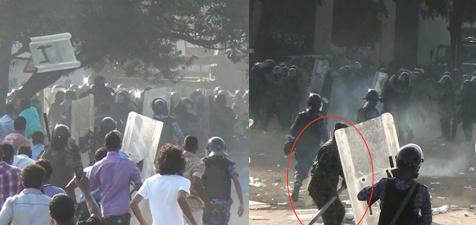
The report recounts the confrontations and provides evidence of police brutality against MDP members, with authorities arming opposition protesters with police shields, gas masks and pepper-spray canisters. It highlights recording showing police protesting in the Republican Square and attacking the Maldives National Defence Force (MNDF) Headquarters, while President Nasheed was still inside.

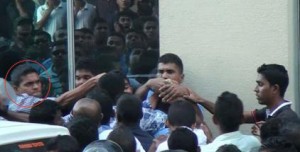
Pictures included in the MDP report show former Deputy Minister for Home Affairs Hassan Mahir being kicked in the back and forced to the ground during the unrest while surrounded by police and protesters.

Senior MDP member Ahmed Shahid (husband of MDP MP Eva Abdulla) was pictured being similarly kicked by a man identified as Corporal Mohamed Niyaz (now promoted to Sergeant). His shirt was ripped off and he was beaten up by police.

Meanwhile, Chief Superintendent Mohamed Jinah, head of police drug unit, was pictured handcuffed on a launch. He was reported to have been beaten up by rogue police officers before being taken to Dhoonidhoo Detention Centre along with several other senior officers.

A picture showing an attack on Superintendent of Police Ibrahim Manik was also included. He was struck on the head using an extendable steel baton, by a man identified as Corporal Waseem from Police Special Operations (SO).

However, to date no action has been taken against any of the officers, while both police and MNDF have refused to comment on the subject until the CNI concludes its investigation.

Neither have any independent institutions including the Human Rights Commission, Prosecutor General Office, Police Integrity Commission announced of an investigation into the criminal activities of the police during the events of February 7.

They all say, “a coup investigation is not within our mandate.”

Likes(0)Dislikes(0)

Amnesty “deeply concerned” over continued police repression of protesters

Amnesty International has called on the Maldives government to halt the use of excessive force against demonstrators, and urged the international community to continue closely monitoring the situation.

In a statement released on Tuesday, Amnesty said it “condemns the excessive use of force by police personnel and urges the Maldives government to ensure a full and impartial investigation is conducted into such attacks. “

Amnesty urged the Commonwealth and UN “to monitor the situation very closely and press the government to ensure people can fully realise their right to protest freely.”

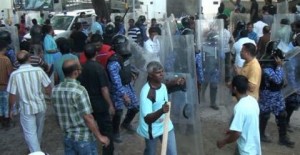
Amnesty’s statement follows its investigation of the police crackdown on a Maldivian Democratic Party (MDP) protest against the extrajudicial dismantling of the MDP’s Usfasgandu protest site on May 29 – a crackdown which included “beatings, pepper-spraying, and arrests. Those attacked include peaceful demonstrators, members of parliament, journalists and bystanders.”

Amnesty said that despite police claims to have used “the minimum required force to dismantle the area and arrest unruly demonstrators”, “it is clear that by far the majority of demonstrators were not using violence, and any such incidents cannot be used by police as an attempt to justify the ill-treatment of bystanders and those rallying peacefully.”

“Amnesty International believes that the police response to the demonstrations on 29 May was a clear example of excessive use of force.”

Amnesty’s statement included testimony from a number of protesters, noting that the latest reports “are consistent with many other testimonies Amnesty International has gathered previously. “

“One woman protesting peacefully in Majeedee Magu Street told Amnesty International that police officers suddenly pushed into them, and hit her and other peaceful demonstrators with their riot shields. Police hit them repeatedly on their back, and then pepper-sprayed them, aiming at their face and eyes. She said that police grabbed one demonstrator by the neck, shouted at him to open his mouth, and sprayed directly into his mouth,” the human rights organisation reported.

“Police also beat bystanders who showed no signs of violence. An eyewitness saw a man sitting on a stationary motorbike taking no active part in the demonstrations. Police went for him and hit him on his head with their batons. He lost consciousness. His friends took him to a nearby house where they arranged private medical treatment for him – they did not take him to hospital straight away as they were afraid he would be arrested.”

Mana Haleem, the wife of former Minister of Foreign Affairs Ahmed Naseem, was among those detained.

“She was walking home with her female friend in Majeedee Magu Street when police stopped them and began beating them repeatedly with their batons on their arms, back and hips before taking them in a van to the police station,” Amnesty stated.

“In her testimony Mana Haleem says: ‘I asked why we were being held, but received no answer. Later, they [police] told us it was because we had not obeyed their orders. We asked them how we could have disobeyed their orders if they had not given any, but they were not interested. I have bruises on my shoulder, my back and my hip.’”

MDP MP Imthiyaz Fahmy was also arrested: “he said police in Dhoonidhoo told him he was arrested for ‘disrupting peace’. The next day, in court, police stated that he had been detained for ‘physically attacking a woman police officer,’” Amnesty stated.

The organisation called on countries supplying police and military equipment to the Maldives, particularly pepper-spray, to ensure that the substance was not being used to commit human rights violations.

“Any country that knowingly supplies police or military equipment to a force that uses them to commit human rights violations is itself partly responsible for those violations,” Amnesty warned.

“Amnesty International is calling on the government of Maldives to halt attacks on peaceful demonstrators including beating and pepper-spraying; bring to justice any police personnel who have used excessive force; ensure that security forces in the Maldives receive comprehensive training on what constitutes human rights violations, which they should not commit.”

In response to Amnesty International’s statement, President’s Office Spokesperson Abbas Adil Riza observed that “there has always been a problem with police brutality in the Maldives, during the past three years as well.”

“We recognise the need to improve, but for this we need political stability and the MDP is not providing that,” he said, noting that the Police Integrity Commission (PIC) existed to hear such complaints.

Likes(0)Dislikes(0)

Bill to amend Judges Act ‘custom fitted’ for former Chief Justice, claim MPs

Maldivian Democratic Party (MDP) and some government-aligned MPs have claimed that the first amendment proposed to the Judges Act (act no. 13/2010) by the Progressive Party of Maldives (PPM) MP Dr Afrashim Ali, is has been “custom fitted” for former Chief Justice Mohamed Rasheed Ibrahim.

Rasheed was the Chief Justice and the President of the Council of Islamic Affairs during former President Gayoom’s administration.

The bill proposes to amend the article 26 of the act, which describes the reasons for declaring the seat of a judge vacant. However, MP Afrashim Ali proposed to change the context of the clause to replace it with privileges of a retiring judge. Afrashim was formerly a member of the Judicial Services Commission (JSC), the judiciary’s heavily criticised watchdog body.

If passed, the amendment would mean that the stated privileges would apply to all judges who failed to qualify as a judge or were retired from their seats under 285(a) of the constitution.

According to the amendment, the privileges entitled to the retiring judges include formal titles and a pension ranging from 33-100 percent of the wages received by a serving judge, depending on years of service.

Judges would further be entitled to a lump sum on their date of retirement, again based on years served on the bench, as well as security services, transport benefits, and medical insurance for the entire SAARC and ASEAN region, also applicable to the judge’s spouse.

During the debate, several MPs raised concerns over the bill and questioned the ‘real’ intention behind its submission by PPM MP Afrashim, at a time the country was facing a huge economic crisis.

Speaking during the debate, Independent MP Mohamed ‘Kutti’ Nasheed – who has been supportive of President Waheed’s government – spoke against the bill, claiming that it was a bill fashioned for a specific person: former Chief Justice Mohamed Rasheed Ibrahim.

“Now all those Judges who were disqualified after the new constitution was ratified claiming that they too are entitled to receive the same privileges  as those who are currently as serving judges. After two years, they are trying to again link to the past,” he said.

MP Nasheed also said that it was difficult to name Mohamed Rasheed Ibrahim on the parliament floor, but that if he continued to pursue benefits and privileges then he has no choice but keep on saying his name.

MDP MP Ahmed Hamza said that he believed there were some “unfair benefits” included in the bill, and that he did not believe retired judges should receive the same benefits as those currently serving on the bench.

“The bill says that a person who has served as a Judge for 30 years should get the same amount of money and privileges as a serving judge. That is unacceptable,” he said.

MP Alhan Fahmy, who recently defected to the Jumhoree Party (JP) from the MDP, said that it was disappointing to see bills being prepared to benefit those who had “hijacked” the judiciary for 30 years, without having provided any betterment or justice to the country.

“We are continuously seeing attempts to protect and find monetary benefits from the national budget by those who were with Maumoon Abdul Gayyoom during his 30 rule,” Fahmy said.

MDP MP Eva Abdulla said that before the parliament began speaking about privileges granted to retiring judges, priority must be given to the quality of judges currently in the courts. She claimed that the MDP government had planned to invest over Rf 300 million (US$19.45 million) improving the judiciary but was stopped after then opposition brought down the government in a coup d’état.

However, PPM MP Ahmed Nihan spoke in favor of the bill, and stated that such privileges should be given to retiring judges and that even if it was targeted for former chief Justice Mohamed Rasheed Ibrahim, he would still support it.

“As a chief justice, as a former Minister of Justice, [Mohamed Rasheed Ibrahim] has done a lot of work for the country. We can’t simply abolish the value of his service,” Nihan said

Speaking to Minivan News, MDP Spokesperson MP Hamid Abdul Ghafoor described the bill as “dirty” attempt to give unfair benefits to those that served former President Gayoom.

He further said the party will not stand in support of the bill, and said that he was getting the same impression from some of the opposition MPs.

He also added that this was another attempt to corrupt the judiciary, and that some business tycoons did not want to have justice established in the country.

“This is a nasty thing. The coup happened because we had a crippled justice system. Some of those in the coup government want it to remain the same way. But interestingly some of the opposition MPs have started taking our stand. This can be seen even in voting records for the Public Finance Committee’s report on Aasandha,” he said.

Ghafoor said the bill was likely to be thrown out of the house.

Speaking to Minivan News, former member of the JSC, Aishath Velezinee, alleged that the bill was an attempt to pay back the judges who had colluded in Gayyoom’s conspiracy to bring down democracy.

“Afrashim – who proposed the motion – and Speaker Shahid stand accused in the JSC’s  high treason case pending in Majlis, and have effectively covered this up since 2010,” she said.

“I maintain that the country does not have constitutionally-appointed judges and that parliament has failed to hold an inquiry. Rewarding the corrupt is against national interest,” she added.

In an article written in 2010, Velezinee noted that the parliament had approved the reward “of a hefty lifetime allowance for interim Supreme Court Justice Mujuthaaz Fahmy, removed from the bench at the end of the interim period.”

“Mujuthaaz Fahmy has on record a conviction for fraud committed in 1996 for which he was  ‘convicted’ in 1998. He was the chief engineer in co-opting the Judicial Service Commission as a tool in the silent coup to derail democratic government through rigging state-building [independent institutions],” Velezinee wrote in 2010.

“The amendment to the Judges Act proposed by MP Abdulla Abdul Raheem, a member of the Parliament Independent Commissions Committee, applies only to Mujuthaaz Fahmy, a fact that only becomes obvious when one checks the records locked up in JSC and out of bounds to media and public alike. That the independence of Judges has been compromised -and no independent judiciary exists in the Maldives – is a fact evident to the thinking mind,” she wrote at the time.

Several MPs who are supportive  of President Waheed suggested that the most recent bill be accepted and sent to committee, while others suggested rejecting the bill and throwing it out of the house.

Likes(1)Dislikes(0)

LGA warns MCC against allowing use of council facilities for political activities

The body assigned to monitor the work and activities of the councils created under the 2010 decentralisation act has urged Male’ City Council (MCC) not to allow its facilities or equipment to be used for political purposes.

The Local Government Authority (LGA) has reported several complaints about the use of council offices for political purposes and has released a statement on its website warning the council that such activities could undermine public confidence in the MCC.

“[The LGA] believes that this could disrupt the system by which these services are provided to the people. Hence, we advise all councils and council offices to refrain from leasing council property and equipment for political gatherings,” read the statement.

Under the terms of the 2010 Decentralisation Act* the LGA was created to “monitor the work and activities and coordinate the work of the councils.”

The act also commits the LGA to “ensure the work and activities of councils created is functioning in accordance with the constitution, this act, and the other laws.”

The LGA statement did not elaborate on its position concerning the legality of the use of MCC facilities for political purposes. Minivan News was informed by an LGA staff member that there was to be no further comment given today.

The legality of the use of council land has become the focal point in the dispute between the MCC and the central government.

The most recent development in the long-running dispute came on June 7 when the government filed a request with the Civil Court, requesting an order for the MCC to hand the Usfasgandu area over to the Housing Ministry.

The ministry first announced its intentions to reclaim the site on April 9 should the MCC fail to dismantle the Maldivian Democratic Party’s (MDP) protest camp.

The government argued that the leasing of the land to the MDP for political purposes was in contravention of the decentralisation act. After the MCC refused to accept this interpretation of the law, the cabinet informed the MCC on May 9 that it was entrusting the Housing Minister to reclaim the area.

The situation escalated once more on May 29 after the government obtained a warrant from the Criminal Court to search the area after the Home Minister Dr Mohamed Jameel Ahmed had alleged complaints of illegal activity in the area. Among the purported misdemeanours listed on the warrant was “suspected black magic performed in the area”.

The security forces began to dismantle the camp before the MDP obtained an order from the Civil Court to halt the process.

The MDP, which enjoys a majority of seats in the MCC, has also been using Male’ City Hall, the council’s main office, for party press conferences in recent weeks.

Under the Decentralisation Act, the LGA is empowered to file suit with the High Court to dissolve the council. One of the situations detailed as warranting such action is the misuse of council’s faciltities.

Article 140 of the constitution states that a member of the cabinet must be assigned responsibility for each of the non-independent government authorities. The Home Minister currently fulfils this role.

*These details have been taken from an unofficial translation of the act.

Likes(0)Dislikes(0)

State spent Rf1.3 million on Gayooms’ health expenses 2010-2012

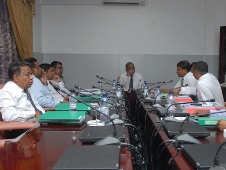
A total of Rf1.3 million (US$84,300) was spent on healthcare costs for former President Maumoon Abdul Gayoom and his wife from 2010 to April this year, MP Ahmed Hamza of the Maldivian Democratic Party (MDP) revealed at parliament’s Finance Committee meeting yesterday.

The MP for Bilehdhoo revealed the figures during committee deliberations on a request by the Ministry of Finance and Treasury to establish rules and guidelines for covering health expenses for former presidents and their spouses.

According to the Finance Ministry, Rf302,560 (US$19,621) was spent for the Gayooms’ healthcare in 2010, Rf713,803 (US$46,290) in 2011 and Rf298,572 (US$19,363) so far this year.

Article 7 of the Protection and Privileges for Former Presidents Act (Dhivehi) – the first piece of legislation passed by the then-opposition majority parliament after convening in May 2009 – stipulates that healthcare for ex-presidents and their spouses either in the Maldives or overseas shall be provided by the state.

The law however does not set any limits to the health expenses to be borne by the state.

In addition to healthcare costs, Rf3.86 million (US$250,324) was spent on the former president’s office in 2010, Rf2.1 million (US$136,187) in 2011 and Rf700,000 (US$45,396) as of April this year.

Finance Committee
Finance Committee meeting on 12 June

Local media reported that following discussions at the Finance Committee yesterday, MPs decided to recommend that the Finance Ministry purchase a health insurance package for former presidents.

MP Hamza suggested offering an insurance package similar to those provided to retired high-ranking officials at the United Nations.

MP Ahmed “Redwave” Saleem of Gayoom’s Progressive Party of Maldives (PPM) reportedly insisted that the package should cover all forms of treatment to be in compliance with article 7 of the Protection and Privileges Act.

However, most MPs concurred that there should be a ceiling limit for healthcare costs for former presidents.

The legislation on protection and privileges for ex-presidents was required under article 128 of the constitution, which states, “A person who has served in the office of president, serving his term of office lawfully without committing any offence, shall be entitled to the highest honour, dignity, protection, financial privileges and other privileges entitled to a person who has served in the highest office of the land. Such protection and privileges shall be specified in law.”

“Unreasonable”

Prior to the passage of the Act in October 2009, MPs of the then-ruling MDP denounced the monetary benefits in the draft legislation as excessive and “unreasonable.”

The bill stipulated a monthly allowance of Rf75,000 (US$6,000) in addition to Rf50,000 (US$4,000) for housing and Rf175,000 (US$14,000) for staff and office space.

The ruling party said at the time that the total figure would shoot up once the cost of health, transportation and security was taken into account, estimating that a total of Rf3 million (US$233,000) would be spent a month on former President Gayoom.

MDP MP for Hithadhoo North, Mohamed Aslam, observed that ex-presidents would be allowed to seek medical care anywhere in the world at the state’s expense.

“The benefits are too high as Rf300,000 (US$19,450) a month for someone who has retired is beyond reasonable expectations,” Aslam had argued. “Also, the government is in a financial crisis and it will be difficult to pay such a huge amount.”

Likes(0)Dislikes(0)

Maldives sponsors BBC weather in US$250,000 deal

Maldivian tourism authorities are pursuing private sector funding to secure advertising with prominent media networks such as CNN, after this week signing a sponsorship agreement with the British Broadcasting Corporation (BBC).

Deputy Tourism Minister Mohamed Maleeh Jamal told Minivan News that authorities were presently looking for ongoing partnerships within the country’s resort industry to help fund a year-long global media campaign to offset the impacts of negative international headlines believed to have affected tourism this year.

The government yesterday finalised a US$250,000 (Rf3.8million) advertising deal to promote the country’s tourism industry on the BBC through sponsorship of its weather services. Tourism authorities said the strategy reflected a collaboration between the government and the private sector to try and strengthen arrival numbers to the country.

Under the recently reinstated “Sunny Side of Life” branding, Maleeh said the sponsorship of the BBC’s weather services will run from June 18 to August 27 on both the BBC World TV service as well as the broadcaster’s website.

Pubic relations

In April, the Maldives Marketing and Public Relations Corporation (MMPRC) confirmed the appointment of New-York based public relations agency Ruder Finn to “oversee the overall media coordination and achievement of PR related solution for destination Maldives.”

According a contract speculated to be worth over US$150,000 per month, Ruder Finn is required to work to: “ instill confidence in the tourism industry of the Maldives, gain understanding and public acknowledgement of the Maldives in the international community and ensure sustainable development of the tourism industry.”

Questioned whether the BBC sponsorship agreement was designed to try and generate greater media coverage about the Maldives on international news services, Maleeh claimed the MMPRC’s promotion plans were focused on tourism rather than generating headlines.

“At present we are trying to build investor confidence in the country,” he claimed. “There has been too much focus on stories such as how the Maldives will be sinking in 30 years.”

Maleeh pointed to recent coverage of several events in the lead up to February’s controversial transfer of power – such as former President Mohamed Nasheed’s proposed spa ban – as an example of headlines that had damaged confidence among tourists and investors in the Maldives.

The previous government under Nasheed claimed a spa ban introduced back in December 2011 was made in response to criticisms made against it during a demonstration of opposition politicians and NGOS relating to “un-Islamic” practices in the country.

“Mainstream” promotion

Once the present BBC sponsorship agreement ends in August, Maleeh added that the MMPRC and tourism authorities hoped to secure more funding to continue its advertising plans. He said that the motivation at present was to extend advertising ideally to “all mainstream media organisations” such as organisations like CNN.

Maleeh stressed that funding remained the biggest issue at present to extending advertising efforts.

“We are seeking support from local and international hospitality groups right now,” he said. “We are still waiting to receive support. However, other hotel chains have shown an interest.”

During the signing of the BBC agreement yesterday at the Conrad Rangali Island Resort, Tourism Minister Ahmed Adeeb welcomed the assistance of local business tycoons Mohamed ‘Champa’ Moosa and Mohamed Umar Maniku in securing the deal, according to local media.

Adheeb told Sun Online that authorities had decided to re-use the country’s “The Sunny Side of Life” branding due to previous experiences the industry had with the slogan, as well as negating costs associated with setting up an entirely new brand.

“Over the past years it has become a very expensive brand. I believe that if we were to opt for a rebranding it would in the least cost us US$50 million. We don’t have that much of a budget. The new government decided to go forward with the old brand,” he was quoted as telling local media.

Meanwhile, Vice President Waheed Deen, who was also present during the signing, lauded the financing of the new ad campaign as an “achievement” and a “success” for the country as it celebrates 40 years since the inception of Maldivian tourism during 2012.

“Coup” allegations

The 50,000 member-strong opposition Maldivian Democratic Party (MDP) maintains it was ousted from power on February 7 following what then President Mohamed Nasheed described as a coup d’état planned by political opposition, sponsored by some wealthy resort tycoons and carried out by a mutinous police and military. The party has continued to claim that President Dr Mohamed Waheed Hassan’s government is illegitimate and represents a return to the autocratic era of Maumoon Abdul Gayoom.

Such criticisms of the present government have led to the establishment of the Maldives Tourism Advisory (MTA) by the Friends of Maldives NGO that names resorts alleged by the MDP to have involvement in the “coup”.

In April, the Maldives Association of Tourism Industry (MATI) has issued a statement expressing “serious concern” over what it describes as a “concerted international campaign” against several of the country’s resort operators.

MATI claimed that calls from the Maldives Tourism Advisory (MTA) for tourists to avoid certain properties on the basis of ownership were “libellous in the extreme”, as the allegations against the tourist resort operators “have not been proven either through an investigation or a court of law.”

The MTA website features a ‘traffic light’ system with “red” resorts recently appearing to have been expanded to include an assortment of 18 properties owned by Vice President Waheed Deen and senior figures associated with the new ruling coalition, including Jumhoree Party (JP) Leader Gasim Ibrahim and Progressive Party of the Maldives (PPM) MP Abdulla Jabir.

Likes(0)Dislikes(0)

Government-majority committee rejects cabinet appointees

The Majlis’s Government Accountability Committee yesterday approved only one of four proposed cabinet members after half of the government coalition’s committee members failed to vote for them.

The governing coalition holds a majority of seats on the committee, with eight members compared to the opposition Maldivian Democratic Party’s (MDP) three.

At yesterday’s committee meeting, only the proposed appointee for the Ministry of Gender, Dhiyana Saeed of the Jumhooree Party (JP), was approved by those present.

After the MDP members voted against Dhiyana’s appointment, the Chair of the committee and Progressive Party of Maldives (PPM) MP Mohamed Mujuthaz cast the deciding vote in her favour.
The other  nominees – Dr Mohamed Muiz as Mohamed as Minister of Housing and Infrastructure, Dr Mariyam Shakeela as Minister of Environment and Energy, and Dr Ahmed Jamsheed Minister of Health – failed to get the required votes.

Three of the pro-government members of the committee failed to attend yesterday’s vote whilst another voted against the appointments, resulting in the failure to gain the votes required to approve three of the government’s candidates.

Following the government’s re-structuring of cabinet, two new members required parliamentary approval, whilst two others required the Majlis’s confirmation after changes to their ministerial portfolios.

MP for Feydhoo constituency Alhan Fahmy is reported by Haveeru to have voted alongside the three MDP members against the unsuccessful government nominees.

Fahmy now represents the Jumhoree Party (JP) in the Majlis after his recent defection from the MDP.

The Jumhoree Party held a council meeting yesterday evening during which it elected Dr Ibrahim Didi, another recent arrival from the MDP, at the party’s President following his uncontested candidacy.

Dr Didi, who was President of the MDP until its National Council voted him out on April 30, told Haveeru yesterday the appointment was “the happiest day of my political career.”

The JP has also announced that its council had backed Dr Didi to be the Health Minister – a position currently held by Dr Ahmed Jamsheed, whose appointment was one of those voted on earlier in the day.

Fahmy, who was unavailable for comment at the time of press, is said to have abstained from the vote concerning his fellow JP colleague Dhiyana, leaving only seven members to vote on her appointment.

Haveeru reported that the JP party leader Ibrahim Gasim will now talk to President Waheed about this proposed change to the cabinet.

The decision on these appointees will now move to the floor of the Majlis where President’s Office Spokesman Abbas Adil Riza is confident that they will still be approved.

Asked by Minivan News if the problems with the ministers’ approvals was indicative of greater problems within the governing coalition, Abbas responded, “no, it’s nothing like that”.

The cabinet changes entailed the division of the ‘Ministry of Health and Family’ into the ‘Ministry of Health’ and the ‘Ministry of Gender, Family and Human Rights’.

The ‘Ministry of Housing and Environment’ has now become the ‘Ministry of Housing and Infrastructure’ and the ‘Ministry of Environment and Energy’.

Likes(0)Dislikes(0)

MDP national council pass motion to “do whatever it takes to bring down coup regime”

The Maldivian Democratic Party (MDP) National Council passed a motion on Monday agreeing to “do everything it takes” to bring down the “coup regime” of President Mohamed Waheed Hassan, by “all necessary means and sacrifices”.

The motion was proposed by the former chairperson of the National Social Protection Agency (NSPA), MDP constituency president of Haa Dhaal Nolhivaram constituency Ibrahim Waheed, and seconded by MDP MP Ahmed Sameer.

The motion stated that the initial three member panel of the Commission of National Inquiry (CNI), which President Waheed formed to investigate the controversial transfer of power on February 7, had failed to include several “key facts” in its timeline. Despite the absence of these facts, the timeline revealed the transfer was a coup d’état, the MDP stated.

It also stated that the report composed by Mohamed Aslam and Ameen Faisal revealed that the government of MDP was toppled illegitimately, and alleged that the perpetrators of the coup had planned to harm President Nasheed.

The motion further stated that current President Mohamed Waheed Hassan had played a pivotal role in the coup, self-proclaiming certain powers which President Nasheed had not delegated to him as per article 117 (a) of the constitution.

The motion concluded stating that the National Council believed that necessary action needed to be taken to bring down the illegitimate government by all means and any sacrifices needed in the process, until a legitimate people’s government was installed in the country.

During the debate over the motion, several members of the national council claimed that President Waheed had come to power in a coup d’état, and the party should do whatever it took to bring down the regime and install a democratic  government.

Members of the national council expressed concern over recurrent  police brutality, and claimed that this had increased to such an extent that some police and MNDF officers had begun openly robbing people on the street.

Speaking in the debate, ousted President Mohamed Nasheed said that despite the MDP refusing to recognise the initial composition of the CNI, the latest timeline released by the initial three member panel of CNI also implied that it was a coup.

Former MP for Thimarafushi Constituency, Mohamed Musthafa, said during the debate that the party must be willing to make sacrifices to ensure that the “legitimate” MDP government was reinstated, and the democracy was  reestablished.

“Coming out on the street once a week to show our hands and dance about and then go home is not a solution. We need a solution by any means possible,” he said.

He further said that the MDP should not be scared if sacrifice also meant going to prison.

During the vote for the motion, the motion was passed unanimously by the 55 attending members of the National Council.

Earlier, fresh protests erupted following a MDP National Council meeting held right next to the police barricades near the swimming tracks after police raided the MDP’s protest camp Usfasgandu. The clustered meeting of 43 members of the council took the stand that “enough was enough” and that party should take to the streets to get their constitutional rights.

Immediately, 400 protesters gathered in the area to challenge the legitimacy of police and demand the return of Usfasgandu, saying that they had not done anything violent. The protests triggered a brutal police crackdown leading to arrests and injuries.

Speaking to Minivan News, MDP Spokesperson Hamid Abdul Ghafoor said that the purpose of the motion meant that the party would stand firm and strong to defend the public rights.

“The National Council’s decision will be forwarded to a committee within the National Council, and they would decide how the party would act upon the motion. What I know is that we will stand strong to defend the public rights,” he said.

He also added that it was a part of party’s ongoing rally under the name of ‘Insaafuge Dhathuru’, translated as Journey to Justice, which began on February 17, just ten days after the MDP government was ousted.

Likes(1)Dislikes(0)