MDP calls on six MPs absent from Supreme Court vote to answer disciplinary charges

The opposition Maldivian Democratic Party’s (MDP) disciplinary committee has ordered the six MPs who violated the party’s three whip-line against dismissing two Supreme Court judges to answer to charges on Friday evening (December 19).

The party’s national council on Monday asked the committee to take disciplinary action against Vaikaradhoo MP Mohamed Nazim, Velidhoo MP Abdulla Yamin Rasheed, Mulaku MP Ibrahim Naseer, Felidhoo MP Ahmed Marzooq, Kurendhoo MP Abdul Bari Abdulla, and Hulhuhenveiru MP Reeko Moosa Manik within seven days.

Disciplinary committee Chair Mohamed Shifaz said the committee would only decide on penalties after reviewing why the six MPs failed to turn up for the vote.

The MDP’s parliamentary group had issued a three-line whip ordering all 23 MPs to be present at the Majlis to vote against dismissing former Chief Justice Ahmed Faiz and former Justice Muthasim Adnan.

The two judges were removed with 53 votes at an extraordinary sitting on Sunday (December 14). Four Jumhooree Party (JP) MPs and 17 MDP MPs opposed the vote.

Bribed?

Opposition leader and former President Mohamed Nasheed has suggested MPs may have been bribed. Reliable sources told Minivan News that opposition MPs were offered MVR2.5 million (US$162,000) each to be absent from the Majlis during the vote.

MP Yamin has since apologised for his absence on Twitter, saying he had left the country for Thailand before the vote was scheduled.

The MDP secretariat, however, said Yameen had initially promised to make arrangements to be present for the vote, but later said he had not been able to get a seat on the flight.

The Judicature Act amendments which reduced the seven-member Supreme Court bench to five judges, and subsequently resulted in Faiz and Muthasim’s dismissal, was first proposed by MDP MP Ibrahim ‘Mavota’ Shareef.

The MDP immediately rejected the proposal, and Shareef voted with the party line against both the amendments and the dismissal of Faiz and Muthasim.

MDP members have urged the party to penalise Shareef for proposing the bill, but the disciplinary committee said it has not received a complaint requesting action on the matter.

Shareef was expelled from the MDP in 2007 on allegations of sexual harassment. He went on to join the Dhivehi Rayyithunge Party (DRP) before rejoining the MDP in 2013 when the DRP decided to back Nasheed during November’s presidential polls.

Reeko Moosa Manik – who has also declared he would contest MDP’s 2018 presidential primaries – said the MDP must first take action against the national council members who voted for a previous MDP resolution to help JP Leader Gasim Ibrahim assume the presidency.

Speaking to Haveeru, Moosa said he would accept any disciplinary action taken against him “with respect” but said the party must treat all members equally.

History of disciplinary action

In January, the MDP’s disciplinary committee suspended MPs of the former Majlis Zahir Adam and Abdulla Abdul Raheem for three months for contravening a three-whip line against approving President Abdulla Yameen’s cabinet.

Four other MPs who breached the whip – MPs Mohamed Rasheed, Ahmed Rasheed, Abdulla Jabir, Ali Riza, and Ahmed Easa – were also penalised. Easa later told Minivan News that his vote in favour of tourism minister Ahmed Adeeb had been the biggest mistake of his political career.

Riza was reprimanded and asked to issue an apology by January 30, and the party decided not to take any action against Easa, stating that his actions on December 30 only constituted a first offense.

Mohamed Rasheed and Ahmed Rasheed, who had left the party at the time, were told that if they intended to rejoin MDP, they must apologise to the party’s membership and submit 50 new membership forms each.

Jabir was stripped of his position as deputy parliamentary group leader, while the party retracted his ticket for the Kaashidhoo constituency and asked him to issue a public apology.

The party’s appeals committee later re-awarded Jabir the MDP ticket claiming the the disciplinary committee could only issue a warning, levy a fine, and suspend or revoke party membership. It could not revoke a party ticket, the ruling said.


Related to this story

MDP votes to discipline MPs absent from Supreme Court vote

Abdulla Saeed appointed as new Chief Justice, dismissed Justice Faiz laments “black day”

MDP suspends MPs Zahir and Abdul Raheem

Likes(1)Dislikes(0)

Judicial independence still an issue in Maldives, says US assistant secretary of state

US Assistant Secretary of State Nisha Biswal has said that judicial independence and politically-motivated threats remain an issue in the Maldives, despite the young democracy’s accomplishments.

“The United States remains committed to supporting Maldives as it works to consolidate the independence of its core governing institutions and establish democratic norms that respond to the will of its people,” said Biswal.

The assistant secretary of state for south and central asian affairs released a statement following her visit to Malé, during which she met with President Abdulla Yameen, senior cabinet members and civil society groups.

Biswal’s visit came soon after the controversial removal of two Supreme Court judges earlier this week, with numerous MPs reporting personal threats and physical assault in the hours preceding the Majlis vote.

Commonwealth groups have since expressed concern that the sudden removal of former Chief Justice Ahmed Faiz and Justice Muthasim Adnan has “severely jeopardised” the independence of the Maldives judiciary and the rule of law.

The US has previously been critical of the Maldives judiciary, noting that it was “not independent and impartial and was subject to influence and corruption” in the State Department’s 2013 human rights report.

The report also described “charges of Supreme Court interference to subvert the presidential elections process,” as among the most significant human rights problems in the Maldives.

Biswal yesterday noted that the Maldives has proven itself to be an “able partner”, with “great potential to serve as a model of a democratic and tolerant Muslim society that can have enormous influence on countries around the world.”

“We look forward to continuing cooperative efforts to address the great challenges of our time –from mitigating the effects of global climate change, to combating piracy, to countering the rise of extremist ideologies,” read the statement yesterday.

An additional report on terrorism from the State Department in May this year reported the Maldives Monetary Authority (MMA) as saying that funds were being raised in the country to support terrorism abroad. The suggestions were subsequently denied by the MMA.

The Maldives’ leadership positions at the UN Human Rights Council and its recent appointment as chair of the Alliance of Small Island States was also noted in Biswal’s statement.

Trade and investment

The assistant secretary welcomed the broadening and deepening of trade with the US in the wake of the first bilateral trade talks in October – five years after the initial Trade and Investment Framework Agreement (TIFA) was agreed.

Despite this delay, total trade between the two countries has more than doubled between 2009 and 2013, though US tourists visiting the Maldives represented less than 2 percent of the market share last year.

2013 saw US private equity firm Blackstone acquire both the Maldives’ major seaplane operators for an undisclosed sum, as well as the introduction of the US designed PISCES border control system.

The PISCES system was utilised in the controversial arrest of alleged Russian hacker Roman Seleznyov by US security personnel while in the Maldives in July. Seleznyov was subsequently transported to the US via Guam where he awaits trial.

US engagement with the Maldives has traditionally concerned foreign assistance to enhance maritime security, counter terrorism, and counter narcotics cooperation with Maldivian security forces.

Rumours of a Status of Forces Agreement – opening up the possibility of US forces being stationed in the Maldives – surfaced in 2013, before the newly elected President Yameen announced that any such deal would be likely to damage relations with neighbouring countries.

The US has also pledged to help the Maldives adapt to the negative effects of global climate change, pledging US$7.2 million (MVR111 million) for a adaptation projects last year.

Assistant Secretary of State Biswal reiterated the US’s commitment to enhancing the Maldives’ resiliency and crisis-response capabilities, praising the government and the public for their response to the recent Malé water crisis.

“The United States will continue to work with the government of Maldives on long-term water production and distribution assessments, and to develop rain-water catchment and desalinization projects to ensure supply of clean drinking water,” said Biswal.


Related to this story


Majlis removes Chief Justice Ahmed Faiz, Justice Muthasim Adnan from Supreme Court

Corruption, religious freedom, and judiciary biggest human rights problems in Maldives, say US report


Likes(2)Dislikes(0)

Malé City Council helpless as housing ministry takes over all land, public services staff

The housing ministry has taken control of 13 plots of land belonging to the opposition dominated Malé City Council, and transferred the majority of the council’s public services division staff to the ministry.

According to a housing ministry announcement, all of Malé City’s streets, the Artificial Beach area, Plot 211, Usfasgandu, the T-Jetty area, Dharubaaruge Convention Center, Sultan Park, Maafannu round-about, Adi Park, Alimas Carnival, Fishermen’s Park and all other parks now belong to the ministry.

Any individual wishing to make use of these lands must now seek permits from the ministry. The State Electric Company (STELCO) and Maldives Police Services would not provide services for any events unless a housing ministry permit is obtained, the announcement said.

The move continues a steady removal of powers from the council, in what has been characterised by its officials as an attempt to destroy decentralisation in the country.

Malé City Mayor Mohamed Shihab has condemned the government’s systematic abrogation of the council’s powers and said it constituted a breach of the powers afforded to the council under the Constitution and the Decentralisation Act.

“We are now only in charge of facilitating construction in Malé, issuing death and birth certificates and cleaning mosques. But the constitution clearly states the Maldives must be administered through decentralised councils,” he said.

The government must respect Maldivian laws to attain development, he contended.

“The powerful are now abusing their powers in the Maldives. This is very sad. Ultimately, it is the ordinary Maldivian citizen who will suffer the most. Investors will not invest here. No one knows what will happen tomorrow or the day after. We have to uphold the law if we want to develop at the same levels as developing countries,” he said.

Deputy Mayor Shifa Mohamed said the council has challenged the transfer of council staff to the housing ministry at the Civil Court.

In addition to transferring council staff, the ministry had also illegally taken over the council’s assets, including dustbins and trees for a greening programme, in the public services section, she said.

Shifa has described the government’s actions as a plot “to destroy decentralization”.

On November 26, the council declared it was close to shut-down after the Maldives Police Services confiscated documents and computer systems at the Malé City Council offices under a court warrant on allegations of corruption.

The warrant, signed by the Criminal Court Chief Judge Abdulla Mohamed, said that “some council staff had shared and gained unlawful advantages from some PDF files sent to the council by Maldives Land and Survey Authority.”

The survey authority and the land registration project fall under the authority of the Ministry of Housing and Infrastructure.

The council has denied receiving such files, stating that any surveys on Malé lands would have originated from the council.

The cabinet in early November announced it had removed the council’s jurisdiction over the city’s roads after disagreements over the replanting of vandalised trees.

Opposition leader and former President Mohamed Nasheed has said the trees were uprooted by masked policemen. Police have dismissed the claims.

Local media have since reported that the ruling Progressive Party of the Maldives believes the trees were being used to curse President Abdulla Yameen.

The roads are now under the control of the housing ministry and the Maldives Road Development Corporation (MRDC) which has started cleaning the drains, bringing some alleviation to persistent flooding.

The government had suggested that the council had failed to adequately maintain both Dharubaaruge Convention Center and the roads of the capital, though the council has maintained that state funds allocated for the work was not released by the finance ministry.

The government in October also scrapped an agreement made with India–based Tatva Global Renewable Energy to provide waste management services in the capital Malé and nearby areas.


Related to this story

Malé City Council close to shut-down after police confiscate documents and server system

Newly planted areca palms uprooted on housing ministry orders

Government terminates Tatva waste management deal

Can decentralisation take root in the Maldives?

Likes(2)Dislikes(0)

Maldives falls in press freedom index for fourth year

The Maldives has fallen in the Reporters Without Borders (RSF) Press Freedom Index for the fourth consecutive year, dropping 5 places to 108th out of the 180 countries ranked.

The index reflects the degree of freedom that journalists enjoy in each country and the efforts made by authorities to ensure respect for this freedom.

After serious attacks against opposition-aligned journalists last year, 2014 marked a new low in Maldivian journalism as the Minivan News journalist and blogger Ahmed Rilwan disappeared in what is widely regarded as an abduction.

The RSF index is again topped by European nations – Finland, Norway, and the Netherlands – while Eritrea, North Korea, Syria, Somalia, and China are again among the lowest scoring countries.

After the Maldives rose as high as 51st in the index in 2009, recent years have seen a steady decline, slipping to 73rd by 2011, 103rd in 2012, and 108th last year.

RSF also released its annual indicator of the global level of media freedom for the second time this year, which increased by 61 points – or 1.8 percent, suggesting a slight decline in respect for freedom of information worldwide.

With over 700 journalists killed worldwide over the past decade, UNESCO last year launched the International Day to End Impunity for Crimes against Journalists, which was observed on November 2.

Rilwan’s disappearance

In early November this year, the Police Integrity Commission accepted a case filed by Rilwan’s family alleging police negligence in the investigation into the 28-year-old’s disappearance.

The Maldivian Democracy Network has also asked the police watchdog to investigate the police’s failure to investigate dangerous criminal activity outlined in a report into the disappearance.

The report by UK-based private investigators concluded radicalised gangs to have been the most likely culprits in the abduction.

Police immediately dismissed the document as politically motivated, though they have yet to make significant progress in the investigation, with Home Minister Umar Naseer telling the media that some cases just could not be solved.

Publication of the details of the MDN report by the media also resulted in threats against journalists, which have frequently followed the publication of stories about the capital’s growing gang problems.

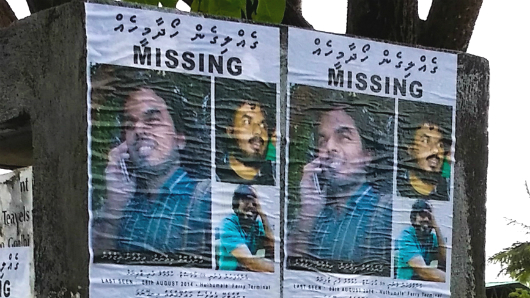
Minivan News journalist Ahmed Rilwan - missing for 131 days

A landmark “Threat Analysis Report” carried out by the Maldives Broadcasting Commission in May found that 84 percent of journalists surveyed reported being threatened at least once, while five percent reported being threatened on a daily basis.

2014 also saw the first criminal proceedings initiated against a journalist since the introduction of the 2008 constitution, though charges of obstructing police duty against Channel News Maldives journalist Abdulla Haseen were later dropped by the state.

Rilwan’s disappearance is the first such instance of its kind in the Maldives, although near fatal attacks were carried out on the blogger Ismail Hilath Rasheed in 2012 and the Raajje TV reporter Ibrahim ‘Asward’ Waheed in 2013.

Noticeable problems

Following Rilwan’s disappearance in August, journalists from across the Maldives joined to declare that his abduction was a threat to all, calling for an end to persistent intimidation faced by the press.

“As intimidation of press grows, and attacks against journalists, equipment, and buildings continue, we are extremely concerned over the delays in bringing to justice those who commit these acts,” read the landmark statement.

Meanwhile, oversight of the industry – one of the key measures in the RSF index – continued to be negatively affected by internal problems within both the Maldives Journalist Association (MJA) and the Maldives Media Council (MMC).

After the last three attempts to hold new elections for the MJA were disrupted, Vice President Ali Shaman said that the continued absence of members had left the association unable to form a quorum for meetings.

“Due to the delays, the MJA’s functions have not been that effective,” said Shaman, who suggested that the introduction of a working journalist’s act could improve the conditions for journalists in the country.

An MJA meeting in August resulted in accusations of assault against one editor and the resignation of MJA President Ahmed ‘Hiriga’ Zahir, while the editor accused subsequently received a death threat via SMS.

Meanwhile, the work of the 15 member MMC – established under the 2008 Maldives Media Council Act to establish and preserve media freedom – has also been hindered this year by delays to internal elections.

All members of the council were confirmed in early December after issues regarding the eligibility of inactive media outlets had delayed the MMC elections by four months.

Observers sent from the EU to oversee this year’s Majlis elections suggested that lack of clarity in the media regulatory framework should be addressed, suggesting a merger between the Media Council and the Maldives Broadcasting Commission.

The council did, however, hold the first Maldives Journalism Awards this year, although the absence of government officials appeared to contradict pledges to respect and protect journalists.


Related to this story

RSF urges government to deploy all necessary resources to find missing journalist

Maldives slides on Press Freedom Index for third consecutive year

Death threats lead to self-censorship, says Reporters Without Borders

Likes(1)Dislikes(0)

Judicial independence, rule of law “severely jeopardised” in the Maldives, says Commonwealth organisations

The sudden removal of former Chief Justice Ahmed Faiz and Justice Muthasim Adnan has “severely jeopardised” the independence of the Maldives judiciary and the rule of law, three Commonwealth bodies have said.

The Commonwealth Lawyers Association (CLA), the Commonwealth Legal Education Association (CLEA) and the Commonwealth Magistrates’ and Judges’ Association (CMJA) in a statement on Tuesday said the judges’ removal was unconstitutional and constituted a clear breach of the Commonwealth Principles to which the government of Maldives has subscribed.

Faiz and Muthasim were removed by a two-third majority of MPs present and voting at an extraordinary session on Sunday following amendments to the Judicature Act that reduced the seven-member Supreme Court bench to five judges.

Expressing concern, the CLA, CLEA and CMJA said the removal contravened Article 154 of the Maldives Constitution that says a judge can only be removed if the watchdog Judicial Services Commission (JSC) find the judge guilty of gross misconduct or incompetence.

The JSC did in fact rule the two judges unfit, but the ruling has not been made available to MPs or the public, despite repeated requests by opposition MPs.

In passing the revisions to the Judicature Act and removing the two senior judges, the Government of Maldives have breached the Commonwealth (Latimer House) Principles on the Accountability of and the Relationship between the Three Branches of Government (2003), said the statement.

“As a result the independence of the judiciary and the Rule of Law have been severely jeopardized”.

The Principles state that “Judges should be subject to suspension or removal only for reasons of incapacity or misbehavior that clearly renders them unfit to discharge their duties.”

They further state that disciplinary procedures must be fairly and objectively administered and should include appropriate safeguards to ensure fairness.

“The Associations urge the Government and Parliament of the Maldives to respect the independence of the judiciary and to comply with the relevant constitutional provisions, Commonwealth Principles and other relevant international standards,” the statement urged.

President Abdulla Yameen appointed Justice Abdulla Saeed as the new Chief Justice on Sunday. Faiz has condemned the Majlis vote as unconstitutional, and said the move raises doubts over the separation of powers and the continuation of judicial independence in the Maldives

Three lawyers mounted a challenge to the Judicature Act’s amendment at the High Court on Sunday, but the court’s registrar has thrown the case out claiming it has no jurisdiction over the matter.

Acting registrar Mariyam Afsha said the complaint’s original jurisdiction lay with the Supreme Court.

Critics have pointed out the High Court registrar’s decision effectively means only the Supreme Court can now hear the challenge and have pointed to a Supreme Court’s conflict of interest in the case.

The opposition Maldivian Democratic Party had also lodged a complaint with the Civil Court challenging the legality of the JSC ruling, but the Supreme Court on Sunday took control of the case minutes after the first hearing began.

The Supreme Court’s writ of prohibition ordered the Civil Court to “to hand over case files, with all relevant documents, to the Supreme Court before 20:45 tonight, 14 December 2014, and to immediately annul any action that may have been taken on the matter.”

The decision followed a declaration by Civil Court Chief Judge Ali Rasheed Hussein, and Judges Aisha Shujoon, Jameel Moosa, Hathif Hilmy, Mariyam Nihayath, Huseein Mazeed, and Farhad Rasheed in which they declared the move to dismiss the two judges to be against principles of natural justice and several international conventions, and could “destroy judicial independence” in the Maldives.

“We believe we are obliged to comment on the issue for the sake of the democratic and judicial history of the Maldives, and we believe keeping silent at this juncture amounts to negligence” the bench said.


Related to this story

Supreme Court takes control of MDP’s Civil Court complaint on Faiz, Muthasim dismissal

High Court claims “no jurisdiction” in Supreme Court bench reduction challenge

Abdulla Saeed appointed as new Chief Justice, dismissed Justice Faiz laments “black day”

Civil Court condemns move to dismiss Chief Justice Faiz and Justice Adnan

Likes(1)Dislikes(0)

High Court claims “no jurisdiction” in Supreme Court bench reduction challenge

The High Court on Tuesday threw out a challenge to Judicature Act amendments that reduced the seven-member Supreme Court bench to five judges and resulted in the sudden removal of Chief Justice Ahmed Faiz and Justice Muthasim Adnan.

High Court Registrar Mariyam Afsha said the complaint’s original jurisdiction lay with the Supreme Court, and not the High Court.

The case lodged by Lawyers Shaheen Hameed, Hassan Ma’az Shareef and Mohamed Faisal, contended the revisions to the Judicature Act were unconstitutional as they forced the removal of sitting Supreme Court judges without due process.

Critics have pointed out the High Court registrar’s decision effectively means only the Supreme Court can now hear the challenge and have pointed to a Supreme Court’s conflict of interest in the matter.

According to Article 11 of the Judicature Act, the Supreme Court has original jurisdiction in controversies that may lead to a constitutional void, cases where two branches of the state or two institutions of the state disagree on interpreting the constitution, and in constitutional matters that affect public interest.

Article 37 of the Judicature Act gives the High Court original jurisdiction in controversies where a law or part of a law is unconstitutional or where regulations or part of a regulation is against laws and the constitution.

Removal of judges

According to Article 154 of the Constitution, a judge, once appointed, can only be removed if the watchdog Judicial Services Commission (JSC) found the judge guilty of gross misconduct and incompetence, and if the Majlis subsequently removed the judge by a two-thirds majority of MPs present and voting.

Within hours of the amendment’s ratification on Thursday (December 11), the JSC in an emergency meeting recommended the two judges unfit for the position.

However, the JSC’s reasons were not made available to the public or MPs when the vote to dismiss the two judges proceeded on Sunday.

Shaheen, also President Yameen’s nephew, told local media that the JSC had failed to afford Faiz and Muthasim the opportunity to speak in their defense.

“[The JSC] is saying that it is alright to dismiss these first two judges by flouting all procedures, but that due process must be followed in dismissing other judges. This is gross violation of equality before the law,” he said.

The MDP had also lodged a challenge to the JSC decision with the Civil Court, but the Supreme Court took control of the case on Sunday minutes after the first hearing started.

The Supreme Court’s writ of prohibition ordered the Civil Court to “to hand over case files, with all relevant documents, to the Supreme Court before 20:45 tonight, 14 December 2014, and to immediately annul any action that may have been taken on the matter.”

The decision followed a declaration by Civil Court Chief Judge Ali Rasheed Hussein, and Judges Aisha Shujoon, Jameel Moosa, Hathif Hilmy, Mariyam Nihayath, Huseein Mazeed, and Farhad Rasheed in which they declared the move to dismiss the two judges to be against principles of natural justice and several international conventions, and could “destroy judicial independence” in the Maldives.

“We believe we are obliged to comment on the issue for the sake of the democratic and judicial history of the Maldives, and we believe keeping silent at this juncture amounts to negligence” the bench said.

The Judicature Act amendments will also divide the nine-member High Court into three branches, with three members each.

The two regional branches in the North and South will only be allowed to hear appeals in magistrate court verdicts. Only the Malé branch will be allowed to hear challenges to laws and regulations.


Related to this story

Supreme Court takes control of MDP’s Civil Court complaint on Faiz, Muthasim dismissal

Abdulla Saeed appointed as new Chief Justice, dismissed Justice Faiz laments “black day”

Civil Court condemns move to dismiss Chief Justice Faiz and Justice Adnan

Likes(1)Dislikes(0)

Parliament approves import duty hikes

The People’s Majlis yesterday passed government-sponsored amendments to the Export-Import Act to raise import duties on 17 items from April 2015 onward.

The amendments (Dhivehi) submitted on behalf of the government by Maldives Development Alliance (MDA) MP Mohamed Ismail were approved with 49 votes in favour and 16 against.

Following ratification by the president, import duties for tobacco would be raised from 150 to 200 percent and from 90 laari to MVR1.25 for a single cigarette.

Finance Minister Abdulla Jihad told parliament’s budget review committee last month that the government anticipated MVR533 million (US$34.5 million) in additional income from import duties.

Among other items, custom duties for luxury cosmetics and perfume would increase from the current zero rate to 20 percent.

Additionally, duties for liquor and pork would be raised to 50 percent and a 200 percent custom duty would be levied for land vehicles such as cars, jeeps, and vans.

While the day prior to the budget’s approval the cabinet’s economic council reversed a decision to impose a 10 percent tariff on staple foodstuffs such as rice, flour, and sugar, the import duty for oil or petroleum products was raised from the current zero rate to 10 percent.

About 30 percent of the Maldives’ GDP is spent on importing fossil fuels. In 2012, US$486 million was spent on oil imports, and the figure is estimated to rise to US$700 million by 2020.

According to the Maldives Customs Service, of the MVR7.2 billion (US$466.9 million) worth of goods imported in the first quarter of 2014, one-third was spent on petroleum products.

The latest monthly economic review from the Maldives Monetary Authority noted that “the price of crude oil fell by 4 percent in monthly terms and by 12 percent in annual terms and stood at US$95.9 per barrel at the end of September 2014,”

Revising import duties was among several revenue raising measures in the record MVR24.3 billion (US$1.5 billion) state budget for 2015 currently before parliament.

The forecast for additional revenue for the 2015 budget was MVR3.4 billion (US$220 million), including US$100 million expected as acquisition fees for investments in special economic zones and MVR400 million (US$25.9 million) from the sale and lease of state-owned land.

The other measures included introducing a green tax of US$6 per night in November 2015 and leasing 10 islands for new resort development.

Tariffs were last revised in April this year after parliament approved import duty hikes for a range of goods proposed by the government as a revenue raising measure.

During last month’s parliamentary budget debate, opposition Maldivian Democratic Party (MDP) MPs strongly criticised the proposed tax hikes, contending that the burden of higher prices of goods and cost of living would be borne by the public.

The current administration’s economic policies – such as waiving import duties for construction material imported for resort development as well as luxury yachts – benefit the rich at the expense of the poor, MDP MPs argued.


Related to this story

Government scraps plan to impose import duty on staple foodstuff

Parliament approves state budget for 2015 with 60 votes in favour

Government proposes import duty hike for oil, staple foodstuffs

Likes(2)Dislikes(0)

President Yameen welcomes restrictions on right to silence and legal counsel

Expressing concern over the rise of dangerous crime in the Maldives, President Abdulla Yameen has welcomed restrictions on the constitutional right to remain silent and right to retain a lawyer.

“The constitution guarantees many rights for citizens. But to my interpretation, these rights are only afforded if they do not obstruct the other’s rights. If they abuse their rights and violate those of others, their rights must be narrowed,” he said speaking at a ceremony to inaugurate a link road to be built by China in Laamu Atoll.

At least five people have been stabbed to death this year alone. Today also marks the 130th day since Minivan News journalist Ahmed Rilwan disappeared.

The People’s Majlis on Monday amended the 2010 law banning threats and possession of dangerous weapons and sharp objects to curb the right to remain silent of any suspect arrested for assault with sharp objects.

Suspects who are accused of murder, or of causing death or loss of limb and organ by assault, cannot exercise the right to remain silent “to any extent” and would only be able to speak to their lawyer for the first 96 hours of arrest in the presence of the police.

Further, suspects would only be allowed six hours to appoint a lawyer. If the suspect fails to appoint a lawyer or if the lawyer is not able to present a valid reason for absence from interrogations, police are authorised to question the suspect without a lawyer.

The amendments also relax requirements courts must consider in extending pre-trial detention.

“The most important aims of this administration is to ensure the streets of Malé and the islands are safe. Today, the strongest bill required for this task has been passed,” Yameen said.

Safety and security are crucial for investor confidence, Yameen said.

“If foreign investors are to invest, start mega projects here, they will first consider if they would be able to work in a secure and peaceful environment.”

“Then they will consider if their assets would be safe here. Third, if they would be able to take back the benefits of their work to their countries. Fourth, if any issue they may have can be resolved speedily, free and fairly through the courts,” he added.

Law enforcement agencies would not take undue advantage of their new powers, Yameen pledged.

The amendments passed with 47 votes. Two MPs abstained while 17 opposition Maldivian Democratic Party (MDP) MPs voted against the revisions.

Advocacy NGOs the Maldivian Democratic Network and Commonwealth Human Rights Initiative (CHRI) on November 30 said the amendments “absolutely violates rather than limits fundamental rights of the people” and that, if passed, “will seriously hinder the democratic system Maldives has transited to”.

Opposition leader and former President Mohamed Nasheed has recently expressed concern over deteriorating public safety and said the government’s failure to investigate and prosecute serious crimes are tantamount to “deliberate state-sponsored terrorism.”

He also accused senior government officials and elements of the police of complicity in abductions, murder, arson attacks, and gang violence.

“I note that the government has not investigated such incidents that have occurred throughout the year and serious criminals are on the loose. The state has not pressed charges against them.”


Related to this story

Failure to prosecute serious crimes tantamount to “state-sponsored terrorism,” says Nasheed

Civil society groups condemn proposed restrictions to constitutional rights

Yameen pledges to end violent crime at ‘Successful 365 Days’ rally

MPs debate restricting constitutional rights after arrest

28-year-old man stabbed to death in gang-related violence

Likes(1)Dislikes(0)

MDP votes to discipline MPs absent from Supreme Court vote

The opposition Maldivian Democratic Party (MDP) has asked its disciplinary committee to take action against six MPs who failed to turn up for the parliamentary vote to dismiss former Chief Justice Ahmed Faiz and Judge Muthasim Adnan.

All 36 members present at the party’s National Executive Council at the Malé City Hall voted for the resolution submitted by Mohamed Ibrahim Manik.

The six MPs are Vaikaradhoo MP Mohamed Nazim, Velidhoo MP Abdulla Yamin Rasheed, Mulaku MP Ibrahim Naseer, Felidhoo MP Ahmed Marzooq, Kurendhoo MP Abdul Bari Abdulla, and Hulhuhenveiru MP Reeko Moosa Manik.

Yamin has since apologised for his absence on Twitter, saying he had left the country for Thailand before the vote was scheduled. The MDP secretariat, however, said Yameen had initially promised to make arrangements to be present for the vote, but later said he had not been able to get a seat on the flight.

MDP members of Vaikaradhoo constituency issued a statement last night condemning MP Nazim’s absence from the vote, claiming he had prioritised personal interest and betrayed his constituents.

Critics have described Faiz and Muthasim’s dismissal as unconstitutional and said the move allows President Abdulla Yameen to assume total control of the judiciary and destroy the system of separation of powers.

The two were voted out with a two-thirds majority of MPs present and voting. 53 MPs of the ruling Progressive Party of the Maldives (PPM), coalition partner the Maldives Development Alliance and Jumhooree Party (JP) MPs voted for the move.

Four JP MPs and 17 MDP MPs voted against the dismissal. The ruling party would have required 57 votes to dismiss the judges with all 85 MPs present and voting.

Opposition leader and former President Mohamed Nasheed said organised political party activities were key to development.

“A dignified life for Maldivian citizens is possible when we are able to get organised and conduct peaceful political activities. The majority of people who support this principle are with the MDP,” he said.

He also condemned Prosecutor General Muhuthaz Muhsin’s order on the Elections Commission to take all legal action possible against the MDP for its recent resolution calling on the government to hand over the presidency to Jumhooree Party (JP) leader Gasim Ibrahim.

“The prosecutor general has spoken on a party resolution to have Gasim Ibrahim assume the presidency. This was done as per fundamental rights afforded to citizens such as freedom of expression, freedom of assembly and right to conduct peaceful political activity. No institution, including the prosecutor general, can infringe on our decision,” he said.

Internal unrest

Moosa – who has also declared he would contest MDP’s 2018 presidential primaries – said the MDP must first take action against the members who voted for the transfer of power resolution.

Speaking to Haveeru, Moosa said he would accept any disciplinary action taken against him “with respect” but said the party must treat all members equally.

He has also called on MDP to reprimand the ministers who had recommended detaining Criminal Court Chief Judge Abdulla Mohamed in January 2012, pointing out Nasheed had last month said the move was “wrong”.

“I believe first things must come first. Then only can you take action against other matters. I will accept any [disciplinary] action with respect. But I call on [on the party] to treat everyone equally in taking disciplinary action,” he said.

MDP’s disciplinary committee meeting held last night, following the national executive council’s request.

PPM parliamentary group leader Ahmed Nihan said the party would not take any action against Kulhudhuffushi MP Mohamed Nasheed from abstaining from the vote.

“This is the second time he voted against the whip line. But he did not run away, he is with us,” Nihan told CNM.

The ruling party is still in the process of compiling regulations for the 43 member parliamentary group, Nihan said. He claimed the PPM’s parliamentary group was unified, unlike the MDP’s.

All PPM MPs, except Nasheed, voted for Faiz and Muthasim’s dismissal.

Meanwhile, PPM’s Deputy Leader and Tourism Minister Ahmed Adeeb thanked Gasim for allowing a free whip in the vote to elect Saeed “as agreed”.

Gasim has rejected Adeeb’s claim in a tweet saying, “the whip line for the vote to remove former Chief Justice and Supreme Court Judge was based on consensus reached by JP PG group only.”

The MDP has submitted 14,500 new membership forms to the Elections Commission this year.


Related to this story

Supreme Court takes control of MDP’s Civil Court complaint on Faiz, Muthasim dismissal

PG orders Elections Commission to reprimand MDP for resolution on transfer of power

Majlis removes Chief Justice Ahmed Faiz, Justice Muthasim Adnan from Supreme Court

JSC recommends dismissal of Chief Justice Ahmed Faiz and Justice Muthasim Adnan

Likes(1)Dislikes(0)