Police probe staff sexual assault allegations at Shangri-La resort

Police are investigating allegations that a female member of staff at the Shangri-La Vilingilli resort in Addu Atoll was sexually assaulted by a colleague.

The Maldives Police Service confirmed to Minivan News that it was investigating a complaint from a young woman working at the resort that she had been sexually assaulted by a co-worker. Police added that no one has been held or arrested at present over the allegations.

Police Sub-Inspector Ahmed Shiyam said that according to the investigation, the alleged victim, who worked at a bar on the resort, had reported feeling unwell after drinking an alcoholic drink and was helped to her room by another member of staff.

According to police, upon being returned to her room, the alleged victim claimed that she had not been unaware of any assault upon herself.

However, Shiyam said that other sources had later come forward to claim that some sexual activity was believed to have occurred in the room involving the alleged victim.

“She doesn’t have any recollection and wasn’t aware of any sexual assault occurring, although someone in the room said they had witnessed something happening,” he added.

After raising the issue with resort management, the girl was taken to hospital, though police claimed that no injuries or indication of a possible sexual assault had been found so far.

“We have not arrested any one so far [in relation to the investigations] and the victim does not appear to have been injured,” he said. “We sent one officer to the resort and he couldn’t find any evidence related to the complaint made to police.”

Earlier this morning, a spokesperson for Hithadhoo Police Station also confirmed that an alleged sexual assault at the Shangri-La resort was under investigation.

Management at Shangri-La’s Villingili Resort and Spa confirmed the investigation was taking place. Resort General Manager Jens Moesker told Minivan News that a male member of staff had been questioned by police over his suspected involvement in the alleged assault, believed to have taken place on Saturday night (May 7).

Moesker claimed that the ongoing police investigation was being viewed as an isolated incident. He added that the company would wait for authorities to conclude their work before considering any operational changes for staff at the site.

“We need to wait for the outcome of the investigation before making any decisions on possible changes at the site,” he said. “If the [police] investigation highlights the need for any reviews of our systems we would certainly do this.”

Likes(0)Dislikes(0)

Police crack down on poker tournaments

Police are investigating complaints of the card game poker being played in Male’, after concerns were raised with a local restaurant manager that patrons were playing the game.

Haveeru reported that police were searching for expatriates who were witnessed playing the game.

“It starts as just having fun. A group of 3-4 people will start playing with a single deck of cards. One day a person lost and he had to pay a lot of money. There was an argument about it,” a restaurant owner told Haveeru.

Gambling is banned under Islamic Sharia law and punishable under Article 88 of the penal code, which defers to Sharia, Haveeru reported.

Likes(0)Dislikes(0)

Court upholds Economic Ministry’s decision to disallow ‘G-Spot’ shop

The Civil Court has ruled the Economic Ministry had no grounds to authorise the name ‘G-Spot’ to be used as the name for a shop, after its owner Mohamed Nizam sued the ministry for refusing him permission to trade under the name.

Civil Court Judge Maryam Nihayath delivered the verdict on Sunday, stating that the word ‘G-spot’ referred to a part of the female sexual organs and was an inappropriate word to be used as a name for a shop. She also said that unless otherwise defined, most people would understand the word G-Spot as relating to female genitalia.

In the court hearings, State Attorney Aishath Seeza had argued defended the Ministry’s decision in disallowing the name ‘G-Spot’, claiming that it was an inappropriate shop name to be seen by women and children.

Nazim contested that ‘G’ stood for ‘Girls’ and that his shop was a ‘Girls-Spot’ as it sold female garments. He argued that Nazim contested that the ‘G-Spot’ as Seeza understood it did not exist, submitting articles published in The Times, BBC and CNN to support his argument.

He also said that he had spent a lot of money making the name board of the shop, printing paper bags and tags, all of which were done in the name of ‘G-Spot’.

Likes(0)Dislikes(0)

Foreign minister spies mutual benefits from Sri Lanka tourism appeal

Rising international interest in the Sri Lankan  tourism market is expected to have mutual benefits for the Maldives travel industry, Ahmed Naseem, the country’s Foreign Affairs Minister has claimed.

Haveeru reported Naseem as stating during a visit to Sri Lanka that the two tourism markets had the potential to complement each other well in their individual aims of trying to attract a wider number of visitors.

He added therefore that working to offer a greater number of joint travel packages between Sri Lanka and the Maldives was seen as a lucrative development that was currently under consideration by authorities.

Preliminary tourism statistics for the first three months of 2011 have suggested that arrival numbers were up by 12.3 percent over the same period the previous year, with 246,606 visitors coming to the country.

Likes(0)Dislikes(0)

Cabinet to ponders repopulating military island of Maafilaafushi

Cabinet will hold a discussion on Tuesday regarding a proposal to repopulate Maafilaafushi in Lhaviyani atoll.

Maafilaafushi is used by the military and has around 100 residents, reported Haveeru, adding that residents protested after President Nasheed visited yesterday to inaugurate two military schools on the island.

Islanders demanded to be relocated to Male’ or Hulhumale, because of the military exercises, Haveeru reported.

Likes(0)Dislikes(0)

Air India resumes flights as pilot strike halted

Air India has restored flights between Male’ and Trivandrum following a 10 day strike by the airline’s 700 pilots.

The pilots were demanding pay parity with colleagues flying international routes, and halted the strike promises by the government to look into the complaints.

The strike reportedly cost Air India US$3.35 million a day in lost revenues, as it was forced to cancel 70-80 percent of its domestic flights.

Likes(0)Dislikes(0)

Mahlouf plots presidential “referendum” as stats show living cost rise

Official statistics supplied by the Department of National Planning have indicated a 4.42 percent increase in the rate of inflation last month compared to March 2011, as one opposition MP plans a referendum on President Mohamed Nasheed’s leadership over the dissatisfaction with living costs.

The new figures indicate increased prices for food and drink products last month, particularly for fish, on the basis of the Consumer Price Index (CPI) when compared to 2011 and April 2010.

The release of the statistics comes as MP Ahmed Mahlouf from the Z-DRP party, a spin-off of the main opposition Dhivehi Rayyithunge Party (DRP), claimed to be ready to forward a resolution to parliament this week calling for a referendum to test public support for the current president and his handling of the economy.

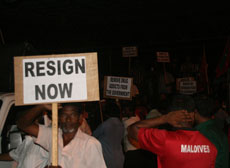
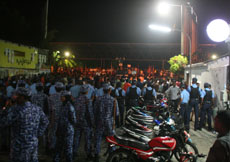
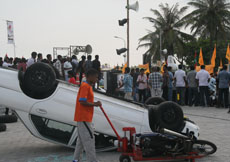
Figures such as the CPI are therefore an important issue following seven consecutive nights of protests in the streets of Male’, with demonstrators announcing they were now willing to negotiate with the government.

Protest organisers have claimed the demonstrations were a non-partisan “youth movement” in response to rising living costs on the back of government attempts to effectively devalue the rufyiya.

Aside from criticising the political opposition for politicising the demonstrations in the media for their own political gain, the country’s financial authorities last week claimed that to be providing some economic support to try and stabilise prices it said that while increasing, varied significantly between different stores.

According to the latest planning department stats, the cost of food and beverages when including fish was up by 20.35 percent during April 2011 compared to the same period the previous year. These costs were also up by 10.65 percent on the same terms compared to March 2011.

When excluding the price of fish, the average cost of food and drinks last month was up by 13.07 percent compared to over the same period of time last year. On the same terms, the statistics found that food and beverage costs last month rose by 4.44 percent compared to March 2011.

When comparing the overall change in CPI between April 2011 and April 2010, increases in costs were recorded across the board with the exception of recreation and culture, which was down by 3.11 percent.

As of late month, healthcare was up by 6.25 percent, transportation was up by 8.96 percent, education was up by 16.89 percent and fish was up by 58.32 percent when compared over the same period the previous year.

Between March to April this year, the statistics showed that the costs of healthcare were up by 1.21 percent, transport was up by 6.56 percent and fish prices were up 42.07 percent. The full statistics can be found here.

Halt to protests

In light of protests last week over rising costs, DRP MP Ahmed Mahlouf told Minivan News today that the party would be postponing any further demonstrations relating until next Friday after requests from police.

In the meantime, he claimed that young people who had initially organised the protests were negotiation with members of the government, a meeting that had been organised through the police to try and find some possible compromises on costs.

“The meetings were scheduled to take place with the government at 12:00pm today though I have not been informed yet of their progress. I imagine that they [the protest organisers] would be demanding some changes to government policy,” he said. “The police have asked us to stop the protests and as some of their members supported the march, we have wanted to keep good relations with them.”

Mahlouf added that he believed there had been a reluctance among organisers to stop the protests as the government were failing to address concerns about costs and “not believing” the financial realities Maldivians were facing.

However, amidst intense media scrutiny, the opposition MP said he believed the protesters had succeeded in their aims to attempt to change government policy on the economy.

However, ahead of the next scheduled protest on Friday, Mahlouf claimed he plans to forward a parliamentary motion for a referendum on whether President Nasheed had sufficient support from the public to enact his planned reforms.

Foreign Minister Ahmed Naseem last week criticised opposition parties like the DRP for “misleading” international media about the nature of the protests and failing to sit down and present their own alternatives for financial reforms in the country.

Likes(0)Dislikes(0)

Doctor’s examination shows dead infant’s body had cuts, wounds and bruises

Doctors examining the body of an dead infant found in a bag in the swimming track area have reported that the baby’s body had cuts, bruises and other wounds.

A police officer swimming in the track area on Thursday discovered the corpse of the premature baby underwater.

“The doctor said there were three cuts in the arms, not very deep cuts,’’ said spokesperson for Indira Gandi Memorial Hospital (IGMH), Zeenath Ali.

‘’There were two bruises on a leg and two wounds to the head,” she added.

She said it was difficult to say the cause of the injuries.

‘’It may be the ropes in the area caused  these injuries,’’ she said, adding that the infant appeared to have been born 26-28 weeks prematurely.

Police Sub-Inspector Ahmed Shiyam also confirmed that several injuries were found on the infant’s body.

‘’We cannot say the cause of the injuries exactly,’’ Shiyam said. ‘’The dead body has now been laid to rest.’’

He said police were currently investigating the case.

Local media reported that the baby was bleeding when it was taken out of the water and that the umbilical cord and placenta were still attached. Haveeru published a picture of infant which appeared to have been put in a plastic bag.

In November last year another abandoned newborn female baby was discovered alive in some bushes near the Wataniya telecommunications tower in Hulhumale’.

As a Muslim country, abortion is illegal in the Maldives except to save a mother’s life, or if a child suffers from a congenital defect such as thalassemia. Several studies on HIV in the Maldives have identified risk factors including high levels of promiscuity and little use of contraception, and anecdotal evidence points overwhelmingly to a high rate of abortion.

In an article on the subject in 2009, Minivan News reported that many women unable to travel to Sri Lanka resort to illegal abortions performed by unskilled individuals in unhygienic settings. Abortion-inducing pills and injections administered by amateur abortionists are one recourse while others turn to harmful vaginal preparations, containing chemicals such as bleach or kerosene. Although infrequent, some insert objects into their uterus or induce abdominal trauma, such is the stigma of having a child out of wedlock.

Likes(0)Dislikes(0)

Turkish navy talks piracy challenges during inaugural Maldives visit

The Turkish navy concluded its first ever official visit to the Maldives last week during a patrol of the Indian Ocean it is conducting as part of a NATO-led anti-piracy initiative to try and deter potential attacks in and around the region’s territorial waters.

A spokesperson said that the three day visit by the naval ship TCG Giresun to the Maldives, which concluded on May 3, was not linked to any specific threat or incident of piracy within the country’s territorial waters.

He said it was instead linked to a wider NATO programme targeting concerns about pirate attacks spreading beyond the horn of Africa into territories around the Gulf of Aden and the Indian Ocean.

“We are trying to promote understanding to fight piracy, so one way to do this is to visit ports like Male’,” said the spokesperson. “The attacks of the pirates have widened into the Indian Ocean with one of the last incidents occurring approximately 250 nautical miles away from the shores of Male’, so NATO has widened the number of ports we are to visit to include Indian Ocean destinations like Mumbai and Male’.

Experts suggest that a growing number of Somali pirates are moving deeper into the Indian Ocean as they come under increased pressure from international task-forces designed to try and limit piracy around the horn of Africa. As a result of this movement, maritime security has become a notable security concern for the Maldives, even around the country’s secluded resort properties.

In March this year, a family were suspected of being kidnapped by Somali pirates after having set sail from the Maldives towards the Arabian sea, although the kidnapping was confirmed by security officials to have occurred outside of Maldivian waters.

Major Abdul Raheem of the Maldives National Defense Force (MNDF) said at the time that security officials in the country had not received any information concerning the kidnappings or any other kind of “terrorist activities” occurring recently within the territorial waters of the Maldives.

Raheem added that Maldivian authorities would not therefore be reviewing maritime security measures or safety advice for sailing sailing in and out of the country on top of measures and international cooperation already in place during the alleged kidnappings.

The Turkish navy says that during 2011 alone, it plans to send between three to four frigates to patrol the Indian Ocean and Arabian Sea as part of its commitments to try and protect Turkish and international merchant vessels from potential pirate attacks.

“We plan to conduct operations to protect merchant vessels,” said a spokesperson for the TCG Giresun. “During this deployment we will visit Aksaz Aqaba, Jidde, Al Hudeyde, Doha, Dubai, Mascat, Karachi and Mumbai.”

In previous patrols conducted by the TCG Giresun in the Gulf of Aden, the Turkish navy spokesperson claimed that the ship’s crew had apprehended 14 suspected pirates and a stash of weapons on a Yemeni dhow vessel along with seven local fishermen that were also being held on the ship.

In instances where suspected pirates were caught, the navy spokesperson said that the Turkish authorities were not able to try or incarcerate any of the individuals themselves.

“They are not our captives as we are operating under United Nations resolutions and currently there is not an established court to judge [alleged] pirates that have been captured. So we attempt to disrupt and deter them [from piracy], we take their weapons and drop the equipment into the sea,” he said.

“We take all their equipments and then return [the suspects] to the Somali coast. Some countries have special [legislative] agreements, such as Kenya and the Seychelles. These agreements relate only between [these nations] and not internationally, so they capture the alleged pirates and then take them to Kenya or to the Seychelles to be judged.”

The spokesperson claimed that a present a number of suspected pirates from Somalia were currently being returned to their native coast.

To try and counteract the challenges of detaining suspected pirates, the UN security council last month voted in favour of forming an international court – supported by a host of potential new laws – that would focus specifically on working to combat the spread of piracy.

Likes(0)Dislikes(0)