President Yameen to make official visit to Japan

President Abdulla Yameen will conduct an official visit to Japan later this month, the President’s Office has revealed.

Yameen will visit Japan between April 14 and 17, during which time he will meet with Emperor Akihito, Prime Minister Shinzō Abe, and other senior Ministers of the Japanese Government.

The President’s Office has said that Yameen will discuss ways to expand Maldivian-Japanese relations, as well as meeting with business leaders and potential investors.

Last week, the president promised that his government was to open up the Maldives in a huge way to foreign investors”.

Japan is the biggest bilateral donor to the Maldives, with data from the Japanese International Cooperation Agency showing that the east Asian nation had given over US$450 million to the Maldives in development assistance between 2004 and 2010.

Projects benefiting from Japanese aid have included the first mechanisation of fishing vessels between 1973-76, the development of Malé’s seawall between 1987-2003, and the extension of loans amounting to US$34 million for post-tsunami reconstruction.

Japan is also one of the Maldives largest trading partners, importing over US$3million worth of fish from the Indian Ocean nation in 2012.

Since winning last year’s election, President Yameen has paid official visits to Sri Lanka and India. He is currently in Saudi Arabia on an unofficial trip.

Likes(0)Dislikes(0)

Two more people arrested in connection with Thinadhoo death

Police have yesterday arrested two more people from the island of Thinadhoo in Gaafu Dhaalu atoll in connection with the death of Ali Rasheed,79, who was found dead inside his house last Friday (April 4).

Police have said that the two persons arrested were Maldivians aged 33 and 39.

The 33 year-old man was arrested late yesterday afternoon while the 39 year-old man was arrested last night, the police told local newspapers.

Ali Rasheed was found dead lying on the floor of his room. He was living alone following the death of his wife some years earlier.

A source from the island told online newspaper Sun that Rasheed had a six-inch laceration on his head and a swollen left eye.

Police said the death was being investigated as they suspected foul play. An investigation team was dispatched to the island.

Likes(0)Dislikes(0)

Man sentenced to two and half years for stealing ten bottles of body lotion

The Criminal Court yesterday sentenced a man to two and a half years imprisonment for stealing ten ‘Enchanter’ brand body lotion bottles from a shop in Malé. The sentence was delivered after he confessed to committing the crime.

The case, sent for prosecution in December 2013, was scheduled five times before the perpetrator was brought before the court yesterday in police custody.

The man was earlier sentenced for one year banishment in 2013 for shoplifting and was sentenced for six year imprisonment in 2004 on drug charges.

At retail price ten bottles of the lotion in question would cost around MVR320 (US$20).

Likes(0)Dislikes(0)

Civil Servants’ Association plans strike over pay discrepancies

Maldives Civil Servants’ Association is planning to go on strike within the month, local news outlet CNM has reported.

Quoting the association’s President Mohamed Shaugee, CNM said that the strike is largely a result of discrepancies in pay among various state institutions which are disadvantageous to civil servants – particularly in comparison to independent state institutions.

“There is a huge difference in take home pay for civil servants and those working in other institutions. But Article 4 of the Employment Act and article 37 (b) of the constitution says there cannot be any discrimination,” Shaugy said.

He said that the issues have been raised for six consecutive years and that even the Civil Service Commission accepted that these issues needed to be addressed.

“I don’t want to make this political, but we still haven’t received an answer for our letter requesting to discuss this issue with President Abdulla Yameen,” Shaugee was quoted as saying.

Yesterday, a large number of teachers participated in a ‘black protest’ to bring their issues to public attention. The Maldives Teachers Association (MTA) which organised the protest after the government ignored several attempts to discuss the issues said it was just a first step in taking action.

The MTA have also threatened to go on strike over various issues in education sector – also including pay discrepancies – but has said it would only take such action as a last resort.

There are more than 25,000 civil servants in the Maldives.

Likes(0)Dislikes(0)

Doctor’s passport held as drug kingpin’s medical release investigated

The Anti-Corruption Commission (ACC) has confiscated the passport of an expatriate doctor who signed the medical report recommending that Ibrahim Shafaz Abdul Razzaq be sent abroad for medical treatment.

Shafaz was sentenced to 18 years in prison last November for drug trafficking, but was permitted to leave the country unaccompanied in February. Shortly after his arrival in Sri Lanka, Shafaz asked the High Court to review his sentence.

The ACC has told the local media that the doctor’s passport was held last week after a warrant had been obtained  from the Criminal Court.

Speaking to Minivan News today, President of ACC Hassan Luthfy said that he could not give any information except to confirm that the passport of an expatriate doctor had been held by the commission.

He said that detailed information on the case will be revealed to the media as soon as the commission concludes its investigation.

Commissioner of Prisons Moosa Azim has previously told Minivan News that all due procedures had been followed in allowing Shafaz to leave to get medical treatment.

“A medical officer does not have to accompany the inmate. He was allowed to leave under an agreement with his family. Family members will be held accountable for his actions, including failure to return,” Azim told Minivan News at the time.

Shafaz was arrested on June 24, 2011 with 896 grams of heroin from a rented apartment in a building owned by PPM MP Ahmed ‘Redwave’ Saleem.

Former head of the Drug Enforcement Department, Superintendent Mohamed Jinah, told the press at the time that police had raided Henveiru Fashan based on intelligence information gathered in the two-year long ‘Operation Challenge’.

Jihah labeled Shafaz a high-profile drug dealer suspected of smuggling and supplying drugs since 2006.

He claimed that the network had smuggled drugs worth MVR1.3 million (US$84,306) to the Maldives between February and April 2011.

Since the formation of the new government late last year, the Home Ministry has made the combating of illegal drugs its top priority, culminating in the confiscation of a record 24kg of heroin.

Likes(4)Dislikes(0)

Masked men break into school to cut down cursed ‘Jinn tree’

Last night group of masked men broke into Thakandhoo School in Haa Alif atoll after threatening the security guard with a knife in order to cut down what they claimed was a ‘Jinn Tree’ with evil spirits.

Thakandhoo Island Council Vice President Ibrahim Saeed said the incident happened around 3am this morning.

“Three masked men jumped over the school wall last night and one of them threatened the security guard with a knife. And while he held the security guard, the other two went in with a hand saw and cut down the tree,” he said.

The Maldives Police Service confirmed that the incident is currently under investigation and that a police team from Ihavandhoo arrived on the island within an hour of the incident.

Local media outlet CNM has reported that the tree is approximately 13 years old and was planted by the school staff.

“It was a beautiful tree planted to give a good look to the school compound. Sometimes students try to climb it, and last year three students were possessed by Jinns,” CNM was told by the school staff member.

“People say it is because of that tree, so we even brought five people to look into the matter. But even they didn’t recommend to cut down the tree.”

CNM also quoted the staff member as saying that the Jinns [of the tree] had already “stabilised” when it was cut down last night.

Fanditha politics

Speaking to Minivan News, a local who supported the cutting down of the tree said that many believed the tree was connected to the jinn possession of children last year.

“Thing went really bad last December,” explained the local man. “Many of those children have recovered now but there is a child who is still possessed. And there is young girl who loses consciousness whenever she walks past by this tree.”

“Even when things are like this, the island is so politically divided that these issues are politicised and an agreement is not reached as to how it should be dealt with.”

He said the rivalry between two group of islanders dates back to the pre-democracy era and that issues have further polarised with party politics.

“Fanditha practice is very common here. The island is divided into two rival groups even before party politics.”

“But now it [the divide] is [politically] colored, and represented by supporters of PPM [ruling Progressive Party of Maldives] aligned with the former island chief’s family and friends, and those supporting MDP [opposition Maldivian Democratic Party]. There are magicians on both sides,” he explained.

Last September a group of ‘Islamic exorcists’ uncovered ‘hexed clay tablets’ buried near the school compound following a series of ‘jinn possession’ incidents. A police team went to the island with a court warrant and searched all the houses for black magicians and traditional fanditha magic related objects.

The incident, which took place as the whole country was preparing for the second (cancelled) round of presidential election, left the island community in shock and fear.

MDP supporters from the island claimed it was a political plot to frame their members for practicing black magic as reports of black magic emerged across the country during the 2013 election period.

Practice of black magic is a criminal offense under Shariah Law, which it is punishable by death – a sentence still handed down for the offence in countries like Saudi Arabia.

In 1953 local black magician Hakim Didi was sentenced to death in the Maldives for practicing magic which eventually lead to the murder of an atoll chief by poisoning and use of black magic in a plot to kill President Mohamed Ameen Didi.

Along with a group of magicians and other co-conspirators, Hakeem Didi is said to have confessed to carrying out many disturbing black magic practices. These include the brewing of a magic poisonous fish potion, the extraction of liver oil from corpses of children, and eating them along with flour dough effigies of the president.

Didi was executed by a firing squad, after which there has been an unofficial moratorium on death penalty in the Maldives.

The permitted forms of white fanditha magic are also regulated by the government and can be legally practiced only with a written permission from the Ministry of Health according to the Traditional Medicine, Fanditha (Magic), Circumcision and Midwifery Services Act of 1978.

Likes(2)Dislikes(0)

Government assures even resort distribution following Haa Dhaalu petition

The Tourism Ministry has assured that the development of resorts will take place throughout the atolls following an online petition calling for tourism growth in Haa Dhaalu.

Placed on the Avaaz website last week, the petition calls upon the government of President Abdulla Yameen to alleviate the atoll’s economic and social problems by bringing resorts to the area.

“It has been over 40 years since the tourism industry flourished in Maldives. However, the atoll with approximately 20,000 people has not yet got the opportunity to enjoy the economic benefits of this sector,” read the petition.

Noting that Haa Dhaalu is the only atoll not to have any operational resorts, the petition argues that development of the region’s “pristine uninhabited islands” would halt the “mass migration” to the capital Malé, which was “tearing up the social fabric of our society”.

“We have waited long enough to enjoy the success and development that tourism industry has brought to other regions of the Maldives,” the petition argues.

“Hence, on behalf of all the people from Haa Dhaal Atoll, we humbly ask the government not to exclude us from this prosperous and growing industry.We urge the government to give the utmost importance to solve the issue of income disparity caused by uneven development of tourism industry in Maldivian atolls.”

The Maldivian economy is heavily dependent on tourism, accounting for an estimated 80 percent of GDP, generating 38 percent of government revenue in 2012. Tourists arrivals grew by 17 percent between 2012 and 2013.

In response to the petition, State Minister for Tourism Ahmed Musthafa Mohamed told Minivan News today that the government’s promises to develop ten resorts a year would include Haa Dhaalu.

“I can’t comment on previous governments but this government in their manifesto had mentioned that they are planning to develop ten new resorts each year – I’m sure sure that developments will be throughout the Maldives.”

Musthafa noted that a lot of issues affected the location of developments, with the issue of transportation in Haa Dhaalu – part of the country’s northernmost natural atoll, Thiladhunmathi – having been a longstanding one.

Thought the Maldives is now home to over one hundred island resorts spread across 26 natural atolls, the majority of resorts are clustered around the country’s capital Malé and the country’s main international airport.

Despite the opening of Hanimaadhoo International Airport in Haa Dhaalu atoll two years ago, the continued lack of economic activity has led to significant local support for a second regional airport in nearby Kulhudhuffushi.

While the new development threatens to destroy much of the island’s mangrove habitat, recently re-elected island MP Abdul Ghafoor Moosa has previously argued that his constituents’ economic concerns outweighed the environmental.

“Over fifty percent in the north are below the poverty level,” Ghafoor told Minivan News in January. “Still they need economic activity. If they don’t get it, it’s very difficult to survive.”

Haa Dhaalu “unnoticed or perhaps unheard”

The Avaaz petition – which has received over 460 signatures – argues that, despite its relatively high population of 20,000 people, the atoll had gone “unnoticed or perhaps unheard” by consecutive governments.

“The state of our local economy is a great concern for the people of Haa Dhaal Atoll. More importantly, the absence of tourism industry within this atoll has become a major barrier for economic and social development.”

The petition goes on to suggest that the limited local opportunities in the civil service, fisheries, and agriculture had failed to provide enough employment opportunities.

“We do understand that three of our islands have been given for resort development but it has been over 12 years without any of them being opened for tourists. This has cost 2,000 jobs that was promised for us with these resorts.”

The 2013 Tourism Yearbook produced by the Tourism Ministry shows that three resorts are currently under development in the atoll, although only one had been given an estimated opening date – for December this year.

Reasons for the failure to develop secondary tourism hubs in the north and south of the were addressed in the ministry’s ‘Fourth Tourism Master Plan – 2013-2017’.

The document explained that historical growth patterns in the tourism industry had centred on the Malé area after private investors sought greater economies of scale. The introduction of sea planes – expanding the area serviceable from Ibrahim Nasir International Airport – had further delayed regional expansion.

“If, as the last two masterplans strongly suggested, the suitable islands around the Malé’s hub are now more or less fully developed, the time has come to give priority to the secondary hubs,” read the document.
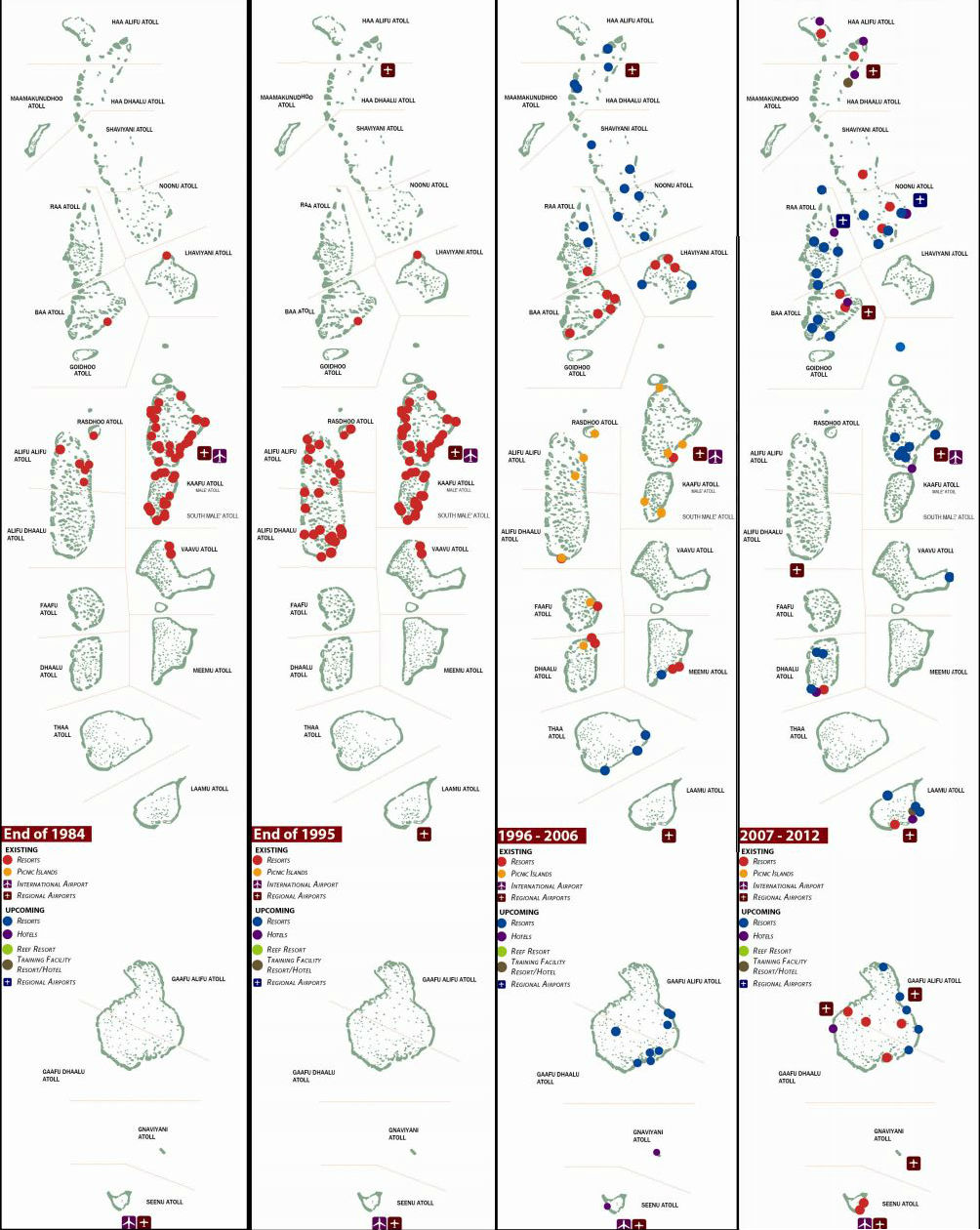
Source: Fourth Tourism Master Plan - 2013-2017
Likes(0)Dislikes(0)

Government warns of dengue and scrub typhus risk on World Health Day

Minister of Health and Gender Dr Mariyam Shakeela has noted an increase in the incidence of mosquito-borne dengue and mite-borne scrub typhus in the Maldives.

In a televised address to mark World Health Day, Shakeela said increased travel, trade, migration and climate change is leading to an increase in insect-borne diseases worldwide.

Dengue fever has become endemic in the Maldives since 2004, she said.

“I am deeply saddened to note that individual level action to control diseases spread by small insects is not being taken. The result is the increase in dangerous diseases such as dengue and scrub typhus and deaths,” said the minister.

There were 680 reported cases of dengue in the Maldives in 2013, a decline from 2006 peak of 2,788 cases, the Health Protection Agency (HPA) said.

The year 2011 also saw a relatively severe outbreak of dengue in the Maldives, with fatalities reaching a dozen – a record high in the country’s history. In 2012 there were a total of 1,083 dengue cases in the Maldives. Construction workers face an increased risk, the HPA has said.

Deaths have also been reported from scrub typhus due to failure to seek healthcare and improper diagnosis, epidemiologist at the HPA Dr Aishath Aroona told Minivan News.

The Health Ministry runs a yearly campaign called ‘Madhiri Rulhi Rulhi’ (‘Unfriendly to Mosquitoes’) to limit mosquito breeding during the rainy season.

Waste management and cleanliness are the most effective methods of controlling mosquito breeding grounds, Aroona said.

The Maldives eradicated malaria in 1984, making it the only country in the region to have done so. The last case of mosquito-borne filariasis was recorded in 2003, and the Health Ministry will complete a screening and surveillance project by October to determine the eradication of the filariasis vector, the ministry has said.

According to the World Health Organisation (WHO), mosquito-borne dengue has spread from nine to over a hundred countries, making it the most rapidly spreading vector-borne disease. Over 40 percent of the global population is at risk from dengue, the organisation said.

The WHO’s World Health Day campaign this year – ‘Small Bite, Big Threat’ – focuses on the risks of diseases spread by mosquitoes, flies, ticks, and freshwater snails.

The International Federation of Red Crescent and Red Cross Societies (IFRC) has called on governments for a shift in approach, from responding to isolated dengue outbreaks to investing in long-term programmes for behavioral change.

“This can be done by empowering communities with essential knowledge concerning hygiene and environmental sanitation, training and engaging community health volunteers to identify and refer suspected dengue cases and improving community-based disease surveillance,” the IFRC said in a recent report

Likes(0)Dislikes(0)

Comment: The enigma of the Adhaalath Party and their radical politics

In the autumn of the first elected democratic government, the Adhaalath Party (AP) brought in major radical reforms and sidelined their original party leadership. The freedom they enjoyed after the 2008 elections became a chance for opportunists among them to seek personal vendettas in politics.

The radicalisation of the AP became most prominent when they gathered on the 23rd of December in 2011 to honour and glorify Allah by becoming the judges of Allah. This reminded me of the assassin who brutally murdered Caliph Ali Ibn Abi Tholib saying, “There is no judge other than Allah” portraying himself as the judge in killing the leader of Muslims.

In a similar fashion, the 23rd December alliance portrayed themselves as judges in becoming the triggermen for ousting their ‘un-Islamic’ president, proclaiming him an infidel. These repercussions were the result of a speech given by President Mohamed Nasheed in Denmark to a predominantly non-Muslim audience regarding the growing fundamentalism of Islam.

The gist of his speech suggested that the way the holy Quran and Prophets words or Hadhith was interpreted by some sheikhs created polarisation among Muslims – a theory widely agreed upon by several Muslim scholars around the world. The radical ideology created by the AP, however, was that they were the only learned Islamic scholars who could glorify Islam – in a country which has been practicing Islam for hundreds of years without any radicalisation or polarisation.

The opposition of Nasheed’s government at the time intelligently utilised the AP as bait in instigating continuous and consistent public strikes, by deceiving the minds of faithful Muslims. The AP was given the role of labelling the government un-Islamic and creating fear among the faithful Muslims that ‘God’s treasured nation’ with one hundred percent Muslims will become a Christian or an atheist nation.

The public became more engaged when small radical groups sponsored by envious politicians came out in public demanding religious freedom. The fall of democracy began with more and more hatred and with the charismatic sheikhs becoming highly pragmatic and vocal against Nasheed -calling him and his regime un-Islamic, accusing him of forming allegiances with Christians and Jews.

The more moderate sheikhs kept their mouths shut and hence did an injustice to naive Islam-loving citizens. One exception was an apolitical sheikh who, through media, spread a silent interpretation in which he claimed the ousting of the leader of a nation who is in Islamic faith is against prophet’s teaching. However, the media turned a blind eye to these words, being more interested in bad news – as bad news is always good news for them.

On the February 7th of 2012 the storm struck and the elected president was ousted. The AP completed their assignment with high distinction. Hence they became powerful and vocal, and got a fair share from the government labelled as a “coup regime” by the Maldivian Democratic Party (MDP).

To most people, the AP was Sheikh Imran, the ‘mighty mouth piece’ of AP who seemingly acts as God’s judge in giving verdicts to defame their opponents as infidels. The people became nostalgic and now could not decide what was right or wrong. The arrogance, pride, and prejudice the sheikh holds against his opponents in fact became so controversial that many in the public came to regard him as a disgrace to Islam. The irony was that no sheikh or learned scholar was able to criticise him. The reality was that most of the learned Islamic scholars were behind the AP, supporting them and looking for opportunities to promote their political careers.

When the time came for parties to prepare for 2013 presidential elections, the AP had a misconception that they were the playmakers in the game, as they believed their high distinction in toppling governments could always change things in their favour. However, the incumbent president was not well convinced and disagreed with them. The opportunists among them demanded large amounts of money according to pundits, which turned off Dr Mohamed Waheed.

This rejection led them to join with Ibrahim Gasim.  They went through the first round with Gasim and were unable to beat the MDP. The obvious second round dragged them to a dilemma and they could not keep their word. It was strange for such people acting on behalf of God and claiming to glorify Islam to show such hypocrisy in their decision-making.

The watchful public then started feeling disgust over the so called truthful, honest, Islam-glorifying sheikhs. The public in fact saw them as unable to make up their mind and lacking in any principles or political ideologies, but rather becoming hitch-hikers and opportunists.

To make matters worse, the AP became much weaker in the new government than they had been under the governance of their arch-rival Nasheed. To their dismay, the old loyal sheikh and classmate of Gayoom – who was cartooned and lampooned by AP sheikhs previously – became their superior in a ministry they had sole control of in the past.

The hitch-hikers finally realised their position when their coalition partners defied their request to allocate some constituents for them to compete for parliament. For them the AP was just a parasite and a pain in their rears. Overwhelmed with lack of support they contested against their partners with the hope of winning over them. However, the already intimidated public rejected their candidates, with the exception of a famous woman with a high reputation for being modest and open minded.

The AP have gradually understood their position in the coalition and have become so weak, they now have to bow down to politicians far more ‘un-Islamic’ than Nasheed. The dilemmas and the enigmas now made them see that ‘There is no judge other than Allah’ and no one can claim to be a judge on behalf of Allah.

The educated elite behind AP want a reform, but regaining public trust is an issue they must overcome. To make matters worse, all major political parties want them to be sidelined as radical fundamentalist Islam is not accepted anywhere in the world, and the supreme leader of the PPM has a powerful aversion to sheikhs. Most of the AP sheikhs also have gone into hiding from public, realising that they had abused a naive public into believing an ideology they created with no basis or principle.

Their arrogance has led several sheikhs allied with them to fall silent and perhaps even to repent for their mistakes in throwing the state in to chaos in the name of Islam. For AP to rise up they need to create a political ideology to play politics equally well with their competitors. The use of Islam, and claiming to be the sole authority of glorifying Islam is no longer a slogan they can sell to public as their competitors now all have equally learned sheikhs with them.

All comment pieces are the sole view of the author and do not reflect the editorial policy of Minivan News. If you would like to write an opinion piece, please send proposals to [email protected]

Likes(0)Dislikes(0)