The Adhaalath Party has issued a statement condemning former President Mohamed Nasheed’s comments on Islamic radicalism during an address in Denmark.
During his address, Nasheed stated the Maldivian population had largely rejected Islamic extremism, and, in a veiled reference to the Adhaalath Party, noted that “the Islamists were never a credible electoral threat.”
“ The Islamic extremists also didn’t like the Maldives’ new democracy because they were unpopular. They failed to win the Presidential elections in 2008, they failed to win local government elections – in 2011 they won less that four percent of the vote. But now, after the coup, extremists have been rewarded with three cabinet positions in government, and in many ways set the tone of government communications. They are busy trying to indoctrinate people with a misguided version of Islam,” Nasheed said.
“Nasheed misled them about the party he fears and envies most: the Adhaalath Party,” the party responded in a statement. “Nasheed knows very well that the Adhaalath Party is not a party that has no power and influence, unlike what he said in Denmark.”
The party accused Nasheed of “placing idols” in Maldivian lands – a reference to the SAARC monuments gifted to the country by other South Asian nations during the 2011 SAARC Summit hosted in Addu Atoll – and of “giving our assets to foreigners” – a reference to the concession agreement to manage and upgrade the international airport granted to Indian firm GMR.
In his address, the former President acknowledged that there was “a lot of xenophobia, Islamic rhetoric and intolerance going on in the Maldives”, and noted the destruction of 12-century Buddhist statues, manuscripts, and other evidence of the Maldives’ pre-Islamic history.
“There is idea of wanting to return to Hejaz at it was in the 7th century. This is Wahabism in principle. And it is difficult and worrying,” Nasheed said.
“The vast majority of our society are very tolerant people. If all this Islamist rhetoric is removed from official discourse, there will be a much more liberal society. I assure you the rhetoric will be removed from official discourse,” he said.
The Adhaalath Party meanwhile expressed astonishment “that there are a few Maldivians joining [Nasheed] in his work to get another chance to brainwash the Maldivian people. God willing Mohamed Nasheed will not be able to come to power ever again,” the party said.
In January 2013, parliament’s Government Oversight Committee heard testimony from six of the highest-ranking officers of the police and military for its review of the Commission of National Inquiry’s (CoNI’s) report into the transfer of presidential power on February 7, 2012. Minutes of the closed-door sessions (Dhivehi) along with audio recordings were made public on January 16, 2013.
Following is a translated summary of the testimony from former Commissioner of Police Ahmed Faseeh to the oversight committee on January 11, 2013. Faseeh retired from the police service shortly after President Mohamed Nasheed’s resignation.
Three or four nights before February 6, 2012, opposition coalition protesters at the Maldives Monetary Authority (MMA) building area took to the streets and began marching through the narrow roads of the capital. At the time, the demonstrations were taking place every night in front of the MMA building, after which the protesters would march across Male’ until the early hours of morning.
On the night in question, about 800 people were gathered at the Maldivian Democratic Party (MDP) Haruge (meeting hall) on Ameenee Magu. Fearing a possible confrontation, Faseeh asked his commanders to make sure that the opposition protesters do not reach Haruge.
While he was inside the police headquarters, Faseeh suddenly heard a platoon of Specialist Operations (SO) riot police take off on a police vehicle.
Acting without orders, the SO platoon stormed Haruge and pepper-sprayed ruling party supporters.
Faseeh called Defence Minister Tholhath Ibrahim and asked for a platoon of soldiers to be sent to the area to control the situation. The SO officers left Haruge when the military platoon arrived.
Following the SO attack on Haruge, two groups of MDP activists led by MPs Alhan Fahmy and ‘Reeko’ Moosa Manik made their way to the Supreme Court building and MMA area. With no command from senior officers, SO officers forcibly broke up the group led by Reeko Moosa as soon as they reached the MMA building.
The next morning, then-head of police intelligence, Chief Superintendent Mohamed ‘MC’ Hameed, informed Faseeh of an intercepted phone call between a SO lance corporal and Progressive Party of Maldives (PPM) MP Ahmed Mahloof. The call was intercepted and shared by military intelligence.
In the recorded phone call, the SO officer boasts of pepper spraying people at Haruge and beating up MDP activists when they came to the MMA area. MP Mahloof asks the lance corporal why they did not break MP Moosa Manik’s leg.
“And [the SO officer] replies, ‘we can’t just break [his leg] like that. That’s not how this is going on.’ In any case, they talked like they were the closest buddies.”
The officer was immediately transferred out of the SO unit to Feydhoo Finolhu pending disciplinary proceedings.
On the night of February 6, President Nasheed called Faseeh and asked for the SO to be withdrawn. Opposition coalition protesters and ruling party supporters were facing off at the artificial beach with riot police separating the rival demonstrators.
Nasheed told the commissioner that he did not have confidence in police based on reliable intelligence information, which suggested that riot police were working with the opposition. Faseeh recalled the intercepted phone call and wondered if the President’s order was prompted by similar intelligence information.
Faseeh then asked Defence Minister Tholhath Ibrahim to dispatch a platoon of soldiers from the Maldives National Defence Force (MNDF) to take over from riot police. The soldiers were sent to artificial beach an hour later and the SO officers reluctantly withdrew to Republic Square. Riot police troops were staged at the helipad in the middle of the square.
Faseeh was in his office with Assistant Commissioner Sodiq when he heard a loud commotion coming from Republic Square. From his balcony, Faseeh saw police vehicles taking off and SO officers screaming, “let’s go beat them up.”
Faseeh ran downstairs and saw SO officers running. Deputy Commissioner Ismail Atheef was there. Faseeh did not know what was going on.
He was later informed that Atheef snatched the keys from one of the police lorries. But the SO officers left on other vehicles while others ran to the artificial beach. The Republic Square was soon empty.
Shortly thereafter, a cousin called Faseeh and said a police lorry was going towards the MDP Haruge on Ameenee Magu. He said they were screaming obscenities very loudly.
MDP Haruge on February 7: Photo by Haveeru
“Then they went to MDP Haruge. They went inside MDP Haruge, beat up some people there and damaged things and even beat some people they met on the road.”
Faseeh also learned that they chased after and beat people at the artificial beach. After attacking Haruge the rogue SO officers returned to Republic Square. Faseeh was despairing “because my troops committed such lowly acts.”
“Even if they were given an order to do something illegal that does not mean they have to commit bigger crimes.”
Faseeh went out to Republic Square and asked Deputy Commissioners Atheef and Muneer to go talk with the SO officers. Faseeh waited near the flag post. Muneer returned and said they responded with filth and obscenities. Muneer advised Faseeh against meeting them.
Faseeh saw three or four officers carry Deputy Commissioner Atheef inside the headquarters after he fainted.
“What happened was Athee couldn’t believe these were actually police.”
Other officers, including “blues,” came out of the headquarters and started loitering around the square. The rogue SO officers at the helipad area occasionally called for the resignation of President Nasheed.
Around 11pm, Faseeh went to the military headquarters. President Nasheed called and asked what was going on.
“I said I don’t know what they’ve done. They are now in a mutiny.”
All the generals, the chief of defence forces and the defence minister were at the military headquarters. They were discussing how to get the police to withdraw.
Faseeh told the senior officers that the mutinying SO was his “elite force.”
“When the SO are insubordinate, there aren’t any others who could talk to them or control them.”
The officers then began preparing to control the situation. Faseeh stayed with Major General Moosa Ali Jaleel and Defence Minister Tholhath and saw that they started working on it.
“They started and gave different times. 12:30, 1:30, 2:30, 3:30. But by the time it turned 4 it still couldn’t be done. It kept dragging on.”
The soldiers would form ranks, get set and withdraw. “The soldiers were very cowardly.”
Around 4am, President Nasheed came to the military headquarters. He asked Major General Jaleel why the military were unable to push the SO back. Faseeh recalled that there were about 150 mutinying officers at the Republic Square at dawn.
The soldiers were sent out again but they did not confront the SO.
A frustrated President Nasheed suggested to Jaleel that he could accomplish the task with a water canon and 20 soldiers.
Shortly after the dawn prayer was called, President Nasheed asked Faseeh to meet the rogue police and attempt to advise them. After praying, Faseeh instructed his secretary to ask the SO commanders to come and meet the commissioner.
The commanders refused.
A few civilians were near the Republic Square at the time. Faseeh’s private secretary informed him that the SO officers were “worse than before and more aggressive.” Faseeh decided not to go out and meet them. He managed to pass on a message to the four SO squad commanders from President Nasheed assuring them that they would be treated fairly.
From inside the police headquarters, Faseeh heard MDP supporters heading into Republic Square from the Chandaneemagu-Orchidmagu junction.
The mutinying officers were chanting their core values, oath or mission statement with one arm on the chest. As soon as it was done, they turned and ran towards the MDP group.
Faseeh saw loud clashes and “a big fight.”
“That was when the flame was lit. And the boys who lost control there came and threw huge stones at the police office, threw things inside the police office, vandalised places, destroyed a lorry there, threw rocks at MNDF.”
Faseeh saw the police officers use their batons during the confrontation. After they vandalised the police office, Faseeh’s bodyguard wanted to take him to a secure location but he went to the administrative commissioner’s office.
The mutinying officers were running inside the police building making death threats. Chief Superintendents Hameed and Mohamed Jinah as well as Atheef were assaulted.
Two officers came looking for Faseeh but were thwarted by the commissioner’s secretary. They slammed into the door twice trying to break it down but soon left.
The violent officers “destroyed” the conference room and mess room and damaged electronic equipment and a television set.
“They are all really the same [riot police] sent out when the MDP people gathered back then to take away the rice pudding bowl, take down banners and do all that. So in truth there is going to be something of Maumoonism inside their heads.”
Faseeh decided to resign after hearing current Defence Minister Mohamed Nazim demand his resignation upon emerging from the military headquarters between 10:00am and 11:00am. Nazim said he had relayed a “non-negotiable” demand for President Nasheed to resign within the hour “without any conditions.”
Candidates for the upcoming presidential elections scheduled for September 7 will be invited to file their candidacy with the Elections Commission (EC) from July 15, the commission has stated.
Along with opposition leader former President Mohamed Nasheed of the Maldivian Democratic Party (MDP), leaders of several political parties currently aligned with the current government of President Mohamed Waheed Hassan – including the incumbent – have publicly announced they will be competing for the office.
Leader of the Dhivehi Rayyithunge Party (DRP) Ahmed Thasmeen Ali, Leader of the Jumhoree Party (JP) and business tycoon MP Gasim Ibrahim and Parliamentary Group Leader of former President Maumoon Abdul Gayoom’s Progressive Party of Maldives (PPM), MP Abdulla Yameen Abdul Gayoom – who won the party’s controversial presidential primary beating rival Umar Naseer – have publicly announced their bids for the presidency.
Speaking Minivan News on Sunday, President of the EC Fuad Thaufeeq said that the opening of the candidacies was not a “new announcement” as the constitution required the commission to announce the presidential election 120 days prior to the end of the current presidential term, which expires in November 2013. Therefore, he said the opportunity to file for formal candidacy needed to be opened on July 15.
“From July 15, all prospective candidates will get a 10-day period to file their candidacy with us. This period will include public holidays as well. So the due date to file candidacy will be July 24,” he said.
According to Thaufeeq, the commission has begun preparations for the presidential poll and is currently working on finalising “regulations” concerning the election which he claimed would be completed within a week’s time.
During the period in which the commission opened the regulation for public commenting, the EC president said it had received significant support from major political parties including the MDP, PPM and DRP.
Apart from the political parties, Thaufeeq also said that local NGO Transparency Maldives had also given very “constructive comments” on the draft regulation.
The election was set to take place “against a context of uncertainty, crises of political legitimacy and unprecedented levels of political polarisation,” the NGO noted.
The Elections Commission has meanwhile revealed that this year’s presidential elections – which will be the country’s second multiparty presidential poll since the formation of political parties in 2005 – will see 31,000 new voters casting their vote.
According to the statistics from the commission, the total number of eligible voters for the election stands at 240,302 – 31,008 more than the number of eligible voters in the 2008 presidential elections (209,294).
The commission in March also opened registration for voters who are currently not residing on the island where they are initially registered to vote, in a bid to increase voter turnout for the 2013 election.
According to the statistics published at the commission’s website, voter turnout for the first round of the 2008 Presidential Elections stood at 85.38 percent with a slight rise in the second round of polling, at 85.58 percent.
The President is elected through a universal suffrage ballot where a candidate must obtain a minimum margin of 50 percent plus 1 vote to secure an election victory. Should any of the candidate contesting in the election failed to get the required number of votes, a run-off election is held after a 20-day period contested by the two candidates with the largest share of votes, to decide the winner.
Former President and the opposition MDP’s presidential candidate Mohamed Nasheed predicted that he would win the election in the first round while the remaining government-aligned candidates have maintained the winner of the elections will be decided in a run-off election, where losing parties form coalitions with either of the two remaining candidates.
Nasheed – who was elected as the President in 2008 with the backing of then-coalition of parties “Wathan Edhey Gothah Iththihaadh” which fell apart within the first year of his presidency – previously claimed that he along with all political leaders of the country had tasted the “bitter lesson” of incompatibility of coalition governments and described that the idea of coalition governments contrasted with the spirit of the constitution.
The largest safari yacht ever constructed in the Maldives was launched from Alifushi port in Raa Atoll on April 22, local media reports.
The vessel was commissioned by Polish company “Scuba Spa”, which is registered in the Maldives, and constructed by Alifushi Island resident Mohamed Yusuf.
The 167 foot by 37 foot boat was under construction for two years and four months, Yusuf told local media. In 2010, an electrical fault caused the vessel and construction shed to burn down, however construction was re-started the following year.
While Scuba Spa has spent approximately MVR 5 million (US$ 324,255) on the boat, the construction costs alone totalled nearly MVR 3 million (US$ 194,553), according to Yusuf.
Lowering the vessel into the water took the construction team three months, he added.
The safari yacht is currently being loaded with travel necessities and Scuba Spa plans for the first passengers to arrive May 4, Yusuf said.
The Rasgetheemu Island Council in Raa Atoll was struck by lightning yesterday (April 27) destroying all the office computer systems, reports local media.
The thunderstorm reached the island at approximately 3pm and shortly afterward the island council office was struck by lightning, “burning” six computer systems within the building, Island Council President Aishath Nazlee told local media.
“The lightning struck the antenna on top of the building. But as soon as lightning had struck, the computer systems inside the office were burned, although inside the council office had not caught on fire,” Nazlee said.
No one was injured given that the office was vacant over the weekend, however no communications are currently possible.
Eco-friendly resort Angsana Ihuru hosted a 24 hour scuba diving event to mark the 14th anniversary of its Rannamaari shipwreck and highlight the importance of protecting coral and marine life in the Maldives.
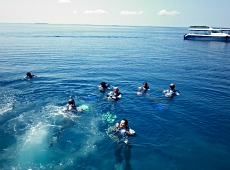
Seventy people representing 12 nationalities – including scuba divers representing all levels of experience, underwater photo journalists, and guests – participated in the “10 to 10 Rannamaari wreck” event, kicked off April 25.
A total of 138 dives and a 24-hour live webcast broadcast worldwide showcased the extraordinary marine diversity and beauty of the Maldives as well as the unique ecosystem that has developed on the shipwreck.
“The Maldives is well known for its natural beauty and among the island resorts Ansana Ihuru in particular is known for its beautiful house reef. The resort was renovated last year and attention was focused on the Marine Centre, because it is the underwater beauty we’d like to share,” said Executive Assistant Manager Henar Rios at the event’s opening ceremony.
The resort boasts of having one of the best ‘house reefs’ in the Maldives. “Seventy-five percent of Angsana Ihuru’s beauty is underwater,” Rios told Minivan News. She further explained that the resort has a 30 percent guest return rate, whereas most resorts average only five percent, even with special incentive programs in place.
“The Rannamaari wreck is now a living structure and symbol which is an extension of our reef that we will protect and share with pride,” Rios added.
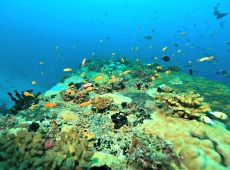
The Rannamaari wreck was previously used as a dredging ship on a nearby island and was towed to Angsana Ihuru in 1999 to be used as an artificial reef. However, the ship sank “mysteriously” several days before the planned event and has since become a home for thousands of sea creatures and corals at a depth of 28 metres.
Scuba divers immediately took to the water to explore the reef following the open ceremony, which included a traditional bodu beru (drumming) performance and kurumba (tender coconut) refreshments.
Throughout the day divers and snorkelers were rotating in and out the water, exploring the Rannamaari wreck just off-shore from both the Marine Centre and Velaavani (shallow bay) Bar.
In addition to the daytime dives, a variety of unique scuba experiences took place to highlight the marine environment’s astounding changes which occur daily, including the “before dusk”, “fluorescent” underwater life, midnight, and “before dawn” dives.
A “try scuba” opportunity catered to non-certified divers, with Angsana Ihuru’s professional dive instructors carefully facilitating participants’ first underwater breathing experience in the island’s shallow lagoon.
The Rannamaari Play was a highlight of the anniversary celebration events. Resort staff creatively recounted the historical Maldivian folklore tale through a shadow-theatre performance accompanied by music and narration.
The sea demon Rannamaari previously terrorized the Maldivian people by demanding the sacrifice of a virgin girl each full moon. However, the Maldivians were saved by a Muslim traveler, who disguised himself as a women and stayed overnight in the temple reading verses of the Quran, causing Rannamaari to disappear forever. Following the traveler’s victory over the demon, the Maldives embraced Islam as a nation in 1153 AD.
Immediately following the play, the Male’-based band Flower Rain provided guests with live music at the bar.
Throughout the day’s events resort’s staff provided an assortment of delicious refreshments – including traditional Maldivian ‘short eats’ – to guests and participants, demonstrating the resort’s genuine hospitality.
In line with Angsana Ihuru’s environmental conservation focus, five percent of earnings generated from the anniversary events dives will be donated to sister-company Banyan Tree’s Green Imperative Fund, which supports community and environmental projects around the world.
The Maldivian telecommunications company Wataniya sponsored the “10 to 10 Rannamaari wreck” event.
“Unique, dive centric resort”
“The highlight of the event was the spirit that was shown by the staff of the island and the in house guests. Plus the online users who kept the momentum going,” the Marine Centre Manager and dive base leader for both Angsana Ihuru and Banyantree Maldives Vabbinfaru Adam Rasheed told Minivan News.
“The Rannamaari wreck is unique because you can swim in simply. It is very close to the reef, which means more or less all levels of divers, even a person who is in the water for the first time, will have a chance to see this.
“Now the wreck is like an artificial reef. The fish life is very, very good and very special, not to mention so easy to access,” Rasheed said.
Average underwater visibility peaks at 30 meters, while the reef drops away gradually from the powder-white sandy shoreline.
Rasheed explained that the initial idea for the “10 to 10 Rannamaari wreck” event came to him during a night dive.
“The dive was really, really good and I wondered when will two of the most important people in my life – my mom and aunt – get the chance to see something like this? So we started to build on that idea to also reflect the reopening of the resort following last year’s renovations, as well as commemorate the 14th anniversary of the wreck,” Rasheed said.
“Angsana Ihuru is trying to do something unique with more of a focus on the water and divers, to position ourselves as a dive centric resort.
“Over the years Ihuru has had an environmental focus and so we wanted to complement this and take the concept to a new level,” he added.
Rasheed further explained that during the recent renovations, the entire dive center structure was changed to reflect the resort’s focus on the underwater environment, diving, and snorkeling.
Angsana Ihuru claims to be the first resort in the Maldives to offer SNUBA, where breathing air is supplied from a long hose that is connected to a floating raft on the surface, allowing guests to dive up to six metres.
“For those who prefer snorkelling or are new to scuba diving, this gives a feel for diving without the need for deep underwater submersion.”
A plethora of marine life frequents the vibrant coral reef surrounding the resort island, including giant moray eels, scorpion fish, stingrays, eagle rays, manta rays, batfish, nurse sharks, big jack fish, and sea turtles.
Pictures and videos from the “10 to 10 Rannamaari wreck” event can be found on the Ihuru Funa Facebook or Twitter pages.
A coalition government with cabinet posts divided among parties is not compatible with the presidential system envisioned in the Maldivian constitution, former President Mohamed Nasheed reiterated during campaign rallies at Fuvahmulah and Addu City this weekend.
Addressing large crowds in the two southernmost atolls, the Maldivian Democratic Party (MDP) presidential candidate accused mogul politicians of forming political parties only to offer its members “on a platter” to negotiate coalition agreements.
“[They say] my party will enter a coalition with your party if I can get this many seats in cabinet, that many judges, as well as a large warehouse and two resorts,” Nasheed said in Fuvahmulah on Thursday night (April 25), adding that “business” deals were made between leaders while party members remained “oblivious.”
Nasheed had previously characterised the cabinet of President Dr Mohamed Waheed as less of a team committed to shared goals than a group of individuals with divided loyalties and disparate ideologies often working at cross-purposes.
Both the Maldives’ own experience of ruling coalitions as well as lessons from “human experience” have established the conditions whereby such alliances could govern effectively without becoming unstable, Nasheed observed.
“In a presidential system, dividing the cabinet into four or five parts is not something we could do under any circumstances, [and] it is not something permitted by the Maldivian constitution either,” Nasheed said in Fuvahmulah.
According to the constitution, Nasheed continued, cabinet ministers are appointed by the president and are sworn to serve at his pleasure.
The constitution does not permit cabinet ministers to take orders from their parties instead of the president, Nasheed added.
Coalition governments therefore went against “the spirit of the constitution,” said Nasheed, and could not function under a presidential system.
Nasheed repeated the criticism of power sharing coalitions in his speech the following night (April 26) in Hithadhoo, Addy City.
The incentive for the proposed “broad coalition” to compete against the MDP was the hoped-for rewards of government posts and the country’s resources, such as uninhabited islands, to be divided among coalition partners, Nasheed contended.
Power sharing agreement
Nasheed’s remarks came while parties in the ruling coalition led by President Dr Mohamed Waheed are reportedly engaged in discussions over power sharing agreements.
However, in addition to President Waheed’s Gaumee Ihthihad Party (GIP), all major government-aligned parties have fielded presidential candidates, including MP Abdulla Yameen from the Progressive Party of Maldives (PPM), MP Gasim Ibrahim from the Jumhooree Party (JP) and MP Ahmed Thasmeen Ali from the Dhivehi Rayyithunge Party (DRP).
Smaller parties such as the religious conservative Adhaalath Party and the Dhivehi Qaumee Party (DQP) – led by Special Adviser to the President Dr Hassan Saeed – have entered into a coalition with Dr Waheed’s GIP.
While business magnate Gasim Ibrahim is reportedly in talks with Dr Waheed over a potential power sharing agreement, the JP presidential candidate has said he would not consider becoming the running mate of any other candidate.
At its recently-concluded fourth congress, DRP Leader Thasmeen meanwhile dismissed the possibility of a coalition with either the PPM or MDP.
The PPM was formed in 2011 by DRP founder, former President Maumoon Abdul Gayoom, following months of factional squabbling and an acrimonious war of words between the PPM figurehead and his successor at DRP.
MDP rally in Addu City
PPM MP Ahmed Nihan told Minivan News last week that parties in the ruling coalition needed to reassess their views on power sharing after thousands of people attended a MDP rally on April 19 to celebrate the signing of Speaker of Parliament Abdulla Shahid.
In his speech at the MDP rally in Addu City last night (April 26), Shahid meanwhile said that 1,300 people have signed for the party during the past week.
Speaking at his first MDP rally on April 19, Shahid pledged to carry out a recruitment drive across the country to bolster the party’s membership strength ahead of the September presidential election.
Umar Naseer has been dismissed from the the government-aligned Progressive Party of Maldives (PPM) over allegations made following his unsuccessful bid to become the party’s presidential candidate, local media has confirmed today.
The Sun Online publication today reported that Naseer has been sent an official notice of dismissal invalidating his PPM membership.
Following the PPM primary last month, Naseer alleged that his opponent MP Abdulla Yameen controlled all of the party’s organs, including the council and election committee, and had “rigged” the vote in his favour by ballot stuffing, falsifying the count and “pouring black money” to buy votes.
He further alleged that Yameen, half-brother of former autocratic ruler, Maumoon Abdul Gayoom, was fully backed by the former president’s family and PPM parliamentary group, as well as criminal gangs, convicts and drug smuggling “networks”.
A case against Naseer was heard by the PPM’s internal disciplinary council on April 14 over the nature of possible action taken against him after he refused to apologise to Yameen or defend himself at the subsequent disciplinary hearing.
When contacted by Minivan News today, a spokesperson for Umar Naseer refused to confirm if such a notice had been received.
“I’m sorry, but we do not give interviews to Minivan News,” the spokesperson said.
PPM MP Ahmed Mahloof was meanwhile not responding to calls from Minivan News. Fellow MP Ahmed Nihan had his phone switched off at time of press.
“Not in the mood”
Nihan told Minivan News earlier this week that Naseer had failed to respond, either verbally or in writing, during a seven day period provided by the PPM’s disciplinary hearing to retract the allegations he had made.
“It seems he was not in the mood to follow the party’s charter,” Nihan added, pointing to several media reports that Naseer had taken a role in discussions to form a broad coalition of government-aligned parties behind current President Dr Mohamed Waheed ahead of the presidential election scheduled for September 7 this year.
However, local newspaper Haveeru has reported that Naseer himself has questioned the legality of any action to remove him from the PPM while the Civil Court is in the process of hearing a case on whether to invalidate the outcome of the PPM primary.
PPM member Rahma Moosa lodged the case earlier this month claiming 8,915 people who were not officially registered as members of PPM had been allowed to vote in the primary.
The PPM has previously said that although the additional persons had not been registered at the Elections Commission by March 10, they were allowed to vote as they had submitted membership forms to the party.
The DRP – the first political party formed by Gayoom back in 2005 – was split into two factions of supporters backing former president Gayoom and those supporting his successor as DRP Leader, Ahmed Thasmeen Ali.
Infighting in the party had intensified from back in December 2010 after Umar Naseer was dismissed as the DRP’s Deputy Leader following a vote by the party’s disciplinary committee.
Amnesty International has announced that “significant human rights challenges” need to be addressed following a nine day visit to the Maldives, where it met with senior government figures and civil society organisations.
In a statement released Thursday (April 25), Amnesty International said that despite the country making “considerable progress” during the last few years in promoting and protecting civil rights, it retained concerns over issues like freedom of expression and wider accountability in the criminal justice system.
The findings were made as part of initial observations by Amnesty’s South Asia Director Polly Truscott and the NGO’s South Asia Researcher Abbas Faiz following a visit to the country between April 16 to April 24 this year.
Speaking to Minivan News at the conclusion of her visit this week, Truscott detailed some of the key human rights challenges facing the country. Among her observations was the controversial flogging sentence handed to a 15 year-old girl over charges of ‘fornication’, which she believed to be just the “tip of the iceberg” in regards to wider issues over how sexual offence victims were treated in the country.
The current government has already appealed the flogging sentence, while also pledging to move ahead with wider legal reforms concerning the possibility of reviewing the use of flogging as a punishment.
“On a positive note, Amnesty International welcomes the efforts now made by Maldivian authorities, in particular the President of the Maldives, to strengthen measures to ensure that any child who has been sexually abused receives protection, not punishment,” the NGO’s statement read.
“These include a review of all cases of children who have been investigated for ‘fornication,’ that is, sex outside marriage. Under international human rights law no one who either engages in consensual sexual activity or who is a victim of sexual assault, should be criminalised or punished, regardless of their age.”
Amnesty said it also held concerns over a lack of “effective investigations” into several high-profile attacks on media personnel, as well as the murder of MP Dr Afrasheem Ali.
The NGO has called on the government of President Dr Mohamed Waheed to end an alleged culture of “impunity for the arbitrary and abusive use of force by security forces against demonstrators” following the controversial transfer of power on February 7, 2012.
Amnesty International said its calls regarding allegations of “excessive force” by police were in line with recommendations included in the Commonwealth-backed Commission of National Inquiry (CNI) released last year.
The full Amnesty International statement can be read here.
 (0)Dislikes
 (1)
(1)