The Maldives Media Council (MMC) has condemned the Criminal Court for barring journalist from a corruption hearing involving Parliament’s Deputy Speaker and People Alliance Party (PA) MP Ahmed Nazim.
The council issued the statement following the Criminal Court judge’s decision, stating that the court’s claim that journalists were blocked because they gave a negative perspective on the court was not probable grounds to disallow journalists from hearing the trial.
The Council said that the Criminal Court’s decision would prevent the court from gaining public confidence.
The MMC’s press statement said the decision to bar journalists from the trial was “a huge challenge” for people’s right to a free press, as outlined in the Constitution.
Local dailies Haveeru and Sun Online reported that the hearing was scheduled to start at 12:00pm, but was actually conducted one hour earlier at 11:00pm. The court had not informed any of the reporters who registered at the court that morning of the time change.
According to Haveeru, court reporters who learned of the time change and requested entry were told that “the judge has decided to hold a closed hearing.”
When asked by reporters to offer a reason for the closed hearing, the court official asked the reporters to wait, went inside and did not appear until the hearing was over.
Almost two hours after the hearing concluded, Criminal Court Media Officer Ahmed Mohamed Manik told the court reporters that had not been allowed to enter because “negative perceptions of the court were being created [among the public] because of some journalists.”
Queried by the court reporters, the Criminal Court official insisted that the judge was authorised to exclude the public from trials under article 42 of the constitution. Members of the public were allowed to attend today’s hearing.
Under normal court procedure, only trials involving child sexual abuse are closed to the public.
A Maldives National Defence Force (MNDF) officer has died in a friendly-fire incident during bodyguard training at the Kadhoo facility in Laamu Atoll.
32 year-old Corporal Ibrahim Shaukath was shot in the head and was taken to Laamu Gan Regional Hospital, where he was pronounced dead at 11:50am.
The MNDF stated that live ammunition was used in the training program, intended to train bodyguards for the upcoming SAARC Summit to be held in Addu.
MNDF Spokesperson Major Abdul Raheem told Minivan News that a joint investigation by police and the MNDF had been launched into the investigation of the death.
“It is too early to say how the incident occurred because the investigation is ongoing,” Abdul Raheem said.
Asked whether officers were required to wear helmets during training requiring the use of live ammunition, Abdul Raheem responded that “during some training, the officers will be equipped with different weapons and tools and I am not sure whether in this training the students were told to wear their helmets,’’ he replied.
A state funeral for Shaukath will be held on his home island of Alifushi in Raa Atoll.
“The family requested we conduct the funeral on Alifushi, so we decided to do so,’’ Abdul Raheem said, adding that senior officers of the MNDF would attend.
He said that the MNDF flag would be hoisted half-mast for three days in mourning of the incident.
“The whole MNDF force is with the family of Shaukath and our prayers are with him and his family,’’ Abdul Raheem said. “It was a very regrettable incident.”
Local media meanwhile reported that Shaukath died immediately when the bullet went straight his forehead.
Defense Minister Thalhath Ibrahim, Chief of Defense Force Major General Moosa Ali Jaleel and Vice Chief of Defense Force Faruhath Shaheeru and MNDF Nothern Area Commander Brigadier General Ahmed Mohamed will attend the funeral.
The opposition Dhivehi Rayyithunge Party (DRP) sent condolences to Shaukath’s family and called for an independent investigation to prevent such incidents from occurring in the future, alleging that existing safety measures during training exercises were “questionable”.
Four Seasons Kudu Huraa resort will host six of the world’s most famous surfers for the 2011 Surfing Champions Trophy, starting from August 29.
Competing surfers include Josh Constable, Mark Richards, Layne Beachley, Nat Young, Damien Hardman and Mark ‘Occy’ Occhilupo, with over 20 world titles to their names.
The five-day event will take place from August 31 to September 4. Representatives from the resort said the event would highlight the Maldives as an attractive surfing destination alongside its already widespread fame as a dive destination.
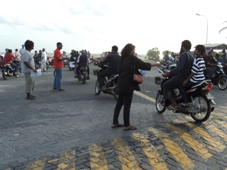
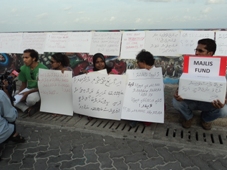
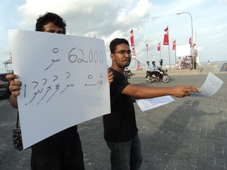
A group of concerned citizens and members of civil society organisations launched a protest today in response to parliament’s Public Accounts Committee (PAC) decision last week to issue a lump sum of Rf140,000 (US$9,000) as committee allowance back pay for January through July this year.
If the PAC decision stands, in addition to a monthly salary of Rf62,500 (US$4,000), at the end of August each MP would receive a lump sum of Rf160,000 (US$10,386) as committee allowance.
At a time when the country faces a crippling budget deficit, the back payment of the allowance will cost the state up to Rf12.32 million (US$800,000), rising to Rf76.23 million (US$4.9 million) in wages for 77 MPs for the whole year.
Gathered near the tsunami memorial after 4:30pm today, the protesting citizens handed out flyers to passersby with a graph showing the steep rise of MPs’ remuneration from Rf4,500 (US$292) a month in 2004 to Rf82,500 (US$5,350) a month in 2011.
“MPs do not need to be paid more money to do committee work!” reads the flyer. “It is the duty of MPs. It is one of the most important responsibilities that has to be carried out by MPs.”
As this was “clearly stated in Majlis’ law,” drawing an additional Rf20,000 from public coffers “is a gross injustice to the Maldivian people.”
Aiman Rasheed from Transparency Maldives told Minivan News that the protestors believed the decision to institute a committee allowance was symptomatic of “inherent problems in the entire system.”
“With such a high budget deficit and high inflation, we do not accept that the hike [in remuneration] is at all responsible,” he explained.
Aiman dismissed the argument that a committee allowance would improve parliament productivity: “The rules of Majlis committees, how they function, the relationship of the parties and procedures on proposing bills should be changed. Basically, they should become better people.”
For productivity to increase, said Aiman, parliament as an institution should function better.
Carrying a placard calling on her MP to not accept the allowance, Salma Fikry, executive board member of NGO Democracy House, said that the “pretext [of improving productivity] the MPs are using is utterly ridiculous.”
“The civil servants are in more close proximity to the public, so what about the productivity of civil servants?” she asked.
Salma argued that as committee meetings were “part of MPs’ duties,” the decision to issue Rf20,000 as committee allowances “is an injustice done to the Maldivian people.”
Aiman meanwhile asserted that the decision to issue a lump sum for seven months cast doubts on MPs “sincerity” as each MP would receive the back pay regardless of attendance.
Moreover, Aiman pointed out that parliamentary committees did not function for two months of the current session over a partisan dispute regarding the revision of committee composition.
“These things need to be talked about,” he said. “What we are trying to do is bring this issue to the spotlight and help the public understand […] With a constitution based on parliamentary supremacy, nothing in the country can go right if the MPs aren’t responsible. We want to create grassroots demand about what is going in Majlis and for the public to be aware of it.”
Salma however said she doubted if MPs would be moved by the protests to scrap the controversial allowances.
“Because in January this year we launched quite a strong campaign against the Parliamentary Privileges Act and we also spoke about the committee allowance during that campaign,” she explained. “But what we see today is that civic action is not bearing what it should in this democracy of ours.”
This was the case because state institutions such as the People’s Majlis were “too strong” and “has a lot of vested interest and a lot corruption,” she said.
Aiman concurred that MPs “do not bow to civic pressure” but the NGOs and concerned citizens hoped to “equip the public with relevant knowledge” to hold parliament accountable and achieve a reduction in “the almost exponential [year-on-year] growth” of salaries in the state budget.
“Thirdly, [we want] the public to understand these issues and demand accountability,” he said. “Fourth, we want to broaden the engagement of citizens with the People’s Majlis. And to let the People’s Majlis know that the people are watching you and that the people do care.”
A Criminal Court judge handling the case of two persons identified by police as “dangerous criminals” has claimed that police had “not cooperated” with the court and that both may have to be released.
Thursday’s hearing of the case against Ahmed Shareef of Gaafu Dhaalu Nadella and Maadhih Mohamed of Laamu Gan, had to be cancelled after police officers who were supposed to testify as witnesses failed to appear, according to local media.
The media reported the judge as saying that it was the fourth hearing in the trial that had to be cancelled because the two police officers did not appear, and stated that the court was informed that one police officer was on vacation while the other was not turning up for work.
The judge said that a hearing would be scheduled for next week and that if the two police officers failed to appear, the two suspects would be released from custody.
Police Sub-Inspector Ahmed Shiyam meanwhile said that police had always fully cooperated with the Criminal Court and had always produced persons necessary for trials.
“If we had failed to produce someone to the court we have always informed the court about it, and given a reason as to why we have been unable to present him,” Shiyam said.
Shareef and Maadhih are both charged of assaulting and stabbing Ismail Firdhaus, near the Hulhumale’ ferry terminal.
Both of them denied the charges against them, however, the court granted the police authority to hold them in police custody until their trial was concluded.
On February 17, Criminal Court’ Chief Judge Abdulla Mohamed released Ibrahim Shahum Adam, a 19 year-old who was arrested in August last year for allegedly murdering 17 year-old Mohamed Hussain.
Adam was presented to the Criminal Court with a police request to extend the period of detention, but Chief Judge Abdulla Mohamed noted that the Criminal Court had already extended the detention of Shahum by six months for investigation which had not yet been concluded.
Police blamed the Health Ministry, and told the judge that the investigation had not concluded because the ministry had not responded to a letter police sent in August 2010 requesting the medical report on the death of Mohamed Hussain.
Judge Abdulla told police this was not reasonable grounds to keep a person in detention.
Later the family of Ahusan Basheer, 21, who was fatally stabbed in a gang fight, accused Shahum of murdering Ahusan and blamed Judge Abdulla for releasing him.
There is an unbearable emptiness to Maldivian political rhetoric. Everywhere we look are people who say what they do not mean, and mean what they do not say.
Take former President Gayoom’s pre-Ramadan Epiphany: Z-DRP and Adhaalath are ideological twins.
Since when? Does Adhaalath not espouse beliefs that Gayoom once allegedly had people tortured for? Legend has it that the kind of beards that men sport with such pride these days were once shaved with chilli powder by Gayoom’s henchmen. This is a madness in method missing even from the notorious ‘enhanced interrogation techniques’ at Guantanamo Bay.
Now, though, we are to believe that this vast ideological chasm between Gayoom and Them has been magically crossed. That somehow, in the turmoil of transition, the ideological kaleidoscope was shaken so much that Gayoom and Adhaalath are now soulmates.
Do you find it hard to believe that an individual could flip-flop across such vast ideological terrain in one lifetime, let alone in one political career (no matter how long)? Is it difficult to grasp how one man can go from actively banning the buruga to aligning himself with those who take the measure of a woman’s morality by the very same piece of cloth?
Do you find it difficult to get your head around how a man who once courted international diplomatic accolade with such rigour would now align himself with a party that thinks Iranian approval is a foreign policy victory? Even bearing in mind that this is Gayoom we are talking about, it is hard to make sense of such a complete volte face, is it not?
Do not be too hard on yourself, though, for no such vast ideological changes have occurred. The truth of the matter is there was no ideology to begin with. We are an ideologically empty vessel, and the proof is not just in the clamour that such vessels tend to make and we hear constantly on our airwaves. It is there to see in the many crossings made over seemingly irreconcilable ideological lines in recent times.
Remember DRP’s most vitriolic and vociferously anti-MDP figure in the Majlis, MP Ali Waheed, moving to MDP in May this year? The air was filled with such a triumphant yellow that everyone looked jaundiced. What was there to celebrate? That MDP was one man closer to an outright parliamentary majority.
Granted, a majority is clearly necessary if MDP is to surmount the blockades to progress set up by the Maldivian Tea Party-ers. But on how firm an ideological ground is a party willing to welcome – if not buy – a man who until the moment of transfer had been against everything the party stood for?
Fast-forward a few months, and there is Mr Ali Waheed, the proud owner of a MRF 4.6 million home, on the beachfront of Hulhumale’. How did he afford it? It is a question that one must not ask for fear of ‘politicising’ the issue, says the man himself. Indeed. These journalists must be insane to find anything political about an MP, even on the outrageous monthly income of Rf 60,000, buying a plot of land for almost Rf 5 million.
Then we have Adhaalath, the party of purists and the gatekeepers of heaven for Maldivians. One day they describe the West as the Great Satan, the Puppet Masters of the religiously weak Dhivehin, the corrupters of our children and the seducers of our youth. The next day they fly in individuals who represent the worst the West has to offer to lecture us on how we should conduct and govern ourselves.
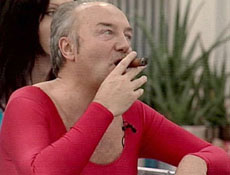
British MP George Galloway
First there was Philip Green, according to whom England is a country full of drunken louts who do nothing but puke and urinate alcohol on the streets of London twenty four hours a day seven days a week.
Then Adhaalath proudly links us via video to George Galloway, former UK MP and Celebrity Big Brother star who once danced on national television in a pink lycra cat-suit. While even sinful liberals found Galloway’s behaviour hard to comprehend, self-righteous Adhaalath seems to have had no such qualms.
If Adhaalath believes what it says, how can it hold Galloway up as a figure of authority to the same people that it wants to cleanse of all alleged Western debauchery? Galloway’s decisions in the Middle East have not been exactly wise, to put it kindly. But that’s all right, because Adhaalath found some perverse use to make of him. And Galloway lapped it all up, like the cat that he was on Big Brother, happily dictating our foreign policy as ‘an entirely Muslim country’.
And this, ladies and gentlemen, in the same week we were celebrating our independence from British protection. It was also the same week in which Gayoom was speaking of the imminent threat we face from a supposed revitalisation of British imperial ambitions.
Ideological complexities? No. Lack of ideology, lack of a purpose except one’s own political or pecuniary power. What matters is knowing which side of your bread your Halal butter is on. What matters is that there is a pot of political gold at the end of the rainbow of beliefs one can feel free to pick and choose from.
This emptiness of rhetoric, of being, is dangerous.
As we saw from the riots in London earlier this month, when the people at the top believe that it is okay to rob from the poor with impunity like the bankers did in the West; and that it is alright to violate the rights of others as Murdoch’s news empire did in Britain – the chances are that the little people below may feel free to do the same.
If we want a society with purpose and belief, we need leaders who say what they mean; not individuals who take a Hypocrite’s Oath when assuming office.
To see the future of things to come if we continue on this path of duplicity, we need only look at the rampant hypocrisy among us from the designation of ‘Top Fashion Accessory’ status to the buruga to the ‘Back to the Prophet’s Day’ men on Harley Davidsons with their orange beards grotesquely flowing in the wind.
If all this is doing your head in, sign up for an Incantation Class at the Islamic Foundation’s Halal Magic Courses. Book early, though. They are proving even more popular than the fishnet stockings and the Botox shots that are to accompany next season’s lamé burugas.
All comment pieces are the sole view of the author and do not reflect the editorial policy of Minivan News. If you would like to write an opinion piece, please send proposals to [email protected]
Parliament’s Public Accounts Committee (PAC) on Wednesday approved a lump sum of Rf160,000 (US$10,376) for every MP, in committee allowance back pay for January through August.
The decision to approve the Rf20,000 (US$1200) monthly allowances in December 2010 was met with protests and widespread public indignation. However in June this year, parliament rejected a resolution proposed by opposition Dhivehi Rayyithunge Party (DRP) MP Ahmed Mahlouf to scrap the allowance.
A Majlis official, who wished to remain anonymous, confirmed to Minivan News that following its decision, the committee asked the Speaker to issue the lump sum allowance with MPs’ salaries this month.
Deputy Speaker Ahmed Nazim, chairman of the PAC and parliamentary group leader of the minority opposition People’s Alliance (PA), was not responding at time of press.
Article 102 of the constitution states that parliament shall determine the salaries and allowances of the President, Vice President, cabinet ministers, members of parliament, members of the Judiciary, and members of the independent institutions.
The opposition-majority PAC decided earlier this month that MPs who attend less than 50 percent of committee meetings would not receive the allowance while those who attended between 50 and 75 percent would receive Rf10,000 (US$648) a month.
While MPs who attend over 75 percent of meetings would receive the full amount, those who did not wish to take the allowance would be allowed to refuse it.
Few MPs that Minivan News contacted today wished to comment on record regarding the controversial allowances.
Independent MP Mohamed Nasheed told Minivan News that he was not informed of the Public Accounts Committee decision.
“There was a decision to institute committee allowance, I know. [But] I am not in support of a committee allowance at all. And if there is any back pay, that would be awfully irresponsible,” he said.
Nasheed added that he had written to the Speaker requesting that he “not be given it and that it may not be deposited with my salary.”
Maldivian Democratic Party (MDP) MP Ahmed Hamza, a member of the PAC, meanwhile said that he too was not aware of the decision.
If a decision had been made, said Hamza, it must have been done while he was either absent or had stepped out of the committee meeting.
“I do not think it is a good idea at all,” he said. “I have expressed my disapproval at the committee when it was first discussed.”
Hamza added that he did not want the allowance. Other MDP MPs on the committee did not respond at time of press.
Parliament’s National Security Committee has voted in favor of signing a memorandum of understanding with the UN to send Maldivian soldiers to UN conflict zones for peacekeeping operations.
According to the parliament, all the members of the committee were present at the meeting last Monday when the voting was held, including Dhivehi Rayyithunge Party (DRP) MP Rozaina Adam, Peoples Alliance Party (PA) MP Abdulraheem Abdulla and DRP MP Mohamed Nashiz.
The committee will now submit the matter to parliament for approval.
On April 5, the cabinet decided to sign a memorandum of understanding with the UN to deploy Maldivian soldiers to UN conflict zones, noting that it would be important for the Maldives to contribute to these international efforts to ensure that every country, society and individual had the opportunity to live in peace and security.
The decision was then sent to the parliament for approval, and the parliament voted in favor of sending it to the National Security Committee to examine the issue further.
According to 243[b] of the constitution, “if the President, as Commander in Chief, authorizes or orders the employment of the military service in defence of the republic or as part of an international undertaking, the President shall without delay submit the authorisation to the People’s Majlis. The People’s Majlis may at any time approve the authorisation, or revoke the authorisation.”
Speaking on the matter in parliament, opposition Dhivehi Rayyithunge Party (DRP) MP, Ahmed Mahlouf, said the issue was concerning.
“This is no joke, this is a very serious issue,” he said. “I do not think any honorable member would want to send some Maldivians abroad to their deaths.”
Mahlouf said death was a real possibility in peacekeeping operations. He also noted that it was possible that terrorists would target the Maldives if Maldivian soldiers were sent to participate in peacekeeping operations.
Religious NGO Jamiyyathul Salaf also expressed concern over the issue and called on the government to withdraw the decision.
Salaf at the that time claimed that any Muslim who assisted non-Muslims in a war against Muslims would themselves be branded infidels.
“Muslims will be obliged to treat him as a non-Muslim in all ways, such as if dead, burying without enshrouding the body, burying the body with other non-believer, and when dealing with inheritance matters the terms and condition that applies to a non-believer who dies in a war against Muslims will be applied to him,” the NGO said.
Local daily Haveeru and Sun Online reports that the hearing was scheduled to start at 12:00pm but was conducted one hour earlier at 11:00pm. The court did not inform any of the reporters who registered at the court this morning of the time change.
According to Haveeru, court reporters who learned of the time change and requested entry were told that “the judge has decided to hold a closed hearing.”
Asked by the reporters to offer a reason for the closed hearing, the court official asked the reporters to wait, went inside and did not appear until the hearing was over.
Almost two hours after the hearing concluded, Criminal Court Media Officer Ahmed Mohamed Manik told the court reporters that they were not allowed to enter because “negative perceptions of the court were being created [among the public] because of some journalists.”
Manik was not responding to Minivan News at the time of press.
Queried by the court reporters, the Criminal Court official insisted that the judge was authorised to exclude the public from trials under article 42 of the constitution.
Article 42(c) states that, “Trials of any matter shall be held publicly, but the presiding judge may exclude the public from all or part of a trial in accordance with democratic norms: 1. in the interests of public morals, public order or national security; 2. where the interest of juveniles or the victims of a crime so require; or 3. in other special circumstances where publicity would prejudice the interests of justice.”
However, according to Haveeru, a member of the public was allowed to attend today’s hearing. Under normal court procedure, only trials involving child sexual abuse are closed to the public.
The Criminal Court has since issued a press statement explaining that the judge decided to hold a closed hearing “because the reporters allowed in to the hearing on May 24, 2011, gave the false depiction of the court to the public and because the court believes this depiction could obstruct the course of justice.”
Nazim meanwhile appeared at court today after reportedly failing to comply with eight summons during the past few months.
The minority opposition People’s Alliance (PA) parliamentary group leader is facing four counts of conspiracy to defraud to the Atolls Ministry, which were first identified in an audit report of the now-defunct ministry.
Following an investigation into the claims in the report, at a press conference in August 2009, Chief Inspector Ismail Atheef said police had uncovered evidence that implicated former Atolls Minister Abdullah Hameed, Eydhafushi MP Ahmed “Redwave” Saleem, former director of finance at the ministry, and Nazim in a number of fraudulent transactions.
Police exhibited numerous quotations, agreements, tender documents, receipts, bank statements and forged cheques showing that Nazim received over US$400,000 in the scam.
A hard disk seized during a raid of Nazim’s office in May 2009 allegedly contained copies of forged documents and bogus letter heads.
Police maintained that money was channelled through the scam to Nazim who laundered cash through Namira Engineering and unregistered companies.
 (1)Dislikes
 (0)
(0)