Government introduces Arabic lessons as part of Islamic education drive

The Ministry of Education yesterday introduced Arabic language as an optional subject for grades 1 – 12 in twelves schools.

At a inaugural ceremony held in Hiriyaa School yesterday, Vice President Dr Mohamed Jameel Ahmed said the government will mainstream Arabic education in the Maldives, focusing particularly on Islamic education and the study of Quran.

Jameel said the introduction of Arabic language will bring a ‘special happiness’ to the people of Maldives, will strengthen the Islamic faith, and will introduce good behavior.

Stating that different ideologies have to be introduced into the education system in order to ensure the peace and stability of the country, Jameel pledged to introduce Islamic ethics as a subject in all schools within the year.

Reading and writing of Arabic script have traditionally been taught in the Maldives at a very young age, either at home or from private teachers. Most people, however, have little or no understanding of the meanings of Arabic language – an issue of concern often raised by local religious scholars.

The schools in Malé city which have introduced the new subject were Thajuddeen School, Muhyuddin School, Dharumavantha School, Aminiya School, and Hiriya School.

In Addu city, the new lessons have been introduced at Maradhoo School, Feydhoo School, Hulhudhoo School, and Shamsuddin School. In Baa Atoll, pupils at Thulhaadhoo School and Naifaru Madrasatul Iftitah will also have the option of taking Arabic lessons.

The ministry has said that the first twelve schools were chosen based on the fact that Arabic teachers were already present within the schools’ staff, and that the subject would be introduced in all schools within the year.

Speaking at the ceremony yesterday, Minister of Education Dr Aishath Shiham said that Arabic language is “very close to our hearts” and that learning the language is very important.

Jameel, Ahmed, Education State Ministers Sheikh Abdul Aziz Hussain, Sheikh Ali Zahir and Dr Abdulla Nazeer took model Arabic classes for Hiriya Schools students yesterday.

The introduction of Arabic language in all schools of the Maldives is part of the government’s stated education policies. The government has also pledged to prepare a scheme for the introduction ‘economically beneficial’ foreign languages within the first hundred days of the government and to choose two islands within this period for the establishment of Arabic medium schools.

With the exception of Arabic-medium Madhrasatul Arabiyyathul Islamiyya, the medium of instruction in all Schools of Maldives is English language – local Dhivehi language and Islamic studies are taught in Dhivehi.

Likes(1)Dislikes(0)

Twelve deaths from road traffic accidents in 2013

In the year 2013 twelve people were killed in road traffic accidents, the Ministry of Transport and Communication has revealed.

Speaking to media, Minister Ameen Ibrahim said that action was taken against 25,000 people for various traffic violations. He said that this is an indication that the number of people breaking traffic rules are increasing.

The minister went on to announce that the ministry would begin a one-year awareness campaign tomorrow.

The campaign will focus on identifying and implementing immediate steps that can be taken to improve road safety.

According to Maldives Police Service 189 cases of traffic accidents were reported in January 2014.

Likes(0)Dislikes(0)

High Court rules that MPs’ police obstruction cases cannot be refiled

The High Court has today overruled a decision made by the Criminal Court to accept a previously withdrawn police obstruction case involving MPs Ali Waheed and Ahmed Mahloof.

The case was first filed in the Criminal Court by the Prosecutor General (PG) on 9 November 2010 before being withdrawn twenty days later.

The public prosecutor had argues that the initial case was only withdrawn temporarily while police investigated a related incident.

After the case was again filed in the Criminal Court, defense lawyers of Ali Waheed – which includes former Attorney General Husnu Suood – invoked procedural issues saying that the case could not be refiled.

According to the High Court, on 12 September 2012 the Criminal Court ruled it would proceed with the case, stating that the PG had full authority under the article 5 of the Prosecutor General’s Act to do so.

Ali Waheed subsequently appealed the decision at the High Court, arguing that the PG did not have the authority to re-submit a case without first bringing changes to it.

The High Court’s ruling stated that there were three situations where the PG could withdraw a case filed at a court: to revise the case, to withdraw a case without specifying any reason, or to withdraw a case after telling the court that that the office did not wish to proceed.

The ruling today said that the PG had sent a letter to the Criminal Court on November 29, 2010, asking it to send all the files concerning the case, and that the PG had not stated that the case was being withdrawn for revision.

The High Court said that PG lawyers had explained the withdrawal was because the PG had asked for police to investigate a case where a group of people stormed into the Civil Service Commission. Both cases were related, but the police had not concluded the investigation when hearings into the first case had started.

Ali Waheed was charged with obstruction of police duty during an anti-government protest he had participated in while a member of the then opposition Dhivehi Rayyithunge Party (DRP).  Waheed, who has since defected to the Maldivian Democratic Party in May 2011, was charged for breaching article 75 of Maldives Police Services Act.

During the hearings held at the High Court, Assistant Public Prosecutor Hussain Nashid claimed that the charges had only been dropped “temporarily” in a bid to respect the “fairness” of criminal trials.

Nashid also argued that the PG had the discretionary power to decide upon the procedures as to how criminal charges can be filed.

Both Waheed and Mahloof were elected to parliament as representatives of the DRP. However, following the split of the DRP into two factions, both Waheed and Mahloof chose to leave the party.

Mahloof went onto join the Progressive Party of Maldives, the party formed by followers of former President Maumoon Abdul Gayoom.

Likes(0)Dislikes(0)

Air Asia ex: low-cost carrier suspends Maldives operations due to “challenging” conditions

Air Asia X has announced it will be suspending all operations to and from the Maldives from March 1, citing “challenging business conditions” both in the country and in the wider region.

“Despite our efforts, external factors such as the depreciation of Asian currencies against the US dollar and the chronic lack of hotel room supply in Maldives resulted in cancellation of thousands of bookings by travel operators,” said Azran Osman-Rani, CEO of AirAsia X – the low-cost carrier of the AirAsia Group.

“As part of our strategy to operate more efficiently, the airline will deploy our aircraft to routes with the right level of demand to be financially viable.”

“We have been very grateful for the huge support rendered by Male Airport, Maldives Tourism and relevant authorities and would like to put on record our appreciation for all the cooperation that has been given to us,” concluded Azran.

Today’s decision comes just months after the brand expanded its services to the Maldives, with regular flights between Kuala Lumpur and Malé via Colombo announced last September. The airline has said that the Sri Lankan service will continue.

Air Asia has subsequently written to all of its customers offering the re-routing or refunding of pre-booked flights that will be affected.

The Maldives tourism industry currently contributes around 30 percent of the country’s GDP, with visitors to county passing the one million mark in 2013 – growing by 17 percent compared with the previous year.

Neither the Tourism Minister Ahmed Adeeb, the President of the Maldives Association of Travel Agents and Tour Operators Mohamed Khaleel, nor the Secretary General of the Maldives Association of Tourism Industries Ahmed Nazeer were answering calls at the time of press.

The most recent government figures – from July last year – show the operational bed capacity of the industry to have been just under 24,000 in the first seven months of the year, with an occupancy rate of 80 percent.

The Maldivian Rufiyaa currently follows a pegged exchange rate with the US Dollar, with a 20 percent band on either side of a central rate of 12.85 rufiyaa to the dollar. After the managed float was introduced in 2011, the official rate quickly rose to the maximum rate of 15.42 rufiyaa to the dollar where it has remained.

Soon after the Maldivian Monetary Authority (MMA) figures showed the government had printed over MVR1 billion (US$ 64,516,129) in the past year, MMA Governor Dr Fazeel Najeed tendered his resignation.

Before departing last month, Najeeb called upon the state to reduce expenditure and to stop printing rufiyaa, which he argued was exacerbating the country’s perennial dollar shortage.

President Abdulla Yameen’s new government has looked toward the tourism industry for new sources of revenue to finance this year’s budget.

The People’s Majlis last week agreed to hike Tourism Goods and Services Tax (T-GST) from eight to 12 percent in November, approved the immediate reintroduction of the discontinued US$8 bed tax, and will now require resort lease extension payments to be made within two years.

Likes(0)Dislikes(0)

Man fined for brewing alcohol

The Criminal Court has handed an MVR1000 (US$64.9) to a Fuvahmulah Island man for brewing alcohol.

The Maldives Police Services arrested Mohamed Saeed on October 1, 2011 on a tip off while he was brewing alcohol in his house with another individual. The police discovered utensils used for alcohol brewing and a 500 ml bottle containing alcohol.

Saeed has been ordered to pay the fine within 7 days – by February 16.

According to the police, Saeed has a record of drug abuse, theft, mugging, and sexual harassment.

Likes(1)Dislikes(0)

Drug kingpin appeals sentence from Sri Lanka

The ringleader of a nationwide drug network who is currently in Sri Lanka for medical treatment has asked the High Court to review his 18-year jail term.

Ibrahim Shafaz ‘Shafa’ Abdul Razzaq, 32, of Maafannu Lonumidhilige was sentenced to 18 years in prison and fined MVR75,000 (US$4,860) for drug trafficking in November.

Shafaz’s departure to Sri Lanka caused a furor in local media last week with newspaper Haveeru claiming the Maldives Correctional Services (MCS) were not informed of a date for the inmate’s return. An MCS officer did not accompany Shafaz, the local daily reported.

Opposition aligned broadcaster Raajje TV alleged Shafaz was not listed in the immigration control system as a convict when he boarded the midnight flight with his family.

But High Court procedures say appellants in criminal cases must be present in the courtroom for trials to proceed.

Meanwhile, Commissioner of Prisons Moosa Azim said all due procedures had been followed in allowing Shafaz to leave to get medical treatment.

Article 70 and 110 of the new Jails and Parole Act states the Commissioner of Prisons may release an inmate to seek medical treatment abroad, on the advise of a medical board, if such care is not available in the Maldives.

“A medical officer does not have to accompany the inmate. He was allowed to leave under an agreement with his family. Family members will be held accountable for his actions, including failure to return,” Azim told Minivan News.

Although an inmate is given a maximum three-month period for treatment, the duration may be extended if documents prove further care is required.

“Shafaz’s family is required to keep us informed through daily reports,”Azim said.

Operation Challenge
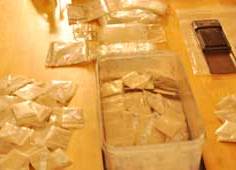
Shafaz was arrested on June 24, 2011 with 896 grams of heroin from a rented apartment in a building owned by PPM MP Ahmed ‘Redwave’ Saleem.

Former head of the Drug Enforcement Department (DED), Superintendent Mohamed Jinah, told the press at the time that police raided Henveiru Fashan based on intelligence information gathered in the two-year long “Operation Challenge.”

Jihah labeled Shafaz a high-profile drug dealer suspected of smuggling and supplying drugs since 2006.

The traffickers had been using an authorised money changer called A J Emporium to transfer funds to Sri Lanka, Jinah revealed.

The drugs were believed to have been smuggled via Sri Lankan Airlines.

Jinah claimed that the network smuggled drugs worth MVR1.3 million (US$84,306) to the Maldives between February and April 2011.

Police also discovered that Shafaz had bought a shop named ‘Charm’ for MVR150,000 (US$9700) that was sold in June 2011 for MVR200,000 (US$12,970).

Moreover, Shafaz was renting three apartments in Malé and owned a tailor shop bought for MVR200,000 (US$13,000), a shop in Kaafu Atoll Maafushi, and a Suzuki Swift car worth MVR180,000 (US$11,673), later sold for MVR170,000 (US$11,025).

As Shafaz was not in the room with the drugs at the time of the raid and his fingerprints were not found on the confiscated drugs, the Criminal Court ruled last year that there was not enough evidence to convict Shafaz on one count of the drug charges.

However, he was found guilty on the second count based on recorded phone conversations and financial transactions with a contact in Colombo, believed to be the supplier.

Three of Shafaz’s accomplices who were caught with the opiates and packing equipment – Ismail Shaheem, Mohamed Meead, and Anas Anees – were meanwhile found guilty of possession and trafficking and sentenced to ten years in prison.

In a speech a few days after the drug bust, former President Mohamed Nasheed said he found it “quite shocking [that] 800 packets of heroin a night were getting sealed in the house of an honourable member of parliament.”

Likes(1)Dislikes(0)

Humam’s confession used against Shan in Dr Afrasheem’s murder trial

The Criminal Court has today heard the prosecution’s evidence against H. Hikost Ali Shan in the case of MP Dr Afrasheem Ali’s murder.

Evidence was presented separately in support of four separate assertions: Shan’s involvement in conspiring to murder, his going to to Dr Afrasheem’s house with the intent of murder, attacking the victim with a sharp object, and Dr Afrasheem’s subsequent death from the attack.

The confession from the Hussein Human Ahmed – who was recently sentenced to death for Afrasheem’s murder – was used to back all four assertions. Humam later stated that the confession was obtained by the  Maldives Police Service through coercive means.

Other evidence presented include two confidential witnesses, audio recording and the script of a phone call, and Dr Afrasheem’s medical report and death certificate.

The defense also presented evidence at today’s hearing. Sun Online reported that the evidence was presented to prove that Shan was in ‘Jalapeno Restaurant’ from 9:00pm on October 1 2012 until 1:00am.

CNMreported that Shan’s Defense lawyer Abdulla Haseen had requested anonymity for defense witnesses stating that, due to the nature of the case, revealing their identities could endanger their lives. The request was granted by the judge.

According to ‘Haveeru‘, a request for leniency regarding Shan’s detention was rejected, with the judge stating that more importance would be given to finishing the case as soon as possible, and that previous scheduled hearings were canceled upon requests from the prosecutor general. The court has been extending Shan’s detention since late 2012.

The judge has  said that a hearing is likely to be scheduled within the next week, and that the case will be concluded as soon as statements of the witnesses are collected.

Dr Afrasheem Ali, a moderate Islamic scholar who was at the time representing Ungoofaaru constituency in the People’s Majlis, was found brutally murdered at his apartment building on the night of October 1 2012.

Shan, along with Humam, was charged with with the murder. In a hearing on May 6 2013, Humam denied the charge before changing his statement and confessing to the murder. He also implicated several others investigated for the murder. After nine days, however, Humam retracted the confession saying that it had been obtained by police through coercive means.

Other suspects mentioned in Humam’s confessional statement – a key piece of evidence on both his own and Shan’s cases – included a juvenile  identified as ‘Nangi, a Maldives National Defence Force officer Azleef Rauf, Abdulla ‘Jaa’ Javid (son-in-law of opposition Maldivian Democratic Party Chairperson ‘Reeko’ Moosa Manik), Jaa’s brother Jana, and another person identified only as ‘Spy’.

In December 2012, then Commissioner of Police Abdulla Riyaz described the murder as a “‘preplanned politically motivated act of terrorism carried out by politicians”.

He also said that both Humam and Shan belonged to a local gang who often carry out criminal acts for politicians and businessmen. Riyaz said that MVR14million was paid for the murder.

Politicians have similarly blamed the recent stabbing of MP Alhan Fahmy on criminal gangs with political paymasters.

Shan, who was arrested at the time of Riyaz’s press briefing, was only charged with the crime on  April 21 2013, where he requested to appoint a defense attorney for himself.

A hearing was held again on 5 May 2013, during which Shan’s defense refused to respond to charges until the findings of police investigations and statements of witnesses were presented. Agreeing to grant the request, the judge said that it was the prosecutor’s wish that it should not be presented.

Since May 2013 several scheduled hearings have been cancelled upon request from the prosecution, including one in July and December last year.

Likes(7)Dislikes(0)

Gasim slams Adhaalath for fielding candidates in Jumhooree Party seats

Jumhooree Party (JP) leader Gasim Ibrahim has slammed the religious conservative Adhaalath Party (AP) over its decision to field candidates in People’s Majlis constituencies reserved for the JP.

Speaking to local media on Sunday, Gasim said Maldivians would not accept the AP’s “unethical” decision.

“Their actions are not in the general interest, in the name of Adhaalath (justice) they are doing everything in the wrong way. This is what I believe. This is the truth. There is no deception in this,” said the JP leader.

“We gave them four seats. They did not accept it. There is nothing we can do,” he said.

The AP was excluded from the governing coalition’s seat allocation. The ruling coalition agreed to contest the People’s Majlis elections as a team and initially allocated 49 seats to the Progressive Party of the Maldives (PPM), eight to the Maldives Development Alliance (MDA), and 28 to the JP.

The AP held a series of discussions with the PPM and JP on the possibility of allocating constituencies to its candidates.

However, negotiations with the JP ended unsuccessfully after it refused to cede the Vaikaradhoo and Makunudhoo constituencies. The PPM also refused to cede five constituencies to the AP.

The AP subsequently announced it would field candidates in all constituencies reserved for the JP, but eventually decided upon seven candidates in PPM reserved constituencies and six in constituencies reserved for the JP.

The AP was among the coalition of parties that backed Gasim during November’s presidential election. After placing third in the re-run of the first round of presidential polls, the JP initially said it would remain neutral and would not support either the PPM or the opposition Maldivian Democratic Party (MDP).

After the AP pledged its unconditional support for the PPM, just days before the second round, Gasim announced that his party had decided to back the PPM in exchange for a 30 percent stake in government and local and parliamentary elections.

Gasim went on to say that any agreement between his party and Adhaalath was invalidated as the two had decided to support the PPM separately.

He said the JP would have fielded candidates for all 85 constituencies if not for the agreement within the coalition.

“Success will not be within reach unless we work together,” he said, calling on coalition supporters vote only for coalition candidates.

The AP’s candidates include Ali Zahir for the Inguraidhoo constituency, Ibrahim Ahmed for the Madduvari constituency, incumbent MP Ibrahim Muttalib for the Fares-Maathoda constituency, Abdulla Ibrahim for the Kendhikolhudhoo constituency, Hassan Rasheed for the Kudahuvadhoo constituency, and Abdulla Haleem for the Isdhoo constituency.

Anara Naeem will contest the Makunudhoo constituency in Haa Dhaal atoll, Aishath Haleela for the Vaikaradhoo constituency, Ahmed Zahir for the Komandoo constituency, Asadhulla Shafie for the Kaashidhoo constituency, and Hisham Ahmed will contest the Meedhoo constituency in Addu City.

The party also named the Fiqh Academy Vice President Dr Mohamed Iyaz Abdul Latheef for the Hulhuhenveiru constituency. Dr Iyaz last week sparked controversy as he endorsed the practice of female genital mutilation in an online forum.

The AP also announced that State Minister for Home Affairs Abdulla Mohamed was awarded the party’s ticket for the Nolhivaram constituency.

Likes(1)Dislikes(0)

PPM concludes primaries, announces seven more candidates

The Progressive Party of Maldives had concluded its primaries for the upcoming Majlis elections, scheduled for March 22.

After having been allocated 49 seats after negotiations with its coalition allies, the party assigned places on the ticket to 13 party members without a vote. A further five were subsequently uncontested for their places on the party roster.

Following primaries for a further 25 seats last Saturday (February 8), the party held six additional races on Sunday, the results for which have been announced today.

Incumbents MPs Ahmed Rasheed and Yoosuf Abdul Ghafoor took the Isdhoo and Gan constituencies, respectively. Ali Shah will contest for the North Fuvahmulah constituency, Azhan Fahmy for the Maavashu seat, Mohamed Ameeth for the Maduvvari constituency, and Ibrahim Didi for the Feydhoo constituency.

After a disagreement with coalition partner, the Maldives Development Alliance (MDA), over the Gahdhoo seat, the PPM eventually ran a primary for the constituency, with Ahmed Rasheed returning as the winner.

Likes(1)Dislikes(0)