Voting began on Saturday morning for the 2013 presidential run-off election, the sixth attempt at a vote in two months.
The 2013 election has faced a series of Supreme Court-issued annulments, restrictions and delays, as well as obstruction by police and the refusal of government-aligned candidates to sign the voter registry – another court-mandated stipulation effectively giving candidates the power to veto polls altogether.
Former President Mohamed Nasheed, who polled 46.93 percent of votes in the first round, is facing Abdulla Yameen, the half-brother of former dictator Maumoon Abdul Gayoom.
Yameen received 29.72 percent in the first round and has been endorsed by third-placed candidate, resort tycoon Gasim Ibrahim, who received 23.34 percent of the vote.
The first round on November 9 saw 86 percent of the Maldives’ nearly 240,000 eligible voters cast their ballot.
Nasheed stands to win the run-off if he can convince just 6180 of Gasim’s 48,131 first round supporters (13 percent of them) to vote for him, while Yameen will be hoping Gasim’s endorsement will see at least 87 percent of Jumhoree Party (JP) support pass to him.
Following Gasim’s declaration of support for Yameen, Nasheed told his supporters “what happened tonight is a very good thing, in terms of ensuring that these elections go forward as scheduled. Had Gasim joined us, PPM would not be signing those voters’ lists.”
The patience of the international community with repeated delays to polls appeared to have run out last week, with the EU declaring its readiness to “consider appropriate measures should the poll on 16 November not bring the electoral process to a successful conclusion.”
Minivan News has ceased updating this feed.
1:30pm – The Elections Commission has held a press conference revealing the provisional results, with Yameen leading by a narrow margin of 51.39 percent (111,203). Nasheed polled 48.61 percent (105,181) – a difference of just 6022 votes.
Total voter turnout was 91.41 percent (218,621), the highest since 2008, up five percent from 208,504 (86 percent) in the first round. 2237 votes were deemed invalid.
11:24pm – Transparency Maldives concluded its press conference, highlighting key findings from its extensive elections observer network, based in 20 atolls, London, Singapore, Colombo, Kuala Lumpur, Delhi and Trivandrum.
There were reports that people were not able to vote because their names were not on the voter registry, but this affected very few cases (less than .07 percent of all voters). Out of those affected (.04 percent) of voters complained at the polling stations.
Voting was temporarily halted in 4.4 percent of polling stations. 50 percent of these cases were interventions at the direction of the presiding officer, while 60 percent were interventions by political party supporters/affiliates, TM revealed.
“We are happy to report that this election has been peaceful with no reported incidents of violence inside a polling station.”
Only .11 percent of ballot papers were disputed by the candidate/party observers during the counting process.
“While election day administration has been excellent, we believe that the real electoral issues are those of lack of political financing transparency, failure of the state to hold to account parties and individuals in violation of electoral offenses, the loopholes in the legal framework which paves the way for abuse, all of which ultimately reduces trust and confidence in the electoral system,” explained the Transparency team
“Transparency Maldives calls on all relevant actors to reform the electoral systems to increase confidence in and improve the electoral systems in the Maldives.”
11:10pm – Speaking at the Maldivian Democratic Party’s post-election press conference, Mohamed Nasheed congratulated the PPM, arguing that his party’s role was now to ensure the government keeps to its election pledges.
He assured that he had no plans to try and overthrow the government, describing the day as a happy one for the Maldives, having attained an elected government.
“We have the opportunity to show citizens how an opposition party that is loyal to the state works.”
Nasheed said that the country had reached an important milestone in maintaining elections. He pointed to the upcoming local and parliamentary elections as the next goals for his party.
“It is early for us to analyse the results and exactly pinpoint where we’ve lost but what is vert clear is that we have lost by a very small margin. That is an indication of the outlook of the country.”
“On the one hand, you have half the country who wants to progress in the light that we see the country and there is another half of the country who wants to remain as PPM sees the country. In my view, democracy is a process. And it is going to take time before we are able to proceed as a normal democratic country. Also in my view, it is our responsibility as an opposition party to make sure that democracy survives,” Nasheed continued.
Asked if he feared for his safety he said no “I will go wherever I have to go.”
Nasheed told his party: “We have repeatedly said, when you fall get up and run. When you lose, be courageous and in victory, be magnanimous.”
When asked what his political future is, he said “I am just 46”.
11:05pm – Also speaking at the press conference, former President Gayoom thanked God for the PPM’s victory.
“Today, the Maldivian citizens have proven that they know democracy and they know democracy’s prosperity and vision.”
“The election went very smoothly and peacefully. The Maldivian citizens have stated their decision clearly.”
“The biggest secret behind us winning this election is that Honorable Gasim Ibrahim joined us.”
To PPM supporters: “Do not let your happiness go to extremes and do not let your thinking go to a point where inappropriate acts are committed.”
Gayoom appealed to his supporters not to allow unrest and wished the best for Mohamed Nasheed.
“We will not allow any harm for President Mohamed Nasheed or detriment to his party.”
“In speeches given at campaign rallies, the president elect Abdulla Yameen Abdul Gayoom has said the new government we establish will not seek revenge. If we are to seek revenge then we will not be able to pay attention and effort to save the country from the state it is in.”
“We want to show the Maldives to be an advanced country. One that knows democracy, to prove to the world that it is a country that is patient in the face of challenges of democracy and works along democratic principles.”
11pm – During the PPM press conference Yameen said his electoral victory is God-granted, a victory for Allah and Islam. “We all worked to save the religion and Allah.”
Yameen pledged that no Maldivian will be ignored, those who voted for him and those who did not. He said he will sit down at the discussion table with MDP and they will not be ignored.
He also thanked former President Gayoom and all others who worked with PPM. “I could not have won the elections without the help of the youth,” said Yameen.
10:33pm – The Elections Commission has notified local media that it will hold a press conference to announce the presidential election’s preliminary results at 1am.
9:55pm – The PPM press conference is ongoing with former President Maumoon Gayoom, his half-brother presidential candidate Abdulla Yameen, running mate Dr Mohamed Jameel, DQP president Riyaz Rasheed, Adhaalath Party president Sheikh Imran Abdulla, Jumhooree Party leader Gasim Ibrahim, and Umar Naseer in attendance. They are offering their congratulations to Yameen for his victory, based on local media reports of polling results.
9:40pm –
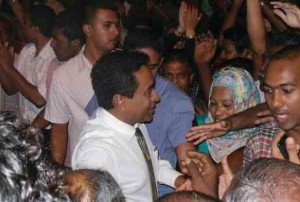
9:15pm- Haveeru’s results have concluded, showing a 51.4 percent share of the vote for the PPM’s Abdulla Yameen. Haveeru have given a figure of 110, 247 votes for Yameen, and 104,462 for Nasheed.
The voter turnout was reported to be 90.8 percent.
Transparency Maldives will hold a press conference at 10pm, the MDP will hold a press conference at 11pm, as will the Elections Commission.
8:20pm – The President’s Office has announced that Sunday, November 17 will be a public holiday.
Haveeru Online has reported that a senior government official informed media that Sunday has been declared a holiday by President Mohamed Waheed Hassan – who is currently in Singapore – as a new elected President will be sworn into office tomorrow.
8:10pm – After gaining 2,777 votes in the past seven days, Yameen has taken Raa Atoll with 57.8 percent, according to Haveeru.
8:05pm – The final counts for the ballot boxes listed in the country’s resorts have seen Nasheed gain 59.1 percent of the vote, despite making only 20 percent of the vote gains his opponent made between rounds, according to Haveeru.
Total eligible voters in this section were 6,522, of which 94.6 percent appear to have voted today.
8:00pm – The results for Kaafu Atoll were recently completed by Haveeru’s monitors, with Yameen gaining 2,269 votes to Nasheed’s 322 between rounds.
The figures show the atoll to have had a turnout of over 93 percent, giving Yameen an eventual 59 percent of votes cast.
7:55pm – Counting has finished in Meemu Atoll, with Yameen winning 57.22 percent, while Nasheed took 42.78 percent – a 627 vote difference according to Haveeru. 4,376 people voted out of 4,693 registered voters.
7:50pm – MVDemocracy’s most recent update shows 33 boxes left to count, with Yameen maintaining a lead of over 5,500 votes at 51.37 percent.
Meanwhile, Haveeru reported 19 boxes remaining, with the PPM candidate holding a lead of over 6,400 votes at 51.57 percent.
7:40pm – The Elections Commission has been made aware of the fault on its update service and has said it is looking into the problem.
7:30pm – With the Fuvamulah boxes all counted by Haveeru’s monitors, Yameen’s gain of 714 votes between the first and second rounds appears to have eclipsed Nasheed’s additional 177 votes, giving the PPM candidate 52.8 percent of Gnaviyani Atoll’s vote.
The EC updates remain unavailable.
7:28pm – According to the results from local newspaper Haveeru, out of the 50 boxes counted in Male City, Yameen gained 6,731 votes more than he won during the November 9 poll. That is an average increase of 134.62 votes increase in each of the 50 boxes.
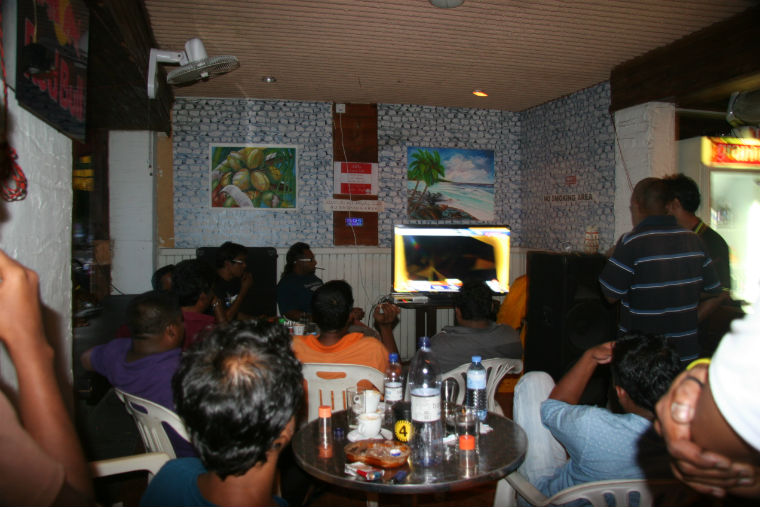
7:25pm – Maldivians across the nation remain glued to any available TV set or mobile phone as the results continue to come in.
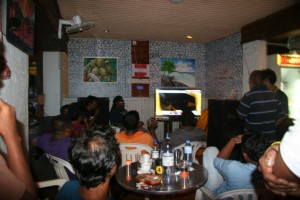
7:20pm – The Elections Commission reports – whose website is down – that 52 percent is going to Yameen so far, with 87 boxes to go. 388 boxes have been counted out of 475.
7:15pm – Former Foreign Minister Dr Ahmed Shaheed has hinted, via Twitter, at the MDP’s likely defeat: “God does not change the condition of a people until they change it themselves! A good day for democracy, but bad day for liberty.
7:10pm – Counting has finished in Dhaalu Atoll, with Yameen winning 53.97 percent, while Nasheed took 46.03 percent; a 381 vote difference according to Haveeru. 4,847 people voted out of 5,053 registered voters.
7:00pm – As the Haveeru total passes 75 percent of eligible votes cast, Yameen leads with 51.71 percent (93,966 votes).
6:45pm – According to MV Democracy website, Yameen has so far won 80,023 votes (51.37 votes) while Nasheed won 75,744 votes (48.63 Percent). A total of 374 out of 475 box counted, 101 remaining. Total 155,767).
6:43pm – “This is what happens when the electorate is lacking in principles. Many of these votes were bought from among the Gasim supporters, I’m sure,” said Ahmed, 47.
“Yameen is clearly winning. And I am moving out of this country,” said Ahmed Nashid, 30.
Ali Ashar, 33, said: “I am speechless. Nasheed struggled to bring in democracy. And the people vote in the old brutality. I am speechless.”
“Alhamdhulillahi. Islam is safe. The Maldives will never compromise Islam,” said 57 year-old Zubaira.
“Yameen’s gotten all the votes he can, I think. We’ll slowly gain in the boxes that are left. My countrymen can’t be this dense, can they? Wait and see,” said first time voter Hanim, sitting a cafe watching the results come in on TV with his friends.
6:40pm – Ballot box held at the Paradise Island resort owned by resort tycoon Gasim Ibrahim shows Yameen winning 43 votes while Nasheed got 30 votes. The result means Nasheed gained 6 votes compared to November 9 polls while Yameen who got just 5 votes gained 38 more votes.
6:35pm – Taking account of 55 percent of the eligible votes cast, Haveeru reports Yameen as holding a lead of nearly 6000 votes with 52.19 percent of the total votes cast. These votes represent 55.5 percent of the total eligible voters.
6:30pm – Fun Island Resort box results: Yameen 43 Nasheed 30. Nasheed in this box gained 6 votes while Yameen who got just 5 votes on November 9 election gained 38 more votes.
6:25pm – Yameen has taken the Holiday Island resort – owned by JP leader Gasim Ibrahim – with over 69 percent of votes cast according to both the EC and Haveeru statistics. After the endorsement of the JP, the PPM candidate’s votes on the resort went from just one to 105 according to Haveeru’s figures.
6:15pm – The EC has updated the provisional results. With 59.58 percent of boxes counted (283 out of 475 total), Yameen has the lead with 51.92 percent (52,467) to Nasheed’s 48.08 percent (48,583).
6:11pm Haveeru’s count now includes half of the boxes, consisting of under 37 percent of total 239,165 eligible voters. Yameen continues to lead the poll, with 52.76 percent (46,170 votes).
6:09pm – The EC’s results have returned the initial count for the first of the boxes on Maamigili – the home island of Jumhoree Party (JP) leader Gasim Ibrahim, whose backing was courted by both parties since his defeat in last week’s first round.
The JP council voted to back the PPM candidate on Wednesday, and the first box shows a win for Yameen, with 53.8 percent of votes cast.
6:01pm – The MVdemocracy site at 257 boxes count reports Nasheed in the lead with 51.84 percent (50.823), with Yameen at 48.16 percent (47,217). SunOnline at 230 boxes counted reports 48.05 percent to Nasheed (39,260), and 51.95% to Yameen (42,449.
5:52pm – With media showing result discrepancies, Minivan News will use the EC’s results where possible.
5:48pm – The Elections Commission has updated its results page. With 192 boxes of 475 counted (40%), Yameen has the lead with 52.53 percent (30,255) of 57,596 valid votes counted, while Nasheed has 47.47 percent (27,341).
5:47pm – With over a quarter of the boxes counted, Haveeru gives Yameen the lead with 52.51 percent of the 66,109 votes counted.
5:45pm – According to Haveeru’s figures, while MDP candidate Nasheed currently takes the lead in Vaadhoo in Gaaf Dhaalu Atoll, as well Maradhoo Feydhoo and Hulhudhoo in Seenu Atoll, PPM candidate Yameen has received twice the number of votes he received in the first round in some areas.
Nasheed received 251 votes in Vaadhoo – an increase of 31 votes from the first round, while Yameen – who received only 65 votes from the island previously – received received 230 votes this round.
In Maradhoo-Feydhoo, Nasheed received 237 votes, while Yameen received 154 votes.
Nasheed is also in the lead in Hulhudhoo, with results indicating he has received 187 votes, but Yameen has received 134 votes – 72 votes more than in the first round.
5:44pm – Young crowds roar in support as local tv station Raajje TV announces a result of a box that is in favor of Nasheed.
At Boafolhi Cafe’, a local cafe located near Nasandura Palace Hotel, a young crowds screams “Yay! GMR is coming back” every time when a result comes in favor of Nasheed.
5:35pm – Minivan News has observed that different media outlets are reporting differing figures for the count. Haveeru’s count at 167 boxes counted states 52.54 percent (27,768) to Yameen, 47.46 percent (25,084) to Nasheed. MVdemocracy.com at 174 boxes states 54.61 percent to Nasheed (29,242) and 45.39 percent to Yameen (24,036). Raajje TV reports 49.79 to 50.28 to Yameen at 171 boxes.
5:03pm – International observers from the EU, Commonwealth, US, UK, Norway. India and Japan are monitoring the elections and the counting process. Local NGO Transparency Maldives is also conducting an extensive nationwide monitoring program, while party observers are present at the majority of ballot boxes.
5:05pm – One Adhaalath Party member told Minivan News to not take photos, citing two reasons: the photographer is female and therefore “her place is not outside taking photos”, and because taking photographs of people is “unarguably ‘haram'”.
5:01pm -The MDP’s Facebook group report the Singapore results, stating that the party has taken 45 percent of the box.
4:52pm – Official progress of counting will be available here http://results.elections.gov.mv/PresidentialElection2013R2/resultweb/
4:25pm – Elections Commission press conference concludes:
The commission stated that the ballot paper has a different security feature to the last ballot paper. EC officials will be informed of the feature at the time of counting and they will check each ballot paper to ensure security feature is present – all ballots without the security feature will be deemed invalid.
The ballot paper was described as being smaller than before because there are only two candidates remaining. It is black and white because they had less time to print the papers, the EC explained.
“I do not believe it is possible for any individual to use any other ballot paper but ours,” says member Ali Manik.
The commission revealed it had received three complaints regarding mismatches between address data on ID cards and the voter registry, though it said it had heard less complaints regarding voters revealing their ballots than had been communicated through the media.
It was noted that, whilst publicly displaying a completed ballot paper is a crime, the act does not invalidate the ballot.
There have also been complaints about anti-campaigning taking place outside of regulated hours. Anti campaigning is against the law, said EC Chair Fuwad Thowfeek, who appealed to all candidates to respect the law and said he does not want to take any action against or fine any media outlet.
Manik said he believes the act of showing ballot paper is part of a plan of buying votes. These acts have occurred before, but this is first time on a large scale in inhabited islands.
Preliminary results will be announced at 12:00 am tonight. And will then address complaints and announce official results by 8:00 am tomorrow morning, Fuwad said.
4:20pm – “We have heard that people have been trying to buy our votes. They are asking us to give them our National Identification cards in return for money. I heard they were giving sums ranging from MVR 500 to MVR 1000,” told Ahmed Thoha, 26 years, who went to vote at the polling station at Muhiddeen School, Villimale.
Another voter told Minivan News that he had got a call from someone who identified himself as an official of the PPM asking him how much would he take to voter for candidate number 3.
An election monitor told Minivan News that they had complained to the officer in charge of the polling station that some voters were trying to show their ballot paper to officials to confirm to the officials who they are voting for. Then the voter meets some other official who stands at a distance from the polling station and gives him the money.
Except for a minor confrontation between a group of youths, polling is otherwise going smoothly in Villimale.
A police officer who was near the polling station at the Maritime Training Centre in Villimale told Minivan News that no one had been arrested during the confrontation and that it was peacefully resolved.
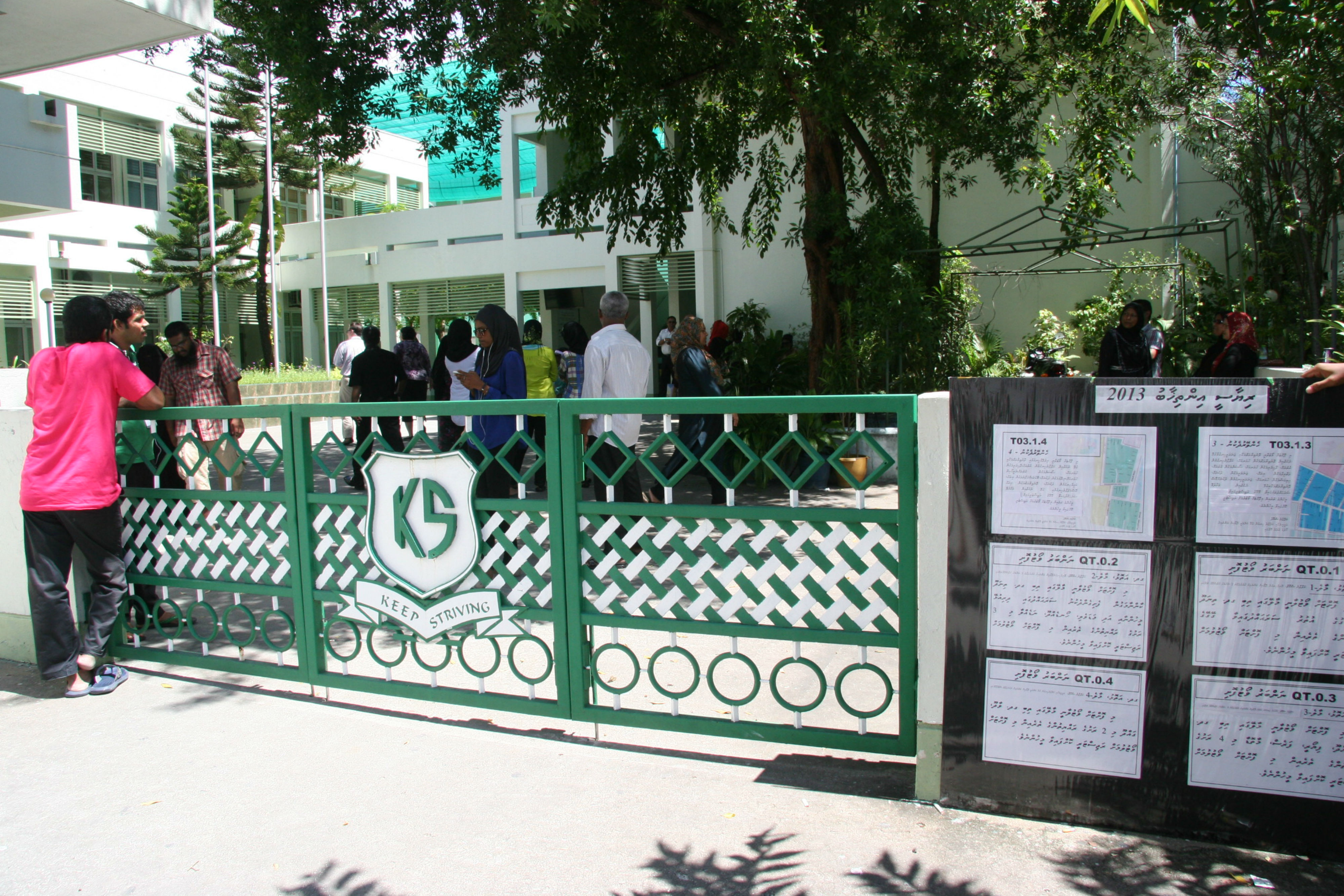
4:10pm – Crowds of people have remained outside a number of polling stations in Male’ to await counting, including Dharumavantha and Arabiyya schools.
Polling officials have said that people are waiting due to their anxiety over the outcome.
Vishal, 25: “Everything calm now but if it looks like Nasheed is ahead during counting, that’s when people may start trouble.”
4:05pm – Police have said that all persons arrested for displaying their ballot paper before putting it inside the ballot box will be released after taking information and a statements from them.
4:00pm – Polls are now closed, those still will be allowed to be cast their votes.
3:50pm – “I don’t care who wins. I just want this whole election drama to end now,” said Dheena Saleem, 29.
“I come to vote because it is my civic responsibility. But I won’t continue being responsible if the state can’t be the same.”
3:40pm – Observing around 150 people waiting outside Majeediyya School in Male’, a polling official told Minivan News that the crowd was waiting for the results to come in.
The official noted that only around seventy people were actually queuing to vote.
3:20pm – 26 year old voter Ali Nasheed claims to have witnessed vote buying near to Jamaludheen School in Male’.
“At around noon, I saw a guy carrying a zipped money bag, handing out notes to people who come out. This is disgraceful on both sides, both who are selling and buying votes. This is no way to contest in a democratic election. I cast a void vote. There is just no point in a place like this.”
3:00pm –
2:50pm – Police arrest a man for obstructing police duty and another for causing disruptions in the polling station in Kaafu Atoll Maafushi Island
2:45pm – Male’ City Council has sent a letter to the two presidential candidates permitting the winning candidateto celebrate on the streets of Male’ and in public spaces within the law.
2:10pm – Minivan News has observed large queues remaining outside many of Male’s polling stations. Many voters appear not to be leaving after having cast their ballot, creating a confused scene outside at a number of locations.
Regarding the large number of arrests for publicly displaying ballots, one EC official said that he was not aware of any such incidents in the capital.
2:05pm – People’s Majlis Speaker Abdulla Shahid has sent a letter to MPs informing them the new president and vice president will be sworn in tomorrow at a People’s Majlis sitting. Shahid said he would give more details regarding the oath ceremony including the time at which the ceremony will be held later.
2:03pm – 27 year old Aishath: “This election will be peaceful with a great result.”
2:00pm – 20 year old Fatu: “We want an elected president because now we don’t have one.”
1:50pm – 25 year old voter Mohamed: “Vote today is good for our religion and for our country. I think it will be close.”
1:45pm – Three men arrested in Gaafu Dhaalu Thinadhoo for stealing ID cards. 60 year old man also reported to have been arrested for hiding his child’s ID.
1:32pm – Ahmed Waheed, a voter in his thirties, just outside the polling station based in Huravee Building said, “I’ve never felt better, to be honest. We’re finally about to moor the ship at the shores of justice and democracy.”
Rauha Waheed, a first time voter, said, “So happy to be part of the 50 percent plus one that is about to re-establish democracy.”
1:05pm – PPM has submitted a complaint to the EC expressing disapproval of the quality and security features of the ballot papers being used in the run-off polls being held today.
PPM Electoral Committee Chair Ahmed Tholal said at a press conference held today that the quality of ballot papers have “drastically gone down” compared to the first round of voting.
“As the ballot papers are in black and white, it will be very easy to extra papers. Or the papers can even be changed. This is something we are very concerned about,” Tholal said.
PPM said that their observers have been alerted to be vigilant about such issues.
1:03pm – Vuham, aged 20: “Today is kind of weird because so many people have been arrested [for showing their ballots] already. They are doing this to make sure they have shown others who they have voted for because they took money from them.”
Inayzh Ameen, aged 23, stated that he hoped he would soon see a democratically elected leader after the “coup”.
“If Nasheed wins, I’m sure they will go to the Supreme Court again. They will have the police again too who will probably have another fake report,” he said.
27 year-old Manik told Minivan News that the vote was important for the good of the nation
Referring to the short-lived secession of the country’s three southernmost atolls in the late 1950s, Manik said: “If Yameen gets elected we will have to liberate the Suvadive from the rest of the republic.”
23 year old voter Tholal: “Today’s vote is important for the future, not just for me but for my children and for democracy in the Maldives.
12:59pm – Elections Commissioner Fuwad Thowfeek said on state TV that the commission is intending to announce the permanent results of today’s run-off polls early Sunday morning.
He further stated that the counting of all ballot boxes can be completed by midnight and that the temporary results will be announced as soon as possible thereafter.
“Everyone is highly anticipating the time when a new President is elected. And so, we are trying to announce the permanent results by very early tomorrow morning, and to announce the elected president. We will be able to share that joy with the citizens by tomorrow morning,” Fuwad is quoted as saying.
Fuwad also commented on the role of monitors and observers, saying “They have a large part to play to ensure that a legit result is released. This is because it will be very difficult to later address an issue that arises at the time of vote counting. Therefore observers must carry out their responsibilities and monitor things closely”.
12:50pm – Fathimath Fazeela, 41 years-old in front of the polling booths in CHSE: “Absolutely exhausted by all this political drama, with all the apolitical, nonpartisan institutions acting all politicised, like the Supreme Court. I hope they don’t do more harm today.”
Ahmed Abu Bakr, 27 years-old at the same polling booth: “Yameen has experience running companies, so he will know to run a country better. Nasheed’s more fitting as an activist, so he can be the opposition. I’m very confident things will turn out that way.”
Aishath Ali, in her late sixties, simply said “Insha Allah we will finally be able to put torture behind us, and bring in a leader who loves the people after today’s vote.”
12:13pm – Polls opened smoothly and preparation was well administered and executed, Transparency Maldives has stated. The local NGO has a nationalwide observer network spanning resorts, prisons, and abroad, including London, Singapore, Kuala Lumpur, Colombo, Trivandrum and Delhi.
The opening of the polls was smooth, and the administrative preparation and execution went well, showing an improvement over the previous two rounds of the Presidential Election. The Elections Commission and relevant stakeholders deserve credit for the smooth opening of polls. The opening procedure went well with 100% of all polling stations open by 8.00am and 91.89% of polling stations open within the first 10 minutes of the required opening time, compared to the first round’s 86.2%.
Nearly all polling station officials were in place at all polling stations. The queue controller and polling station controller were absent at only 0.9% of polling stations.
The materials required for voting were present and the ballot papers were counted and reconciled at all polling stations. All ballot boxes were verified as empty at the start.
Candidates were well represented at polling stations. One or more candidate/party observers were present at 92.4% of all observed polling stations whilst no candidate/party observer was present in 7.7% of cases.
Transparency Maldives also notes that police were present at 95.9% of the observed polling stations at the time of opening, similar to the last round.
Observers concluded that the polling stations were set up to ensure a secret vote in 100% of polling stations .
We encourage all parties to maintain the climate of peace. Our observers are working hard at polling stations and will be present at the polling stations till closing and during counting.
12:04pm – Police state one arrested in Thaa Atoll Kimbidhoo and three arrested on Thimarafushi for violating secrecy of ballot by showing their ballot papers. Total 28 individuals arrested so far on same charges. Of the 28, 16 are from Thimarafushi.
12:01pm – An 18 year old has been arrested in Addu Atoll for stealing 4 ID Cards. Police found four ID cards on him. Police warned the public last night to be cautious of their identity cards as they had received complaints of lost ID cards.
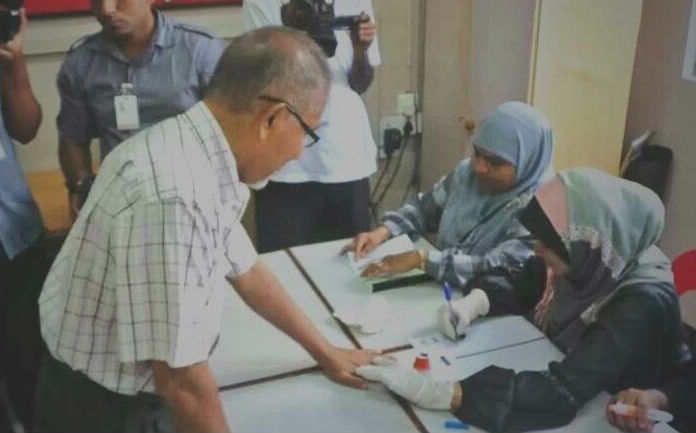
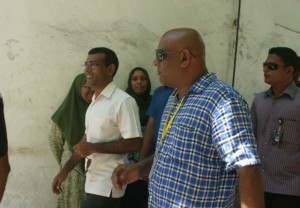
11:40am – Nasheed has voted at the Centre for Higher School Education (CHSE). He did not comment to reporters.
However following the conclusion of last night’s march around Male by thousands of MDP supporters, he said:
“God willing, we will again establish a people’s government in the Maldives. The Maldivian citizen’s hopes will become reality. A government by the people will be established. God willing, we will find shelter for each and every single one of you. We will provide social protection for the elderly, take care of single mothers, orphans and the disabled. We will establish a citizen’s government, a government by you.
“They cannot set us back. After a long journey, we are going to win. We will ascertain that success tomorrow. I thank all you. In this long journey, you have remained steadfast, without getting tired, you have every time, every day, worked hard with strength and determination. God willing, we will get the results of that hard work. Vote for candidate number 4. We will win.”
11:33am – 48 year old Fareesha Abdulla, who voted at Kalaafaanu:
“Today is absolutely critical for democracy and the future of our country. It will determine whether we become a democracy or a dictatorship.”
Asked if this was the case, why people would willingly vote for a dictatorship, she replied “There has been a lot of negative campaigning, using nationalism and religion.”
She also raised concerns over potential intimidation of MDP voters: “The PPM have control of the police and military, and today there is no president in the country. It is totally bizarre.”
11:30 – Voting has restarted at Holiday Island resort.
11:15 –
An anonymous text message sent to several MDP observers reads: “We are watching if you do anything that will benefit Anni [Nasheed] we will wipe out your whole family. Do not think we are joking around. We are watching.”
11:02am –
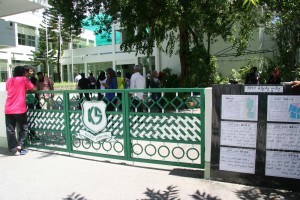
People lining up to vote under the shade-cloth at Kalaafaanu School in Male appeared anxious but peaceful this morning. However the tense atmosphere was apparent over in the pack of party observers near the main gate, with Minivan News observing a verbal confrontations after a PPM monitor in a pink head-dress accused her yellow T-shirted counterpart of campaigning in the queue.
Tensions increased as the MDP monitors accused the PPM side of trying to discourage MDP voters from lining up.
11:00am – – Police arrest 9 in Thimarafushi for revealing who they voted for by publicly showing their ballot papers. Total arrested on same charges is now 23.
10:55am – Total number of people arrested for showing ballot papers up to now is 14.
10:50am – Yameen speaking to the media after casting his ballot:
Asked if he would accept the results, Yameen said that the party would: “But we hope there won’t be huge irregularities. We see things proceeding smoothly. So God willing, we will accept the vote results.”
“The Election [Commission]’s conduct has been OK? Our problem was not having time to check the lists. But we checked the lists and today we are voting. I am not informed of any complaints regarding the voter registry.”
Yameen said that his expectation was a victory with 55 percent to 60 percent of the vote.
“I came to vote absolutely confident. Because we have a very grand coalition. Except the MDP all the other political parties and leaders are together with us.”
Asked if his first act of president, Yameen said it would be “to empower youth economically, improve economic agenda, provide job opportunities.”
10:45am – PPM Presidential candidate Abdulla Yameen arriving at Jamaaludin School to cast his ballot earlier today.
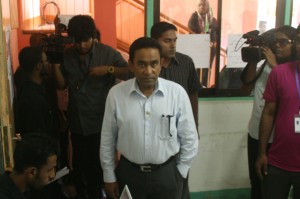
10:35am – Holiday Island is a resort owned by Jumhooree Party leader Gasim Ibrahim. Ahmed Mohamed is the MDP Maamigili Constituency President, he has been told to leave the resort. But he said he will only go away with a police escort.
10:30am – MDP vice presidential candidate Dr Mustafha Lutfy voting in the Addu City ballot box in Majeedhiya School, Male’.
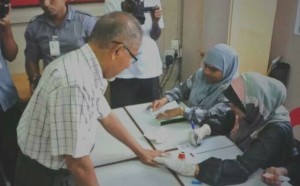
10:15am – Voting has been suspended at the ballot box in Holiday Island Resort. Ahmed Mohamed, an accredited MDP observer, said voting started in their presence and he noticed voters were folding their ballot papers inside out and told voters not to do so as it affected the secrecy of the ballot.
Soon afterwards, resort management told them to leave the island as they were not authorized to observe that particular ballot box. MDP had submitted names of different individuals to observe at the ballot box.
10:10am – Voter Yameen Rasheed, aged 25:
“Today’s vote will ultimately be a contest between modern democratic ideas, and the traditional feudal thinking that could dutifully return to the power the same anti-democratic forces that oppressed Maldivians for decades, if not centuries. A frightening prospect.”
10:00am – A 29 year old arrested in Raa Atoll Meedhoo for publicly showing his ballot paper.
9:55am – Voting has restarted in Laamu Atoll Isdhoo Island but the problem with the voting system has still not been resolved.
9:50am – One man arrested in Faafu Atoll Feeali Island for publicly showing his ballot paper.
9:45am – Voting in Vaavu Fulidhoo voting was earlier suspended before being restarted after a dispute over the ink used to mark voters.
9:40am – One man detained in Gaaf Dhaal Atoll Thinadhoo island on allegation of hiding his father’s ID card.
9:35am – Four men detained in Thaa Atoll Thimarafushi after showing their ballot papers.
9:30am – 43 year old Aishath Waheeda: “Today is important for me because we need an elected president. I have voted in all three rounds now.”
9:20am – Police report that a voting has been suspended in Laamu Atoll due to an issue with the computer systems there.
9;10am – EC Secretary General Asim Abdul Sattar told Minivan News that he is hopeful of a smooth outcome to today’s poll.
“I am more optimistic this time because I think people have had enough of this.”
7:50am – Local media reports that Progressive Part of Maldives vice presidential candidate Mohamed Jameel Ahmed has cast his vote at the Fuvahmulah constituency Arabiyya school, Male’.
7:30am – Voting begins in the country’s second presidential run-off. The Maldives goes to the polls to select the country’s sixth president.
Likes (0)Dislikes
 (0)
(0)