South Asia’s ability to shape its future never stronger: leaders address SAARC

The 17th SAARC Summit was opened this afternoon in Addu City by Prime Minister of Bhutan, Lyonchhen Thinley.

The leaders of Nepal, Pakistan, Sri Lanka, Afghanistan, Bangladesh, Bhutan and India arrived at the purpose-built Equatorial Convention Centre in motorcades, escorted by police outriders in ceremonial uniform, dozens of bodyguards and an ambulance.

The Maldives National Defence Force (MNDF)’s Rehendi helicopter hovered overhead, while arriving heads of state emerged from their vehicles to be greeted by President of the Maldives Mohamed Nasheed and First Lady Laila Ali. They entered the convention hall to the sound of bodu beru drums and the sight of local girls waving paper garlands.

“South Asia is more powerful and prominent than any other time in its history. The future is ours to shape,” President Mohamed Nasheed said, in his inaugural address as the new Chairman of SAARC.

“Our economies are booming. Our political influence is growing. And our ability to shape the course of world affairs has never been stronger. Our populations are youthful and energetic. Our thinkers, researchers and scientists are globally renowned. Our culture is internationally acclaimed. Our private sector companies are some of the world’s largest and most profitable,” Nasheed said.

Citizens in SAARC countries had similar aspirations, he noted: “They want to live in societies based on the rule of law, in which basic freedoms are protected. They want the chance to succeed in our region’s economic miracle. They want what everyone wants: a decent life to live in dignity.”

Nasheed raised three key areas of focus: trade, transport and economic investment, security against piracy and climate change, and good governance.

However climate change, he said, was the greatest long-term threat affecting the region, “causing havoc, threatening our development and prosperity. But the solution to climate change is not cutting back. Rather, it is investing in the new, clean technologies that not only reduce pollution, but also improve energy security and provide long term economic growth.”

President Nasheed also noted the potential for a human rights mechanism in SAARC, “not to point fingers, or open historic and painful wounds, but because we have a duty to improve the lives of citizens.”

Nasheed welcomed the proposal to set up a SAARC Independent Commission on Gender, commenting that South Asian women “suffer from a wide range of disadvantages and discrimination. Women in our region have some of the world’s lowest rates of property ownership and political representation.”

He finished on an optimistic note: “The fundamentals of our region are strong. We have young, energetic populations. We live in a region of vibrant democracies, with strong civil societies.”

“As our economies race ahead, our political importance increases ever more. Let us not be held back by history or convention. Let us be the leaders our people want us to be. Let us change our region for the better. Let us change the world,” Nasheed said.

Leaders address SAARC

In his address to the SAARC delegates, Prime Minister of Nepal Baburam Bhattarai observed that SAARC nations were situated “in the cradle of human civilisation, with abundant natural and human resources. But despite this, our potential is unfulfilled. We face widespread poverty, unemployment and inequality.”

The largest number of world’s poor “live in our region”, Bhattarai said, but the “flow of growth, people and ideas has been hindered and our potential remains unfulfilled.”

Pakistani Prime Minister Yousaf Raza Gilani congratulated Nasheed on hosting the first SAARC Summit in the southern hemisphere.

In bilateral talks on Thursday morning with Indian Prime Minister Manmohan Singh, the historically tense relationship between the two nuclear-armed nations lightened after the two leaders took measures to ease trade limitations. Singh even described Gilani as a “man of peace” following the meeting.

In his speech to the assembled delegates, Gilani emphasised that Economic development was linked to the availability of energy at a reasonable price, an and urged investment “in harnessing indigenous energy sources such as solar, wind, biomass and hydro power.”

President of Sri Lanka, Mahinda Rajapaksa, meanwhile prioritised education in his speech, stating that as leaders, “we have a sacred duty to develop our people.”

“In Sri Lanka we believe in social mobility. Education, communications and healthcare must be made available to all,” said Rajapaksa, adding that “ignorance, deceit, and poverty” were “common evils” facing SAARC nations.

“Social equality goes hand-in-hand with economic progress,” he stated, emphasising that this could only be achieved through peace and security.

President of Afghanistan, Hamid Karzai, also highlighted the importance of education in his address.

“Despite the progress we have made, lack of education and unemployment is a vicious cycle that is creating fertile ground for extremism,” he said.

A stable Afghanistan would enable its use as a land bridge between many countries and greatly improve trade links in the region, he said.

While terrorism was the biggest cause of suffering for the Afghan people, he said, the violence was not only limited to Afghanistan, but also affected Pakistan and India.

“We need to overcome the trust deficit that exists and learn to cooperate,” Karzai said.

He noted that Afghanistan was pursuing a strategic long term partnership with the United States, but said he wished to “reassure our neighbours that such a partnership is no threat to the region.”

The theme of education was continued slightly differently by Prime Minister of Bangladesh, Sheikh Hasina, who in her address emphasised the need for SAARC countries to promote cross-border educational cooperation by institutions such as universities. Bangladesh was interested in opening a university in the Maldives, she added.

Like the Maldives, Bangladesh was also very vulnerable to climate change, Sheikh Hasina said.

“Along with the global economic crisis, we are vulnerable to factors beyond our region,” she said. “Increases in fuel and food prices due to climate change jeopardise a sustainable way of life for our people.”

Another priority for Bangladesh was the expansion of the SAARC convention of the prevention and combat of trafficking in women and children.

“We want to ensure our migrant labour is well treated when working in other countries,” Sheikh Hasina said.

Prime Minister of Bhutan, Lyonchhen Thinley, expressed hope for “youth and dynamism” now the chairmanship of SAARC had been passed to President Mohamed Nasheed and the role of Secretary General to Fathimath Dhiyana Saeed, both the first female and youngest person to assume the role in the organisation’s history.

Despite the distance between the Maldives and Bhutan, the two countries had a surprising number of similarities, Thinley said – and not just because they were the two smallest SAARC nations.

“Rising temperature is a threat to our ecology, and while our GDP is improving, we need to diversify our economy,” he said.

As former SAARC Chairman Thinley was among the most vocal about the effectiveness of SAARC, warning against empty rhetoric and noting “that there is a feeling that cooperation should yield more concrete results.”

“There has been a failure to resolve geopolitical realities, and we have allowed ourselves to be guided by the politics of the past. Good intentions have been foiled, or remain only in documents. Progress has stalled, depriving South Asia of the opportunity to flourish as a peaceful region with people free of poverty,” he said.

Intra-region trade was not more than five percent of the total volume, and cultural interaction between countries was limited, he said.

Furthermore, antagonists such as the “mischevious media” confined goodwill to symbolic gestures.

“We have half the world’s poor. We need be bigger and bolder than those who are holding us back,” he said.

“At the same time, mankind is hurtling toward self-annihilation, and the planet’s capacity to provide for a growing population is declining day by day. We extract, sell, consume, waste and pollute, while our financial system is unravelling.

“We need to act before global order is compromised and a frightened world falls into disarray. We cannot allow natural resources to fall to a level where there is a violent struggle for control.”

GDP was adopted as an indicator of social progress 70 years ago, Thinley said, and was an ineffective measure of human happiness. Bhutan had shifted its perspective towards sustainable development and was taking a more holistic approach, he said.

Indian Prime Minister Manmohan Singh was among the most direct of the leaders, reeling off initiatives India was pursuing.

He announced India’s willingness to facilitate the development of a regional telecommunications infrastructure and promote broadcasting exchanges.

Singh offered India’s scientific and technological base to assist SAARC countries in their development, “and above all our young population who will drive consumption and investment in the years ahead.”

India also proposed establishing a travelling exhibition on the ancient history of South Asia, with pieces drawn from each SAARC member country, hosted in each country’s national museum for three months.

Singh announced the doubling of scholarships offered to post-graduate courses in South Asian University, from 50 to 100, and a further 10 scholarships for doctoral studies in forestry.

“We have to learn to trust each other and to learn from each other. The security of our countries are closely interlinked,” Singh said. “None of us can prosper in isolation. We cannot afford to allow the many problems we face to stand in the way of our ambitions and dreams.”

The Summit is being observed by Australia, China, the European Union, Iran, Japan, South Korea, Mauritus, Myanmar and the United States, as well as many international institutions.

Eighty percent of Commonwealth in SAARC

Outside the convention centre following the meeting, Commonwealth Secretary General Kamalesh Sharma observed to Minivan News that 80 percent of the population of the Commonwealth live in SAARC countries.

“Five of the eight SAARC countries are in the Commonwealth,” he noted.

While acknowledging that this meant there was “a lot of overlap” between the two organisations, the Commonwealth could offer its experience in developing areas such as the rule of law.

“For me it has been very useful to meet the leaders in person. This year is pioneering – this is the first time the head of the Commonwealth has been invited to SAARC,” Sharma said.

Many of the goals of SAARC countries, expressed by their leaders during their respective addresses, boiled down to “a better deal for their people”.

“One remark that particularly stuck me was that ‘no country is working in isolation’,” Sharma said, adding that in developing as a regional body SAARC could learn from the “bitter lessons learned in Europe.”

“As for speed, you can’t change the facts on the ground. There are competing ideologies, and pace is determined by politics,” he acknowledged.

There was space within SAARC for a human rights mechanism, he said, and while many of its concerns related to trade, once the vehicle existed it could be used to talk about human rights as well.

“If SAARC wanted help with this, we would provide it,” he said.

On Friday the Heads of State will attend a Summit Retreat at the Shangri La resort, while their spouses are entertained in Fuvahmulah, before the Summit resumes in the afternoon.

Statements will be made by SAARC observer nations, and agreements will be signed. President Nasheed will present his concluding address, and the delegates will depart in the evening.

Likes(0)Dislikes(0)

Police thwart removal of alleged Christian imagery on SAARC posters at airport

Several members of former President Maumoon Abdul Gayoom’s Progressive Party of the Maldives (PPM), including some MPs, were arrested last night after forcing a dhoni to take them to Ibrahim Nasir International Airport (INIA) where they intended to take down SAARC banners allegedly featuring Christian and other religious imagery.

“The police received information that people had tried to get to the airport using force,” said Police Sub-Inspector Ahmed Shiyam. “The dhoni owner said he refused to take them but that they attacked him and made him go to the airport,” he said.

The individuals were detained at Dhoonidhoo last night. Some have been released while others are being held in custody.

PPM MP Ahmed Mahloof was released at 1:30am this morning. He said the act was organised by several friends and was not attached to PPM.

“It was not a violent or political act,” Mahloof claimed. “We each paid Rf10 for the airport ferry, maybe the dhoni owner got nervous when the police came because about ten people on the ferry were yelling at him to keep going because they had to get to the airport, so he told the police he had been attacked.

“All we said was that they had violated our right to move freely,” said Mahloof, adding that the interaction between those arrested and the police was peaceful. “The police trust the opposition, as does the Maldives National Defence Force (MNDF), because they do not support the President. They told us that we would have to be arrested, and we agreed to cooperate.”

Shiyam said that “with SAARC, the security is very high right now, so we are using a very quick and strong response to this issue.”

Police also took action against Mohamed ‘Wadde’ Waheed, lawyer for former president and current PPM leader Maumoon Abdul Gayoom, who was found walking around Dhoonidhoo island without approval after last night’s arrests.

“Being a lawyer he must have known about the procedures to get onto Dhoonidhoo,” said Shiyam.

Wadde, who was discovered to have arrived on the island via speedboat, was sent back to Male’ for interrogation. He was not arrested, but did not respond to Minivan’s inquiries.

The banners at INIA are part of a series created by local company Mooinc Pvt Ltd for the SAARC summit under the theme ‘Building Bridges’. They are also in display in Fuvamulah and Addu City, where the summit is currently being held.

Mooinc Creative Director Ali Saeed said the designs were based on five themes approved by the cabinet to depict the culture and religion of the eight SAARC nations, which cumulatively practice 10 religions.

Under Religious Unity Regulations published by the government in September, it is illegal to propagate any other religion other than Islam, to carry or display in public books on religions other than Islam, and the translation into Dhivehi language such books and writings on other religions. Proselytising by foreigners remains punishable by deportation.

The regulations interpret the Religious Unity Act passed by parliament in 1994, which carries a 2-5 year prison sentence for its violation.

Mahloof confirmed that the group’s goal was to remove the banners at the airport.

“Our constitution makes it very clear that no other religions are to be displayed in our society because we are a 100 percent Muslim society,” he said, claiming that the government’s approval of the banners for the purposes of an international event surpassed necessary diplomatic etiquette.

“I don’t think the other heads of state were expecting to see their religions shown when they came here. They know that we are Muslim. I have had the opportunity to travel abroad and meet with delegates, and I never expected those countries to have mosques if they weren’t officially Muslim just to show support,” said Mahloof.

Mahloof emphasised that members of all religions are welcome in the Maldives. “It’s not that we are opposed to other religions. Their members are very welcome, we would never support the kinds of attacks that take place elsewhere. But I believe other countries respect our decision to be Muslim, and there’s no need to show so much support for other faiths. I’m sure everyone will be respected in turn,” he said.

Mahloof added that tourists have steadily come through the Maldives without complaining about a lack of Buddhist or Christian displays. He said the banners are not a threat, but rather represent a loosening religious structure.

“My concern is this: since Nasheed came to power we have seen slowly the breaking of the pillars of Islam, making holes to open doors for other faiths. Being a Maldivian, and a young person, I wouldn’t want to see other religions here. If other religions were allowed into the Maldives, I’m sure we would see more terrorist attacks and the kind of violence that is happening elsewhere. Already families don’t talk to each other just from the political changes. If Nasheed tries to bring in other religions, things will go from bad to worse.”

Speaking for PPM, Mahloof said there was suspicion that the current government is making private deals to bring in other religions. “But I believe other countries respect our decision,” he reiterated.

The SAARC summit has tempered what Mahloof said is rising frustration among Maldivian people. “PPM made an agreement yesterday not to do anything during SAARC,” he said. “I’m sure after the summit there will be protests and huge crowds in the streets.”

Mahloof, who has been arrested twice, said “we will take the steps we should with the authorities, appearing before the Human Rights Commission and the Police Integrity Commission” to discuss their arrest.

Likes(0)Dislikes(0)

Comment: SAARC summit should make a bridge to face climate change

“I had five houses but only one is left, all are destroyed by cyclone Ayla. We were not poor, we had everything but now we are street beggar. It happened within a few seconds. Water flows up to the eight feet over the embankment. Now it looks like sea. In every tide saline water flows over the land so we have no way to grow here anything. How shall we get food, shelter and education now? Some people are going to Dhaka and other city but we cannot dare to do this, ultimately we have no choice. We have to leave this place.”

That is a statement of one of Ayla’s victims (at Khulan, a southern part of Bangladesh), made to the UK’s Guardian newspaper.

They are waiting to leave Khulan. 200,000 people have already migrated from the area.

People in Bangladesh are already living with the effects of climate change. Bangladesh is trapped between the Himalayas in the north and the encroaching Bay of Bengal to the south, and is the most vulnerable country in the world to natural disasters due to the frequency of extreme climate changes, and its high population density.

At the 16th summit of  the South Asian Association of Regional Cooperation (SAARC), Nobel Laureate and chairperson of the International Panel for Climate Change (IPCC), Dr Rajendra Kumar Pachaur, said that the Summit would provide an opportunity for SAARC countries to discuss common problems related to climate change that will affect all the countries of SAARC.

However, the slogan of the 17th SAARC summit of the Maldives is`Building Bridge’. The effects of the climate change should be the main focus and SAARC countries should build bridges to face these effects.

All the eight SAARC countries  are facing the effects of climate change: Bangladesh is facing internal migration of its people. Climate change has affected agriculture, so every day large number of people are migrating from village to capital and they are living an unhygienic life, with no sanitation facilities or drinking water. A World Bank study says that in the near future 700 million people in India will migrate to urban areas due to the impact of climate change on agriculture.

The 17th SAARC Summit is being held in the Maldives. Eighty percent of its 1,200 islands are no more than one metre above sea level, and scientists fear the sea may rise up to 0.9cm a year. If the world does not fight against climate change, within 100 years the Maldives could become uninhabitable.

The country’s 360,000 citizens would be forced to evacuate. In Kandholhudhoo in the Maldives, tidal surges already flood homes every fortnight.

Sri Lanka is also vulnerable country to the effects of climate change. Once it used to be said that that climate change in Sri Lanka was more dangerous than civil war – major part of Jaffna and other northern areas of Sri Lanka will be submerged when the sea level rises.

Climate change in Sri Lanka will have dire consequence for water, agriculture, health and coastal regions. Already there are early signs of impact, which will reach serious proportions by 2025.

Melting glaciers could affect 500 million people in South Asia, alongside rising sea level, changing rainfall patterns and scarcity of drinking water. Like Bangladesh, rural Nepalese are already living in poverty due to this effect, and winter wheat crops have been failed due to the warmer climate. Indian wheat is also facing that problem.

Nepal, Bhutan and the Himalayan mountainous region are a few of the most vulnerable areas in the world to climate change. Pakistan has suffered from dangerous floods for a long time.

Thus all the South Asian countries are facing the effects of climate change. Bangladesh is the among most vulnerable of these while the 17th SAARC host country, the Maldives, is no less vulnerable than Bangladesh. Sri Lanka is also in the same condition.

So we hope that the Prime Minister of Bangladesh, Sheikh Hasina, and the President of the Maldives, will take the lead to make a bridge to face the climate change. Other affected countries: Sri Lanka, India, Nepal, Bhutan, Pakistan and Afghanistan should also help to make this bridge. The richest country in the world, the USA, is an observer of SAARC now. Their representative is joining the summit. They have a duty to fight together with the worst climate-affected countries like Bangladesh, the Maldives, Sri Lanka and others.

Swadesh Roy is Executive Editor of the The Daily Janakantha, Bangladesh.

All comment pieces are the sole view of the author and do not reflect the editorial policy of Minivan News. If you would like to write an opinion piece, please send proposals to [email protected]

Likes(1)Dislikes(0)

SAARC Heads of State arrive in Addu Atoll

Heads of State from SAARC countries have begun arriving in the Maldives.

Prime Minister of Bhutan Jigme Thinley arrived early this morning, followed by President of Sri Lanka Mahinda Rajapaksa and First Lady Shiranthi Rajapaksa, and Prime Minister of Nepal Baburam Bhattarai.

The leaders of Pakistan, Bangladesh and Afghanistan are due to arrive this afternoon, ahead of the opening ceremony tomorrow.

Roads around Addu Atoll have been closed during the arrival of the Heads of State, and boat traffic in the atoll halted by the Maldives National Defence Force (MNDF) coastguard.

Likes(0)Dislikes(0)

Scale of the SAARC Summit

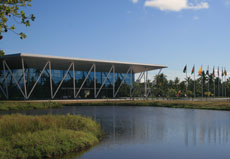
Addu’s new convention centre, purpose-built for the SAARC Summit, looms out of a deserted patch of swampy marshland in Hithadhoo like some kind of spaceship, thoroughly incongruous with the background.

When Minivan News first visited yesterday, a large crowd of local residents stood by the road leading to the giant building, staring at it dumbfounded as if waiting for extraterrestrials to emerge.

Past the polished lobby, the cavernous chamber inside is warmly lined with wood and resembles a modern concert hall. Opposition media outlets have ungenerously suggested the structure is sinking into the swamp, while assorted government officials were quick to attribute this to political jealousy.

Addu is a fiercely independent atoll, neglected by successive governments following an abortive attempt to secede from the Maldives alongside Huvadhu Atoll and Fuvahmulah as the United Suvadive Republic in 1959. This was brutally crushed in 1962 by then-President Ibrahim Nasir using a gunboat borrowed from Sri Lanka, and the entire island of Havaru Thinadhoo was depopulated and its inhabitants dispersed, killed or imprisoned.

The presence of the British airbase at Gan ensured steady employment, English proficiency and free medical treatment. Even today a disproportionate number of the country’s most successful businessmen are from Addu.

The departure of the RAF in 1976 hit the atoll’s independence hard, and the tourism boom beginning to take hold in other parts of the Maldives was slow to develop in Addu despite the presence of an airport and some of the country’s best dive spots.

President Mohamed Nasheed’s decision to declare Addu Atoll a city prior to the local council elections, the declaration that it would be hosting the SAARC Summit, and the building of the convention centre has played to the atoll’s independent sentiment and given it unprecedented political recognition.

There are 30,000 votes in that sentiment – and an additional 8000 with the opening of the new airport at Fumuvalah, a single-island atoll and the country’s most isolated, surrounded by rough and inhospitable seas.

As a domestic political strategy, SAARC appears to be working. Driving along the link road from Gan to Hithadhoo yesterday, Minivan News observed amid the country flags of SAARC nations an abundance of yellow buildings, the colour of President Nasheed’s Maldivian Democratic Party (MDP).

A local woman, sweeping up weeds with a rake under a large billboard, described her work as a “national duty”. The billboard read: “Thank you President Nasheed, you led us to believe in dreams.”
Development after SAARC

Speaking to Minivan News in between juggling mobile phones, Foreign Minister Ahmed Naseem observed that conferencing and event tourism had “huge potential” in the Maldives, given the country’s already “five star personality”. It would shift the Maldives from its reliance on beach and sun tourism, he suggested.

There were, he noted, some “tabloid” opinions about the centre, but said there was already interest in the tender for running the centre post-SAARC and the construction of a nearby hotel from hoteliers around the country and region.

“The infrastructure has been developed and people have been trained to run this kind of event,” he said.

SAARC dignitaries have been staying at the upmarket Shangri-La Villingili resort, while journalists around the world from London to Bangladesh have taken over Equator Village, the former RAF Sergeant’s mess, moaning about the sporadic shuttle bus and opportunistic US$10 taxi fares.

The locals have meanwhile launched a campaign of parades and evening entertainment, with music performances and enough fairy lighting along the link road as to give the place a festive feel. Participation was initially muted, acknowleged one official – “everyone still seems surprised. It hasn’t sunk in yet.”

Among the most successful local operations is the Hubasaana 2011 Arts, Crafts and Food festival, which has set up stalls at major venues and been doing a brisk trade in T-shirts, local handicrafts, and peppery Adduan short-eats and banana-leaf wrapped medicines all made by local producers. Trails of foreign journalists crunching their way through packets of homemade spicy gulha are a common sight.
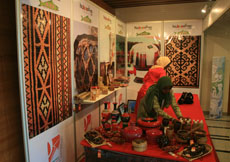
Stalls have been selling local foods and handicrafts to visitors

SAARC Summit

The key day of the Summit is November 10, the opening ceremony during which SAARC heads of state will give their address. During the two-day Summit all traffic in the atoll will be stalled, divers pulled out of the water, and travel on the link road restricted. Last night checkpoints backed up as police logged the registration of every passing vehicle.

During the presence of the world leaders mobile communications around the centre will be jammed; foreign journalists became flustered after being told they would be unable to take laptops or phones into the convention centre during the opening and closing ceremonies due to tight security.

Foreign Minister Ahmed Naseem told Minivan News the most important objective of the Summit was to improve and promote trade in the region, and remove existing barriers and impediments: “only three percent of trade among SAARC countries is regional.”

“We should adopt SAFTA (South Asian Free Trade Area) as soon as possible,” he said.

Economically, the Maldives is most concerned about developing ferry transport connections with countries in the region, reducing its dependence on air travel, and on the climate change front, “promoting renewable energy investment”.

Naseem also raised the prospect of introducing a human rights mechanism into SAARC, but acknowledged that it was ambitious and that SAARC had “an embedded system.”

There was, however, “a lot of good will on all sides”, he said. SAARC would be a success “even if we can agree on the issues to be solved.”

For Addu, the outcome of SAARC has already been assured.

Likes(0)Dislikes(0)

Local handicraft producers join forces against imported counterfeits

The tourists who buy tokens of remembrances prior to returning home after a brief holiday in Maldives tend to believe that the items they have bought are authentic or “Made in Maldives”.

The souvenir items bought are carried all the way from the Maldives, far across the oceans to their home country and gifted to their loved ones, sometimes displayed in their living rooms, providing significance to the brief holidays the tourists have spent in Maldives. The items displayed often create interest and knowledge about the history and culture of the country and sometimes what the buyers learn about the work of art are fixed in their mind and are passed on with the products. The importance of authentic handicraft items and the handicraft industry goes beyond this.

Maldives is country rich in heritage and a culture worthy of immersion and discovery through token and memory. The authentic souvenir items bought by tourists buy show aspects of culture, history and identity, be it the Gadhdhoo mat, the coconut shell necklace or the lacquer item for Baa Thuladhoo.

These authentic handicraft items helps in defining who we are and the context which we live in both in the past and present.

Today, Maldives is a country where tourism has become the largest economic industry playing an important role in earning foreign exchange revenue and generating employment in the tertiary sector. The sector has its linkage to the handicraft industry as well. The constraints confronting the handicraft industry reflects that the weak linkage between the tourism industry and the authentic handicraft industry.

It is said that in the past Maldivian craftsmanship had a regional reputation of excellence reaching as far as the Arab nations. Over time development has taken place with 1972 marking the introduction of the tourism industry to the Maldives. Although the demand for handicraft items increased with this development, with the limited natural and human resources, the supply was not sufficient enough to cater for the increasing demand, resulting in imported handicraft items flooding the market.

Today imported handicraft items, with counterfeit labels identifying them as “Made in Maldives”, dominate the market. The local producer does not have the necessary marketing skills nor the proper channels to market their products as authentic local products, while the visiting tourists do not have the means of identifying authentic handicraft items.

With the market dominated by the cheap imported counterfeited products, the local producer is unable to compete in terms of price and supply. The significance of the culture and heritage of Maldives, which can be displayed through the handicraft items, are often lost and out of focus when the visiting tourists are unable to distinguish them from the imported counterfeits.

The visitors do not get a fair choice of choosing between the authentic local products and the imported counterfeits. These constraints confronting the local producers require measures and support from different stakeholders including the concerned government authorities, businessmen, producers and society at large.

Sustainable tourism requires these constraints to be minimised, paving way for the local producers to share the opportunities and gain more from the benefits of tourism. Maldives Authentic Crafts Cooperative Society (MACCS) was initiated with this aim – to assist the local producer to market their products. MACCS aims to overcome the current constraints confronting the artisans of the rural areas of Maldives and to become identified throughout the Maldives and the world as a development and marketing cooperative of authentic Maldivian handicrafts.

Registered in Male’, MACCS was inaugurated during the Hubasaana festival in October 2011 in Seenu Atoll Maradhoo. Following the inauguration, MACCS has been tirelessly networking with the producers of the country, finding ways and means of marketing their products for the SAARC Summit to be held in Addu City from November 10-11 2011.

During the SAARC Summit, First Lady Laila Ali graced the stall of MACCS at the Gan International Airport. Members of MACCS welcomed her with a handmade gift item designed and made by one of the MACCS members. The displayed products were shown which ranged from items of heritage value, items of utility, and items of beauty and adornment all of which are made by local producers.

The Gadhdhoo mats renowned for their meticulous artisanship, beauty and quality, produced by Faiza of Gdh Gadhdhoo, are displayed in different forms in the stall. It is framed as show piece and it is also displayed as small table mats ideal for a gift item. Bags are also designed with an “indigenous flair”, using designed pieces of mats providing a functional gift item.

Faiza is a producer who has networked with MACCS, and MACCS in turn is promoting her creations. Designed mats have been produced in Huvadhoo Atoll of Maldives for more than four hundred years. It is well established that fine pattern mats, or kunaa, were presented as royal gifts in ancient times. Mats are made from natural vegetation found in the islands. In making a Maldives mat it is dyed using natural dye to the three basic colors used in the kunaa, which are black, brown and yellow. The strips are then woven manually to produce fine quality mats of unique designs.

MACCS is not only showcasing heritage items like the Gadhdhoo mats or lacquer items produced in Baa Atoll. Contemporary creations like those of self-taught designer Wimla are also displayed. These creations are one of a kind pieces often fused with subtle touches of flaura and fauna of our environment. Her creations are also inspired by traditional themes and are often based on motifs and designs found in traditional mats and lacquer work.

Displayed in the Gan airport stall are her hand painted shawls – unique and excellent gift items. Using shells, small rocks pieces found on the beach and waste items such as plastic bottles, she also designs necklaces and brooches creating unique and distinct pieces of jewelry adding significance to recycling and re-using, one of the major goals of MACCS. There are many local producers and designers among us who are artistic and creative who wants to give significance to recycling and reusing.

Displayed are also the products of Moomina Abdulla of Lh Naifaru, who has skillfully crafted the Samusa Gonu, Thoshali and Mulhoashi, items which are commonly used throughout the Maldives in the past. These products are made from the leaves of the coconut tree and are basketry items use to carry fish and different type of things.

In addition to a source of food, historically parts of the coconut tree have been used to make household products such as food covers, sieves and winnowers while the timber is used for boat building. Her creations illustrate Maldivian island setting and the multifaceted use of our national tree, the coconut palm.

In total there are 28 producers out of which the work of 11 are on display at the Departure Terminal of Seenu Gan International Airport. Anyone who wishes to see these creations are welcome to stop by at the Gan International Airport departure terminal. MACCS hope to replicate this exhibition in the near future in resorts all over the Maldives.

MACCS is working with passion and interest to promoting local arts and crafts and facilitating market access for local products. The cooperative acts as a central buying and selling point and is creating a network of producers and buyers. The cooperative will procure the crafts from all over Maldives directly from the producer. The idea is to improve their income by doing away with the middleman, and also ensuring that the customer receives the item at a reasonable price. MACCS is committed and determined through its cooperative to support communities, in the promotion of handicrafts making it a sustainable livelihood for the producers throughout Maldives.

While we all recognize pieces of heritage need to be preserved for future generations we also believe that much has to be done to reap the benefits of the handicrafts industry, by marketing and promoting local authentic products.

MACCS is the logo that visitor has to look for when they are shopping for souvenir items. The logo involves not only the passion of a like minded house wives who are dedicated to promote the handicraft industry of Maldives but it also proudly represents a number of producers of Maldives who are living in the far flung island of Maldives.

The logo reflects the aim for wider outreach, empowering producers and pursuing sustainable development through promoting the local handicraft industry of Maldives. The next time when you are shopping for a souvenir item, perhaps you will see the small logo proudly displayed on authentic handicraft items representing the authenticity and quality of a product made and marketed by MACCS. The creativity and ingenuity of MACCS products will set them apart from counterfeited imported products. This is the way how MACCS is going to go forward and market the local producers’ creations.

Aminath Latheefa is a member of the Maldives Authentic Crafts Cooperative Society (MACCS): www.maccs.com.mv

Likes(0)Dislikes(0)

“It’s not as friendly as it used to be”: the price of politics on Maalhos

Eid brings Muslims worldwide together in a shared sense of celebration. It is also a litmus test for change.

Earlier this year councils were elected for the first time on Maldivian islands. Although they allegedly give islands a larger voice in the national dialogue, in some places the shift has rearranged community life.

“The activities are less common – women don’t play and men do less for Eid,” said Haleema Adam, a Maalhos resident.

Her daughter Nazeera attributed the shift to the advent of multi-party democracy.

“The democracy and party systems created divisions, now people don’t always agree on things,” she said. “Now, people make distinctions by party lines. They still go to the celebrations and help cook for big events, but it’s not as friendly as it used to be. If [our family] plans a party, the others won’t come,” she said.

In keeping with most reports from Maldivian islands, Maalhos residents do not find solutions in aggression. “They don’t show anger in the face,” said Nazeera. “But in the heart it’s there, so they don’t want to play at Eid.”

Eid activities are a favored pastime – ask most islanders on Maalhos about the festivities and they will smile as they recollect a favorite food, game or performance. Yet as young people move to Male’ and technology becomes more accessible, the strongest memories seem to rest with the elderly.

At Ramazan, a conche shell is traditionally blown to signal to other islands that the holiday is being observed. Lately, television and radio have eliminated the need, and therefore the tradition.

Electricity has been a useful advent, however. According to Nazeera, boys and girls no longer have to wait for a full moon to play gon kulhun, a night time game of tag and capture.

Aneesa Adam has many grandchildren, and has lived on Maalhos for most of her life. She remembers a swing that was traditionally hung from a tall palm tree before Eid prayer and used by children throughout the holiday.

“Now, the really tall palm trees have gone,” she said. “They were cut down to build the jetty. A nearby resort bought the trees and in exchange built our jetty.”

The game of fankulhun, a palm leaf version of dodge ball played by women, has fallen in the wake of uncompromising fashions. “Now, we’re too fashionable, too western to play those running games,” said Aminath Nasiha. Another girl gestured to her hijaab.

The changes in Eid traditions are most noticeable by women, who note that activities faded with the rise of Islamic fundamentalism.

“Religious people don’t like activities that gather men and women together. Those who are in charge of the activities have also become more religious, so they can decide what happens,” said Haleema. “Islanders like the activities, women especially, but most have stopped with religion. We don’t like the change.”

“We used to have Women’s day and Fisherman’s day and all those days,” said Haleema. “The women would cook and we’d bring the food in a keyn (large dish) to the school, because it was the only communal space big enough for everyone to gather.” She said the practice stopped four years ago when sheikhs disapproved.

Maalhos residents used to cook on the 40th day after a death to remember the life of the deceased. “We thought it was a Muslim tradition, but now they are saying it is a waste and not good,” said one resident.

Mosques have been gradually segregated over the years, but now women report being told to pray at home. Maalhos has four mosques, two for men and two for women.

Entertainment has been restricted as well. Haleema said local authorities oppose concerts and dance shows as well as a variety of traditional activities. On a quiet island, few options remain.

Several sports-based games featuring women are less common, or are played on a quieter level within families or household units. Women interviewed said they used to play bodu beru, a traditional drumming music still featured at most events. None could explain why they had stopped.

At a bodu beru celebration this Eid girls encouraged onlooking foreigners to dance. When asked if they would join, most girls gestured to their hijaab or burqa and shrugged. “You should have come two years ago, I was dancing then, oh!” said one girl. “But then I took up this [burqa], and that changed.”

“It’s just not very comfortable to dance with this long dress,” said another.

Likes(0)Dislikes(0)

Five lessons for the Arab Spring learned in the Maldives: Time

“Observers of the Arab Spring are wondering what will become of these revolutions once the euphoria subsides and the struggle over democracy grows apace,” writes Jyoti Thottam for Time Magazine.

“There is one corner of South Asia where these questions hit particularly close to home.

In October 2008, voters in this 100 percent Sunni Muslim nation decisively threw out Maumoon Gayoom, the man who had ruled the Maldives for 30 years, making him Asia’s longest-serving ruler. The 41-year-old Nasheed, a human rights activist and longtime critic of the regime, became president, riding a euphoric wave of idealism. As one of his allies told my colleague Ishaan Tharoor, ‘We are not interested in revenge. Now is the time to look to our future.’

So what’s happened to the Maldives since then? On a visit there earlier this year, I found a country that was roiled with protests over rising prices and joblessness, where many people were deeply uneasy about the new prominence enjoyed by Islamists and where the former dictator’s presence still loomed large.

“Despite those challenges, its new democracy is firmly in place. Every country will take its own path, but there are some useful lessons.

1. Don’t be afraid of the Islamists.

In the Maldives, the conservative Islamist Adhaalath Party was until recently a key political ally of Nasheed’s government. The partnership, while it lasted, wasn’t easy. To keep the Islamists happy, for example, Nasheed did little to change the country’s extremely punitive apostasy laws. In an interview with me in Malé, Ahmed Shaheed, a top foreign policy official in Nasheed’s government, explained the rationale for working with the Islamists — their grassroots appeal: ‘That’s where the mullahs excel. On a daily basis they talk to them, five daily prayers, other events, in constant touch with them and as Muslim people who want to know about Islam, about rituals and so on so there is a lot of contact between the mullahs and these lot.’

It turned out that their popular support in local elections wasn’t as strong as anticipated. But the Islamists aren’t just a political force; they’ve also been pushing for the establishment of religious schools, and for expanding the extensive links between madrassas in Pakistan and students from the Maldives.

For all those reasons, Nasheed wanted to keep the Islamists involved in the political process, rather than allowing them to develop into a separate, unaccountable power center. At least for now, the strategy seems to be working. I spoke to Ibrahim Fauzee, head of the extremely conservative Islamic Foundation of the Maldives and a former inmate of Guantanamo Bay (he was picked up in Pakistan in 2002 and repatriated without charges after three years). He does not, however, challenge the legitimacy of Nasheed’s government. He told me: ‘Now we have much more freedom, because we are opening our eyes to the world, following democracy. The nation is going to accept democracy. It’s encouraging us to promote religious activities. We can hold programs. Before, it’s not easy to arrange events in open areas.’

Those events and programs sometimes make liberal Maldivians shudder. The radical preacher Zakir Naik (said to have inspired the accused would-be American militant Najibullah Zazi) spoke to a crowd of thousands in Malé last year, at the invitation of the Islamic Foundation. The real test will come now, with the Adhaalath Party in the opposition.

2. Do worry about the economy.

During the first week of May, the capital city of Malé went through a week of nightly protests, in which young people filled the narrow streets to express their anger over the government’s decision to partially float the rufiyaa (the local currency), a move that led to a sudden drop in its value and a spike in prices. Many in the government suspected that the protests were organized by opposition parties; whether that’s true of not, it was a wake-up call for the government.

‘It was ironic because in the Middle East we saw people wanting to bring down dictators, and here it is the other way round,’ press secretary Mohamed Zuhair told me. ‘We have already brought down the dictator. Probably what happens here might play out in the Middle East.’

3. Be ready for ghosts.

After he was ousted from power, former president Gayoom wasn’t killed or exiled; he still lives in the capital, Malé, and is still a leader of the Progressive Party of the Maldives. He may never be elected president again, but he still wields an enormous amount of influence – most Maldivians have never known any other leader. Even officials in the government sometimes find it hard to hide their animosity toward the man whom they blame for decades of human rights abuses. When a dictator rules for 30 years, his support networks don’t dry up overnight.

4. Expect pragmatic foreign policy.

During Gayoom’s rule, foreign policy was largely put to the service of keeping him in power. In 1988, when faced with a coup d’etat, Gayoom invited the Indian military in to help him. India obligingly sent in paratroopers and put down the rebellion within a matter of hours, further strengthening the Gayoom regime’s ties with India. Of course, that didn’t stop him from also courting Pakistan — where thousands of Maldivians students have studied in madrassas. Since the new government came to office, those two relationships are still by far the most important. India is the acknowledged regional superpower, although its economic support is now much more important than its military support. And until the Maldives expands and improves its schools, devout Maldivian families will continue to send their children to Pakistani madrassas in the absence of any better option.

5. Create strong institutions, not just governments.

Perhaps the most important lesson — one that I heard over and over in my conversations with Maldivians — is that after dramatic political change, a country has to turn its attention to civil society. The nature of any authoritarian regime is that it extends itself into every institution — from schools to the media to the police and judiciary. The hard work of the post-revolution revolutionaries is taking those institutions back and making them truly independent.

One of the most inspiring people I met was Aminath Arif, founder of the Salaam School and a longtime campaigner for education and women’s rights. She was full of creative ideas to improve the skills and employability of young people in the Maldives so the all-important tourism industry wouldn’t need to bring in so many guest workers. She even supported the radical idea of relocating most of the country’s populations to the two largest islands, to make it more feasible for the government to build bigger, better primary schools. Sadly, she died in July after suffering burns in an accident. Her work, and that of the Maldives’ new democracy, continues.”

Read more

Likes(0)Dislikes(0)

Palm pyre, koadi and coloured water: Maalhos celebrates Eid

While government officials flock to Addu for international convention SAARC and Male’ residents enjoy a calm holiday atmosphere, islands across the Maldives are welcoming family and friends home for Eid celebrations.

The island of Maalhos in Arif Atoll has been preparing since last week.

Male’-based residents who arrived last Thursday, November 3 spent the following day and evening preparing curries, rice, poppadums and juices for those cousins, children and guests hitching an overnight fishing dhoni from Male’ on Saturday, November 5.

November 6 began with an unofficial sunrise burning of a palm pyre on a beach facing several nearby islands, a traditional signal that Maalhos is celebrating Eid.

Residents later flocked to an extended morning prayer, filling Maalhos’ four gender-distinct mosques. Afterwards the traditional exchange of invitations to eat at neighbors’ houses began, and doors, kitchens and tables became communal property as grandmothers and aunts shuttled dishes and glasses of fruit juice from hand to hand.

A quiet island of population 800, Maalhos actually houses 200-300 people at any given time – most residents live in Male’ or work at sea. During Eid, however, a steady stream of school children, adolescents and mothers-to-be bring gossip and activity into the island streets and homes.

When asked how Eid days compare to typical Maalhos days, most interviewed replied, “It’s the same. We don’t do much, we are just here.” What is their favorite part of Eid? “Food!,” said many, listing favorites such as mahdu (a Maldivian cake), bondi bai (a round rice sweet) and kashi key, a fruit which falls from trees at bowling ball size and is commonly exported for sale in Male’.

One islander observed that Maalhos has shed some of its traditional Eid practices, but maintained that “it’s a very fun holiday, we have food and play. We like to see the traditional cultural games and hear Maldivian music, like bodu beru.”

Eid holidays last one week beginning November 5, however festivities are condensed into the first four days.

In addition to the first days’ morning torch, Maalhos’ youth flirtatiously ambushed each other with sacks and bottles of red water on their way to the sea. Those wearing white walked at their own risk.

In the late afternoon, married and unmarried men challenged each other to a friendly football match near the harbor; women will carry out their own game later today.

Late in the evening, a procession of men dressed as women and old sages paraded through the streets amidst clouds of flour tossed by onlookers (vedhumaa dhiun). Following young male dancers to the island’s president, the leader requested permission to “play” on the second day of Eid. A bodu beru group performed by the harbor in the evening’s finale.

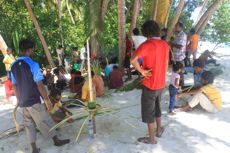
Today, males of all ages assembled by the beach to build the traditional koadi, an array of coconuts, papayas, flowers and coconut palm leaves inscribed with raivaru (poems) recounting local romances and juicy gossip.

“It’s a tradition, but it’s just for fun,” said Koki, a Maalhos girl home for the school holidays. “They march the koadi through the streets with bodu beru and then put it on a girl’s head and chase her. Everyone tries to destroy the koadi by tearing off the palm leaves and passing around the poems.”

Women and children greeted the male procession by tossing sacks and vats of colored water over house walls. Afterwards, procession members paraded Maalhos’ streets with their own colored waters, chasing girls into their houses.

Although Maalhos will not host activities for the next two days of Eid, an islander said the island’s traditions are similar to those of other Maldivian islands.

“I don’t know why we don’t do these celebrations any more, I think nowadays many things are changing,” said islander. A few girls nearby suggested that religion was a factor. He said there was more than just religion, but concluded that “on Maalhos, it will be quiet except for maybe a concert or a football game.”

Traditionally, the third day of Eid is marked with a mahdi and bodumas, a large fish constructed from palm leaves and paraded around the island. Day four is designated for black mali, or people who paint themselves in black and throw black balls at residents, wearing only palm leaf skirts.

Many say Eid’s rhythm isn’t a far cry from the average Maalhos day. A quiet island whose population has mostly migrated to Male’, its holiday habits suggest a strong focus on communal stability rather than a need for razzle dazzle. Minivan’s repeated inquiries about the history of Eid festivities consistently yielded a satisfying, simple response: “It’s tradition, it’s just for fun.”

Likes(0)Dislikes(0)