Mother of deceased premature baby receives 100 lashes for fornication

Aminath Shaira, age 30 of Finolhu/Noonu atoll Manadhoo, was publicly lashed 100 times outside the Justice Building for committing fornication. Lashing is the standard punishment for intercourse outside of marriage under Maldivian law.

Shaira was sentenced to one years’ imprisonment after she was identified as the mother of a premature baby that was found on 19 May in a Coast Milk tin in the bushes near the Vilimale’ powerhouse.

Forensic experts at the time claimed the baby was dead upon birth, and had been aborted after a five-month pregnancy.

Shaira was also sentenced to 100 lashes and one year’s house arrest for fornication, the Criminal Court confirmed today. Officials said she would be transferred to a prison in the next few days.

Shaira had been charged with disobedience to an order under article 88(a) of the 1968 penal code as well as violations under the Child Protection Act.

Fingerprints belonging to Mariyam Rizna, 18, of Guraidhoo in Kaafu Atoll, had been found on the Coast Milk tin at the time. Rizna was sentenced to six months in prison for helping Shaira deliver the baby.

A third suspect, Aishath Aniya, 24, of Huraa in Kaafu Atoll, was released after the court determined that there was not enough evidence to prove that she had provided abortion pills to the defendant.

Police were unable to identify the baby’s father at the time, and Shaira did not reveal his name.

Abortion is illegal in the Maldives except to save a mother’s life, or if a child suffers from a congenital defect such as thalassemia. Anecdotal evidence, however, points overwhelmingly to a high rate of abortion and unwanted pregnancy.

Around the same time as Sharia’s arrest, a dead infant was found in a plastic bag in Male’s swimming track area. A medical examination later concluded that the baby had sustained cuts, bruises and other wounds, an indication of possible abortion practices.

In November 2010, an abandoned newborn was discovered alive in bushes near the Wataniya telecommunications tower in Hulhumale’.

In January 2010, Minivan News reported that many women unable to travel to Sri Lanka resort to illegal abortions performed by unskilled individuals in unhygienic settings.

Deputy Minister of Health and Family Fathimath Afiya told Minivan News that a meeting was held today to discuss reproductive services in the Maldives. While Maldivian and Shariah law criminalise abortion and intercourse outside of wedlock, Afiya said communication between relevant services and the judiciary made it difficult to fully address each case.

“There needs to be an appropriate legal framework for reporting these cases to the services that could help unmarried and teenage women in compromised positions,” said Afiya. “We are very concerned about the rising number of unwanted pregnancies and abortions by married and unmarried women. Today, we began formulating an action plan for short- and long-term improvements.”

The action plan, which will be finalised during a half-day workshop in November, aims to create awareness of the challenges that pregnant married or unmarried women face, and the comparative lack of appropriate services, among citizens and legislators.

“The situation is very serious, I was surprised at the work that needed to be done to improve the situation,” Afiya said.

Sexual education is not administered per se in the Maldives, and the only official study of reproductive health was done in 2004. Other unofficial studies have noted that very little information is available on the subject.

According to Afiya, up to three cases of abortion are reported by Indira Ghandi Memorial Hospital’s (IGMH) family protection unit–a scant slice of the real picture. Most abortions go unreported or are only brought to medical professionals when an unsafe abortion has damaged the mother.

The stigma of having a child out of wedlock appears to drive women to grave action. Some use abortion-inducing pills or receive injections from amateur abortionists; others turn to harmful vaginal preparations, containing chemicals such as bleach or kerosene. Although infrequent, some women insert objects into their uterus or induce abdominal trauma.

Afiya said the situation is not limited to abortions – an increasing number of women abandon their babies at the hospital after birth.

“Some will just leave after giving birth. It does happen somewhat regularly,” she said.

In 2009, a young woman convicted of having extra-marital sex was also flogged. Amnesty International called for a moratorium on the “inhumane and degrading” punishment in the Maldives.

Although flogging is still a legal form of punishment in many Muslim countries worldwide, Amnesty officials claim that it specifically discriminates against women. Of the 184 people sentenced to lashing in 2006, 146 were female.

Likes(2)Dislikes(0)

MDP Parliamentary Group considers no-confidence motion against HRCM

Maldivian Democratic Party (MDP) MP Mohamed Mustafa today said that the MDP Parliamentary Group was considering forwarding a no-confidence motion against the Human Rights Commission of the Maldives (HRCM) members, for failing to protect the human rights of citizens.

‘’We have noticed that the HRCM members that we appointed have failed to protect the rights of the citizens, and are more concerned about protecting the rights of particular persons,’’ said MP Mustafa. ‘’I am ashamed of HRCM for they have showed no effort in fulfilling the duty assigned to them.”

Mustafa referred to the recent incident where a 17 year-old boy was injured in a protest led by the MDP calling for judicial reform, during which the activists gathered outside former President’s house.

‘’HRCM did not even a say a word of sympathy to the young boy who was injured, they did not even visit the hospital to see him, but when police arrested the former President’s son Gassan Maumoon, they prepared a press statement,’’ he claimed. ‘’This shows what kind of things concern HRCM members.’’

Mustafa said that HRCM had another statement, as yet unreleased, calling on the MDP not to gather near the former President’s residence, and not to threaten the judiciary.

‘’But we have a right to protest, we conducted the protest in accordance to the laws,’’ he claimed. ‘’So there is no use of the current HRCM members and paying money to them is a big waste.’’

He called on the resignation of the commission members and said the commission would be “better with empty desks”.

‘’That day knives were dropped and pots filled with stones were thrown from the former President’s house, and a 17 year-old boy left disabled. He is very young and he is half-paralysed.”

President of the Human Rights Commission Mariyam Azra did not respond to Minivan News at time of press.

In August, a delegation from the Maldives headed by Attorney General Abdulla Muiz reported to the UN Committee on the Elimination of Racial Discrimination that the country’s Human Rights Commission “was one of the most active national institutions in Asia”.

Likes(0)Dislikes(0)

Addu Cultural Centre promotes arts in plan for progress

As Addu moves forward with SAARC preparations, local artists are also recommending a look at the past.

The Addu Cultural Center is the first historical replica village in the region, and the second in the Maldives. Founders Saifulla Hameed, Ibrahim Fariq and Min Haj said it serves three purposes: to respect the elderly, to remind the youth, and to introduce tourists to Maldivian heritage.

“Even now, people are visiting the center,” said Project Director Hameed. “They are shocked when they see this replica of how Maldivians lived years ago. For the older generation who remember this lifestyle, it’s like traveling back in time, and they are especially happy to see this. We also plan to invite schools to educate the young people.”

Construction of the center began six months ago, and is due for completion in time for the SAARC Summit, which starts on November 10.

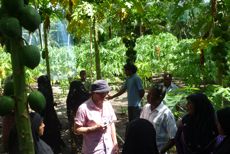
The center includes seven buildings made from palm materials: a blacksmith, a living area, a bathroom, a 60-year-old koda dhoni, a kitchen, a school and a historical display room. A garden is also being cultivated. Buildings are furnished with original artifacts. Local crafts will be sold in one display building as souvenirs.

As SAARC approaches, the centre’s finishing touches are being made during any possible moment.

“It is hard to work because most people are preparing for the summit, but we work at night or during the day, when people are available,” said Hameed.

Project Partner Ibrahim Firaq began collecting artifacts at age 16; he is now 47. The Cultural Centre is the first opportunity he has had to make use of his collection.

“It was one of my dreams to put the collection on public display. I can’t even sleep, I am so eager to open this place,” he said.

Firaq’s collection includes coal-blowers, traditional cookware, rope bed frames, boat building tools and more. Many items, such as colonial clocks, European pottery and Arab tea and coffee pots, indicate the importance of international trade to the Maldives.

The collection will be used by a team of 20 staff who will “live” in the village.

“We have been training these workers to work, live and behave appropriately to illustrate a traditional lifestyle,” said Hameed. “The elderly picked it up easily, since many have actually lived like this when they were younger. But the younger workers need training.”

Hameed said he had developed the concept years ago, but applications for funding were previously rejected. Recent council elections and SAARC preparations paved the way for funding and expansion.

The centre is privately funded, and supplemented by a government contribution. Hameed said growing interest in developing Addu as a tourist destination has made the centre more significant.

“People staying at resorts have nice food and activities, but there isn’t much to see on those islands. Now, with more paved roads and things to see in Addu, there will be more reason to come here,” said Hameed, who looks forward to the attention that Addu is expected to receive during and after SAARC.

Addu atoll features a mere two resorts and two local hotels; council officials called accommodation a development priority. Mayor Abdullah Sodiq however said Addu offers unique opportunities for tourism within the Maldives.

“Addu is unlike other areas in that it offers places to visit. The remains of the British royal air force can be of interest to Europeans, and the Commonwealth War Grave is interesting to Commonwealth countries,” said Sodiq. “We also offer a protected marine area, as well as excellent diving.”

The Cultural Centre’s team also reported local interest in opening art galleries, crafts markets and Maldivian restaurants.

Haj said Addu should use the new convention center for more than just business events.

“Right now, Addu needs more accommodation to really host big conventions. I’m not sure that they’ll get more than two events a year. They should use the center for exhibitions, concerts or plays,” he suggested.

Few Maldivian schools boast artistic and cultural studies as a strong point. The government, however, has taken steps to foster cultural awareness.

Maldives Hulhevi Media Project recently began the first digital recording and documentary of the traditional Buruni Ballad, funded by the United States Embassy.

In September, the government announced plans to sign the UNESCO Convention for the Safeguarding of Intangible Cultural Heritage. Deputy Minister for Tourism, Arts and Culture, Mamduh Waheed, said at the time that protecting cultural heritage would improve tourism in the Maldives. “We have a market for the natural aspect of the Maldives, and now we will be able to add cultural attractions and destinations. I think it will draw tourists interested in cultural conservation,” he observed.

Recently, a UN State of the World report found that over half of the global population was under the age of 25. One-quarter of the Maldives’ population is aged between 15 and 24, with a quarter of the young men and half of the young women reported as unemployed.

Vice President of the Maldives Dr Mohamed Waheed Hassan recommended creating more job opportunities in the atolls.

Deputy Minister of Finance Haifa Naeem said it was important to “diversify jobs to attract the youth market, in fields such as arts and culture.”

The SAARC summit will be preceded by several days of festivities by local and international dance, music and sports groups.

Likes(0)Dislikes(0)

MNDF concludes investigation into the shooting death of Sergeant Shaukath

The Maldives National Defence Force (MNDF) has concluded its investigation into the death of MNDF Sergeant Ibrahim Shaukath, who was accidently shot in the head while he was on SAARC Bodyguard Training.

In a statement, the MNDF said that the investigation team had determined that Shukath’s death occurred due to the negligence of Lieutenant Muaz Mohamed.

The MNDF said that Shaukath was accidently shot while he and fellow MNDF Officers were doing a private training in the resting area to prepare for a ‘’wounded shoot’’ test due to be held the next day of the incident.

In a ‘Wounded Shoot’ exercise, soldiers are trained how to shoot and reload when one hand is wounded. While they were practicing, Muaz received a magazine with a bullet in it did not check whether the magazine was loaded before putting it into his pouch.

According to the MNDF he inserted the magazine into his pistol and fired at Shaukath. The soldiers were standing in a circle when the incident occurred and Shaukath was in front of Muaz.

The MNDF said the incident was unintentional but due to the negligence of Muaz, he had been ousted from the course and transferred to a section where he does not have to handle weapons.

The MNDF said that according to its regulation it is a required to check whether a magazine has bullets before firing, and that in the bodyguard Training, instructors had not told the students that officers should point weapons at each other in violation of MNDF regulations.

‘’While bodyguard Training is a high risk course, there wasn’t an adequate number of trained instructors sent to the program,’’ the MNDF statement acknowledged.

There were not enough magazines to use in the program and officers had to share magazines, a practice that was not safe, noted the MNDF in the statement, adding that officers had mismanaged the issuing of the magazines.

‘’That day there was only one first aid-trained person in the training centre, and he was also not a person trained for high risk programs,’’ the MNDF said in the statement. ‘’Some tools that are used in first-aid were unavailable at the training centre and the emergency vehicle used in the training was  not an adequate vehicle to use in emergencies.’’

The MNDF said that the issues noted in the investigation have been sent to the Defence Ministry as recommendations.

Likes(0)Dislikes(0)

Half the world aged under 25: UN State of the World Report

With almost half the world’s seven billion people aged under 25, and 1.2 billion aged 10-19, investment and education in the young has never been more important.

That was one stand-out finding of the UN’s State of the World Population Report for 2011, unveiled in the Maldives today during a ceremony in the UN’s headquarters in Male’.

Rather than preach population reduction measures, the report acknowledges seven billion as testimony to the success of humanity, and advocates “planning and the right investments in people now – to empower them to make choices that are not only good for themselves but for our global commons.”

Space, a video promo by National Geographic for the report noted, was not the problem. Rather, it was a question of balance.

“Our world of seven billion can have thriving, sustainable cities, productive labour forces that can fuel economic growth, youth populations that contribute to the well-being of economies and societies, and a generation of older people who are healthy and actively engaged in the social and economic affairs of their communities,” noted Executive Director of the UNFPA, Babatunde Osotimehin, in the report’s introduction.

“People are living longer, healthier lives. But not everyone has benefited from his achievement or the higher quality of life that this implies. Great disparities exist between and within countries. Disparities in rights and opportunities also exist between men and women, girls and boys,” Osotimehin wrote. “Governments that are serious about eradicating poverty should also be serious about providing the services, supplies, information that women need to exercise their reproductive rights.”

Many of the issues to do with providing opportunities for youth outlined in the report have strong parallels in the Maldives, where a quarter of the population is aged between 15-24.

Speaking at the report’s launch in Male’, Vice President of the Maldives Dr Mohamed Waheed Hassan observed the migration of young people to Male’, and the need to create more job opportunities in the atolls.

Currently, a quarter of all young men and half of all young women in the atolls are unemployed. Anecdotally, many youth in Male’ are voluntarily unemployed.

Dr Waheed acknowledged the problem: “As important as access to jobs are better wages. People make calculations on whether it is worth working. If the pay is so low [they are unable to afford rent], they will stay at home and remain dependent on their parents,” he noted.

“It is also important to look at jobs not just in terms of salaries, but work satisfaction,” Dr Waheed said, noting that teachers in the Maldives frequently claimed this as their highest concern.
It was also important to ensure growing the number of jobs – an estimated 21,000 were needed each year – also included women, he added.

Deputy Minister of Finance Haifa Naeem suggested the Maldives needed to “diversify jobs to attract the youth market, in fields such as arts and culture.”

“Social investments in youth people’s education, health and employment can enable countries to beuild a storng economic base, thereby reveersing intergenerational poverty. Enhancing young people’s capacties can yield larger returns during the course of their economically productive lives,” the report noted.

Read the report

World at a glance:

  • People under 25 make up 43 percent of the world’s population, and 60 percent of the population of developing countries
  • Seven billion people would fit shoulder-to-shoulder in Los Angeles
  • 27.3 percent of young women in South Asia are employed, compared to 47.7 percent in developed countries. In the Middle east, the figure is 21.5 percent.
  • Half the population of the world live in cities
  • Asia currently accounts for 60 percent of the world’s population, while Africa is expected to triple to 3.6 billion by 2100
  • The average fertility rate is 2.5 children
  • The population growth rate for developed regions is 0.4 percent. For least developed regions, 2.2 percent
  • The population grew by one billion in just 12 years

Maldives at a glance:

  • The Maldives’ population in 2011 is 325,125, not including 70,259 foreign workers
  • Male’s population in 2011 was 110,000. In 1911 it was 5236, and in 1970, it was 14,037
  • 40 percent of the population are aged 15-24, and half of the country’s young people live in Male’
  • 1 in 4 people in the country are expatriate workers
  • Life expectancy has increased by 20 years since the 1980s
  • Every day, 20 people are born and three people die
  • The average annual income in Male’ is US$7217. In the atolls, it is US$647 – eight percent
  • One in three Maldivian women experience physical or sexual violence in their lifetimes
  • 42 percent of working-age women are unemployed
  • In the atolls, 50 percent of young women and 25 percent of young men are unemployed
  • The average woman is married at 19, and has her first child at 20
  • The Maldives spends 15 percent of its GDP importing fossil fuels, over US$200 million a year
Likes(1)Dislikes(0)

Addu grows roots with SAARC preparations

“This is the foundation of Addu’s development,” said Addu’s mayor Abdullah Sodiq, referring to the city’s SAARC preparations during a press conference held in Hithadhoo yesterday. He said the projects had been supported by “99 percent” of Addu residents.

Maldivian media was flown to Addu yesterday to observe preparations for the upcoming 17th annual SAARC Summit, scheduled for November 10-12. Festivities will be held in the area starting on the first of the month, in conjunction with the Muslim holiday of Eid.

“We are expecting a lot of traffic through here, and are confident that everything will be ready in time,” Sodiq said. “But this is only the beginning, and we have many more plans for development.”

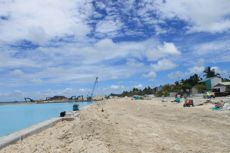
Addu’s SAARC projects have been underway for six months, officials report. As the deadline approaches, construction teams are working round the clock to finish two harbors, a VVIP lounge, roads and the country’s largest convention center.

Sodiq said the harbors will renovate Addu’s commercial prospects, while the convention center provides new opportunities for locals, officials and foreigners alike.

Construction of Feydhoo harbor continues as the first deadline passes and another approaches.

“The harbor is a central place for Addu, there is demand for it even after SAARC and we have plans to generate more industry and shipping using these new resources,” said Sodiq.

New roads constructed around the convention center have made future road development less expensive for the council’s budget, he added.

Addu’s council also plans to use the Rf115 million convention center, a two-story building of glass, wood and marble with a capacity of 3000, to transform the atoll from a quiet place to a hub of business and tourism.

“We have some representatives talking to businesses in Singapore and Malaysia about hosting events here,” Sodiq told Minivan News. “We will be soliciting bids to find the right event manager to look after the convention center as well. I think there are people interested in what Addu has to offer, and I’m sure we can get a market for it.”

Officials and locals interviewed also hinted at hopes for musical events, theatrical performances, art exhibitions and holiday celebrations.

Ministry of Tourism, Arts and Culture Assistant Director Ahmed Abeer Ismail said the centre’s origins were a sign of Addu’s potential. “That area began as a swamp, now it’s the biggest convention center in the country.” The swamp was heavily landscaped by MNDF and police forces, and now features a few scenic islands.

One of the Maldives’ most strategic atolls, Addu has been largely left to seed since the British withdrew its forces and influence in 1975. City councilor Ahmed Mirzad called SAARC the beginning of a new Addu.

“For 30 years we had Gayoom, and nothing was done in Addu. Then there was a new president, and unlike Gayoom he didn’t just look after Male’, he looked after the entire Maldives. For 30 years we didn’t even have one harbor that was working for Addu, but in the past six months, we have gotten everything,” said Mirzad.

Addu’s councilors were elected for the first time six months ago. Mirzad said the next three years will be a difficult but critical time for the council to prove itself to Addu’s people. Still, the timing is ideal.

“I don’t think, I know that this summit is the right starting point. Now, we will only keep going with our plans to grow,” he said.

Workers cross a newly-constructed road to continue landscaping across from the convention center.

One particular operation illustrates the grassroots motives behind the SAARC preparations. Selected from Maldives National University (MNU) Addu first-year students in hospitality, 24 Media Liaison Officers greeted Male’s press pack yesterday.

One young woman said the event was as much for the liaisons as for Male’ press.

“It’ll be challenging to handle foreigners and media personnel,” a group of students concurred. “But we are so happy to have this opportunity.”

“I was shocked to be asked to take part in SAARC, I never thought that I would get to work at something I’d heard so much about,” said another student. “And the certificate of reference that I’ll get afterwards will be really helpful for me when I’m looking for a job after graduation,” she added.

Liaisons have just completed a six-month management course and are attending seminars and briefings for SAARC. They will be divided into 11 teams of two to three officers and assigned to press pooles from different countries.

“The ministry was going to get people from Male’, but I suggested we use the local energy. They are good, they can do the job, and this is a key event, so why shouldn’t these students take part?” said Abeer.

Addu’s development isn’t only tailored to foreigners; Sodiq said part of the development plan is to bring Addu residents home.

“Unlike other islands, we have historical places to visit and our islands are connected, so tourists can actually see more than the sun, sand and sea. We will be constructing more lodgings as well, and our hospital and airport are going to be expanded. More business means more jobs, and part of the purpose of all this is to bring Addu citizens back after their migrations to Male’,” he said.

In Addu, infrastructure is a priority for community growth. Noting that education was key to development, Sodiq said that a Kangaroo school is scheduled to open next year, and a Billabong school is being considered.

For the moment, however, Addu’s mind is on SAARC.

With teams working around the clock to complete harbors in Gan and Feydhoo, and MNDF motorcades practicing their moves late into the night, Addu is a bustle of construction and security.

Both harbors were originally due for completion on October 25, yet concrete foundations have not yet been laid. However officials assure that they are 90 percent complete. When asked about setbacks, National Security Advisor Ameen Faisal said, “The weather. Due to heavy rains, many projects were delayed. It was unexpected and beyond our control, but we managed and we are on target.”

Inquiries of Addu’s appearance for SAARC yielded few details. “It’s a secret, we want it to be a surprise,” Faisal and Sodiq concurred.

Security, however, is highly detailed.

MNDF has delegated security teams to specific event components including media, medical, resort transport, and the airport. “Right now we are very confident in our security personnel and do not anticipate any problems during the SAARC summit,” said International Media Coordinator Ahmed Ibrahim.

Ibrahim added that “it will be helpful to have the extra security forces that other countries are providing because Addu is very big.” In addition to ground security, MNDF will be supported by the coast guard, which will establish multiple security layers around Addu’s marine perimeter, special task forces from Sri Lanka, and surveillance equipment from China, among others.

Summit guests include three of the world’s most controversial heads of state from India, Pakistan and Afghanistan. Their reputations do not appear to cause anxiety to SAARC officials.

“They will not receive any special treatment, unless requested of course,” said MNDF Commander of SAARC Airport Security, Ahmed Shafeeq.

“There is no risk at all,” said Faisal. “We aren’t even bothered about it.”

Likes(0)Dislikes(0)

Former Deputy Police Commissioner denies PIC allegations

Former Deputy Commissioner of Police Mohamed Rishwan has denied findings of a Police Integrity Commission (PIC) investigation that he ordered police officers to forcibly cut the hair of several persons that were arrested during a special operation, conducted in July last year when he was in police force.

In a press statement issued to the media, Rishwan said that he had never committed a criminal offence during his time as Deputy Commissioner, and that he had only sought to be accountable for the actions of police as he was in charge of the operations conducted across the country.

Rishwan said he had served the nation for 18 years and that he had a right to defend his status and protect his reputation.

Rishwan denied giving the order to cut the hair of the detained suspects and insisted that he had cooperated with the investigation into the incident after he had learned of it.

The PIC launched an investigation into allegations made by several persons that were arrested during the special operation that they were mistreated and their hair was forcibly cut without their consent.

After the investigation, the commission publicised the investigation report which said that Rishwan was the person bearing responsibility for the action, as he had confessed to the PIC that he gave orders to cut the hair of arrested persons.

The PIC also alleged that Rishwan had violated the Police Act and said that the case had now been sent to the Prosecutor General to press criminal charges against Rishwan.

Rishwan resigned from his position in July this year. Speaking to local media about the decision at the time, Rishwan said his resignation was based solely on wanting to spend more time with his family.

Back in February, Rishwan was reported to have been temporarily suspended from his duties after allegedly failing to follow orders regarding a dispute over taking control of the Thulusdhoo Atoll Council’s office without a court warrant.

In July last year, police and the Maldives National Defense Force (MNDF) arrested almost 60 people, including children, in a joint special operation launched to curb the rise in gang violence.

Many arrested at the time claimed that their mobile phones and personal belongings were confiscated and not returned when they were released.

Almost everyone arrested in the operation was released without any charges.

A number of those arrested claimed they were mistreated and abused in custody, including being forced to remove their clothes, blindfolded and beaten.

Likes(0)Dislikes(0)

Police to release 11 suspects in light of Criminal Court ruling

The Maldives Police Service has decided it would no longer detain suspects arrested without a warrant on suspicion of having committed an offence after Criminal Court Chief Judge Abdulla Mohamed ruled Monday night that the arrest of Gassan Maumoon violated article 46 of the constitution.

Article 46 states, “No person shall be arrested or detained for an offence unless the arresting officer observes the offence being committed, or has reasonable and probable grounds or evidence to believe the person has committed an offence or is about to commit an offence, or under the authority of an arrest warrant issued by the court.”

The legal team of the former President’s son argued at court that a Supreme Court ruling (page 11 point 11) on July 11, 2010 – which overturned a High Court ruling extending the arrest of MPs Abdulla Yameen and Gasim Ibrahim for alleged bribery – established a precedent for interpreting article 46.

Gassan’s lawyers contended that his arrest did not fall under the exceptions provided for in article 46 where a suspect could be taken into custody without an arrest warrant.

Responding to the legal argument at court, Police Superintendent Mohamed Jinah insisted that the arrest was lawful as police had reasonable grounds to suspect Gassan had committed a crime and were prepared to submit early evidence.

In a press statement released today, police noted that before Monday night’s ruling the Criminal Court had not followed the criminal justice procedure established by the Supreme Court ruling for suspects taken before the court since July 2010.

Article 48 of the constitution states that suspects must be brought within twenty-four hours before a judge, “who has power to determine the validity of the detention, to release the person with or without conditions, or to order the continued detention of the accused.”

Police therefore decided to only detain suspects arrested from the scene of the crime or after the arresting officer observed the offence being committed.

“Eleven suspects in police custody have now been released,” the statement revealed. “However they do not include people detained from the scene of the crime or while committing the crime. The [police] service has done this in order to enforce court verdicts with fairness and equality and to ensure that such an incident is not repeated before the constitutional problem is resolved.”

Police were consulting with the relevant authorities to resolve the constitutional dispute, it added.

Meanwhile, the Criminal Court issued a court order today demanding that police answer to the release of two Maldivian Democratic Party (MDP) activists released from custody after the court extended their detention.

The activists were arrested for their part in disturbances outside the former President’s residence, Maafanu Endherimaage, which resulted in damage to private property.

Police Sub-Inspector Ahmed Shiyam told Minivan News today that police did not wish to comment on the matter or clarify whether the police appeared at the Criminal Court in accordance with the court order.

Local media however reported that police sent a letter in response to the court order explaining that it had the authority to release suspects after interrogation, notwithstanding an extension of detention. The letter reportedly noted that a number of suspects had been similarly released in the past.

In a statement put out today, the Criminal Court said an individual had sent a letter requesting the court take action against Police Commissioner Ahmed Faseeh as the police spokesperson Sub-Inspector Shiyam’s statements in the media claiming police were considering the release of over 300 suspects amounted to contempt of court.

Chief Judge Abdulla Mohamed was not available for comment at the time of press.

Likes(0)Dislikes(0)

Maldives rebranded as ‘always natural’

The Maldives has been officially rebranded with a new marketing slogan, ‘always natural’, and a fingerprint logo consisting of islands, corals, turtles, sharks and herons that transitions from blue to green.

The objective, said CEO David Keen of agency Quo, was to create a brand “in which Maldivians around the world can be proud.”

Speaking at the unveiling of the rebranding at the The Maldives Marketing and PR Corporation (MMPRC) today, Keen said the brand “should talk to the Maldivian people, about industry, sustainability and environmental challenges and successes the Maldives has had.”

“The slogan ‘always natural’ emphasises the huge influence the natural world has on the Maldives,” Keen added.

The new logo and slogan replace the Maldives’ existing 11 year-old branding, ‘The Sunny Side of Life’.

“The old tag line was more targeted towards the tourism industry,” said State Minister for Tourism, Thoyyib Mohamed Waheed, explaining that the new branding broadened the brand to attract investment in industries such as energy and fisheries.

The former national branding targeted tourism

“The last slogan was great for the European market,” added Managing Director of the MMPRC, Simon Hawkins, as visitors from countries such as the UK considered the sun a key drawcard. “But the number one market is now the Chinese, who don’t like the sun [as much]. We have to adapt to the market.”

Keen noted that the broader national branding would allow cross-marketing opportunities, such as stamping the logo on Maldivian products such as tins of tuna.

“A can of Maldivian tuna sold in Marks&Spencer or Waitrose is reaching exactly the market we need to reach for tourism,” added Hawkins.

The new branding was approved by the Cabinet today.

The Tourism Ministry has meanwhile published figures revealing an almost 15 percent increase in tourist arrivals in September 2011, compared to the previous year, and a 17.7 percent increase in arrivals for the first nine months of the year.

Tourist arrivals from traditional European tourism markets for the Maldives dropped in September, including the UK (10.3 percent) and Italty (16.6 percent). Chinese arrivals meanwhile increase 54 percent.

Visitors stayed an average seven nights in the country’s 24,480 beds, while the average occupancy rate was 71.5 percent across the country.

Likes(0)Dislikes(0)