Expatriate worker dies of dengue

An expatriate worker has died of dengue haemorrhagic fever, after being infected on Konottaa in Gaaf Dhaal Atoll.

The 37 year-old Indian national died during treatment at Thinadhoo Regional Hospital.

“He died of dengue shock syndrome less than three hours into treatment,” hospital overseer Aminath Abdul Hakeem told Haveeru.

Five more workers from the island tested positive to the disease, and were treated at the hospital.

Meanwhile, a team from Thinadhoo was dispatched to destroy breeding grounds and fog the island, which is being developed as a resort.

Nine people have died of the mosquito-borne disease this year.

Likes(0)Dislikes(0)

Tour giant funding project to raise resistance of coral reefs in the Maldives

Travel giant Kuoni, the International Union for the Conservation of Nature (IUCN) and local environmental consultancy Seamarc have launched a comprehensive project to protect coral reefs and address the impact of climate change in the Maldives.

Speaking at the launch of the project this week at the Nalahiya hotel in Male’, Kuoni’s Head of Corporate Responsibility Matthias Leisinger observed that “tourism is like fire. You can cook with it, but it can also burn your house down.”

Kuoni has conducted a similar project in Egypt, targeting the Red Sea. Such projects were, Leisinger said, investment by the company in the long-term sustainability of destinations and a tool well within the company’s business model.

The 100 year-old leisure travel operator employs 10,000 people across 40 countries, and had as a result of its breadth broadened its scope from travel and tour provision to “destination management”.

“Investment in corporate social responsibility is a long-term business tool,” Leisinger said. Tackling practices such as sex tourism, for instance, was also a way of protecting the company’s brand, he explained.

Ensuring that hotels had no waste on beach, that islands had infrastructure such as sewerage plants and that staff were treated fairly increased the quality of the company’s end product, which affected its bottom line, he explained.

One aspect of the project involves establishing waste management facilities on 10 inhabited islands near Kuoni resorts. According to the project synopsis, “islanders will be taught to segregate waste at household level and bins will be provided to store the waste separately until removal from the island. A once-off large clean up may need to be organised before implementation of the system as most islands have accumulated waste over time.”

As well as improving the environment of the local island and allowing the resort to tick one of its ‘corporate social responsibility’ boxes, the facilities will “reduce the waste that washes up on the shores of the resorts themselves.”

A key focus of the project is protection and management of the resorts’ housereefs, which are currently protected by law from all fishing activities apart from bait fishing, “and as such, these areas act as marine protected areas (MPA) by default.”

However few resorts employed marine biologists to manage the housereef and limit destructive activity, and many times the boundries were ambigious “which results in unacceptable use of the reefs by outsiders leading to conflicts between the resort and local people.”

Under the project, four resorts will trial an ‘MPA management plan’ involving ecologicial surveys and the use of a warden to “drive away intruders”.

The project will also include an extensive series of training sessions and workshops for resort staff and local communities, and including on the reporting and monitoring of coral bleaching.

Senior Advisor at IUCN Dr Ameer Abdulla explained that bleaching represented the expulsion of symbiotic plants from coral due to stress factors such as pollution, sudden changes in temperature and ocean acidification, making the coral vulnerable to algae.

“Eventually the reef disintegrates, with the loss of shoreline protection and tourism benefits,” he explained.

“A bleaching event in 1998 saw close to 100 percent mortality in some areas [of the Maldives],” he said. “It was 87 percent in the Great Barrier Reef in Australia, but because the area has been well managed the rate of recovery was very high.”

Tackling climate change was a broader problem requiring international effort, but local measures to reduce impacts and increase the resistance threshold of the reefs could “give the coral a fighting chance”, he explained.

Dr Abdulla noted concerns raised by dive staff at one resort that local fishermen had begun fishing for grouper on the resort’s house reef, but were unsure of their mandate and did not want to spark local conflicts.

A representative from the Ministry of Tourism, present at the launch, observed that such incidents were likely to increase “as stocks diminish elsewhere.”

The representative also noted new challenges arising with the changing market profile of tourism in the country – whereas visitors from European countries such as France and Germany responded well to requests to respect the natural environment, “the market is changing, and Chinese guests are walking on the reefs, catching and eating crabs… During a recent visit to Shanghai we tried to get the message across, but it’s a very different culture.”

A representative from the Marine Research Centre (MRC) retaliated that it was in the interests of the Tourism Ministry to legally mandate resorts “to take responsibility for the natural environment for the duration of the lease.”

Much of the country’s lucrative resort industry “remains very closed,” he observed.

Likes(0)Dislikes(0)

Rock Paper Scissors to play in Olympus backyard on July 27

Well known local rock band ‘Rock Paper Scissors’ (RPS) are planning a music show with a slight difference.

The show to be held on July 27 at the Olympus backyard compound will be different to most music shows held in Male’, said band member Akif Rafeeq.

“We chose this venue because of its relative smaller size, we want to create a more intimate experience for our fans, and have a bit more crowd interaction,” he said.

The bands aims to have around 300 to 350 fans turn up for the show.

Another famous band in Male’ hugely popular with youth, ‘1 Knight Stand’ will also be playing on the night.

Rock Paper Scissors were formed in 2009 and are probably most well known for winning the 2009 Maldives Breakout Festival. The band has since played internationally including the 2010 O2 Arena showcase in the UK as well as headlining the 2010 Malaysian Breakout Festival.

Tickets will be available at Music World, Time Zone and at Olympus.

Likes(0)Dislikes(0)

Cabinet appoints sub-committee to investigate 2003 shooting at Maafushi jail

Cabinet has decided to investigate who gave the order to shoot inmates in Maafushi jail in September 2003, an incident in which three inmates died.

Further details were not mentioned, and Press Secretary for the President’s Office, Mohamed Zuhair, did not respond to Minivan News at time of press.

In June this year three of the 12 former prison guards sentenced to death – who were living at large – were arrested by police for the enforcement of their 25 year sentence.

During the trial, 13 guards were accused of murdering three inmates and all were found guilty of the crime and sentenced to death by the Criminal Court.

The 13th person, the head of the prison that time, was later pardoned by the High Court. Former President Maumoon Abdul Gayoom then used presidential privilege to commute the death sentences of the others to 25 year imprisonment.

Maafushi Jail ShootingState Home Minister Mohamed Naeem told Minivan News in June that the documents at the Home Ministry showed that the 12 officers were at first kept in Maafushi Prison until the new prison head sent a letter to the-then Home Minister Ahmed Thasmeen Ali – now the leader of the opposition – that it was unsafe for the 12 to be among the other inmates.

“They were then transferred to Dhoonidhoo prison, and after two months another letter was sent to Thasmeen from the then Deputy Police Commission saying that there were no lawful grounds for keeping convicts in Dhoonidhoo for the implementing of their verdicts,” he said. “And that was the end of the document trail. We do not know what Thasmeen said in reply, or how they managed to stay at large.”

Prison guards at Maafushi claimed to have shot the inmates to control a prison riot sparked by the custodial death of fellow inmate Evan Naseem, who allegedly died of injuries sustained during the brutal torture he was subjected to inside the prison. His death – and his family’s decision to display the body and his injuries – is considered a watershed moment in Maldivian politics that led to the ousting of the former President.

Likes(0)Dislikes(0)

Two men arrested for secretly filming a couple having sex

Police have arrested two islanders from Utheemu in Haa Alifu Atoll, after they allegedly filmed a husband and wife while they were inside their room having sex.

Police Sub-Inspector Ahmed Shiyam confirmed that the arrests was made.

“The two of them were arrested following a report received by police that they had secretly filmed and watched a husband and wife while they were inside their room having sex,” Shiyam said, adding that he could not reveal further information as the investigation was ongoing.

Councilor of Utheemu Asrar Adam told Minivan News that the men were “caught red-handed” at midnight on Monday.

“A person living in the house came out to have a cigarette and saw the two of them trying to watch the husband and wife,” Asrar said. “The next day police arrived on our island and arrested them.”

Asrar identified the men arrested as Mohamed Hassan, 26. and Ali Munaz, 21.

“Islanders of Utheemu have been suspicious that these men have been watching the toilets of houses in the island and have been secretly filming while girls are inside,” he said.

Asrar said police have not officially shared any information with the council regarding the incident, and the council was only aware of other allegations made by islanders.

“No one has officially reported it to the council,” he noted.

He added that one of the suspects, Mohamed Hassan, 26, was the vice president of Maldivian Democratic Party (MDP)’s Utheeemu Wing.

Asrar said that the detention period of the arrested pair had been extended by the court, according to information he had received.

Likes(0)Dislikes(0)

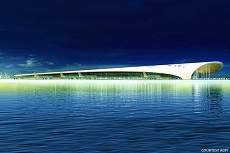
Airport architect releases further images of planned development

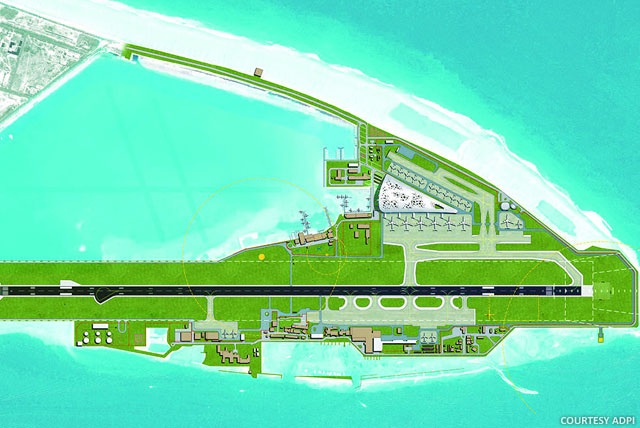
Airport architecture and engineering firm ADPI has unveiled new images of the design for Male’ International Airport, which is being developed by Indian infrastructure giant GMR.

The existing terminal is being upgraded before the construction of a new terminal on the opposite side of the island of Hulhule, which the developer has pledged to complete in 2014.

As well as being a visually dramatic structure on the skyline, the new airport will include various sustainability initiatives such as seawater air-conditioning.

Artist's impression of the exterior

Ultimately the development will involve 45,000 square metres of new terminal, repair and expansion of the runway, parking and taxiing space, and a turning point so more flights can be landed in the space of an hour.

The infrastructure giant’s ‘brownfields’ approach – refurbishing an active airport, as opposed to a ‘greenfields’ or ‘from scratch’ project – mirrors that of its much larger airport development in Dehli. The old terminal was upgraded prior to the opening of the new one last week, which is now expected to cater to 90 percent of the airport’s passengers, with capacity of 34 million per annum upgradable to 100 million.

At over US$400 million the project is the largest single foreign investment ever made in the Maldives and has run into political controversy, including persistent allegations from opposition parties that there was corruption in the bidding process, and several referrals to the Anti-Corruption Commission (ACC).

“There has been no formal communication [with the ACC], and we are extremely confident of standing up to any scrutiny because of the way the bid was scrutinised by the World Bank’s International Finance Corporation (IFC),” CEO Andrew Harrison told Minivan News in an interview in March, setting a target for the completion of the refurbishment in October.

The refurbishment is “essentially throw-away” considering it will have  less than a three year lifespan until the new terminal is completed in 2014, Harrison told Minivan News at the time, but will include a food court and a raised ceiling in arrivals so tourists can see the sea as they emerge from the gate.

Besides ongoing upgrade work and staff training exercises, recent developments include the signing of a US$140 million contract with the State Trading Organisation (STO) to supply fuel, switching the contract over from Dubai-based Galana Petroleum.

More recently, the government announced that the airport was to be renamed after former President Ibrahim Nasir, who ordered its construction during his rule.

A map of the redevelopment, due 2014
Likes(0)Dislikes(0)

Nasheed meets President of Asian Chess Federation

President Mohamed Nasheed has met with the President of the Asian Chess Federation, Sheikh Sultan Bin Khalifa Al-Nehyan, reports the President’s office.

“Sheikh Sultan Al-Nehyan and President Nasheed shared ideas on ways to implement chess as a sport in schools, and to further encourage the younger generations to take part in chess tournaments,” the President’s office said in a statement.

Nasheed invited the Asian Chess Federation to hold an international chess tournament in the Maldives, upon Sheikh Sultan Al-Nehyan’s request.

Likes(0)Dislikes(0)

Marine biologists report outbreak of Portuguese Man-o-War

An outbreak of Portuguese Man-o-War jellyfish around the Maldives has sent guests at many of the country’s upmarket resorts out of the water and back to their villas.

The creatures, which can give a nasty sting, have been reported appearing in lagoons and housereefs around islands in atolls including North Male Atoll, Baa Atoll, North Ari Atoll and Gaaf Dhaal Atoll.

Four Seasons Resort Maldives at Landaa Giraavaru reported a brief outbreak, while Huvafen Fushi in North Male Atoll has had the creatures washing up on the beach for eight days. Kuramathi in North Ari Atoll has also been affected.

Marine biologist Verena Wiesbauer Ali said seasonal outbreaks were not unusual. The creatures were not native to the Maldives reef ecosystem but swarms of them could become trapped by the reef and end up on the beach, she said.

“They can still sting for quite some time on the beach if the cells in the tentacles are still active, which can affect guests walking [barefoot],” noted Wiesbauer, who coauthored a first aid guide together with Dr Jens Lindner and Dr Reinhard Kilinger to the country’s toxic marine life after she was stung by a purple jellyfish while swimming, and was asked by an island doctor why she had eaten one.

Despite its appearance the Portuguese Man-o-War was not really a jellyfish, she explained, and that the usual treatment for jellyfish stings – vinegar, urine or alcohol – could discharge more of the toxic nematocysts in the sting.

Hot water was the recommended treatment for protein-based toxins, such as those from the Portugese Man-o-War or stonefish, she said.

“Clinics should have supplies of anti-histamine because the itching from a sting can be extreme. Applying ice for a few minutes can stop it from spoiling a holiday,” she added.

“Hotels have a duty to inform tourists when there is an outbreak, as someone stung may sue the hotel. It’s also important for snorkelers to understand the risk, and protect themselves with long sleeves – even thin cover is effective, although obviously this does not cover the face.”

Marine Biologist at Kuramathi Resort and Spa in Rasdhoo Atoll, Laura Riavitz, said the outbreak at the resort was worse than last year, “when there was a day when you wouldn’t even stick your toe in the water.”

“We are informing people on welcome and have put out notices at the main reception and the dive school, being careful not to panic people and asking them to wear rash vests,” she said.

Riavitz was herself stung by one last year: “It began very painfully, like a burning sensation on the skin. Sometimes you can’t see anything and don’t know what it is. The most important thing is not to scratch it, otherwise the sting can be carried to other parts of the body, such as the face,” she said.

The Portuguese Man-o-War did not move under its own power, and instead drifted with the currents using a gas bladder and with its tentacles stretching out behind it, she explained.

The creature was normally eaten by predators such as sea turtles, she noted, “although at the moment there are not enough predators to keep the numbers down.”

Any sightings of the Portuguese Man-o-War or reports on the success or failure of treatment can be reported to [email protected]

Likes(1)Dislikes(0)

World must prepare for the deterritorialised state: NYT

Rising sea levels could threaten the existence of small island states such as Tuvalu, Kiribati, the Marshall Islands and the Maldives. If the international community cannot or will not slow global warming, the least it can do is help those states prepare for life after land by recognizing a new category of state — the deterritorialised state, writes Rosemary Rayfuse for the New York Times.

“If we do nothing and these nations become uninhabitable, their citizens will not only become displaced persons seeking refuge in other countries; they will also lose control of their vast maritime zones, including valuable fisheries and mineral deposits, which will likely become the property of neighboring states or the global commons.

“A few solutions have already been offered. Disappearing states could try to acquire territory from another state. However, no other government is likely to give up some of its land, no matter the price. The construction of artificial islands has also been proposed, but the financial, engineering, cultural and legal challenges may be insurmountable. The best scenario under current international law appears to be for disappearing states to enter into some form of federation with another state. However, a merger would threaten their cultural identities and likely oblige them to relinquish control over their resources.”

Read more

Likes(0)Dislikes(0)