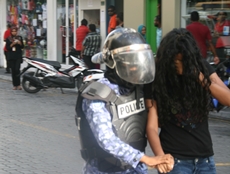
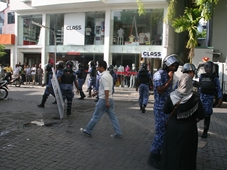
“JSC politicised, trying to eliminate Nasheed and MDP from elections”: JSC Member Shuaib

Judicial Services Commission (JSC) member Sheikh Shuaib Abdul Rahman has spoken out against the judicial watchdog body, declaring it as politicised and attempting to eliminate former President Mohamed Nasheed from the September 7 elections.

The JSC has not only created the Hulhumale’ Magistrate Court in which the former President is being tried, but has appointed the three-member panel of judges overhearing the case. The JSC’s membership includes several of Nasheed’s direct political rivals, including Jumhoree Party leader and resort tycoon Gasim Ibrahim, one of Nasheed’s rival presidential candidates.

Sheikh Rahman, the member of the commission appointed by the public, said political influence of the commission had heightened after Gasim had been appointed.

He is the second JSC member to blow the whistle on the Commission, echoing the concerns of JSC member Aisthath Velezinee who was stabbed in the street in early 2011.

Sheikh Rahman made the remarks during a live appearance on local TV channel Raajje TV, just over a week after UN Special Rapporteur on the Independence of Judges and Lawyers Gabriela Knaul also aired concerns over the JSC in a statement following a fact finding mission to the Maldives.

Speaking on the show, Sheikh Rahman said the JSC had openly discussed their intent to ensure the elimination of the Maldivian Democratic Party and presidential candidate former President Mohamed Nasheed from the upcoming elections.

Sheikh Rahman alleged that Chair of the Commission, Supreme Court Judge Adam Mohamed, had abused his post and powers as the chair to try and eliminate Nasheed from contesting the elections, and alleged that Adam Mohamed had “used the commission as a political tool”.

“The politics of the majority control the commission, hence the rule of law, due process and due diligence do not exist in the JSC,” Sheikh Rahman stated. “The commission has no amount of respect for constitutional principles.”

“It is common now to hear a lot of MDP and Nasheed bashing in commission meetings. This was not how things usually were before. I believe politically biased comments like this have increased since Gasim joined the JSC as a representative of the parliament,” Sheikh Rahman continued.

“Gasim even went to the point of asking the UN Special Rapporteur Knaul when she held a meeting with us to state in her report that it was MDP who torched the courts. I heard him say exactly that,” Sheikh Rahman said.

JSC Chair abuses power to continue running unlawful Hulhumale’ Court

Sheikh Rahman further revealed that the JSC had “handpicked” magistrates to preside over the case against Nasheed, for his detention of Criminal Court Chief Judge Abdulla Mohamed.

He said that the JSC’s intention in assigning the case at the Hulhumale’ Magistrate Court to the three specific magistrates was for the explicitly stated purpose of “sentencing Nasheed”.

According to Sheikh Rahman, the Hulhumale’ Magistrate Court was initially established through misinformation and manipulation of the commission on the part of JSC Chair Adam Mohamed.

“The Hulhumale’ Magistrate Court is actually abolished automatically with the concept of judicial districts coming into effect upon the ratification of Judicature Act on 10 August 2010. And yet, they continue to run the court,” Sheikh Rahman stated.

He went on to say that as the constitution defines Hulhumale’ and Villingili as parts of the capital Male’ city, there was no authorisation to set up separate magistrate courts on these islands.

Sheikh Rahman alleged that despite these facts, JSC Chair Adam Mohamed had invoked the theory that Hulhumale’ and Villingili were separate islands and were therefore qualified to have their own magistrate courts.

Appendix 2 of the Constitution of Maldives which defines administrative divisions, states that Male’ is inclusive of Villin’gili and Hulhumale’.

Sheikh Rahman revealed that he had, as a member of the JSC, submitted a complaint to the commission to review the decision regarding the court on the grounds that it was unlawfully established. He stated that his attempts were in vain as Chair Adam Mohamed had once again abused his powers and refused to schedule the matter during the commission sessions.

Sheikh Rahman stated that he had made multiple requests for a decision on the Hulhumale’ Court, all of which was rejected by the chair. He confirmed that he had not received any written or official responses to the motions he submitted on the matter.

“Another false justification that Adam Mohamed used is that the matter cannot be discussed in the commission as it referred to an ‘ongoing case’,” he said.

UN Special Rapporteur Gabriella Knaul also criticised the ‘arbitrary appointment’ of judges to Nasheed’s case. She also stated that the Hulhumale’ Court did not have the constitutional mandate to oversee the specific case.

Former JSC member Velezinee also repeated her concerns about the politicisation of the JSC at a recent press conference held to share her remarks on the preliminary findings of UN Special Rapporteur Gabriela Knaul.

Incumbent JSC Member Gasim Ibrahim, meanwhile called Knaul’s findings ‘lies and jokes’ at a JP party rally.

The Hulhumale’ Court meanwhile on Wednesday refused to delay Nasheed’s trial until after the elections, despite the prosecution stating they had no objection to such a decision.

Gasim Ibrahim was not responding to calls at time of press.

Likes(0)Dislikes(0)

Uncertainty over 2011 case of British couple killed in resort quad bike accident

The Criminal Court has said it still requires statements from the parents of a British couple killed in a quad bike accident at Kuredu Island Resort in 2011.

Swedish national Filip Eugen Petre, a son of a shareholder in Kuredu Island Resort, is currently facing trial for his alleged role in crashing a quad bike carrying British nationals Emma and Jonathon Grey at Kuredu on August 6, 2011.

The case is at a stand still as the court awaits responses from the parents of the deceased, regarding the preferred form of punishment for the accused.

However, both police in the UK and the respective families of the deceased have both insisted that the families decision has been submitted and then re-submitted to the court.

Earlier today, Director of the Department of Judicial Administration Ahmed Maajid, contacted the Criminal Court media official on behalf of Minivan News for more information on the case.

“The Criminal Court media official, Mr Manik, told me that the trial hearings are now over. However, the court is currently awaiting statements from all of the family members regarding the preferred form of punishment for the accused. Only then will there be a final verdict,” Maajid claimed.

In October, 2012, Maajid told Minivan News that the court was awaiting a response from only of the victim’s family in regard to the accused’s punishment.

“A Criminal Court media officer tells me that what remains in the case is to obtain the word of the family of one of the victims, as to whether they want a sentence of execution, or blood money or to forgive,” Maajid told Minivan News back in October.

Minivan News attempted to contact the Criminal Court media official today, but he was not responding to calls or text messages throughout the day.

Maajid, when asked to clarify the information in relation to the previous comments made by courts, said that the official from the Criminal Court had later found more information regarding the case.

“Criminal Court has said they have a statement from the mother of the deceased man. But they have not received one from the father of the man, or either of the parents of the deceased woman,” Maajid claimed.

Under Islamic law, the family of the victim is given the option to sentence the accused to execution, blood money or to forgive them.

A relation to the deceased told Minivan News today that their statements had been submitted multiple times on different occasions to the courts.

According to the relation, the last the family had been told by the court was that the final verdict of the charge would be delivered at the next scheduled hearing.

“On the last hearing, which was held on February 27, closing arguments were given by the state and the defense. The judge has stated that the final verdict of the charge would be delivered at the next scheduled hearing.

“Furthermore, in the same hearing the court indicated that, they would contact the families of the deceased if they find there is a need to do so,” the relative said the family had been told.

UK police re-submit family requests

In October 2012, UK police were made to resubmit requests from the relatives regarding the punishment.

A relation of the Grays confirmed to Minivan News in October 2012 that neither victim’s family had received any official notification from the Maldivian courts themselves.

The UK police however, through a family liaison officer, confirmed that their Maldivian counterparts were informed “months ago” of the families’ preferred sentence.

“The police have said that they are going to re-submit the issue to the Maldives police today,” claimed the relation.

“That’s what is holding up the case right now, [the police] do not seem to have forwarded this information to the courts.”

The relative added that while they did wish to see some form of punitive sentence for the driver if he was convicted, they did not want any severe or long-term action to be taken against the defendant.

“He’s just a young guy. We don’t want to see his life ruined,” the relative said.

Jonathan Grey’s mother Cath Davies told UK-based newspaper the Halifax Courier in March 2012 that the prospect of Petre facing the death penalty was “shocking. It’s absolutely horrendous.”

Previous hearings

In previous hearings, the prosecution claimed that the charge of ‘disobedience to order’ Petre stands accused of resulted from his decision to carry people on a vehicle which was not intended for passengers.

The prosecution contended that his criminal action began from the moment he allowed the couple to ride with him on the vehicle.

Presiding Judge Abdul Baary Yousuf declared in court during earlier hearings that Petre’s lawyer had himself confessed during the trial that his client had driven the quad bike carrying Emma and Jonathan Gray as it crashed on the tourist property.

As a result of this confession, the judge said the state did not have to produce any evidence to prove Petre was the driver of the vehicle during the collision.

Representing the prosecution, State Attorney Aishath Fazna also contended that because Petre had “confessed” to driving the quad bike, she did not believe the state had to produce evidence to support this assumption.

However, Petre’s lawyer Areef Ahmed responded at the time that his client had not directly confessed to driving the quad bike and argued that his client continued to deny the charges against him.

Areef additionally claimed that the judge could not declare a verdict regarding the alleged confession said to have been during the previous hearing.

Areef contended that his confession could be withdrawn before the case reached to a conclusion, but the state attorney argued that after confessing in the trial, there was no way it can be withdrawn.

Petre’s lawyer has also contended that his client could not be charged under Islamic Sharia because his client is non-Muslim.

Likes(0)Dislikes(0)

MPs raise concern over “spy devices, toxic gas, poison” in parliament

Maldivian Democratic Party (MDP) MP Abdulla Jabir has claimed that security forces have planted ‘spy devices’ throughout parliament, local media reported.

During today’s parliament session, Jabir claimed that ‘information’ had been received regarding the bugging and that security forces were not listening in to the conversations of MPs, a report in local media stated.

In response to Jabir’s allegations, Parliament Speaker Abdulla Shahid said that the matter is to be taken up as a “matter of serious concern”.

Local media reported that immediately after Jabir’s claim, Dhivehi Qaumee Party (DQP) MP Riyaz Rasheed then claimed that he had information that meals provided in parliament were laced with drugs.

“Various effects were felt even yesterday after consuming some of the food,” Rasheed was quoted as saying in local newspaper Haveeru.

A further claim was then made by Milandhoo constituency MP Ali Riyaz, who said that he had received more information that toxic gas would be put into the air-conditioning in parliament to poison the members.

Shahid assured the MPs that the allegations would be thoroughly investigated.

Likes(0)Dislikes(0)

Rubbish fire smoke engulfs school, 50 students forced to seek medical attention

Children from Imaduddin School in Male’ were given emergency treatment today after they reported dizziness and nausea caused by smoke rising from a nearby rubbish dump.

Local media reported that smoke began to rise around 10:30am today (March 6), causing 50 students to seek medical care. A teacher was also taken to hospital after her health suddenly deteriorated.

Imaduddin School Principal Ibrahim Asif Rasheed told local media that the school has to cancel certain lessons when the wind is strong and facing in a certain direction.

According to the principal, the school was engulfed by smoke in the morning and that parents had been requested to collect their children who were suffering from the smoke.

After contacting the meteorological centre to clarify weather conditions for the next few days, Rasheed told local media that lessons will commence tomorrow.

Likes(0)Dislikes(0)

Oil transport vehicle set on fire

An oil transport vehicle was set on fire at 2:30am this morning while parked inside the Hakatha Petrol Shed near the Henveyru swimming track.

Local media reported that there had been no reported injuries during the incident, which was attended by police and military personnel who extinguished the fire.

Police told local media that a man was arrested for obstructing police duty whilst attending the fire.

Likes(0)Dislikes(0)

MDA reaches 10,000 members

Maldives Development Alliance (MDA) has announced that it has reached 10,000 members, meaning it will be now recognised as an official party under the new political parties’ bill.

The recently-formed party, led by Ahmed ‘Sun Travel’ Shiyam, submitted 4,900 membership forms yesterday (March 6) – the same day as parliament passed the political parties bill – bringing the party’s total membership over 10,000.

Elections Commission President Fuad Thaufeeg told local media that a further 1,000 were submitted on February 13, 536 on February 24 and 618 forms on February 25.

In addition to the pending forms, MDA has 3,354 official registered members, local media reported.

The political parties’ bill requires parties to have a minimum 10,000 members before they will be official recognised.

The same bill was passed by parliament in December 2012, however President Mohamed Waheed Hassan Manik returned the bill when it was presented to him to be ratified.

During Tuesday’s (March 5) session, the bill was again passed with 60 out of the 67 members present voting in favour of the bill.

Likes(0)Dislikes(0)

Outrage, dancing and ugly confrontations follow Maldives ex-leader’s arrest

It was around 2:00pm on March 5 when news of the arrest of former President Mohamed Nasheed became public, leading to gridlock on sections of Majeedhee Magu – the main road cutting through the Maldives capital.

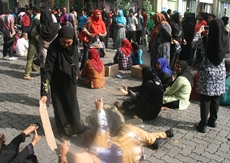
Throughout the day, a few hundred demonstrators aligned to the opposition Maldivian Democratic Party (MDP) attempted to “bring the capital to a standstill” with a protest to blockade traffic following the arrest of the former president.

A sit-down protest on Majeedhee Magu

At sporadic points during the afternoon, in between clashes with police forces and peaceful sit downs, ugly scenes of confrontation were also witnessed where trucks, bikes and even government-aligned people deemed “Baghee” – a traitor – were swarmed and attacked by the crowd.

“Your photos will be a problem,” isolated figures explained throughout the day, following such confrontations. “Do not take pictures here. Take them from further away,” they said. “Do not give them to police.”

In the battle for international media attention, an image speaks a thousands words – so long as it is the right image.

Following the arrest of Nasheed, who is currently standing trial for the controversial detention of the Criminal Court chief judge during his time in office, men and women of all ages gathered outside the Male’ City Council building (MCC) between the intersections at Alikilegefaanu Magu and Rahdebi Magu.

Among the crowd was Mohamed Aslam, a former Environment Minister under Nasheed’s government, who claimed there was no official plan for demonstrations or a protest at the time.

“People are agitated, they are angry,” he said. “There is no plan, there is just outrage.”

Nasheed taken

It was earlier in the afternoon that 15 masked police officers had entered Nasheed’s family compound of Kenerege with a court warrant to detain the country’s first democratically elected president.

Police themselves later provided video footage of its officers taking Nasheed into detention.

Sources within the MDP later told Minivan News that the former president was taken peacefully, if reluctantly, briefly saying goodbye to his family before being escorted away by authorities. Police later returned for a second time to the compound, though no further arrests were made in the building.

However, by 2:00pm, there was clear anger among some three dozen predominantly male figures around the corner from Kenerege on Majeedhee Magu.  The tension was exacerbated as a group of officers in the back of a van quickly singled out an elderly gentleman across a crowded intersection and took him away.

Media were quick to capture the image, as angry onlookers heckled the officers over a blare of horns from taxis and other motorists now blocked by the unfolding drama.

A group of people including Nasheed’s representative on the Commission of National Inquiry (CNI), Ahmed ‘Gaha’ Saeed, soon blocked the road in what they claimed was a makeshift protest.

Perched on front of delivery vehicle, Saeed told Minivan News that demonstrators had opted to blockade the truck that he said to belonged to one of the country’s largest private retailers alleged to be one of the masterminds behind a “coup d’etat” that saw Nasheed controversially resign from office last year.

“People have waited a year since the coup and are very angry and unlikely to act reasonably now. They could bring Male’ to a standstill,” Saeed stated.

As some attempted to dissuade Saeed from his actions, other figures in the crowd attempted to limit the taking of pictures – an impossible task considering the prevalence of I-pads, camera phones and social media in the country.

By 2:30 pm, as the sun beat down intensely on the intersection, tensions continue to escalate as the crowd singled out a figure passing through the intersection on his bike. The figure was  Ali Waheed, the brother of current President Dr Mohamed Waheed Hassan Manik.

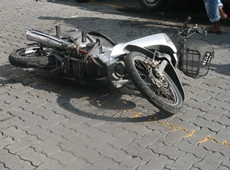
In the first of several such isolated attacks during the day, a crowd swarmed and surrounded Ali Waheed amidst shouts of Baghee, before he was pushed from his bike, surrounded and attacked. After a tense minute of confrontation, Ali Waheed was ushered from the intersection by some figures in the crowd – his bike abandoned on the street. It would not be the last vehicle left on the capital’s street during the day.

The crowd’s attention later turned to a military car with tinted windows. Isolated figures attacked the vehicle, ripping off its mirrors and smashing a rear passenger side window. Some three or four dozen young men appeal divided amidst appeals for calm from Saeed and several other figures asking to let the vehicle pass.

Heavy rainfall temporarily cleared the road and the simmering tension. As the situation calmed, Saeed explained that the crowd had sought out figures perceived to be tied either to senior government or the security forces, particularly the police’s Special Operations (SO) officers.

“They see it as you are either with us or against us,” he said. “We continue to ask for calm, but as always happens, it is the loudest in crowds who have their way.” Saeed rejected the accusation that individuals were being purposefully singled out as they passed through the barricade.

Sit down demonstrations

As the blockade continued, a growing number of men and women began to join the demonstrations, with former Environment Minister Mohamed Aslam joining a sit down in the middle of the street.

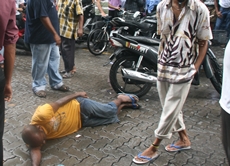
Further down the road, a single man lay in the rain soaked road outside the Male’ City Council building. The crowd suddenly appeared happy to clear to one side to let media to take a photo opportunity of the man. Meanwhile, curious and often bemused onlookers and shoppers stepped over him.

Demonstrator holds lie-down protest

However, the lighter mood was at times broken.  In one instance, a man riding a bike with a young girl on the back was heckled as a “Baaghee” – prudently he avoided the crowd and detoured down a side street.

At the height of the demonstration, some two or three blocks on Majeedhee were blockaded, with an orange rope set up across the street to stop traffic coming through.  A few motorists tried to get through to the derision of the crowd.

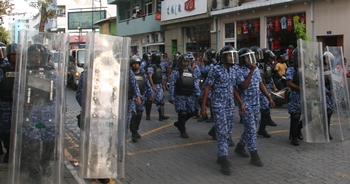
Shortly before 4:00pm, around 30 police officers in helmets arrive and begin to clear the intersection outside the city council building, removing Mohamed Aslam from the scene, while coming under fire from plastic water bottles and small sections of pavement stones.

Several other figures in the crowd were also taken by authorities, as police left the scene.

Behind them, some 200 demonstrators remained on the road, continuing with their blockade and chanting.  Another group of women soon resumed their sit-down protests and anti-government chants.

The light mood again sporadically broken as another male – accused of being a member of the Police’s SO division – attempted to pass through the crowd. He was quickly swarmed as he was mobbed by a crowd divided over whether to attack or protect the figure.

Shouts of “baghee” from the crowd were punctuated by the screams of a woman travelling with the man.  Both are eventually moved to safety.

“There is hatred here,” said one protester. “He was asking for it. He could see there was a [blockade] but came through anyway. It is very hard to control some of these [demonstrators].”

Soon after, individuals once again spoke to media figures, reiterating appeals to cease taking photos as some of the group turn their attentions to breaking through a glass door of a large clothes shop – eventually they are dissuaded by others in the crowd.

At the same time, the Maldives Journalists Association (MJA) released a statement strongly condemning violent attacks said to be carried carried out against a journalist and a cameraman working from private media outlet Sun Online. Earlier in the day, a journalist for the same organisation had stayed in Nasheed’s family compound over concerns about his safety among the crowd outside.

Reinforcements

By 4:30pm, Police reinforcements once again arrived to clear the intersections, heckled by the 200 demonstrators who has sought to block sections of the road during the afternoon.

Though some officers were witnessed carrying firearms with rubber bullets, no such measures were witnessed being used by police, though one young woman arrested had appeared to have been pepper sprayed.

During the ongoing police operation, a further two dozen demonstrators were arrested and loaded into the back of a police van – among them a middle-aged women taken for heckling and singing songs.  she soon becomes an inadvertent hero among her fellow demonstrators. Aware of her status, she begins dancing in the back of the police truck.

As order is restored by authorities and the arrested are taken from the scene in an open topped van, the crowd cheer and wave at the figures, including an elderly woman who blew kisses and waved to the crowd.

With the police presence again gone, the crowd return to their blockade to songs and anti-government chants. The mood once again light temporarily until protesters attack and roll over a van belonging to Eydhafushi MP Ahmed Saleem, another figure unpopuler among the core MDP supporters. According to local media, milk packets are taken from the van and distributed among the protesters.

Whether demonstrators succeeded in bringing the capital to a standstill as some had claimed, for large parts of the day, one of the capital’s busiest roads was transformed into a protest site for dissatisfaction with the government.

As police began to bring the crowds under control, among a blockaded section of Majeedhee Magu between Alikilegefaanu Magu and Rahdebi Magu, a shop-owner looked out from his door at the deserted road.

“It’s been a slow day for business,” he said.

Likes(0)Dislikes(0)

India “monitoring”, UK “puzzled”, Canada “deeply concerned” by Nasheed arrest

The Indian government has said it is “closely monitoring” the situation in the Maldives following the arrest of former President Mohamed Nasheed yesterday (March 5).

The court warrant to produce Nasheed before the Hulhumale’ Magistrate Court ahead of his hearing on Wednesday at 4:00pm was signed by Senior Judge Usman.

At 1:30pm the same day, several dozen police wearing riot gear and balaclavas escorted Nasheed from his family home in Male’ to the jetty, where he was taken to the detention centre on Dhoonidhoo island.

A video of the arrest released by police shows Nasheed being mobbed by several dozen riot police in balaclavas outside his home, one of whom reads from a piece of paper.

Nasheed’s Maldives National Defence Force (MNDF) bodyguard attempts to remain beside the former President, but is pushed away by the police. He is seen to follow the group, arguing with the officers.

Nasheed had evaded earlier court summons by seeking refuge in the Indian High Commission for 10 days, prompting calls from the UK, US, EU, Commonwealth and UN that the government ensure elections in September were “free, fair, and inclusive”, and that all parties be free to field the candidate of their choosing.

Nasheed emerged from the High Commission only after a purported “understanding” was reached between the government and a high-level Indian delegation including Joint Secretary of the Indian External Affairs Ministry Harsh Vardhan Shringla, that Nasheed would be “allowed to continue his social and political life” ahead of the September 7 elections.

Yesterday, the government denied such an understanding, the arrest of the former President sparked protests in Male’, a blockade of the main street, an assault on the President’s brother, the upturning of several vehicles, and by 7:00pm, 47 arrests, including 16 women.

“India expects due process and the Rule of Law would be followed; We would urge all concerned to exercise caution and restraint and not to resort to any violence or extra-constitutional means and steps which would weaken the democratic system,” said India’s Ministry of External Affairs (MEA) in a statement, following Nasheed’s arrest.

“We have received information that former President Nasheed was taken into (police) custody following an order issued by the Hulhumale’ Magistrate Court to produce him at 1600 hrs on March 6, 2013. We have been informed that former President Nasheed’s lawyers and family are going to meet him now as allowed by the authorities,” the statement added.

“We are monitoring the situation closely.”

“Puzzled”

Parliamentary Under Secretary of the UK’s Foreign and Commonwealth office, Alistair Burt, meanwhile informed the British parliament that the UK was “puzzled” over the arrest of Nasheed.

“At present we remain puzzled about the turn of events. It was widely believed that an arrangement was in place following former President Nasheed leaving the Indian high commission a couple of weeks ago, in relation to his trial and his part in the forthcoming elections,” said Burt, in response to a query from MP Karen Lumley.

“We are watching the situation carefully and have made it clear to the Maldivian authorities that no harm must be orientated towards the former President,” Burt said.

The Canadian government meanwhile issued a statement expressing “deep concern” over the “violation of clear commitments made by the current President, Mohammed Waheed, at Commonwealth Ministerial Action Group (CMAG) meetings in New York City last September.”

“[Nasheed’s arrest] also violates key Commonwealth values and principles and directly threatens the prospect of fair and inclusive elections in the Maldives this fall.,” warned Canadian Minister of Foreign Affairs, John Baird.

“Canada calls on President Waheed to release the former president and to guarantee his safety while also committing to free and fair elections. We continue to encourage Commonwealth Secretary-General Kamalesh Sharma to engage fully in defence of Commonwealth principles in the Maldives,” Baird stated.

“These developments of serious concern reaffirm the need to maintain the situation in the Maldives on the agenda of the Commonwealth Ministerial Action Group, which will have its next formal meeting in London in April,” he added.

Amnesty International meanwhile labelled Nasheed’s arrest an example of “selective justice”, which “highlights the failure of the Maldives authorities to investigate other serious human rights abuses in the country.”

“Of course political leaders, including Nasheed, should be held to account – but the targeting of Nasheed is an example of selective justice,” said Abbas Faiz, Amnesty International’s Maldives Researcher.

“Amnesty International, and many others, have documented a wide range of human rights violations committed by security forces following Nasheed’s resignation. These include police violence against peaceful protesters and the deliberate targeting of Nasheed’s supporters.

“No one has yet been held to account for these abuses despite the huge amount of documentary evidence available. The Maldivian authorities must carry out a full investigation into alleged abuses by anyone, and not just target political opponents.

“Former President Maumoon Abdul Gayoom (1978-2008) has never been investigated or held to account for alleged abuses committed during his rule. All leaders should be held to account for alleged abuses and in fair trials,” Faiz said.

The United States also expressed concern at “ongoing events in Male”, stating that “the integrity of and public confidence in the Maldivian electoral process must be maintained.”

“Accordingly, we note that all parties participating in these elections should be able to put forward the candidate of their choice. We also call upon the Government of the Maldives to implement all the recommendations of the Commission of National Inquiry (CONI) report, including the recommendations related to judicial and governmental reforms. We continue to urge all parties to chart a way forward that strengthens Maldivian democratic institutions, the rule of law, human rights and fundamental freedoms,” the US Embassy in Colombo said in a statement.

Hulhumale Court challenged

Several recent reports produced by international bodies have challenged both the legitimacy of the Hulhumale’ Magistrate Court, the charges against the former President – of detaining Chief Judge of the Criminal Court during the final days of his presidency in 2012.

Last week, UN Special Rapporteur on the Independence of Judges and Lawyers, Gabriela Knaul, criticised the “arbitrary” appointment of the judges in the Nasheed case “outside the parameters laid out in the laws.”

Knaul furthermore stated that the Judicial Services Commission (JSC) – responsible for establishing the Hulhumale Magistrate Court and appointing the three member panel of judges – was politicised, subject to external influence, and hence unable to fulfill its mandate effectively.

The UK’s Bar Human Rights Committee (BHRC) also recently published a report based on its observation of the first hearings of the Nasheed trial.

“BHRC is concerned that a primary motivation behind the present trial is a desire by those in power to exclude Mr Nasheed from standing in the 2013 elections, and notes international opinion that this would not be a positive outcome for the Maldives,” the report concluded.

Police video of the Nasheed arrest on March 5:

http://www.youtube.com/watch?v=gK_YSHtcbvI&feature=youtu.be

Likes(0)Dislikes(0)

Comment: Political scene hots up again

After a week of relative lull on the political front, Maldivian politics revved up on Tuesday, March 5, after the police detained former President Mohamed Nasheed to produce him before the suburban Hulhumale’ court in connection with the ‘Judge Abdulla abduction case’.

The arrest, possibly delayed pending the President’s customary annual address to Parliament a day earlier, came less than 10 days after Nasheed ended his 11-day sit-in at the Indian High Commission in Male, claiming that New Delhi had brokered a ‘deal’ for his contesting the presidential polls in September – denied by both governments.

If tried, convicted and sentenced to a prison term exceeding one-year imprisonment (it can go up to three years, or a fine of MVR 12,000), and he also runs out his appeals ahead of the poll notification, Nasheed will be disqualified from contesting the polls. It is in this context, his claim that India has brokered a ‘deal’ assumes significance. So has his subsequent appeal/declaration of sorts, implying that New Delhi should ensure that he contests the polls.

Defining moment

In a way the presidential polls, scheduled for September, are turning out to be as much a defining moment as the one that institutionalised multi-party democracy in Maldives. Yet, as the chips are down, President Waheed managed to address the People’s Majlis amid interruptions and in four installments. Out after the sit-in in the Indian High Commission and anticipating detention and disqualification, his predecessor would not acknowledge the legitimacy and continuance of President Waheed. A couple of days before the customary/mandatory presidential address to Parliament in its first session in the calendar year, Nasheed had an uninterrupted interview with NDTV.

The Indian television channel is accessible in Maldives and much of South Asia, and in many other parts of the world. The uninterrupted nature of Nasheed’s interview also made it cohesive and comprehensive, to viewers afar and nearer home, too – what with the local newspapers also picking it up for their readers. Against this, President Waheed’s address, disrupted constantly by parliamentarians belonging to Nasheed’s Maldivian Democratic Party (MDP), was limited in its appeal to the Maldives, at best, and political Male, positively.

As much as the content of the speech – whose text would have been anyway made readily available – the punter, if any, would have wagered on the possibility of President Waheed completing his address in the first place – and, if allowed to do, with how many interruptions. The final count was three breaks and in four innings. The score was better this time than in the previous year – Waheed’s first address to Parliament as President – when fresh for the controversial power-transfer, MDP parliamentarians did not allow him to do so on March 1, the first day in the calendar year when the House met after the long recess. Waheed had to go to the Majlis on another day, March 19, to be precise, when alone he could manage to do the honours – of course, with MDP interruptions.

This time round, the President could deliver his address, even if amidst interruptions, only after Parliament Speaker Abdulla Shahid ‘named’ a few MDP members for disturbing the proceedings, and the security people moved i  to bundle them out. Incidentally, as MDP parliamentary group leader Ibrahim Solih said later, the party, as the largest (non-government) segment in the House, has stuck to its previous year’s decision not respond to President Waheed’s address within 14 days under Article 25 (b) and 25 (e) of the Constitution, holding it an ‘illegitimate regime’.

At the same time, the presidential address on both occasions would have gone into the records of Parliament for all time to come. It is thus unclear, what benefit the MDP could have derived by disturbing Parliament, that too during presidential address, when it is felt that the party would need to win over the ranks of ‘non-party’ or ‘undecided voters’. Invariably, these are moderate segments of the electorate, and take their time, evaluating not just the motives of the contending parties but also their methods. Their numbers supposedly add up to 50 per cent of the electorate.

Certainly, it does not do any good to the kind of democracy that the MDP wants to usher in all over again in the country – going by unforgettable memories of the turn that the protest by the party MPs took this time last year. In electoral terms, it might have kept the party cadre-mood upbeat, but their votes are already for the MDP. The party needed votes from outside this constituency, and that needed greater, different and differentiated initiatives and efforts – not just the beaten path of the past year alone.

‘Aggressive’ India, defence deal with China

In his television interview, Nasheed was clearly addressing an Indian audience. He claimed that there was kind of a deal between India and the Maldivian Government for him to end his 11-day sit-in in the Indian High Commission in Male, protesting the imminence of his arrest, possibly leading to his disqualification from contesting the presidential polls, scheduled in September. He wanted India to take an ‘aggressive’ posture if the Maldivian government tried to arrest him again. He did not explain what he meant by New Delhi’s ‘aggressive’ posturing.

That Nasheed was addressing the Indian TV viewers, possibly with the hope of pressuring New Delhi into ensuring that the Maldivian government did not pursue with its current moves to have him tried and punished in the ‘Judge Abdulla abduction case’ before the presidential polls became clearer when he referred to China, which could not be contextualised either to his own predicament, or bilateral relations between India and Maldives, otherwise.

“Well, there is instability in the Maldives. So, there will always be a room for other actors to come in. Therefore that is all the more a reason why we should be able to have free and fair elections as quickly as possible,” Nasheed told the interviewer. “We did not have a military-defence agreement with the Chinese government but this government has now come up and signed an agreement,” he said.

Nasheed’s reference to an ‘aggressive’ India thus did not relate to China, but to the internal political dynamics of Maldives – and that was saying something in terms of his current perceptions about bilateral relations between India and Maldives on the one hand, and India and China, on the other.

Media reports in Maldives, citing Nasheed’s interview, also quoted Waheed government’s reiteration of the denial about the existence of any such agreement. As some reports have been recalling from time to time, Nasheed as President inaugurated the Chinese Embassy in Male in November 2011 – which was understandable – but on the very day Indian Prime Minister Manmohan Singh was landing in the country for the SAARC Summit, followed by a bilateral.

‘Small state, small justice’

Against this, President Waheed seemed to have taken off from where Nasheed had left – not the ‘China factor’ as in the latter’s interview, but the Indian angle, instead. Without naming India or any other nation, the President told parliament that the foreign policy of the Maldives will always aim at defending the country’s independence, sovereignty and Islamic values. He claimed that several groups were interested in influencing and interfering with the political independence of the country, and said that the government would (nonetheless) address the issues and concerns of the international community.

The President, as local media quoted him, said that foreign countries’ concerns will be acknowledged but their interference in internal politics of the country and calls to hold elections before a certain date, will not be accepted.

“The government will not accept ‘small justice’ because we are a small state,” he said. In context, Waheed referred to ‘certain groups’ in the country welcoming the pressure by the international community, and said that such pressure are not aimed at the government, but would affect the country’s independence.

In the same vein, President Waheed, again without any pointed reference to President Nasheed’s tenure, when he himself was Vice-President, and said that the nation’s economy had ‘fallen into a pit’ when he took over in February last year. The external debt stood at $725 million (MVR 11,179.5 million) owing to high expenditure, and his government, he claimed prioritised on early economic recovery. “Several steps have been taken to reduce Government costs, and several Bills have been submitted to Parliament related to increasing Government income and revising laws,” he said, without acknowledging the early initiatives taken in this regard by the Nasheed government.

In this context, President Waheed claimed that regaining cogtrol of Ibrahim Nasir International Airport from the GMR Group, the Indian infrastructure major, had increased foreign currency-flow into the country, and facilitated solutions to the problem of dollar-shortage. “The Government’s aim is to ensure that foreign currency that enters the country is retained,” he said. In contrast, Nasheed had said that if returned to power, he would restore the GMR contract.

‘Free and fair polls’

Alluding obviously to the international community’s call for ‘free, fair and inclusive’ presidential polls, Waheed promised as much in his parliamentary address. By referring to his government in this regard, he distanced the judiciary from the process, after his camp had repeatedly asserted that the administration did not have anything to do with the case against Nasheed at this stage. It was for the court to decide on the next course, seemed to be the government’s refrain.

“I would like to assure members that the government will put every effort to see that the Maldives presidential election this year is a free, fair, and open to all political party participation, and is held according to the Constitution and laws of the State,” local media reported Waheed as telling the Majlis. Clearly, he was countering the MDP declaration that the party would boycott the polls if Nasheed was disqualified, and was possibly indicating that it could/should nominate another candidate, instead. He also said that the government will cooperate with the Elections Commission to clear any obstacles that might oppose free and fair elections – possibly referring to anticipated street-protests by the MDP if Nasheed was disqualified.

“I also give assurance that the government will not influence an election, and will not do anything that might hinder electoral rights,” Waheed said, in an obvious reference to the exclusively role of the nation’s Judiciary in the matter from the current stage on. “The Government continues cooperate with the Elections Commission and provide any assistance they might require. If there are any obstacles to holding the election, the Government will provide whatever cooperation necessary to the Elections Commission to remove such an obstacle,” said the President.

‘Reforming judiciary’

For his part, Abdulla Yameen, parliamentary group leader of the second-largest, Progressive Party of Maldives (PPM), a presidential hopeful himself, said that President Waheed should lead the process of strengthening criminal justice system in the country. By timing and implication, his observations could be interpreted, or mis-interpreted, as the case may be, to be projected as a left-handed backing for the MDP’s charge that Nasheed would not get justice from the existing judicial system in the ‘Judge Abdulla abduction case’.

“The entire criminal justice system has problems. Regardless of the reasons behind the problems, the Head of State should take the responsibility of finding solutions if the delivery of justice is being delayed. The purpose of this isn’t to ensure that the case is concluded in a particular way. It is a responsibility of the President, under Article 115 of the Constitution,” Yameen reportedly told a local television channel.

Yameen, according to media reports, said his was only ‘constructive criticism’ of the existing system and should not be construed as a personal criticism against President Waheed. Incidentally, while suggesting that not all charges taken to the police have to be converted into court proceedings, Yameen referred to avoidable delays in the dispensation of justice, which is what the MDP seeks to imply through its demands, through Nasheed’s offer to face trial in the abduction case after the conclusion of the presidential polls. If elected President, Nasheed could not be tried while in office, followed by certain immunities, post-retirement, but unavailable to him now in the ‘Judge Abdulla case’, it would seem.

Line-up unclear, yet

For all this however, the presidential poll line-up is unclear, as yet. Nasheed’s candidacy depends upon the pending court case, which has however not made much headway in recent weeks. Despite his arrest – the third since October, if only to ensure that he presented himself before the court – there is still a chance of the case not running its due course, including possible interlocutory and appeals stages, at this pace before the Election Commission issues the required notification in due course. The Waheed camp used to assert his own candidacy until the top-rung PPM partner in his Government declared its intention to contest the presidency itself, and set its primary for the purpose for March 30.

Yameen, who is one of the two candidates in the primary – the other being former PPM vice-president Umar Naseer – and he could consider full-throttled campaign, if at all, only after the primary. The same applies to Umar Naseer, who contesting alone in 2008 presidential polls, obtained less than one per cent vote-share, before joining the Dhivehi Rayyatunge Party (DRP), founded by former President Maumoon Abdul Gayoom. Inside the DRP, Umar Naseer used to be seen as the voice of Gayoom, and used to remain so even after the latter walked out with his group, to found the PPM. Gayoom, after being unanimously elected PPM president in December, has vowed to work for whichever nominee the party’s General Council chooses.

That leaves out DRP leader Thasmeen Ali and Jumhooree Party (JP) founder Gasim Ibrahim. As elected party leader succeeding Gayoom, Thasmeen automatically became DRP’s presidential nominee as early as 2009. Gasim also announced his candidacy very long ago. Between them, however, Gasim has been seen actively campaigning for the party while the DRP leader is still busy competing with the breakaway PPM, enrolling new members for the party, to become the second largest one after the MDP – outside Parliament after it had lost the game inside the Majlis.

Otherwise, the course of the elections depends on the decision of the MDP should Nasheed be disqualified. The party’s National Council has announced that the MDP would boycott the presidential polls if Nasheed is not allowed to contest. Independent of other arguments and consequences, such a course would flag the theoretical question if the MDP if the party would continue with this position even for the parliamentary polls, which is due in May next year.

The writer is a Senior Fellow at Observer Research Foundation

All comment pieces are the sole view of the author and do not reflect the editorial policy of Minivan News. If you would like to write an opinion piece, please send proposals to [email protected]

Likes(0)Dislikes(0)