MDP holds ‘Black March’ against police brutality

The Maldivian Democratic Party (MDP) held a march attended by nearly 10,000 supporters in the capital city on Friday to mark the anniversary of February 8, 2012, when police were accused of committing many acts of brutality against its supporters.

The march is one of a series of rallies being held weekly on Friday afternoons, but stood out due to the huge number of participants and the theme of black worn by most marchers to mark a year since the controversial transfer of power.

Many of the party’s senior officials marched on the front lines. MDP MPs Ibrahim Mohamed Solih, Ali Waheed,  Hamid Abdul Ghafoor, Mohamed Nazim, Mohamed Rasheed and Ahmed Sameer were among the leaders who participated.

Former Deputy President of the party Alhan Fahmy also participated in Friday’s march. Fahmy last year signed with Jumhooree Party (JP) and has been vocal against the MDP and its leadership. Minivan News observed some of the participants shouting ‘baaghee’ (traitor) upon Fahmy’s entrance to the rally grounds.

“The MDP is an open, liberal party. Incidents like this test our liberal attitude. We are able to be diplomatic and liberal, anyone can join these rallies. But then of course, people will have reservations about these things,” Hamid Abdul Ghafoor said.

MP Alhan Fahmy was not responding to calls at the time of press.

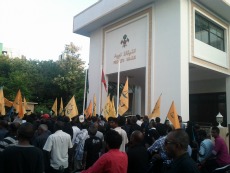
The marchers, under the banner “I condemn the coup d’etat'”, marched against police brutality and impunity. Starting near the MDP rally site – currently locked down by the police under a High Court order – the march proceeded on the same route as it took a year ago.
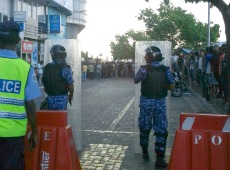
The demonstrators came up against a police blockade halfway into the march, near the local market area, and forced their way through two separate police lines to approach the Maldives Monetary Authority (MMA) area.

Demonstrators came to a halt about 10 feet from the final police cordon, which blocked entry into the Republican Square. The march then took a detour through side streets and reconvened on Fareedhee Magu.

Minivan News did not observe any physical confrontations between demonstrators and security forces, who maintained a high presence in the area.  However, Minivan News journalists were initially refused entry behind the police lines despite other media personnel active in the area.

The demonstrators continued to shout slogans against police, and many held placards with messages against the “coup government” and police brutality.

The march concluded back near the MDP’s protest site at Usfasgandu. Some senior MDP officials spoke to the gathered crowds before the rally ended.

Speaking at the rally, MP Ali Waheed said the MDP would henceforth come out to protest with the attitude of “an eye for an eye”, and that the current “coup government has 30 days to do what they will. The MDP will start our most intense actions within this time.”

“The numbers we saw today are far more than what we saw even on February 8 last year. I believe people now have a higher resolve to bring an end to this coup,” said MDP Spokesperson Hamid Abdul Ghafoor.

“I believe protests will become more aggressive in future. People are fed up of  the blatant impunity with which the police operate,” Hamid said, but added that any resistance would “happen within the framework of rule of law.”

Some acted against the Freedom of Peaceful Assembly Act: police

Police have said that four police officers were injured due to demonstrators throwing objects at them and had to seek medical attention.They further said that the police were analysing video footage taken during the march to identify the perpetrators of these acts, and that legal action would be taken against them.

“Some of the protesters had their faces covered, while some also damaged the chains on the MNDF monument near the National Monument. These are acts which go against the Freedom of Peaceful Assembly Act,” Superintendent Abdulla Nawaz stated at a press briefing held Friday night.
Nawaz noted that parliament members had also participated in the march, adding “MPs should know that such events should be conducted within the legal framework. They should also demonstrate this to other people.”

Police have called on the public to demonstrate within the rights and freedoms granted by Freedom of Peaceful Assembly Act and the Constitution of the Maldives.

The Freedom of Peaceful Assembly Act is a bill redefining restrictions on assembly which was recently ratified by President Mohamed Waheed Hassan.

Meanwhile, MDP Spokesperson Hamid Abdul Ghafoor stated that the party had noticed that police had exercised more restraint during today’s march in comparison with recent other demonstrations of the same calibre.

“We noticed that police were in a more rational mood,” Ghafoor said, “They were not confrontational despite protesters getting rather aggressive.”

“People’s attitudes are one notch higher when it comes to standing up against police impunity. People are getting more impatient. There is an overall lack of respect for the police institution,” Ghafoor said.

“I think this is people’s way of showing that we’ve had enough. Groups of police would muscle into crowds and drag away people they hand-picked. I think people have crossed the threshold into no longer accepting such acts, and not accepting police brutality and police impunity any more.”

Similar demonstrations took place at the same time on Friday on other islands across the Maldives, including the islands of Kudafaree and Velidhoo.

Likes(0)Dislikes(0)

Maldives banks revising home finance to cater to emerging real estate demand

Two banking groups operating in the Maldives have announced the launch of new home financing mechanisms they have said will cater for predicted growth in the country’s real estate sector.

Both the Maldives Islamic Bank (MIB) and Bank of Maldives (BML) have launched new home finance packages in recent weeks to try and cater for a perceived emerging demand amongst local buyers.

MIB on Tuesday (February 5) officially launched a new mechanism for home financing based on the Islamic principle of “Diminishing Musharaka”.

A spokesperson for MIB explained that the principle required the formation of a partnership between itself and an individual customer or institution to jointly buy a property.

Once acquired, eligible customers enter an agreement with the bank to divide shares in the property into units.  These units must must then be periodically purchased by the client until ownership is fully transferred from MIB.

Properties covered by the financing program must be fully constructed and not more than 10 years old, while also found to have been kept in good condition in accordance to standards outlined by the bank.

The maximum financing available under the scheme was 80 percent of a property’s total purchase price, the bank added.  The maximum tenure of the loan – the time by which the customer is required to have fully paid back the financing to MIB – is 20 years.

According to the company, individual customers looking to make use of the finance scheme must be 21 years of age or above, while institutions must be registered in accordance to local laws.

Prior to the MIB launch, state-owned BML also announced a new home finance package for its customers that it claims offers more favourable loan conditions for the purchase or refinancing of properties specifically in the capital Male’ or the nearby island of Hulhumale’.

“Recently the Maldives has seen a rise in real estate business and this sector is expected to grow in coming years. To cater for this demand, BML launched a competitive home loan product,” a spokesperson for the company has claimed.

Despite being one of the country’s longest-serving providers of home finance, BML has claimed that its revised loan package was more attractive to local buyers, increasing the repayment period to 15 years from the previous 10.

The company added that the interest rate for the loan had also been cut to 11 percent, a .75 percentage point reduction on its previous housing finance package.  Meanwhile, customer equity has also been cut to 20 percent from 30 percent previously, the company added.

Likes(0)Dislikes(0)

Optimistic about democratic future, “despite a few hiccups”: President Waheed

President Mohamed Waheed Hassan has stated that he is considering contesting in the upcoming presidential elections “in view of the current achievements and the general reading [he] gets from the public,” adding, however, that “much work has still to be done during the next few months.”

Although the Progressive Party of Maldives (PPM) has previously stated that Waheed could contest as the party’s candidate if he became a member, local media has recently reported that Waheed is considering running through his own 3217-member strong Gaumee Ithihaad Party (GIP).

GIP has recently announced that it is seeking to form coalitions with other political parties.

“Democracy is in its infancy [in the Maldives]. Despite a few hiccups, I am very optimistic about our democratic future,” Waheed stated in an interview with AFP, one year following the contentious transfer of power on February 7, 2012.

Waheed, who was Vice President during the previous administration, was sworn in as President after former President Mohamed Nasheed resigned following street protests and a police mutiny.

The Maldivian Democratic Party (MDP) has maintained that the transfer of power was brought about through a coup d’etat. However, the Commission of National Inquiry(CNI), a Commonwealth-backed inquiry established by Waheed, concluded that the transfer of power was legal.

The credibility of the CNI report is now being challenged by parliament’s Executive Oversight Committee, after six of the country’s most senior police and military intelligence figures testified that none of their evidence was included in the final report. All six have since been suspended or dismissed.

Nasheed, again the presidential candidate of the Maldivian Democratic Party (MDP), has an ongoing trial against him for the arrest of Criminal Court Chief Justice Abdulla Mohamed. The MDP contend that the charges are a politically motivated attempt to prevent him from contesting the election.

According to AFP, Waheed said his full year in office was “marked by ‘inclusiveness’, while rejecting opposition claims that he was stifling individual freedoms and had become a hostage of Islamic extremists.”

During the past year, Waheed has ratified the “Freedom of Peaceful Assembly” bill, which redefines limitations on assembly and political gatherings.

MDP Spokesperson Hamid Abdul Ghafoor previously alleged that the ratification of the said bill was “a direct response to the MDP’s proposed revolution.”

“We are not happy with this bill, and on principle alone we are against it. The current government feels the need to restrict freedom of expression and unwind the democratic gains of this country,” Ghafoor alleged.

“As our honeymoon with democracy nears its end, I am convinced that a new model for true democracy will glow from these islands,” Waheed said.

In response to Waheed’s remarks, Ghafoor said that Waheed seemed to be in “a state of total denial.”

“Waheed became president through a coup d’etat, completely wrecked our economy, made a pact with the Islamists, caused foreign investors to lose confidence, and inflation is rocketing. He has done everything a liberal democratic leader would never do,” Ghafoor alleged.

Correction: An earlier version on this article mistakenly reported that GIP has 2099 members. The party has 3217 members.

Likes(0)Dislikes(0)

Court released child sex abuse suspect to house arrest in victim’s home

The High Court this week rejected a request to place a male suspect accused of sexually abusing an 11-year old relation in custody. The suspect was previously held under house arrest at the same property where his alleged victim lived.

The Prosecutor General (PG’s) Office confirmed that following a remand hearing on Tuesday (February 5), the suspect had been released from the house arrest – with no restrictions currently placed upon his movement ahead of his unscheduled trial.

The remand hearing took place at a time when the PG’s Office is already facing government criticism for pursuing a case against a 15 year-old minor on charges of having “consensual sexual relations”.

The government, which has said it is in the process of reviewing and amending laws on sexual abuse with authorities including the Ministry of Gender, Family and Human rights and Islamic Ministry, today accused state prosecutors of showing “bad judgement” in charging the 15 year-old girl.

The two cases are the latest in a line of high profile sexual abuse trials concerning minors, which have met with international condemnation.

The 15 year-old presently facing charges of having “consensual sexual relations” has also been identified as the victim of child sex abuse in an unrelated criminal case also being pursued by authorities.

The PG’s Office confirmed this week that after reviewing the charges against the 15 year-old girl, a decision had been taken to proceed with her trial at the Juvenile Court over charges of fornication. The PG’s Office was unable to comment further.

However, a source familiar with the matter told Minivan News that the charges against the minor had to be pursued because the girl had confessed to having consensual sex.  The charges relate to an incident reported before her alleged sexual abuse.

Meanwhile, the PG’s Office confirmed to Minivan News that the High Court rejected a request on February 5 to retain a sexual abuse suspect – believed to be an uncle of the victim – after it emerged he had been kept under house arrest in the same property as the 11 year-old victim.

A source with knowledge of the case said that the court released the suspect after enquiring as to why police and state prosecutors had failed to raise concerns about the house arrest earlier.

With no date yet scheduled for the suspect’s trial, the outcome of the remand hearing has meant the suspect had no restrictions on his movement, according to the source.

Minivan News understands the victim has since been moved to a new location on a separate island.

Government legal review

With these two high profile sexual abuse cases ongoing in the courts, the Maldives government has maintained its commitment to reviewing related laws in the Maldives.

President’s Office Media Secretary Masood Imad told Minivan News today that certain laws in the country, which he has previously criticised as treating sexual abuse victims as perpetrators, would be amended following consultations with relevant government authorities.

“We will be holding a one day seminar with the Islamic Ministry either sometime next week or the week after,” Masood said.

The government last month announced its intention to review the laws within the space of a few weeks. However, Masood added that there were many “pressing issues” requiring its attention at the present time.

Minister of Islamic Affairs Sheikh Mohamed Shaheem Ali and Acting Minister of Gender, Family and Human Rights,  Dr Mariyam Shakeela were not responding to calls from Minivan News at time of press.

“Bad judgement”

Despite its stated commitment to review laws concerning sexual abuse in the country, Masood added that the PG’s Office itself remained an independent entity that pursued cases without government involvement.

He added that prosecutors had shown “bad judgement” in pursuing the case involving the 15 year-old while other matters were still pending.

Highlighting what he perceived to be more pressing issues for the PG’s Office, Masood raised concerns against MPs Abdulla Jabir and Hamid Abdul Ghafoor – both aligned with the opposition Maldvian Democratic Party (MDP) – over their alleged  refusal to provide a urine sample after they were arrested under suspicion of drinking alcohol in November 2012.

MPs Jabir – at the time an elected representative for the government-aligned Jumhoree Party (JP) – and Hamid were arrested back in November along with eight others on the island of  island of Hodaidhoo in Haa Dhaal Atoll, on suspicion of drug and alcohol offences.

“[The PG’s Office] should be taking [to court] the issue of suspects refusing to give urine tests after being found at drunken parties,” Masood claimed.

Likes(0)Dislikes(0)

Transparency Maldives announces extensive election monitoring program

Transparency Maldives has said it will conduct an extensive program of election monitoring during the 2013-14 elections in a bid to ensure the polls are fair and credible.

The Elections Commission (EC) announced this week that presidential elections would be held on September 7, with any run-off election to be held later the same month if required.

Transparency conducted domestic election monitoring during the 2008-2011 cycle of elections, including the country’s first multi-party presidential, parliamentary and local council elections. The results of these elections were widely accepted both locally and internationally – a notable outcome given the high temperature of the country’s politics.

“However, the current political polarisation and the tense, sometimes violent, political environment have strained and continue to further threaten the democratic gains of the previous election processes,” Transparency Maldives warned.

“The next round of elections is currently headed to unfold against this polarised background that appears to deteriorate in terms of political and economic problems,” it added.

In addition to nationwide election monitoring, Transparency Maldives will deploy observers to monitor the entire campaign period, as well as conduct a pre-election technical assessment that includes a focus on voter education.

“Educating voters is a crucial component of a credible election. Voter education is important to instil the values of civic responsibilities and prevent electoral violations such as vote buying and patronage, and change the attitudes of the general public to encourage wider public participation in increasing the integrity of the electoral system,” Transparency said.

The organisation will also run an online complaints mechanism, and perform media monitoring of the country’s heavily polarised fourth pillar.

Behind the “buy-elections”

Election results in the Maldives since 2008 have been widely declared credible by local and international observers, in large part due to a crackdown on practices such as photographing ballots with camera phones, and ‘assisting’ elderly or infirm relatives to vote. However, undemocratic activities in the lead up to polling – such as vote buying, patronage and intimidation – are rampant.

Minivan News observed many such activities first-hand during the Kaashidoo by-elections in April 2012.

“The people of this island will vote for money, they don’t have any principles,” confided a 21 year-old islander at the time. “The problem is that people want to force you to vote for who they support. Everyone should have the right to vote for whoever they want. Arguments within families have gone to the point that people are losing face.”

All sides were guilty of handing out cash, he said, in the guise of extending assistance for medical care: “Some people even use the money for drugs.”

In another instance, Minivan News observed a group of youths openly warning an elderly man in a cafe that they would cut of his cigarette supply unless he voted as they wished.

Other practices are more subtle – youth clubs or island NGOs may receive sizeable donations of cash or equipment in exchange for leaders influencing their members to vote in a certain manner.

During voting day on Kaashidoo, Minivan News observed that both candidates had set up exit poll booths under wide parasols, and were crossing off people who had voted.

Many islanders Minivan News spoke to at the time were open about the assistance they had received, justifying it on the grounds that the campaign period was the only time they would ever see their elected representative.

Likes(0)Dislikes(0)

Presidential power struggle in the Maldives: South Asia Journal

The detention of the judge had provided the spark for a police and military mutiny – labelled by many a coup d’etat – which resulted in Nasheed’s departure from office on February 7, 2011, writes Daniel Bosley for the South Asia Journal.

“Alleging his resignation had come under duress, Nasheed and his supporters took to the streets the following day where they were met with brutal suppression by a police force which has yet to be brought to account for the numerous human rights abuses that ensued.

The Kafkaesque legal polemics when Nasheed was forcefully brought before the court for the first hearing in October hinted at deeper issues which underscore the country’s recent crises. Contending legal opinions suggested an illegal arrest warrant had been used, from an illegally assembled court, to bring an illegally removed president to trial, for the illegal detention of an illegal judge.

This labyrinthine situation indicates the urgent need for police and judicial reform in a struggling democracy which is looking increasingly rudderless. After months of political deadlock, street demonstrations, accusation and counter-accusation, Nasheed’s trial presents an opportunity to bring the political crisis back to where it began, with the judiciary and the criminal justice system.

Read more

Likes(0)Dislikes(0)

Islamic Minister calls on state to withdraw all cases against religious scholars

Minister of Islamic Affairs Sheikh Mohamed Shaheem Ali has called on the state to withdraw all court cases filed against Islamic scholars during past administrations.

“The cases filed against scholars during past administrations often involve charges for preaching religious advice without permits,” Shaheem told local media SunOnline.

“There are some charges previously filed against certain scholars, for example Sheikh [Ibrahim] Fareed. The charges against him are for preaching without a permit. I have spoken with Sheikh Fareed about this matter. In my capacity as Islamic minister, I call on the relevant authorities of the government to withdraw cases like this. These are very hurtful charges. Such charges should not be allowed to be levied against university educated, capable scholars, especially not under the current constitution,” Shaheem said.

Shaheem said that in a time where freedom to preach religion is exercised so freely, it is the duty of scholars to “invite people to religion to the extent of their capabilities” and that they should be granted that freedom as long as they do not make any statement which goes against Islam.

“Now, if they start giving out ‘fatwa’s, giving out judgements on what is ‘haram’ or ‘halal’ and speaking against the principles of Sharia, then action against them can be taken under the Religious Unity Act. I, however, cannot agree that there must be charges against someone for simple religious preaching, like asking people to go pray or pay alms,” Shaheem stated.

Speaking about scholars who held different views on religious matters, Shaheem said that such differences should be sorted through peaceful dialogue, and not through jail sentences and torture.

The Ministry of Islamic Affairs has previously held meetings to resolve dissenting opinions on religious matters, under the name of ‘Scholar’s Dialogue’.

Shaheem was travelling and unable to speak at the time of press.

Likes(0)Dislikes(0)

Media Council concludes investigation of Minivan News

The Maldives Media Council (MMC) has issued a statement concluding its investigation into Minivan News at the behest of the Islamic Ministry concerning the publication of comments by an individual “who assumed the name of Allah and had harassed Islam and Allah.”

The case concerned a comment located on a story dated November 28, 2012 titled: ‘Government “cynically used xenophobia, nationalism and religious extremism” to attack foreign investor: former President’, in which a reader posted a comment under the pseudonym ‘Maai Allah’.

Minivan News at the time complied with a Criminal Court warrant dated December 3, seeking both the comment’s removal and the provision of the commentator’s email and IP address on the grounds they had violated Islamic principles.

Following the removal of the comment, the Ministry of Islamic Affairs sent a letter to the Communications Authority of the Maldives (CAM), dated December 5 and obtained by the Minivan News, calling for the site to be shut down.

“It has come to this ministry’s knowledge that among the comments published on an article named “Government ‘cynically used xenophobia, nationalism and religious extremism’ to attack foreign investor: former President” there were some comments made under the name of’ ‘Maai Allah’ offending Allah and Islam,” wrote Minister of State for Islamic Affairs, Mohamed Didi.

“Hence, the management of the prior-mentioned website has breached Article 8 and 10 of the regulation made under the Religious Unity Act. We therefore request you to close down that website at the earliest possible convenience, and to take action against online newspapers and websites which publish writing of this manner,” the letter reads.

Deputy Director General of CAM, Abdulla Nafeeq Faashaa, referred the matter to the MMC on December 10, stating in a letter that it was “in the mandate of the Maldives Media Council to govern codes of conduct and ethical standards, and because it is also in the council’s mandate to look into complaints sent in regarding media content.”

Faashaa further advised the MMC that “we would like to assure you that this authority will extend any technical work that needs to be done regarding this matter.”

The original letter was sent to the MMC on December 11.

In a statement this week, the MMC said the investigation panel had been informed by “those running Minivan News that the concerned comment has been removed from the website and have assured the council that no such comment has been published anymore. And the newspaper has also assured that such a thing would not be repeated by its editorial board. The council believes that Minivan News has therefore taken steps to make amends following the action and have been also informed the complainant.”

“Also, while looking into the case, the council strongly believed that Minivan News editor should adhere to the laws of the Republic of Maldives, therefore the council has decided formally request the owners of Minivan News website to ensure that its editor remains in line with the laws of the country,” the MMC stated.

Likes(0)Dislikes(0)

Funding and “public hesitancy” key challenges for continuing successful immunisation program

Some 95 percent of the target population of the Maldives’ national inoculation program have received their recommended vaccinations, despite declining state funding for such initiatives and growing public reticence, health authorities have said.

While ongoing commitments by Maldives authorities to protect the public against preventable diseases were praised this month by international experts, sources within the Ministry of Health have said maintaining high immunisation coverage across the country remains challenging.

Aishath Thimna Latheef, Public Health Program Manager for the Expanded Program on Immunisation (EPI) at the Ministry of Health told Minivan News that a lack of funding for additional training and supervision were among crucial challenges facing national inoculation efforts.

Other issues included a growing number of parents opting against having their children inoculated, and need for improved coordination with private schools.

The World Health Organisation (WHO) reviewed the Maldives EPI and vaccine preventable disease (VPD) surveillance programs between January 27 and February 3 this year, and praised the country’s efforts.

Representatives from the Ministry of Health, UNICEF, the Centre for Communicable Diseases, Atlanta (CDC) and experts from Indonesia, India, Nepal, Myanmar, Thailand and Sri Lanka conducted the review, according to the WHO.

“The government is ensuring immunisation against 10 vaccine preventable diseases. Furthermore, steps are being undertaken for the introduction of pentavalent vaccines into routine immunisation schedules,” said the WHO.

“The team verified that more than 95 percent of the target population have received all the recommended vaccines and immunisation service delivery functions, including vaccine distribution and cold chain management. Effective partnership with the government, WHO, UNICEF and other stakeholders have contributed to these achievements.”

The review was the first study of its kind to be conducted in the country since 2006, following previous research carried out in 1994 and 1988.

“Basic right”

Immunisation Program Manager Thimna maintained that immunisation was a “basic right” of Maldives children under successive governments.

“The government regards children as one of the most important assets of the nation and therefore every effort should be made without discrimination of person’s gender and socio-economic status to promote welfare and full development of their potential for a useful and quality of life,” she said.

“This policy has not changed. Immunisation in the Maldives is 100-percent government funded. But over the years the funds for immunisation have gradually declined, limited now to only the purchase of vaccines and vaccine consumables. Training, supportive supervision and IEC developments are not funded any more. From a programmatic perspective, this is a serious concern for us.”

According to Thimna, the reduced funding was a direct result of economic difficulties experienced in recent years that had resulted in continued calls to cut state expenditure both from within parliament and by international organisations like the International Monetary Fund (IMF).

Beyond financial challenges, authorities indicated that education was another area needing review in order to ensure that all children and young people were being included in national inoculation plans.

According to Thimna, in 1994 the government introduced a policy whereby each schoolchild studying at a public institution was included in a state immunisation program.

However, she contended that with a growing number of public schools in the country, some of these institutions were not following state policies such as the inoculation program.

Without greater collaboration between the state and private education providers, Thimna claimed that a growing number of young people faced being excluded from the national immunisation program if fewer schools signed up.

Anther potential concern identified by authorities was a small but growing number of parents who were opting not to have their children immunised, for unspecified reasons.

Thimna said while only a small number of children were not receiving inoculations recommended by the state as a result of “vaccine hesitancy” among parents, the issue was growing and could potentially become a “huge concern” for authorities in the future if not addressed.

However, she stressed that recent amendments to national legislation did grant health authorities power under the law to give vaccinations to children – even if parents refused – on the grounds of public health.

“The most recent change is the passing of Public Health Act in December 17, 2012. This has given some power to the program to address issues of vaccine hesitancy. But this will only be in action after the rules and regulations and  developed and  incorporated and a new immunisation policy is developed,” Thimna added.

Polio prevention

Addressing the potential risk of a re-emergence  of the polio virus, Thimna said the country was always at risk of importation of such threats.  According to official statistics, the last reported indigenous case of the virus in the Maldives was 1982, however the last imported case of the polio virus was in 1994.

“As a tourist destination, the Maldives is always at risk of importation like any other country in the world. We need to have stringent active and passive Acute Flaccid Paralysis (AFP) surveillance to detect and investigate any case of suspected polio. This is something which we already do but needs to be strengthened,” Thimna said.

“The only thing that would perhaps work in our favour if  an importation occurs is the high level of  hygiene and sanitation in the Maldives.”

In an open editorial piece last month, Regional Director for the WHO in the South-East Asia region, Dr Samlee Plianbangchang, stressed a need for vigilance to eradicate the virus from the region.

With India having recorded a second consecutive year without a reported case of polio virus, Dr Plianbangchang called for sustained efforts to combat potential spreads of the disease, particularly across international borders.

“Although not all countries face the same risk, most countries in the region remain at a risk of polio resurgence through a distant or cross border importation of the wild polio virus from countries where it continues to circulate,” he wrote.

“As India completes two years without any cases of wild polio virus, WHO’s South-East Asia Region is firmly on-track for polio-free certification in early 2014. The South-East Asia Region will be the fourth WHO Region to be certified as polio free, the first Region in more than 12 years after the European Region was certified in 2002.”

Likes(0)Dislikes(0)